Exhibition | Rubens and His Legacy

François Boucher, Pan and Syrinx, 1759
(London: National Gallery)
◊ ◊ ◊ ◊ ◊
Press packet from BOZAR:
Sensation and Sensuality: Rubens and His Legacy
BOZAR (Centre for Fine Arts), Brussels, 25 September 2014 — 4 January 2015
Royal Academy of Arts, London, 24 January — 10 April 2015
Peter Paul Rubens was one of the most innovative painters in the history of art. His impact on subsequent generations has been immense. For the first time, the Royal Museum of Fine Arts Antwerp (KMSKA), the Royal Academy of Arts in London, and BOZAR in Brussels have joined forces to look at Rubens as a role model. The exhibition Sensation and Sensuality: Rubens and his Legacy brings together some 160 works, including some iconic paintings by Rubens himself and, more particularly, works by his artistic heirs.
It is a paradox that Peter Paul Rubens (1577–1640) is both inimitable and has served, for four centuries now, as the great model for painters such as Rembrandt, Murillo, Watteau, Fragonard, Gainsborough, Reynolds, Delacroix, Cézanne, Renoir, Kokoschka, and many others, often far beyond the frontiers of Europe. Even in the work of Picasso, we encounter his visual language. The international exhibition Sensation and Sensuality: Rubens and His Legacy looks at this phenomenon and brings works by these celebrated artists to the world-renowned Flemish master’s homeland.
Sensational and Sensual

Thomas Gainsborough, after Rubens, The Descent from the Cross, 1766–69 (Sudbury: Gainsborough’s House)
Many Rubens works are sensational: loud, forceful, and sometimes violent, created in the service of Catholic propaganda and of absolutist rulers. With his almost cinematographic depiction of aggression, fighting, and barbaric scenes, Rubens could be called the Quentin Tarantino of his time. But he is also a sensual painter in his informal family portraits, landscapes and pastoral scenes, peasant dances and gardens of love, in which he was a precursor of Rococo, Romanticism, and Impressionism. Rubens was so many-sided that he appealed to artists of every nationality. Their interest was often selective. Spaniards preferred his religious works. The English were inspired by his portraits and landscapes. French painters were attracted, above all, by the eroticism and poetry in his work. German and Austrian artists admired his vitality and vigour. A great many talented artists were captivated by his use of composition, colour, and technique and developed flourishing careers by following his example. After meeting Rubens, Velázquez began to paint in a different way;
following his counsel, he used a lighter undercoat.
160 Works of Art, 6 Themes
The Sensation and Sensuality exhibition presents more than 160 works of art and takes the visitor through six fascinating themes that explore different aspects of life and of the painter’s art: violence, power, lust, compassion, elegance, and poetry. Each of these chapters demonstrates the links between masterpieces by Rubens and the work of artists who came after him. The Tiger Hunt from the Musée des Beaux-Arts in Rennes hangs alongside the Delacroix Lion Hunt from Stockholm and the voluptuous Pan and Syrinx from the Gemäldegalerie in Kassel alongside Boucher’s work of the same name from the National Gallery in London; the portrait of Marchese Maria Grimaldi and Her Dwarf from Kingston Lacy is juxtaposed with A Genoese Noblewoman and Her Son from Washington, by Rubens’s famous pupil van Dyck; and Manet’s Rubens pastiche Fishing from the Metropolitan Museum in New York can be seen alongside The Bacchanalia on Andros by Rubens, from the Nationalmuseum in Stockholm.
The 20 paintings, 6 oil sketches, 8 drawings, and 10 prints by Rubens himself are presented in a dialogue with works by his artistic heirs, including Böcklin, Carpeaux, Constable, Corinth, Coypel, Daumier, Delacroix, Fragonard, Gainsborough, Géricault, Jordaens, Klimt, Kokoschka, Le Brun, Makart, Murillo, Picasso, Rembrandt, Renoir, Reynolds, Sandrart, Turner, Watteau, and others.
Prestigious Loans
Exceptionally, one of the jewels of the Prado collection in Madrid, Rubens’s Garden of Love, will travel to Brussels, where it will be brought together with preparatory sketches from the Amsterdam Museum and two drawings that Rubens made of his painting for a superb print (Metropolitan Museum, New York). Bringing these pieces together allows us to see how this famous composition took shape, from idea to reproduction. As well as those already mentioned, major foreign lending institutions contributing include Tate Britain (London), the Neue Pinakothek (Munich), the Nasjonalgalleriet (Oslo), Her Majesty Queen Elizabeth II, and a number of private collections.
International Cooperation
Sensation and Sensuality is an exhibition organised by the Royal Museum of Fine Arts Antwerp (KMSKA), the Royal Academy of Arts, London, and BOZAR (Centre for Fine Arts), Brussels. After the show at the Centre for Fine Arts Brussels the exhibition will travel to the Royal Academy of Arts in London (24.01 – 10.04.2015)
Multidisciplinary Programme
This autumn, BOZAR pays homage to Rubens and shows how the Antwerp master has also inspired artists in other artistic disciplines.
BOZAR MUSIC is presenting a concert series, The Musicall Humors of Rubens, with music of the painter’s time; the highlight will be the concert on 6 December 2014, The Ear of Rubens, performed by the Huelgas Ensemble. Besides, BOZAR MUSIC and Ricercar (Outhere) present a CD with examples of the major musical genres that Rubens would have heard during his travels in Europe.
BOZAR LITERATURE has invited six writers—David Bosch, Annemarie Estor, Lydia Flem, Peter Holvoet-Hanssen, Pjeroo Roobjee, and Jean-Philippe Toussaint—to draw inspiration from a work by Rubens: you can read the results in the visitor’s guide or listen to them on a videoguide.
BOZAR CINEMA, moreover, is screening the art film that Henri Storck made about Rubens in 1948. There will also be two multimedia installations on show during the BOZAR NIGHT and the BEAF: Ingrid Van Wantoch Rekowski will present her video installation Rubens-Metamorfoses during the BOZAR NIGHT (10 November 2014); during the BEAF (25–27 September 2014), the video artist Quayola will show his installation Strata #4, a—literally—penetrating look at the great altarpieces of Rubens and van Dyck via high-resolution images.
◊ ◊ ◊ ◊ ◊
From
Tim Barringer, Arturo Galansino, Gerlinde Gruber, and Nico van Hout, David Howarth, and Alexis Merle du Bourg, Rubens and His Legacy (London: Royal Academy Publications, 2014), 352 pages, ISBN: 978-1907533778, $75.
 Peter Paul Rubens (1577–1640) is undoubtedly the most influential of all Flemish painters. Himself indebted to Titian, Rubens became a role model to Van Dyck, Rembrandt, and Velázquez, and influenced artists well beyond his time, including figures such as Cézanne, Picasso, Bacon, and Freud. This sumptuous new volume explores Rubens’s legacy thematically, through a series of sections devoted to violence, power, lust, compassion, elegance, and poetry. Each section will link artists across the centuries in their references to Rubens, from Van Dyck and Watteau to Manet, Daumier, Renoir, and Van Gogh, as well as Gainsborough, Constable, and Turner.
Tim Barringer is Paul Mellon Professor of the History of Art at Yale University. Arturo Galansino is curator at the Royal Academy of Arts, London. Gerlinde Gruber is curator for Flemish Baroque paintings at the Kunsthistorisches Museum in Vienna. Nico van Hout is a member of the collections research team at the Royal Museum of Fine Arts Antwerp. David Howarth is professor of history of art at the University of Edinburgh. Alexis Merle du Bourg is an art historian and a Rubens specialist.
Film | National Gallery
◊ ◊ ◊ ◊ ◊
Frederick Wiseman’s new documentary from Zipporah Films has its US premier in New York this month at Film Forum (November 5–18), with the director himself appearing at several of the early screenings (November 5, 7, and 8). The DVD release is scheduled for early 2015.
Frederick Wiseman, National Gallery (Zipporah Films, 2014), 181 minutes.
London’s National Gallery, one of the world’s foremost art institutions, is itself portrayed as a brilliant work of art in this, Frederick Wiseman’s 39th documentary and counting. Wiseman listens raptly as a panoply of docents decode the great canvases of Da Vinci, Rembrandt, and Turner; he visits with the museum’s restorers as they use magnifying glasses, tiny eye-droppers, scalpels, and Q-tips to repair an infinitesimal chip; he attends administrative meetings in which senior executives do (polite) battle with younger ones who want the museum to become less stodgy and more welcoming to a larger cross-section of the public. But most of all, we experience the joy of spending time with the aforementioned masters as well as Vermeer and Caravaggio, Titian and Velázquez, Pissarro, and Rubens and listen to the connoisseurs who discourse upon the aesthetic, historical, religious, and psychological underpinnings of these masterpieces.
More information is available from the Toronto International Film Festival (TIFF).
Exhibition | The Diligent Needle
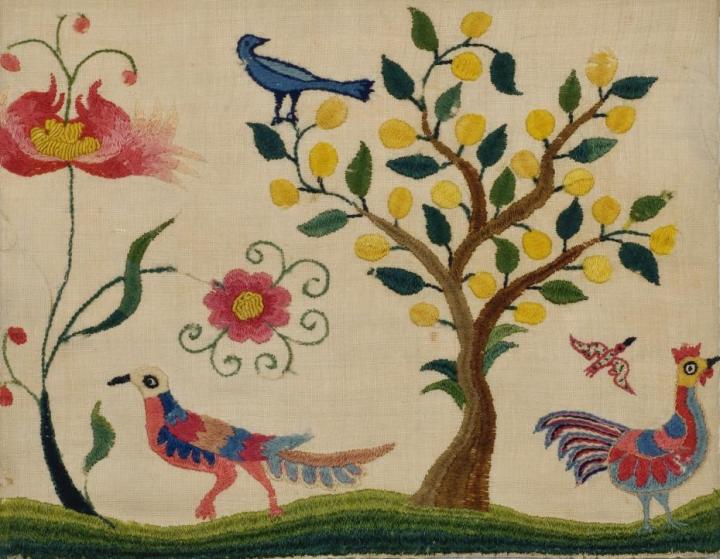
Needlework picture, 1750–1800
(Winterthur: Gift of Henry Francis du Pont 1961.1697)
◊ ◊ ◊ ◊ ◊
Now on view at Winterthur:
The Diligent Needle: Instrument of Profit, Pleasure, and Ornament
Winterthur, Wilmington, Delaware, 23 August 2014 — 5 July 2015
For centuries, instruction in needlework was an important part of women’s education. Both plain sewing and fancy embroidery are skills that take considerable time and effort to acquire, and as a result, many women took great pride in their work. Women might use their skill to earn a living through teaching or sewing, to create objects of beauty for themselves and for others, or to embellish clothing and household furnishings. This exhibition showcases the evolution of needlework and the prominent role it played in women’s lives during the 17th through 19th centuries. It opens with the diligence and skill required to learn and excel at needlework and delves into the various applications of the skill with sections on diligence, profit, pleasure, and ornament, featuring stunning visual examples:
Diligence
Samplers diligently worked on in day and boarding schools are the best documented examples of a girl’s education, but needlework skills were also learned at home, where women of all ages too part in the needlework activities of the household.
Profit
Women could use their skill with a needle to generate extra income or support themselves and their families. Some women, known as mantua makers, milliners or tailoresses, created fine dresses and other clothing, others taught embroidery or offered their skill in decorating clothing and furnishings, while others used the skill for plain sewing, mending and hemming.
Pleasure
Not everyone loved embroidery, but those who did would continue to develop their skill and artistry throughout their life.
Ornament
Those skillful with a needle often used their talent to embellish their own clothing, accessories, and textile furnishings.
Call for Papers | Entre l’œil et le monde, 1740–1840
From H-ArtHist:
Entre l’œil et le monde: dispositifs et expédients d’une nouvelle
épistémologie visuelle dans les sciences de la nature entre 1740 et 1840
Université de Neuchâtel, 4–7 November 2015
Proposals due by 5 January 2014
I. Contexte de l’événement
Du 6 au 7 novembre 2014 aura lieu à Neuchâtel un colloque intitulé “‘La bêtise des yeux’. Illusions des sens et épistémologie visuelle au XVIIIe siècle” (“‘Der Augen Blödigkeit’. Trugwahrnehmungen und visuelle Epistemologie im 18. Jahrhundert”). Il s’agit de se pencher sur les dimensions physiologique, individuelle et sociale du processus de perception visuelle, tel que le mettent en scène la littérature, les beaux-arts et la philosophie du XVIIIe siècle. Nous avons placé au centre de cette rencontre les expériences visuelles problématiques, qu’elles relèvent de l’illusion ou soulignent la faiblesse des sens, voire le caractère trompeur des informations prodiguées par ceux-ci, relativisant ainsi la valeur d’une connaissance essentiellement fondée sur une ‘idéologie de la lumière et de l’œil’. En novembre 2015, un second volet de cette réflexion sera organisé autour de questions plus spécifiquement liées aux sciences naturelles et expérimentales des années 1740 à 1840. (more…)
Two More Waddesdon Manor Treasures Now Online
Le Ballet Royal de La Nuit and Jean de La Fontaine’s Fables choisies, two treasures of Waddesdon Manor’s library collected by Ferdinand de Rothschild (1848–1898) are now accessible via the online collection catalogue.

Jean de La Fontaine, Fables choisies, (Paris, 1755–59); Waddesdon, The Rothschild Collection (The National Trust) Bequest of James de Rothschild, 1957; acc. 3681.1-4. Photo by Mike Fear © The National Trust, Waddesdon Manor.
Le Ballet Royal de La Nuit at Waddesdon was probably produced as a gift for Louis Hesselin (1602–1662) as a reward for the successful staging of the ballet, first performed at the French court on 23 February 1653. It contains material from three distinct sources: the booklet of the ballet printed by Robert Ballard in 1653, a poem called Le Docteur Muët, and 129 original designs depicting costumes and scenes from the ballet now attributed to Henry Gissey (c. 1621–1673). Reproductions of the bindings; inscriptions by a previous owner, Baron Jérome Pichon (1812–1896); as well as the designs are available online, accompanied by commentaries based on the publication: Michael Burden and Jennifer Thorp (eds), Ballet de la Nuit: Rothschild B1/16/6 (Hillsdale; Pendragon Press; 2009).
Also now online are entries for four volumes of Jean de La Fontaine’s (1621–1695) Fables choisies, published in Paris between 1755 and 1759 by Desaint and Saillant. This edition is considered to be the most magnificent illustrated book made before the advent of modern printing. The binding of the Waddesdon example, by Louis Douceur (d. 1769), is decorated with specially-cut tools also illustrating the fables. The dolphin which occurs on the spine panels of the Waddesdon volumes may indicate that these were bound especially for the Dauphin Louis (1729–1765), son of Louis XV. Details of the location and sizes of the illustrations in all four volumes, along with a transcription of the title and names of the designer and engraver of each print, are included in the online entries.
Both books can also be explored further in the newly published catalogue by the late Giles Barber, The James A. de Rothschild Bequest: Printed Books and Bookbindings (The Rothschild Foundation, 2013). The Waddesdon collection is one of the finest of its kind in the world, and the published catalogue along with the online entries allows for many of these treasures to be revealed to the public for the first time. For more information about the printed catalogue, please visit the website.










 Enfilade
leave a comment