New Book | Commercial Visions in the Dutch Golden Age
From The University of Chicago Press:
Dániel Margócsy, Commercial Visions: Science, Trade, and Visual Culture in the Dutch Golden Age (Chicago: The University of Chicago Press, 2014), 336 pages, ISBN: 978-0226117744, $40.
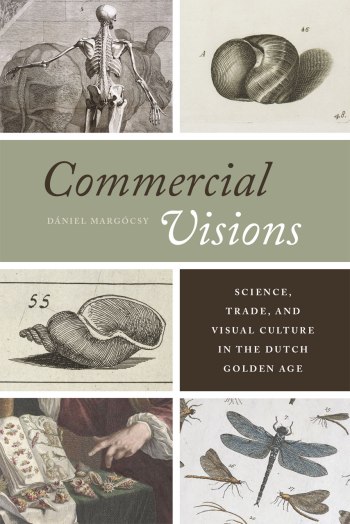 Entrepreneurial science is not new; business interests have strongly influenced science since the Scientific Revolution. In Commercial Visions, Dániel Margócsy illustrates that product marketing, patent litigation, and even ghostwriting pervaded natural history and medicine—the ‘big sciences’ of the early modern era—and argues that the growth of global trade during the Dutch Golden Age gave rise to an entrepreneurial network of transnational science.
Margocsy introduces a number of natural historians, physicians, and curiosi in Amsterdam, London, St. Petersburg, and Paris who, in their efforts to boost their trade, developed modern taxonomy, invented color printing and anatomical preparation techniques, and contributed to philosophical debates on topics ranging from human anatomy to Newtonian optics. These scientific practitioners, including Frederik Ruysch and Albertus Seba, were out to do business: they produced and sold exotic curiosities, anatomical prints, preserved specimens, and atlases of natural history to customers all around the world. Margócsy reveals how their entrepreneurial rivalries transformed the scholarly world
of the Republic of Letters into a competitive marketplace.
Margócsy’s highly readable and engaging book will be warmly welcomed by anyone interested in early modern science, global trade, art, and culture.
Dániel Margócsy is assistant professor at Hunter College, City University of New York.
◊ ◊ ◊ ◊ ◊
C O N T E N T S
List of Illustrations
1 Baron von Uffenbach Goes on a Trip: The Infrastructure of International Science
2 Shipping Costs, the Exchange of Specimens, and the Development of Taxonomy
3 Image as Capital: Forging Albertus Seba’s Thesaurus
4 Anatomical Specimens in the Republic of Letters: Scientific Publications as Marketing Tools
5 Commercial Epistemologies: The Anatomical Debates of Frederik Ruysch and Govard Bidloo
6 Knowledge as Commodity: The Invention of Color Printing
7 Peter the Great on a Shopping Spree
Acknowledgments
Abbreviations
Notes
Bibliography
Exhibition | Enlightenment: Carte Blanche of Christian Lacroix
◊ ◊ ◊ ◊ ◊
Press release from the Musée Cognacq-Jay:
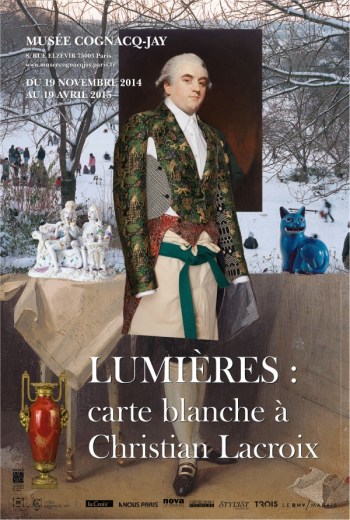
Lumières: Carte Blanche à Christian Lacroix
Musée Cognacq-Jay, Paris, 19 November 2014 — 19 April 2015
Curated by Christian Lacroix and Rose-Marie Mousseaux
In celebration of its grand reopening, the Musée Cognac-Jay has offered Christian Lacroix a creative carte blanche.
Established in 1928 by the founder of the La Samaritaine department store, Ernest Cognacq, in 1990 the museum was transferred to the Hôtel Donon, a recently-renovated sixteenth-century townhouse in the Marais district. The Musée Cognacq-Jay is home to a collection of emblematic eighteenth-century artworks, selected by its founder to be displayed in wood-panelled rooms representative of “the artistic décor of French life.”
Renowned for his creative collaborations with museums, Christian Lacroix has accepted the dual challenge of reimagining the ‘guiding narrative’ of the exhibition spaces while exploring a concept which has shaped his own approach to his art—the fascination exerted by the eighteenth century. He has curated contributions from over 40 contemporary artists, invited to reflect upon ten key themes identified in Ernest Cognacq’s collections with a view to enhancing our understanding of the Age of Enlightenment and its continued relevance in our own era.
◊ ◊ ◊ ◊ ◊
Christian Lacroix
Visions of the Enlightenment
 My perspective on the Age of Enlightenment is simply that of someone who is passionate about that era. It is an indirect perspective of the late 19th and early 20th century, when the Cognacqs built up their collection in consultation with ‘enlightened’ art historians. However, I admit that its influence on my work is less clear, as I see myself as more Dionysian than Apollinian. I can only gratefully advocate everything that the Enlightenment brought about in terms of social progress, political thinking, the fight against obscurantism, tolerance and a thirst for knowledge, as demonstrated by the encyclopaedists. All the more so given that, paradoxically, this seemingly unshakeable knowledge, these foundations that were thought to be the definitive basis of modern societies were suddenly undermined, disputed and denied in the early 21st century. If only for these reasons, it is interesting to make these connections between the 18th century and our own times. However, in my opinion we should also consider 19th-century taste—the ‘century of the pastiche’—when almost nothing new was created. Post-Napoleon III, decorative arts did nothing but ‘sample’ previous centuries, just as the Romantic period revived the medieval troubadour. There was no sign of pure, ex nihilo ‘contemporary creativity’, unlike what was emerging in England and the northern countries. From 1880 to 1910, people were expected to live in accordance with good taste—that is, past tastes—as the middle class post-Napoleon III adopted the style of the pre-Revolution enlightened aristocracy. I must confess that, beyond my appreciation and respect for the Age of Enlightenment, I am not impervious to all the rococo froth it created and inspired in the second half of the 19th century and beyond, with the somewhat risqué ‘marquise’, ‘shepherdess’ style, which was basically bourgeois and borderline kitsch. Contemporary artists often look back upon the 18th century from this angle.
◊ ◊ ◊ ◊ ◊
Rose-Marie Mousseaux, Director of the Musée Cognacq-Jay
A Return to the Museum’s Founding Vision
The Musée Cognacq-Jay is more than just a general collection of 18th-century art. It is an evocation of the taste in the 1900s for the Age of Enlightenment. The artistic collaboration with Christian Lacroix happened at exactly the same time as we were rethinking our vision of the Musée Cognacq-Jay, its place among Paris’s museums today, and what it has to offer in terms of revealing the appeal of the 18th century. To develop our 21st-century perspective, we had to go back to the founding vision of Ernest Cognacq, philanthropist and founder of the La Samaritaine department store who bequeathed the works to the City of Paris.
The exhibition design had not been reviewed since the museum moved premises in 1990, although the thematic display of the works had changed over time. This resulted in the creation of a temporary exhibition space but also led to an imbalance between the number of exhibits and the space in the rooms to display them. The empty galleries detracted from the ‘charm’ of the tour through the wood-panelled rooms. Finally, when the exhibits in the collection underwent the statutory inspection of their condition and physical integrity, we were able to look at each item in greater detail and consider its importance and meaning in the context of the collection as whole.
Today, the challenge is to make the museum’s layout clearer by structuring it around better defined themes. By giving Christian Lacroix carte blanche, we were able to identify ten recurring themes within the collection and structure them around two key aspects of 18th-century society—the importance of social occasions and the emergence of the individual. The layout has therefore been designed to go beyond the chronological limits of the temporary exhibition and incorporate several of the themes explored in the museum’s future permanent exhibition spaces. We adopted the same approach when deciding how to present each theme.
Christian Lacroix played a key role in presenting the collections in a way that was both physical and conceptual. The carte blanche that we gave him marks a highlight in the history of the Musée Cognacq-Jay. The temporary exhibition that he has curated combines contemporary works with historical exhibits and is an opportunity to reconsider our perspective of the Age of Enlightenment, its promises, and disappointments by inviting visitors to explore and reflect upon its legacy.
◊ ◊ ◊ ◊ ◊
The New Museum Layout
Thanks to Christian Lacroix’s input, we have been able to rethink how the museum’s collections are displayed and show the exhibits in a new light by presenting them in a more structured way that reflects the personalities of Ernest Cognacq and Marie-Louise Jay. The themes explored as part of this new layout reflect the different motifs found in the collection, which were influenced by the choices made by Ernest Cognacq and Marie-Louise Jay as collectors and by the major artistic movements of the 18th century.
The tour begins in the introductory room, which explains the history of the collection and its founders. After that, the exhibition is structured around ten different themes:
• Sensory experience and knowledge in the 18th century (room 2)
• Shows, balls, and sociability (rooms 3 and 4)
• Paris, capital of the Enlightenment (room 5)
• Europe’s artistic economy (rooms 6 and 7)
• 18th-century exoticism (room 8)
• The classical model (room 9)
• Childhood and education (rooms 10 and 11)
• Portraits and the emergence of the individual (rooms 12, 13 and 15)
• The age of Boucher (room 14)
• Fables, stories, and novels (room 17)
Throughout the exhibition, Christian Lacroix draws links between the museum’s collections and photographs, textiles, design pieces, and installations by contemporary artists. In doing so, he encourages visitors to reflect on how the Age of Enlightenment has influenced today’s society and gain a better understanding of its cultural legacy.
Details are available from the press kit, available as a PDF file here»
◊ ◊ ◊ ◊ ◊
It seems to me that the historiographical layers involved with the new presentation of the museum are also playing out in curious ways with the fate of La Samaritaine, the department store founded by Ernest Cognacq; Adan Gopnik provides commentary in “The View from a Bridge: Shopping, Tourism, and the Changing Face of Luxury,” The New Yorker (8 December 2014), pp. 42–47. –CH










leave a comment