LACMA’s New Vicente Albán Paintings

Vicente Albán, Indian Woman in Special Attire (India en traje de gala), ca. 1783, Los Angeles County Museum of Art, purchased with funds provided by the Bernard and Edith Lewin Collection of Mexican Art Deaccession Fund.
◊ ◊ ◊ ◊ ◊
From LACMA’s Unframed (28 January 2015) . . .
LACMA’s New Vicente Albán Paintings from Ecuador Now on View
Ilona Katzew, Curator and Department Head, Latin American Art
Back in 1996, when I organized my first exhibition of Spanish colonial art in New York City, I included a group of fascinating works portraying racial types from Ecuador. The paintings were part of a set of six canvases, four of which had just been acquired by a private collector. The whereabouts of the two missing canvases was at the time unknown. Inscribed with the numeral 1 in the lower center, it was clear that this set was the first of two. The other series (bearing the numeral 2) is now in the Museo de América in Madrid and was shipped to Spain’s Royal Cabinet of Natural History in the late 18th century. It is signed by the Quito master Vicente Albán (active 1767–96). LACMA’s recent acquisition of the two missing paintings from the first set is thrilling. What makes these paintings exceptional? To start, there were only two sets created of Ecuadorean racial types (in contrast to the over 120 sets of the popular Mexican casta paintings that I have identified to date). Striking for their meticulous portrayal of local bounty and combination of indigenous and European textiles and jewels, the works are also eloquent documents of the Hispanic Enlightenment.

Vicente Albán, Noble Woman with Her Black Slave (Sra. principal con su negra esclava), ca. 1783, Los Angeles County Museum of Art, purchased with funds provided by the Bernard and Edith Lewin Collection of Mexican Art Deaccession Fund.
In Noble Woman with Her Black Slave, the white (or Spanish) woman wears an array of exquisite textiles, a string of pearls, and other jewels such as a gold crucifix and oval reliquary to signal that she is Catholic (and hence ‘civilized’). Her black slave (a conventional status symbol) is more modestly, if still lavishly, bedecked and is depicted barefoot. Worth noting are the ‘black’ flowers of the noblewoman’s skirt and hat. Scientific analysis has shown that they were originally painted in silver—a feature that would have bolstered the image of the colony as a land of unsurpassable riches. Though now irreversibly tarnished, it is not hard to imagine the impact that the painting once caused, peppered with abundant touches of gold and silver.
In Indian Woman in Special Attire, ancient indigenous costume elements—including a tupu (metal pin) fastening her lliclla (shoulder mantle), a belt with tocapus (geometric motifs associated with rank), which was an essential part of a coya, or queen’s dress, and a small chu’spa (a bag to carry coca leaves that gave energy and staved off hunger)—are combined with elements of European dress, such as the lavishly ornamented lace collar and sleeves of her blouse. Noticeable, too, is the black fabric laid over her skirt, fastened with a black sash. The X-radiograph clearly shows the large-sized pin, which is difficult to see due to the tarnishing of the metallic silver paint. It also reveals a delicate herringbone pattern on the woman’s mantle, now virtually undetectable to the naked eye. The pattern may suggest that this is a textile type known as tornasol (literally meaning ‘turns to the sun’). These shimmering silk fabrics were highly coveted in Europe and favored by the Spanish nobility. Colonial Andean weavers skillfully adapted them to their ancient textile traditions by combining a dark fiber warp (usually made of alpaca) and brighter contrasting weft (commonly silk). When the fabrics moved, they caught the light and created a glimmering two-tone effect. Contemporaneous travelers described this kind of pleated mantle as a distinct costume element worn by noble Indians.
One of the most salient elements of the paintings is the gigantic fruit placed next to the figures, making an explicit connection between the region’s inhabitants and its flora. The works convey a sense of American nature as extravagantly fertile. In Europe there existed the widespread idea that the Americas were an unusually hot place where nature and people—regardless of their racial makeup—ripened and spoiled quickly. These paintings counter such notion by representing local types from Ecuador dressed in lavish clothing and standing next to an assortment of giant tropical fruits, emphasizing the abundance of the land. An elaborate key in the lower section describes the trees and fruits, directing the viewer to selected parts of the canvases. This technology of production and reception of meaning was amply used in New World pictures (though it was by no means exclusive to it) to render ‘difference’ clear, transmit specific information, and reinforce the overall efficacy of messages.
Several scholars have linked the set at the Museo de América in Madrid with the Spanish botanist José Celestino Mutis (1732–1808), who led an important royal-sponsored expedition to the viceroyalty of Nueva Granada (1783–1816), and produced thousands of images of the region’s flora. (Nueva Granada refers to the Spanish colonial jurisdiction in northern South America, corresponding mainly to modern Colombia, Ecuador, Panama, and Venezuela.) This would explain the equal emphasis lavished on the racial types of the region and the precise botanical renditions that show both the exterior and the interior of local fruits. Throughout the 18th century, the Spanish Crown sponsored a number of expeditions to the Americas to gain better knowledge of their natural resources and exploit them for commercial ends. The production of images became an inherent part of these Enlightenment-era imperial taxonomic projects.
Despite the scant information about Vicente Albán (who signed the Madrid set), we know that he often collaborated with his brother, Francisco (1742–88), and that they both were regarded among the most prominent Quito painters of the day. Mutis may have commissioned Vicente to paint the Madrid set as a gift for Madrid’s Royal Natural History Cabinet, which was established in 1771. LACMA’s paintings, which are not signed, are very similar to the works in Madrid. But they also present intriguing formal and stylistic differences. The Madrid set, for example, is painted more freely and possibly by more than one hand, suggesting that it was created with workshop assistance. The figures in the LACMA pictures, on the other hand, seem to sit better in space and are more restrained in their handling of details (check back next week on Unframed to read more about the conservation process of these paintings). It is likely that Mutis also commissioned the set to which LACMA’s paintings belong as a gift for another important patron who supported his expedition. It is important to keep in mind, however, that LACMA’s set also could have been commissioned by another Enlightened royal functionary that remains unidentified. Commissioning replicas was part and parcel of the culture of image making at the time, and it was not uncommon among Spanish functionaries to request copies of the same image. In addition, artists often copied their own paintings, which had an important place in their workshops. Rich in detail, these two extraordinary pictures add an important dimension to our collection of viceregal art. A more complete study of the works will soon be published in a handbook of LACMA’s growing Spanish colonial collection.
Exhibition | Close-up and Personal: Eighteenth-Century Gold Boxes
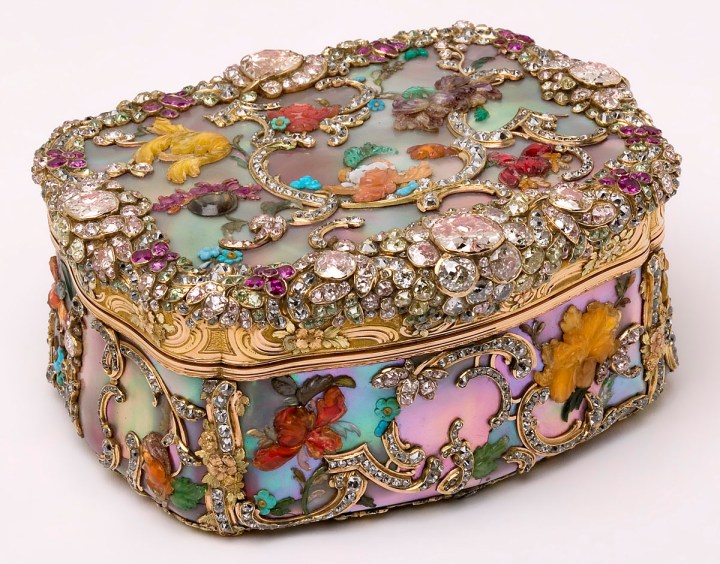
Snuffbox with Flowers, Berlin, Germany, ca. 1765, from the Rosalinde and Arthur Gilbert collection on loan to the Victoria and Albert Museum, London (formerly in the collection of Frederick II of Prussia, 1712–1786), photo Victoria and Albert Museum, London.
◊ ◊ ◊ ◊ ◊
A loan exhibition from the V&A, Close-Up and Personal includes 28 boxes in LA and nearly 60 in Cambridge. As reported by Paula Weideger for The Financial Times in 2009, the history of the fate of the collection is complicated, thanks partially to Arthur Gilbert’s conflicted relationship with LACMA, where he served as a member of the board of trustees. From LACMA:
Close-up and Personal: Eighteenth-Century Gold Boxes
from the Rosalinde and Arthur Gilbert Collection
Los Angeles County Museum of Art, 6 September 2014 — 1 March 2015
The Fitzwilliam Museum, Cambridge, 24 March — 6 September 2015
“So small a thing imposes on people,” remarked the notorious Giacomo Girolamo Casanova (1725–1798), who also carefully selected the type of tobacco to send inside such boxes when he presented them as gifts. Taking snuff and carrying it with you in an elaborate container was a universal practice in 18th-century Europe. A year before the death of the Elector of Cologne, one of the most powerful men in Europe at the time, Casanova had been given a snuffbox decorated with the Elector’s portrait. Going incognito to the Ridotto (the famous gambling halls of Venice), it was important that Casanova use an accessory he had not been seen with before. However, the very distinctive gold box with the Elector’s portrait eventually betrayed him when a former lover remembered it.
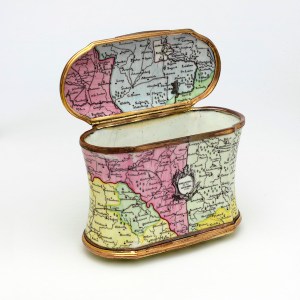
Double Snuffbox with Maps, ca. 1757, possibly Berlin, Germany, from the Rosalinde and Arthur Gilbert collection on loan to the Victoria and Albert Museum, London.
You yourself may recognize some of the gold boxes on view at LACMA through March 1, 2015. Carefully collected by Rosalinde and Arthur Gilbert in Los Angeles, they are here on loan from the Victoria and Albert Museum in London. Designed to carry just a small amount of powdered tobacco, the fine decorations of these pocket-sized containers have to be examined close up. The proximity of the viewing experience makes it very personal, intensifies the response, and can be a powerful experience when shared. Even today, a common reaction when examining them is wonderment, but these complex objects also have the potential to spark a wide range of emotions. Infinitely customizable, gold boxes became the most versatile form of gift in the 18th century.
Unlike the cups of precious metal that continue to lend themselves to specific types of acknowledgment such as loyalty of service or achievements in sport, these portable presents made it possible to communicate a spectrum of sentiments in a variety of social situations. While the double snuffbox covered with maps detailing maneuverings in the Seven Years’ War was probably made in Berlin or among the Prussian allies, other examples are less readily attributable to one side of the conflict. The same imagery would have been understood as a political statement and demonstration of allegiance by participants on either side.
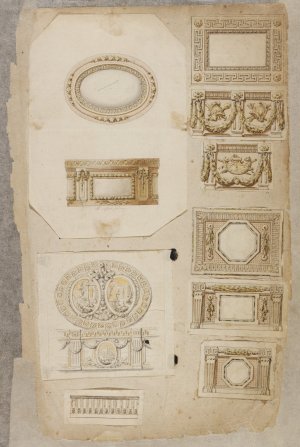
Pierre-Philippe Choffard, Design for an Oval Gold Box, 1759, Victoria and Albert Museum, London.
Elite production of the flashiest boxes was controlled by Frederick II, King of Prussia from 1740 to 1786, who banned imports from France (the unrivalled center of production at the time) “for the best [interest] of the gold workers in Berlin.” He presented some of his lavish commissions to courtiers and other sovereigns, and the local industry flourished under his patronage. Frederick’s personal enjoyment of these intensely bejeweled trinkets, and appreciation for their artistry, inspired him to engage with the manual process of designing them himself. Often the precious metal of the boxes is marked, revealing the places, names, and sometimes dates attached to their making and circulation. However, the designers, royal or otherwise, upon whose creativity all gold snuffboxes depend, cannot be as readily identified. A design on paper signed ‘Choffard fecit 1759’ for a box bearing the mark of maker Jean Ducrollay, is the great exception. However, we have very little information about Pierre-Philippe Choffard as a man or an artist.
Tantalizing details are a major characteristic of gold boxes, and eccentric examples have captivated many onlookers through their puzzling appearance. Like other curious objet d’art, such as the elephant supported musical vanity box (called a nécessaire), some snuffboxes were more than just containers. In the form of gadgets or figurines, they beg to be picked up and turned over in the hand. For example, a delicate box imitating a wicker basket reveals (when the lid is lifted) a cornucopia of fruit painted to fool the eye.
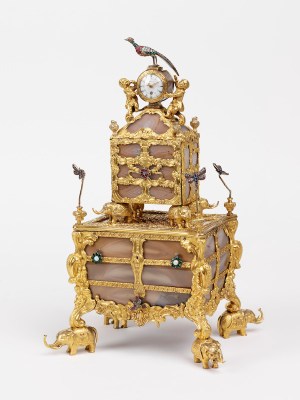
James Cox, Nécessaire, ca. 1770, from the Rosalinde and Arthur Gilbert collection on loan to the Victoria and Albert Museum, London.
You would have to travel to Strawberry Hill near London, the residence of Horace Walpole (1717–1797), to see a truly bizarre example of a snuffbox commissioned exclusively as a curiosity rather than a functional object. Exploiting the genre’s reputation for erudite encoding and connoisseurial delectation, it titillates through its command of wit. An elaborate ruse, it was conceived by the French patron of the arts Marie Anne de Vichy-Chamrond, marquise du Deffand (1697–1780) as a fake declaration of love from a social rival of hers to Walpole, the fourth Earl of Orford and a famous English collector. Her good friend was completely taken in by the exquisite portrait-clad box containing a flattering letter, and he wrote to the marquise about the excitement it gave him. Although the prank was at his expense, he seems to have been rather tickled by the incident. In the introduction to the catalog of his private collections, he recounts the practical joke as an enticement to his readers.
There can be no joking about the significance of the display of gold snuffboxes in the Koenig Gallery. Nothing prepares you for the power of these petite and precious masterpieces of extraordinary design and making. To really understand their attraction, you must encounter the real thing. And once you do, you will have an insider’s view of the preoccupations and passions of 18th-century aristocrats as well as an admiration for the genius of the best makers and designers of the period. With their curious shapes, elaborate surfaces, and the intriguing thoughts they express, gold boxes are some of the most delightful objects ever made.










 Enfilade
leave a comment