Notes and Queries | Info on Benjamin Haydon or Charles Stanhope?
 To date, we’ve not done a lot of inquiry-oriented things here at Enfilade, but I’ve long thought it could be a useful forum for certain kinds of notes and queries. Here’s a question from Susan Dixon:
The La Salle University Art Museum in Philadelphia recently acquired a painting attributed to Benjamin Haydon (1786–1846). The staff have some cause to believe it’s a portrait of the Stanhope family. Charles Stanhope, the 3rd Earl Stanhope (1753–1816), invented a type of printing press that bears his name. He had three sons and a few daughters.
Might anyone be conducting research relevant to the painting?
Feel free to respond with a comment below or email Susan directly, dixons@lasalle.edu. –CH
Exhibition | Bonaparte and the British: Prints and Propaganda

James Gillray, Maniac Ravings, 1803, hand-coloured etching on paper
(London: The British Museum)
◊ ◊ ◊ ◊ ◊
From The British Museum:
Bonaparte and the British: Prints and Propaganda in the Age of Napoleon
The British Museum, London, 5 February — 16 August 2015
This exhibition focuses on the printed propaganda that either reviled or glorified Napoleon Bonaparte, on both sides of the English Channel. It explores how his formidable career coincided with the peak of political satire as an art form. 2015 marks the 200th anniversary of the Battle of Waterloo—the final undoing of brilliant French general and emperor Napoleon Bonaparte (1769–1821). The exhibition will include works by British and French satirists who were inspired by political and military tensions to exploit a new visual language combining caricature and traditional satire with the vigorous narrative introduced by Hogarth earlier in the century.
The print trade had already made the work of contemporary British artists familiar across Europe. Continental collectors devoured the products of the London publishers, and artists across Europe were inspired by British satires. This exhibition includes work by James Gillray, Thomas Rowlandson, Richard Newton and George Cruikshank, some of the most thoughtful and inventive artists of their day. The range and depth of the British Museum’s collection allows the satirical printmakers’ approach to be compared with that of portraitists and others who tended to represent a more sober view of Napoleon.
The exhibition begins with portraits of the handsome young general from the mid-1790s and ends with a cast of his death mask and other memorabilia acquired by British admirers. Along the way, the prints will examine key moments in the British response to Napoleon—exultation at Nelson’s triumph in the Battle of the Nile in 1798, celebration of the Peace of Amiens in 1802, fear of invasion in 1803, the death of Nelson at the Battle of Trafalgar in 1805, and Napoleon’s triumph at Austerlitz, delight at his military defeats from 1812 onwards, culminating in his exile to Elba in 1814. 1815 sees triumphalism after Waterloo and final exile to St Helena, but some prints reflect an ambiguous view of the fallen emperor and doubts about the restoration of the French king Louis XVIII.
◊ ◊ ◊ ◊ ◊
From The British Museum Press:
Tim Clayton and Sheila O’Connell, Bonaparte and the British: Prints and Propaganda in the Age of Napoleon (London: The British Museum Press, 2015), 256 pages, ISBN: 9780714126937, £25.
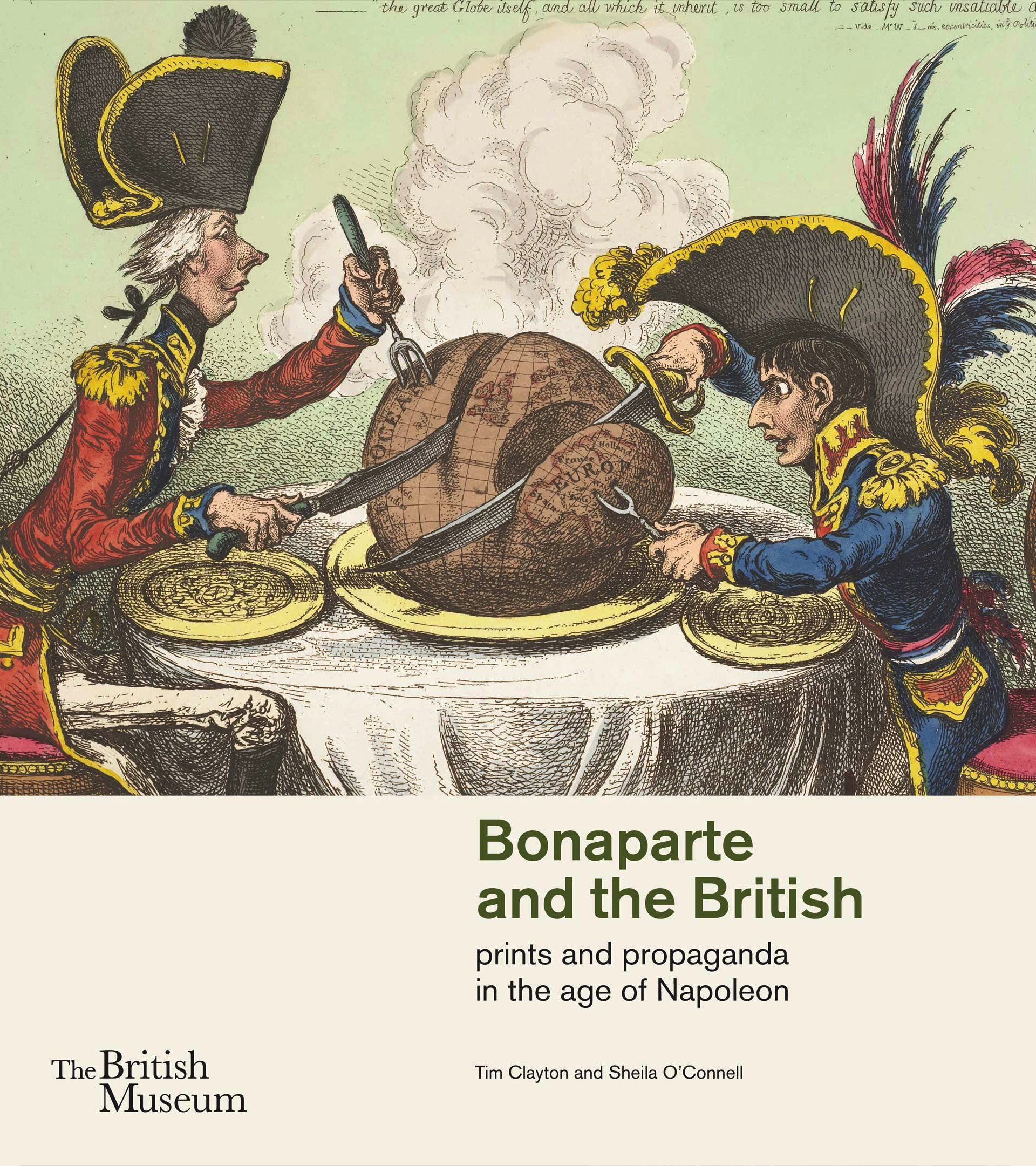 This fascinating book explores through contemporary prints how Bonaparte was seen from across the English Channel where hostile propaganda was tempered by admiration for his military and administrative talents. Featuring works from The British Museum’s world-renowned collection of political satires, including examples by the greatest masters of the genre, James Gillray, Thomas Rowlandson and George Cruikshank, the authors examine in detail these fascinating and humorous prints.
Attitudes to Bonaparte were coloured by political tensions in Britain as highlighted in satires of Charles James Fox, Richard Brinsley Sheridan, Lord Holland and other radicals. French, German, Russian and Spanish copies of British prints demonstrate the wide dissemination of prints and the admiration of continental artists for British satirists. From portraits of the handsome young general to the resplendent Emperor to the cast of his death mask, this book explores crucial events of Bonaparte’s career and the period. French satires showing the British in relation to Bonaparte are also included alongside portraits of Bonaparte and his family made for the British market. This richly illustrated title reveals the stories behind the prints, explaining how satire was used as propaganda and how the artists worked. It features intricately detailed prints in full colour, bringing to life a key period in European history.
Tim Clayton is a leading authority on British prints of the period and the author of several critically acclaimed military histories. Sheila O’Connell is curator of British prints before 1900 at The British Museum.










 Enfilade
leave a comment