New Book | Imperial Illusions: Crossing Pictorial Boundaries
From the Art History Publication Initiative—which, with exciting models for supporting and marketing art history books, is itself well worth a visit:
Kristina Kleutghen, Imperial Illusions: Crossing Pictorial Boundaries in the Qing Palaces (Seattle: University of Washington Press, 2015), 384 pages, ISBN: 978-0295994109 (ebook, ISBN: 978-0295805528), $70.
 In the Forbidden City and other palaces around Beijing, Emperor Qianlong (r. 1736–1795) surrounded himself with monumental paintings of architecture, gardens, people, and faraway places. The best artists of the imperial painting academy, including a number of European missionary painters, used Western perspectival illusionism to transform walls and ceilings with visually striking images that were also deeply meaningful to Qianlong. These unprecedented works not only offer new insights into late imperial China’s most influential emperor, but also reflect one way in which Chinese art integrated and domesticated foreign ideas.
In Imperial Illusions, Kristina Kleutghen examines all known surviving examples of the Qing court phenomenon of ‘scenic illusion paintings’ (tongjinghua), which today remain inaccessible inside the Forbidden City. Produced at the height of early modern cultural exchange between China and Europe, these works have received little scholarly attention. Richly illustrated, Imperial Illusions offers the first comprehensive investigation of the aesthetic, cultural, perceptual, and
political importance of these illusionistic paintings
essential to Qianlong’s world.
Kristina Kleutghen is assistant professor of art history
and archaeology at Washington University in St. Louis.
◊ ◊ ◊ ◊ ◊
C O N T E N T S
Acknowledgments
Note to Readers
Chronology of Chinese Dynasties and Political Periods
Introduction: A New Vision of Painting
1 Painted Walls and Pictorial Illusions
2 The Study of Vision
3 Contemplating the Future
4 Peacocks and Cave-Heavens
5 Staging Europe
6 The Beauty in the Garden
Epilogue: Illusions, Imperial and Otherwise
Appendix: Chinese Texts
Notes
Glossary of Chinese Characters
Bibliography
Index
Display | Elaborate Embroidery: Fabrics for Menswear before 1815
From The Met:
Elaborate Embroidery: Fabrics for Menswear before 1815
The Metropolitan Museum of Art, New York, 2 February — 19 July 2015
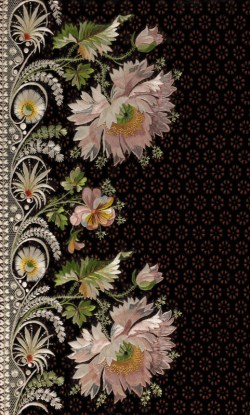 This installation features lengths of fabric for an unmade man’s suit and waistcoat, as well as a selection of embroidery samples for fashionable menswear made between about 1760 and 1815. During this period, France was the undisputed epicenter of the European fashionable world, and professional embroidery workshops there produced a dizzying array of colorful designs from which a man could choose. The installation features a copy of L’Art du Brodeur (The Art of the Embroiderer), which was published in Paris in 1770. This book contains detailed descriptions about subjects such as preparing fabric to be embroidered and the variety of threads used in a workshop, as well as illustrations of designs for men’s suits.
Seen together, the fabrics and the book provide a glimpse into the world of vividly colored and highly decorative fashion that was a key component of an upper-class European man’s life in the eighteenth and early nineteenth centuries.
Exhibition | Indigenous Australia: Enduring Civilisation
Press release (January 2015) for The British Museum exhibition:
Indigenous Australia: Enduring Civilisation
The British Museum, London, 23 April – 2 August 2015
National Museum of Australia, Canberra, Fall 2015

Kunmanara Hogan, Tjaruwa Woods, Yarangka Thomas, Estelle Hogan, Ngalpingka Simms and Myrtle Pennington, Kungkarangkalpa, acrylic on canvas, 2013. © The artists, courtesy Spinifex Arts Project.
In April 2015 the British Museum will open a major exhibition presenting a history of Indigenous Australia, the first exhibition in the UK devoted to the history and culture of Indigenous Australians: both Aboriginal peoples and Torres Strait Islanders. Drawing on objects from the British Museum’s collection, accompanied by important loans from British and Australian collections, the show will present Indigenous Australia as a living culture, with a continuous history dating back over 60,000 years. The objects in the exhibition will range from a shield believed to have been collected at Botany Bay in 1770 by Captain Cook or one of his men, a protest placard from the Aboriginal Tent Embassy established in 1972, contemporary paintings, and specially commissioned artworks from leading Indigenous artists. Many of the objects have never been on public display before.
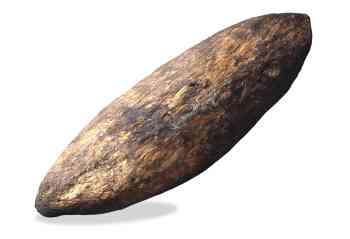
Shield collected at Botany Bay during Captain Cook’s visit, 1770 (London: The British Museum).
The objects displayed in this exhibition are immensely important. The British Museum’s collection contains some of the earliest objects collected from Aboriginal people and Torres Strait Islanders through early naval voyages, colonists, and missionaries dating as far back as 1770. Many were collected at a time before museums were established in Australia and they represent tangible evidence of some of the earliest moments of contact between Aboriginal people, Torres Strait Islanders and the British. Many of these encounters occurred in or near places that are now major cities such as Sydney, Melbourne, Adelaide, and Perth. As a result of collecting made in the early 1800s, many objects originate from coastal locations
rather than the arid inland areas often associated with
Indigenous Australia in the popular imagination.
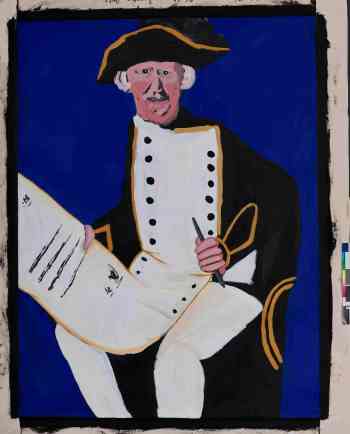
Vincent Namatjira, James Cook—with the Declaration, 2014. © Vincent Namatjira
The exhibition will present not only Indigenous ways of understanding the land and sea but also the significant challenges faced by Indigenous Australians from the colonial period until to the present day. In 1770 Captain Cook landed on the east coast of Australia, a continent larger than Europe. In this land there were hundreds of different Aboriginal groups, each inhabiting a particular area, and each having its own languages, laws and traditions. This land became a part of the British Empire and remained so until the various colonies joined together in 1901 to become the nation of Australia we know today. In this respect, the social history of 19th-century Australia and the place of Indigenous people within this is very much a British story. This history continues into the twenty first century. With changing policies towards Indigenous Australians and their struggle for recognition of civil rights, this exhibition shows why issues about Indigenous Australians are still often so highly debated in Australia today.
The exhibition brings together loans of special works from institutions in the United Kingdom, including the British Library, the Pitt Rivers Museum and the Cambridge Museum of Archaeology and Anthropology. A number of works from the collection of the National Museum of Australia will be shown, including the masterpiece ‘Yumari’ by Uta Uta Tjangala. Tjangala was one of the artists who initiated the translation of traditions of sand sculptures and body painting onto canvas in 1971 at Papunya, a government settlement 240km northwest of Alice Springs in the Northern Territory. Tjangala was also an inspirational leader who developed a plan for the Pintupi community to return to their homelands after decades of living at Papunya. A design from ‘Yumari’ forms a watermark on current Australian passports.
This exhibition has been developed in consultation with many Aboriginal and Torres Strait Islander individuals, Indigenous art and cultural centres across Australia, and has been organised with the National Museum of Australia. The broader project is a collaboration with the National Museum of Australia. It draws on a joint research project, funded by the Australian Research Council, undertaken by the British Museum, the National Museum of Australia and the Australian National University. Titled Engaging Objects: Indigenous communities, museum collections and the representation of Indigenous histories, the research project began in 2011 and involved staff from the National Museum of Australia and the British Museum visiting communities to discuss objects from the British Museum’s collections. The research undertaken revealed information about the circumstances of collecting and significance of the objects, many of which previously lacked good documentation. The project also brought contemporary Indigenous artists to London to view and respond to the Australian collections at the British Museum.
Neil MacGregor, Director of the British Museum said, “The history of Australia and its people is an incredible, continuous story that spans over 60,000 years. This story is also an important part of more recent British history and so it is of great significance that audiences in London will see these unique and powerful objects exploring this narrative. Temporary exhibitions of this nature are only possible thanks to external support so I am hugely grateful to BP for their longstanding and on-going commitment to the British Museum. I would also like to express my gratitude to our logistics partner IAG Cargo and the Australian High Commission who are supporting the exhibition’s public programme.”
Peter J. Mather, Group Regional Vice President, Europe and Head of Country, UK, BP: “BP is extremely pleased to support The BP Exhibition Indigenous Australia: Enduring Civilisation, part of our five year commitment to the museum’s special exhibitions programme. BP has had a presence in Australia for almost 100 years and our support for this exhibition is part of BP’s wider contribution to the societies where we operate, enabling audiences to connect with a variety of different cultures. We are delighted to continue our long-standing relationship with the British Museum by supporting this exhibition which we hope will inspire interest in Australia’s indigenous people and culture for many thousands of visitors.”
Dr Mathew Trinca, National Museum of Australia Director, welcomed the British Museum exhibition: “We are delighted to support this major exhibition in London with the loan of some key objects from our collection. We look forward to continuing our work together to realise our ambition for an exhibition of these artefacts in Canberra in late 2015.”
Patron: HRH The Prince of Wales
Supported by BP
Organised with the National Museum of Australia
Logistics partner IAG Cargo
Public programme supported by the Australian High Commission
Gaye Sculthorpe, John Carty, Howard Morphy, Maria Nugent, Ian Coates, Lissant Bolton, and Jonathan Jones, Indigenous Australia: Enduring Civilisation (London: The British Museum Press, 2015), 272 pages, ISBN: 978-0714126944, £30.
This ground-breaking publication explores the unique and ongoing relationship that Aboriginal people and Torres Strait Islanders have to place and country. It also explores the profound impact and legacy of colonialism, the nature of collecting and the changing meaning of objects now in the collection of The British Museum.
Symposium | Exotic Anatomies: Stubbs, Banks, and Natural History

George Stubbs, Portrait of the Kongouro (Kangaroo) from New
Holland, 1772 (Greenwich: National Maritime Museum)
◊ ◊ ◊ ◊ ◊
From Royal Museums Greenwich in connection with the exhibition The Art and Science of Exploration:
Exotic Anatomies: Stubbs, Banks, and the Cultures of Natural History
Royal Museums Greenwich, London, 9 March 2015
When Joseph Banks returned from Cook’s first voyage of exploration, he brought with him a new world. Not only did he bring collections of specimens that would occupy him and his assistant Daniel Solander for a lifetime, but he brought images and accounts of the South Pacific that changed forever how Europeans saw the world.
One of the oddest was the pelt of a kangaroo, a new animal encountered by the expedition in Australia, which would tax scientists and fascinate the public for decades. Banks commissioned George Stubbs to paint the animal’s portrait, reconstructed from the inflated or stuffed skin, drawings and descriptions. The painting then hung in his house in Soho Square, part of a domestic and scholarly space that soon became a virtual institution where the scientific community gathered.
Further afield, Banks’s specimens were dissected and analysed by the famous surgeon brothers William and John Hunter. They became anatomical objects in the same spaces where the Hunters taught and studied human anatomy, and where they displayed their collections, including others of Stubbs’s ‘exotic’ animal paintings. Stubbs’s kangaroo was rapidly engraved for the published public account of Cook’s voyage, while Cook and his successors brought back live kangaroos for royal menageries and popular entertainments.
Considering the interrelationship between Stubbs, Banks, Cook and the Hunter brothers, this symposium will place Stubbs’s kangaroo at the centre of a number of burgeoning cultures of natural history in 18th-century London. From the gentleman-scholar’s fashionable home, to the practical and controversial space of the anatomy theatre, to the hyperbolic public entertainment, the kangaroo brought a new ‘exoticism’ to natural history.
Fee: £10 | Concessions £7.50. Download the booking form.
◊ ◊ ◊ ◊ ◊
P R O G R A M M E
9.30 Registration and refreshments
10.00 Session 1: Stubbs In Soho Square with the Bankses
• Getting To Know You: Joseph Banks, Australia and the Kangaroo after Stubbs — Jordan Goodman (University College London)
• Science and Sociability: Sarah Sophia Banks and the Domestic Quarters at 32 Soho Square — Arlene Leis, (University of York)
Chair/comment: Simon Schaffer (University of Cambridge)
11.30 Coffee and tea
12.00 Session 2: Stubbs in the Anatomy Theatre with the Hunter Brothers
• William Hunter, George Stubbs, and the Pursuit of Nature — Helen McCormack (The Glasgow School of Art)
• John Hunter (1728–93): Dr Jekyll or Dr Dolittle? — Wendy Moore (author and freelance journalist)
Chair/comment: Katy Barrett (Royal Museums Greenwich)
13.30 Lunch
14.30 Session 3: Stubbs in the London Exhibition Hall with the Public
• The Kangaroo as Scientific Curiosity and Public Spectacle in the Late 18th Century: From Sydney Cove to London — Markman Ellis (Queen Mary, University of London)
• Wonders From Down Under: Kangaroos in Popular Menageries — Helen Cowie (University of York)
Chair/comment: Christine Riding (Royal Museums Greenwich)
16.00 Round Up and Response Session
Richard Dunn (Royal Museums Greenwich)
Geoff Quilley (University of Sussex)
16.30 Curator-led tour of The Art and Science of Exploration
17.00 Wine reception










 Enfilade
leave a comment