Research Project | Marrying Cultures: Queens Consort, 1500–1800
This HERA-funded research project on queens consort will be of interest to many readers. Upcoming events are scheduled to take place throughout Europe: Wolfenbüttel, Berlin, Oxford (in conjunction with Kensington Palace), Warsaw, and Stockholm. –CH
Marrying Cultures: Queens Consort and European Identities, 1500–1800
Marrying Cultures is a three-year research project funded by HERA (Humanities in the European Research Area) focusing on the foreign consort as agent of cultural transfer. The case studies to be investigated are the Polish princesses Katarzyna Jagiellonka, Duchess of Finland and Queen of Sweden (1526–83), and Zofia Jagiellonka, Duchess of Braunschweig-Wolfenbüttel (1464–1512); Hedwig Eleonora of Schleswig-Holstein-Gottorp, Queen of Sweden (1636–1715), and Charlotte Amalie of Hessen-Kassel, Queen of Denmark (1650–1714); the Portuguese princess Catarina of Braganza, Queen of Great Britain (1638–1705); Maria Amalia of Saxony, Queen of the Two Sicilies and Queen of Spain (1724–1760); and Luise Ulrike of Prussia, Queen of Sweden (1720–82).
Working with colleagues in historic palaces, museums and libraries (including Kensington Palace, the Victoria and Albert Museum and the National Portrait Gallery, London; the Royal Armoury, Stockholm, and the Duke August Library, Wolfenbüttel), the project members will also consider how it is that certain consorts become embedded in national cultural memory and others do not.
Partners
Historic Royal Palaces (Kensington Palace, London): Dr Joanna Marschner
National Portrait Gallery, London: Dr Catharine Macleod
Victoria and Albert Museum, London: Dr Julius Bryant
Livrustkammaren (The Royal Armoury), Stockholm: Dr Malin Grundberg
The Museum of Polish History, Warsaw: Monika Matwiejczuk
Supportive Institutions
Herzog August Bibliothek, Wolfenbüttel: Professor Hellwig Schmidt-Glintzer
Hochschule für Musik, Theater und Medien, Hannover: Professor Susanne Rode-Breymann
Husgerådskammaren (The Royal Collections), Stockholm: Dr Lars Ljungström
Turku Castle and Historical Museum: Olli Immonen

Exhibition | Vivienne Westwood: Cut from the Past

◊ ◊ ◊ ◊ ◊
From Danson House:
Vivienne Westwood: Cut from the Past
Danson House, Bexleyheath, Kent, 1 April — 31 October 2015
The 18th century is the high point of art and culture. —Dame Vivienne Westwood
The impact of 18th-century art and design on the work of distinguished British fashion designer Vivienne Westwood is celebrated in a new exhibition at Danson House this spring. Vivienne Westwood: Cut from the Past brings together for the first time a number of her ground-breaking designs, and explores the collections that proved to be her turning point both critically and commercially.
Danson House, a splendidly restored Georgian villa, provides a tailor-made backdrop to the exhibition which highlights Westwood’s seminal work of the 1990s which was influenced by the 18th century. Designs and outfits on show make particular reference to the Rococo paintings of French artists Watteau and Boucher. Westwood’s passion for 18th-century design is also reflected in some earlier pieces from the ‘Cut, Slash and Pull’ and ‘Mini Crini’ collections, and the Malcom McLaren and Vivienne Westwood ‘Seditionaries’ Collection.
Caroline Worthington, Chief Executive, Bexley Heritage Trust said, “We are delighted to be working together with the Victoria & Albert Museum for the first time to bring cutting edge design back to Danson House for the 2015 season—just as the original owners, the Boyd family, did in the 18th century.”
◊ ◊ ◊ ◊ ◊
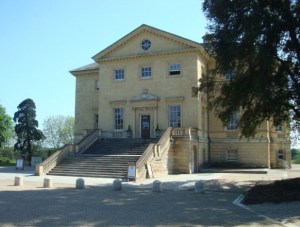 Danson House boasts a suite of rooms created for Sir John Boyd, a man besotted with his young bride. Enjoy this superb example of 18th-century architecture with its classical proportions, elegant interiors and rich symbolism celebrating love and marriage. Designed as a retreat from the hustle and bustle of central London, Danson House was completed in 1766. Sir John Boyd was a sugar merchant and vice-chairman of the British East India Company. Together with the notable architect Sir Robert Taylor, Boyd created this homage to the Golden Age of Antiquity, filling it with art and sculpture from his travels on the Continent. Today his home gives us a fascinating insight into fashionable
Georgian life.










 Enfilade
leave a comment