Working Group | Home Subjects, ca. 1750–1900

Arthur Devis, The John Bacon Family, 1742–43, 30 x 52 inches (76.2 x 131.1 cm), oil on canvas (New Haven: Yale Center for British Art, Paul Mellon Collection).
◊ ◊ ◊ ◊ ◊
Thanks to Historians of British Art for sponsoring the “Home Subjects” panel at the 2015 meeting of the College Art Association last week in New York. The panel kicked off a series of activities that the organizers of Home Subjects are planning over the course of the next few years in an attempt to bring together scholars interested in the display of art in the the private or domestic interior. Our hope is to make connections across traditional period boundaries in order to encourage and facilitate research and discussion about the role art played in the decoration of the private interior and, in turn, how the display of art in the private interior shaped the direction of contemporary art. Further information about the topics Home Subjects would like to address can be found on our blog. We also encourage anyone interested in participating or sharing ideas to sign up for our email list at homesubjects@gmail.com. Stay tuned for blog posts, calls-for-papers, and more!
Melinda McCurdy, The Huntington Library, Art Collections and Botanical Gardens, San Marino, CA
Morna O’Neill, Wake Forest University, Winston-Salem, NC
Anne Nellis Richter, Independent Scholar and part-time faculty, American University, Washington, DC
2015 Dresden Summer Academy
From Staatliche Kunstsammlungen Dresden:
Dresden Summer Academy
Dresden, 22–29 August 2015
Applications due by 30 April 2015
 During this intensive seven-day course the participants explore the city of Dresden, its great monuments, and its museums. The main theme is the study of the collections in a context that considers the princely attitudes of the Saxon rulers during the late Renaissance, the magnificent royal patronage of the arts, and flourishing of courtly display especially in the 18th-century Augustan Age, and the role of the monarchy in 19th-century bourgeois society.
These collections are presented in the beautiful royal palaces in and around Dresden where their meaning and importance can be studied in the original surroundings. With their modern and often highly innovative exhibitions and the diversity of the themes explored in them, the museums and their collections are essential features of the vibrant cultural life and lively discourse that characterise the city of Dresden today.
Scholarships are available and are intended for candidates who are unable to pay the fee personally or whose organisation / institution cannot support them in full.
New Book | Sir John Soane’s Influence on Architecture from 1791
From Ashgate:
Oliver Bradbury, Sir John Soane’s Influence on Architecture from 1791: A Continuing Legacy (Aldershot: Ashgate, 2015), 480 pages, ISBN: 978-1472409102, $165.
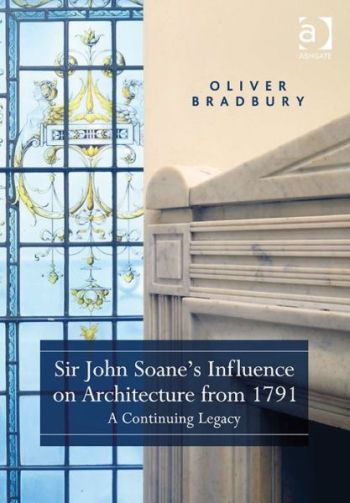 Sir John Soane’s Influence on Architecture from 1791: A Continuing Legacy is the first in-depth study of this eighteenth-century British architect’s impact on the work of others, extending globally and still indeed the case over 200 years later. Author Oliver Bradbury presents a compelling argument that the influence of Soane (1753–1837) has persevered through the centuries, rather than waning around the time of his death. Through examinations of internationally-renowned architects from Benjamin Henry Latrobe to Philip Johnson, as well as a number of not so well known Soanean disciples, Bradbury posits that Soane is perhaps second only to Palladio in terms of the longevity of his influence on architecture through the course of more than two centuries, from the early 1790s to today, concluding with the recent return to pure revivalism. Previous investigations have been limited to focusing on Soane’s late-Georgian and then post-modern influence; this is the first in-depth study of his impact over the course of two centuries. Through this survey, Bradbury demonstrates that Soane’s influence has been truly international in the pre-modern era, reaching throughout the British Isles and beyond to North America and even colonial Australia. Through his inclusion of select, detailed case studies, Bradbury contends that Soane’s is a continuing, not negated, legacy in architecture.
Oliver Bradbury is an independent researcher, based in London.
◊ ◊ ◊ ◊ ◊
C O N T E N T S
List of Figures
Preface
Acknowledgements
Introduction
1 Imitation: A survey of Soane’s influence on his pupils and contemporaries in Great Britain, North America and Australia, 1791–c. 1850, with a case study
2 The Survival of Soane? Wilderness years: collapse of Soane’s influence and reputation; ridicule and critical nadir, 1850–1884
3 Transmutation: Soane’s influence on late nineteenth- and twentieth-century Classicism, beginning with Beresford Pite, and the revival in interest and a new appreciation of Soane’s achievements, 1885–1956
4 Soane and Modernity: The influence of Soane on twentieth-century Modernism and Classical revivalism, 1953 until now
Select Bibliography
Index










 Enfilade
leave a comment