New Book | Women Artists: The Linda Nochlin Reader
Due out this summer from Thames & Hudson:
Linda Nochlin, Women Artists: The Linda Nochlin Reader, edited by Maura Reilly (London: Thames & Hudson, 2015), 434 pages, ISBN: 978-0500239292, $50.
 Linda Nochlin is one of the most accessible, provocative, and innovative art historians of our time. In 1971 she published her essay “Why Have There Been No Great Women Artists?”—a dramatic feminist call-to-arms that called traditional art historical practices into question and led to a major revision of the discipline.
Women Artists brings together twenty-nine essential essays from throughout Nochlin’s career, making this the definitive anthology of her writing about women in art. Included are her major thematic texts “Women Artists After the French Revolution” and “Starting from Scratch: The Beginnings of Feminist Art History,” as well as the landmark essay and its rejoinder “‘Why Have There Been No Great Women Artists?’ Thirty Years After.” These appear alongside monographic entries focusing on a selection of major women artists including Mary Cassatt, Louise Bourgeois, Cecily Brown, Kiki Smith, Miwa Yanagi, and Sophie Calle. Women Artists also presents two new essays written specifically for this book and an interview with Nochlin investigating the position of women artists today.
Linda Nochlin is a highly celebrated feminist art historian. She is the Lila Acheson Wallace Professor of Modern Art Emerita at the Institute of Fine Arts, New York University. Her major books include Courbet, Representing Women, and Women, Art, and Power.
Maura Reilly has worked as a critic for Art in America and as a lecturer at the Museum of Modern Art, New York. She has held curatorial positions at the Brooklyn Museum and at the American Federation of Arts, New York. She is coauthor, with Linda Nochlin, of Global Feminisms: New Directions in Contemporary Art.
Call for Papers | Sixth Annual Feminist Art History Conference
Sixth Annual Feminist Art History Conference
American University in Washington, D.C., 6–8 November 2015
Proposals due by March 2015
This annual conference builds on the legacy of feminist art-historical scholarship and pedagogy initiated by Norma Broude and Mary D. Garrard at American University. To further the inclusive spirit of their groundbreaking anthologies, we invite papers on subjects spanning the chronological spectrum, from the ancient world through the present, to foster a broad dialogue on feminist art-historical practice. Papers may address such topics as: artists, movements, and works of art and architecture; cultural institutions and critical discourses; practices of collecting, patronage, and display; the gendering of objects, spaces, and media; the reception of images; and issues of power, agency, gender, and sexuality within visual cultures. Submissions on under-represented art-historical fields, geographic areas or national traditions, and issues of race and ethnicity are encouraged.
To be considered for participation, please provide a single document in Microsoft Word. It should consist of a one-page, single-spaced proposal of unpublished work, up to 500 words in length for a 20-minute presentation, followed by a curriculum vitae of no more than two pages. Please title the document “[last name]-proposal”. Submit materials with the subject line “[last name]-proposal” to: fahc6papers@gmail.com. Submission Deadline: May 15, 2015. Invitations to participate will be sent by July 1. Send general queries to: fahc2015queries@gmail.com.
Keynote speaker: Professor Amelia Jones, University of Southern California: “The Curating of Feminist Art (or is it the Feminist Curating of Art?)”
Sponsored by the Art History Program and the Department of Art, College of Arts and Sciences, American University. Organizing committee: Juliet Bellow, Norma Broude, Kim Butler Wingfield, Mary D. Garrard, Helen Langa, Andrea Pearson, and Ying-chen Peng
New Book | Imperial Illusions: Crossing Pictorial Boundaries
From the Art History Publication Initiative—which, with exciting models for supporting and marketing art history books, is itself well worth a visit:
Kristina Kleutghen, Imperial Illusions: Crossing Pictorial Boundaries in the Qing Palaces (Seattle: University of Washington Press, 2015), 384 pages, ISBN: 978-0295994109 (ebook, ISBN: 978-0295805528), $70.
 In the Forbidden City and other palaces around Beijing, Emperor Qianlong (r. 1736–1795) surrounded himself with monumental paintings of architecture, gardens, people, and faraway places. The best artists of the imperial painting academy, including a number of European missionary painters, used Western perspectival illusionism to transform walls and ceilings with visually striking images that were also deeply meaningful to Qianlong. These unprecedented works not only offer new insights into late imperial China’s most influential emperor, but also reflect one way in which Chinese art integrated and domesticated foreign ideas.
In Imperial Illusions, Kristina Kleutghen examines all known surviving examples of the Qing court phenomenon of ‘scenic illusion paintings’ (tongjinghua), which today remain inaccessible inside the Forbidden City. Produced at the height of early modern cultural exchange between China and Europe, these works have received little scholarly attention. Richly illustrated, Imperial Illusions offers the first comprehensive investigation of the aesthetic, cultural, perceptual, and
political importance of these illusionistic paintings
essential to Qianlong’s world.
Kristina Kleutghen is assistant professor of art history
and archaeology at Washington University in St. Louis.
◊ ◊ ◊ ◊ ◊
C O N T E N T S
Acknowledgments
Note to Readers
Chronology of Chinese Dynasties and Political Periods
Introduction: A New Vision of Painting
1 Painted Walls and Pictorial Illusions
2 The Study of Vision
3 Contemplating the Future
4 Peacocks and Cave-Heavens
5 Staging Europe
6 The Beauty in the Garden
Epilogue: Illusions, Imperial and Otherwise
Appendix: Chinese Texts
Notes
Glossary of Chinese Characters
Bibliography
Index
Display | Elaborate Embroidery: Fabrics for Menswear before 1815
From The Met:
Elaborate Embroidery: Fabrics for Menswear before 1815
The Metropolitan Museum of Art, New York, 2 February — 19 July 2015
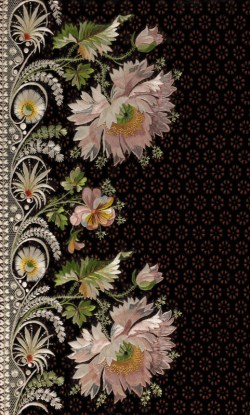 This installation features lengths of fabric for an unmade man’s suit and waistcoat, as well as a selection of embroidery samples for fashionable menswear made between about 1760 and 1815. During this period, France was the undisputed epicenter of the European fashionable world, and professional embroidery workshops there produced a dizzying array of colorful designs from which a man could choose. The installation features a copy of L’Art du Brodeur (The Art of the Embroiderer), which was published in Paris in 1770. This book contains detailed descriptions about subjects such as preparing fabric to be embroidered and the variety of threads used in a workshop, as well as illustrations of designs for men’s suits.
Seen together, the fabrics and the book provide a glimpse into the world of vividly colored and highly decorative fashion that was a key component of an upper-class European man’s life in the eighteenth and early nineteenth centuries.
Exhibition | Indigenous Australia: Enduring Civilisation
Press release (January 2015) for The British Museum exhibition:
Indigenous Australia: Enduring Civilisation
The British Museum, London, 23 April – 2 August 2015
National Museum of Australia, Canberra, Fall 2015

Kunmanara Hogan, Tjaruwa Woods, Yarangka Thomas, Estelle Hogan, Ngalpingka Simms and Myrtle Pennington, Kungkarangkalpa, acrylic on canvas, 2013. © The artists, courtesy Spinifex Arts Project.
In April 2015 the British Museum will open a major exhibition presenting a history of Indigenous Australia, the first exhibition in the UK devoted to the history and culture of Indigenous Australians: both Aboriginal peoples and Torres Strait Islanders. Drawing on objects from the British Museum’s collection, accompanied by important loans from British and Australian collections, the show will present Indigenous Australia as a living culture, with a continuous history dating back over 60,000 years. The objects in the exhibition will range from a shield believed to have been collected at Botany Bay in 1770 by Captain Cook or one of his men, a protest placard from the Aboriginal Tent Embassy established in 1972, contemporary paintings, and specially commissioned artworks from leading Indigenous artists. Many of the objects have never been on public display before.
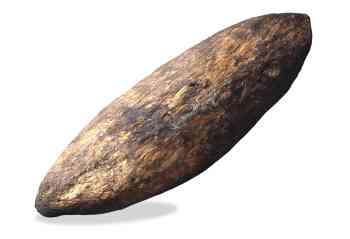
Shield collected at Botany Bay during Captain Cook’s visit, 1770 (London: The British Museum).
The objects displayed in this exhibition are immensely important. The British Museum’s collection contains some of the earliest objects collected from Aboriginal people and Torres Strait Islanders through early naval voyages, colonists, and missionaries dating as far back as 1770. Many were collected at a time before museums were established in Australia and they represent tangible evidence of some of the earliest moments of contact between Aboriginal people, Torres Strait Islanders and the British. Many of these encounters occurred in or near places that are now major cities such as Sydney, Melbourne, Adelaide, and Perth. As a result of collecting made in the early 1800s, many objects originate from coastal locations
rather than the arid inland areas often associated with
Indigenous Australia in the popular imagination.
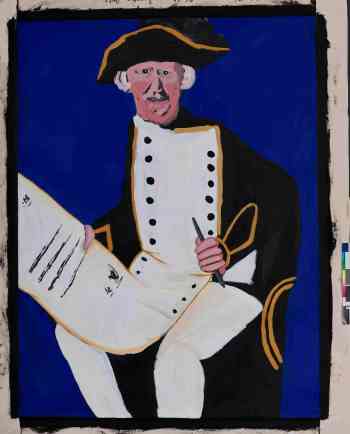
Vincent Namatjira, James Cook—with the Declaration, 2014. © Vincent Namatjira
The exhibition will present not only Indigenous ways of understanding the land and sea but also the significant challenges faced by Indigenous Australians from the colonial period until to the present day. In 1770 Captain Cook landed on the east coast of Australia, a continent larger than Europe. In this land there were hundreds of different Aboriginal groups, each inhabiting a particular area, and each having its own languages, laws and traditions. This land became a part of the British Empire and remained so until the various colonies joined together in 1901 to become the nation of Australia we know today. In this respect, the social history of 19th-century Australia and the place of Indigenous people within this is very much a British story. This history continues into the twenty first century. With changing policies towards Indigenous Australians and their struggle for recognition of civil rights, this exhibition shows why issues about Indigenous Australians are still often so highly debated in Australia today.
The exhibition brings together loans of special works from institutions in the United Kingdom, including the British Library, the Pitt Rivers Museum and the Cambridge Museum of Archaeology and Anthropology. A number of works from the collection of the National Museum of Australia will be shown, including the masterpiece ‘Yumari’ by Uta Uta Tjangala. Tjangala was one of the artists who initiated the translation of traditions of sand sculptures and body painting onto canvas in 1971 at Papunya, a government settlement 240km northwest of Alice Springs in the Northern Territory. Tjangala was also an inspirational leader who developed a plan for the Pintupi community to return to their homelands after decades of living at Papunya. A design from ‘Yumari’ forms a watermark on current Australian passports.
This exhibition has been developed in consultation with many Aboriginal and Torres Strait Islander individuals, Indigenous art and cultural centres across Australia, and has been organised with the National Museum of Australia. The broader project is a collaboration with the National Museum of Australia. It draws on a joint research project, funded by the Australian Research Council, undertaken by the British Museum, the National Museum of Australia and the Australian National University. Titled Engaging Objects: Indigenous communities, museum collections and the representation of Indigenous histories, the research project began in 2011 and involved staff from the National Museum of Australia and the British Museum visiting communities to discuss objects from the British Museum’s collections. The research undertaken revealed information about the circumstances of collecting and significance of the objects, many of which previously lacked good documentation. The project also brought contemporary Indigenous artists to London to view and respond to the Australian collections at the British Museum.
Neil MacGregor, Director of the British Museum said, “The history of Australia and its people is an incredible, continuous story that spans over 60,000 years. This story is also an important part of more recent British history and so it is of great significance that audiences in London will see these unique and powerful objects exploring this narrative. Temporary exhibitions of this nature are only possible thanks to external support so I am hugely grateful to BP for their longstanding and on-going commitment to the British Museum. I would also like to express my gratitude to our logistics partner IAG Cargo and the Australian High Commission who are supporting the exhibition’s public programme.”
Peter J. Mather, Group Regional Vice President, Europe and Head of Country, UK, BP: “BP is extremely pleased to support The BP Exhibition Indigenous Australia: Enduring Civilisation, part of our five year commitment to the museum’s special exhibitions programme. BP has had a presence in Australia for almost 100 years and our support for this exhibition is part of BP’s wider contribution to the societies where we operate, enabling audiences to connect with a variety of different cultures. We are delighted to continue our long-standing relationship with the British Museum by supporting this exhibition which we hope will inspire interest in Australia’s indigenous people and culture for many thousands of visitors.”
Dr Mathew Trinca, National Museum of Australia Director, welcomed the British Museum exhibition: “We are delighted to support this major exhibition in London with the loan of some key objects from our collection. We look forward to continuing our work together to realise our ambition for an exhibition of these artefacts in Canberra in late 2015.”
Patron: HRH The Prince of Wales
Supported by BP
Organised with the National Museum of Australia
Logistics partner IAG Cargo
Public programme supported by the Australian High Commission
Gaye Sculthorpe, John Carty, Howard Morphy, Maria Nugent, Ian Coates, Lissant Bolton, and Jonathan Jones, Indigenous Australia: Enduring Civilisation (London: The British Museum Press, 2015), 272 pages, ISBN: 978-0714126944, £30.
This ground-breaking publication explores the unique and ongoing relationship that Aboriginal people and Torres Strait Islanders have to place and country. It also explores the profound impact and legacy of colonialism, the nature of collecting and the changing meaning of objects now in the collection of The British Museum.
Symposium | Exotic Anatomies: Stubbs, Banks, and Natural History

George Stubbs, Portrait of the Kongouro (Kangaroo) from New
Holland, 1772 (Greenwich: National Maritime Museum)
◊ ◊ ◊ ◊ ◊
From Royal Museums Greenwich in connection with the exhibition The Art and Science of Exploration:
Exotic Anatomies: Stubbs, Banks, and the Cultures of Natural History
Royal Museums Greenwich, London, 9 March 2015
When Joseph Banks returned from Cook’s first voyage of exploration, he brought with him a new world. Not only did he bring collections of specimens that would occupy him and his assistant Daniel Solander for a lifetime, but he brought images and accounts of the South Pacific that changed forever how Europeans saw the world.
One of the oddest was the pelt of a kangaroo, a new animal encountered by the expedition in Australia, which would tax scientists and fascinate the public for decades. Banks commissioned George Stubbs to paint the animal’s portrait, reconstructed from the inflated or stuffed skin, drawings and descriptions. The painting then hung in his house in Soho Square, part of a domestic and scholarly space that soon became a virtual institution where the scientific community gathered.
Further afield, Banks’s specimens were dissected and analysed by the famous surgeon brothers William and John Hunter. They became anatomical objects in the same spaces where the Hunters taught and studied human anatomy, and where they displayed their collections, including others of Stubbs’s ‘exotic’ animal paintings. Stubbs’s kangaroo was rapidly engraved for the published public account of Cook’s voyage, while Cook and his successors brought back live kangaroos for royal menageries and popular entertainments.
Considering the interrelationship between Stubbs, Banks, Cook and the Hunter brothers, this symposium will place Stubbs’s kangaroo at the centre of a number of burgeoning cultures of natural history in 18th-century London. From the gentleman-scholar’s fashionable home, to the practical and controversial space of the anatomy theatre, to the hyperbolic public entertainment, the kangaroo brought a new ‘exoticism’ to natural history.
Fee: £10 | Concessions £7.50. Download the booking form.
◊ ◊ ◊ ◊ ◊
P R O G R A M M E
9.30 Registration and refreshments
10.00 Session 1: Stubbs In Soho Square with the Bankses
• Getting To Know You: Joseph Banks, Australia and the Kangaroo after Stubbs — Jordan Goodman (University College London)
• Science and Sociability: Sarah Sophia Banks and the Domestic Quarters at 32 Soho Square — Arlene Leis, (University of York)
Chair/comment: Simon Schaffer (University of Cambridge)
11.30 Coffee and tea
12.00 Session 2: Stubbs in the Anatomy Theatre with the Hunter Brothers
• William Hunter, George Stubbs, and the Pursuit of Nature — Helen McCormack (The Glasgow School of Art)
• John Hunter (1728–93): Dr Jekyll or Dr Dolittle? — Wendy Moore (author and freelance journalist)
Chair/comment: Katy Barrett (Royal Museums Greenwich)
13.30 Lunch
14.30 Session 3: Stubbs in the London Exhibition Hall with the Public
• The Kangaroo as Scientific Curiosity and Public Spectacle in the Late 18th Century: From Sydney Cove to London — Markman Ellis (Queen Mary, University of London)
• Wonders From Down Under: Kangaroos in Popular Menageries — Helen Cowie (University of York)
Chair/comment: Christine Riding (Royal Museums Greenwich)
16.00 Round Up and Response Session
Richard Dunn (Royal Museums Greenwich)
Geoff Quilley (University of Sussex)
16.30 Curator-led tour of The Art and Science of Exploration
17.00 Wine reception
Exhibition | Spirits of the Passage: The Transatlantic Slave Trade
From the press release for the exhibition:
Spirits of the Passage: The Story of the Transatlantic Slave Trade
The Frazier History Museum, Louisville, Kentucky, February 2 through June 16, 2013
The DuSable Museum of African American History, Chicago, 19 September 2014 — 4 January 2015
Reading Public Museum, Reading, Pennsylvania, 24 January — 3 May 2015

Slave Shackles from The Henrietta Marie, ca. 1700 (Key West: The Mel Fisher Maritime Museum)
The Reading Public Museum invites guests to the new exhibition, Spirits of the Passage: The Story of the Transatlantic Slave Trade, exploring the transatlantic slave trade through a display of nearly 150 historical objects, many salvaged from sunken ships. This exhibition, sponsored locally by The Historic Abraham Lincoln Hotel, was developed in conjunction with the 150th anniversary of Abraham Lincoln’s 1863 Emancipation Proclamation and the turning point it represented for thousands of enslaved people at a pivotal point in the American Civil War. It’s the first exhibit of its kind to examine the entire history of the Transatlantic Slave Trade from the 16th through 19th centuries, while also presenting the most up-to-date research and discoveries to the public. These include the latest marine archaeological discoveries from the Mel Fisher Maritime Museum, new research on key African societies, and an exploration of the slave trade’s modern day legacies.
Spirits of the Passage allows guests to see authentic artifacts from the wreck of an actual slave ship, such as restraints, tools, plates and trade goods, as well as dozens of other objects from West African societies that show the uniqueness of the individual cultures they represent. These include religious objects, bronze- and beadwork, pottery, and jewelry. These compelling artifacts create a provocative picture of this tragic era, while also engendering a sense of pride in the legacy of strength these enslaved people left behind.
Spirits of the Passage was produced in partnership by The Mel Fisher Maritime Museum in Key West, Florida and The Frazier History Museum in Louisville, Kentucky.
◊ ◊ ◊ ◊ ◊
The 1972 discovery of The Henrietta Marie occasioned this 1997 book:
Madeleine Burnside and Rosemarie Robotham, with a foreword by Cornell West, Spirits of the Passage: The Transatlantic Slave Trade in the Seventeenth Century (New York: Simon & Schuster, 1997), 192 pages, ISBN: 978-0684818191.
 In a watery grave off the coast of Florida lies the earliest slave ship ever recovered. The English-owned Henrietta Marie plied the waters from Europe to Africa and the New World, sinking in the year 1700. She has waited three hundred years to reveal her story. Taking the wreck of the ship as its dramatic heart, Spirits of the Passage presents the first general-interest history of the early years of the slave trade. Told in part from the decks and the cargo hold of a single merchant slaver, this powerful and fascinating story covers a period that has heretofore been largely the territory of scholars—the late seventeenth century, when the slave trade began a period of explosive growth.
Spirits of the Passage describes the story of the largest forced migration in human history, with a powerful text that personalizes the experience of slavery in the most gripping way. Richly illustrated with artifacts found in the wreck along with etchings and paintings of the time, the book documents a tragic tale of human misery even as it reveals the strength of spirit that made survival possible for enslaved Africans. Included throughout are narratives of resistance and survival, many of them never before told. The mosaic of profiles breathes life into stories from all sides of the trade, stories that will contribute to a more complete understanding of the dilemmas of the time. As integral parts of this important volume, profiles, anecdotes, illustrations, and incisive narrative all combine to create a compelling account of one of history’s most important, and shattering, moments.
NEH Summer Institute | 3D Modeling of Cultural Heritage Sites

From H-ArtHist:
Advanced Challenges in Theory and Practice in 3D Modeling of Cultural Heritage Sites
UMass Amherst, 22–28 June 2015, and UCLA, 20–23 June 2016
Applications due by 30 March 2015
Directors: Alyson A. Gill (UMass Amherst) and Lisa M. Snyder (UCLA)
Applications are currently being accepted for Advanced Challenges in Theory and Practice in 3D Modeling of Cultural Heritage Sites. This NEH Summer Institute for Advanced Topics in the Digital Humanities will take place over two consecutive summers. In 2015, participants will gather at UMass Amherst from June 22–28 to discuss key issues and challenges facing scholars working with 3D content with an emphasis on the end user experience, and define research questions that they will explore in the subsequent academic year. In 2016, participants will present their findings at a three-day symposium to be held at UCLA from June 20–23.
Submissions are encouraged from scholars with research or teaching projects that would benefit from advanced discussion of theoretical issues related to 3D content; in-service educators interested in pedagogical applications for 3D content across humanities disciplines and grade levels; library, museum, and publishing professionals investigating or using 3D content in installations or born-digital publications; and technologists involved with interactive 3D computer graphics, educational games, or dissemination platforms.
Applications due by March 30, 2015; applicants notified by April 13, 2015. Successful applicants receive a $1,375 stipend to defray expenses related to the 2015 Summer Institute at UMass Amherst and an additional $1,000 to defray expenses related to the 2016 Symposium at UCLA. Please visit advancedchallenges.com for details about the schedule, institute faculty, and the application process.
◊ ◊ ◊ ◊ ◊
And the website really is worth visiting even if you have no intentions of applying; the reading list alone is pretty exciting. –CH
New Book | Antiquity, Theatre, and the Painting of Henry Fuseli
From Oxford UP:
Andrei Pop, Antiquity, Theatre, and the Painting of Henry Fuseli (Oxford: Oxford University Press, 2015), 288 pages, ISBN: 978-0198709275, £70 / $115.
 The rediscovery of Pompeii and Herculaneum in the eighteenth century challenged European assumptions about ancient life; just as influential, if quieter, was the revolution caused by translations of Greek tragedy. Art of the mid-eighteenth to early nineteenth centuries dealt with the violence and seeming irrationality of tragic action as an account of the rituals and beliefs of a foreign culture, worshipping strange gods and enacting unfamiliar customs. The result was a focus on the radical difference of the past which, however, was thought to still have something to teach us: not how to live better, but that we live differently and should allow others to do so as well. In recognizing tragedy as an alien cultural form, modern Europe recognized its own historical status as one culture among many.
Naturally, this insight was resisted. Greek tragedy was seldom performed. In painting, it lived a shadow existence alongside more didactic subject matter, emerging explicitly only in a corpus of wash drawings by Anglo-Swiss artist Henry Fuseli (1741-1825) and an international circle of artists active in Rome in the 1770s. In this volume, Pop examines Fuseli as exemplary of a pluralist classicism, paying especial attention to his experiments with moral and aesthetic conventions in the more private medium of drawing. He analyses this broad view of culture through the lens of Fuseli’s life and work. His remarkable acquaintances Emma Hamilton, Erasmus Darwin, and Mary Wollstonecraft, and the great theorists of art and morals to whom he responded, Jean-Jacques Rousseau, Johann Joachim Winckelmann, and David Hume, play prominent roles in this investigation of how antiquity became modern.
Andrei Pop is Associate Professor in the John U. Nef Committee on Social Thought at the University of Chicago.
◊ ◊ ◊ ◊ ◊
C O N T E N T S
Introduction: Classicism and its Discontents
1 Tragedy, the Cultural Relativism of Henry Fuseli
2 Grave Monuments, Writing, and the Antique Present
3 Comedy, Dreaming, and the Sympathetic Spectator
4 Winckelmann’s Fake and Activist Neoclassicism
5 The Satyr Play, or Naturalizing Human Nature
6 Ordinary Antiquity
Conclusion
Appendix I: Fuseli and Herder
Appendix II: Fuseli and Homer
Bibliography
Index
Notes and Queries | Info on Benjamin Haydon or Charles Stanhope?
 To date, we’ve not done a lot of inquiry-oriented things here at Enfilade, but I’ve long thought it could be a useful forum for certain kinds of notes and queries. Here’s a question from Susan Dixon:
The La Salle University Art Museum in Philadelphia recently acquired a painting attributed to Benjamin Haydon (1786–1846). The staff have some cause to believe it’s a portrait of the Stanhope family. Charles Stanhope, the 3rd Earl Stanhope (1753–1816), invented a type of printing press that bears his name. He had three sons and a few daughters.
Might anyone be conducting research relevant to the painting?
Feel free to respond with a comment below or email Susan directly, dixons@lasalle.edu. –CH










 Enfilade
leave a comment