At Sotheby’s | Musical Automaton ‘Bird Cage’ Clock
The clock dates to around 1825, but it is an eighteenth-century kind of object—a kind of object that’s not yet appeared here at Enfilade. Try a keyword search for ‘bird cage automaton’ (to the right) and now something turns up. Press release from Sotheby’s:
Important Watches (Sale #GE1601)
Sotheby’s, Geneva, 14 May 2016

Attributed to Jean-David Maillardet with clavier by Charles-Frédéric Nardin, musical automaton bird cage clock, ca. 1825–30 (Sotheby’s Sale #GE1601; estimate: $411,000–825,000).
Sotheby’s upcoming sale of Important Watches, to be held on Saturday, 14 May, will be led by an exceptional and rare musical automaton clock, shaped as a bird cage. This stunning object proudly showcases the very finest of Swiss craftsmanship: its external appearance combines exquisite design and detail, while its inner mechanics represent the most advanced horological complications of the age. The bird cage features two charming singing birds as well as a captivating butterfly. Thanks to three automaton mechanisms, the elements combine to form a delightful scene filled with movement and music. This exceptional piece will be offered with an estimate of CHF 400,000–800,000 ($411,000–825,000).
Speaking ahead of the sale, Pedro Reiser, Department Manager of Sotheby’s Watch Division in Geneva, commented: “It is truly an honour to have been entrusted with such an extraordinary timepiece for our upcoming auction of important watches. This wonderful automaton is a rare find—all the more exceptional because it features an automated butterfly. Records suggest that only one other double-bird cage clock with an automaton butterfly is currently known. We are delighted to be able to present this exquisite creation, which would be equally at home in the collection of a connoisseur or in a museum.”
The ornate cage, of chiselled golden bronze, sits on four lion paw-shaped feet atop a pedestal. The whole structure is finished in shiny piqué-mat. Inside the rectangular cage are two singing birds, which jump from one perch to another, opening and closing their beaks alongside an animated fountain. The fountain is topped by a beautiful butterfly, whose hand-painted wings move as it turns within the cage. The mechanism articulating these delicate movements, built in brass and steel, are ingeniously concealed inside the lower section of the cage. The birdsong, mimicking canaries and nightingales, is reproduced by a combination of bellows, whistles and cams, enabled by an intricate fusee-and-chain mechanism. This feat of horological complexity can be attributed to a highly accomplished craftsman, Jean-David Maillardet (1748–1834) from La Chaux-de-Fonds.
Birdcage clocks were primarily made between 1780 and 1840. In the late 18th century, singing birds were produced in extremely small quantities, and they were considered the ultimate in luxury. The number of privately held pieces has diminished greatly, and their appearance at auction generates tremendous interest.
The music box, which is concealed inside the base of this striking piece, plays three melodies which are triggered on the passing of each hour or on demand. The mechanism triggers brass cylinders, which in turn vibrate the 93 blades of the clavier, or the ‘comb’. The clavier is signed ‘C. F. Nardin’ for Charles-Frédéric Nardin from La Chaux-de-Fonds. The three charming melodies which can be selected include Der Jägerchor (The Huntsmen’s Chorus) by Carl Maria von Weber (1786–1826), written in 1820.
This masterpiece combines the exceptional skills of Swiss craftsmen, including horologists from Neuchatel, la Vallée de Joux and Geneva, who specialised in singing birds. Among the best known makers were Jaquet-Droz, Frédéric Leschot, Jacob Frisard, Jean-David Maillardet, the Rochat family and the Bruguiers. Their popularity can be seen to rise in parallel with the expanding commercial relationship with the Chinese, Ottoman and Russian markets, which blossomed towards the end of the eighteenth century.
Call for Papers | SAH 2017, Glasgow
From SAH:
2017 Society of Architectural Historians Conference
Glasgow, 7–11 June 2017
Proposals due by 6 June 2016
The Society of Architectural Historians is now accepting abstracts for its 70th Annual International Conference in Glasgow, Scotland, June 7–11. Please submit an abstract no later than June 6, 2016, to one of the 32 thematic sessions, the Graduate Student Lightning Talks, or the open sessions. The thematic sessions have been selected to cover topics across all time periods and architectural styles. SAH encourages submissions from architectural, landscape, and urban historians; museum curators; preservationists; independent scholars; architects; and members of SAH chapters and partner organizations.
Please note that those submitting papers for the Graduate Student Lightning Talks must be graduate students at the time the talk is being delivered (June 7–11, 2017). Open sessions are available for those whose research does not match any of the themed sessions. Instructions and deadlines for submitting to themed sessions and open sessions are the same.
Submission Guidelines
1 Abstracts must be under 300 words.
2 The title cannot exceed 65 characters, including spaces and punctuation.
3 Abstracts and titles must follow the Chicago Manual of Style.
4 Only one abstract per conference by author or co-author may be submitted.
5 A maximum of two authors per abstract will be accepted.
Abstracts are to be submitted online at the SAH website.
A selection of sessions of particular relevance for scholars working on the eighteenth century are included below. See the call for papers for the full list.
◊ ◊ ◊ ◊ ◊
‘A Narrow Place’: Architecture and the Scottish Diaspora
Session Chair: Neil Jackson, University of Liverpool
This session, which is hosted by the Society of Architectural Historians of Great Britain, invites papers on Scottish architects who have made their mark outside their native country. Despite the Acts of Union of 1707, south of the border was, and still is, a separate country, and it has been in England that many Scottish architects, from James Gibbs to Norman Shaw and Basil Spence have built their best work. The colonies, and later the British Empire, attracted a disproportionate number of Scots: to America went Robert Smith who built Nassau Hall at Princeton University and who sat on the First Continental Congress of 1774, while to Canada, South Africa, Australia and New Zealand went others, either to official positions or simply to make a living. Most recently, in 2015, Kirsteen MacKay was appointed Government Architect in South Australia. “Scotland,” Robert Adam wrote in 1755, “is but a narrow place.” Was it just the opportunities offered elsewhere which, for so long, drew Scottish architects abroad, or something deeper—a need to atone for the supposed barrenness of their own country? Is there something in the Scottish architects’ character and education that allows them to be so peripatetic? What made Colen Campbell, Robert Adam and James Stuart, all resident in England, such propagandists of foreign architectures? Was it no more than informed patronage which brought Charles Cameron to the Moscow of Catherine the Great or encouraged James Stirling to design university buildings at Rice, Harvard, Cornell and UC Irvine—but only once in Scotland, at St Andrews? And could Kathryn Findlay ever have achieved in Scotland what she did in Japan? Papers which investigate any architectural aspect of the Scottish diaspora will be welcome.
◊ ◊ ◊ ◊ ◊
Architectural Ghosts
Session Chairs: Karen Koehler, Hampshire College, and Ayla Lepine, University of Essex
This session explores the concept of the ghostly in architecture. While the ‘ghost’ in architecture might refer to actual haunted places, it also refers to the unfinished, the remnant, the referenced, the remembered, and the ruined. How, when, and where do we find and interpret the ghostly in architecture? Whether it be the flicker of spatial remembrance like a passing sense of cold, the palimpsest of a former window on a solid brick wall, or a crumbling foundation overgrown in the woods—spirits, souls, traces, and the spaces in between abound in our experience of, and critical approaches to, architecture and its histories. The ghostly can complicate ideas about originality, temporality, authenticity, and the sacred. It may imply a process of design that could linger in uncanny twilight between the conscious and the unconscious. Moreover, might architectural ghostliness lure us towards nostalgia, utopia, and imagined histories? Architects haunted by various histories may be caught up in the ghostly too: the spectres of lost opportunities or ruined spaces, and, significantly, the persistent power of the past. The concept of the architectural phantom could equally imply spaces of the ephemeral—opening up possibilities of the architectural image in visual culture or performative practices. What can writers—from ancient dramas to gothic tales to modern critical theory—offer to the study of the ghostly in design? We are interested in papers that explore any aspect of the architectural ghost: the unfinished project, the troubled biography, the voices of the memorialized in monuments or crypts, the fragment and its imagined completion, or any case study or theoretical paradigm in which architectural apparitions, residues, shadows or wraiths might be found.
◊ ◊ ◊ ◊ ◊
Architecture and Carbon
Session Chairs: Jason Nguyen, Harvard University, and Marrikka Trotter, Harvard University
In the eighteenth century, the scientist René-Antoine Ferchault de Réaumur set about differentiating steel from cast iron. What separated them, he discovered, was their carbon content, and he praised the lower levels in steel for its artistic and industrial benefits. Later, John Ruskin lectured his Victorian audience that limestone was nothing but carbon, air, and lime: “the breath of the earth joining with the cold metals produced a thing that was a blessing to man.” Today, the element evokes images of damaging excess rather than the promise of a limitless resource. Creating a ‘carbon-neutral economy’ was the goal of the COP21 conference, which proposed leveraging taxes against greenhouse emissions. As these examples suggest, architecture’s entanglements with carbon range from materials science to ethical claims and cultural taboos. Yet even casual borrowings like the expression ‘the building block of life’ underscore carbon’s fundamental role in human existence. On the one hand, it is an essential component of all living assemblies, from DNA to the plants and animals making human life possible. On the other, as we plunder the carbon-rich remains of previous mass-extinctions, we risk precipitating our own. This panel seeks to probe architecture’s relationships with carbon in its multiple guises, across any period or region. We ask that papers attend to architecture’s engagement with nature in its elemental forms, preferring case studies to trans-historical speculation. How has the study, manufacturing, or use of carboniferous resources influenced architecture and its discourses? What are the stakes where the ‘organic’ or ‘sustainable’ are concerned? What avenues have been opened by non-carbon-based products like glass and silicon? How might these inquiries relate to larger discussions on nature and man’s place within it?
◊ ◊ ◊ ◊ ◊
Chinese Architecture and Gardens in a Global Context
Session Chair: Tracy Miller, Vanderbilt University
Although known as one of the world’s most distinctive cultural traditions, the architecture of China did not develop in isolation. Ongoing research in the field continues to break new ground regarding the complexity of the ‘architectures’ of traditional China and the ways in which they influenced, and were influenced by, the artistic and philosophical traditions of other regions. The goal of this panel is to provide a forum to discuss the influence of global networks of exchange on the development of the architecture China, broadly construed. Possible topics would include: the impact of non-native religious traditions, such as Buddhism and Islam, on the development of temple architecture; how conceptions of paradise and the exotic from South and West Asia inspired innovations in landscape garden design in the Chinese context; the influence of Chinese garden design and horticulture elsewhere in Eurasia and the US; and how concerns for sovereignty impacted the choice of architectural style in East Asia during periods of aggressive imperialism in the recent, and more distant, past. In an effort to foster lively discussion and introduce creative approaches to the examination of the role of China within global architectural history, the final panel will be composed of papers emerging from a variety of theoretical and methodological perspectives.
◊ ◊ ◊ ◊ ◊
Colour and Light in Venetian Architecture
Session Chairs: Andrew Hopkins, University of L’Aquila, and Deborah Howard, University of Cambridge
The session explores the ways in which architects in Venice manipulated colour and light. How did light reflected upward from water surfaces influence design decisions on canal facades? How was lighting adapted to the respective needs of coloured or whitewashed interiors? Shadows and darkness also deserve attention. That the facades of both major plague churches, the Redentore and the Salute, are almost permanently in shadow might have a symbolic meaning. The use of Murano glass chandeliers seen through large windows changed the city’s appearance at night, making Venetian palaces glow like lanterns. How were streets and campi lit after dark: did moonlight and starlight prove adequate in a less lightpolluted environment than today? In what ways were lighting and colour controlled or modified to create a particular religious effect? How were existing churches modified in the post-Tridentine era? How did the hanging of carpets and tapestries transform church interiors and palace facades on special occasions? How did the use of coloured materials change over time? Did the availability of marbles and glass mosaic condition the local demand for polychromy? Did the colours used in Venetian painting, and the flourishing trade in pigments, influence architectural patronage and practice? Did colour symbolism confer specific meanings on different marbles? What effect did the burgeoning phenomenon of architectural treatises—all printed in black and white— have on the perception of architectural colour from the sixteenth century onwards? How were changes to material colour perceived, such as the rebuilding in stone of the Rialto bridge rather than in wood? Can different colour choices be defined for different patronage groups? This session invites proposals on any dimension of the use of light and colour in the Venetian townscape, whether in terms of design, construction or meaning.
◊ ◊ ◊ ◊ ◊
Evidence and Narrative in Architectural History
Session Chairs: Michael Osman, University of California, Los Angeles, and Daniel M. Abramson, Tufts University
To write histories of architecture necessarily employs tools of rhetorical persuasion: what facts to select in support of an argument, and how to sequence events to tell a convincing story. Architectural historians, however, have generally not been self-conscious about these devices. What kinds of facts are deployed as evidence in architectural history? What kinds of stories do we tell to make sense of events? How have strategies for evidence and narrative evolved over time in architectural history? Nor have architectural historians usually explored the methods of evidence and narrative they share with other disciplines, and what may be particular to architectural history. Like other historians, for example, architectural historians take much of their evidence from textual archives. But photographs, drawings, buildings, and other material objects also support our arguments and stories. How are these materials selected and deployed as evidence in architectural history? How do they relate to techniques for developing evidentiary claims in other fields, such as science or law? This session, on the uses of evidence and narrative in the historiography of architecture, welcomes papers from all periods and all geographies. The aim is to focus on methodological questions in historical scholarship. Papers may focus on a particular text or work of an architectural historian; or within a group of texts and/or figures within a period in architectural history. Papers may also treat narrative and/or evidence in architectural history from a theoretical perspective, and in comparison with other disciplines. We are particularly interested in papers that point to specific problems of using evidence and narrative to position buildings, cities, and architectural techniques, in a broader account of historical change.
◊ ◊ ◊ ◊ ◊
Piranesi at 300
Session Chairs: Heather Hyde Minor, University of Notre Dame, and John Pinto, Princeton University
Giovanni Battista Piranesi (1720–1778), one of the most outstanding graphic artists of any age, made enduring contributions to both the representation of architecture and the narrative of its history. Through the alchemy of his etching needle, he gave expression to the mute poetry of Roman ruins. Piranesi also published a series of artfully structured volumes in which he orchestrated textual erudition and visual pyrotechnics to advance his polemical views on the history of architecture. Always a passionate advocate of the virtues of creativity and innovation over blind adherence to rules, Piranesi became a touchstone in the roiling Quarrel of the Ancients and Moderns. Piranesi’s polemical publications and extensive corpus of over one thousand prints extended his reach and exerted a powerful influence on architectural discourse that persists into our own day. Much new information relating to Piranesi has emerged in recent years, such as numerous drawings, archival documents, and the eloquent testimony of his surviving copper plates, which have recently been conserved. In the run-up to the three-hundredth anniversary of Piranesi’s birth in 2020, we propose a session that will provide a fresh view of Piranesi and his place in the history of architecture. We invite papers that address such themes as Piranesi’s representational strategies, his polemical vision of architectural history, his audience and reception, as well as how his ideas and his art have been taken up in more recent years.
◊ ◊ ◊ ◊ ◊
Graduate Student Lightning Talks
Session Chair: R. Scott Gill, University of Texas at Austin
The Graduate Student Lightning Talks provide graduate students with an invaluable opportunity to test their ideas, refine their thoughts, and enhance their presentation skills among a circle of empathetic and supportive peers. This session is composed of approximately 12 five-minute talks that allow graduate students to introduce their current research. We are seeking work in various forms, including a focused summation, concentrated case study, and methodological exegesis. The individual talks are divided into thematic groups with a short question and discussion period following each set of presentations. Graduate students are invited to submit a concise abstract (under 300 words). Authors/co-authors must be graduate students at the time the talk is being delivered (June 7–11, 2017). Preference will be given to doctoral students, but all graduate students are encouraged to apply, and the Lightning Talks co-chairs welcome geographic and institutional diversity.
New Book | Jacobites: A New History of the ’45 Rebellion
From Bloomsbury:
Jacqueline Riding, Jacobites: A New History of the ’45 Rebellion (London: Bloomsbury, 2016), 608 pages, ISBN: 978-1608198047, £25.
 The Jacobite Rebellion of 1745–46 is one of the most important turning points in British history–in terms of national crisis every bit the equal of 1066 and 1940. The tale of Charles Edward Stuart, ‘Bonnie Prince Charlie’, and his heroic attempt to regain his grandfather’s (James II) crown remains the stuff of legend: the hunted fugitive, Flora MacDonald, and the dramatic escape over the sea to the Isle of Skye. But the full story—the real history—is even more dramatic, captivating, and revelatory.
Much more than a single rebellion, the events of 1745 were part of an ongoing civil war that threatened to destabilize the British nation and its empire. The Bonnie Prince and his army alone, which included a large contingent of Scottish highlanders, could not have posed a great threat. But with the involvement of Britain’s perennial enemy, Catholic France, it was a far more dangerous and potentially catastrophic situation for the British crown. With encouragement and support from Louis XV, Charles’s triumphant Jacobite army advanced all the way to Derby, a mere 120 miles from London, before a series of missteps ultimately doomed the rebellion to crushing defeat and annihilation at Culloden in April 1746—the last battle ever fought on British soil. Jacqueline Riding conveys the full weight of these monumental years of English and Scottish history as the future course of Great Britain as a united nation was irreversibly altered.
Dr Jacqueline Riding specialises in eighteenth- and early nineteenth-century British history and art. She read History and Art History at the universities of Leicester, London and York, and has over twenty-five years’ experience working as a curator and consultant within a broad range of museums, galleries and historic buildings, including the Guards Museum, Tate Britain and Historic Royal Palaces. From 1993 to 1999 she was Assistant Curator at the Palace of Westminster and later founding Director of the Handel House Museum, London. Her publications include Houses of Parliament: History, Art, Architecture (2000). She was the consultant historian and art historian on Mike Leigh’s award-winning Mr. Turner (2014) and is the consultant historian on his next feature film, Peterloo. Jacqueline Riding is an Associate Research Fellow in the School of Arts, Birkbeck College, University of London and lives in South London.
Scottish NPG Acquires Ramsay’s Portrait of Bonnie Prince Charlie
On this day (16 April) in 1746, the armies of Charles Edward Stuart were defeated at Culloden. From the Scottish National Portrait Gallery:

Allan Ramsay, Portrait of Prince Charles Edward Stuart, 1745 (Scottish National Portrait Gallery)
A hugely significant portrait of Bonnie Prince Charlie by the greatest Scottish portrait painter of the eighteenth century has been acquired by the Scottish National Portrait Gallery thanks to the AIL (Acceptance in Lieu of Tax) Scheme.
Prince Charles Edward Stuart (1720–1788), later known as Bonnie Prince Charlie, was the Jacobite hero who sought to re-capture the British throne for the House of Stuart during the ill-fated Rising of 1745. He landed in Scotland on the 23rd of July, and marched to Edinburgh, defeating a government army at the Battle of Prestonpans. Charles then travelled south as far as Derbyshire, before returning to Scotland; his army was eventually crushed at the Battle of Culloden on the 16th of April 1746. The Jacobite cause was lost and he fled to exile.
This portrait is thought to have been created at Holyrood in Edinburgh during Bonnie Prince Charlie’s short time in the city at the height of the Rising, by the most accomplished Scottish portrait painter of the period, Allan Ramsay (1713–1784). Ramsay was born in Edinburgh, the son of a poet of the same name, and studied in London, Rome and Naples, before returning to Scotland in 1738. He worked for the grandest patrons both north and south of the border, creating a reputation for displaying great sensitivity to the characters of his sitters and masterly renderings of their clothes and poses in his paintings.
His portrait of Bonnie Prince Charlie is an accomplished early work, created when the sitter was 25 and the artist 32. Charles is depicted in half-length format, turning to confront the viewer directly. He wears a powdered wig, has a velvet robe fringed with ermine, and the blue riband and star of the Order of the Garter. The portrait was used as a prototype for painted and engraved versions, which were employed to promote the Jacobite cause.
Since the eighteenth century, the painting has formed part of a collection outside Edinburgh; it has come from the Wemyss Heirlooms Trust and was last exhibited in the city in 1946. Recently attention was drawn to its status by a BBC 2 Culture Show Special, presented by Dr. Bendor Grosvenor (22 February 2014). The painting will be displayed in Gallery 4 of the Scottish National Portrait Gallery as a centrepiece to the Gallery’s outstanding collection of Jacobite art which is one of the great strengths of the collection. The National Galleries of Scotland houses an unsurpassed collection of Ramsay’s drawings and paintings. The amount of tax settled by the acceptance of the portrait through the AIL system is £1,122,838.33.
Christopher Baker, Director of the Scottish National Portrait Gallery, commented “This meticulous and dashing portrait is a work of great historical resonance, which in a real sense has now come home, as it will be celebrated as a key work in the nation’s Jacobite collection and as such become widely accessible. We are immensely grateful to everyone who has made its transference to public ownership, through the AIL scheme, possible.”
Edward Harley, the Acceptance in Lieu Panel Chairman, noted “The Acceptance in Lieu Panel is pleased to have helped this iconic image of Bonnie Prince Charlie return to the city in which it was painted 270 years ago. It now takes its fitting place as one of the highlights of the great collection of the Scottish National Portrait Gallery where it can be enjoyed by all. This is indeed a unique moment in Scottish history.”
Call for Nominations | Top 100 British Art Books, 1600–1850

John Carter, View of the Library at Strawberry Hill, watercolour, 23.7 × 28.8 cm, from Horace Walpole, A Description of the Villa … at Strawberry-Hill (Strawberry Hill, 1784). The Lewis Walpole Library, Yale University.
◊ ◊ ◊ ◊ ◊
The 100 Most Important Books for Understanding British Art, 1600–1850
Nominations due by 1 June 2016
As a cooperative initiative with Choice Magazine, the Historians of British Art (HBA) is working to assemble a list of the most important books for understanding British art produced between 1600 and 1850. The project, which will result in a bibliographic review essay for Choice, is particularly aimed at strengthening library holdings, and so nominations of studies broad in scope or significance are especially encouraged. In addition to studies of paintings, sculpture, and print culture, scholarship addressing country houses, gardens, decorative arts, patronage, and the history of exhibitions and collections for the period are welcome. Exhibition catalogues, historiographical studies, and works that situate British art within international contexts are also welcome. Books published within the past 10–20 years will anchor the final list, but nominations of titles from any period are eligible. Self-nominations are entirely appropriate. Don’t be shy. Nominate early and often!
Nominations may be submitted at the HBA website or emailed directly to HBA president, Craig Hanson, Top100BritishArtBooks@gmail.com. Nominations due by June 1.
Symposium | IFA and The Frick Host History of Art Symposium
This weekend’s symposium includes two papers on the eighteenth century; the full program is available as a PDF file here. Details are also available from The Frick Collection.
A Symposium on the History of Art
The Institute of Fine Arts of New York University (Friday) and The Frick Collection (Saturday), 15–16 April 2016
Friday, 15 April, 3:20pm, “‘An Event Like a Ritual’: Representative Fictions in The Declaration of Independence by John Trumbull” Abigail Glogower, University of Rochester
Saturday, 16 April, 10:00am, “Seductive Surfaces in Anne Vallayer Coster’s Still Life with Seashells and Coral (1769)” Kelsey Brosnan, Rutgers University
Lecture | Basile Baudez on Color in Architectural Drawing

François-Joseph Bélanger, An Elevation for the Projected Mill at Méréville, ca. 1786 (New York: The Metropolitan Museum of Art, Gift of Mrs. Charles Wrightsman, 2003)
◊ ◊ ◊ ◊ ◊
Basile Baudez (Paris-Sorbonne University), Histoire de la couleur dans le dessin d’architecture, XVIe–XIXe siècles / History of Color in Architectural Drawing, 16th–19th Centuries
Centre André Chastel, Paris, 11 May 2016
Architectural historians have focused on the history of drawing as one of project design tools. By applying the methods of art history, this paper traces color as a key player in the long history of rivalry and exchange between European traditions in architectural drawing and practice. While Italian Renaissance drawings were largely monochrome and developed their conventions under pressure from engravers, the seventeenth-century European situation is characterized by a contrast between a colorful German and Dutch world around architect-painters’ designs and a still largely monochrome tradition in Italy and England. At the end of Louis XIV’s reign, French architects adopted a series of color conventions taken from the engineers, largely for informational purposes. In the middle of the eighteenth century, however, a color revolution took place, one in which a new generation of architects who were working alongside painters developed a wide chromatic range that was no longer limited to informing the worker but to persuading academic juries and gain commissions. This eighteenth-century French employment of color laid the foundation for Beaux-Arts architectural drawings in the first half of the nineteenth century, at a moment when English architectural drawings, too, adopted color in response to the English watercolor movement. Wednesday, 11 May 2016, 6:30–8:00pm, Galerie Colbert, 2 rue Vivienne, 75002 Paris, salle Ingres (2nd floor).
New Book | Órdenes y espacio: sistemas de expresion
From Artbooks.com:
Esther Alegre Carvajal and Consuelo Gómez López, Ordenes y espacio: sistemas de expresion de la arquitectura moderna, siglos XV–XVIII (Madrid: UNED, 2016), 311 pages, ISBN: 978-8436269970, 30€ / $58.
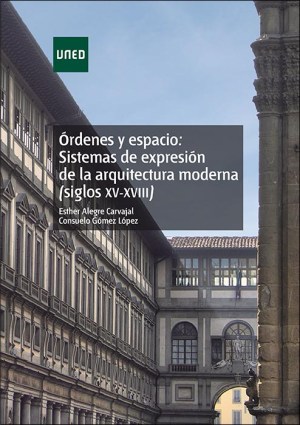 Un recorrido por la arquitectura y el urbanismo europeos de la Edad Moderna nos muestra un lenguaje arquitectónico vinculado al Clasicismo, que con la articulación de los órdenes clásicos, sus normas y sus proporciones crea espacios arquitectónicos y urbanos para los usos culturales, ideológicos y políticos del momento. Con este encuadre es necesario centrarse en el estudio del lenguaje de los órdenes arquitectónicos y los debates teóricos que surgieron durante los siglos XV al XVIII; el proceso de configuración formal y simbólico del espacio arquitectónico y su interpretación historiográfica; la creación de tipologías arquitectónicas, la relación entre el edificio y su espacio urbano; cómo influyeron las fuentes impresas y su circulación en la configuración de tipologías y modelos espaciales, o la recepción y aplicación que tuvo el Clasicismo como un sistema arquitectónico válido en los diferentes territorios europeos.
Lecture | Satish Padiyar on Fragonard, Temporality, and Suprises
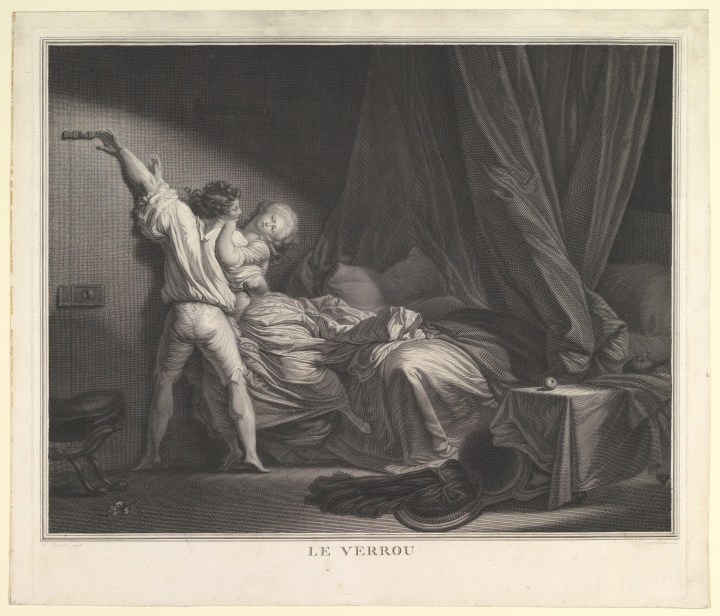
Maurice Blot, after Jean Honoré Fragonard, Le Verrou (The Bolt, or The Lock), etching, second state, sheet: 41.8 × 49 cm, image: 36.8 × 45 cm (New York: The Metropolitan Museum of Art, The Elisha Whittelsey Collection, The Elisha Whittelsey Fund, 1974.652). Fragonard’s painting is in The Louvre.
◊ ◊ ◊ ◊ ◊
Satish Padiyar, Surprises: Fragonard and Temporality
The Institute of Fine Arts, New York University, 21 April 2016
Arguably, Jean-Honoré Fragonard (1732–1806) was a painter at odds with late-eighteenth-century bourgeois notions of progressive time and the Enlightenment concept of historical and material progress. In this talk, Satish Padiyar asks how Fragonard marks time and what is the time and the timing of his quasi-expressionist marks.
In an oeuvre eminently about love, it is the particular moment of ‘surprise’ that Fragonard obsessively returns to: a moment of temporal suspense in which the human subject is taken by storm and which resurrects a quasi-infantile sense of un-control and openness to the unexpected. Through the “spontaneous gesture” (Winnicott), Fragonard seeks to throw the subject outside the received norms of time and social courtesies. The surprise attack characterizes both his technical audacity and his psychology of love, corporeal attraction and violence. Thursday, 21 April 2016, 6:00pm, Institute of Fine Arts, Lecture Hall, New York University, 1 East 78th Street.
Satish Padiyar is a Visiting Scholar at the Institute of Fine Arts and Senior Lecturer in Nineteenth-Century European Art at The Courtauld Institute of Art.
RSVP here»
The lecture is scheduled to be live-streamed.
Exhibition | Freemasonry
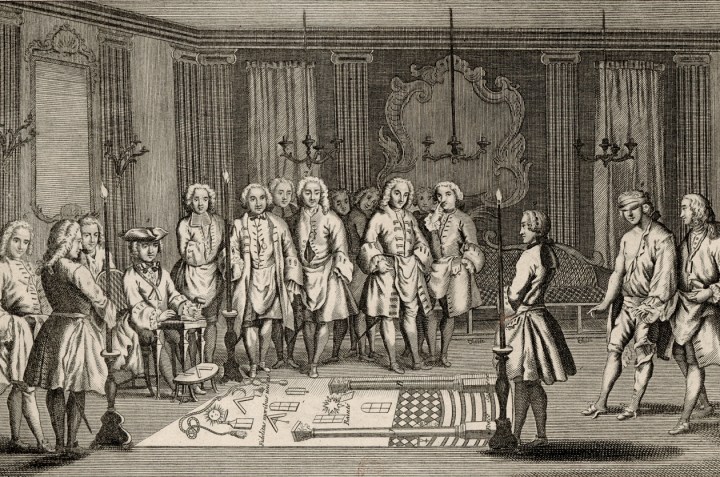
Assemblée de Francs-Maçons pour la réception des Maîtres, 1745
◊ ◊ ◊ ◊ ◊
Now on view at the BnF:
Freemasonry
Bibliothèque Nationale de France, Paris, 12 April — 24 July 2016
Curated by Pierre Mollier, Sylvie Bourel, and Laurent Portes
The Bibliothèque nationale de France, which houses one of the most important Masonic collections in the world, organizes a major exhibition dedicated to French freemasonry, in partnership with the Musée de la franc-maçonnerie. Over 450 pieces are presented, some of them for the first time ever. Some of these pieces belong either to the library’s collections or to major French obediences. Others were exceptionally lent by foreign owners. The exhibition focuses on the following issues: the origins of freemasonry, how it was founded in France, its symbols and rituals, its involvement in the political, religious, artistic and philosophical fields, the variety of associated legends… Its aim is to present freemasonry as an accessible issue.
The exhibition website is available here»
◊ ◊ ◊ ◊ ◊
Pierre Mollier, Sylvie Bourel, et Laurent Portes, La franc-maçonnerie (Paris: Bibliothèque Nationale de France, 2016), 344 pages, ISBN: 978-2717726992, 45€.
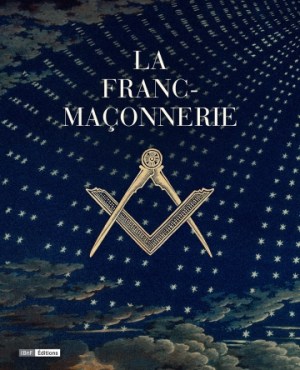 À partir du XVIIIe siècle, la franc-maçonnerie s’implante aussi profondément que durablement dans la société française. Si, de nos jours, celle-ci fait régulièrement la une des journaux, elle n’en demeure pas moins mal connue—quand elle ne nourrit pas encore d’obscurs soupçons de trafic d’influence, de complot ou d’occultisme. Publié à l’occasion de l’exposition d’une envergure sans précédent que la Bibliothèque nationale de France consacre à la franc‑maçonnerie, cet ouvrage est appelé à devenir l’une des références incontournables du domaine. Réunissant les contributions des plus grands spécialistes, il répond à la légitime curiosité dont la maçonnerie fait l’objet.
Des origines légendaires à la franc-maçonnerie moderne, dite spéculative, il retrace l’histoire de la franc-maçonnerie en faisant la part du fantasme et de la réalité. Il présente le corpus symbolique et les rites maçonniques associés à la notion, ici centrale, d’initiation. Excluant tout esprit polémique, il répertorie les réalisations politiques et sociétales de l’histoire moderne qui puisent leurs sources dans l’engagement philanthropique des maçons : les lois sur la liberté de la presse, la liberté d’association, la laïcité, l’école gratuite et obligatoire ou encore les premières bases de la protection sociale. Il relève également les inspirations maçonniques variées qui, depuis trois siècles, irriguent les arts et les lettres, de La Flûte enchantée de Mozart à Léon Tolstoï ou Rudyard Kipling, en passant, aujourd’hui, par la bande dessinée ou le roman policier. Riche par la diversité des thèmes abordés, cet ouvrage l’est enfin par son iconographie. La Bibliothèque nationale de France abrite l’un des plus importants dépôts de documents maçonniques au monde : manuscrits, estampes, livres rares y sont à la fois nombreux et d’une qualité remarquable. Ces collections exceptionnelles méritaient d’être connues et admirées au-delà du monde des chercheurs et des spécialistes ; reproduites ici, parfois pour la toute première fois, elles contribueront désormais, de manière aussi spectaculaire que documentée, à la meilleure compréhension d’une société dont les adeptes eux-mêmes reconnaissent la complexité.
Cet ouvrage est publié à l’occasion de l’exposition «La franc-maçonnerie», organisée par la Bibliothèque nationale de France et présentée sur le site François-Mitterrand, du 12 avril au 24 juillet 2016.










 Enfilade
leave a comment