Aaron Wile Awarded the 2015–16 James Clifford Prize

Jean-Antoine Watteau, Le rendez-vous de chasse, ca. 1717–18, oil on canvas, 124.5 × 189 cm
(London: The Wallace Collection)
◊ ◊ ◊ ◊ ◊
As noted at CAA News (15 March 2016) . . .
Aaron M. Wile is the winner of the 2015–16 James L. Clifford Prize. The prize is awarded annually by the American Society for Eighteenth-Century Studies to the author of the best article regarding any aspect of eighteenth-century culture. Receiving the award is Wile’s “Watteau, Reverie, and Selfhood,” published by College Art Association in The Art Bulletin.
The Clifford Fund was originally established to support an annual prize in honor of James L. Clifford. Clifford founded The Johnsonian News Letter in 1940, was Secretary to the English Institute, twice a Guggenheim Fellow, a Fellow of the Royal Society of Literature, and third President of the American Society for Eighteenth-Century Studies. During his long and energetic life, he produced numerous books, articles, bibliographies, essays, edited collections, editions and, of course, the much beloved, imitated, and quoted Johnsonian News Letter. Accordingly, the Clifford Prize is awarded to the author of the best article on an eighteenth-century subject, interesting to any eighteenth-century specialist, regardless of discipline.
The American Society for Eighteenth-Century Studies is a non-profit, educational group founded to promote the study of all aspects of the eighteenth century. It sponsors conferences, awards, fellowships and prizes, and publishes Eighteenth-Century Studies and Studies in Eighteenth-Century Culture. Requests for information about the Clifford Prize and nominations may be addressed to: asecs@wfu.edu.
Aaron M. Wile, “Watteau, Reverie, and Selfhood,” The Art Bulletin 96 (September 2014): 319–37.
Watteau’s fêtes galantes break with key aspects of academic art theory in early eighteenth-century France—particularly as put forward by Roger de Piles—to elicit an experience of reverie in the spectator. Watteau’s formal innovations inaugurated a new relationship between painting and beholder that opened up a new sphere of subjective experience, linking the artist’s enterprise with the rise of modern interiority.
The article is available free to everyone through the Taylor & Francis website, until 30 June 2016.
New Book | Elegantiores statuae antiquae: Parole e immagini
From Artbooks.com:
Leonarda Di Cosmo and Lorenzo Fatticcioni, Elegantiores statuae antiquae: Parole e immagini per una fruizione ‘turistica’ dell’Antico nella Roma del Settecento (Rome: Bentivoglio, 2016), 350 pages, ISBN: 978-8898158553, 40€ / $70.
 Legato al genere degli ‘atlanti’ statuari, il volumetto Elegantiores statuae antiquae in variis romanorum palatiis asservatae di Dominique Magnan (1731–1796), offrendo una selezione aggiornata delle più apprezzate statue antiche, si connota come uno dei numerosi canali di divulgazione della cultura antiquaria operativi nel secondo Settecento. Organizzando il testo secondo strategie comunicative mutuate dalle più aggiornate ‘guide di Roma’ e coniugando nell’apparato iconografico le immagini di consolidate e nuovissime eccellenze statuarie, Magnan realizza un prodotto editoriale nuovo e di sicuro impatto commerciale. Configurate dunque come un’antologia del ‘più bello’ delle collezioni romane di antichità e quasi anticipando le rubriche ‘da non perdere’ o ‘vale il viaggio’ delle guide turistiche a noi contemporanee, le Elegantiores si proponevano come un agile prontuario che poteva essere acquistato ad accompagnamento di altri prodotti dell’ ‘industria’ culturale basata sull’Antico.
Leonarda Di Cosmo e Lorenzo Fatticcioni, studiosi di Storia dell’Archeologia Classica, svolgono la loro attività di ricerca presso la Scuola Normale Superiore di Pisa. Si occupano in particolare di antiquaria e di ‘fortuna dell’Antico’, di Storia del Collezionismo e, in parallelo, di Metodologie Informatiche applicate ai Beni Culturali. In quest’ultimo settore si dedicano alla progettazione di banche dati per la gestione di fonti storico-artistiche e documentarie e di siti web per la Museologia e la Comunicazione del Patrimonio Culturale. Hanno coordinato, tra l’altro, i progetti Monumenta Rariora. Metamorfosi dell’Antico, sulla fortuna della statuaria antica in età moderna e Arretinum Museum, sulla storia del collezionismo di antichità in territorio aretino. Tra le loro pubblicazioni più recenti si segnalano i volumi Le componenti del classicismo secentesco: Lo statuto della scultura antica e Le regole della bellezza: Saperi antiquari e teorie dell’arte nei ‘Segmenta nobilium signorum et statuarum’ di François Perrier.
At Sotheby’s | Voyage to Rome, A Distinguished Italian Collection, Part II
Next month at Sotheby’s Paris:
Voyage à Rome: Collection particulière italienne, IIème partie (Sale #PF1640)
Sotheby’s, Paris 4 May 2016
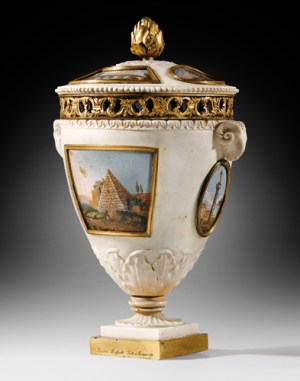
A gilt-bronze mounted white marble micromosaic vase with cover signed by Giacomo Raffaelli and dated 1777.
Following Sotheby’s New York’s 28 January auction The Road to Rome, the first installment in an artistic journey to the Eternal City seen through the eyes and paintbrushes of the great Italian painters of the late 18th century such as Vanvitelli, Anesi, Caffi and Van Lint, Voyage à Rome marks the second chapter in this recollection of the Grand Tour. This second catalogue continues the well-deserved tribute to an important Italian private collection, the spirit and taste of which was inspired by the classical revival. The sale, which will take place at Sotheby’s in Paris on 4 May, will bear witness to the tradition and continuity of the artistic and cultural quest that flourished in Rome at the end of the Enlightenment. It will also bring together a wonderful group of neo-classical objects created by the most famous artisans of the period, such as Valadier, Righetti, Raffaelli and Aguatti. The decorative arts have been collected with the same fervour and passion as the fine arts, just as they may well have been centuries earlier by the aesthetes and enthusiasts who roamed the provinces of Italy.
The light of the natural landscapes and beauty of the architectural decoration were taken up by the expertise and creativity of these artisans, who knew how to blend fine materials, precious stones, bronze and micro-mosaic while striving for perfection and driven by the quest for beauty. Among the most emblematic pieces in this collection of around 240 lots is a vase signed by the famous Italian micro-mosaicist, Giacomo Raffaelli (1753–1836), illustrating Rome’s most famous ancient sites; this valuable and refined object could not have failed to captivate enthusiasts on the Grand Tour. Also featured in this sale is a bust of the Spanish ambassador to Rome, José Nicolàs de Azara, sculpted in 1790 by Francesco Righetti (1738–1819). A pendant to that of Mengs, a leading exponent of neo-classicism and a friend of Azara, the work summarises what Rome promoted in the way of intellectual exchange, virtuosity and artistic effervescence.
The section dedicated to Old Master Paintings marvellously illustrates the poetry of the Roman campagna and the gentle quality of the Italian light when painted by vedutisti such as Paolo Anesi, Jacob de Heusch, and Hendrick Franz van Lint. Beautifully crafted and in excellent condition, this collection has clearly been assembled by someone passionate about painting.
New Book | The Mansion House, Dublin
Published by Four Courts Press:
Mary Clark, ed., The Mansion House, Dublin: 300 Years of History and Hospitality (Dublin: Four Courts Press, 2015), 180 pages, ISBN: 978-1907002199, €25 / $65.
 Dublin’s Mansion House is the only mayoral residence in Ireland and is older than any surviving in Great Britain. Originally the town house of merchant and property developer Joshua Dawson, it was purchased by the Dublin City Assembly in April 1715 and since then has been the home of each lord mayor during their term of office. This is the first major work on the Mansion House and includes essays on its history, architecture, and antique furnishings, along with an account of one year in the residence, which gives a vivid picture of how the building is used.
Mary Clark is the Dublin City Archivist and is curator of the Dublin Civic Portrait Collection. Fanchea Gibson is the Administrator of the Mansion House and oversees the day-to-day running of the mayoral residence. Nicola Matthews is architectural Conservation Officer with Dublin City Council and her research interests include the historic fabric of Merrion Square. Susan Roundtree was Senior Executive Architect with Dublin City Council and was responsible for the care and conservation of the Mansion House. Patricia Wrafter is Senior Executive Council and is responsible for the historic furnishings of the Mansion House.
Introducing the 2016 Spring Intern, Caitlin Smits
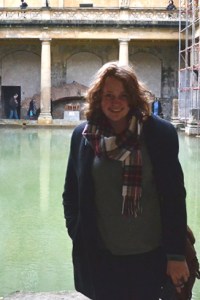 Anyone paying particularly close attention to postings here at Enfilade over the past few months (really since the end of last year) will have noticed that many of them—often the most interesting and lively ones—have come from ‘InternCS’. I’m delighted here to give Caitlin Smits, one of my own students, her due with this posting. It’s been especially enjoyable to work with Caitlin over the past several years. She went to London as part of my January 2014 interim, and she’ll also be part of my upcoming May course based in Stockholm and Copenhagen (all 16 of us are counting the days). Her art historical interests are wide-ranging, her instincts are spot-on, and she’s perhaps the most effective administrator I’ve ever encountered in an undergraduate. Yes, she’s also keenly intelligent and witty, to boot. Thanks, Caitlin, for all the terrific work.
—Craig Hanson
David Pullins on Painting, Decoration, and Porcelain at The Frick
Upcoming talks at The Frick:
David Pullins, Shared Practices: Painting and Decoration in Eighteenth-Century France
The Frick Collection, New York, 20 April 2016
Motifs after François Boucher and other leading painters populate the surface of Sèvres porcelain, including pieces in The Frick Collection. David Pullins considers what it was about academic painters’ training and working methods that encouraged the adaptation of their motifs from canvas to porcelain, textiles, and other media. Wednesday, 20 April, 6pm, in the Music Room. Free, though seating is on a first-come, first-served basis; a live webcast will also be available.
David Pullins, The French Dialogue with Chinese Porcelain
The Frick Collection, New York, 21 April 2016
Focusing on examples from The Frick’s permanent collection, learn how France became familiar with Chinese culture through its porcelain, which traveled around the globe during the seventeenth and eighteenth centuries. We will also ask how a foreign material was repackaged into a symbol of French cultural identity, one that was considered a necessary part of Gilded Age collections. Thursday, 21 April, 5:30pm. Advance registration is required; courses are free with a $25 student membership or a full membership for recent graduates.
New Book | Frederick de Wit and the First Concise Reference Atlas
From Brill:
George Carhart, Frederick de Wit and the First Concise Reference Atlas (Leiden: Brill, 2016), 600 pages, ISBN: 978-9004299030, 125€ / $162.
 This book is about the life and work of Frederick de Wit (1629–1706), one of the most famous dealers of maps, prints and art during the Dutch Golden Age, and his contribution to the dissemination of the knowledge of cartography. The Amsterdam firm of Frederick de Wit operated under the name ‘De Witte Pascaert’ (‘The White Chart’) from 1654 to 1710. It offered all kinds of printing and was one of the most successful publishers of maps and prints in the second half of the seventeenth century. The description of De Wit’s life and work is followed by an in-depth analysis and dating of the atlases and maps issued under his name.
After a career in yacht, boat, and historic building restoration and a stint in the army, George Carhart began his second career in academia with a BA in history from the University of Southern Maine. The history of cartography has been a central point of his interests. After receiving his BA in 1998 he joined the staff at the Osher Map Library and Smith Center for Cartographic Education, working there as the assistant curator. After leaving the Osher Map Library in 2006 to complete his doctoral work, he has continued to research, publish, and teach in the field of cartographic history. Since receiving his PhD from the University of Passau in 2011, he has worked on projects at several universities including Dresden University of Technology and Trinity College Dublin.
C O N T E N T S
Acknowledgments
Introduction
1 Frederick de Wit’s Biography and His Business
2 The First Modern World Atlas
3 Frederick de Wit’s New Concise Reference Atlas
4 Today’s Bibliographic Methods Collide with Printing and Publishing Methods of the Early Modern World, 1577–1800
5 Dating De Wit’s Maps and Atlases
6 De Wit’s Legacy
7 The Cartographic Origins of De Wit’s Maps
8 Conclusion
Overview of the atlases published by De Wit
Cartobibliography of maps in De Wit’s atlases
List of consulted libraries
Acknowledgement of the illustrations
A fully detailed table of contents is available here»
Conference | Transforming Topography
◊ ◊ ◊ ◊ ◊
From The Paul Mellon Centre:
Transforming Topography
The British Library, London, 6 May 2016
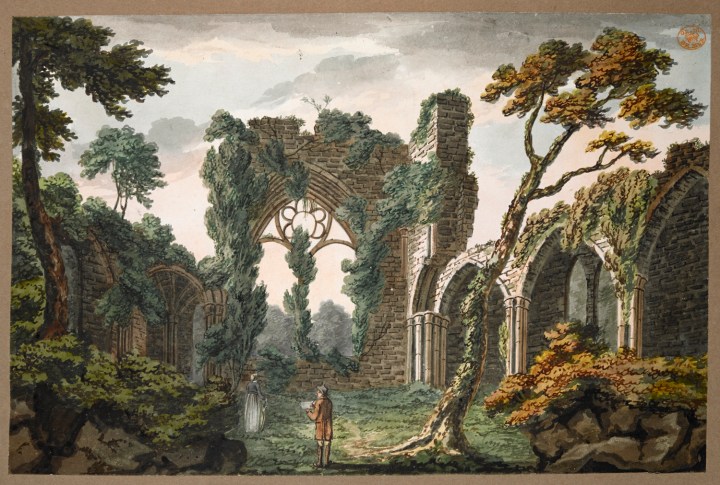
A conference, organised by The British Library and The Paul Mellon Centre, that promises to shed new light and fresh insights on the field of topography and on The British Library’s collection
Topography is an emerging and dynamic field in cultural and art historical scholarship. The British Library holds an extensive and extremely fine collection of place-related material including topographical views, travel diaries, and antiquarian texts, amassed by distinguished collectors such as Charles I and II, Hans Sloane, and not least George III. The Transforming Topography conference is one element of an on-going research project which aims to explore The British Library’s topographic collections in the light of current research. George III’s topographical collection—estimated at 40,000 maps and views—is currently being catalogued and digitised with a new web space due in 2017. With talks delivered by both established and emerging scholars, the day will end with a chaired panel discussion, addressing the matter of ‘topography now’ in art history, cultural geography, and other disciplines. Ticket prices: £20 (full price, adult), £16 (senior citizens), £14 (students).
P R O G R A M M E
9:30 Registration
10:00 Welcome by Kristian Jensen (Head of Collections and Curation, British Library)
10:05 Introduction by Mark Hallett (Director of Studies, Paul Mellon Centre for Studies in British Art) and Felicity Myrone (Lead Curator, Western Prints and Drawings, British Library)
10:15 Session One
Chaired by Finola O’Kane Crimmins (University College Dublin)
Daniel Maudlin (University of Plymouth), A Narrow View of Nature: The Natural World Experienced through Early Modern Itineraries, Travel Maps, and Inns
This paper will consider how the road-building boom of Georgian Britain and British America transformed actual and imaginative experiences of travel. Drawing on the Library’s collection of contemporary travel aids, it will address how travel was recast as a distinctly linear experience: how printed itineraries and route maps presented a modern world defined by mobility but which reduced nature to a strip, experienced through a succession of views from a carriage window.
Kelly Presutti (Massachusetts Institute of Technology), Louis Garneray and Topographical Painting as Border Control
Ports were one of the earliest sites depicted topographically in fine art; the practice was institutionalized in France in 1817 when Louis Garneray (1783–1857) was named official painter to the navy. His Vues des côtes de France in the British Library’s King’s Topographical Collection reveal how topography was deployed as an instrument of state formation and as a means to secure the nation at the site where it is most vulnerable—its borders. Garneray’s work was also widely disseminated in various formats, and in ways which transcended historical divisions between fine and decorative arts, such as a porcelain service produced at the state-sponsored Sèvres manufactory.
11.15 Coffee
11:45 Session Two
Chaired by John Bonehill (University of Glasgow)
Matthew Sangster (University of Birmingham), Accumulating London
How did the topographical series produced in the late eighteenth and early nineteenth centuries seek to encompass and explain the rapidly-expanding metropolis of London? During this period, advances in print technologies, growing audiences and the interventions of clever entrepreneurs led to an unprecedented burgeoning of city images. As a legacy of past productions piled up, authors, artists and publishers began to cater to different constituencies by offering increasingly specialised versions of London. This talk will consider the contrasting ways in which these works organised, selected from and represented the city by employing digital methods and historical plans to display the geographical and cultural patterns that they trace.
Jenny Gaschke (Bristol Museum and Art Gallery), ‘Available for Useful Purposes’: The Braikenridge Collection of Topographical Drawings in Bristol
The antiquarian collector George Weare Braikenridge (1775–1856) brought together vast numbers of objects relating to Bristol’s history and keenly collected and commissioned views of Bristol, its harbour and environs. The Braikenridge collection will be evaluated within the wider practice of antiquarianism, and will also be situated within the development of British landscape art during the first half of the nineteenth century. Can the Braikenridge collection also shed light on how ‘topography’ is defined in the museum and art gallery, via collecting policies, storage, access, display, interpretation and research?
12.45 Lunch
13:45 Session Three
Chaired by Martin Postle (Paul Mellon Centre for Studies in British Art)
Mikael Ahlund (Museum Gustavianum, Uppsala University Museum), Topography, Iron-Making, and National Identity: A British–Swedish Comparison
This paper addresses the role British topography played in Scandinavia, paying particular attention to the output of two Swedish artists: Elias (1739–1818) and Johan Fredrik Martin (1755–1816). The brothers worked in London producing topographical images of the British countryside, and moved in the same circles as Paul Sandby. When they returned to Sweden in 1780 they emerged as the country’s leading topographical artists. With recourse to contemporary travel writing, this paper will attempt to identify themes in the brothers’ topographical imagery—themes connected to contemporary debates about national identity, economics, and social order.
Amy Concannon (University of Nottingham / Tate Britain), A Place for the ‘Full Exercise of the Intellectual Powers of a Topographical Writer’: Lambeth’s Topographical Image, ca. 1800–50
With important antiquarian sites like Lambeth Palace and places of popular entertainment like Vauxhall Gardens, the London parish of Lambeth was a rich resource for topographical artists and writers at the turn of the nineteenth century. It was also a landscape in flux: a traditional ‘rural retreat’ on the Surrey side of the Thames undergoing rapid urbanisation. With a particular focus on the work of Lambeth-born topographer Edmund Wedlake Brayley (1773–1854), how did contemporary producers of topographical material—both visual and textual—negotiate the changing landscape of Lambeth?
Lucy Hodgetts (University of York), Topography and Graphic Caricature in Dagaty’s and Rowlandson’s Six Views of Different Entrances to London (1797–98)
From 1797 Rudolph Ackermann published six views of entrances to London after drawings by Rowlandson and Dagaty. They were sold at his Strand gallery, the Repository of Arts. This paper will analyse the social identities of the human figures in the views, their mobility, and how metropolitan topographical settings were employed by artists and writers to comment on contemporary social anxieties. It will also reveal the possible political agendas of a generic cross-over between topography and graphic caricature in visualising politically unstable subjects.
15:15 Tea
15:45 Round Table Discussion: Topography Now
Chaired by Mark Hallett (Paul Mellon Centre for Studies in British Art)
Position papers and discussion with Jane Roberts (formerly Royal Collection, Windsor Castle), Stephen Daniels (University of Nottingham), John Barrell (Queen Mary, University of London), and Stephen Bann (University of Bristol)
17:00 Conclusion
Call for Papers | Entertaining the Georgian City
2016 Fairfax House Georgian Studies Symposium
Polite and Impolite Pleasures: Entertaining the Georgian City
Fairfax House, York, 21 October 2016
Proposals due by 29 July 2016
The Georgian era saw a great increase in the variety of entertainments available to an expanding and urbanising population, and it was in towns and cities that eighteenth-century cultures of recreation and leisure, both ‘high’ and ‘low’, were most developed. From theatrical performances and musical recitals, assemblies and dances, to race meetings, boxing matches, cock fights and hangings, Georgian urban life offered a dazzling and constantly changing kaleidoscope of polite and impolite pleasures.
In Georgian cities the lowest and the highest forms of entertainment were catered for along with everything in between, from the cultivated recreations of the nobility through the gentility of middle-class leisure to the earthier enjoyments of the ‘common folk’. New cultures of entertainment reflected changing patterns of work, mobility and social relations, and reflected developments in class, gender and the dynamics of personal and collective identity. The urban environment itself was affected by these changing cultures of entertainment. From London to provincial centres, industrial cities to market towns, new promenades, parks, streets and squares were developed, new theatres, assembly rooms and concert halls were built and embellished. And paralleling this brightly-lit and orderly world of polite pleasure was another, darker urban realm of more dubious diversions: prostitution and prize fights, the gambling stew and the drinking den.
This symposium, the fourth Fairfax House Symposium in Georgian Studies, aims to explore the theme of entertainment with particular reference to the concept of ‘polite and impolite pleasures’ in an urban context during the long eighteenth century (c.1680–c.1830). Contributions in the form of papers not exceeding 20 minutes in length are invited addressing relevant topics which may include, but are certainly not limited to:
• The city as a focus for polite and impolite entertainments
• Entertainment shaped by, and a shaper of, the Georgian city
• Urban/rural interaction in Georgian entertainments
• High and low in eighteenth-century urban entertainments
• Selling entertainments: publicity, advertising, industries of pleasure
• Questions of class, gender and identity in entertainment
• Entertainments: spectators and spectacle
• Policing pleasure in the city
Please send proposals of around 200 words, accompanied by a brief one-paragraph biography, to fairfaxhousesymposium@gmail.com by Friday 29 July 2016.
Heather McPherson Awarded the 2016 Annibel Jenkins Prize
Heather McPherson is the 2016 recipient of the Annibel Jenkins Prize presented annually by the Southeastern American Society for Eighteenth-Century Studies for the best essay in performance and theatre studies, for her article “Tragic Pallor and Siddons,” published in Eighteenth-Century Studies 48 (Summer 2015): 479–502.
The committee’s remarks highlight the range of topics addressed, “topics as disparate as cosmetics’ association with misogyny, authenticity, Aristotle, Lady Macbeth, and the ‘tubercular look’.” The citation goes on to state that, “the essay provides us with a window into Siddons’s celebrity and the attributes that led her contemporaries to recognize her as the greatest tragic actor of her day. ‘Tragic Pallor and Siddons’ combines … close attention to textual detail, an immersion in the documented history of the period, and clear and lucid writing enhanced by judicious illustrations.”










 Enfilade
leave a comment