Call for Papers | Nomadic Objects: Material Circulations
From the conference website:
Nomadic Objects: Material Circulations, Appropriations, and the
Formation of Identities in the Early Modern Period, 1500–1800
Paris, 2–4 March 2017
Proposals are due by 15 September 2015

Domenico Remps, Trompe-l’oeil with an Open Cabinet (Cabinet of Curiosities), ca. 1690s (Florence: Museo dell’Opificio delle Pietre Dure)
This interdisciplinary conference, organized in partnership with two museums of the Paris region, the Musée National de la Renaissance in Écouen and the Musée Cognacq-Jay in Paris, seeks to confront the material history of early modern objects with their artistic and literary representations. It proposes to look at the various ‘traces’ left by material culture as it circulated and was appropriated. Studying the history of material culture (be it dress and personal accessories, everyday and decorative objects, art works, and technical, scientific, or musical instruments…) sheds light upon the various processes of cultural appropriation, transculturation or hybridization that accompanied such material circulations across Europe or between Europe and the rest of the world. Material objects, whether commodities, tools, devotional objects or works of art, can all be considered as bearers or vehicles of cultural identities. By travelling across space they call into question national, religious and linguistic boundaries. The early modern period (1500–1800) corresponds to a period when national identities became more firmly entrenched in Europe with the definition of clearer national territories, languages and religious traditions. The establishment of such boundaries resulted from the development of a new political philosophy, born in part in reaction to Renaissance court culture and its intrinsic nomadism (A. M. Thiesse, La Création des identités nationales, 1999). Following the trajectories of objects as they crossed these boundaries brings into focus the tension between sedentariness and nomadism that Daniel Roche identified as a key element in the advent of modernity (Humeurs vagabondes, 2003).
In addition to the tight network of material circulations within Europe linked to trade, diplomatic exchanges, aristocratic modes of life or religious exile at a time defined by intense religious and political strife, more complex trajectories yet are to be traced. In the context of proto-globalization and of the rise of international trading companies, goods often followed global paths, coming from distant locations and transiting through a number of countries or cultural spaces before reaching their destinations. Because these objects found their way into artistic and literary representations, they also generated in turn less material forms of circulation, posing the question of multi-layered processes of appropriation.
We are seeking proposals that address such processes of circulation and appropriation by looking at the reception of these objects in literature and the arts or at their production and consumption, and the craftsmanship, techniques or practices thereby implied. Suggested topics include, but are not limited to
• Legal and illegal networks for the circulation of objects and goods, whether through trade, smuggling or personal relationships
• Diplomatic gifts and exchanges
• Travelling objects in court culture
• Objects in exile and objects of the exiles
• The transmission of craftsmanship and technologies and its links to human migrations
• Decorative, artistic and literary motifs, and their circulations from one country to another
• The meaning and implications of literary and artistic appropriations of objects
• Processes of linguistic appropriation and cross-fertilization linked to the circulation of objects
• The notion of proto-globalization and its economic, social, material, cultural and artistic manifestations
We hope that this conference will bring into play a variety of methodologies and foster a fruitful dialogue between different disciplines (history, material culture, history of technologies, art history, European languages and literatures, anthropology, archaeology…). Outreach activities, such as workshops and round-tables open to the general public, will also be included in the program. We welcome proposals from established scholars, doctoral students, curators and other professionals working on or with early modern objects. We particularly encourage proposals discussing objects in the collections of the Musée de la Renaissance or the Musée Cognacq-Jay. 300-word proposals, along with a brief CV (1 page maximum), should be sent by September 15, 2016 to the conference organizers at objetsnomades2017@gmail.com.
Professor Giorgio Riello (University of Warwick) will be one of the keynote speakers.
Conference Organizers: Line Cottegnies (Sorbonne Nouvelle – Paris3); Anne-Valérie Dulac (Paris 13); Ariane Fennetaux (Paris Diderot – Paris 7); Anne-Marie Miller-Blaise (Sorbonne Nouvelle – Paris 3); Nancy Oddo (Sorbonne Nouvelle – Paris 3); Sandrine Parageau (Paris Ouest Nanterre La Défense); Laetitia Sansonetti (Paris Ouest Nanterre La Défense); Jean-Paul Sermain (Sorbonne Nouvelle – Paris 3)
Scientific Committee: Muriel Barbier (Conservateur du patrimoine, Musée d’Ecouen) ; Pascale Gorguet-Ballesteros (Conservateur du patrimoine, Palais Galliera) ; Isabelle Bour (Université Paris 3) ; Marie-Madeleine Fragonard (Professeur émérite, Université Sorbonne Nouvelle – Paris 3) ; Rose-Marie Herda-Mousseaux (Conservatrice du Patrimoine, Musée Cognacq-Jay) ; Beverly Lemire (University of Alberta) ; Angela McShane (Victoria & Albert Museum) ; Lesley Miller (Victoria & Albert Museum), Alain Montandon (Université Blaise Pascal – Clermont II) ; Ladan Niayesh (Université Paris Diderot – Paris 7) ; Isabelle Paresys (Université Lille 3) ; Joad Raymond (Queen Mary University of London) ; Helen Smith (Centre for Renaissance and Early Modern Studies University of York) ; Chantal Schütz (École Polytechnique).
PhD Studentship | Hans Sloane’s Books: An Early Enlightenment Library
From H-ArtHist:
AHRC Collaborative Doctoral Partnership
Hans Sloane’s Books: An Early Enlightenment Library and Its Material Relationships
London, 3 October 2016 — 30 September 2019
Applications due by 6 July 2016
Queen Mary University of London and the British Library intend to make a PhD studentship appointment under the AHRC Collaborative Doctoral Partnership scheme (CDP) from autumn 2016.
The project will investigate the intellectual significance of the library of Sir Hans Sloane (1660–1753) to the gathering and dissemination of medical and scientific knowledge in the Enlightenment period. It will focus on Sloane’s library (now housed within the British Library) in relation to his wider collection of natural and artificial specimens, now divided between the Natural History and British Museums. The research will be co-supervised by the British Library and Queen Mary. The project offers privileged access to Sloane’s books at shelf as well as extensive curatorial support in their study and interpretation, in addition to the standard academic doctoral training and supervision.
The project is open to either full-time or part-time students. Studentships are awarded for 3 years (or part-time equivalent) initially, at RCUK rates and subject to standard eligibility criteria for RCUK training grants. Additional Student Development Funding is available to allow time for further training and skills development opportunities that are agreed as part of the PhD programme. If required, this may be used to extend the studentship by up to six months (or part-time equivalent). The British Library also offers the student generous research expenses funding, specialist training, and access to work-space within its curatorial offices.
Application guidelines and a detailed description of the project are available here. Candidates with interests in bibliography, book history, the material book, the history of science and medicine, early-modern scientific literary writing, exchange networks, and the history of collections will be especially welcome. Once recruited, the successful PhD candidate will contribute to the development of the final agreed research topic. Potential candidates are welcome to contact Professor Claire Preston (Queen Mary – c.preston@qmul.ac.uk) and Dr Karen Limper-Herz (the British Library – Karen.limper-herz@bl.uk) for further details.
Exhibition | Out of Their Heads: Building Portraits of Scottish Architects
Press release, via Art Daily:
Out of Their Heads: Building Portraits of Scottish Architects
Scottish National Portrait Gallery, Edinburgh, 11 June 2016 — 5 February 2017
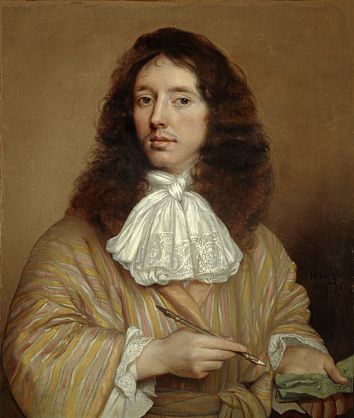
John Michael Wright, Portrait of Sir William Bruce, ca. 1664 (Edinburgh: National Galleries of Scotland, purchased 1919; photo by Antonia Reeve)
Some of Scotland’s most stunning buildings and the achievements of the country’s most distinguished architects are being celebrated this summer at the Scottish National Portrait Gallery in an innovatively-presented exhibition that explores the key figures who have helped to shape Scotland’s world-renowned architectural heritage. Out of Their Heads: Building Portraits of Scottish Architects, organised by the Royal Incorporation of Architects in Scotland (RIAS) and the Scottish National Portrait Gallery and supported by the Scottish Futures Trust, is a headline event of the year-long Festival of Architecture 2016 and the Year of Innovation, Architecture and Design. It features a series of 12 special constructions, based upon the profiles of key buildings, drawn by Edinburgh artist Ian Stuart Campbell Hon FRIAS. On each has been installed a portrait of an architect—paintings, photographs, drawings and busts are drawn from the collections of the SNPG and RIAS.
Internationally recognised names, such as Charles Rennie Mackintosh (1868–1928) and Robert Adam (1728–1792) feature. The exhibition also introduces some architects perhaps less familiar but whose buildings are very well known, such as Jack Coia (1898–1981) and Sir Robert Matthew (1906–1975). Coia was responsible for many of Scotland’s finest Roman Catholic churches, while Matthew’s practice was behind buildings including London’s Royal Festival Hall and the Royal Commonwealth Pool, Edinburgh.
Scotland has produced an impressive array of architect pioneers. The dozen selected architects in Out of Their Heads span a range of styles and a long chronology, beginning with Sir William Bruce (about 1625–1710, depicted in a vivid portrait by John Michael Wright), who almost single-handedly introduced neo-classicism to Scottish architecture in the 17th century, and culminating with the late Kathryn Findlay (1954–2014), former Associate Professor of Architecture at Tokyo University and avant-garde architect of the surrealist, Salvador Dalí-inspired, Soft and Hairy House (1994) in Tsukuba, Japan.
Kathryn Findlay forged a strong career in Japan, producing neo-expressionistic homes alongside her husband Eisaku Ushida (b. 1954). In 2012, Findlay collaborated with the artist Anish Kapoor, on the striking ArcelorMittal Orbit tower in the London’s Olympic Park. Two years later, Findlay was awarded the prestigious Jane Drew prize by the Architects Journal for her “outstanding contribution to the status of women in architecture,” tragically announced on the same day as she passed away.
Other architects featured include Sir Basil Spence (1907–1976), designer of Glasgow University’s Natural Philosophy building—on display is a photograph of Spence by the renowned photojournalist Lida Moser; James Craig (1739–1795), responsible for the lay-out of Edinburgh’s New Town, and Sir Robert Lorimer (1864–1929), creator of the magnificent Scottish National War Memorial at Edinburgh Castle.
Margaret Brodie (1907–1997) was site architect for much of the building of the Glasgow Empire Exhibition of 1938 and was the first female student to graduate from the Glasgow School of Architecture with First Class Honours.
Also represented is Sir Robert Rowand Anderson (1834–1921), the architect responsible for the red-sandstone Gothic Scottish National Portrait Gallery and the founder in 1916 of the Royal Incorporation of Architects in Scotland (RIAS).
One of Scotland’s leading Victorian architects, Anderson enjoyed an outstanding architectural career, with the highlight being the Portrait Gallery. The Gallery was completed in 1890, the first specially built portrait gallery in the world. Among his many other commissions were the Dome of Old College, The Faculty of Medicine and McEwan Hall at Edinburgh University, the Catholic Apostolic Church in Edinburgh, Glasgow Central Station Hotel and Mount Stuart House on the Isle of Bute. Anderson also restored many churches, cathedrals and abbeys, namely Dunblane Cathedral and Paisley Abbey.
Also featured is the great Modernist Peter Womersley (1923–1993), who lived in the Scottish Borders but also worked in Singapore.
As Scotland’s most famous architect and a massively influential figure worldwide, Charles Rennie Mackintosh secured his international reputation upon completion of the stunning Glasgow School of Art in 1909. In the exhibition, he is wonderfully captured in a very personal portrait by his friend and patron Francis Newbery, the Head of Glasgow School of Art.
This year, Scotland’s achievements in innovation, architecture and design will be showcased across the globe through a range of events and activity. The Festival of Architecture 2016 is a key to this exciting year-long celebration with hundreds of events across the length and breadth of the country.
To also mark the Festival of Architecture 2016 and running alongside Out of Their Heads, a series of celebrity photographic portraits have been commissioned by the RIAS from Broad Daylight (Tricia Malley and Ross Gillespie), to showcase and document the world class architecture of Scotland. Each portrait features a celebrity along with a commentary on their favourite Scottish building.
Christopher Baker, Director of the Scottish National Portrait Gallery, said: “The variety and outstanding quality of Scotland’s architecture is a key element of its distinctive culture and international profile. This exhibition celebrates the extraordinary achievements of Scottish architects, ranging from the brilliant seventeenth-century innovator Sir William Bruce to great contemporary figures, such as Kathryn Findlay. It seems fitting that their work should be highlighted within one of Edinburgh’s finest buildings—Sir Robert Rowand Anderson’s spectacular Scottish National Portrait Gallery. We are immensely grateful to the RIAS and Scottish Futures Trust for supporting the project so generously.”
Olivier Meslay Named Next Director of the Clark Art Institute
Press release (13 June 2016) from The Clark:
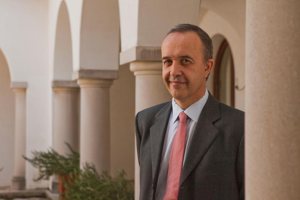 The Board of Trustees of The Clark Art Institute in Williamstown, Massachusetts has selected Olivier Meslay to serve as its Dena and Felda Hardymon Director. Meslay, an accomplished museum professional and noted scholar, will become The Clark’s fifth director when he assumes his new role on August 22. He currently serves as associate director of curatorial affairs, senior curator of European and American art, and The Barbara Thomas Lemmon Curator of European Art at the Dallas Museum of Art (DMA) and brings more than thirty-five years of international experience to his role. Meslay was unanimously elected to the position during a special session of The Clark’s board.
“We are thrilled to welcome Olivier Meslay as our new director,” said Andreas Halvorsen, chairman of the Institute’s Board of Trustees. “Olivier’s vision, international experience, and exceptional academic and curatorial qualifications match The Clark’s ambitious aspirations. He comes to the Clark with a deep appreciation for our academic mission, an expert understanding of our museum program, and an energetic perspective on ways to enhance our dual mission and extend The Clark’s reach and impact.”
Since assuming his current position in 2012, Meslay has overseen the DMA’s European and American art collection of more than 4,000 paintings, sculptures, and works on paper, and has managed the museum’s curatorial department, conservation program, and art research library. He has also served as the DMA’s curatorial representative with the French American Museum Exchange (FRAME), a collaborative organization of thirty American and French museums. Meslay served as the DMA’s interim director from 2011 to 2012, managing a staff of 250 employees, directing an extensive fundraising program, and coordinating donor relations that have provided continuing support for the museum. He joined the DMA staff in 2009 after a distinguished career at the Musée du Louvre in Paris.
“Olivier first came to know The Clark as a Fellow in our Research and Academic Program in 2000, and it was clear from the very beginning that he had a deep affinity for The Clark and for the unique relationship between our museum and research programs,” said Francis Oakley, The Clark’s interim director. “It is heartening to see such a long relationship culminate in this way. Olivier’s passion for The Clark and for Williamstown and the Berkshires, combined with his extraordinary scholarship and leadership, hold great promise for the future.”
Meslay is the author of the recent publication From Chanel to Reves: La Pausa and Its Collections at the Dallas Museum of Art (2015). He served as the co-organizing curator for Mind’s Eye: Masterworks on Paper from David to Cézanne (2014) and co-organized the exhibition Chagall: Beyond Color (2013) for the DMA. Meslay was the organizing curator of an exhibition commemorating the fiftieth anniversary of the assassination of President John F. Kennedy, Hotel Texas: An Art Exhibition for the President and Mrs. John F. Kennedy (2013). The exhibition brought together works of art installed in the presidential suite at Hotel Texas during Kennedy’s November 1963 trip to Dallas.
The European art collection at the DMA is recognized for the strength of its holdings of eighteenth-, nineteenth-, and twentieth-century paintings, sculpture, and works on paper. During his tenure, Meslay has been instrumental in leading the acquisition of several important works including paintings by Gustave Caillebotte, Ernest Ludwig Kirchner, Paul Signac, Ramon Casas, Guillaume Guillon Lethière, Antoine Giroust, and Edouard Vuillard, as well as sculptures by Anne Whitney and Auguste Préault.
Meslay held a variety of leadership positions at the Musée du Louvre over a period of seventeen years, from 1993 to 2009. He served as curator in charge of British, American, and Spanish paintings from 1993 to 2006; as chief curator of Louvre–Atlanta, a collaborative project with the High Museum, from 2003 to 2006; and as chief curator in charge of the Louvre–Lens project, the first regional branch of the Louvre. During his tenure at the Louvre, Meslay organized such exhibitions as William Hogarth (2006‒07), American Artists and the Louvre (2006), L’art anglais dans les collections de l’Institut (2004), Constable, Le choix de Lucian Freud (2002) and La collection de Sir Edmund Davis (1999). Meslay also served as a professor at the École du Louvre from 1997 to 2000 and from 2003 to 2006.
“The Clark Art Institute has always been, for me, a unique institution blending in perfect balance a refined, strong, and seductive museum; a forum shaping the present and the future of art history through its Research and Academic Program; and a teaching institution thanks to its unique partnership with the Williams College Graduate Program in the History of Art,” said Meslay. “Adding to all of this is the beauty of The Clark’s natural environment, which is undoubtedly integral to its identity. My longstanding relationship with The Clark now comes to fruition as if in a dream-come-true, but also as a great opportunity to maintain, at the highest level of excellence, what this institution brings to the art world.”
In 2009, the French government honored Meslay as a Chevalier des Arts et Lettres in recognition of his contributions to furthering French arts and culture throughout the world. A graduate of the Institut National du Patrimoine (1992–93), the French State School for Curators, Meslay received an MA from the École du Louvre in 1983, having previously received an MA from the Sorbonne in 1982, where he also earned his BA in 1981. He is a member of the editorial board of The British Art Journal, London, and is a member of the Société d’Histoire de l’Art Français, Paris.
Meslay is the author of several books, including Mind’s Eye: Masterworks on Paper from David to Cezanne (2014); Turner, Life and Landscape (2005); and J.M.W. Turner, The Man Who Set Painting on Fire (2005). He has published extensively on the Franco-British artistic relationship in both the United States and Europe, and has contributed essays to numerous exhibition catalogues.
Meslay’s wife, Laure de Margerie, is a noted scholar on French sculpture and was also a Clark Fellow in 2000–01. She spent most of her career at the Musée d’Orsay before becoming the founding director of the French Sculpture Census—a comprehensive survey of French sculpture in American public collections—in 2009. Meslay and de Margerie are the parents of three adult children.
Chosen after an international search conducted with the assistance of Korn Ferry, New York, Meslay replaces Michael Conforti, who retired from The Clark in August 2015.
Lin-Manuel Miranda’s ‘Hamilton’ Wins 11 Tony Awards

From left: Daveed Diggs, Okieriete Onaodowan, Christopher Jackson, Leslie Odom, Jr., Jasmine Cephas Jones, Renée Elise Goldsberry, Phillipa Soo, and Anthony Ramos. Photographed by Annie Leibovitz, Vogue (July 2015). Adam Green’s story for Vogue is available here»
◊ ◊ ◊ ◊ ◊
I’m at least a year overdue with this posting, but after Sunday evening’s Tony’s Awards, I feel compelled finally to note Lin-Manuel Miranda’s Hamilton. I’ve not yet seen it; so my comments can address only the place of the production within the media and popular culture, rather than the musical itself, but for anyone interested in how the eighteenth century continues to matter for the present, Hamilton is difficult to ignore (notes on the cast recording at Genius.com are extraordinary, as noted in April by Shea Stuart for ABO Public). That a Broadway production could save the first U.S. Treasury Secretary’s place on the $10 bill is itself pretty remarkable. Nominated for a record-setting sixteen Tony Awards, it won eleven (second only to the twelve awards that went to The Producers in 2001)—including Best Musical, Best Book of a Musical, Best Original Score, and Best Costume Design. A production opens in Chicago in September, followed by a pair of North American tours and a London production.

Lin-Manuel Miranda, photographed by Annie Leibovitz, Vogue, July 2015
Writing for The New Yorker (9 February 2015), Rebecca Mead recounts the origins of the project. In the spring of 2009, Miranda had been invited to perform at a White House event addressing “the American experience,” with general expectations that he would perform something from the Broadway musical In the Heights.
Miranda had something different in mind. A few months earlier, he and his girlfriend, Vanessa Nadal, who has since become his wife, had been on vacation in Mexico, and while bobbing in the pool on an inflatable lounger he started to read a book that he had bought on impulse: Ron Chernow’s eight-hundred-page biography of Alexander Hamilton. Miranda was seized by the story of Hamilton’s early life. Born out of wedlock, raised in poverty in St. Croix, abandoned by his father, and orphaned by his mother as a child, Hamilton transplanted himself as an adolescent to a New York City filled with revolutionary fervor. An eloquent and prolific writer, he was the author of two-thirds of the Federalist Papers; after serving as George Washington’s aide during the Revolutionary War, he became America’s first Treasury Secretary. Later, Hamilton achieved the dubious distinction of being at the center of the nation’s first political sex scandal, after an extramarital affair became public. He never again held office, and before reaching the age of fifty he was dead, killed in a duel by Aaron Burr, the Vice-President, after a personal dispute escalated beyond remediation.
Miranda saw Hamilton’s relentlessness, brilliance, linguistic dexterity, and self-destructive stubbornness through his own idiosyncratic lens. It was, he thought, a hip-hop story, an immigrant’s story. Hamilton reminded him of his father, Luis A. Miranda, Jr., who, as an ambitious youth in provincial Puerto Rico, had graduated from college before turning eighteen, then moved to New York to pursue graduate studies at NYU. Luis Miranda served as a special adviser on Hispanic affairs to Mayor Ed Koch; he then co-founded a political consulting company, the MirRam Group, advising Fernando Ferrer, among others. On summer breaks during high school, Lin-Manuel worked in his father’s office; later, he wrote jingles for the political ads of several MirRam clients, including Eliot Spitzer, in his 2006 gubernatorial bid. Chernow’s description of the contentious election season of 1800—the origin of modern political campaigning—resonated with Miranda’s understanding of the inner workings of politics. And the kinds of debate that Hamilton and his peers had about the purpose of government still took place, on MSNBC and Fox. . .
With another contentious election season raging—and rearing its particularly ugly head in the wake of the devastating news of Sunday’s shootings in Orlando—Hamilton’s success may be even more timely than anyone could have imagined. And like the production itself, Annie Leibovitz’s photographs for Vogue might serve as a reminder that the future always gets worked out through thoughtful, imaginative engagements with the past.
–Craig Hanson
Newly Redesigned Getty Research Portal Now Available

◊ ◊ ◊ ◊ ◊
The Getty Research Institute (GRI) is pleased to announce the launch of an updated version of its research tool, the Getty Research Portal. A virtual library of art history texts, the newly redesigned Getty Research Portal now offers more than 100,000 volumes available from more than 20 international partners.
Launched in 2012, and created in partnership with some of the world’s leading art libraries, the Getty Research Portal is a free online search gateway that aggregates the metadata of art history and cultural texts, with links to fully digitized copies that are free to download. There are no special requirements in order to use this resource and it is completely open to anyone with internet access.
“When we began this exceptional project we had eight founding institutions, all committed to sharing their digitized collections of rare books, foundational art historical literature, catalogues, periodicals, and other published resources with researchers without limit or impediment,” says Thomas W. Gaehtgens, director of the GRI. “On our 4th anniversary, we renew that commitment, with an improved user interface, more international partners, and now more than 100,000 volumes available for download. Thousands of people use this tool and our books have been viewed nearly 13 million times. This broad access is fundamental to the GRI’s mission to further the understanding of art and a core principal in our approach to art historical research.”
The re-launched Portal has been rebuilt and redesigned, marking it easier to explore digitized texts on art, architecture, material culture, and related fields from the Getty Research Library and international partners. The new user interface features several key improvements, including: new search filters that make results sortable by criteria such as date and language; a responsive design that allows for better use on phones and tablets; individual pages for each digitized text enabling users to easily share links; prominent display of edition details for books, when available; and new additions from participating libraries are more clearly highlighted.
The newest partners to join the Portal are the Bibliotheca Hertziana — Max-Planck-Institut für Kunstgeschichte in Rome, the Herzog August Bibliothek in Wolfenbüttel, the Menil Library Collection in Houston, the Ryerson & Burnham Libraries — Art Institute of Chicago, the Solomon R. Guggenheim Museum Library and Archives in New York, and the Warburg Institute Library in London.
To learn more about the recent updates to this project, see this post from the Getty’s online magazine, The Iris.
The Met Launches New Edition of the Heilbrunn Timeline of Art History
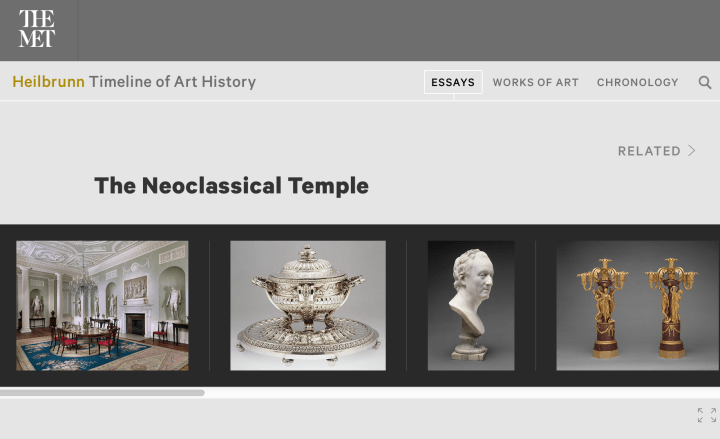
Screen shot (June 2016) of The Met’s Heilbrunn Timeline of Art History, with Cybele Gontar’s essay “The Neoclassical Temple” (October 2003).
◊ ◊ ◊ ◊ ◊
From H-ArtHist (13 June 2016). . .
Heilbrunn Timeline of Art History: The New Edition
The Heilbrunn Timeline of Art History is rethought with a new navigation and interface, updated images, and restructured editorial content. Still relational in nature, it allows a reader to find exactly what he or she needs while also encouraging total immersion through a seamless browsing experience. The new Timeline is fully optimized to be responsive on desktop and mobile devices, enabling easy access anywhere.
The Heilbrunn Timeline of Art History presents a chronological, geographical, and thematic exploration of global art history through The Met collection. It is a reference, research, and teaching tool conceived for students and scholars of art history. Authored by The Met’s experts, the Timeline comprises 300 chronologies, close to 1000 essays, and over 7000 works of art. It is regularly updated and enriched to provide new scholarship and insights on the collection, and draws 1 to 1.5 million visits per month during the academic year. The Met’s Heilbrunn Timeline of Art History is funded by the Heilbrunn Foundation, New Tamarind Foundation, and Zodiac Fund.
We would love to know what you think of the new site. For all questions and comments, please contact timeline@metmuseum.org.
Call for Essays | Interiority and the Interior
From H-ArtHist:
Interiorities: Artistic, Conceptual, and Historical Reassessments of the Interior
Palgrave Communications
Guest Editor: Vlad Ionescu (Faculty of Architecture and Art, Hasselt University, Belgium)
Article proposals due by 31 October 2016; full submissions due by February 2017
Palgrave Communications is inviting article proposals for a collection dedicated to the theme of ‘Interiority and the Interior’. The collection addresses interiority as a concept debated by artists and philosophers, historians and sociologists alike. The goal of this interdisciplinary collection is to approach interiority and the interior as relational entities that interact with architectural spaces, visual arts and music, social and political ideologies, geographical and historical structures. We welcome contributions that address the interior as an opportunity to research the status of the subjectivity in modernity and beyond. Article proposals and enquires should be sent to the Managing Editor at palcomms@palgrave.com.
Palgrave Communications is an open access online-only journal dedicated to publishing high quality original research across all areas of the humanities, the social sciences, and business. Multi-disciplinary in scope, Palgrave Communications also champions interdisciplinary research, fostering interaction, creativity, and reflection within and between the rich disciplines the journal encompasses. The journal is supported by an international Editorial Board and aspires to be the definitive peer-reviewed outlet for open access academic research in and between its subjects. Palgrave Communications is open to submissions on all theoretical and methodological perspectives.
Exhibition | Handel Exhibition at Boughton House

Boughton House, Northamptonshire. Most of the present building was undertaken by Ralph Montagu, 1st Duke of Montagu (d. 1709) who inherited the house in 1683. The Buccleuch Living Heritage Trust now looks after the house and estate.
◊ ◊ ◊ ◊ ◊
Later this summer at Boughton:
Handel Exhibition at Boughton House
Boughton House (near Kettering), Northamptonshire, August 2016
This August Boughton House celebrates the composer George Frideric Handel’s extraordinary legacy with items from the Buccleuch musical archives. The exhibition looks at key moments in Handel’s life, from his formative years in the palaces of cardinals and princes in Rome, to his rise as England musical genius presiding over London, the European capital of music theatre in the eighteenth century.
The exhibition will launch with an event hosted by the Duke of Buccleuch on Sunday, 17th July (see below). The Paris dance company, Les Corps Eloquents, will create a unique Handel performance in Boughton’s Great Hall, including re-created scenes from some of Handel’s most spectacular operas. London theatre-goers expected ballet in their opera, and Handel did not disappoint. He created over 70 works for the French dancers he had at his disposal, thanks to patrons like the Duke of Montagu.
The exhibition presents
• Glimpses of Handel’s early life in the palaces of cardinals in Rome
• Rare images of Handel and his colleagues, including a life size bust after Louis François Roubiliac
• Roubiliac’s terracotta model for the Handel statue in Vauxhall Pleasure Gardens
• A 1720 harpsichord thought to have belonged to Handel
• Original choreographies as used by Handel’s dancers at The Kings Theatre, Haymarket
• A small orchestra of Chelsea Porcelain musicians
• Rare scores and manuscripts including the first edition of The Messiah
• When Handel came to lunch: the menu and guest list from Montagu House April 1747
• Musical instruments as used in the music for the Royal Fireworks
Handel at Boughton
Boughton House (near Kettering), Northamptonshire, 17 July 2016
Hosted by the Duke of Buccleuch, this unique event begins with a welcoming coffee and the opportunity to stroll through Boughton’s glorious gardens and landscape. A buffet brunch is then followed by a tour of the house as well as a private view of Boughton’s 2016 Handel exhibition, which takes a fresh look at Handel’s life in Rome and London—with rare paintings, instruments, and original scores from the family archives, including The Messiah.
This one-off programme of events includes a splendid Handel performance in the Great Hall with counter-tenor James Laing and Paris dance company Les Corps Eloquents. Together they will re-create scenes from some of Handel’s most spectacular operas. You’ll also be treated to the first public performance of composer Luke Styles’s Passacaille—an extraordinary 21st-century re-imagining of Handel’s work through music, song, and dance. Tea and cakes will be served shortly afterwards. Luke Styles is one of the UK’s leading composers of his generation. Over the last four years his operas have been performed at Glyndebourne, the Royal Opera House Covent Garden, and the Vault Festival. Passacaille, his new piece for Boughton, is a re-imagining of an original Handel dance. For voice, instruments, and four dancers, its harmony, phrasing and melodic shapes are all given a 21st-century treatment, combining Sytles’s own musical language with the Handelian aesthetic.
The day starts at 11am and ends at 5pm. Please advise us in advance if you are a wheelchair user by calling 01536 515731 or emailing us. Early bird tickets cost £55 if purchased before 20th June and £65 thereafter.
Exhibition | Emma Hamilton: Seduction and Celebrity

◊ ◊ ◊ ◊ ◊
Looking ahead to the fall . . . press release from the National Maritime Museum:
Emma Hamilton: Seduction and Celebrity
National Maritime Museum, Greenwich, 3 November 2016 — 17 April 2016
From humble origins, Emma Hamilton rose to national and international fame as a model, performer, and interpreter of neo-classical fashion. Within the public mind, however, she typically continues to occupy a passive and supporting role and is often remembered simply as the mistress of Britain’s greatest naval hero, Admiral Lord Nelson. This landmark exhibition recovers Emma from myth and misrepresentation and reveals her to be an active and influential historical actor in her own right: one of the greatest female lives of her era.
Born into poverty in 1765, Emma’s talent and beauty brought her fame while still in her teens as muse to the great portrait artist George Romney. In her twenties she achieved still greater artistic prominence in Naples, the epicentre of the fashionable Grand Tour. Here, as the confidante of Queen Maria Carolina, she also came to wield considerable political power. Emma embarked on a passionate affair with Admiral Lord Nelson but risked her security and social status in the process. Her fortunes never recovered from the tragedy of his death at Trafalgar, and—following a period in debtor’s prison—she died in self-imposed exile in Calais in 1815.
The exhibition carries visitors through the arc of this remarkable story, revealing Emma’s driving ambition and her brilliance as a performer and placing in sharp relief the social conventions ranged against her. In an age when people tended to remain fixed in the social categories in which they began their lives, she crossed boundaries of all kinds, broke through barriers, and ultimately paid a heavy price.
Emma’s story will be told through over 200 objects from public and private lenders around a core from the Museum’s own collections. Emma’s compelling story will be explored through exceptional fine art, antiquities that inspired Emma’s famous ‘attitudes’, costumes that show her impact on contemporary fashions, prints and caricatures that carried her image to a mass audience, her personal letters and those of Nelson and William Hamilton, and finally the uniform coat that Nelson wore at Trafalgar, retained by Emma until destitution forced her to part with it.
◊ ◊ ◊ ◊ ◊
From Thames & Hudson:
Quintin Colville and Kate Williams, with contributions by Vic Gatrell, Hannah Greig, Jason Kelly, Margarette Lincoln, Christine Riding, and Gillian Russell, Emma Hamilton: Seduction and Celebrity (London: Thames & Hudson, 2016), 280 pages, ISBN: 978-0500252208, £30 / $50.
 Emma Hamilton (1765–1815) is widely known as a temptress who ensnared the naval hero Horatio Nelson and paid the price by dying in poverty in Calais. But this epic love affair, and the judgments surrounding it, have obscured a spectacular life story. This book, published to coincide with a major exhibition on Hamilton at the National Maritime Museum, Greenwich, explores her remarkable life and recovers Emma from myth and misrepresentation. Distinguished contributors provide a fresh evaluation of her artistic undertakings, cultural achievements, and legacy, as well as of the momentous years of her association with Nelson and the unravelling of her fortunes after his death at the Battle of Trafalgar in 1805. Illustrated with paintings, prints, and drawings capturing the beauty that propelled her to celebrity status, Emma Hamilton tells the story of an extraordinary woman who broke through barriers of class and privilege to win her own unique place in British history.
Quintin Colville is Curator of Naval History at the National Maritime Museum. He edited Nelson, Navy & Nation and is the author of The British Sailor of the First World War.
Kate Williams is Professor of History at the University of Reading. Her biography England’s Mistress: The Infamous Life of Emma Hamilton was published in 2006.
◊ ◊ ◊ ◊ ◊
Note (added 28 October 2016) — The original version of this posting used an earlier working title, Seduction and Celebrity: The Spectacular Life of Emma Hamilton. Other changes have been made to reflect updated information.










 Enfilade
leave a comment