Frick Announces Gift of Du Paquier Porcelain

Du Paquier Porcelain Manufactory, Elephant Wine Dispenser, ca. 1740 (New York: The Frick Collection, gift of the Melinda and Paul Sullivan Collection, 2016; photo by Michael Bodycomb).
◊ ◊ ◊ ◊ ◊
Press release from The Frick, via Art Daily (16 September 2016). . .
The Frick Collection announced a gift from Paul Sullivan and Trustee Melinda Martin Sullivan of porcelain produced by the Du Paquier manufactory in Vienna. The Sullivans generously permitted the Frick to choose fourteen superb examples from their collection, considered to be the finest private collection in the world from this important early Western manufactory. The objects, dating from about 1720 to 1740, perfectly complement the museum’s porcelain holdings, which have grown since Henry Clay Frick’s day to represent in depth some of the best productions of this prized material. Mr. Frick focused his porcelain collecting on Sèvres, which accompanied beautifully the eighteenth-century French paintings and furniture he acquired. In 1966, his collection of Chinese porcelain was augmented by some two hundred pieces through the bequest of his son, Childs. The museum’s holdings were again extended by recent and promised gifts of Meissen porcelain from Henry Arnhold. Now, the Sullivan’s gift of Du Paquier porcelain adds to the Frick’s already strong assemblage, which illustrates the Western fascination with Eastern models and represents the brilliant and distinctive tradition of porcelain production in Europe. Starting September 28, these stunning works will be on view in the Frick’s Reception Hall, remaining there through March of 2017.
Europe had long sought to duplicate the composition and physical qualities of the ceramics it imported from China; the feat was achieved only in the first decade of the eighteenth century at the Royal Meissen Manufactory outside Dresden, Germany, before being replicated by the Du Paquier manufactory in Vienna, then by the Sèvres manufactory in France, and elsewhere. In 1718, Claudius Innocentius du Paquier, an agent in the Imperial Council of War at the Vienna court, was granted a twenty-five year charter by Emperor Charles VI to operate a porcelain factory in Vienna. Although the secret of making porcelain by combining local clays containing kaolin with ground alabaster was jealously guarded by the Meissen manufactory, Du Paquier used his diplomatic connections to lure several key figures from Germany to Austria. These included Christoph Conrad Hunger, a porcelain painter; Just Friedrich Tiemann, an expert in kiln construction; and Samuel Stöltzel, the Meissen kiln master, who brought with him the formula for porcelain paste. Named for its founder, the Du Paquier manufactory produced a range of tablewares, decorative vases, and smallscale sculpture that found great popularity with the Hapsburg court and the Austrian nobility.
An early work of about 1725 testifies to the Viennese factory’s pride in its achievement. A tulip vase, part of a set of vessels called a garniture, features a fanciful view of Vienna and its spiritual center, St. Stephen’s Cathedral. Circling the frame of this scene is a Latin inscription that translates: “The bowls that Vienna formerly shipped here under a thousand perils of the sea, she now produces for herself.” The legend clearly signals the Du Paquier manufactory’s debt to Asian ware, which the Emperor Charles VI’s Ostend East-India Company had imported to the city since 1722.
A number of Asian motifs cover a Du Paquier tureen and stand of 1730–35, a form common in both European ceramic and silver dinner services of this period. Chinese-inspired handles in the form of leaping fish enliven the vessel. Its cobalt blue underglaze decorated with gold patterns and cherry blossoms reflect color combinations influenced by Imari ware, which was imported to Europe from Japan during the late seventeenth and eighteenth centuries. Within the fan-shaped cartouches, scenes of Chinese figures and temples have been adopted from German engravings published about 1720 in Amsterdam. The variety of sources and inventive adaptations characterize Du Paquier’s spirited production.
As the renown of the Du Paquier manufactory spread, commissions came from capitals throughout Europe; the emperor and members of his court also sent these prized objects as diplomatic gifts to their counterparts in foreign lands. A magnificent tureen—one of more than forty from an extensive service created in 1735 for Czarina Anna Ivanovna—illustrates porcelain’s role in cementing political and dynastic ties. In 1726, Austria and Russia had signed a treaty of mutual defense against military threats from the Ottoman Empire and subsequently were allies during the War of Polish Succession (1733–35). It is likely that to strengthen this alliance, Charles VI sent Anna Ivanovna the Du Paquier service, most of which is still in the State Hermitage Museum in St. Petersburg. The Russian imperial arms are emblazoned in the center of the tureen’s lid, beneath the finial, a gilded statuette of a cross-legged, turbaned man. These two features perfectly illustrate Du Paquier’s brilliant integration of flat, painted decoration with three-dimensional applied forms. Circling the body of the tureen is a modeled garland held in the mouths of grotesque masks, its brightly painted flowers popping from the surface. In contrast, geometrical bands of a type called Laub- und Bandelwerk accent the bottom of the tureen and the lid. This decorative motif consisting of infinite variations based on patterns of trelliswork, angled strapwork, and stylized foliage became a virtual signature of the Viennese porcelain. Painted in a distinctive palette of iron-red with purple, blue, and green, the designs highlight the factory’s use of exuberant colors.
While sculptural forms like fish handles and seated-man finials are a hallmark of Du Paquier’s production, some works take these features to the highest level. One of the most charming is a tankard of 1735–40, the handle of which is in the shape of a cooper. Identified by the leather apron he wears under his coat, the craftsman specialized in making barrels like that which forms the shape he holds. Designed to contain beer, Du Paquier tankards often had lids, but the cooper’s hands grasp the rim, preventing a top from being added. The lively expression of the man, the bold pattern of flowers set off by bands of Laub-und Bandelwerk, and the tankard’s exceptionally large size make it a superb example of these drinking vessels.
Among the rarest of Du Paquier’s sculptural vessels is the elephant wine dispenser featured on the front of this release, one of three known to survive. A colorfully glazed version, in the Hermitage, is part of an elaborate centerpiece made about 1740 for Anna Ivanovna. That elephant stands above a rotating silver platter on which eight dancing figures hold cups ready to receive wine from the elephant’s trunk. The elephant is ridden by a figure of Bacchus, who can be lifted to fill the cavity with wine. The pure white surface of the Frick elephant allows the animal’s sculptural details to be clearly seen. Although it is possible that it was prepared as a spare in the event of breakage during firing, close observation reveals that the figure was once cold-painted (meaning paint was applied to the surface of the object, but it was not fired afterward). Elephants were favorites of the Czarina, who received one as a gift from Persian emissaries in 1736 and who featured a full-size model in a festival she staged on the frozen Neva River in 1740.
The elephant wine service was among the last of the great works produced by the Du Paquier manufactory. By 1744, its founder was overcome with debt and was forced to sell the factory to Empress Maria Theresa. Over its three-decade history, Du Paquier produced a body of work that was inventive and often whimsical, a truly distinctive voice in the evolution of European porcelain.
Comments Frick Director Ian Wardropper, “It gives me great pleasure to see these works come to the Frick. In 1993, while I was the Eloise W. Martin Curator of European Decorative Arts and Sculpture at the Art Institute of Chicago, Melinda and her sister, Joyce Hill, offered to fund an acquisition in honor of their mother, Eloise. Several suggestions were made, one of which was a group of three exquisite pieces of Du Paquier porcelain that the department was very interested in acquiring. Melinda was smitten with these objects, and—after purchasing the group for the Art Institute—she and her husband, Paul, began to acquire their own Du Paquier works. As their collection grew, so too did their interest in the history of the manufactory and its production, which led them to underwrite the research for and publication of Fired by Passion, a definitive three-volume monograph released in 2009. To celebrate its publication, as the head of the Department of European Sculpture and Decorative Arts at The Metropolitan Museum of Art, I initiated an exhibition drawn from the Sullivan’s and the Met’s collection (Imperial Privilege: Vienna Porcelain of Du Paquier, 1718–44). We are now honored to have this exceptional selection of porcelains enter The Frick Collection owing to the Sullivans’ extraordinary generosity.”
Exhibition | A Century of French Elegance
On view this week in Paris from The State Hermitage Museum:
A Century of French Elegance / Un siècle d’élégance française
Grand Palais, Paris, 10–18 September 2016
Curated by Tamara Rappe

Julien Le Royi, Watch on a chatelaine, Paris, mid-18th century.
The State Hermitage Museum presents the exhibition A Century of French Elegance, organized within the frames of the 28th Biennale des Antiquaires. The exhibition presents 34 works—some on view for the first time—in an installation of important eighteenth-century masterworks from the institution’s renowned collection. For centuries, France represented a certain model of art de vivre for all of Europe and Russia; the eighteenth century was profoundly marked by this ‘French elegance’, found both in fashion and in furniture. The collection of French decorative arts at the Hermitage is considered one of the finest outside the country itself. This is explained by the close Russian-French ties over many centuries. Russian monarchs regularly visited Paris for the acquisition of objects in porcelain, silver and bronze, and were offered exceptional masterpieces as diplomatic gifts.
In 1717, Tsar Peter the Great laid the foundation for official Russian-French relations during a visit to Paris. The main achievement of this visit was that Peter attracted French craftsmen of various trades to Russia. In subsequent years, Russian monarchs almost exclusively took their cue from the French capital. During the reign of Elizabeth Petrovna, French goods arrived from Paris in a constant stream. It was in the period of Elizabeth’s reign that items made of porcelain came to Saint-Petersburg. It was a favourite material in France in the mid-18th century, and the ‘green service’—items of which are preserved at the Hermitage—proves this perfectly. The porcelain plaque with a portrait of Louis XV presented at the exhibition is a rare example of this type of work from the Sevres Manufactory. Under Elizabeth Petrovna, furniture was ordered for the Chinese Palace in Oranienbaum. This delivery included the famous filing cabinet that is now kept at the Hermitage.
However, the main items from Paris in the Hermitage collection date from the time of Catherine the Great. The Hermitage has a unique collection of commissions from David Roentgen dating from Catherine’s reign. The Empress royally rewarded her numerous favourites. The magnificent French porcelain service, the ‘cameo service’, was ordered for Grigory Potemkin. Catherine’s political ambitions were reflected in the works of decorative art connected with Russian military victories. Thus, the Chesma inkstand, a unique work from the second half of the eighteenth century, was designed as a memorial to the victory over the Turkish navy. The author of the inkstand, the goldsmith and enameller de Mailly, created an ensemble which symbolised in allegorical form the victories of the Russian navy in the war with the Turks.

Clock Vase, Sevres, 1780s.
We encounter the name of the renowned enameller de Mailly once again on the signed ‘Egg shaped Vase’ decorated with the scene of the ‘Sacrifice of hearts at the altar of Catherine the Great’. Silver table services were ordered in Paris for the provinces, so that each Russian province would have its own. The Kazan, Yekaterinoslav, Nizhny Novgorod and Moscow services were made by Robert-Joseph Auguste from 1776 to 1782. The attention of the Russian court was focused on the French capital where the empress and her circle placed their main orders. In a very brief period, first class collections of works of art, drawings and cameos were gathered. However, the decorative objects ordered in Paris were not intended to form collections, but were rather purchased to delight the eye and ensure that the imperial palace in Saint-Petersburg was the equal of its European counterparts.
The reign of Paul I was also marked by a keen fondness for everything French. The architect Vincenzo Brenner ordered most of the furniture for Saint Michael’s Castle, built for Paul I, from France. Thanks to this, the Hermitage holds a unique collection of decorative bronzes and furniture bought in Paris at the end of the 18th century. Among these pieces of furniture were the only known console table signed by Pierre-Philippe Thomire, lacquered furniture, and a fall front desk and its matching chest of drawers ornamented with Sevres plaques.
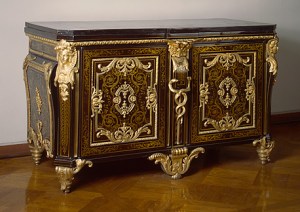
Medal Cabinet, Paris, 1723.
After the 1917 revolution, the fate of the Hermitage collection of decorative arts changed drastically. Through the National Museum Fund, the Hermitage received pieces from nationalized aristocratic collections, many of which had been converted into museums after the Revolution.
Another component of the museum collection comes from the Baron Stieglitz School of Technical Drawing the museum of which became attached to the Hermitage in 1924. The Russian patron Baron Stieglitz bequeathed an enormous sum of money to acquire items for the collection of the School’s museum founded in Saint-Petersburg in the last quarter of the nineteenth century.
Unfortunately, there was a period in the Hermitage’s history when, by order of the Soviet government, paintings and pieces of decorative arts were sold through the special agency called ‘Antiquariat’ established by the Government in order to export the museum objects. This is why porcelain pieces from the ‘Green’ and ‘Cameo’ services, silver from the Orlov, Paris and provincial services, and furniture by Charles Cressent can be found in museums in Europe and America. Despite all the historical vicissitudes, the Hermitage has a unique collection of French pieces of decorative arts. These works are displayed in the rooms of the Winter Palace and the Hermitage. Many of them can be seen at temporary exhibitions, both in Russia itself and abroad. At the Biennale, we are showing just 34 items of French decorative arts from the Hermitage collection, but they give an idea of the high level of our collection dating from the eighteenth century—the century of French elegance.
Call for Participants | Resembling Science: The Unruly Object
This working group will meet at the RBS-Mellon Conference Bibliography among the Disciplines in October 2017.
Resembling Science: The Unruly Object across the Disciplines
Philadelphia, 12–15 October 2017
Proposals due by 25 October 2016
Organizers: Meghan Doherty (Berea College), Dahlia Porter (University of North Texas), and Courtney Roby (Cornell University)
The task of transforming observation and experience into representational media is a constant concern in the long history of scientific knowledge. We might even argue that the history of of consolidating and communicating scientific thought is structured by a tension between two kinds of unruly objects: the objects we seek to represent, and the objects produced by representational media. Scientific media instantiate a wide range of representational modes, from drawings, tables, and diagrams to printed text and script in various languages. In this working group, we will examine the strategies deployed by writers and artists to transform material objects—whether a body, a specimen, a machine, or an observed phenomena—into knowledge that could be shared and disseminated materially as image, text, and/or book.
This working group will meet for four sessions over three days (see schedule below) to discuss the tension between the unruly material object and the equally unruly materiality of the objects used to represent it. In so doing, we seek to promote conversations about the tools, practices, and processes of scientific knowledge making across modern disciplinary divisions. What verbal and visual strategies are used to discipline objects of scientific study? How do the conventions of description and depiction render objects knowable to particular communities, or within a specific cultural context? Within any given context, is it possible to identify a ‘visual grammar’, or ‘regime of description’, on which scientific knowledge depends? How does the combination of text and image forward, or disrupt, the communication of scientific ideas? What methods of analysis or interpretive approaches might advance the study of images, texts, and objects across the history of science?
Interested scholars, librarians, curators, and members of the book trade are invited to send statements of interest describing a particular representational problem or proposing a case study that exemplifies the materiality of scientific knowledge. Statements may address any national tradition or time period from antiquity to the present; those focused on non-western representational traditions are particularly welcome.
Participants should be able to commit to attending all sessions of the working group:
Thursday, 12 October 2017, 2:00–5:00
Friday, 13 October 2017, 1:45–3:15
Saturday, 14 October 2017, 10:45–12:15
Participants should further be able to commit to meeting again within one year after the conference to work toward the final publication of the results of the working group. In their statements of interest, participants should indicate their availability to meet during the year following the conference (e.g., will you be abroad—if so, when, and do you anticipate that you will have sufficient internet connectivity to meet virtually?).
In order to be considered please submit proposals for participation by 25 October 2016 here. Proposals should include a statement of interest of no more than 250 words, outlining your relevant research, what you hope to contribute toward the group, and what you hope to take away from it.
Bibliography among the Disciplines, a four-day international conference, will bring together scholarly professionals poised to address current problems pertaining to the study of textual artifacts that cross scholarly, pedagogical, professional, and curatorial domains. The conference will explore theories and methods common to the object-oriented disciplines, such as anthropology and archaeology, but new to bibliography. The program aims to promote focused cross-disciplinary exchange and future scholarly collaborations. Bibliography among the Disciplines is supported by the Andrew W. Mellon Foundation, and organized by the Andrew W. Mellon Fellowship of Scholars in Critical Bibliography at Rare Book School.
Call for Articles | Transatlantic Literary and Cultural Relations
Transatlantic Literary and Cultural Relations, 1776 to the Present
Special Issue of The Wenshan Review of Literature and Culture 11.2 (June 2018)
Guest Editors: Li-hsin Hsu and Andrew Taylor
Articles due by 30 June 2017
This special issue The Wenshan Review of Literature and Culture seeks essays of 6,000 to 10,000 words engaged in debate around historical, cultural, and literary issues in the Atlantic World. Whilst national narratives have often sought to assert the truth of universal values, a more self-conscious focus upon the methodological framework of the transnational Atlantic world concerns itself explicitly with ways in which diverse and competing local or national paradigms might contest the kinds of ideological assumptions that underwrite narratives of progress, civilisation and modernity. The editors are keen to receive submissions that explore what happens when the assumptions of a nationalistic model of doing literary and cultural criticism, in which geography is allegorised as the autonomous locus of all possible meaning, are challenged by forms of encounter and contagion that disrupt and expand our frames of interpretation. How might the Atlantic space map a series of textual disruptions and contagions during the period? In what ways does transatlanticism open up possibilities for thinking about literary comparison as a critical practice? How do the crossings of people, objects and ideas complicate our sense of literary and intellectual inheritance? What kinds of relationship does the Atlantic world have with other spatial paradigms—the Pacific, the Orient, Australasia? The essays in this special issue seek to explore the meshed networks of interaction—aesthetic, ideological, material—that constitute the space of Atlantic exchange. This, we hope, will result in a wide-ranging, geographically diverse collection that displays much of the best research being undertaken in this exciting and vibrant field.
Possible areas of interest may include, but are not limited to:
• ecology and landscape
• migration and travel
• nature and nation
• Asia/Orientalism and transatlanticism
• social reform
• class and conflict
• gender and sexuality
• art and aesthetics
• slavery and empire
• science and technology
• nationalism and cosmopolitanism
The Wenshan Review of Literature and Culture (www.wreview.org) is a Scopus-indexed journal of interdisciplinary nature based in the Department of English, National Chengchi University, Taipei, Taiwan. Please follow the submission guidelines to submit articles online by 30 June 2017.
Li-hsin Hsu is Assistant Professor of English at National Chengchi University, Taipei, Taiwan. She holds a PhD in Transatlantic Romanticism from the University of Edinburgh and specialises in transatlantic studies, ecocriticism, and Orientalism. She received the 2014 Emily Dickinson International Society (EDIS) Scholar in Amherst Award and has published in journals such as Symbiosis: A Transatlantic Journal and The Emily Dickinson Journal.
Andrew Taylor is Senior Lecturer and Head of English Literature at the University of Edinburgh. He specialises in 19th- and 20th-century North American literature and intellectual history and has an interest in the intersection of historiography and contemporary American fiction. He’s the author of Henry James and the Father Question (Cambridge UP, 2002), Thinking America: New England Intellectuals and the Varieties of American Experience (U of New Hampshire P, 2010), and co-author of Thomas Pynchon (Manchester UP, 2013). He’s the co-editor of several books including Transatlantic Literary Studies: A Reader (Johns Hopkins UP, 2007), Stanley Cavell: Literature, Philosophy, Criticism (Manchester UP, 2012), and Stanley Cavell, Literature and Film: The Idea of America (Routledge, 2013). An awardee of the Leverhulme Trust Project Grant, Dr Taylor is a series editor of the Edinburgh Critical Studies in Atlantic Literatures and Cultures, published by Edinburgh UP.
New Book | French Art of the Eighteenth Century
Distributed by Yale UP:
Heather MacDonald, ed., French Art of the Eighteenth Century: The Michael L. Rosenberg Lecture Series at the Dallas Museum of Art (New Haven: Yale University Press, 2016), 192 pages, ISBN: 978-0300220179, $25.
 This beautiful book brings together ten years of research on a superb collection of 18th-century French masterworks, which was formed by the late Michael L. Rosenberg and is now on deposit at the Dallas Museum of Art. This research, originally presented in lectures at the museum by an impressive roster of scholars and curators of European art, combines close studies of individual paintings by such artists as François Boucher, Jean-Baptiste Greuze, and Louis Léopold Boilly with rich accounts of the historical, cultural, and political climates of their time. The works, many of which have not yet been widely published, span elegant portraits, intimate genre paintings, erotic canvases depicting mythological themes, and bloody images of the hunt. Through careful reconstructions of the lives of these artworks—from their first audiences to their contexts of display—the essays in this book unfold the history of a century of French art.
Heather MacDonald is program officer at the Getty Foundation.
◊ ◊ ◊ ◊ ◊
C O N T E N T S
• Walter Elcok, Foreword
• Lawrence Barzune, Dedication to Michael L. Rosenberg
• Philip Conisbee, Michael L. Rosenberg’s Eighteenth Century
• Kathleen Nicholson, Beguiling Deception: Allegorical Portraiture in Eighteenth-Century France
• Mary D. Sheriff, Love Hurts: On the Pleasures and Perils of Love in Eighteenth-Century French Art
• Mary Tavener Holmes, Nicolas Lancret and Tale of Three Collectors
• Amy Freund, Good Dog! Jean-Baptiste Oudry and the Politics of Animal Painting
• Christoph Martin Vogtherr, Moving on from Watteau: Jean-Baptiste Pater and the Transformation of the Fête Galante
• Alastair Laing, Artist in a Garret: The Young Boucher in Rome
• Deborah Gage, Fired by Passion: Michael L. Rosenberg’s Sèvres Tableau and the French Royal Prerogatives of Ceramics and Stag Hunting
• Eik Kahng, Greuze’s The Dreamer: Portrait, Tronie, or Fantasy Figure?
• Aileen Ribeiro, The Mirror of History: The Art of Dress in Late Eighteenth-Century France
• Susan L. Siegfried, Louis-Leopold Boilly: Between Genre and Portraiture
• Anne L. Poulet, On the Run: Clodion’s Bacchanalian Figures
Bibliography
Index
Photography and Copyright Credits
◊ ◊ ◊ ◊ ◊
The DMA celebrates the book with a lively evening of events on Thursday, October 27, from 5:00 to 9:00pm . . .
Annual Fête: Celebrating French Art of the 18th Century
Dallas Museum of Art, 27 October 2016
Step back in time to 18th-century France at the inaugural Annual Fête celebrating French painting and sculpture from the Michael L. Rosenberg Collection. Arrive in style with an 18th-century–inspired costume for a chance to win a copy of French Art of the Eighteenth Century: The Michael L. Rosenberg Lecture Series at the Dallas Museum of Art and two tickets to the upcoming exhibition Art and Nature in the Middle Ages.
Performance
18th-century music from members of the Dallas Symphony Orchestra.
Self-Guided Tour
Depart on a grand tour of art from our global collection made during the 18th century.
Talk — Greuze’s The Dreamer: Portrait, Tronie, or Fantasy Figure?
7:00pm Heather MacDonald shares a brief history of the Michael L. Rosenberg Foundation before introducing Eik Kahng, contributor to the new Michael L. Rosenberg Collection catalogue.
Curator Q&A in the Galleries
8:00pm Heather MacDonald, Nicole Myers, and Eik Kahng answer questions about the Rosenberg Collection.
Lecture | Mr. Boswell Goes to Corsica

◊ ◊ ◊ ◊ ◊
From The Lewis Walpole Library:
David A. Bell | Mr. Boswell Goes to Corsica: Charismatic
Authority in the Age of Democratic Revolutions
22nd Lewis Walpole Library Lecture
Yale Center for British Art, New Haven, 6 October 2016
David Bell’s lecture examines how new ways of imagining political leadership emerged during the Enlightenment, across the Atlantic world, using as a case study the way the Corsican independence leader Pasquale Paoli become an unexpected hero in Britain and its American colonies. He then speculates on how these ways of imagining political leadership helped shape the character of the great Atlantic revolutions of the century’s end. The lecture (held in the Yale Center for British Art Lecture Hall and starting at 5:30pm on Thursday, October 6) is free and open to the public.
David A. Bell, Sidney and Ruth Lapidus Professor in the Department of History at Princeton University, is a historian of early modern France with a particular interest in the political culture of the Old Regime and the French Revolution. He earned a Ph.D. from Princeton University in 1991. Prior to joining Princeton’s faculty in 2010, he taught at Yale University (1990–96) and at Johns Hopkins University, where he held the Andrew W. Mellon chair in the Humanities and served as dean of faculty in the School of Arts and Sciences. He is the author of five books including, most recently, Shadows of Revolution: Reflections on France, Past and Present (Oxford University Press, 2016). He is currently working on a comparative and transnational history provisionally entitled “Men on Horseback: Charismatic Authority in the Age of Democratic Revolutions.” He is also a frequent contributor to general-interest publications on a variety of subjects ranging from modern warfare to the impact of digital technology on learning and scholarship.
New Book | Visual Culture and the Revolutionary and Napoleonic Wars
From Routledge:
Satish Padiyar, Philip Shaw, Philippa Simpson, eds., Visual Culture and the Revolutionary and Napoleonic Wars (New York: Routledge, 2016), 252 pages, ISBN: 978-1472447111, $150.
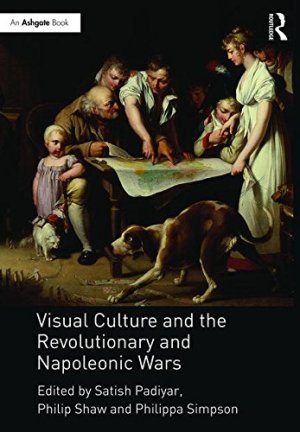 Individually and collectively, the essays in this cross-disciplinary collection explore the impact of the revolutionary and Napoleonic Wars on European visual culture, from the outbreak of the pan-European conflict with France in 1792 to the aftermath of the Battle of Waterloo in 1815. Through consideration of a range of media, from academic painting to prints, drawings and printed ephemera, this book offers fresh understanding of the rich variety of ways in which warfare was mediated in visual cultures in Britain and continental Europe.
The fourteen essays in the collection are grouped thematically into three sections, each focusing on a specific type of visual communication. Thus, Part One engages with historically specific ways of transmitting messages about war and conflict, including maps, prints, silhouette imagery and war games produced in France and Germany. Part Two considers popular and elite imagining of war between 1793 and 1815, encompassing readings of paintings by Turner, Girodet and Goya, Portuguese anti-French drawings and British satirical book illustrations. Part Three concentrates on visual cultures of commemoration, addressing British theatrical reenactments and museum collections, and British and Dutch paintings of the Battle of Waterloo. As such, the volume uncovers fascinating new visual material and throws fresh light on some of the more canonical visual representations of conflict during the first ‘Total War’.
Satish Padiyar is Senior Lecturer in Nineteenth-Century European Art at The Courtauld Institute of Art. He is author of Chains: David, Canova and the Fall of the Public Hero in Postrevolutionary France (2007) and editor of Modernist Games: Cézanne and His Card Players (2013). He is currently preparing a monograph on Jean-Honoré Fragonard.
Philip Shaw is Professor of Romantic Studies at the University of Leicester. He is author of Waterloo and the Romantic Imagination (2002), The Sublime (2006) and Suffering and Sentiment in Romantic Military Art (2013), and editor of Romantic Wars: Studies in Culture and Conflict, 1793–1822 (2000). He has written essays on military art in the Romantic period for Soldiering in Britain and Ireland, 1750–1850: Men of Arms (2013) and Tracing War in British Enlightenment and Romantic Culture (2015).
Philippa Simpson is Client Project Manager at the Victoria and Albert Museum. She was co-curator and catalogue author of Turner and the Masters (Tate Britain, Musée du Louvre, Museo del Prado) and Blake and British Visionary Art (Pushkin Museum) and has contributed essays to Turner Inspired: In the Light of Claude (2012), Blake 2.0: William Blake in Twentieth-Century, Art, Music and Culture (2012) and Sexy Blake (2013).
◊ ◊ ◊ ◊ ◊
C O N T E N T S
Introduction—Contested Views: The Image in the First Total War, Satish Padiyar, Philip Shaw, and Philippa Simpson
Part One: Cultures of Participation
1 The Territorial Imaginary of the Revolutionary and Napoleonic War, Katie Hornstein
2 Beholder, Beheaded: Theatrics of the Guillotine and the Spectacle of Rupture, Stephanie O’Rourke
3 Smuggled Silhouettes: Opacity and Transparency as Visual Strategies for Negotiating Royal Sovereignty during the Revolutionary and Napoleonic Wars, Allison Goudie
4 Wargaming: Visualizing Conflict in French Printed Boardgames, Richard Taws
5 Battle Lines: Drawing, Lithography and the Casualties of War, Sue Walker
Part Two: War and the Image
6 From the Nore: Turner at the Mouth of the Thames, Richard Johns
7 Ghosts and Heroes: Girodet and the Ossianic Mode in Post-Revolutionary French Art, Emma Barker
8 King Ferdinand’s Veto: Goya’s 2nd and 3rd May 1808 as Patriotic Failures, Simon Lee
9 “The most atrocious [acts] one may imagine”: The So-called Series of the French Invasions and Anti-French Propaganda during the Peninsular War, Foteini Vlachou
10 The Comic View of Johnny Newcome’s Military Adventures, Neil Ramsey
Part Three: Cultures of Commemoration
11 Reality Effects: War, Theatre and Re-enactment around 1800, Gillian Russell
12 Ephemeral Histories: Social Commemoration of the Revolutionary and Napoleonic Wars in the Paper Collections of Sarah Sophia Banks, Arlene Leis
13 Exhibiting the Nation’s Navy: The Foundation of the National Gallery of Naval Art, 1795– 1845, Cicely Robinson
14 Picturing the Battlefield of Victory: Document, Drama, Image, Susan L. Siegfried
Exhibition | Sylvester Schedrin and the Posillipo School
On view at Saint Michael’s Castle:
Sylvester Schedrin and School of Posillipo: To the 225th Anniversary of the Artist
Mikhailovsky Castle, Saint Petersburg, 11 August — 1 November 2016

Sylvester Schedrin, New Rome, Castle St.Angelo, c. 1823, oil on canvas, 47 x 60, the State Russian Museum.
Silvester Schedrin (1791–1830) is a prominent master of Russian landscape of romanticism epoch. He was one of the first masters who started making landscapes directly from nature, reflecting the vision of the air and light and the idea of the unity of man and nature. His works were highly praised by the contemporaries and heirs, becoming the classics of the Russian school of landscape painting.
From 1818 until his death, Schedrin lived in Italy and sent the works he made there to the motherland. While working in Rome and Naples and their environs Schedrin communicated with local artists and influenced the southern-Italian landscape school— the so-called Posillipo school—that united various artists from Italy, Germany and Holland (Antonis Pitloo, Giacinto Gigante, and others).
The exhibition will comprise around 100 pieces of art by Schedrin and painters of the Posillipo school from the Russian Museum and other museum collections. The exhibition will present the oeuvre of this brilliant representative of Russian landscape school together with paintings of his European contemporaries.
Exhibition | Feeding the 400
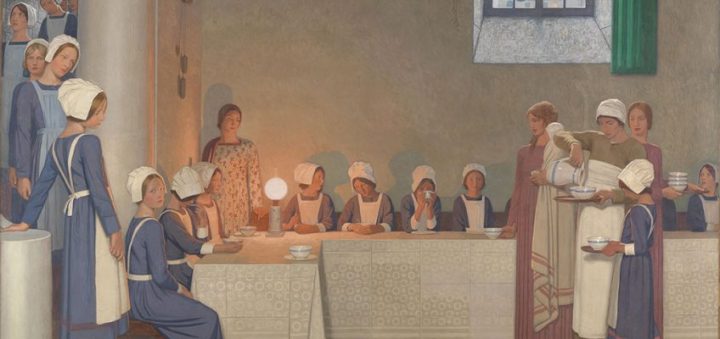
Frederick Cayley Robinson, Orphan Girls Entering the Refectory of a Hospital, 1915, oil on canvas (London: Wellcome Library). According to Art UK (the operating name of the Public Catalogue Foundation), the picture is one “in a set of four allegorical paintings on the theme of the ‘Acts of mercy’ commissioned from F. Cayley Robinson for the Middlesex Hospital in 1912. The hospital was demolished in 2008 and the paintings were acquired from the health authority in 2009.”
◊ ◊ ◊ ◊ ◊
From The Foundling Museum:
Feeding the 400
The Foundling Museum, London, 23 September 2016 — 8 January 2017
Curated by Jane Levi
Based on new research, guest curator Jane Levi presents the multi-faceted impact that food and eating regimes had on children at the Hospital from 1740 to 1950. This fascinating story is explored through art, archival material, photographs and the voices of former pupils, whose memories of food are captured in the Museum’s extensive sound archive.
Feeding the 400 explodes myths and misconceptions around eating at the Hospital, demonstrating how the institution’s food choices were far more than just questions of economy, nutrition and health. Working with historians, scientists and cultural practitioners, the exhibition brings alive the connections between what, when, where and why the foundlings ate what they ate; the beliefs and science that underpinned these decisions; and their physiological and psychological effects. Alongside archival material, paintings and objects including tableware from the Foundling Museum collection, a newly commissioned sound work evokes the experience of communal eating, conjuring sounds common to the Hospital’s dining rooms. Feeding the 400 is supported by a Wellcome Trust People Award.
Display | So That They May Be Usefull to Themselves
Opening in November at The Foundling Museum:
So That They May Be Usefull to Themselves
The Foundling Museum, London, 15 November 2016 — 7 May 2017
This display in the Introductory Gallery explores the Foundling Hospital’s work with disabled children. The Foundling Hospital was ground-breaking in its approach to access, as shown by the education and care it gave to disabled children in its custody. In some cases this led to lifelong support, even into old age. Curated by the Museum’s volunteers, this in-focus display explores their treatment of disability at the Foundling Hospital in the eighteenth and nineteenth centuries, alongside stories of former pupils.










 Enfilade
leave a comment