Exhibition | Reuniting the Masters: European Drawings

François Boucher, The Birth of Venus, n.d., black and white chalks and charcoal on beige laid paper, 32.6 × 44.9 cm
(Sacramento: Crocker Art Museum).
◊ ◊ ◊ ◊ ◊
Press release for the exhibition now on view at the Crocker:
Reuniting the Masters: European Drawings from West Coast Collections
Crocker Art Museum, Sacramento, 13 November 2016 — 5 February 2017
Reuniting the Masters: European Drawings from West Coast Collections brings together related European drawings, separated over centuries and continents, that are now in the possession of the West Coast’s great art collections. By coincidence or by design, drawings by the same artist, for the same project, and even from the same sketchbook, have made their way separately into galleries and museums on the West Coast. Bringing these long-estranged drawings together again illuminates the work and process of specific artists in the rich history of European draftsmanship and brings forward the history of drawings collectors and scholars in the West.
“Through the generosity of our fellow West Coast institutions, we are delighted to unite these drawings, some separated for centuries, in our galleries,” said Crocker curator William Breazeale. “They illuminate not only artists’ working process but also a chapter in American patronage and scholarship that should be better known. West Coasters from E.B. Crocker to Vincent Price and Cary Grant have fallen under the spell of master drawings, and distinguished curators here have furthered their study.”
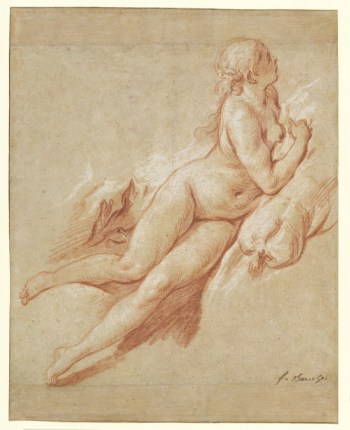
François Boucher, Study of a Reclining Nude. 1732–35, red and white chalk on beige laid paper, 32.5 × 24.6 cm (Los Angeles: The J. Paul Getty Museum, 84.GB.21).
Some works, such as François Boucher’s Study of a Reclining Nude at the J. Paul Getty Museum in Los Angeles and his Birth of Venus at the Crocker Art Museum, relate to the same project, though one made its way to California a century later than the other. Pieter Quast’s A Man in Oriental Dress at the Iris and B. Gerald Cantor Arts Center for Visual Arts at Stanford University and A Skater at the Achenbach Foundation for Graphic Arts in San Francisco, come from the same sketchbook, where they originally appeared just pages apart. Others, such as Adolph Menzel’s Artist’s Model in Eighteenth-Century Costume at the Cantor Center and Study for a Tree at the Fine Arts Museums of San Francisco illustrate contrasting aspects of the same artist’s work.
Reuniting the Masters is presented in four sections representing the major European schools, showcasing the development of draftsmanship across the continent in a series of comparative pairs. Many of the most appealing artists from the 16th through 19th centuries are highlighted, including Italy’s Fra Bartolommeo and Guercino, the Low Countries’ Adriaen Frans Boudewijns and Anthonie van Waterloo, Germany’s Friedrich Heinrich Füger and Adrian Zingg, and France’s Jean-Baptiste Oudry and Charles-Nicolas Cochin the Younger. Among the objects are newly acquired and newly attributed drawings, representing the continuing work of patrons and scholars in the West.
Consisting of 52 drawings, Reuniting the Masters is accompanied by an 150-page, full-color catalogue authored by Breazeale; Cara Denison, curator emerita at the Morgan Library and Museum in New York City; and Victoria Sancho Lobis, Prince Trust curator of prints and drawings at the Art Institute of Chicago.
Online Resources from the National Portrait Gallery
From the newsletter of the Society of Antiquaries of London, Salon 375 (15 November 2016). . .
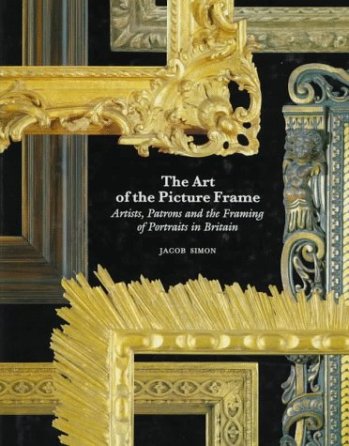 Jacob Simon FSA, Research Fellow at the National Portrait Gallery, notes that 2016 is the tenth anniversary of the launch of the Gallery’s online resource British Artists’ Suppliers, 1650–1950, in partnership with Cathy Proudlove. Three other resources have since been added: British Picture Framemakers, 1600–1950 (2007), British Picture Restorers, 1600–1950 (2009), and British Bronze Sculpture Founders and Plaster Figure Makers, 1800–1980 (2011). These four online resources are selectively updated twice a year and have doubled in size since launch. Further reviews and additions are planned, including to the features on picture framing; the Gallery’s exhibition, The Art of the Picture Frame, celebrated its 20th anniversary on 8 November. Karen Hearn FSA writes to commend these remarkable online resources and “the exceptional amount of research, work, and coordination that their originator, Jacob Simon, has put into making so much invaluable information available to a wide audience.”
British Miniatures on View at Compton Verney
As noted at Art Daily (15 November 2016). . .
The Dumas Collection of British Portrait Miniatures
Compton Verney Art Gallery and Park, Warwickshire
Over forty miniature paintings, not previously seen in public, have now gone on show at Compton Verney Art Gallery and Park in Warwickshire. The works are part one of the most important collections of this art form held anywhere in the world. The collection consists of 842 works in total and has been generously loaned on a permanent basis by Simon Dumas following the death of his father in 2013.
Simon Dumas said: “We wanted Dad’s exceptionally broad and, in the context of miniatures, important collection to be in the Midlands and not in London, Cambridge, or Oxford—since the Victoria and Albert Museum and National Portrait Gallery, the Fitzwilliam and the Ashmolean already have such wonderfully rich resources to display. We approached Compton Verney because they already have a fine collection of English portraits, which we thought Dad’s mainly English collection would complement well.”
Upon his retirement from a successful career in the City, Dumas’s firm, ED&F Man Capital Markets, gave him and his wife a round-the-world trip as a leaving present. It was on a wet day in Canada that the couple visited an art gallery that happened to be staging an exhibition of miniatures.
“They captivated Dad, who at the time was vaguely looking around for an indoor hobby for his retirement. He asked a curator where these little paintings were from, only to learn that they were from his own country, England. He started collecting almost immediately on their return from their trip in 1975, with the objective—impossible to achieve, but still a reference point—of acquiring an example, signed if possible, by every artist who ever worked in the British Isles,” Simon explained.
With his enthusiasm fired, Dumas developed and added to his collection over the next thirty years.
The advent of photography and its ability to capture people’s likenesses relatively cheaply and led to the rapid decline of the portrait miniature from about 1850 onwards. Miniatures were often carried around or worn as a necklace or brooch but, because of the skill required to create them, were expensive to commission. Deeply personal and available only to the wealthier echelons of society, miniatures were rarely seen by the greater public; consequently, miniature painting is not a well-known aspect of art—albeit that it flourished for some three centuries.
Steven Parissien, Director of Compton Verney, believes the Dumas loan makes a significant contribution to our understanding of the British tradition of miniature portraits: “We are delighted that this world-class collection of outstanding British portrait miniatures has finally come back to England from Scotland, allowing us to share in the hidden delights of this most intimate and touching form of portraiture—as well as to learn much about their Stuart and Georgian sitters.”
Highlights include Lucas Horenbout’s Unknown Lady, painted ca. 1543. Sir Roy Strong has suggested that the sitter was King Henry VIII’s sixth and last wife, Queen Catherine (Parr). Horenbout worked for Henry VIII from 1525 and is said to have taught Holbein how to paint miniatures—thus introducing this skill into Britain. Catherine herself died aged 36, five years after this portrait was painted, giving birth to a child by her fourth husband.
The celebrated Elizabethan and Jacobean painter Nicholas Hilliard is also represented, with Unknown Gentleman (1589). Hilliard made portrait miniatures popular in Britain, largely due to the patronage of Queen Elizabeth I herself. Having helped create fashionable images of the Virgin Queen and her court—one of whose members may be depicted here—Hilliard became the royal miniaturist (‘court limner’) to her successor, James I.
Also of note are the works of six female artists, including the exceptional Sarah Biffin (1784–1850). Born without hands, arms, or feet, Sarah taught herself to paint and write by using her mouth. Apprenticed by her family to a man who exhibited her round the country as a sideshow freak, she simultaneously taught herself how to paint miniatures. She was rescued by the Earl of Morton, who sponsored formal painting lessons for her at the Royal Academy, and she built up a large practice painting miniatures as a result of Queen Victoria’s patronage.
Having just visited the national gallery in Warwickshire to see the first selection from the collection on display, Simon Dumas says he is very pleased that his father’s collection has found the ideal place for members of the public to enjoy them: “I hope the miniatures stay for many years in the beautiful surroundings of Compton Verney, where they are displayed so very well in the newly-made cabinet alongside the British paintings of the permanent collection. The display is far better than those in some of the London galleries in my opinion!”
The Dumas Loan can be seen in the British Portraits gallery at Compton Verney, along with remarkable collections such as the nationally-designated Chinese Bronzes and Britain’s best collection of British Folk Art.
Exhibition | Meta-painting: A Journey to the Idea of Art
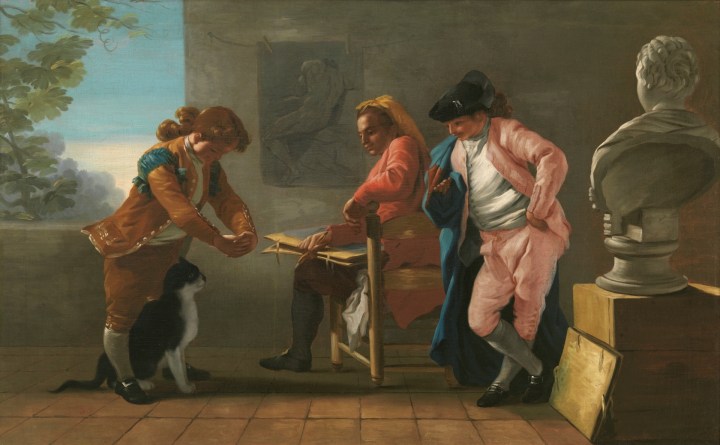
José del Castillo, The Study of Drawing, 1780, oil on canvas, 105 × 160 cm
(Madrid: Prado).
◊ ◊ ◊ ◊ ◊
Now on view at the Prado:
Meta-painting: A Journey to the Idea of Art / Metapintura: Un viaje a la idea del arte
Museo Nacional del Prado, Madrid, 15 November 2016 — 19 February 2017
Curated by Javier Portús
With Meta-painting, the Museo del Prado is offering a new approach to its collection in the latest in a series of exhibitions that began in 2010 with Rubens and continued with Captive Beauty (2013) and Goya in Madrid (2014). This series has aimed to offer visitors the chance to reflect on the Museum’s own collections and to look at its works in a new context which encourages different interpretations. Meta-painting proposes a journey that begins with mythological and religious narratives on the origins of artistic activity at the dawn of the modern age and concludes in 1819, the year of the Prado’s foundation. The exhibition thus also celebrates the 197th anniversary of the Museum’s founding as a temple of the arts, signifying their full acceptance as disciplines of social utility.
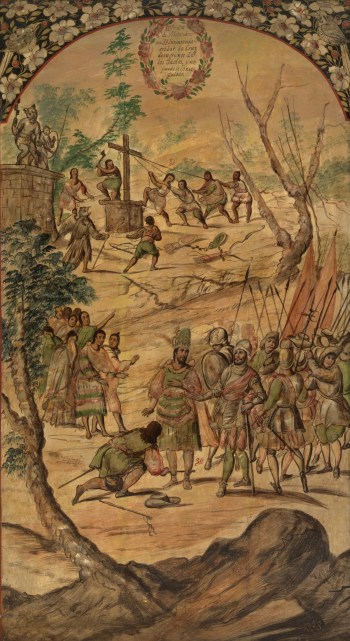
Juan González / Miguel González, Conquista de México por Hernán Cortés (30 y 31), 1698. Enconchado, Óleo sobre lienzo sobre tabla, 97 × 53 cm.
Two aspects central to the Prado—the Spanish royal collections and Spanish art—provide the context for the exhibition’s structure. Furthermore, these are two inseparable terms, given that the evolution of Spanish art was determined by the existence of the royal collections. The survey offered by the exhibition is a wide-ranging and varied one, including paintings, drawings, prints, books, medals, examples of the decorative arts and sculptures. Twenty-two of these works have been loaned by eighteen museums and collections, including the Fundación Casa de Alba, the National Gallery in London, the Museo de Bellas Artes in Seville, the Banco de España, and the Museo de la Real Academia de Bellas Arts de San Fernando in Madrid.
All the 137 works in the exhibition refer to art or to images, either as self-portraits of creators such as Titian, Murillo, Bernini and Goya; or because they include other paintings and sculptures, such as Saint Benedict destroying Idols by Ricci and Arachne by Rubens; or because they analyse issues relating to the definition of art and its history, such as José García Hidalgo’s book Principles for studying the very noble and royal art of painting […] and Goya’s Portrait of Jovellanos.
The exhibition’s ‘journey’ is divided into different phases. Fifteen sections focus on the relationship between art, the artist and society, each one of which looks at a specific issue, among them: the powers attributed to religious images; the role played by the ‘painting within the painting’; artists’ attempts to break through the pictorial space and continue it towards the viewer; the origins and practice of the idea of artistic tradition; portraits and self-portraits of artists; places for the creation and collecting of art; the origin of the modern concept of art history; the subjectivity that emerged in self-portraits from the Enlightenment onwards; and the importance of the concepts of love, death and fame in the modern artistic discourse.
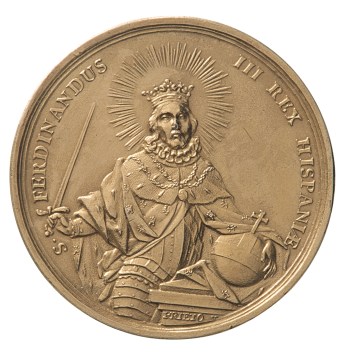
Francisco Tomás Prieto, Segundo premio de primera clase de la Academia de San Fernando, 1753, Silver-gilt, 44,5 mm diameter (Madrid: Prado)
The exhibition also represents a tribute by the Museo del Prado to Cervantes on the 400th anniversary of his death as it includes a section on Don Quixote as one of the great examples of self-referential literature, juxtaposed with Las Meninas. Thus, just as Cervantes’ text is a ‘novel within a novel’ so Velázquez’s painting is a ‘painting on painting’ in which the artist not only depicts himself painting but which involves various important issues regarding the potential of the art of painting and the role of the painter.
Las Meninas will remain in Room 12 of the Villanueva Building where it is habitually displayed but it is present in the exhibition through a modern facsimile of part of Laurent’s graphoscope which is displayed alongside editions of the two parts of Don Quixote, reminding visitors that these two masterpieces of the Spanish Golden Age are both reference points in the history of meta-fiction.
Javier Portús, Metapintura: Un viaje a la idea del arte (Madrid: Museo Nacional del Prado, 2016), 304 pages, ISBN: 978-8484803270.
In Memoriam | Giles Waterfield (1949–2016)
From Giles’s website:
Giles Waterfield
(24 July 1949 – 5 November 2016)
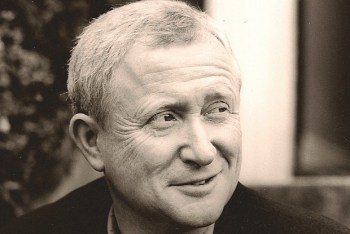 It is with very great sadness that we announce the death of Giles Waterfield, curator, novelist (his novel The Long Afternoon won the McKitterick Prize in 2001), and belletrist. He was Director of the Dulwich Picture Gallery from 1979 to 1996 and was Director of Royal Collection Studies (organised on behalf of Royal Collection Trust by the Attingham Trust) and Associate Lecturer at the Courtauld Institute of Art in addition to lecturing at the University of Notre Dame, London and Arcadia University.
Javier Pes’s obituary for The Art Newspaper is available here»
Thomas Marks’s tribute for Apollo Magazine is available here»
Anna Somers Cocks’s obituary for The Guardian is available here»
Condolences may be offered here»
Note (added 27 November 2016) — There will be a Service of Thanksgiving for Giles on Wednesday, 11th January 2017 at 3pm at St Martin-in-the-Fields, Trafalgar Square, London. All are very welcome.
Attingham Offerings for 2017

Giovanni Paolo Panini, Modern Rome, 1757, 172 × 233 cm
(New York: The Metropolitan Museum of Art, 52.63.2)
◊ ◊ ◊ ◊ ◊
Along with Attingham’s regular course offerings, next year’s study programme will be based in Italy. More information and application forms are available at Attingham’s website. Applicants from the U.S. may contact Cynthia Drayton, admin@americanfriendsofattingham.org. Applicants from outside the U.S. may contact Rita Grudzień, rita.grudzien@attinghamtrust.org.
The 66th Attingham Summer School, 29 June — 16 July 2017
Applications due by 27 January 2017
Directed by David Adshead and Elizabeth Jamieson, and accompanied by specialist tutors and lecturers, this intensive 18-day course will include visits to country houses houses in Sussex, Derbyshire, Nottinghamshire, and Oxfordshire. The Summer School will examine the country house in terms of architectural and social history, and the decorative arts.
Royal Collection Studies, 3–12 September 2017
Applications due by 12 February 2017
Run on behalf of Royal Collection Trust, this strenuous 10-day course is based near Windsor. The school will visit royal palaces in and around London with specialist tutors (many from the Royal Collection) and study the extensive patronage and collecting of the royal family from the Middle Ages onwards.
Attingham Study Programme: Palaces and Villas of Rome and Naples, 18–26 September 2017
Applications due by 12 February 2017
Conceived from the perspective of the British, European, and American travellers who visited Italy to experience antique, renaissance, and baroque Rome during the period c.1650–1950, this intensive Study Programme is in association with the British School at Rome. . . . The programme will consider palaces and villas with their collections in the light of papal patronage and focus upon some of the key Roman families and their influence upon their contemporaries. The choice of properties encompasses those that inspired travellers to collect sculpture, books, paintings and works of art, their taste inspired by the desire to furnish and sometimes rebuild their town and country houses back home. The course director is Andrew Moore.
The London House Course, 3–9 October 2017
Applications due by 12 April 2017
The programme studies the development of the London house from the Renaissance to the present. It combines numerous visits to houses—many of them private—with a series of lectures by leading authorities. Progressing chronologically and exploring all over London, the course takes members inside grand aristocratic buildings, smaller domestic houses, artists’ studios, and the garden suburb. Speakers include Neil Burton, Caroline Dakers, Joseph Friedman, Sarah Nichols, and Gavin Stamp. The course is directed by David Adshead.
◊ ◊ ◊ ◊ ◊
Note (added 28 January 2017) — The original posting did not include information on The London House Course.
New Book | Painting and Narrative in France
From Routledge:
Peter Cooke and Nina Lübbren, eds., Painting and Narrative in France, from Poussin to Gauguin (New York: Routledge, 2016), 218 pages, ISBN: 978-1472440105, $150.
 Before Modernism, narrative painting was one of the most acclaimed and challenging modes of picture-making in Western art; yet, by the early twentieth century storytelling had all but disappeared from ambitious art. France was a key player in both the dramatic rise and the controversial demise of narrative art. This is the first book to analyse French painting in relation to narrative, from Poussin in the early seventeenth to Gauguin in the late nineteenth century. Thirteen original essays shed light on key moments and aspects of narrative and French painting through the study of artists such as Nicolas Poussin, Charles Le Brun, Jacques-Louis David, Paul Delaroche, Gustave Moreau, and Paul Gauguin. Using a range of theoretical perspectives, the authors study key issues such as temporality, theatricality, word-and-image relations, the narrative function of inanimate objects, the role played by viewers, and the ways in which visual narrative has been bound up with history painting. The book offers a fresh look at familiar material, as well as studying some little-known works of art, and reveals the centrality and complexity of narrative in French painting over three centuries.
Peter Cooke is Senior Lecturer in French Studies at the University of Manchester. His most recent book is Gustave Moreau: History Painting, Spirituality and Symbolism.
Nina Lübbren is Art Historian and Principal Lecturer in Film Studies, and Deputy Head of Department of English, Communication, Film and Media, Anglia Ruskin University.
◊ ◊ ◊ ◊ ◊
C O N T E N T S
List of Figures
Notes on Contributors
Acknowledgements
Introduction: Narrativity and (French) Painting, Peter Cooke and Nina Lübbren
I. Ancien Régime
1 Units of Vision and Narrative Structures: Upon Reading Poussin’s Manna, Claudine Mitchell
2 Figures of Narration in the Context of a Painted Cycle: The North Bays of the Grande Galerie at Versailles, Marianne Cojannot-Le Blanc
3 The Crisis of Narration in Eighteenth-Century French History Painting, Susanna Caviglia
4 Obscure, Capricious, and Bizarre: Neoclassical Painting and the Choice of Subject, Mark Ledbury
II. Restoration and July Monarchy
5 Delacroix and ‘The Work of the Reader’, Beth S. Wright
6 Narrative and History in Léopold Robert’s Arrival of the Harvesters in the Pontine Marshes, Richard Wrigley
7 Narrative Strategies in Paul Delaroche’s Assassination of the Duc de Guise, Patricia Smyth
III. Second Empire and Third Republic
8 Eloquent Objects: Gérôme, Laurens, and the Art of Inanimate Narration, Nina Lubbren
9 Tyrannical Inopportunity: Gustave Moreau’s Anti-narrative Strategies, Scott C. Allan
10 Theatricality versus Anti-Theatricality: Narrative Techniques in French History Painting (1850−1900), Pierre Sérié
11 The Conflicted Status of Narrative in the Art of Paul Gauguin, Belinda Thomson
IV. Key Issues of Pictorial Narrative
12 Narrativity, Temporality and Allegorisation, from Poussin to Moreau, Peter Cooke
13 Towards a Study of Narration in Painting: The Early Modern Period, Étienne Jollet
Index
London’s Blue Plaques Turn 150

From English Heritage:
London’s famous blue plaques link the people of the past with the buildings of the present. Now run by English Heritage, the London blue plaques scheme is thought to be the oldest of its kind in the world and celebrates its 150th anniversary this year. Across the capital over 900 plaques, on buildings humble and grand, honour the notable men and women who have lived or worked in them.
The official blue plaques app is now available to download for free for iPhone and Android. Use the app to follow guided walks around Soho and Kensington, or explore all of the 900 plaques by finding ones nearby and searching for your favourite figures from history. From Sylvia Pankhurst’s former home in Chelsea to Jimi Hendrix’s flat in Mayfair, let English Heritage’s blue plaques guide you through the streets of London. Download the free app now from the Apple App Store for iPhone or the Google Play Store for Android.
◊ ◊ ◊ ◊ ◊
Frank and Sue Ashworth have been making the Blue Plaques from their home since 1986; for photos, see The Daily Mail (2 May 2016).
Katie Engelhart recently wrote about the Blue Plaques for The New York Times (10 November 2016).
Anna Marie Roos on a Portrait of Martin Folkes
From The Societies of Antiquaries of London:
Anna Marie Roos on a Portrait of Martin Folkes
Society of Antiquaries of London, Unlocking Our Collections, added 1 November 2016

Jonathan Richardson the Elder, Portrait of Martin Folkes, 1718, oil on canvas (Society of Antiquaries of London).
This is a portrait of Martin Folkes (1690–1754), the only person to have been President of both the Society of Antiquaries of London and of the Royal Society. What would being President of a society dedicated to the material past have to do with leading a society dedicated to science? In the 18th century, the ability to observe nature was thought to make scientists ideal to understand the empirical details of ancient artefacts and how they were created. Science and archaeology were seen as one, the Society of Antiquaries and the Royal Society had many common members and held their meetings on the same day, and Folkes tried to unite the two groups into one organisation. If he had succeeded, the humanities and sciences would perhaps be more united today. . . .
Anna Marie Roos is Reader at College of Arts, University of Lincoln.
The full essay, with a video and suggestions for further reading, is available here»
At Sotheby’s | Qianlong Emperor’s Musket Fetches $2.5million
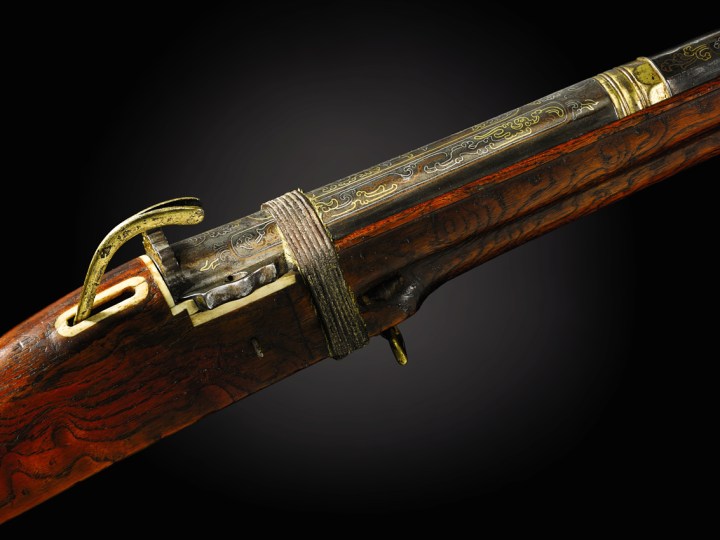
Imperial matchlock musket, made for the Qianlong Emperor (r. 1736–1795), Qing Dynasty. The gun bears the imperial reign mark on top of the barrel, and incised on the breech of the barrel are four Chinese characters that denote the gun’s ranking: te deng di yi (‘Supreme Grade, Number One’).
◊ ◊ ◊ ◊ ◊
Press release for Sotheby’s Sale L16215, Lot #1:
‘Supreme Grade, Number One’ Imperial Matchlock Musket
Sotheby’s, London, 9 November 2016
At Sotheby’s in London, the first Chinese firearm with an imperial reign mark ever to be offered at auction sold for £1,985,000 (US$2,461,400 / HK$19,198,920). The gun—a brilliantly designed and exquisitely crafted musket, produced in the imperial workshops—was created for the Qianlong Emperor of the Qing dynasty (r. 1736–1795), arguably the greatest collector and patron of the arts in Chinese history. Estimated at £1–1.5 million, the firearm ignited a ten-minute bidding battle, finally selling to an Asian private collector.
Robert Bradlow, Senior Director, Chinese Works of Art, Sotheby’s London, said: “This gun ranks as one of the most significant Chinese treasures ever to come to auction. Today’s result will be remembered alongside landmark sales of other extraordinary objects that epitomise the pinnacle of imperial craftsmanship during the Qing dynasty. Over the last 10 years we’ve seen the market for historical Chinese works of art go from strength to strength, with collectors drawn from across the globe and exceptional prices achieved whether the sale is staged in London, Hong Kong, or New York.”
The musket bears not only the imperial reign mark on top of the barrel, but in addition, incised on the breech of the barrel, are four Chinese characters that denote the gun’s peerless ranking—the exceptional grading te deng di yi, ‘Supreme Grade, Number One’. This grading makes it unique among the known extant guns from the imperial workshops and asserts its status as one of the most important firearms produced for the Qianlong Emperor.
The advent of Western firearm technology sparked the production of muskets in the imperial workshops, and this modern mode of weaponry had unquestionable advantages over the traditional bow and arrow for hunting. Using only the most luxurious materials, imperial muskets were created in very small numbers for the Qianlong Emperor. While the Emperor is unlikely ever to have held a gun in battle, he would regularly hunt with a musket.
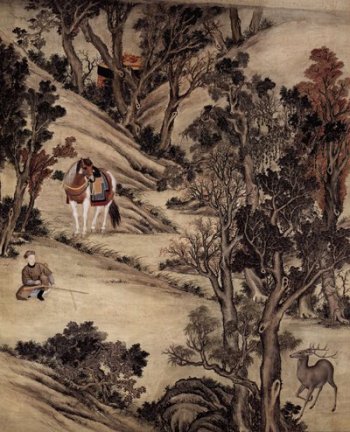
Anonymous court painter, The Qianlong Emperor Shooting Deer (Beijing: Palace Museum), from The Complete Collection of Treasures of the Palace Museum: Armaments and Military Provisions (Hong Kong, 2008), p. 205.
The Supreme Number One is closely related to six celebrated, named imperial Qianlong muskets in the collection of the Palace Museum, Beijing, which appear to correspond with seven muskets listed in the Qing work Collected Statutes of the Qing Dynasty with Illustrations. These guns were probably graded in the same way as the Supreme Number One, but of lower grade and/or number (‘Supreme Grade, Number Two’, ‘Top Grade, Number 2’).
Revered as one of the most powerful ‘Sons of Heaven’, the Qianlong Emperor (1711–1799) was the longest-lived and de-facto longest-reigning emperor in Chinese history (r. 1736–1795). In the 60th year of his reign (1795), the eighty-five year old Qianlong Emperor declared his abdication, lest he surpassed the 60-year reign of his grandfather, the Kangxi Emperor (r. 1662–1722). In a grand coronation ceremony the following year, his fifteenth son took position of emperor, though the Qianlong Emperor continued to rule China as the Qing dynasty’s only, and China’s last, Emperor Supreme.
◊ ◊ ◊ ◊ ◊
Note (added 11 November 2016) — The original version of this posting included a view looking down the barrel of the gun. Once the posting was published, I was struck by how threatening the photo could appear to some (myself included). The point of the posting was to highlight something of the collection (and market interest in the collection) of the Qianlong Emperor. I didn’t mean to make the world a more hostile place. It’s been a tough enough week without more guns pointed at anyone. It was a mistake, and I’m sorry. –CH










 Enfilade
leave a comment