U of Michigan Graduate Symposium: All That Glitters
The day’s presentations include these eighteenth-century papers:
All That Glitters: Magnificence in Art, Architecture, and Visual Culture
2016 Graduate Symposium
University of Michigan Museum of Art, Ann Arbor, 12 November 2016
• Philippe L. B. Halbert (Yale University), ‘Our Colony Has Today Become Opulent’: Material Magnificence in the French Atlantic World, 1660–1789
• Emily Anderson (University of Southern California), Magnificent Macabre: The Engravings of the Anatomical Preparations of Frederik Ruysch
Acquisition Appeal | Thomas Lawrence’s Unfinished Portrait Wellington
An appeal from the NPG:
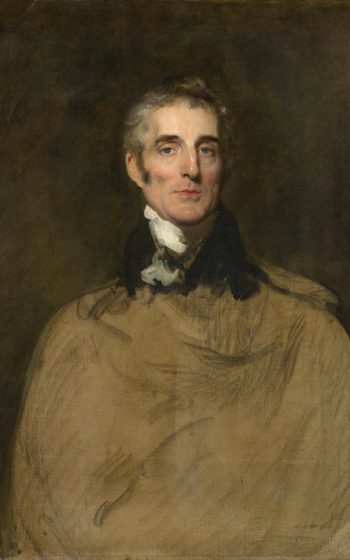
Sir Thomas Lawrence, Unfinished Portrait of Arthur Wellesley, 1st Duke of Wellington, 1829, oil on canvas, 94.3 × 74.3 cm (Private Collection).
The National Portrait Gallery has launched a public appeal to acquire Sir Thomas Lawrence’s unfinished final portrait of Arthur Wellesley, 1st Duke of Wellington, it was announced today, Thursday 3 November 2016. The portrait has been offered to the National Portrait Gallery for £1.3 million. The appeal was kick started today by a donation of £350,000 from the Art Fund, whose generous support means that alongside the Gallery’s own funds, £1 million of the total has already been raised. The Gallery has £300,000 to raise by spring 2017.
The Gallery has no other significant portrait of the Duke in its Collection, an omission of one of the most iconic and popular figures in British history. The Gallery has been seeking to secure such a portrait since it opened in 1856. This work is one of only two world-class portraits of Wellington ever likely to come up for sale. The leading artist of his age Sir Thomas Lawrence made eight portraits of Wellington and was the Duke’s definitive image maker.
Started in 1829, the year Wellington was appointed Lord Warden of the Cinque Ports and in which he fought a duel with Lord Winchilsea over the issue of Catholic emancipation, the unfinished portrait shows him in civilian dress with only his black collar and white stock visible. It was commissioned at the height of Wellington’s political career when he was Prime Minister. At the time he was closely involved in the legislation around catholic emancipation and deeply opposed to the reform of the House of Commons. Earlier in the decade he had been involved in the delicate negotiations between the Prince Regent and the Prince’s estranged wife, Queen Caroline. He also represented British interests at the Congress of Verona in 1822, one of a series of conferences on European affairs after the Napoleonic Wars.
The large oil-on-canvas portrait was commissioned a year after Wellington had become Tory Prime Minister by Sarah, Countess of Jersey, a leading political hostess and supporter of the Tories in the 1820s. Initially dedicating her social gatherings to the cause of the Whig party, in the late 1820s Lady Jersey switched her allegiance to the Tories, with Wellington becoming one of her favourites. She believed herself to be one of his confidantes, but he mistrusted her ability to keep a secret: earlier in life her loquacity had earned her the nickname ‘Silence’.
At Lawrence’s death in 1830 the portrait remained unfinished. But unlike many other clients, Lady Jersey refused to have it finished by a studio assistant. On hearing that the Duke of Wellington had fallen from power in 1830, Lady Jersey burst into tears in public. She reportedly ‘moved heaven and earth’ against the Reform Act 1832 which Wellington had also opposed.
Dr Nicholas Cullinan, Director of the National Portrait Gallery, London, says: “We have been searching for a portrait that can do justice to this iconic British hero since 1856. The lack of a suitable depiction of the Duke of Wellington has long been identified as the biggest gap in our collection. If we can raise the funds this remarkable painting by Sir Thomas Lawrence will be on permanent display and free for over two million visitors to enjoy each year.”
Dr Stephen Deuchar, Art Fund Director, says: “The National Portrait Gallery will make a fine home for this intensely compelling portrait of Wellington. We are pleased to have made a major grant towards its purchase, and hope the public will support the appeal to raise the remaining funds. This is a very important national acquisition.”
Dr Lucy Peltz, Senior Curator, 18th-Century Portraits and Head of Collections Displays (Tudor to Regency), National Portrait Gallery, London, says: “This is a compelling portrait of one of the most famous figures in early nineteenth-century Britain. Lawrence was a superlative portrait painter with the flair and talent to capture surface glamour and deeper currents. This unfinished portrait is shot with psychological insight.”
Dan Snow, historian, broadcaster and co-author of The Battle of Waterloo Experience, says: “The ‘Iron Duke’ is one of the towering figures of British history. He never lost a battle, reshaped Europe, and dominated Britain until his death. His career and legacy are intimately involved with the development of the United Kingdom. Now, more than 200 years after his most famous victory at the Battle of Waterloo it’s time we helped the National Portrait Gallery win the day.”
The painting was lent to the National Portrait Gallery’s exhibition Wellington: Triumphs, Politics and Passions staged in 2015 to mark the bicentenary year of the Battle of Waterloo. Prior to its loan to the Gallery from a private collection for a short period of display just before the exhibition opened, the portrait, which is in excellent condition, had not been on public view for any significant period since it was painted.
Fellowships | Lewis Walpole Library, 2017–18
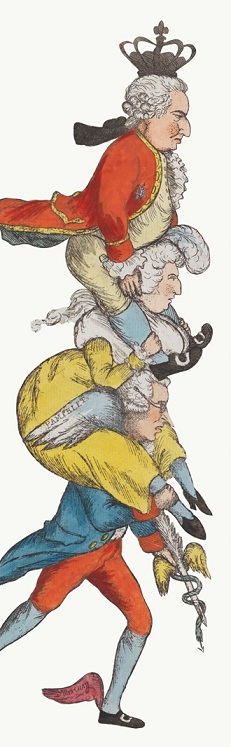 The Lewis Walpole Library, a department of Yale University Library, invites applications to its 2017–18 fellowship program:
Visiting Fellowships and Travel Grants
The Lewis Walpole Library, 2017–18
Applications due by 9 January 2017
Located in Farmington, Connecticut, the library offers short-term residential fellowships and travel grants to support research in the library’s rich collections of eighteenth century materials (mainly British), including important holdings of prints, drawings, manuscripts, rare books, and paintings. In addition, the library offers a joint fellowship award with the Beinecke Rare Book and Manuscript Library to support up to eight weeks of research in both collections. Scholars pursuing postdoctoral or advanced research, as well as doctoral candidates at work on a dissertation, are encouraged to apply.
Recipients are expected to be in residence at the library, to be free of other significant professional obligations during their stay, and to focus their research on the Lewis Walpole Library’s collections. Fellows also have access to additional resources at Yale, including those in the Sterling Memorial Library, the Beinecke Rare Book and Manuscript Library, and the Yale Center for British Art. Residential fellowships include the cost of travel to and from Farmington, accommodation for four weeks in an eighteenth-century house on the library’s campus, and a per diem living allowance. Travel grants cover transportation costs to and from Farmington for research trips of shorter duration and include on-site accommodation.
Application details and requirements are available here. The application deadline is January 9, 2017. Awards will be announced in March.
Exhibition | Bitter Sweet: Coffee, Tea, and Chocolate
Overlapping, at least partially, with The Edible Monument, this DIA exhibition explores luxury drinks:
Bitter|Sweet: Coffee, Tea, and Chocolate
Detroit Institute of Arts, 20 November 2016 — 5 March 2017
Curated by Yao-Fen You
The Detroit Institute of Arts presents Bitter|Sweet: Coffee, Tea & Chocolate, on view from November 20, 2016 to March 5, 2017. The introduction of coffee, tea, and chocolate to Europe, beginning in the late 16th century, profoundly changed drinking habits, tastes, and social customs, and spurred an insatiable demand for specialized vessels such as tea canisters, coffee cups, sugar bowls, and chocolate pots. The exhibition is organized by the Detroit Institute of Arts with support from the National Endowment for the Arts.

Pineapple Coffeepot, ca. 1750, creamware with colored glazes, Staffordshire, England (Detroit Institute of Arts).
The 68 works of art in Bitter|Sweet are mostly from the museum’s comprehensive holdings in pre-1850 European silver and ceramics. Highlights include three exquisitely decorated beverage services: a rare 24-piece set made by Germany’s Fürstenberg Porcelain Manufactory; a set once owned by Prince Louis, Duke of Nemours that illustrates the refinement of early 19th-century French Sèvres porcelain; and a Vienna Porcelain ensemble for two associated with Archduke Joseph of Austria. DIA paintings, prints, and sculpture related to the arrival and impact of the beverages in Europe help create new contexts and connections for objects from the permanent collection.
Other key works include Madame de Pompadour’s coffee grinder from the Musée du Louvre; a 1684 handwritten Spanish manuscript satirizing the vogue for chocolate from the Hispanic Society, New York; and an 18th-century German breakfast set containing chocolate beakers from the Clark Art Institute, Williamstown, Massachusetts. Diego Velázquez’s painting Infanta Maria Theresa from the Museum of Fine Arts Boston helps tell the story of the cocoa bean’s migration from the New World to the French royal court of Louis XIV via Spain.
Bitter|Sweet will be the first DIA exhibition to engage all five senses. In addition to the artworks, there will be videos about the preparation of coffee, tea, and chocolate as well as opportunities to touch, to hear, to smell, and even to taste. Such interactive components demonstrate the DIA’s commitment to engaging visitors in meaningful experiences with art.
“The exhibition is a very exciting venture for the DIA, with regards to the rich, complex story we’re telling and the innovative visitor-centered ways in which we are presenting it,” said Salvador Salort-Pons, DIA director. “While European art will be at center stage, the exhibition examines global interconnections from centuries ago that we hope will resonate with all visitors today. Just about everyone—regardless of culture or background—has a personal relationship with one or more of these beverages. I’m also excited about the ways the exhibition engages the permanent collection. Of course, I love that several of the loans in Bittersweet comment on Spain’s relationship to chocolate.”
Bitter|Sweet also touches on the human cost of procuring the raw materials to produce coffee, tea, and chocolate as well as the sugar used to alter the beverages’ bitter taste. Coffee was imported from Africa through the Middle East, tea from Asia, chocolate from the Americas, and sugar harvested by slaves on colonial plantations. To meet demand and keep prices down for the European market, merchants—such as the Dutch East India Company and the British East India Company—eventually found ways to cultivate tea and coffee bushes on foreign lands colonized under their rule.
◊ ◊ ◊ ◊ ◊
From Yale UP:
Yao-Fen You, with essays by Mimi Hellman and Hope Saska, Coffee, Tea, and Chocolate: Consuming the World (New Haven: Yale University Press, 2016), 142 pages, ISBN: 978-0300222500, $25.
 Coffee, tea, and chocolate were all the rage in Enlightenment Europe. These fashionable beverages profoundly shaped modes of sociability and patterns of consumption, yet none of the plants required for their preparation was native to the continent: coffee was imported from the Levant, tea from Asia, and chocolate from Mesoamerica. Their introduction to 17th-century Europe revolutionized drinking habits and social customs. It also spurred an insatiable demand for specialized vessels such as hot beverage services and tea canisters, coffee cups, and chocolate pots.
This beautiful book demonstrates how the paraphernalia associated with coffee, tea, and chocolate can eloquently evoke the culture of these new beverages and the material pleasures that surrounded them. Contributors address such topics as the politics of coffee consumption in 18th-century Germany; 18th-century visual satires on the European consumption of tea, coffee, and chocolate; and the design history of coffee pots in the United States between the colonial period and the present.
Yao-Fen You is associate curator of European sculpture and decorative arts at the Detroit Institute of Arts.
Call for Papers | Poor Taste
From H-ArtHist:
Poor Taste and the Exclusionary Mechanisms of Cultural Consumption
University of California Santa Barbara 42nd Annual Graduate Student Symposium
University of California Santa Barbara, 28 April 2017
Proposals due by 31 December 2016
“Taste classifies, and it classifies the classifier.”
–Pierre Bourdieu, Distinction
Cultural consumers are defined and classified by their taste. Through an evaluation of their choices and preferences, whether biologically or socially informed, taste functions as a mechanism of distinction and exclusion. Art and Architectural History has arguably been a cornerstone of this very tradition, disciplining bodies and senses in the formation of canons and cultural hierarchies. While taste is now widely accepted to be subjective and localized rather than universal, ideals of good taste and quality endure in both our disciplinary frameworks and institutional practices.
This symposium therefore aims to address the judgment of taste, and the agents and spaces involved in its creation and enforcement. We consider such questions as: Can terms like consumption, digestion, and indigestion provide useful metaphors or models for the processes by which cultural traditions and products are validated and/or dismissed? How has cultural consumption been designated as legitimate or alternatively illegitimate in various historical and cultural contexts? In the history of cultural consumption, how have poor taste and good taste proven to have both opposed and informed one another? We welcome proposals from emerging scholars of all disciplinary backgrounds whose work engages with the themes of the conference.
Topics of interest
• The performance of distinction
• Decolonization of taste
• The spaces and institutionalization of judgment
• The historical construction of (poor) taste
• Craft, camp, kitsch, and the popular aesthetic
• Cultural appropriation
• Studies of foods and foodways
We invite abstracts of 300 words or less and a 1-page CV to be sent to ucsb.haa.symposium@gmail.com by December 31, 2016. (Inclusion of working title and images encouraged). Conference presentations will be 20 minutes. All participants will be notified by early February.
Please feel free to contact conference organizers J.V. Decemvirale and Maggie Mansfield at ucsb.haa.symposium@gmail.com with any questions.
2016 Georgian Group Architectural Awards

Wimpole Gothic Tower, Cambridgeshire, designed in 1749 and built 1768–1772; photo, following restoration, from Treasure Hunt, Emile de Bruijn’s blog on National Trust Collections (18 August 2015). The posting includes additional views and lots more information. In May, the restoration project received a European Union Prize for Cultural Heritage / Europa Nostra Awards, Europe’s highest honor in the heritage field.
◊ ◊ ◊ ◊ ◊
As recently announced, the 2016 Georgian Group Architectural Award for Restoration of a Structure in the Landscape went to Wimpole Gothic Tower:
Restoration of a Structure in the Landscape: Wimpole Gothic Tower
The Gothic Tower, designed to look like a picturesque medieval ruin, is based on a sketch by the architect Sanderson Miller in 1749 for his patron, Lord Hardwicke, the owner of Wimpole. The design was later realised in an amended form under the supervision of the great landscape designer Lancelot ‘Capability’ Brown from 1768 to 1772. In the following centuries, the ruin suffered extensive and gradual damage with many important characteristics being completely eroded while public access to the Tower and landscape was near enough impossible. Located in the magnificent parkland of Wimpole Estate, the Gothic Tower presented a complex conservation challenge for the National Trust. The work called for repair of the structure, stabilization of the stonework and reinstatement of missing components of the building, while preserving the weathered beauty and original ‘ruined’ appearance.
Wendy Monkhouse, National Trust Curator in the East of England, said, “We’re delighted to have been recognized by the European Commission and Europa Nostra for the work we’ve done on the Gothic Tower—it’s the most prestigious heritage award in Europe, and it means a lot to the National Trust and to the staff and volunteers at Wimpole. Many people know and love the magnificent mansion and the eighteenth-century farm, but the Tower was an almost forgotten ruin—a kind of sleeping beauty, literally surrounded by briar roses and nettles. Now, with its reinstated crenellations triumphant on the main Tower, it sits once more at the focal point of the landscape designed by Capability Brown, whose tercentenary we are celebrating this year.”
Additional Awards
• Restoration of a Georgian Country House: Combermere Abbey
• Restoration in the Public Realm: Sheffield non-Conformist Chapel
• The Brown Tercentenary Award: Compton Verney
• New Building in the Classical Tradition: A Chapel in South East England
• Restoration of a Georgian Interior: Crichel Grange
Details for winners and commended sites are available here»
New Books | American History and the Enlightenment
As these six books underscore, America has always been a complicated place. All the best for a Happy Election Day! –CH
From the University of Georgia Press:
Jennifer Goloboy, Charleston and the Emergence of Middle-Class Culture in the Revolutionary Era (Athens: University of Georgia Press, 2016), 208 pages, ISBN: 978-0820349961, $55.
 Too often, says Jennifer Goloboy, we equate being middle class with ‘niceness’—a set of values frozen in the antebellum period and centered on long-term economic and social progress and a close, nurturing family life. Goloboy’s case study of merchants in Charleston, South Carolina, looks to an earlier time to establish the roots of middle-class culture in America. She argues for a definition more applicable to the ruthless pursuit of profit in the early republic. To be middle class then was to be skilled at survival in the market economy.
What prompted cultural shifts in the early middle class, Goloboy shows, were market conditions. In Charleston, deference and restraint were the bywords of the colonial business climate, while rowdy ambition defined the post-Revolutionary era, which in turn gave way to institution building and professionalism in antebellum times. Goloboy’s research also supports a view of the Old South as neither precapitalist nor isolated from the rest of American culture, and it challenges the idea that post-Revolutionary Charleston was a port in decline by reminding us of a forgotten economic boom based on slave trading, cotton exporting, and trading as a neutral entity amid warring European states. This fresh look at Charleston’s merchants lets us rethink the middle class in light of the new history of capitalism and its commitment to reintegrating the Old South into the world economy.
Jennifer L. Goloboy is an independent scholar based in Minneapolis, specializing in the history of the early American middle class. She is the editor of Industrial Revolution: People and Perspectives. Goloboy earned her PhD in the history of American civilization from Harvard University.
◊ ◊ ◊ ◊ ◊
From Basic Books:
Nicholas Nicholas Guyatt, Bind Us Apart: How Enlightened Americans Invented Racial Segregation (New York: Basic Books, 2016), 416 pages, ISBN: 978-0465018413, $30.
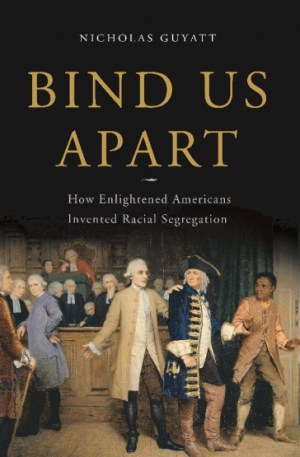 Why did the founding fathers fail to include blacks and Indians in their cherished proposition that “all men are created equal”? The usual answer is racism, but the reality is more complex and unsettling. In Bind Us Apart, historian Nicholas Guyatt argues that, from the Revolution through the Civil War, most white liberals believed in the unity of all human beings. But their philosophy faltered when it came to the practical work of forging a color-blind society. Unable to convince others—and themselves—that racial mixing was viable, white reformers began instead to claim that people of color could only thrive in separate republics: in Native states in the American West or in the West African colony of Liberia. Herein lie the origins of “separate but equal.” Decades before Reconstruction, America’s liberal elite was unable to imagine how people of color could become citizens of the United States. Throughout the nineteenth century, Native Americans were pushed farther and farther westward, while four million slaves freed after the Civil War found themselves among a white population that had spent decades imagining that they would live somewhere else. Essential reading for anyone disturbed by America’s ongoing failure to achieve true racial integration, Bind Us Apart shows conclusively that “separate but equal” represented far more than a southern backlash against emancipation—it was a founding principle of our nation.
Nicholas Guyatt is a university lecturer in history at the University of Cambridge. He is a regular contributor to The Nation, London Review of Books, and The Guardian. Guyatt lives in Cambridge, England.
◊ ◊ ◊ ◊ ◊
From The University of North Carolina Press:
Robert Parkinson, The Common Cause: Creating Race and Nation in the American Revolution (Chapel Hill: The University of North Carolina Press, for the Omohundro Institute of Early American History and Culture, Williamsburg, 2016), 768 pages, ISBN: 978-1469626635, $45.
 When the Revolutionary War began, the odds of a united, continental effort to resist the British seemed nearly impossible. Few on either side of the Atlantic expected thirteen colonies to stick together in a war against their cultural cousins. In this pathbreaking book, Robert Parkinson argues that to unify the patriot side, political and communications leaders linked British tyranny to colonial prejudices, stereotypes, and fears about insurrectionary slaves and violent Indians. Manipulating newspaper networks, Washington, Jefferson, Adams, Franklin, and their fellow agitators broadcast stories of British agents inciting African Americans and Indians to take up arms against the American rebellion. Using rhetoric like “domestic insurrectionists” and “merciless savages,” the founding fathers rallied the people around a common enemy and made racial prejudice a cornerstone of the new Republic. In a fresh reading of the founding moment, Parkinson demonstrates the dual projection of the “common cause.” Patriots, through both an ideological appeal to popular rights and a wartime movement against a host of British-recruited slaves and Indians, forged a racialized, exclusionary model of American citizenship.
Robert G. Parkinson is assistant professor of history at Binghamton University.
◊ ◊ ◊ ◊ ◊
From Yale UP:
Steve Pincus, The Heart of the Declaration: The Founders’ Case for an Activist Government (New Haven: Yale University Press, 2016), 224 pages, ISBN: 978-0300216189, $26.
 From one election cycle to the next, a defining question continues to divide the country’s political parties: Should the government play a major or a minor role in the lives of American citizens? The Declaration of Independence has long been invoked as a philosophical treatise in favor of limited government. Yet the bulk of the document is a discussion of policy, in which the Founders outlined the failures of the British imperial government. Above all, they declared, the British state since 1760 had done too little to promote the prosperity of its American subjects. Looking beyond the Declaration’s frequently cited opening paragraphs, Steve Pincus reveals how the document is actually a blueprint for a government with extensive powers to promote and protect the people’s welfare. By examining the Declaration in the context of British imperial debates, Pincus offers a nuanced portrait of the Founders’ intentions with profound political implications for today.
Steve Pincus is the Bradford Durfee Professor of History at Yale University. He is the author of several books on seventeenth- and eighteenth-century British history.
◊ ◊ ◊ ◊ ◊
From Johns Hopkins UP:
Richard Alan Ryerson, John Adams’s Republic: The One, the Few, and the Many (Baltimore: Johns Hopkins University Press, 2016), 576 pages, ISBN: 978-1421419220, $60.
 Scholars have examined John Adams’s writings and beliefs for generations, but no one has brought such impressive credentials to the task as Richard Alan Ryerson in John Adams’s Republic. The editor-in-chief of the Massachusetts Historical Society’s Adams Papers project for nearly two decades, Ryerson offers readers of this magisterial book a fresh, firmly grounded account of Adams’s political thought and its development.
Of all the founding fathers, Ryerson argues, John Adams may have worried the most about the problem of social jealousy and political conflict in the new republic. Ryerson explains how these concerns, coupled with Adams’s concept of executive authority and his fear of aristocracy, deeply influenced his political mindset. He weaves together a close analysis of Adams’s public writings, a comprehensive chronological narrative beginning in the 1760s, and an exploration of the second president’s private diary, manuscript autobiography, and personal and family letters, revealing Adams’s most intimate political thoughts across six decades. How, Adams asked, could a self-governing country counter the natural power and influence of wealthy elites and their friends in government? Ryerson argues that he came to believe a strong executive could hold at bay the aristocratic forces that posed the most serious dangers to a republican society. The first study ever published to closely examine all of Adams’s political writings, from his youth to his long retirement, John Adams’s Republic should appeal to everyone who seeks to know more about America’s first major political theorist.
Richard Alan Ryerson, the former academic director and historian of the David Library of the American Revolution, was the editor-in-chief of the Adams Papers from 1983 to 2001.
◊ ◊ ◊ ◊ ◊
From Yale UP:
Caroline Winterer, American Enlightenments: Pursuing Happiness in the Age of Reason (New Haven: Yale University Press, 2016), 368 pages, ISBN: 978-0300192575, $35.
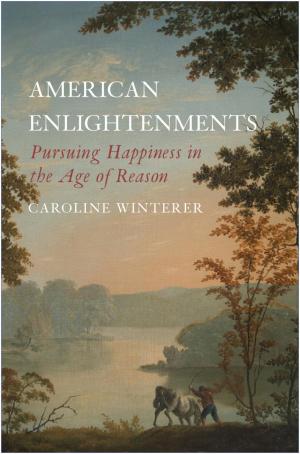 The accepted myth of the ‘American Enlightenment’ suggests that the rejection of monarchy and establishment of a new republic in the United States in the eighteenth century was the realization of utopian philosophies born in the intellectual salons of Europe and radiating outward to the New World. In this revelatory work, Stanford historian Caroline Winterer argues that a national mythology of a unitary, patriotic era of enlightenment in America was created during the Cold War to act as a shield against the threat of totalitarianism and that Americans followed many paths toward political, religious, scientific, and artistic enlightenment in the 1700s that were influenced by European models in more complex ways than commonly thought. Winterer’s book strips away our modern inventions of the American national past, exploring which of our ideas and ideals are truly rooted in the eighteenth century and which are inventions and mystifications of more recent times.
Caroline Winterer is Anthony P. Meier Family Professor in the Humanities at Stanford University and director of the Stanford Humanities Center. The author of three previous books, she received an American Ingenuity Award from the Smithsonian Institution.
Exhibition | John Trumbull: Visualizing American Independence

Press release (1 November 2016) from the Wadsworth Atheneum:
John Trumbull: Visualizing American Independence
Wadsworth Atheneum Museum of Art, Hartford, 5 November 2016 — July 2017
Three historic scenes by America’s first history painter, John Trumbull, are central to a new installation at the Wadsworth Atheneum Museum of Art that explores the visual interpretation of the Revolutionary War (1775–83). John Trumbull: Visualizing American Independence features more than 30 objects taken from the museum’s permanent collection, including additional work by Trumbull, as well as works by modern artists who revisited the legacy of the war in the twentieth century in observance of major anniversaries such as the bicentennial of George Washington’s birth in 1932 and the nation’s bicentennial in 1976. The installation opens November 5, 2016 and is on view through July 2017.
John Trumbull (1756–1843) served in the Continental Army during the Revolutionary War and later created a series of eight paintings devoted to the subject, explaining once to Thomas Jefferson that he hoped the paintings would “diffuse the knowledge and preserve the memory of the noblest series of actions which have ever dignified the history of man.” After completing a second edition to adorn the rotunda of the United States Capitol in Washington, D.C., Trumbull began a third and final series in 1831. Due to his failing health, Trumbull was able to complete only five of the paintings, all of which were purchased by the trustees of the Wadsworth Atheneum. Trumbull’s Revolutionary War scenes were some of the museum’s inaugural objects and were displayed when the first gallery opened in 1844. Three of those paintings—The Death of General Montgomery in the Attack on Quebec, December 31, 1775; The Declaration of Independence, July 4, 1776; and The Capture of the Hessians at Trenton, December 26, 1776—are included in the installation. The Death of General Warren at the Battle of Bunker’s Hill, June 17, 1775 is on view in the museum’s Morgan Great Hall, and The Death of General Mercer at the Battle of Princeton, January 3, 1777 is scheduled for loan to a peer institution.
Trumbull’s role as artist-historian encouraged later generations of artists to address the American Revolution, securing the legacy of its heroes. “Trumbull set the stage for later generations of artists to reinterpret the Revolutionary War and enhance the iconography of American independence,” says Erin Monroe, the Robert H. Schutz, Jr., Associate Curator of American Paintings and Sculpture.
One of the most frequently portrayed subjects from this period is George Washington, whose image—especially after his death—became so symbolic that memorial portraits elevated him to a divine figure. Many portraits were made into engravings and mass-produced, providing artists with easy accessibility to Washington’s likeness for transfer onto textiles, decorative arts, jewelry, postage stamps, currency, and other objects. John Trumbull: Visualizing American Independence features a range of such renditions, including several nineteenth-century ceramic jugs decorated with Washington’s image and a 1975 color lithograph by Alex Katz, titled Young Washington, from the Kent Bicentennial Portfolio, Spirit of Independence.
Conference | The Inexplicable and the Unfathomable: China and Britain
This weekend at The Courtauld:
The Inexplicable and the Unfathomable: China and Britain, 1600–1900
The Courtauld Institute of Art, London, 11–12 November 2016
Organized by David Park, Lars Tharp, and Frances Wood
 The “Chinese character seems at present inexplicable,” observed Lord Macartney during his celebrated embassy to China in the 1790s, while the Chinese themselves at this time often described “western ocean barbarians” as “unfathomable.” The failure of Macartney’s embassy is well known, not least the Emperor Qianlong’s dismissive comment that “we possess all things. I set no value on objects strange or ingenious, and have no use for your country’s manufactures.”
A sense of bafflement might therefore overwhelm the present-day visitor to the Forbidden City, on encountering its glorious array of English clocks, many imported during Qianlong’s reign. The present conference will consider some of the endless misunderstandings and deliberate deceptions that characterised relations between Britain and China in the four centuries under review, in fields as varied as religion and art, and commerce and literature. It will also explore, however, the burgeoning range of contacts between the two countries, and the increased mutual understanding achieved by two cultures separated by “the confines of many seas.”
Advance booking required: £16 general admission / £11 students and concessions.
Organisers
David Park, The Courtauld Institute of Art
Lars Tharp, Ceramics Historian, Curator and Broadcaster
Frances Wood, Former Curator of Chinese Collections, The British Library
◊ ◊ ◊ ◊ ◊
F R I D A Y , 1 1 N O V E M B E R 2 0 1 6
17.30 Registration
18.00 Keynote Address
• Donald S. Lopez (University of Michigan), Britain and Buddhism: George Bogle in Tibet, 1774–75
19.15 Reception
S A T U R D A Y , 1 2 N O V E M B E R 2 0 1 6
9.45 Registration
10.15 Session 1 – Chair: Roderick Whitfield
• Greg Clingham (Bucknell University, PA), Cosmology and Commerce on Lord Macartney’s Embassy to China, 1792–94
• Catherine Pagani (University of Alabama), Elaborate Clocks and Sino-British Encounters in the Eighteenth Century
11.25 Tea and coffee
11.55 Session 2 – Chair: David Park
• Tang Hui (University of Warwick), ‘The Finest of Earth’: Selling Porcelain in Eighteenth-Century Canton
• Lars Tharp, China on a Plate: Images from Hogarth to Whistler
13.00 Lunch break
14.30 Session 3 – Chair: Frances Wood
• Jessica Harrison-Hall (The British Museum), Collecting Chinese Art at the British Museum, 1760–1860
• Edward Weech and Nancy Charley (Royal Asiatic Society), The Thomas Manning Archive and Prospects for a New Perspective on British Intellectual Engagement with China in the Early 1800s
15.45 Tea and coffee
16.45 Session 4 – Chair: Lars Tharp
• Elizabeth Chang (University of Missouri), Writing Personhood from the Frontier of Western China
• Frances Wood, The View from the Other Side: China’s Reactions to the West
17.45 Concluding remarks
Exhibition | Fashionable Likeness: Pastel Portraits in Britain
Press release (21 October 2016) from The Getty:
Fashionable Likeness: Pastel Portraits in 18th-Century Britain
Getty Center, Los Angeles, 1 November 2016 — 7 May 2017
Curated by Julian Brooks and Ketty Gottardo with assistance from Alessandra Nardi
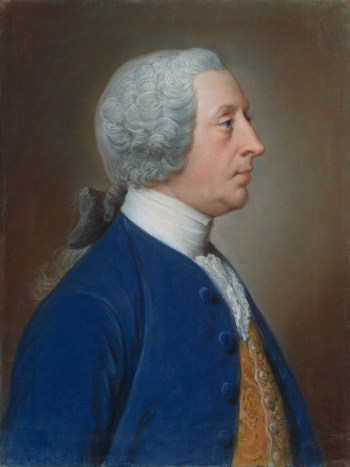
William Hoare, Portrait of Henry Hoare, ‘The Magnificent’, of Stourhead, ca. 1750–60, pastel on paper. Unframed: 61 × 45.7 cm (Los Angeles: The J. Paul Getty Museum, 2013.47.1).
In eighteenth-century Britain, portraits were commissioned by an increasingly wide cross-section of society, including the newly rich, as a visible symbol of their wealth and cultural aspirations. Fashionable Likeness: Pastel Portraits in 18th–Century Britain explores the topic of portrait drawing through a number of works in the Getty Museum’s permanent collection and select loans.
“Eager to affirm their elevated social status, sitters in 18th-century Europe were frequently portrayed in the latest fashion, wearing opulent outfits topped with powdered wigs and elaborate hairstyles,” explains Timothy Potts, director of the J. Paul Getty Museum. “With its unique texture and luminosity, pastel was the perfect medium to capture the sitters’ evanescent expressions and the symbols of their stature—the richness of their silk dresses and velvet coats. As well as its rich artistry, this exhibition also provides an insight into the carefully calibrated social structure of the day.”
“For artists and sitters, pastel painting offered practical advantages over oil, as it required fewer sittings and did not need to dry between sessions,” says Julian Brooks, co-curator of the installation. “In addition, ready-made pastel sticks were easily portable and cost less than oils.”
The first artist to become internationally renowned for pastel portraits was the Venetian artist Rosalba Carriera, whose work was much sought after by collectors across Europe. Praised for her talent at capturing a vivid likeness, Carriera employed a subtle technique of smoothing and blending hues that influenced a generation of British pastelists. Among those was John Russell, who trained with Francis Cotes and later authored Elements of Painting with Crayons (1772), one of the earliest English treatises on the pastel technique.
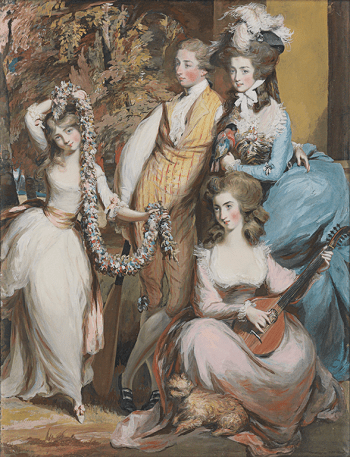
Daniel Gardner, Portrait of Mary Sturt of Crichel and Her Three Eldest Children, ca. 1777, pencil, pastel, and opaque watercolor on paper (Private collection).
In a sumptuous and vibrant family portrait by Daniel Gardner, Portrait of Mary Sturt of Crichel and Her Three Eldest Children (about 1777), Gardner perfectly illustrates English high society’s taste for fashionable costumes. Mary Sturt’s son, Humphry, wears a ruffled necktie and double-breasted striped waistcoat with large pointed lapels. His matching pair of breeches fastened at the knee feature a stylish rosette instead of the usual buckle, details only made possible with the use of pastels. “This portrait is a magnificent example of Gardner’s very original technique,” says Ketty Gottardo, co-curator of the installation. “Unusual for a pastelist, he mixed pastel powder with alcohol and applied it with a brush to paint faster, only rendering the faces in dry pastel.”
Fashionable Likeness: Pastel Portraits in 18th–Century Britain is curated by Julian Brooks, senior curator of drawings at the J. Paul Getty Museum, and Ketty Gottardo, former associate curator of drawings at the J. Paul Getty Museum now at The Courtauld Gallery in London. They were assisted by former graduate intern Alessandra Nardi.










 Enfilade
leave a comment