2017 Scholar-in-Residence Program, Hillwood Estate in D.C.
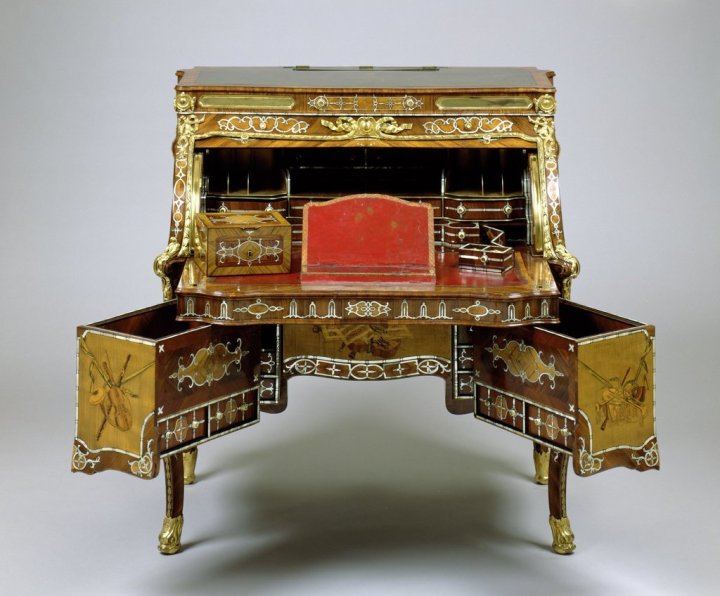
Abraham and David Roentgen, Rolltop Desk, 1765–70, wood marquetry, mother-of-pearl, gilt bronze, steel, leather, glass, 46 × 42 × 25 inches (Washington, D.C., Hillwood Estate, Museum & Gardens).
◊ ◊ ◊ ◊ ◊
2017 Scholar-in-Residence Program
Hillwood Estate, Museum & Gardens, Washington, D.C.
Applications due by 15 February 2017
PhD candidates and other highly qualified scholars conducting research that may benefit from Hillwood’s holdings are encouraged to apply. Applicants should submit a curriculum vitae and a proposal—not to exceed 500 words—stating the necessary length of residence, materials to be used, and the project’s relevance to Hillwood’s collections or exhibition program, including, but not limited to: art and architecture, landscape design, conservation and restoration, archives, library or special collections, as well as broader study areas such as the history of collecting or material culture. The project description should be accompanied by two letters of recommendation. Materials will be reviewed by the selection committee. There are three types of awards:
1 Week
Hillwood will arrange and pay for travel costs to and from the museum; housing near campus; shop and café discounts; free access to all public programs.
2–3 Weeks
Hillwood will arrange and pay for travel costs to and from the museum; shop and café discounts; free access to all public programs; a stipend of up to $1,200 depending on length of stay.
1–2 Months
Hillwood will arrange and pay for travel costs to and from the museum; shop and café discounts; free access to all public programs; a stipend of up to $1,500 per month depending on length of stay.
Founded by Marjorie Merriweather Post (1887–1973), heir to the Post Cereal Company, which later became General Foods, the Hillwood Estate, Museum & Gardens houses over 17,000 works of art. Hillwood is in a special class of cultural heritage institution as a historic site, testament to the life of an important 20th-century figure, an estate campus, magnificent garden, and a museum with world renowned special collections. It includes one of the largest and most important collections of Russian art outside of Russia, comprising pieces from the pre-Petrine to early Soviet periods, an outstanding collection of French and European art, and jewelry, textile, fashion, and accessories collections. Scholars will have access to Hillwood’s art and research collections based on accessibility and staff availability. The Library has over 38,000 volumes including monographs, serials, annotated and early auction catalogues, and electronic resources; the Archives contain the papers of Marjorie Merriweather Post, her staff, and family members. Please submit applications or inquiries to Scholarinresidence@hillwoodmuseum.org by 15 February 2017 (applicants will be notified by 13 March 2017).
Continent Allegories in the Baroque Age: A Research Database

An introduction to the Erdteilallegorien im Barockzeitalter project and database:
Continent Allegories in the Baroque Age: A Research Database
By Marion Romberg, of the Austrian Research Project Erdteilallegorien im
Barockzeitalter in the University of Vienna’s Department of History
During the late Renaissance—around 1570—humanists developed a new ‘shorthand’ way of representing the world at a single glance: personifications of the four continents Europe, Asia, Africa and America. While the continent allegory as an iconic type had already been invented in antiquity, humanists and their artists adapted the concept by creating the four- continent scheme and standardized the attributes characterizing the continents. During the next 230 years until ca. 1800, this iconic scheme became a huge success story. All known media were employed to bring the four continent allegories into the public and into people’s homes. Within this prolonged history of personifications of the continents, the peak was reached in the Late Baroque, and especially the 18th century. As a pictorial language they were interwoven with texts, dogmas, narratives and stereotypes. Thus the project team find himself asking: What did continent allegories actually mean to people living in the Baroque age?
Notably—though not exclusively—this question is the topic of a research project on continent allegories carried out between 2012 and 2016. The project team approached the subject in a new and systematic fashion. First, a clearly defined geographic area consisting of the greater part of Southern Holy Roman Empire from Freiburg in the Breisgau to the eastern frontier of Lower Austria including Vienna was chosen; the northern limit of the study area is constituted by the Main River, the southern one by South Tyrol. Secondly, the project studied continent allegories in immovable media like fresco, stucco and sculptures within abbeys, palaces, parks and gardens, townhouses and—most importantly—in churches. The systematic survey conducted by the project team identified 407 instances of continent allegories in the south of the Holy Roman Empire. To facilitate the systematic and detailed analysis of all identified instances of continent allegories, a database was developed and is now open access: continentallegories.univie.ac.at. This database allows the use of the collection of sources for various research interests: iconography and iconology, reception of aesthetics, cultural history, social history, history of identity, history of science, etc.
Further results of this research project can be found in the in English published anthology The Language of Continent Allegories in Baroque Central Europe (Stuttgart, 2016) and in the doctoral thesis by Marion Romberg “Die Welt im Dienst der Konfession. Erdteilallegorien in Dorfkirchen auf dem Gebiet des Fürstbistums Augsburg im 18. Jahrhundert“ (Stuttgart, 2017).
Project Team, 2012–16
Prof. Dr. Wolfgang Schmale, University of Vienna, www.wolfgangschmale.eu
Dr. Marion Romberg, University of Vienna, www.marionromberg.eu
Dr. Josef Köstlbauer, University of Bremen, josef.koestlbauer@univie.ac.at
◊ ◊ ◊ ◊ ◊
Wolfgang Schmale, Marion Romberg, and Josef Kostlbauer, eds., The Language of Continent Allegories in Baroque Central Europe (Stuttgart, Franz Steiner Verlag, 2016), 240 pages, ISBN 978 3515 114578, 52€ / $78.
 The iconography of the four continents dates back to 16th and early 17th centuries, at a time when Europe’s vision of the world was changed dramatically by discovery and conquest of the New World. Its peak of dissemination was reached in the 18th century. The late Baroque claims a special role for two reasons: first is the large number of reproductions and applications during this period, and the second is the multifaceted significance these allegories enjoyed. They could be inserted into religious and liturgical settings as well as into political language or that of the history of civilization and mankind. ‘Language’ in this sense means that the continent allegories were less the object of an art historical interpretation than being considered a formative part of religious, liturgical, political, historical, and other discourses. As pictorial language they were interwoven with text, dogmas, narratives, and stereotypes. Thus the authors of this volume inquire what the allegories of the four continents actually meant to people living in the Baroque age.
Cover image: Continent Allegories by Johann Baptist Enderle in the parish church St. Martin in Schwabmühlhausen (Germany) of 1759 (detail).
Call for Proposals | Companion to 18th-Century Literary Illustration
A Companion to Eighteenth-Century Literary Illustration, Volume I: Approaches
Edited by Leigh G. Dillard and Christina Ionescu
Proposals due by 20 January 2017
Proposals are invited for the first installment in a multi-volume collection, titled A Companion to Eighteenth-Century Literary Illustration. The first volume is designed for students and established researchers seeking an introduction to approaches in this field; it can also be used for book illustration scholars seeking to extend their theoretical and methodological tool kit. Contributions should provide an introduction to pertinent theoretical terms and concepts, a practical demonstration, and suggestions for further reading. When possible, examples should be chosen from more than one national tradition. We invite proposals on the following topics to fill gaps in our existing commitments:
• Book illustration and consumer culture
• Book illustration and fashion studies/costume studies
• Book illustration and visual rhetoric
Please send 300–500 word proposals to Christina Ionescu (cionescu@mta.ca) and Leigh Dillard (leigh.dillard@ung.edu) by January 20, 2017. The deadline for the submission of completed chapters will be December 15, 2017.
New Book | Bibliothèques, décors, XVIIe–XIXe siècle
From Éditions des Cendres and available from ArtBooks.com:
Frédéric Barbier, Andrea De Pasquale, István Monok, eds., Bibliothèques, décors, XVIIe–XIXe siècle (Paris, Éditions des Cendres, 2016), 306 pages, ISBN 978 2867 422546, $63.
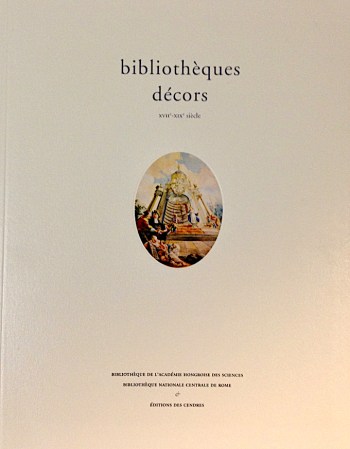 La chronologie est spécifique au domaine : dans la seconde moitié du xvie et au début du xviie siècle, la bibliothèque abandonne le mobilier traditionnel des pupitres pour prendre la forme moderne d’une grande salle de travail dont les murs sont tapissés de livres. Ce modèle deviendra à son tour de moins en moins adapté, jusqu’à ce que, face à l’accroissement de la production imprimée qui se produit au xixe siècle, le principe des magasins de stockage des livres se développe et l’organisation interne de la bibliothèque se modifie. Au fil de cet espace de temps des xviie–xixe siècles, les grands courants artistiques se succèdent, du baroque au classicisme puis au néo-classique, et jusqu’à l’émergence de l’architecture industrielle.
Parallèlement, l’institution de la bibliothèque garde une charge symbolique élevée, mise en scène par le biais du décor. On connaît les somptueuses bibliothèques baroques du monde catholique, de la péninsule Ibérique à l’Allemagne méridionale, à l’Europe centrale, ou encore à l’Italie. Pourtant, d’autres modèles de décor se rencontrent, qu’il s’agisse de la France (à la Bibliothèque Mazarine) ou encore de la géographie de la Réforme protestante. À côté des exemples les plus célèbres, y compris celui de la Hofbibliothek de Vienne, les contributions présentent un certain nombre de bibliothèques historiques largement méconnues jusqu’à aujourd’hui, notamment en Europe centrale et orientale (Alba Iulia), mais aussi en Italie (avec le Palais Borromini à Rome).
Ce travail transdisciplinaire réunit les meilleurs spécialistes européens, confrontant les leçons de l’histoire générale avec celles de l’histoire de l’art, de l’histoire des idées et de l’histoire du livre et des bibliothèques. Un ouvrage placé sous la direction de Frédéric Barbier, István Monok & Andrea De Pasquale qui ont réuni à leurs côtés une équipe internationale de spécialistes de l’histoire des bibliothèques et du livre / Ample iconographie, bibliographie et index.
T A B L E D E M A T I È R E S
• Frédéric Barbier, Bibliothèques, décors, XVIIe–XXIe siècle
• Frédéric Barbier, Illustrer, persuader, servir: le décor des bibliothèques, 1627–1851
• Elmar Mittler, Kunst oder Propaganda? Bibliothekarische Ausstattungsprogramme als Spiegel kultureller Entwicklungen und Kontroversen in Renaissance, Gegenreformation, Aufklärung und Klassizismus
• Hans Petschar, Der Pruncksaal der Österreichichen Nationalbibliothek : zur Semiotik eines barocken Denkraumes
• Andreas Gamerith, Klosterbibliotheken des Wiener Umlandes: alte und neue Motive
• Michaela Seferisová Loudová, Ikonographie der Klosterbibliotheken in Tschechien, 1770–1790
• Szabolcs Serfözö, Barocke Deckenmalereien in klosterbibliotheken des Paulinerordens in Mitteleuropa
• Anna Jávor, Bücher und Fresken: die künstlerische Ausstattung von Barockbibliothecken in Ungarn
• János Jernyei-Kiss, Die Welt der Bücher auf einem Deckenbild: Franz Sigrists Darstellung der Wissenschaften im Festsaal des Lyzeums in Erlau
• Doina Hendre Biró, Le décor de la Bibliothèque et de l’Observatoire astronomique fondés par le comte Ignác Batthyány, évêque de Transylvanie, à la fin du XVIIIe siècle
• Yann Sordet, D’un palais (1643) l’autre (1648): les bibliothèque(s) Mazarine(s) et leur décor
• Fiammetta Sabba, I Saloni librari Borrominiani fra architettura e decoro
• Andrea De Pasquale, L’histoire du livre dans le décor des bibliothèques d’Italie au XIXe siècle
• Jean-Michel Leniaud, L’invention du programme d’une bibliothèque, 1780–1930
• Alfredo Serrai, I vasi o saloni librari. Ermeneutica della iconografia bibliotecaria
New Book | Artefacts of Encounter: Cook’s Voyages
From the University of Hawaii Press:
Thomas, Nicholas Thomas, Julie Adams, Billie Lythberg, Maia Nuku, and Amiria Salmond, Artefacts of Encounter: Cook’s Voyages, Colonial Collecting and Museum Histories (Honolulu: University of Hawai’i Press, 2016), 364 pages, ISBN: 978 0824 859350, $68.
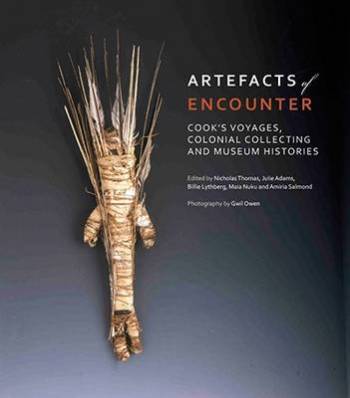 The Pacific artefacts and works of art collected during the three voyages of Captain James Cook and the navigators, traders, and missionaries who followed him are of foundational importance for the study of art and culture in Oceania. These collections are representative not only of technologies or belief systems but of indigenous cultures at the formative stages of their modern histories, and exemplify Islanders’ institutions, cosmologies, and social relationships.
Recently, scholars from the Pacific and further afield, working with Pacific artefacts at the Museum of Archaeology and Anthropology in Cambridge (MAA), have set out to challenge and rethink some longstanding assumptions on their significance. The Cook voyage collection at the MAA is among the four or five most important in the world, containing over 200 of the 2000-odd objects with Cook voyage provenance that are dispersed throughout the world. The collection includes some 100 artefacts dating from Cook’s first voyage. This stunning book catalogues this collection, and its cutting-edge scholarship sheds new light on the significance of many artefacts of encounter. Published in association with Otago University Press.
The William Blake Archive Launches Updated Website

William Blake, The First Book of Urizen, Plate 14, Object 7 (Bentley 85.7, Butlin 262.7), from A Large Book of Designs, ca. 1796 (London: British Museum).
In collaboration with UNC Libraries and ITS Research Computing, The William Blake Archive launched on 12 December 2016 a complete and transformative redesign of its website. This new site, www.blakearchive.org, retains all of the features of the previous site, which had become so indispensable to Blake scholars, and offers vast improvements, making it easier than ever for educators and scholars to access and study Blake’s inimitable works.
The Blake Archive, one of the preeminent digital humanities sites in the world, is a hypermedia archive of Blake’s poetry and art that is sponsored by the Library of Congress and supported by the University of North Carolina at Chapel Hill and the University of Rochester. Past support came from the Getty Grant Program, the Paul Mellon Centre for Studies in British Art, and the National Endowment for the Humanities. The Archive integrates, for the first time, all of Blake’s visual and literary work. It comprises almost 7000 high-resolution digital images of Blake’s illuminated books, paintings, drawings, manuscripts, and engravings drawn from over 45 of the world’s great research libraries and museums.
New Book | Clothing Art
From Yale UP:
Aileen Ribeiro, Clothing Art: The Visual Culture of Fashion, 1600–1914 (New Haven: Yale University Press, 2017), 582 pages, ISBN: 978-0300119077, $60.
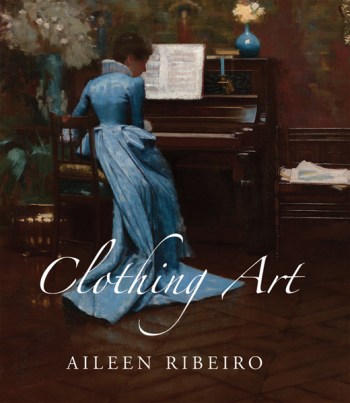 There have always been important links between art and clothing. Artists have documented the ever-evolving trends in fashion, popularized certain styles of dress, and at times even designed fashions. This is the first book to explore in depth the fascinating points of contact between art and clothing, and in doing so it constructs a new and innovative history of dress in which the artist plays a central role.
Aileen Ribeiro provides an illuminating account of the relationship between artists and clothing from the 17th century, when a more complex and sophisticated attitude to dress first appeared, to the early 20th century, when the boundaries between art and fashion became more fluid: haute couture could be seen as art, and art used textiles and clothes in highly imaginative ways. Ribeiro’s narrative encompasses such themes as the ways in which clothing has helped to define the nation state; how masquerade and dressing up were key subjects in art and life; and how, while many artists found increasing inspiration in high fashion, others became involved in designing ‘artistic’ and reform dress. Sumptuously illustrated, Clothing Art also delves into the ways in which artists represent the clothes they depict in their work, approaches which range from photographic detail, through varying degrees of imaginative reality, to generalized drapery.
Aileen Ribeiro is professor emeritus in the history of art at the Courtauld Institute of Art, London.
Netherlands Yearbook for History of Art, November 2016
Latest issue of NKJ:
Thijs Weststeijn, Eric Jorink and Frits Scholten, eds., Netherlandish Art in its Global Context (Leiden: Brill, 2016), 296 pages, ISBN: 978-9004334977, €105 / $123. [Netherlands Yearbook for History of Art / Nederlands Kunsthistorisch Jaarboek 66 (November 2016)].
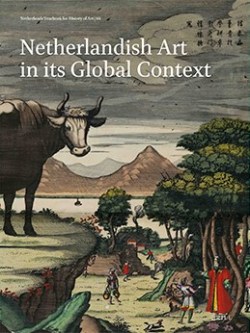 Netherlandish art testifies to the interconnectedness of the Early Modern world. New trade routes, the international Catholic mission, and a thriving publishing industry turned Antwerp and Amsterdam into capitals of global exchange. Netherlandish prints found a worldwide public. At home, everyday lives changed as foreign luxuries, and local copies, became widely available. Eventually, Dutch imitations of Chinese porcelain found their way to colonists in Surinam. This volume of the Netherlands Yearbook for History of Art breaks new ground in applying the aims and approaches of global art history to the Low Countries, with essays ranging from Greenland to South Africa and Mexico to Sri Lanka. The Netherlands, as a fringe area of the Habsburg Empire marked by internal fault lines, demonstrated remarkable artistic flexibility and productivity in the first period of intensive exchange between Europe and the rest of the world.
Thijs Weststeijn, PhD (2005), University of Amsterdam, is professor of art history before 1850 at Utrecht University. He chairs the research project The Chinese Impact: Images and Ideas of China in the Dutch Golden Age (2014–19).
Eric Jorink, PhD (2004), University of Groningen, is Teylers professor at Leiden University and researcher at the Huygens Institute (KNAW). He is the author of Reading the Book of Nature in the Dutch Golden Age, 1575–1715.
Frits Scholten, PhD (2003), University of Amsterdam, is senior curator of sculpture at the Rijksmuseum and holds the chair in the History of Western Sculpture before 1800 at the Universiteit van Amsterdam. He has published widely on Western sculpture and decorative arts. His most recent publication is Small Wonders: Late-Gothic Boxwood Micro-carvings from the Low Countries (Amsterdam 2016).
C O N T E N T S
• Thijs Weststeijn, Introduction: Global Art History and the Netherlands
• Nicole Blackwood, Meta Incognita: Some Hypotheses on Cornelis Ketel’s Lost English and Inuit Portraits
• Stephanie Porras, Going Viral? Maerten de Vos’s St Michael the Archangel
• Christine Göttler, ‘Indian Daggers with Idols’ in the Early Modern Constcamer: Collecting, Picturing and Imagining ‘Exotic’ Weaponry in the Netherlands and Beyond
• Barbara Uppenkamp, ‘Indian’ Motifs in Peter Paul Rubens’s The Martyrdom of Saint Thomas and The Miracles of Saint Francis Xavier
• Thijs Weststeijn and Lennert Gesterkamp, A New Identity for Rubens’s ‘Korean Man’: Portrait of the Chinese Merchant Yppong
• Ebeltje Hartkamp-Jonxis, Sri Lankan Ivory Caskets and Cabinets on Dutch Commission, 1640–1710
• Julie Berger Hochstrasser, A South African Mystery: Remarkable Studies of the Khoikhoi
• Ching-Ling Wang, A Dutch Model for a Chinese Woodcut: On Han Huaide’s Herding a Bull in a Forest
• Annemarie Klootwijk, Curious Japanese Black: Shaping the Identity of Dutch Imitation Lacquer
• Thomas DaCosta Kaufmann, The ‘Netherlandish model’? Netherlandish Art History as/and Global Art History
Exhibition | Master Drawings Unveiled: 25 Years of Major Acquisitions
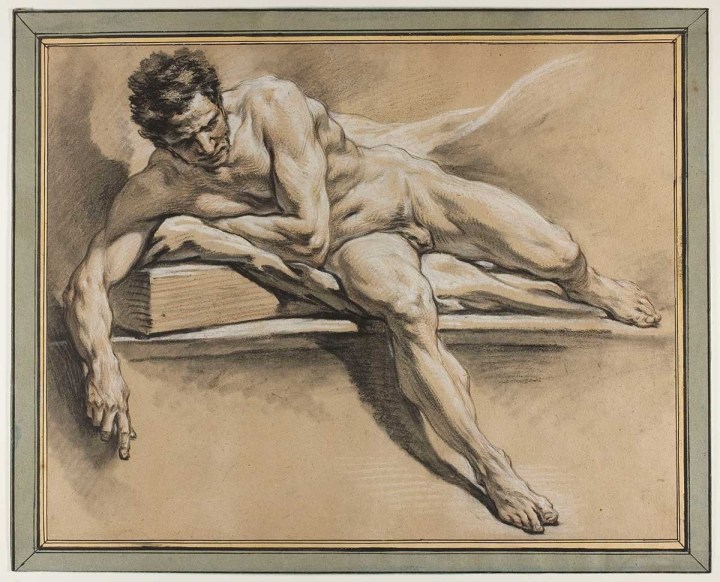
François Boucher, Academic Study of a Reclining Male Nude, ca. 1750
(Art Institute of Chicago, Regenstein Endowment Fund).
◊ ◊ ◊ ◊ ◊
Press release (8 June 2016) from AIC
Master Drawings Unveiled: 25 Years of Major Acquisitions
Art Institute of Chicago, 27 August 2016 — 29 January 2017
The Art Institute of Chicago presents 84 hitherto unexhibited masterful drawings carefully and thoughtfully acquired over the last quarter century in an exhibition titled Master Drawings Unveiled: 25 Years of Major Acquisitions. Building upon an established and world-renowned collection, these masterpieces range from the French and Italian schools of the 17th century to Swiss, German, and Austrian Romanticism, midcentury Realism, Belgian Symbolism and into the mid-20th century. The recent acquisitions will be on display from August 27, 2016 to January 29, 2017 and provide visitors a full range of artistic achievement, featuring key works by François Boucher, Henri Fantin-Latour, Edgar Degas, Odilon Redon, Francis Picabia, Grant Wood, and other iconic figures.
The exhibition is a culmination of the legacy and focus of curator Suzanne Folds McCullagh, who along with Mark Pascale, Martha Tedeschi, and Douglas Druick strategically acquired the works to reinforce the strengths of the collection and add new dimensions and greater depth. The selected works offer a “leap through the ages,” says McCullagh. “This is only the tip of the iceberg, not including gifts or bequests, or works that have been or will be shown in other exhibitions here. We have acquired over 9,000 prints and drawings since 1991; this installation reveals some of the areas we have sought to develop through purchases. The range of the materials means the show offers something for everyone.”
Among the works never-before-seen in Chicago are three studies for beloved works in the permanent collection. A full-scale study of A Young Peasant Woman Drinking her Café au Lait, 1881, is almost the same size as the painting (Gallery 246). There is a final compositional study for Puvis de Chavanne’s Sacred Grove, Beloved of the Arts and the Muses, 1883/84 (Gallery 245). And, most surprising of all is the large abstract planning drawing for Gustave Caillebotte’s Paris Street; Rainy Day, 1877 (Gallery 201).
Exhibition | Doctrine and Devotion: The Spanish Andes
Now on view at AIC:
Doctrine and Devotion: Art of the Religious Orders in the Spanish Andes
Art Institute of Chicago, 19 March — 25 June 2017
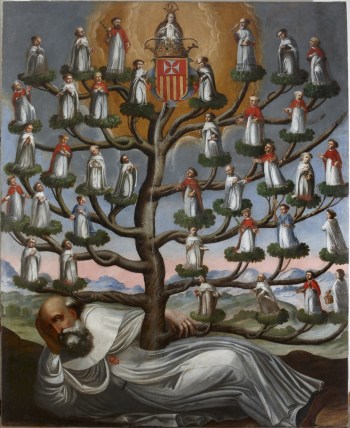
Unidentified artist, active in Potosí, Bolivia, Genealogical Tree of the Mercedarian Order, mid-18th century (Thoma Collection).
Presenting 13 paintings by South American artists from the 17th through 19th century, this focused exhibition introduces visitors to images promoted by several Catholic orders at work in the Spanish Andes—the Dominicans, Franciscans, Mercedarians, and Jesuits—examining the politics of the distinct iconographies each group developed as they vied for devotees and dominion.
Francisco Pizarro arrived in Peru with a mandate from Charles V to impose Spanish law and order, as well as the Roman Catholic religion, upon the indigenous Inca society that he encountered. The enormous task of converting the indigenous peoples of Spain’s overseas territories to Christianity fell largely to missionaries from several religious orders rather than parish clergy. For a native population that had no written language tradition, the missionaries relied heavily on works of art to illustrate their sermons and lessons and help them gain converts.
In the wake of the Protestant Reformation, the Catholic church embraced the use of images both as pedagogical tools and instruments of devotion, and the religious orders in South America relied on them in similar ways—as didactic materials employed in the teaching of new converts, and in later years as a means of spreading devotions specific to their own interests. While their ultimate goals were the same, each religious order promoted images specific to their own histories, identities, and goals. This exhibition explores examples of the iconographies that were particular to each group.
Doctrine and Devotion: Art of the Religious Orders in the Spanish Andes is generously supported by the Carl and Marilynn Thoma Art Foundation.










 Enfilade
leave a comment