Call for Papers | Enchanted Isles, Fatal Shores: Living Versailles

Hall of Mirrors (Galerie des Glaces), 1678–84
(Château de Versailles)
◊ ◊ ◊ ◊ ◊
From the National Gallery of Australia:
Enchanted Isles, Fatal Shores: Living Versailles
NGA, the Australian National University, and the University of Sydney, 17–18 March 2017
Proposals due by 30 October 2016
Organized by Mark Ledbury, Robert Wellington, and Lucina Ward
On the occasion of the Versailles: Treasures from the Palace exhibition at the NGA, which brings major works of art from the Palace of Versailles to Canberra, this conference showcases the latest ideas about the lives of past people and objects, as well as the living culture of Versailles today. Staged in Canberra, which like Versailles is a planned capital city, centre of government and culture, this is a unique opportunity to explore the enduring influence and resonance of Versailles, its desires and self-perceptions of modernity, from film to fashion to architecture. Gathering a generation of scholars whose work is shifting our perceptions of the art, culture and life of ancien-régime Versailles and its reception, this is the occasion for fresh and challenging research, and new perspectives on canon-defining works.
1664 is formative in the history of Versailles—the year a modest hunting lodge began to be transformed, to become a centre of art, fashion and power in Europe for more than a century. The dream of Versailles as an enchanted isle for the French aristocracy came to a grisly end with the 1789 revolution. Only two years later, the first fleet of British colonists came to settle on the east coast of Australia, on what Robert Hughes famously dubbed ‘the fatal shore’. Life at Versailles changed irreparably just as it would for those who lived in, and migrated to, Australia at the close of the eighteenth century.
Versailles was not the static creation of one man but a hugely complex cultural space, a centre of power, of life, love, anxiety and creation, as well as an enduring palimpsest of aspirations, desires and ruptures. The splendour of the castle, and the masterpieces of art and design it contains, masks a more sordid history. The conference’s theme, Enchanted isles, fatal shores, encourages examination of the tensions between splendour and misery, insiders and outsiders, display and privacy that framed life at Versailles.
Conference conveners seek proposals to deliver 20-minute papers addressing the subject of the conference; those that address the key themes below are especially welcome. Please send an abstract of 300 words and a short CV to the conveners at Versaillesconference@nga.gov.au by 30 October 2016.
Key Themes
• The ‘lives’ of Versailles
• Virtual Versailles
• Adaptations and destructions
• Challenging period terms
• The private and the public
• ‘Le sale et le propre’
• Versailles and Paris
• Being there
• Resonances of Versailles
• Versailles on film
Conveners
Mark Ledbury, Power Professor of Art and Visual Culture, University of Sydney; Robert Wellington, Lecturer, ANU School of Art Centre for Art History and Art Theory; and Lucina Ward, Senior Curator and coordinating curator for the exhibition, National Gallery of Australia
Book Launch | Georgian Gothic
From Eventbrite:
Talk and Book Launch: Georgian Gothic: Medievalist Architecture, Furniture and Interiors
Strawberry Hill, Twickenham, 17 November 2016
Dr Peter Lindfield, an expert on the Gothic Revival, will be giving an illustrated 30-minute lecture at Strawberry Hill, Twickenham, on the topic of Georgian Gothic design between 1730 and 1840. Strawberry Hill and Horace Walpole, along with Thomas Chippendale, Robert Adam, Gillows of Lancaster and A.W.N. Pugin, will figure heavily in the talk. Architecture, interiors and furniture will be covered as well as key issues of design, fashion and taste in the Georgian period.
Following a Q&A session and a champagne reception, Peter will be signing copies of his new book at this launch party, Georgian Gothic: Medievalist Architecture, Furniture and Interiors, 1730–1840. Copies of the book will be available on the night for purchase at a specially reduced price (£35: RRP £50). You can select a registration option for the talk and reception only, or additionally pre-purchase the book to be signed and collected on the night.
2017 ISECS Seminar for Early Career Scholars: Cities and Citizenship
From H-ArtHist:
2017 ISECS Seminar for Early Career Scholars
Cities and Citizenship in the Enlightenment / Cité et citoyenneté des Lumières
Université du Québec, Montreal, 11–15 September 2017
Proposals due by 30 January 2017
The International Society for Eighteenth-Century Studies (ISECS) is pleased to announce the 2017 International Seminar for Early-Career Eighteenth-Century Scholars. Colleagues from all fields of eighteenth-century studies are invited to submit abstracts for this one-week event. Formerly called the East-West Seminar, the International Seminar for Early-Career Eighteenth-Century Scholars brings together young researchers from a number of countries each year. The 2017 meeting will take place in Montreal, Canada and will be organized by the University of Quebec in Montreal (UQAM) and the Research Group on the History of Sociabilities (RGHS).
The seminar will be held from Monday, September 11 to Friday, September 15, 2017 in Montreal, under the direction of Pascal Bastien (History, UQAM), Marc André Bernier (Literature, UQTR), Sébastien Charles (Philosophy, UQTR), Peggy Davis (Art History, UQAM), Benjamin Deruelle (History,UQAM), Geneviève Lafrance (Literature, UQAM), Laurent Turcot (History, UQTR).
The seminar will also be an opportunity to pay tribute to Professor Robert Darnton (Harvard University), former president of ISECS as well as co-founder, with Jochen Schlobach (1938–2003), of the East-West Seminar.
The theme this year’s seminar will be Cities and Citizenship in the Enlightenment. The ISECS International Seminar for Early Career Scholars will engage discussions on the forms, representations and modalities of political action and social and political identities in the eighteenth century. ‘Citizenship’ in the eighteenth century did not yet encompass the notions of property rights, equality before the courts, or even the electoral system of political representation. The result of a process rather than a status, urban citizenship can be understood as an appropriation of the urban space, the sociabilities found therein, and, fundamentally, civic culture within a civil society. The study of citizenship should not, therefore, be restricted to nationality and naturalization. Is the public space strictly an urban space? How should we understand political dynamics, collective emotions and urban citizenship in eighteenth-century cities?
If the Marxist undertones of the Habermas model have been questioned over the years, the notion of ‘public space’ still retains its significance and relevance. The questions surrounding language, verbal exchanges, and discourse in general remain at the center of the reflections by historians of society and class consciousness. At the crossroad of texts, discourses and practices, sociability is the field of enquiry for those who wish to grasp the different forms of public opinion and citizen commitment, especially within eighteenth-century urbanization. A detailed description of this theme is available online.
The seminar is limited to 15 participants. The proposals (approx. 2 pages, single spaced) should be based on an original research project (e.g. a doctoral dissertation) which addresses one of the aspects mentioned above. Because this is a seminar rather than a conference, each participant will be given approximately one hour to present the texts and questions that will then form the basis of a group discussion. Preference will be given to scholars who are at the beginning of their academic career (PhD or equivalent for less than six years). The official languages are French and English.
Accommodation costs will be covered in full by the organizers, who will be responsible for reserving hotel rooms. Other travel costs are currently under evaluation for a grant from the Government of Canada. If the seminar should benefit from such funding, airline tickets and other living expenses (lunches and dinner) may also be covered.
As it is the case each year, the proceedings of the seminar will be published by Honoré Champion (Paris) in the Lumières internationales series.
Applications should include the following information: a brief curriculum vitae with date of PhD (or equivalent); a list of principal publications and scholarly presentations; a brief description of the proposed paper (approx. 2 pages, single-spaced); and one letter of recommendation. Colleagues are invited to submit proposals by January 30, 2017. Please send abstracts by e-mail to Pascal Bastien: bastien.pascal@uqam.ca.
New Book | 18th-Century Fashion in Detail
The first edition appeared in 1998; the second edition is scheduled for release in November from Thames & Hudson.
Avril Hart and Susan North, 18th-Century Fashion in Detail (London: Thames & Hudson, 2016), second edition, 224 pages, ISBN: 978-0500292631, $35.
This beautifully illustrated book reveals the decorative seams, refined stitching, voluptuous drapery, strict corseting, slashing, and stamping that make up some of the garments in the Victoria and Albert Museum’s superlative fashion collection. With an authoritative text, exquisite color photography of garment details, and line drawings showing the complete construction of each piece, the reader has the unique opportunity to examine up close historical clothing that is often too fragile to be on display. It is an inspirational resource for students, collectors, designers, and anyone who is fascinated by fashion and clothing. This new edition features an updated design, improved navigation, a comprehensive index, and an introduction that sets the examples in full historical context.
Avril Hart is an expert in historical dress. Her publications include English Men’s Fashionable Dress: 1600–1799, Ties, and Fans. Susan North is the Curator of Fashion 1550–1800 at the V&A.
New Book | The Silhouette
From Bloomsbury:
Georges Vigarello, The Silhouette: From the 18th Century to the Present Day, translated by Augusta Dorr (London: Bloomsbury Visual Arts, 2016), 192 pages, ISBN: 978-1474244657, £30 / $45.
 From bone-crushing corsets to modern ‘slimming’ creams, our preoccupation with the silhouette has shaped centuries of fashion and culture. The contours of the body can convey everything from physical health and beauty to social class—and both men and women have long sought to mold and reshape them, often with alarming and even dangerous results.
Tracing the history of the silhouette from its birth in 18th-century portrait sketches, this engrossing book takes the reader on a journey through 250 years of a cultural obsession. From Hogarth’s ‘line of beauty’ to the advent of nude photography, from the crinoline to the Dior suit and the early bathing costume, The Silhouette reveals how the shape of the body has become an eloquent symbol of status, sexuality and the aspirational quest for physical and moral ‘perfection’. Drawing on numerous textual and visual resources, leading scholar Georges Vigarello anatomizes a fixation with the human form which has shaped not just our bodies but our very identities. With over 120 color images, The Silhouette is a remarkable resource for scholars, students, and fashion-lovers alike.
Georges Vigarello is a historian and sociologist. He is Research Director at the École des hautes études en sciences sociales (EHESS) in Paris, France. He has published widely on topics ranging from Concepts of Cleanliness (Cambridge) and The History of Rape: Sexual Violence in France from the Sixteenth to the Twentieth Century (Polity) to The Metamorphoses of Fat: A History of Obesity (Columbia).
◊ ◊ ◊ ◊ ◊
C O N T E N T S
Introduction
I | A New Word, a New Line
The Invention of the Word ‘Silhouette’ (18th century)
The Art of ‘Silhouetting
From Shaded Faces to Shaded Figures
II | From the Mezzotint to the Romantic Aesthetic
The Enlightenment and the Emergence of Morphology
Before the ‘Silhouette’: Early Incarnations
The Quest for Detail: The Triumph of the ‘Full-Length’ Profile Portrait
The Complex and Curious Realm of the Shadow
The Romantic Perspective
III | Innovations in Graphic Art
A Process Expands: Press and Image
A Word Expands: Physical and Moral Significance
The Silhouette: A Social ‘Museum’ in the 19th Century
The ‘Invention’ of Morphology
The Silhouette: an Academic Approach
The Silhouette and Fashion in the Romantic Era
A Wealth of Creativity in Graphic Art
From the Press to the Poster
IV | The Art of Expression
Photography and Figures in Motion
The Female Contour: from Slender to Erotic
The Nude Becomes ‘Commonplace’
The Honing of the Female Form
A Growing Personal Imperative
The Honing of the Male Form
The Theme of Decline
The Quest to Classify
The Tragic Danger of ‘Race’
The Realms of Expression and Information
Between Curves and Muscles
The Emergence of Psychology: The Dawn of a Cult?
V | The Contemporary Silhouette
Radical Changes in the Figure
The Challenge of Identity
The Silhouette: The Mastery and Weakness of the Body
Conclusion
Notes
Index
Photographic credits
New Book | Urban Space as Heritage in Late Colonial Cuba
From the University of Texas Press:
Paul Niell, Urban Space as Heritage in Late Colonial Cuba: Classicism and Dissonance on the Plaza de Armas of Havana, 1754–1828 (Austin: University of Texas Press, 2015), 344 pages, hardcover ISBN: 978-0292766594, $55 / paperback (print on demand) ISBN: 978-1477311301, $35.
 According to national legend, Havana, Cuba, was founded under the shade of a ceiba tree whose branches sheltered the island’s first Catholic mass and meeting of the town council (cabildo) in 1519. The founding site was first memorialized in 1754 by the erection of a baroque monument in Havana’s central Plaza de Armas, which was reconfigured in 1828 by the addition of a neoclassical work, El Templete. Viewing the transformation of the Plaza de Armas from the new perspective of heritage studies, this book investigates how late colonial Cuban society narrated Havana’s founding to valorize Spanish imperial power and used the monuments to underpin a local sense of place and cultural authenticity, civic achievement, and social order.
Paul Niell analyzes how Cubans produced heritage at the site of the symbolic ceiba tree by endowing the collective urban space of the plaza with a cultural authority that used the past to validate various place identities in the present. Niell’s close examination of the extant forms of the 1754 and 1828 civic monuments, which include academic history paintings, neoclassical architecture, and idealized sculpture in tandem with period documents and printed texts, reveals a ‘dissonance of heritage’—in other words, a lack of agreement as to the works’ significance and use. He considers the implications of this dissonance with respect to a wide array of interests in late colonial Havana, showing how heritage as a dominant cultural discourse was used to manage and even disinherit certain sectors of the colonial population.
Paul Niell is Assistant Professor of Art History at Florida State University. He is the coeditor, with Stacie Widdifield, of Buen Gusto and Classicism in the Visual Cultures of Latin America, 1780–1910.
◊ ◊ ◊ ◊ ◊
C O N T E N T S
List of Illustrations
Acknowledgments
Introduction
1 The Plaza de Armas and Spatial Reform
2 Classicism and Reformed Subjectivity
3 Fashioning Heritage on the Colonial Plaza de Armas
4 The Dissonance of Colonial Heritage
5 Sugar, Slavery, and Disinheritance
Epilogue
Notes
Bibliography
Index
Conference | Architect-Designed Objects, 1650–1950
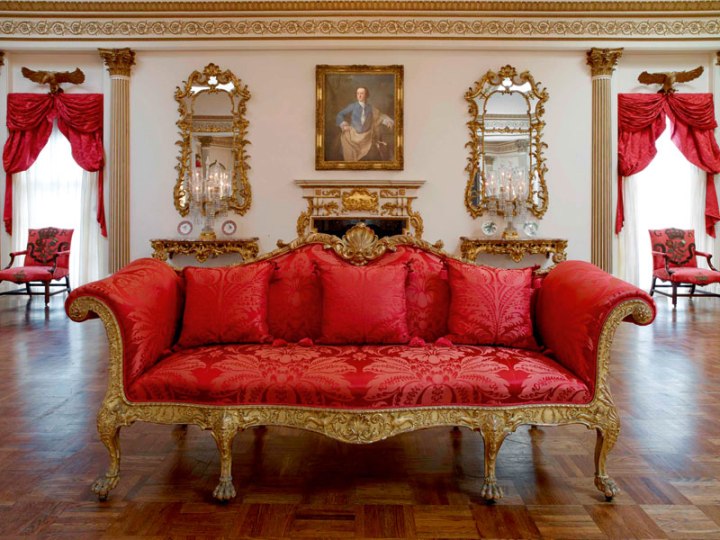
Designed by Robert Adam, made by Thomas Chippendale, The Dundas Sofa, commissioned 1764, made 1765, gilt pine and beech, with later silk upholstery (Museum of Fine Arts, Houston)
◊ ◊ ◊ ◊ ◊
From the MFAH:
A Sense of Proportion: Architect-Designed Objects, 1650–1950
Museum of Fine Arts, Houston, 24 September 2016
Rienzi, the MFAH house museum for European decorative arts, presents its biennial symposium. This edition focuses on objects that are the embodiments or extensions of an architect’s ideas or aesthetic. Scholars discuss objects made for particular spaces, objects used to explore new design sources, and objects intended to be part of an integrated space.
The keynote address will presented by Adriano Aymonino, coordinator of undergraduate programs, department of art history, University of Buckingham. Dr. Aymonino’s main academic interest is the reception of the classical tradition in the Early Modern period, with a particular focus on Britain. He is working on a revised edition of Francis Haskell and Nicholas Penny’s Taste and the Antique and on a project tracing the impact of antiquarian publications on 17th- and 18th-century European art and architecture. Aymonino obtained his PhD at the University of Venice and has held postdoctoral fellowships at the Paul Mellon Centre for Studies in British Art and at the Getty Research Institute.
Ticket information is available here»
◊ ◊ ◊ ◊ ◊
10:00 Welcome by Christine Gervais (director, Rienzi; curator, decorative art)
10:15 Keynote Address
• Robert Adam (1728–1792) and the Sources of the ‘True Style of Antique Decoration’, Adriano Aymonino (University of Buckingham)
11:30 Coffee Break
12:00 Session A
• Baroque Furnishings: Aesthetics and Design in Giacomo Amato’s Graphic Oeuvre (1643–1732), Sabina de Cavi, professor (University of Córdoba)
• Marvelous Volumes: Artistry of the 18th-Century British Designer’s Manuscript, Elizabeth Deans (assistant director, Smithsonian-George Mason University)
12:45 Lunch Break
1:50 Session B
• Jean-Démosthène Dugourc’s 1787 Model for a Jewel Cabinet and the Stakes of Royal Furniture Design in Pre-Revolutionary France, Iris Moon (visiting assistant professor, Pratt Institute)
• The Furniture Design Legacy of Karl Friedrich Schinkel, Serena Newmark (doctoral student and English-language children’s programs assistant, Museum August Kestner)
2:35 Coffee Break
3:05 Session C
• The Quality of Calmness and Clarity: Heinrich Tessenow’s Search for Objectivity in the Design of Furniture and Household Goods, Jurjen Zeinstra (doctoral student and associate professor, University of Technology)
• Transitional Moments: Architectural Hardware, Marcel Breuer, and the Bauhaus in America, Robert Wiesenberger (doctoral student and curatorial fellow, Harvard Art Museums)
New Book | Oriental Interiors
From Bloomsbury:
John Potvin, ed., Oriental Interiors: Design, Identity, Space (London: Bloomsbury Academic, 2015), 296 pages, hardback ISBN: 978-1472596642, $115 / paperback ISBN: 978-1472596635, $30.
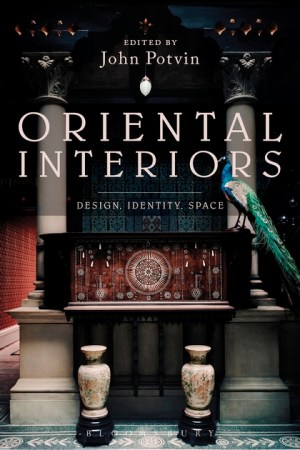 Since the publication of Edward Said’s groundbreaking work Orientalism 35 years ago, numerous studies have explored the West’s fraught and enduring fascination with the so-called Orient. Focusing their critical attention on the literary and pictorial arts, these studies have, to date, largely neglected the world of interior design. Oriental Interiors is the first book to fully explore the formation and perception of eastern-inspired interiors from an orientalist perspective.
Orientalist spaces in the West have taken numerous forms since the 18th century to the present day, and the fifteen chapters in this collection reflect that diversity, dealing with subjects as varied and engaging as harems, Turkish baths on RMS Titanic, Parisian bachelor quarters, potted palms, and contemporary yoga studios. It explores how furnishings, surface treatments, ornament and music, for example, are deployed to enhance the exoticism and pleasures of oriental spaces, looking across a range of international locations. Organized into three parts, each introduced by the editor, the essays are grouped by theme to highlight critical paths into the intersections between orientalist studies, spatial theory, design studies, visual culture and gender studies, making this essential reading for students and researchers alike.
John Potvin is Associate Professor in the Department of Art History at Concordia University, Montreal, where he teaches on the intersections of art, interior design and fashion. He is the author of Bachelors of a Different Sort: Queer Aesthetics, Material Culture and the Modern Interior in Britain (Manchester University Press, 2014), Giorgio Armani: Empire of the Senses (Ashgate, 2013), and Material and Visual Cultures Beyond Male Bonding (Ashgate, 2008). He is also editor of The Places and Spaces of Fashion (Routledge, 2009) and co-editor of Material Cultures, 1740–1920: The Meanings and Pleasures of Collecting (Ashgate, 2010) and Fashion, Interior Design and the Contours of Modern Identity (Ashgate, 2010).
◊ ◊ ◊ ◊ ◊
C O N T E N T S
Introduction: Inside Orientalism: Hybrid Spaces and Modern Interior Design, John Potvin
Section I: Modes of Display and Representation
Introduction to Section I
1 The Emptiness of Western Aesthetics Versus the Aesthetics of Eastern Intimacy: A Reading of Interior Spaces and (Colonial) Literary Impressionism in E. M. Forster’s A Passage to India, Victor Vargas (Cogswell Polytechnic)
2 The Exhibitionary Re-production of ‘Islamic’ Architecture, Solmaz Mohammadzadeh Kive (University of Colorado)
3 Promoting the Colonial Empire through French Interior Design, Laura Sextro (University of Dayton)
4 Orientalism and David Hockney’s Male-positive Imaginative Geographies, Dennis S. Gouws (Springfield College and the Australian Institute of Male Health and Studies)
5 The Excessive Trompe l’Oeil: The Saturated Interior in Tears of the Black Tiger, Mark Taylor (University of Newcastle) and Michael J. Ostwald (University of Newcastle)
Section II: Gendered and Sexual Identities
Introduction to Section II
6 On Oriental Interiors in Eighteenth-Century British Women Writers’ Novels, Marianna D’Ezio (Luspio University for International Studies of Rome)
7 Bachelor Quarters: The Spaces of Japonisme in Nineteenth-Century Paris, Christopher Reed (Pennsylvania State University)
8 Coming Out of the China Closet?: Performance, Identity and Sexuality in the House Beautiful, Anne Anderson (Exeter University and Kingston University)
9 Orientalism, Collecting and Shame: Inside Rolf de Maré’s Hildesborg Estate, John Potvin (Concordia University)
Section III: Spaces and Markets of Consumption
Introduction to Section III
10 Paradise in the Parlour: Potted Palms in Western Interiors, 1850–1914, Penny Sparke (Kingston University)
11 Traveling in Time and Space: The Cinematic Landscape of the Empress Theatre, Camille Bédard (McGill University)
12 Oriental Spaces at Sea: From the Titanic to the Empress of Britain, Anne Massey (Middlesex University)
13 Posturing for Authenticity: Embodying Otherness in Contemporary Interiors of Modern Yoga, Lauren Bird (Queen’s University)
Index
Oxford Art Journal, August 2016
In the latest issue of the Oxford Art Journal:
Oxford Art Journal 39 (August 2016)
 • Introduction | Katie Scott, David Bindman, and Tom Gretton, “Helen Weston ‘in three positions’”
• Denis Diderot, “Regrets on Parting with My Old Dressing Gown,” translated by Kate Tunstall and Katie Scott
• Katie Scott, “The Philosopher’s Room: Diderot’s Regrets on Parting with My Old Dressing Gown“
Regrets on Parting with My Old Dressing Gown recounts the story of Diderot’s internal struggles with affluence and comfort and his attempt to reconcile luxury with the philosopher’s life. This article analyses some of the ways he sought to do this is by attending closely to Regrets’ spatial and material forms. Not things, but relations to things, the article argues, characterised Diderot’s ethics of consumption. It further suggests that the politics of luxury was for Diderot linked to questions not only of property but also of access and that the ancient virtue of hospitality was crucial to his defence of his new ‘revered’ dressing gown and all that it connoted.
• Valerie Mainz, “The Inequalities of Infamy”
The contribution has for focus the etching by Isaak Cruikshank, entitled The Martyr of Equality: Behold the Progress of our System. The critical analysis of the satire conjoins the figurative forms of the visual imagery with its words investigating, in the process, several of the interdependent layers of meaning that can be imputed therefrom. Produced in the days after the execution of the French king Louis XVI, which had taken place on 21 January 1793, this satirical view of the beheading of the monarch shows off the mechanism of the guillotine as a bloody, equalising, killing machine. The central figure of Philippe Égalité, the king’s distant cousin who had voted for the death of the king, is in the guise of the executioner here, but he, too, would be sent to the guillotine on 6 November of the same year.
• David Bindman, “Lost Surfaces: Canova and Colour”
The unremitting whiteness of Canova’s sculptures makes the question of colour seem an odd one to raise in connection with his art, but in fact almost all of them were originally coated or tinted to give a mellowness and a certain realism to the surface of the marble. This raised fundamental questions to do with sculpture’s relationship to painting and to ancient Greece and made the sculptor a controversial figure. He was evidently influenced by his friend and biographer the French theorist Quatremère de Quincy, who published in 1814 a pioneering book demonstrating the use of colour on ancient Greek sculptures.
• Richard Taws, “Conté’s Machines: Drawing, Atmosphere, Erasure”
This article examines the graphic practice of Nicolas-Jacques Conté, an artist, chemist, engineer, and balloonist probably best known for his invention, in 1795, of the modern pencil, synthesising English ‘lead’ rendered unavailable by the naval blockade. Conté, a former pupil of Jean-Baptiste Greuze, subsequently became a key member of the Napoleonic expedition to Egypt. He participated in the production of its most extensive visual document, the monumental Description de l’Égypte, devising an ‘engraving machine’ that facilitated the production of uniform backgrounds for the Description’s plates. With this machine, the cloudless Egyptian skies that populated the large sheets of the Description could be reproduced at speed with minimal opportunity for artistic error, reducing complex atmospheric effects to a simple mechanical process. Tracing the reemergence of Conté’s numerous inventions in subsequent accounts of media change, particularly those that focused on photography, this article examines the ways in which Conté’s work often pivoted on the question of drawing and suggests that his practice asks broader questions of the relationship between technology, vision, and imperialism in the nineteenth century.
• Richard Wrigley, “Unreliable Witness: The Flâneur as Artist and Spectator of Art in Nineteenth-Century Paris”
One of the main reasons for the flâneur’s celebrity in studies of nineteenth-century Paris has been a connection with art and artists. The flâneur has been championed as a model for artists who depict the modern, urban world; this has been allied to assumptions that the flâneur embodies a process of aestheticisation which corresponds to capturing the essence of modernity (and thereby modern art). This article reconsiders such orthodoxy and suggests that a more historicised account of the figure’s origins and meaning. The canonical texts habitually called on to illustrate accounts of the flâneur’s identity (Le Physiologie du flaneur, Baudelaire’s ‘Le Peintre de la vie moderne’ etc.) are reconsidered critically. The article concludes by arguing that a more solidly based history of the flâneur should, firstly, reach back into the early nineteenth century, and secondly, also acknowledge the political character of such independent scrutiny of contemporary Paris, it spaces and social landscape.
• Tom Gretton, “ ‘Un Moyen Puissant de Vulgarisation Artistique’. Reproducing Salon Pictures in Parisian Illustrated Weekly Magazines c. 1860–1895: From Wood Engraving to the Half Tone Screen (and Back)”
L’Illustration and Le Monde illustré, Parisian up-market general-interest weekly illustrated magazines of the Illustrated London News genre published long Salon reviews every year there was a Salon. They also reproduced numbers of Salon pictures each year, in fluctuating (often very large) numbers, in a range of reproductive technologies, and accompanied by textual and presentational clues about what sorts of value the magazine was inviting its reader/viewers to attach to the reproduction: to the painting represented also but in the first instance to the reproduction.
Engaging with recent work by Stephen Bann, this article discusses the ways in which, in these magazines, reproductive wood engravings were aligned with the great tradition of French reproductive intaglio printmaking, and it looks at the impact of the introduction of photomechanical technologies (the line block and the half-tone screen) on the values that were attached to these pictures of Salon pictures. It demonstrates the persistence into the 1890s of the value system of reproductive engraving, and its eventual displacement by the more mechanical efficiencies of the half-tone screened photograph of a work of art. The essay calibrates this displacement with the increasingly compelling demands of the news cycle in relation to the visual reporting of the Salon, and it provides evidence that the half-tone screen, for a decade after its introduction, was a less-than-adequate technology for the reproduction of photographs of works of art, as the evidence of its uptake in the more technologically progressive of these two titles, L’Illustration, demonstrates.
The essay also engages with the debate over “the end of the Salon” (Mainardi). From the evidence of the resources that these magazines devoted not only to writing about but also to reproducing pictures from, the Salon through from the 1860s to the end of the 1890s, the essay argues that, at last for the national-bourgeois audience that was constituted by the wide readership of these two magazines, reports of the Salon’s death have been greatly exaggerated.
• Satish Padiyar, “Proust and Old Time: On ‘Chardin’ and ‘Watteau’”
Before Marcel Proust began working on his masterpiece À la Recherche du temps perdu, he had an idea to be an art critic. His youthful essay “Chardin” (1895) constitutes his first important piece of art criticism. Approaching Chardin’s work ‘philosophically’, Proust’s essay draws from the old painter’s work significant ideas about the affective life of objects, the pathos of interiors and interiority, and the shattering of the frame separating museum art from modern life. My essay argues that Chardin’s painting offered young Proust a significant new ‘way’ to begin to approach the ‘involuntary memory’ of Recherche, one that he delineates through his essay’s quasi-Platonic structure. Proust’s later incomplete essay on Watteau shifts his art writing into a more subjective mode; the early ‘art’ Proust becoming before our eyes the later genre-abolishing one.
Lecture Series | Philip Hardie on Celestial Aspirations
From H-ArtHist:
Philip Hardie | Celestial Aspirations: 17th- and 18th-Century
British Poetry and Painting and the Classical Tradition
The 2016 E. H. Gombrich Lecture Series on the Classical Tradition
London, Warburg Institute, 11–13 October 2016
Organised by the Warburg Institute and Princeton University Press
Philip Hardie, Honorary Professor of Latin and Senior Research Fellow at Trinity College, Cambridge, will deliver three lectures (each beginning at 17.30). They are free of charge, but pre-registration is required.
• Tuesday, 11 October: Visions of Apotheosis and Glory on Painted Ceilings: From Rubens’s Banqueting House, Whitehall to Thornhill’s Painted Hall, Greenwich
• Wednesday, 12 October: Poetic Ascents and Flights of the Mind: Neoplatonism to Romanticism
• Thursday, 13 October: ‘No Middle Flight’: Miltonic Ascents and Their Reception










 Enfilade
leave a comment