Exhibition | The White Dress
Press release (25 May) from the NGC:
Masterpiece in Focus: The White Dress
National Gallery of Canada, Ottawa, 27 May — 25 September 2016
Curated by Erika Dolphin
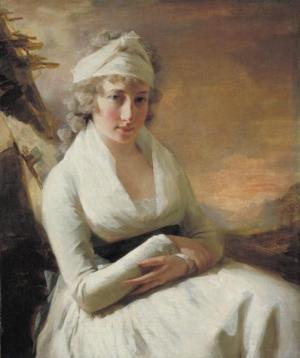
Henry Raeburn, Jacobina Copland, ca. 1794–98, oil on canvas, 76.2 × 63.5 cm. (Ottawa: National Gallery of Canada)
The National Gallery of Canada presents, as part of its Masterpiece in Focus program, The White Dress, an exhibition that highlights the evolution of the chemise dress and the drastic transformation in fashion around the turn of the nineteenth century. Complementing the Gallery’s major summer retrospective of Elisabeth Louise Vigée Le Brun (1755–1842), the portraitist to Marie Antoinette, The White Dress offers a rich exploration of the trends and artistic movements of the time. At the heart of this Masterpiece in Focus presentation are two portraits by Vigée Le Brun’s contemporaries: Scottish artist Henry Raeburn and French artist Anne-Louis Girodet. These magnificent works from the national collection—Jacobina Copland (ca. 1794–98), by Raeburn, and Madame Erneste Bioche de Misery (1807), by Girodet—can be seen alongside insightful drawings and illustrations, as well as stunning period dresses on loan from the Royal Ontario Museum and a private collector.
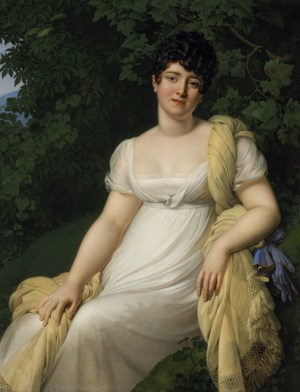
Anne-Louis Girodet, Madame Erneste Bioche de Misery, 1807, oil on canvas, 115.7 × 91.5 cm (Ottawa: National Gallery of Canada)
With the aid of a simple white dress, the exhibition unveils the world that portraitist Elisabeth Louise Vigée Le Brun and her sitters navigated at the turn of the eighteenth century. Although it may seem demure to contemporary eyes, Vigée Le Brun’s portrait of Marie Antoinette in a Chemise Dress caused a scandal when it was exhibited at the Paris salon in 1783. Royal etiquette required elaborate formal dress. The notorious portrait depicting France’s queen in a simple muslin garment was seen as immodest and had to be removed from view. But more than a breach of decorum, nearly a decade before the French Revolution of 1789, the painting can also be seen as announcing the end of formality, luxury and all that was synonymous with the monarchy.
At the time, court gowns, made of ornately embellished heavy brocades, required structural undergarments—panniers, hooped petticoats, and whalebone stays (an early form of the corset)—for support. It was a style designed to inspire respect for the French monarchy. Marie Antoinette’s preference for the chemise dress was deemed not only a breach of decorum, but an act of treason: court dress was largely a product of the French textile industry—especially the silk looms of Lyon, while the white muslin was a foreign import from India and Britain.
The Gallery’s website presents a time-lapse video of Dr. Anne Bissonnette, dress historian at the University of Alberta, preparing one of the eighteenth-century muslin dresses for the exhibition in the Gallery’s conservation lab.
Additional information and images are available from Sheila Singha’s article “A Scandal in Muslin: Marie Antoinette’s Little White Dress,” for NGC Magazine (24 May 2016).
Lecture | Aaron Wile, Watteau: Making as Meaning
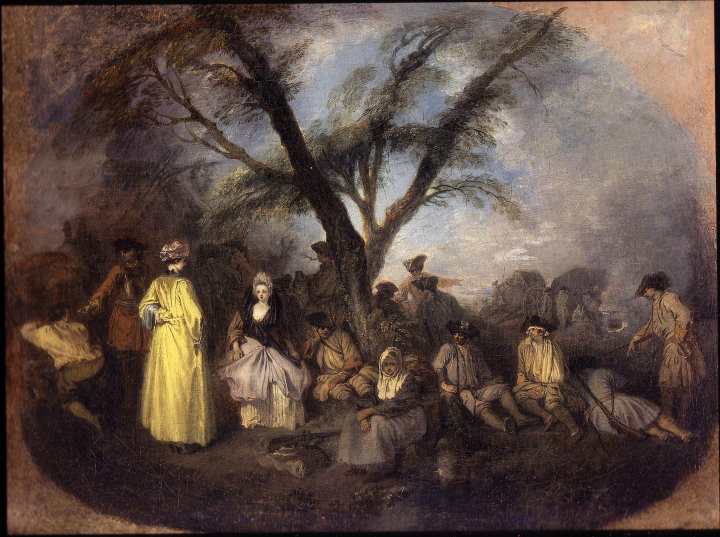
Jean-Antoine Watteau, The Halt (Alte), ca. 1710–11, oil on canvas, 13 × 17 inches
(Madrid: Museo Thyssen-Bornemisza)
◊ ◊ ◊ ◊ ◊
Next week at The Frick:
Aaron Wile, Watteau: Making as Meaning
The Frick Collection, New York, 13 July 2016
Jean-Antoine Watteau’s military works proffer a modern vision of war in which the soldier’s inner life is brought to the fore. This talk, presented by the curator of the special exhibition Watteau’s Soldiers: Scenes of Military Life in Eighteenth-Century France (on view until October 2), examines how the problem of representing interiority informed the artist’s working methods. Wednesday, July 13, 6pm.
Aaron Wile is the Anne L. Poulet Curatorial Fellow at The Frick Collection.
Display | Regarding Trees
On view now at The Courtauld Gallery:
Regarding Trees
The Courtauld Gallery, London, 18 June — 25 September 2016
Curated by Rachel Sloan
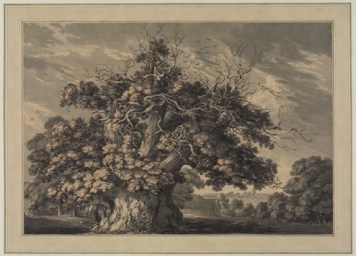
Thomas Hearne, The Chestnut Tree at Little Wymondley, Hertfordshire, 1789, watercolour (London: The Courtauld Gallery)
“It is no exaggerated praise to call a tree the grandest, and most beautiful of all the productions of the earth.” With these words, the artist and theorist William Gilpin (1724–1804) opened his influential treatise Remarks on Forest Scenery and other Woodland Views (1791).
For as long as artists have created landscapes, the tree has been an essential element of them. But, intriguingly, almost from the beginning, individual trees have been the subject of close study in their own right. In many cases they serve as a means for artists to develop their powers of observation and manual dexterity as well as a tool for constructing larger landscapes. Whether studied directly from nature or conjured from the artist’s imagination, whether loaded with poetic or political symbolism or addressed in a down-to-earth, factual manner, artists through the ages have treated trees with the same reverence and psychological insight as a portraitist would accord a sitter.
This display of drawings, drawn from The Courtauld Gallery’s collection, explores artists’ enduring fascination with the tree. Ranging from the early sixteenth to the mid nineteenth centuries and including works by Fra Bartolommeo, Jan van Goyen, Claude Lorrain and John Constable, among others, it takes the framework of Gilpin’s treatise as its starting point, moving from portraits of individual trees to depictions of trees within landscapes and concluding with a selection of forest scenes. Together, they offer an insight into some of the many roles trees have played over the centuries.
Call for Papers | The Architect as Active Reader
From H-ArtHist:
The Architect as Active Reader
Vicenza, 15–17 June 2017
Proposals due by 15 September 2016
The Centro Internazionale di Studi di Architettura Andrea Palladio (CISA) will organize an international conference on the theme of The Architect as Active Reader, 15–17 June 2017. Printed treatises and texts have been the main vehicle for the communication of architectural ideas. Architects and builders, as owners of these texts, have left records of their thoughts in the form of subsequent annotations, comments, and drawings within the texts or closely connected to them. In developing the notion of the architect as an ‘active reader’ who absorbs new information for future practical application, the conference seeks to bring out examples of architects in dialogue with texts.
Geographic area and time period are open. Scholars may apply individually or propose a theme to be carried through in a single session by a group or team. (Such a theme might address a single architect’s varied reading practices; multiple approaches to a single work; the collecting practices revealed in an architect’s library). Contributions from scholars and librarians are welcome.
Those interested in participating with a contribution (20 minute limit) should send an outline (no more than 250 words) and brief CV (no more than 100 words) to cfp@cisapalladio.org by 15 September 2016. Speakers will be notified by 31 October 2016.
Exhibition | Chinamania: Walter McConnell
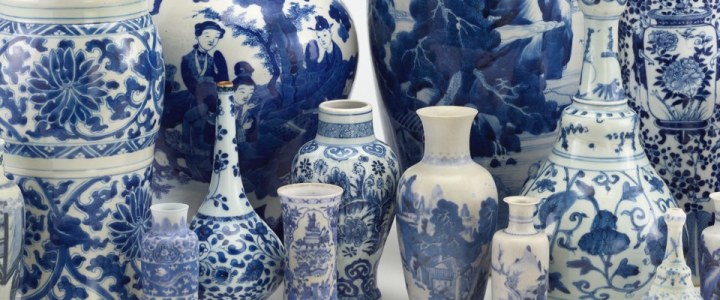
Contemporary art, engaging an iconic nineteenth-century interior, engaging perennially popular early eighteenth-century ceramics—opening next week at the Sackler:
Chinamania: Walter McConnell
Arthur M. Sackler Gallery, Washington, D.C., 9 July 2016 — 4 June 2017
A mania for Chinese blue-and-white porcelain swept through London in the 1870s as a new generation of artists and collectors ‘rediscovered’ imported wares from Asia. Foremost among them was American expatriate artist James McNeill Whistler. For him, porcelain was a source of serious aesthetic inspiration. For British shoppers, however, Chinese ceramics signified status and good taste. Cultural commentators of the time both embraced and poked fun at the porcelain craze. Illustrator George du Maurier parodied the fad in a series of cartoons for Punch magazine that documented what he mockingly called “Chinamania.”
More than a hundred fifty years later, American artist Walter McConnell explores Chinamania in our own time. In this exhibition, he juxtaposes two monumental porcelain sculptures, which he terms stupas, with export wares from China’s Kangxi period (1662–1722). Those blue-and-white ceramics are similar to those that once filled the shelves of Whistler’s Peacock Room in London. These historical porcelains also inspired McConnell to create a new work based on 3D-printed replicas. His interest in replication and in the serialized mass production of ceramic forms began after he visited China more than a decade ago. The large kilns and busy factories at Jingdezhen prompted McConnell to look at China as an enduring resource for ceramic production.
Chinamania complements the exhibition Peacock Room REMIX: Darren Waterston’s Filthy Lucre, a contemporary installation that reimagines the Peacock Room as a resplendent ruin. Inspired by museum founder Charles Lang Freer’s collection of Asian ceramics, Waterston painted scores of vessels and arranged them on the buckling shelves of Filthy Lucre. These oozing, misshapen ceramics convey a sense of unsustainable luxury and excess. They also echo McConnell’s interest in the interplay of creativity, the mass production of aesthetic objects, and the powerful forces of materialism and conspicuous consumption.
◊ ◊ ◊ ◊ ◊
Summer Open House: Chinamania After-Hours Preview
Arthur M. Sackler Gallery, Washington, D.C., 8 July 2016
Free and open to the public
Join us for a special after-hours celebration of the opening of Chinamania, the third and final installation in the Peacock Room REMIX series. Explore the craze for Chinese porcelain that took the West by storm in the nineteenth century and discover the interplay between creativity and mass production. Chinese blue-and-white ceramics from the Freer|Sackler collection join monumental installations by contemporary sculptor Walter McConnell and 3D objects printed especially for this exhibition.
The open house will feature tours led by McConnell and curator Lee Glazer, music, photo booths, and hands-on activities such as customizable screen-printed tote bags and create-your-own stop motion animation, featuring decorative motifs inspired by Chinese blue-and-white porcelain.
Across the street from the Sackler, food will be available through the USDA Farmer’s Market at Night, which hosts over 20 of our city’s most popular local food trucks from 4:00 to 7:00pm. So come get a first look at Chinamania and enjoy a picnic on the National Mall.
Friday, July 8, 5:30pm, Arthur M. Sackler Gallery, 1050 Independence Ave. SW, Washington, D.C.
Exhibition | Kakiemon and 400 Years of Porcelain
Press release for the exhibition now on view at The British Museum:
Made in Japan: Kakiemon and 400 Years of Porcelain
The British Museum, London, 23 June — 21 August 2016
Japanese Porcelain
Founded by Korean potters . . .
Inspired by Chinese styles . . .
Encouraged by Dutch traders . . .
The Kakiemon style has absorbed foreign influence while incorporating distinctive Japanese elements.
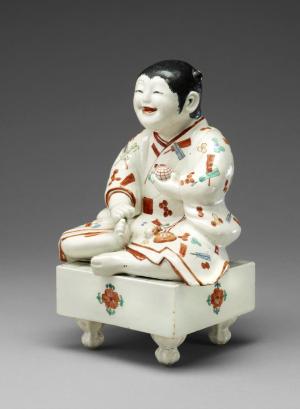
Boy on a Go Board, Kakiemon kiln, Arita, Japan, ca. 1670–80, nigoshide porcelain (London: The British Museum)
This Asahi Shimbun Display Made in Japan: Kakiemon and 400 Years of Porcelain celebrates fifteen generations of porcelain production in Arita by showcasing work by one of the most famous potting dynasties. 2016 is the 400th anniversary of the birth of porcelain in the town of Arita in Saga Prefecture, and the show will feature, among other examples, a new work decorated with acorn branches by Sakaida Kakiemon XV (b. 1968) representing his coming of age as an artist that he created specifically for the British Museum. Featured in the display is an original film made by the British Museum at the Kakiemon kiln, which allows viewers to see and feel through the actions of the potters how Kakiemon porcelain is actually created.
The Kakiemon (pronounced ‘ka-ki-e-mon’) kiln is still modeled on the traditional Japanese early modern workshop system. Succession is based on the principle of iemoto or ‘head of the household’, the oldest son inheriting and sustaining the brand and workshop. The current head of the kiln is Kakiemon XV. He recently received the title following the death of his greatly admired father Kakiemon XIV in 2013.
Historically, the Kakiemon workshop produced some of the most exquisite porcelain for export to Europe and the Middle East, notably in the later 1600s. In 1647 Sakaida Kizaemon was credited with introducing the overglaze enameling technique to the Arita porcelain kilns, making advanced porcelain production possible and starting the potting dynasty. He was thought to have learnt the secrets to overglaze enameling on porcelain from a Chinese specialist in adjacent Nagasaki. This success earned him the name Sakaida Kakiemon I—which derived from kaki or ‘persimmon’ after the orangey-red colour of the most important overglaze enamel. Japan was a late starter to porcelain production compared to China and Korea, but it quickly made up for lost time. Japan benefitted from domestic turbulence in China and was able to start exporting to Europe and elsewhere through the Dutch East India Company.
The classic Kakiemon style, lasting from 1670 to 1700, is defined by its refined yet sparse decoration executed with bright overglaze enamels in a palette of orange-red, green, blue and yellow. Some of the most exquisite porcelain is on view in this display such as Boy on a Go Board, ca. 1670–80. This figurine was specifically created with a distinctive creamy-white porcelain body called nigoshide, the formula for which was developed by the Kakiemon kiln. The contrast in colours and tones emphasises the brightly coloured enamels. A 3D model of this figurine can be viewed online.
Kakiemon grew in international popularity in the late 17th century, and became particularly valued in England during the reign of Queen Mary II (1686–1694), who was passionate about the Kakiemon style. Classic Kakiemon style in Japan ceased production in the 18th century; but its popularity continued, and the style was reproduced in China and in Europe, examples of which can be seen in this display. There was a revival in the mid-20th century of traditional Kakiemon style due to the ingenuity of Kakiemon XII and Kakiemon XIII. They rediscovered the forgotten techniques and created a renaissance for the nigoshide creamy white porcelain used earlier with Boy Sitting on a Go Board. Kakiemon XIII was awarded the high honour from the Japanese government as a ‘Living National Treasure’ for his revitalisation of classic Kakiemon style. His son, Kakiemon XIV continued the legacy of his father while also developing the Kakiemon brand through inspired naturalistic designs. Kakiemon XV is now poised to take the revitalised Kakiemon legacy forward.
The Asahi Shimbun Displays are a series of regularly changing displays which look at objects in new or different ways. Sometimes the display highlights a well-known item; sometimes it surprises the audience with extraordinary items from times and cultures that may not be very familiar. This is also an opportunity for the Museum to learn how it can improve its larger exhibitions and permanent gallery displays. These displays have been made possible by the generous sponsorship of The Asahi Shimbun Company, who are long-standing supporters of the British Museum. With a circulation of about 7 million for the morning edition alone, The Asahi Shimbun is the most prestigious newspaper in Japan. The company also publishes magazines and books, and provides a substantial information service on the internet. The Asahi Shimbun Company has a century-long tradition of staging exhibitions in Japan of art, culture, and history from around the world.
Course | The Country House: Art, Politics, and Taste
From the Paul Mellon Centre for Studies in British Art:
Public Lecture Course | The Country House: Art, Politics, and Taste
Paul Mellon Centre for Studies in British Art, London, 13 October — 1 December 2016
The Paul Mellon Centre is pleased to announce the 2016 Public Lecture Course: The Country House: Art, Politics, and Taste. The course has been developed in conjunction with the research project Country House: Collections and Display, and both will explore various facets of the collections and display of art in the country house in Britain and Ireland from the sixteenth century to the present day.
The Country House course will be taught by Martin Postle, Deputy Director of Grants and Publications; Jessica Feather, Allen Fellow at the Paul Mellon Centre; and other distinguished scholars from the field. This year’s course will run for eight lectures and will continue to be held weekly on Thursday evenings starting with an informal reception at 18.30. Lectures will then begin at 19.00 followed by a discussion session until 20.30.
The course requires some preparation on the part of the participant. Each lecture will have at most two readings (provided electronically ahead of the start of the course), which participants are strongly encouraged to read in order to have some background knowledge on the topics being discussed in class each week.
As an educational charity the Paul Mellon Centre strives to promote and support academic research into the history of British Art. The Public Lecture Course, which will be free to attend, offers an exciting opportunity to broaden our audiences and to communicate the newest and most original research on British art in an engaging and accessible way.
The Country House will take place on Thursday evenings between 13th October and 1st December 2016 in the Lecture Room at the Paul Mellon Centre. The course syllabus will be made available in July. Registration will open to the public on 1st August 2016. The reading list will be circulated to participants in September.
Call for Papers | Art in the British Country House: Collecting and Display
From the Paul Mellon Centre for Studies in British Art:
Art in the British Country House: Collecting and Display
Paul Mellon Centre for Studies in British Art, London, 7 October 2016
Proposals due by 8 July 2016
The Paul Mellon Centre’s research project Art in the British Country House: Collecting and Display investigates the collection and display of works of art in the country house in Britain from the sixteenth century to the present day. Focusing on specific case studies, the project addresses two closely related issues:
• The formation, character and function of country-house art collections
• The conventions, development and dynamics of pictorial and sculptural display within the country house
The crucial importance of the country house to understanding the history of art-collection and display in Britain is indisputable and of long-standing interest to historians of British art. This project, in turning a fresh eye on the collections of art associated with the country house, builds on exciting new developments within this area of scholarship, which shed new light on the wide range of motivations and circumstances that have shaped such collections. The project extends to the country house a growing scholarly interest in modes of pictorial display, which has hitherto tended to focus on the display of paintings, sculpture, and prints within more urban and public environments, and on the exhibition space in particular.
The project will concentrate attention on the ways in which country house art collections were formed and on the reasons why they took the form they did. It will address the impact upon collecting practices of such factors as the growth of continental travel, the development of a sophisticated art market, fluctuations in taste, and dynastic ambitions and familial alliances. It will also address the conditions, facilities, and habits of display in the country house, investigating such issues as the shifting modes of the picture hang, the introduction of dedicated gallery spaces within the country house, the relationship between the country house and the town house as sites of collection and display, the development of cataloguing, and the growth of professional curatorship.
As an integral part of this project, the Centre is organizing the first of a series of conferences designed to showcase new research in this area. We invite proposals for 30-minute papers which discuss some aspect of the collecting and/ or display of art in a single country house from any point over the past five hundred years. We welcome proposals from academics, museum curators, independent scholars, those working in the heritage sector, and those actively involved in postgraduate studies. While the Call for Papers has a purposefully broad and open brief, it is essential that submissions offer fresh, methodologically ambitious perspectives on the topic.
Possible themes for exploration might include, but are not limited to:
• The impact of commerce and travel on collecting
• The creation and presentation of spaces for display
• The commissioning and display of portraiture in the country house
• The collecting and display of historic and/or contemporary art
• The relationship between country- and town-house modes of collection and display
• The interaction of works of art within the country-house interior
• The relationship between the fine and decorative arts in country-house display
• Patterns of display across the different rooms of a single country house
Proposals, of no more than 250 words, together with a short CV, for 30-minute papers, should be submitted to Ella Fleming at efleming@paul-mellon-centre.ac.uk by 8th July 2016.
Call for Papers | Romanticism and the Peripheries
From the conference website:
Romanticism and the Peripheries
Calouste Gulbenkian Foundation, Lisbon, 5–7 December 2016
Proposals due by 30 July 2016
“The Romantic phenomenon seems to defy analysis, not only because its exuberant diversity resists any attempt to reduce it to a common denominator but also and especially because of its fabulously contradictory character” (Michael Löwy and Robert Sayre, Romanticism against the Tide of Modernity, trans. by Catherine Porter, Durham: Duke University Press, 2001). In an attempt to accommodate both its diversity and contradictory character, Löwy and Sayre defined Romanticism as “a worldview constituted as a specific form of criticism of ‘modernity’” and expanded the term beyond artistic and literary phenomena to encompass a wide range of fields such as religion, political theory, philosophy, etc. Even though Löwy and Sayre may offer a guiding principle outside the interpretative confusion often generated by the term, their analysis is still mostly, if not exclusively, concerned with the definition of the phenomenon as it manifested in the principal centers of Europe (namely England, France, and Germany).
This three-day conference, organized on the occasion of the bicentenary of Fernando II’s birth, the Portuguese king responsible for the edification of what is widely considered the hallmark of Romantic Portuguese architecture, seeks to focus on Romanticism in the peripheries, both European and non-European, and explore the validity of the concept for the analysis of artistic and cultural forms that, for the most part, originated outside the centers of bourgeois industrial civilization. Taking as its starting point the definition proposed by Lowy and Sayre, the conference invites participation on a number of issues including, but not limited to:
1 When Was Romanticism? Attempts at Periodization and Definition
2 Sublime matters: Romanticism and Material Culture
3 Transfers and Cross-Sections: Literature, Theater and the Visual Arts
4 The Romantic Traveler: Drawings, Prints and Souvenirs
5 Artistic Education. Academy versus Nature?
6 Romantic Landscape, Gardens and Architecture
7 Romantic Nationalism – Romantic Imperialism? The Politics of Style
Abstracts (of no more than 300 words), accompanied by a short bio (approximately two paragraphs) should be sent to the members of the organizing committee, at iha.romanticism2016@gmail.com by July 30, 2016. Participants will be notified by the end of August, and the conference program will be published in mid-September. The languages of the conference are English and Portuguese.
A selection of papers from the conference will be published as a special number of the Revista de História da Arte, an annual peer-reviewed journal, and a second publication, in the form of a book, is also being contemplated by the organizers. For all questions regarding administration and practical matters, as well as the payment of the conference inscription, please contact Mariana Gonçalves and Inês Cristóvão (iha.romanticism2016@gmail.com). Conference inscription rates: speakers 50€, participants 40€, students 20€.
Exhibition | Bouchardon: Royal Artist of the Enlightenment
Opening in September at the Louvre:
Bouchardon: A Sublime Idea of Beauty / Une idée du beau
Bouchardon: Royal Artist of the Enlightenment
Musée du Louvre, Paris, 14 September — 5 December 2016
The Getty Center, Los Angeles, 10 January — 2 April 2017
Curated by Anne-Lise Desmas, Edouard Kopp, Guilhem Scherf, and Juliette Trey

Edme Bouchardon, Femme nue de dos, bras gauche le long du corps (RMN-Grand Palais/Louvre / Michel Urtado)
The Musée du Louvre and the J. Paul Getty Museum, Los Angeles pay tribute to Edme Bouchardon (1698–1762), a renowned French sculptor and draftsman, who was considered an exceptional artist in his own time. The son of an architect-sculptor, he trained at the Royal Academy of Painting and Sculpture in Paris before spending a productive period at the French Academy in Rome (1723–32). Learning of Bouchardon’s great reputation, the director of the King’s Buildings summoned him back to France, where he quickly received a studio and lodgings at the Louvre. Accepted into the Academy in 1735, he thus became Sculptor to the King.
Listed in the Encyclopédie—Diderot and d’Alembert’s encyclopedic dictionary of the sciences, arts, and trades—as the continuator of Puget and Girardon, Bouchardon was regarded by his contemporaries as the advocate of artistic renewal, “the greatest sculptor and the best draftsman of his century” (Cochin).
While many studies have shed new light on our understanding of Neoclassicism, this exhibition—the first major monograph on Bouchardon’s oeuvre—will be an opportunity to comprehend the sculptor’s style, a perfect balance between classical influence and life-like rendering.
◊ ◊ ◊ ◊ ◊
Juliette Trey, avec la participation d’Hélène Grollemund, Inventaire général des dessins du musée du Louvre. Ecole française. Edme Bouchardon (1698–1762): Catalogue raisonné (Paris: Mare & Martin / Musée du Louvre, 2016), 720 pages, ISBN: 979-1092054651, 110€.
Le musée du Louvre conserve un fonds très important de dessins (1038 feuilles) attribués à Edme Bouchardon dont le catalogue sommaire a été publié par Jean Guiffrey et Pierre Marcel en 1907 et 1908 (Inventaire général des dessins du musée du Louvre et de Versailles, Ecole française, vol. I et II). La dernière étude monographique sur l’artiste date de 1910 (Alphonse Roserot, Edme Bouchardon, Paris, Librairie centrale des beaux-arts).
L’inventaire des dessins de Bouchardon est organisé de manière chronologique, présentant les feuilles dans l’ordre de leur réalisation, et thématique. Il est divisé en trois parties, correspondant aux trois étapes essentielles de la carrière de Bouchardon : Rome (1723–1732), qui compte essentiellement des copies d’antiques, de peintures et de sculptures, exécutées par l’artiste lors de son séjour à l’Académie de France ; Paris (1733–1748), qui rassemble les dessins pour les sculptures qui firent la gloire de Bouchardon, notamment l’Amour taillant son arc dans la massue d’Hercule et la fontaine de Grenelle ; la statue équestre de Louis XV (1748–1762), chantier colossal qui occupa toute la fin de la carrière du sculpteur et pour lequel le fonds du Louvre s’élève à près de 440 dessins. Chaque partie puis chaque thème sont introduits par un court texte de présentation. La plupart des notices sont également commentées avec l’identification du modèle copié ou de la sculpture préparée, présentant les oeuvres en rapport, les estampes gravées d’après le dessin. L’étude matérielle des dessins a fait l’objet d’une grande attention, avec un relevé systématique des filigranes, permettant une étude chronologique nouvelle et fine des dessins.
Enfin, l’ouvrage est complété par une présentation générale de l’artiste, une chronologie, un index, auxquels s’ajoute un chapitre dédié aux dessins rejetés pour lesquels de nouvelles attributions sont parfois proposées.
◊ ◊ ◊ ◊ ◊
From ArtBooks.com:
Guilhem Scherf, et al., Edme Bouchardon (1698–1762): Sculpteur et Dessinateur du Roi (Paris: Somogy, 2016), 448 pages, ISBN: 978-2757210697, $80.
From ArtBooks.com:
Anne-Lise Desmas, Edouard Kopp, Guilhem Scherf, and Juliette Trey, Bouchardon: Royal Artist of the Enlightenment (Los Angeles: Getty Publications, 2017), 448 pages, ISBN: 978-1606065068, $80.
 One of the most imaginative and fascinating artists of eighteenth-century France, Edme Bouchardon was instrumental in the transition from Rococo to Neoclassicism and in the artistic rediscovery of classical antiquity. Much celebrated in his time, Bouchardon created some of the most iconic images of the age of Louis XV. His oeuvre demonstrates a remarkable variety of themes (from copies after the antique to subjects of history and mythology, portraiture, anatomical studies, ornament, fountains and tombs), media (drawings, sculptures, medals, prints), and techniques (chalk, plaster, wax, terracotta, marble, bronze).
With five essays by experts on Bouchardon’s sculpture and graphic arts, more than 140 catalogue entries, and a detailed chronology, this book aims to demonstrate the originality of Bouchardon’s art within the cultural and social context of the period, while suggesting the subtle relationship between, as well as the relative autonomy of, the artist’s two careers as a sculptor and a draftsman. This lavishly illustrated publication represents an unprecedented and thorough survey on this major and unique artist from the Age of Enlightenment, offering indepth scholarship based on unpublished material.
Anne-Lise Desmas is curator and head of the Department of Sculpture and Decorative Arts at the J. Paul Getty Museum. Édouard Kopp is the Maida and George Abrams Associate Curator of Drawings at the Harvard Art Museums. Guilhem Scherf is chief curator in the Department of Sculpture at the Louvre. Juliette Trey is curator in the Department of Graphic Arts at the Louvre.










 Enfilade
leave a comment