New Harley Gallery Showcases The Portland Collection
A new building at The Harley Gallery (Welbeck, Nottinghamshire) opens on Sunday to showcase The Portland Collection. . .
The Harley Gallery and Foundation is delighted to announce a new building which will display historic works from The Portland Collection, the historic fine and decorative arts collections of the Cavendish-Bentinck family. The family, currently headed by William Parente, grandson of the 7th Duke of Portland, have lived at Welbeck for over 400 years and through the generations have developed a beautiful and intriguing collection. The Portland Collection includes examples from some of the most highly regarded artists of each era.

George Stubbs, 3rd Duke of Portland, Welbeck Abbey, 1766 (The Portland Collection)
Hugh Broughton Architects were appointed to design the new building after a tightly fought architectural competition. The new building will consist of a glazed entrance pavilion and two gallery spaces, with a fresh new look for the courtyard itself. The main gallery spaces will be housed in a new structure, nestled between the Victorian walls. A top lit, barrel vaulted roof will filter light into the long gallery. A broad variety of pieces from the beautiful Portland Collection will be on show in a large gallery space.
The new building will be situated next to the existing Harley Gallery, within the walls of the Victorian Tan Gallop. Recently, this area has been used for storage. It was originally built as a covered area where the Welbeck Estate’s race horses could be trained in winter or poor weather. The name ‘Tan Gallop’ comes from the oak chippings that were used to cover the floor. By-products of the tanning process, these chippings were soft and provided a good surface for the horses to run on. A portion of the Tan Gallop, further away from The Harley Gallery, was converted into artists studios by the Harley Foundation in 1980.
Curatorial Advisory Panel
Karen Hearn, Honorary Professor, UCL
Alex Farquharson, Director, Nottingham Contemporary
Tim Knox, Director, The Fitzwilliam Museum
Hannah Obee, Curator, Chatsworth House Trust
Michael Hall, Architectural Historian and Journalist
New Book | Swedish Desire: Centuries of Luxury Consumption
From the Centre for Fashion Studies at Stockholm University:
Paula von Wachenfeldt and Klas Nyberg, eds., Det svenska begäret: sekler av lyxkonsumtion (Stockholm: Carlsson Bokförlag, 2015), 315 pages, ISBN: 978-9173316712, 255kr.
 With essays by Paula von Wachenfledt, Klas Nyberg, Marjatta Rahikainen, Kirsi Vainio-Korhonen, Håkan Jakobsson, Carolina Brown, Leif Runelfelt, Helena Kåberg, Louise Wallenberg, and Ulrika Berglund, this collection of essays The Swedish Desire: Centuries of Luxury Consumption is the first academic Swedish book on luxury history and development between the seventeenth and the first half of the twentieth century. There are few things that can create so much debate and resentment as the topic of luxury. As much as it creates well-being and comfort for its owner, luxury can also be a needle in the eye of the viewer. And as much as it can be an aesthetic expression, it remains a bitter reminder of social ills. As in most Western societies, Sweden has been an interesting arena for all kind of luxury parades and consumption and, not least, resistance. This book illustrates different historical examples of luxury use, human desire, and bitterness.
The editors of the book are senior lecturer Paula von Wachenfeldt and Professor Klas Nyberg at the Centre for Fashion Studies, Stockholm University.
◊ ◊ ◊ ◊ ◊
Beteckningen Det svenska begäret avser att visa att fenomenet lyx vinner på att betraktas som ett dynamiskt element i sitt historiska, kulturella och samhälleliga sammanhang. 1600-, 1700- resp. 1800-talen har haft olika välbeställda grupperingar som skilt ut sig genom olika typer av lyx: slottsbyggen, lyxig klädsel och heminredning; stora egendomar och nybyggnation. I boken utforskas lyxens svenska historia från nya infallsvinklar med utgångspunkt i aktuell forskning av historiker, konst- och modevetare. Här skrivs om manlig resp. kvinnlig lyx i förordningar och modeartiklar; hur svensk aristokrati beställde lyxartiklar som kalescher och karosser; hur spetsar – den vita lyxen – demonstrerade välstånd; hur indigoblått markerade god ekonomi; hur borgerliga värderingar och ideal tar sig uttryck i lyxens tjänst. Hur lyx och begär demonstrerades i svensk film på 1910–1940-talen; hur medelvägens lyx i form av franska hantverkstraditioner passade in i det svenska folkhemmet etc.
Paula von Wachenfeldt, docent, modevetare, litteraturvetare universitetslektor vid Centrum för modevetenskap, Stockholms universitet, redaktör och författare i boken.
Klas Nyberg, modevetare och professor i nationalekonomi vid Södertörns Högskola. Professor i ekonomisk historia vid Uppsala universitet och professor vid Centrum för modevetenskap, Stockholms universitet. redaktör och författare i boken.
Exhibition | James Gillray’s Hogarthian Progresses
From The Lewis Walpole Library:
James Gillray’s Hogarthian Progresses
The Lewis Walpole Library, Farmington, CT, 6 April — 16 September 2016
Curated by Cynthia Roman
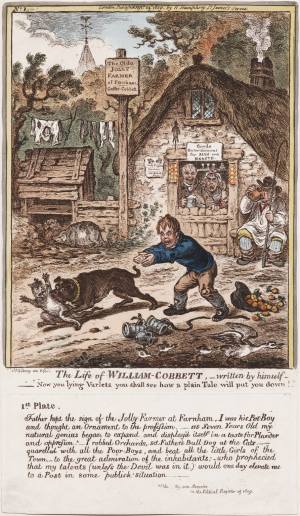
James Gillray, The life of William-Cobbett, written by himself. : Now you lying varlets you shall see how a plain tale will put you down! / Js. Gillray inv. & fec. Published in London, 29 September 1809 (Lewis Walpole Library).
Sequential narration in satiric prints is most famously associated with the ‘modern moral subjects’ of William Hogarth (1697–1764): Harlot’s Progress (1732), A Rake’s Progress (1735), Marriage A-la-Mode (1745), and Industry and Idleness (1747) among others. Less well-known is the broad spectrum of legacy ‘progresses’ produced by subsequent generations drawing both on Hogarth’s narrative strategies and his iconic motifs. James Gillray (1756–1815), celebrated for his innovative single-plate satires, was also among the most accomplished printmakers to adopt Hogarthian sequential narration even as he transformed it according to his unique vision. This exhibition presents a number of Gillray’s Hogarthian progresses alongside some selected prints by Hogarth himself.
P R O G R A M S
Study Day
James Gillray’s Experimental Printmaking
Organized by Esther Chadwick, History of Art, Yale University and Cynthia Roman, The Lewis Walpole Library, Yale University, 10 June 2016
Graduate Student Seminar
Collecting the Graphic Work of William Hogarth
Sheila O’Connell, Former Curator of Prints, British Museum, 14 June 2016
Graduate Student Seminar
Connoisseurship: Graphic Satire from William Hogarth to James Gillray
Andrew Edmunds, Collector and Dealer, 15 June 2016
Master Class for Graduate Students
A Contest of Two Genres: Graphic Satire and British History Painting in the Long Eighteenth Century
Mark Salber Phillips, Professor of History at Carleton University, Ottawa, and Cynthia Roman, Curator of Prints, Drawings, and Paintings at the Lewis Walpole Library, 22–26 August 2016
Master Class for Graduate Students
The Comic Image 1800–1850: Narrative and Caricature
Brian Maidment, Professor of the History of Print, Liverpool John Moores University
Cynthia Roman, Curator of Prints, Drawings, and Paintings at the Lewis Walpole Library, 14—16 September 2016
Conference | Creating the Europe 1600–1815 Galleries at the V&A
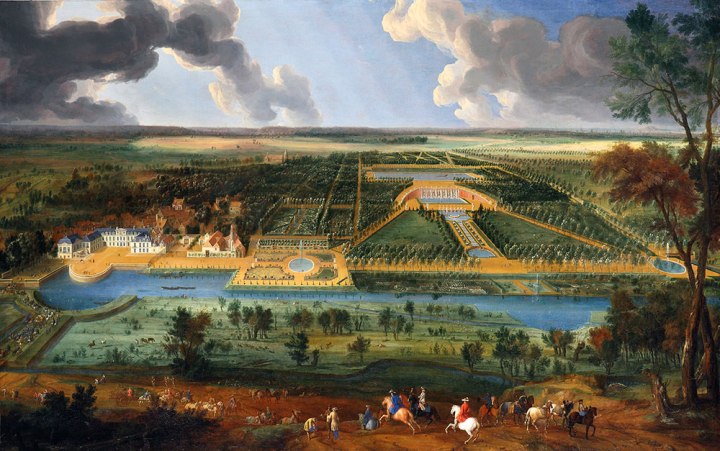
Pierre-Denis Martin, The Château de Juvisy,
165cm x 265cm, ca. 1700 (London: V&A)
◊ ◊ ◊ ◊ ◊
From H-ArtHist:
Creating the Europe 1600–1815 Galleries
Victoria and Albert Museum, London, 8 April 2016
This conference celebrates the opening of the V&A’s new Europe 1600–1815 Galleries. It will introduce some of the new patterns of living that laid the foundations for our modern world. The papers will be presented according to the three main themes that create a narrative structure for the displays and interpretation in the galleries: first, that, for the first time ever, Europeans systematically explored, exploited, and collected resources from Africa, Asia and the Americas in their art and design; second, that France took over from Italy as leader of fashion and art in the second half of the 17th century; and third, that ways of living came to resemble those we know today. The conference is supported by The Heritage Lottery Fund.
Booking information is available here»
◊ ◊ ◊ ◊ ◊
P R O G R A M M E
10.00 Registration
10.30 Welcome by Bill Sherman (Head of Collections and Research, V&A)
10.40 Session One: The Europe Galleries 1600–1815 at the V&A
• Why Does 17th- and 18th-century Europe Matter Now?, John Styles (Professor of History, University of Hertfordshire, Senior Research Fellow, V&A)
• Creating the Europe 1600–1815 Galleries, Lesley Miller (Lead Curator, Europe 1600–1815 Galleries, V&A) and Lucy Trench (Head of Interpretation, Science Museum, formerly Lead Educator, Europe 1600–1815 Galleries, V&A)
11.40 Session Two: Explored and Exploited
• A Global Context for Europe, Beverly Lemire (Henry Marshall Tory Chair, Department of History and Classics, University of Alberta)
• The Cabinet: Collecting Art and Science, Eric Jorink (Tylers Professor of Enlightenment and Religion, Leiden University and a Research Professor, Department of History of Science and Scholarship, Huygens Institute for the History of the Netherlands, The Hague)
• Displaying Spain and Spanish America, 1600–1720, Kirstin Kennedy (Curator of Metalwork, V&A)
13.15 Lunch
14:00 Session Three: The Rise of France
• The Invention of Comfort in the Modern City, Joan DeJean, (Trustee Professor of Romance Languages, University of Pennsylvania)
• Luxury and Shopping in the Long Eighteenth Century, Natacha Coquery (Professor of History, University of Lyon II; INHA, Paris)
• Displaying French Historical Interiors: La Tournerie and the Serilly Cabinet, Joanna Norman (Senior Curator, Research Department, V&A)
15.15 Refreshments
15:45 Session Four: Then and Now
• The Impact of the Enlightenment, Colin Jones (Professor of History, Queen Mary’s, University of London)
• Fashion in Print, Patrick Steorn (Director, Thielska Galleriet, Stockholm; participant in HERA Fashioning the Early Modern Research Project)
• Bringing Interactivity into the Galleries: The Masquerade, Dawn Hoskin and Nadine Langford (Assistant Curator and Assistant Educator, Europe 1600–1815, V&A)
16:45 Closing Remarks on V&A’s Approach to Gallery Development, Sofía Rodriguez Bernis (Director of Museo Nacional de Artes Decorativas, Madrid)
Call for Papers | Association of Print Scholars at CAA 2017, New York
Collaborative Printmaking across Cultures and Time
Association of Print Scholars Session at CAA, New York, 15–18 February 2017
Chair: Jasper van Putten, Harvard University
Proposals due by 31 March 2016
Printmaking, from its earliest to its most recent expressions, has generally been characterized by collaboration. This panel explores the impact of collaboration on the artistic practice of printmaking across various cultures and times. In the West, renaissance printmaking was characterized by divisions of labor that designated specific tasks of professionals. Designers, woodcutters, engravers, printers, and publishers indicated their respective role on the prints they helped produce with designations such as invenit [invented], delineavit [traced/delineated], or excudit [printed/published]. The production of Japanese woodcuts in the nineteenth century was similarly defined by collaboration and specialization. Generally, publishers commissioned drawings from artists, which were transferred to wood, cut, and printed by specialized craftsmen on behalf of the publisher. Collaboration also characterized much of the printmaking in the modern period, despite the emphasis on artistic individuality in this time. Artists like Édouard Manet, Pablo Picasso, and Robert Rauschenberg produced some of their most celebrated prints in collaboration with master printmakers. More recently, digital social networks have opened up completely new venues for artistic collaboration. As technology has made sharing of images and ideas faster and easier than ever before, it stands to reason that artistic collaboration also changes.
Scholars have studied the more famous collaborations in the history of printmaking in great detail. Still, the impact of collaboration on artistic practice is often overlooked. Blockbuster shows especially tend to focus on famous artists and neglect the vital contributions of other individuals. How did the contributions of craftsmen, patrons, publishers, and agents impact the prints they helped produce and disseminate? How was their relative input valued and remunerated? To what extent can we interpret prints as the products of networks of different makers? Answers to such questions will differ from time to time and from place to place. This panel seeks to further our understanding of collaborative printmaking by seeking submissions engaging these issues from any culture and era. Side-by-side, these papers will highlight commonalities and differences with the aim to obtain unexpected insights. Especially welcome are contributions that make use of network theory to account for the total range of actors involved in collaborations. Also of special interest are papers that engage the role of digital tools and social networks in facilitating collaborations in contemporary printmaking.
Please send an abstract of 250 words or less and a CV to Jasper van Putten (jaspervputten@me.com) and info@printscholars.org by March 31, 2016.
Exhibition | Giovanni Battista Piranesi
From The Pushkin State Museum of Fine Arts:
Giovanni Battista Piranesi: Artworks from Russian and Foreign Collections
The Pushkin State Museum of Fine Arts, Moscow, 20 September — 12 November 2016
 The Pushkin State Museum of Fine Arts is planning to host a major exhibition dedicated to the art of Giovanni Battista Piranesi (1720–1778), an Italian engraver, architect, researcher, decorator, and collector of Ancient Roman objects. The display will include more than 100 etchings by Piranesi, engravings and drawings by his predecessors and followers, plaster casts, medals, books, models from the collection of the Pushkin State Museum of Fine Arts, the Cini Foundation (Venice), the Schusev State Museum of Architecture, the Russian Academy of Fine Arts Museum, and other collections based in Russia and Western Europe.
The works of the predecessors and the followers of the Italian master will help visitors get a better understanding of how Piranesi’s artistic personality was formed, how his art influenced the following generations of artists and of the role of his legacy in Russia. Piranesi’s art inspired the architects of Catherine II’s court—Giacomo Quarenghi, Charles Cameron, Vincenzo Brenna; as well as masters of Russian Avant-garde—Ivan Leonidov, Konstantin Melnikov, Yakov Chernikhov. This art still continues to impress its admirers with its sophistication: a contemporary Russian artist Valeriy Koshlyakov will display an artwork he has created exclusively for this exhibition.
Exhibition | Idea of the Perfect Painter

◊ ◊ ◊ ◊ ◊
From The Pushkin State Museum of Fine Art:
The Idea of the Perfect Painter: Russian Academic Model
Engraving and Books for Artists from the 18th Century
The Pushkin State Museum of Fine Arts, Moscow, 20 February — 22 May 2016
The exhibition Idea of the Perfect Painter will help visitors extend their knowledge on the learning methods of the Russian academic school of the 18th century. It is no coincidence that the display is located in the Olympic hall, surrounded by plaster casts similar to those, which could be found in studios. Plaster casts constituted the second step of artistic education, while the first one was dedicated to engraved ‘models’. The exhibition will showcase drawings, engravings, and prints dating from the end of the 18th century, as well as the first European art-related manuals and books. The display will feature original works by Georg Friedrich Schmidt (1712–1775) and sheets by his scholars—Alexey Grekov, Prokofy Artemyev, and others.
Exhibition | The Empress and the Gardener
Press release from Hampton Court:
The Empress and the Gardener
Hampton Court Palace, London, 28 April — 4 September 2016
Curated by Sebastian Edwards
 A remarkable collection of watercolour paintings and drawings once owned by the Empress Catherine the Great of Russia will go on show at Hampton Court Palace this spring, as part of the nationwide commemorations marking the 300th anniversary of Lancelot ‘Capability’ Brown’s birth. Never displayed before, the exhibition of almost 60 intricately detailed views of the palace, park and gardens vividly captures Hampton Court during the time when Capability Brown served there as Chief Gardener to King George III. The intriguing history of this collection, which lay forgotten in the stores of the State Hermitage Museum in St Petersburg, Russia for over two centuries, will be explored in The Empress and the Gardener.
Arguably Britain’s most famous landscape gardener, Capability Brown served as Chief Gardener to King George III at Hampton Court Palace from 1764 to 1783. The job came with a handsome salary and residence at the palace, but Brown, who famously transformed landscapes across the country, actually did very little to change the palace’s Baroque formal gardens, choosing instead to preserve them out of respect for his predecessors. Nevertheless, by the time he moved into royal service, he was already operating a busy landscaping business, and winning international acclaim as one of the most famous proponents of the ‘English Style’ of landscape design.
Famously a voracious consumer of foreign culture, Catherine the Great was a great admirer of all things English, declaring to the philosopher Voltaire that “Anglo-mania rules my plantmania.” She built herself an ‘English Palace’ and ‘English Park’ at her palace at Peterhof, with the help of British designers but was unable to find a Capability Brown of her own. Seizing a lucrative opportunity, a figure in the shadows, John Spyers, assistant to Brown, sold two albums of his detailed drawings from Brown’s home and workplace, Hampton Court Palace, to the Empress for the huge sum of 1,000 roubles.
Quite how Spyers managed to achieve this extraordinary coup remains a mystery, but ironically the Empress found herself the possessor of an album of drawings of a palace landscape which Brown himself had barely touched. The albums, which alone had cost Catherine a tenth the price of creating her new gardens, disappeared in her collection at the Hermitage (now the State Hermitage Museum) and lay forgotten for over two centuries before being rediscovered by Hermitage curator Mikhail Dedinkin in 2002.
Today, the Spyers views are a unique survival: the richest and most revealing record of how Hampton Court gardens looked when Brown was in charge. Together they are considered one of the most complete visual records of any historic landscape ever captured before the dawn of photography. From rare glimpses of the ordinary people who lived in or visited the palace and its gardens, to evocative details of Hampton Court’s celebrated courtyards, passageways and picturesque corners, they explore an almost-forgotten period in the palace’s history in vivid detail.
The Empress and the Gardener will see these rare works go on public display for the first time, in the very setting that inspired their creation. The exhibition will also feature contemporary portraits of Capability Brown and the Empress Catherine, previously unseen drawings of Catherine’s ‘English Palace’ in the grounds of Peterhof near St. Petersburg and several pieces of the famous ‘Green Frog’ dinner service, a triumph of British design created for the Empress by Wedgwood, featuring images of some of the celebrated landscapes where Brown worked across England.
Sebastian Edwards, exhibition curator, said, “We are thrilled to be able to present this remarkable window into a forgotten Georgian era in the palace’s past, in the year when garden lovers up and down the country are celebrating the 300th anniversary of Capability Brown’s birth. We hope that after enjoying The Empress and the Gardener our visitors will follow in John Spyers’s footsteps, out into Hampton Court’s magnificent gardens and discover how they have changed over the centuries.”
◊ ◊ ◊ ◊ ◊
From Artbooks.com:
Mikhail Dedinkin and David Jacques, The Hampton Court Albums of Catherine the Great, (London: Fontanka 2016), 160 pages, ISBN: 978-1906257224, £32 / $45.
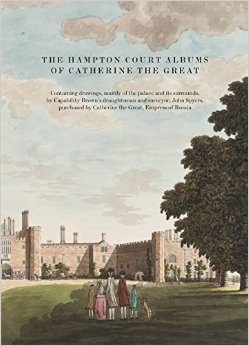
This album publishes, for the very first time, 100 hitherto unknown watercolours/drawings of Capability Brown’s designs for Hampton Court Palace gardens. These were purchased by Empress Catherine the Great of Russia through her own gardener James Meader, a disciple of Capability Brown, and then forgotten in the Hermitage stores. John Spyers, the artist to whom the albums have been attributed by Hermitage curator Mikhail Dedinkin, was Brown’s surveyor. Catherine the Great paid the huge sum of 1,000 roubles for them in the early 1780s and they were clearly bought as Capability Brown drawings. Almost no other visual material about Hampton Court and its gardens and park at the period when Lancelot ‘Capability’ Brown was the resident Royal Gardener has survived, so the importance of these views, which have never been published or on exhibition before, cannot be overstated.
Capability Brown Festival 2016 Marks Designer’s 300th Birthday

Blenheim Palace
◊ ◊ ◊ ◊ ◊
Press release for the Festival, which includes events throughout the year:
Capability Brown Festival 2016
The Capability Brown Festival 2016 is the first-ever nationwide celebration of the work of Lancelot ‘Capability’ Brown (1716–1783). It marks the 300th anniversary of his birth in August 1716. The Festival unites 19 partner organisations, in the UK’s largest festival of its kind to date. It is funded with a grant from the Heritage Lottery Fund, with additional match funding, and funding in kind, from the Festival’s partners and supporters. The Festival is managed by the Landscape Institute.

Richard Cosway, Portrait of Lancelot ‘Capability’ Brown, ca.1770–75 (Private Collection/Bridgeman Images)
The Festival has two key strands. The first is about increasing audiences and public access to the sites Brown worked or advised on. People will be able to explore and engage with Brown’s legacy landscapes, features and houses. The Festival will encourage as many Brown sites as possible to open in 2016, including those not ordinarily open to the public, and will support site owners and guardians in interpreting their landscapes for visitors. The second strand of the project is to discover more about Brown’s work and how he created his amazing landscapes and management systems with the tools available in the eighteenth century. Researchers, volunteers, independent groups and individuals, universities and sites themselves are being encouraged to undertake research projects on Brown and his work. This will be collated and shared through exhibitions, websites, social media and a range of events.
The Capability Brown Festival 2016 will
• Celebrate Capability Brown as an artist and landscape designer
• Encourage an increased number of people and a more diverse audience to visit, learn about and enjoy Brown’s landscapes
• Commission a range of interesting and innovative projects to encourage sites and people to get involved across the country
• Encourage a greater appreciation of our designed landscape heritage.
 To achieve this the Festival project team will
• Offer a comprehensive programme of support to owners of Brown sites, aiming to open as many as possible during Festival year, including those not normally open to the public
• Develop a network of hub sites across England to support and engage the Brown sites in their area or region
• Work with sites, with a special focus on those in urban areas and those commissioned to run projects, to bring Brown to new audiences
• Interpret all or as many sites as possible, using research by volunteers who will be trained and supported by the Festival
• Use media, PR, partner and central communication opportunities to promote understanding of Brown’s art and design influence
• Stimulate new research, and create a definitive record of Brown sites
• Ensure that the Festival’s findings, research and learning resources are accessible to as many people as possible, and share learning as it develops through a programme of regional seminars
• Engage volunteers in all aspects of the 2016 celebrations.
Lancelot ‘Capability’ Brown changed the face of eighteenth-century England, designing country estates and mansions, moving hills and making flowing lakes and serpentine rivers. Brown was baptised on 30 August 1716 at Kirkharle, Northumberland, the fifth of the six children of William Brown, a yeoman farmer and Ursula, née Hall, who had worked in the big house on the Kirkharle estate. He went to the village school at Cambo, and then began work as a gardener at Kirkharle, leaving in 1739. In 1741 he reached Stowe, Buckinghamshire where he rapidly assumed responsibility for the execution of both architectural and landscaping works in the famous garden. It was at Stowe in 1744 that Brown married Bridget Wayet, with whom he eventually had nine children. While at Stowe, Brown also began working as an independent designer and contractor and in autumn 1751, shortly after Cobham’s death, he was able to move with his family to the Mall, Hammersmith, the market garden area of London. His nickname of ‘Capability’ is thought to have come from his describing landscapes as having ‘great capabilities’.
Brown’s style derived from the two practical principles of comfort and elegance. On the one hand there was a determination that everything should work, and that a landscape should provide for every need of the great house. On the other his landscapes had to cohere and look elegant. While his designs have great variety, they also appear seamless owing to his use of the sunk fence or ‘ha-ha’ to confuse the eye into believing that different pieces of parkland, though managed and stocked quite differently, were one. His expansive lakes, at different levels and apparently unconnected, formed a single body of water as if a river through the landscape, that like the parkland itself, ran on indefinitely. This effortless coherence is taken for granted today in a way that was predicted in his obituary: ‘where he is the happiest man he will be least remembered, so closely did he copy nature his works will be mistaken’.
Brown offered a number of different services to his clients: for a round number of guineas, he could provide a survey and plans for buildings and landscape, and leave his client to execute his proposal; more frequently he provided a foreman to oversee the work, which would be carried out by labour recruited from the estate. Even in 1753, when he opened his account with Drummond’s Bank, Brown was employing four foremen and by the end of the decade he had over twenty foremen on his books. Finally, he could oversee and refine the work himself, usually by means of visits for a certain number of days each year. He also practiced architecture, and during the 1750s contributed to several country houses, including Burghley House, Blenheim, Chatsworth and Harewood. However, his architecture played second fiddle to his ‘place-making’. In 1764 he was appointed to the gardens of Hampton Court, Richmond and St James’s, and he then moved to Wilderness House, Hampton Court.
Brown had suffered from asthma all his life, and his habit of the constant travel, together with his practice of not always charging for work (he would sometimes allow his client to determine the value of what he had done and seems frequently to have submitted plans and surveys without a bill), did affect both his health and finances. He continued to work and travel however until his sudden collapse and death on February 6th, 1783. He died at his daughter Bridget Holland’s house in London, but was buried at Fenstanton, in Cambridgeshire, the only place he is known to have owned property and where he became Lord of the Manor.
Brown is best remembered for landscape on an immense scale, constructing not only gardens and parkland, but planting woods and building farms linked by carriage drives, or ‘ridings’, many miles from the main house. Although his work is continually reassessed, every landscape gardener and landscape architect since, both in Britain and across the developed world, has been influenced in one way or another by Brown. Over two centuries have passed since his death, but such are the enduring qualities of his work that over 150 of the 260 or so landscapes with which he is associated remain worth seeing today. The images that Brown created are as deeply embedded in the English character as the paintings of Turner and the poetry of Wordsworth.
Founding Partners
The Landscape Institute
The National Trust
The Historic Houses Association (HHA)
English Heritage
Historic England
VisitEngland
The National Garden Scheme
The Gardens Trust
Kolab
The National Association of Decorative & Fine Arts Societies (NADFAS)
VisitBritain
Parks & Gardens UK
Festival Partners
Blenheim Palace
The Royal Horticultural Society
Bridgeman Images
The Embroiderers’ Guild
Festival Supporter
The Georgian Group
Festival Funder
Heritage Lottery Fund
New Book | The Philip Johnson Glass House: An Architect in the Garden
From Rizzoli (for anyone thinking about where Capability Brown’s ideas lead in the twentieth century) . . .
Maureen Cassidy-Geiger, with a foreword by Charles A. Birnbaum and photography by Peter Aaron, The Philip Johnson Glass House: An Architect in the Garden (New York: Skira Rizzoli, 2016), 224 pages, ISBN: 978-0847848362, $55.
 The first authoritative book on the history of the Glass House property—Philip Johnson’s fifty-year project of iconic modernist design, encompassing the remarkable buildings, landscape, and follies. From its completion in 1949 to the present day, Philip Johnson’s Glass House has drawn cognoscenti and the curious from around the world to New Canaan, Connecticut, to experience what might be the most photographed modernist residence in America. The property—an architectural playground on forty-seven acres with eleven Johnsonian follies dating from 1949 to 1995—is an icon of twentieth-century architectural and landscape design. The book chronicles how Philip Johnson and David Whitney, the architect and the plantsman, lived on the property for decades and used the landscape as an ever-changing canvas for their designs—the result of a unique synthesis of influences and ideas from across history and geography. New research reveals Johnson’s and Whitney’s interaction with the landscape and the evolution of the site from a five-acre parcel to a world-renowned gentlemanly estate for modern times. The Philip Johnson Glass House—beautifully illustrated with vintage and commissioned photography—will be a must-have for connoisseurs of architecture, landscape design, photography, and social history.
Maureen Cassidy-Geiger is an internationally recognized curator, scholar, and educator with expertise in European decorative arts, gardens, photography, and the history of architecture.
Charles A. Birnbaum, FASLA FAAR, is president and CEO of the Cultural Landscape Foundation in Washington, D.C.










 Enfilade
leave a comment