Salon du Dessin 2016
From the art fair’s website:
Salon du Dessin 2016
Palais Brongniart, Paris, 30 March — 4 April 2016 / Symposium, 30–31 March 2016
 The Salon du Dessin is a unique event of worldwide renown, lead by its new chairman Louis de Bayser. Serving as a reference for drawing collectors, the Fair also gathers curators, experts or amateurs from across the globe. This year, the Salon du Dessin, will feature 39 prestigious galleries specialising in Old Masters, Modern and Contemporary drawings. More than 1000 drawings will be showcased in the prestigious Palais Brongniart.
To celebrate its 25th anniversary, special works from the Pushkin State Musuem will be unveiled for the first time in France. Curator of French drawings at the Pushkin State Museum and curator of the exhibition Vitaly Michine worked with curators from the private collections department along with the graphic arts department of the Pushkin State Museum to choose the twenty-six works that will be exhibited. Of the drawings, Russian artists produced seventeen, among which three come from Zilberstien collection; nine of the works were produced by European artists.
◊ ◊ ◊ ◊ ◊
Salon du Dessin 2016 Symposium
Palais Brongniart, Paris, 30–31 March 2016
W E D N E S D A Y , 3 0 M A R C H 2 0 1 6
• Sarah Catala, ‘Carcer Socratis Domus Honoris’: The Drawings of Hubert Robert in Prison
• Anne Lenoir and Sophie Join-Lambert, Joseph-Benoit Suvée: A New View of Italy, 1772–78
• Anna Ottani Cavina, Jean-Thomas Thibault: Italian Landscapes, 1788–92
• Emilie Beck Saiello, Typology of Vernet’s Sketchbooks
• Benjamin Couilleaux, Jean-Baptiste Huet: A Neoclassical Artist?
T H U R S D A Y , 3 1 M A R C H 2 0 1 6
• Louis-Antoine Prat, Some New Drawings by David
• Patrick Ramande, The Second Part of the Album of Jean-Germain Drouais de Rennes
• Sylain Laveissière, Prud’hon Draughtsman
• Mehdi Korchane, The Nude under His Skin: The Academic Drawings of Jean-Baptiste Regnault
• Isabelle Mayer-Michalon, Drawings by Charles-Toussaint Labadye for the 1798 Rome Competition: The Battle between the Horatii and the Curiatii
• Rébecca Duffeix, Drawings by Alexandre-Évariste Fragonard in Sèvres
2016 Summer Institute in Technical Art History for PhD Students
◊ ◊ ◊ ◊ ◊
From the Institute of Fine Art’s Conservation Center:
Manifestations of the Model in Art and Architecture
2016 Summer Institute in Technical Art History for PhD Students
Institute of Fine Arts, New York University, 6–17 June 2016
Applications due by 21 March 2016
The Summer Institute in Technical Art History (SITAH) is an intensive two-week course, geared towards PhD candidates in art history who are looking to delve more deeply into technical studies. Students are immersed into the world of technical art history and conservation of works of art, with faculty ranging from conservators to conservation scientists, curators, art historians, and artists. The course takes full advantage of the wonderful resources of New York City, and many sessions are held in local conservation labs, where attendees have the opportunity to closely examine works of art with experts in the field. Off-site visits also include artists’ studios, museum permanent collections, and, where relevant, special exhibitions and galleries. A priority is placed on case studies and discussions, and students are encouraged to build relationships within the group, in the hopes of enriching their own research.
This year’s Summer Institute in Technical Art History focuses on forms of the model in art and architecture. We will examine preparatory materials such as sketches, bozzetti, and architectural plans, as well as presentation models for sculpture and architecture, and will look for evidence of the model in the finished work of art. Our study will consider works that served as models for other media, like prints and lay figures; maps, globes, and three-dimensional botanical and medical replicas; so-called tomb models; the contemporary use of models in art making; and the afterlives of models as collection objects. This topic will allow us to explore questions of scale, material, and process through close examination of objects in New York City museums and conservation laboratories.
Participants will study with distinguished conservators, art historians, scholars and artists, with a focus on materiality and process through close looking at art objects. Hands-on studio sessions will introduce historic and contemporary working practices. Participants will discuss how these methodologies materially and theoretically inform their own diverse research interests. This seminar will provide a forum to develop critical skills in the interpretation of object-based analyses.
Generously funded by the Andrew W. Mellon Foundation, the seminar will be held at the Conservation Center of the Institute of Fine Arts, and in New York City’s leading museums. Participants will receive housing and a stipend of $1400 to help defray travel costs.
Students currently enrolled in or completing a doctoral program in the US and Canada are eligible to apply. No background in science or conservation is required. A maximum of fifteen participants will be admitted to the program. Applicants will be evaluated on the basis of their academic accomplishment to date and on their expressed interest in integrating technical art history into their own research.
Applicants should submit a cover letter addressed to Professor Michele Marincola, Conservation Center, Institute of Fine Arts, NYU; a statement of purpose (maximum 1200 words) expressing interest in integrating technical art history into their research; a letter of support from their advisor that addresses their academic standing and their interest in the topic; and an academic and professional CV. The application deadline is March 21, 2016. Please submit applications in electronic format to: Sarah Barack, course coordinator, sb340@nyu.edu.
Exhibition | Grezler’s Choices: Work from the ITAS Collection
Now on view at the Castello del Buonconsiglio:
Grezler’s Choices: Work from the ITAS Collection, 1500–1900
Le scelte di Grezler: Opere antiche della collezione Itas al Castello del Buonconsiglio
Castello del Buonconsiglio, Trento, 5 December 2015 — 1 May 2016
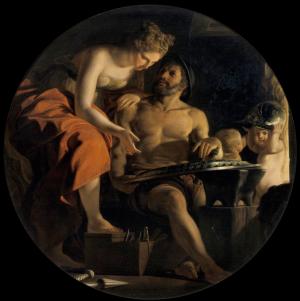
Bernardino Nocchi (previously attributed to Pompeo Batoni), Vulcan Delivering the Weapons of Aeneas to Venus, second half of the eighteenth century
Claudio Grezler, well known in Trento as having been president for over twenty years of the insurance company ITAS (Istituto Trentino Alto Adige per Assicurazioni), was also distinguished as a passionate art-lover. Over the years, this passion translated itself in the accumulation of a rich and varied personal collection of paintings. For the most part consisting of pictures by Italian and Flemish artists from the 1500s to the 1800s, his collection included outstanding works along the theme of the sacred and profane, of portraits, battles, and landscapes. By his own wish, his collection was merged with that of ITAS on his death and, in 1981, was exhibited in the prestigious setting of Buonconsiglio Castle. Claudio Grezler expressly wished that his collection, built up “with time, effort and sacrifice” should not be divided up and should instead become a public heritage.
Today, in gathering together this important patrimony, the Buonconsiglio Castle museum and ITAS have worked in harmonious synergy to pay homage to this important figure through a new initiative in appreciation of his collection. After assiduous research and a painstaking restoration process, the paintings are presented to the public in an exhibition that is further enriched by other exquisite works that Grezler, during his time as president, had added to the insurance company’s own collection.
Among the works exhibited are many that have only now, thanks to research conducted especially for this occasion, emerged from anonymity and been associated with their legitimate authors. We can, for instance, now admire Antonio Giuseppe Sartori’s baroque relief featuring the figure of Saint Florian, the patron saint of fire-fighters which is ideally suited to the insurance activities of ITAS. Present, too, is a delicate representation of Holy Conversation attributed to Nicolò de Barbari, alongside a sumptuous painting by Antonio Marini and an equally vivacious Bacchanalia from the Flemish school.
Call for Session Proposals | CAA in New York, 2017
From CAA News (22 January 2016). . .
105th Annual Conference of the College Art Association
New York, 15–18 February 2017
Proposals due by 18 April 2016
For the CAA 105th Annual Conference, CAA will change the format of the conference as we look to liven up the experience for all our members. The changes highlighted below are the result of a critical look at the event by the organization’s Annual Conference Committee.
• New time grid: All sessions will be ninety minutes in length, allowing for more sessions
• More types of submissions and therefore more ways to participate, such as complete session proposals, with participants chosen in advance; proposals to chairs, who will solicit speakers through a call for papers; and independent proposals of papers
• Individuals may participate in consecutive years, if their proposals are accepted
• Other Annual Conference Events (more information available here)
You can download and read the full report of recommendations by CAA’s Task Force on the Annual Conference. Please remember all participants will have to be members and registered for the conference for 2017.
Key Dates for the 2017 Conference
March 1 Call for Annual Conference session and paper proposals
April 18 Deadline for session and paper proposals
June 3 Annual Conference Committee meets to select sessions and papers
June 20 Notification sent regarding approved sessions
July 1 Call for Participation
July 1 Deadline for travel grant applications
August 30 Paper titles and abstracts due for sessions soliciting contributors
Mid-September Online conference registration opens
September 30 Deadline for chairs to choose speakers for sessions soliciting contributors
October 1 Deadline for Hot Topics session proposals
February 15–18 CAA 105th Annual Conference, New York
Affiliated Society Submissions
• One session per Affiliated Society will be accepted with a note of approval from the chair of the group; subsequent submissions may be submitted separately by individuals and require peer review by the Annual Conference Committee; these submissions will not be labeled as an Affiliated Society panel.
• Each Affiliated Society is still guaranteed one 90-minute session, as well as a business meeting, which will be tagged as an Affiliate Society meeting.
• Sessions should be submitted in the proposal submission process above.
Exhibition | The Splendor of Venice
◊ ◊ ◊ ◊ ◊
From Fondazione Cariplo:
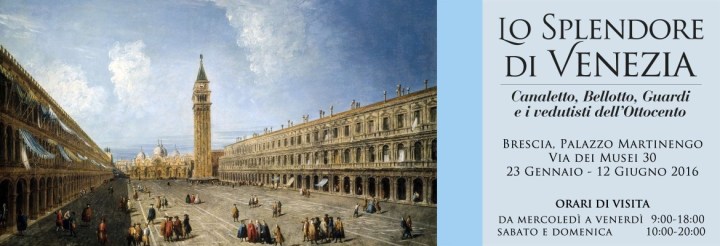
Lo Splendore di Venezia: Canaletto, Bellotto, Guardi e i Vedutisti dell’Ottocento
The Splendour of Venice: Canaletto, Bellotto, Guardi and the Vedutisti of the Nineteenth Century
Brescia, Palazzo Martinengo, Brescia, 23 January — 12 June 2016
Palazzo Martinengo is hosting a new international art exhibition to celebrate the city of Venice. The Splendour of Venice shows how the city has been and still is—more than any other city—a timeless legend in the world’s collective imagination. Down through the centuries, Venice has been immortalised by Italian and foreign artists so often that it was identified as the origin of vedutismo. ‘Veduta’ in English was a successful new landscape genre that was appreciated by the rich and educated Grand Tour travellers who wanted to return to their home countries with a lovely picture of the charming sights they had seen in Italy.
To tell the public about the origins and development of the glorious season of Venetian vedute, Palazzo Martinengo presens for the first time ever a selection of over one hundred masterpieces by Canaletto, Bellotto, Guardi, and other important vedutisti from the 18th and 19th centuries. The paintings, on loan from prestigious private and public collections in Italy and Europe, have been carefully selected by an international scientific committee. This artwork demonstrates that the popularity of the genre did not end with the Republic of Venice, which came about with the Treaty of Campo Formio, signed in 1797 by the French and the Austrians, but instead continued during the entire 19th century.
The exhibition will follow an interesting chronological itinerary, divided into ten thematic sections, which all feature a selection of Murano glass objects created by master craftsmen of the 20th century. The exhibition will end with a final surprise, set up in the section ‘Venice, theatre of life’, with scenes from daily life in the squares, open spaces, streets, and canals of the city. Fondazione Cariplo is present at this event with four masterpieces from its art collection, painted by Guglielmo Ciardi and Pietro Fragiacomo.
Study Day | Textiles and Diplomacy: Diplomats and Spies
From H-ArtHist:
Textiles and Diplomacy: Diplomats and Spies in the Early Modern Age
Centre for Textile Research, SAXO Institute, University of Copenhagen, 17 March 2016
Convened and introduced by Corinne Thépaut-Cabasset
13:00 Corinne Thépaut-Cabasset (CTR/SAXO Institute Copenhagen), ‘Textiles and Diplomacy: Diplomats and Spies in the Early Modern Age’
13:30 Axel Harms (Rosenborg Castle), ‘Splendour and Confidentiality: Rosenborg Castle and the Diplomacy of Christian IV’
14:00 Cecilia Candreus (Uppsala University), ‘An Embroidered Marriage Proposal to Elizabeth I of England’
14:30 Charlotte Paludan (Independent Textile Scholar Copenhagen), ‘French Espionage on Danish Textile Production’
15:00 Nadia Fernández de Pinedo (Universitad Autonóma Madrid), ‘Textile Consumption in Mid-18th Century-Madrid: Diplomats and Upper Middle Class’
15:30 Sidsel Frisch (University of Copenhagen), ‘Textile Diplomacy: Tapestries of War and Peace’
Call for Papers | Romantic Legacies
From the Call for Papers and conference website:
Romantic Legacies
National Chengchi University (NCCU), Taipei, 18–19 November 2016
Proposals due by 15 May 2016
Keynote Speakers: Rachel Bowlby (Comparative Literature, Princeton University/English, University College, London) and Arthur Versluis (Religious Studies, Michigan State University)
In his seminal book The Roots of Romanticism (1999), Isaiah Berlin regards Romanticism as “the largest recent movement to transform the lives and the thoughts of the Western world.” Indeed, Romantic ideas and attitudes—embraced by Goethe, Hegel, Sade, de Staël, Rousseau, Baudelaire, Wollstonecraft, Wordsworth, Coleridge, Shelley, Beethoven, Schubert, Poe, Emerson, Thoreau, Dickinson, Turner, and Delacroix, to name but a few—not merely changed the course of history in the West in the late-eighteenth and nineteenth centuries but helped to fashion twentieth-century democracy, environmentalism, Surrealism, fascist nationalism, communist universalism, spiritualism, social liberalism, and so forth in the West as well as in the East. This two-day interdisciplinary conference aims to bring together academics from across the humanities and social sciences to explore the full spectrum of possible Romanticisms, the germination, maturation, and development of this heritage on both sides of the Atlantic and its afterlife in our global capitalist culture today.
We invite proposals for individual papers or collaborative panels from academics in the humanities and social sciences to reassess Romanticism and its legacies in different nations and disciplines. Possible topics may include, but are not limited to esotericism and spiritualism, emotion and neuroesthetics, Gothic and uncanny, imagination and memory, childhood, revolution and anarchy, geographies and the tourist gaze, romantic Victorians, romanticism as proto-modernism, romanticism and Abstract Expressionism, romanticism and empire, romanticism and its afterlife in the Far East, romanticism and Realism, the environmental humanities, romanticism and the inhuman, the Apocalypse, romanticism and the everyday, romanticism and world literature, the technological sublime, psychiatry and psychoanalysis, celebrity culture, gender performance, sensibility and social reform, solitude and sociability, the country and the city.
Proposals of no more than 300 words should be sent by 15 May 2016 via EasyChair. Should you have any questions or enquiries, please contact us at earn.nccu@gmail.com. We intend to produce an edited volume from the conference with a major academic publisher and a special issue for The Wenshan Review of Literature and Culture.
This conference is organised by the EARN (Enlightenment and Romanticism Network) in partnership with The Wenshan Review in the Department of English at NCCU.
Organising Committee
John Michael Corrigan (NCCU)
Yih-Dau Wu (NCCU)
Shun-liang Chao (NCCU)
Li-hsin Hsu (NCCU)
Jing-fen Su (NCCU)
Emily Sun (NTHU/Barnard College)
Alex Watson (Japan Women’s University)
Laurence Williams (University of Tokyo)
Lecture | Giorgio Riello, Towards a Global Cultural History?
Giorgio Riello, Towards a Global Cultural History? Gifts,
Commodities and Diplomacy in the First Global Age
Deutsches Haus, Columbia University Department of History, New York, 23 March 2016
Columbia University Department of History is pleased to present the Dr. S. T. Lee Annual Lecture in History: Towards a Global Cultural History? Gifts, Commodities and Diplomacy in the First Global Age, presented by Professor Giorgio Riello (University of Warwick, Department of History), Wednesday, March 23rd, Deutsches Haus (420 West 116th Street, between Amsterdam Avenue and Morningside Drive), 6:00–7:30pm. Reception to follow.
Giorgio Riello was trained as an economic historian, with a focus on material culture and the history of technology. After his work on the transformation of Italian and European industry in the eighteenth century, he began publishing on global history, becoming founding director of the Centre for Global History and Culture at Warwick University, one of the world’s leading programs focusing on the global history of material culture. His multiply award-winning publications have ranged from the global history of cotton to south Asian textile production, to the global industry of shoe production.
New Book | The Global Lives of Things
Published in December by Routledge:
Anne Gerritsen and Giorgio Riello, eds., The Global Lives of Things: The Material Culture of Connections in the Early Modern World (New York: Routledge, 2015), 266 pages, paperback ISBN: 978-1138776753, $50 / hardback ISBN: 978-1138776661, $160.
 The Global Lives of Things considers the ways in which ‘things’, ranging from commodities to works of art and precious materials, participated in the shaping of global connections in the period 1400–1800. By focusing on the material exchange between Asia, Europe, the Americas and Australia, this volume traces the movements of objects through human networks of commerce, colonialism and consumption. It argues that material objects mediated between the forces of global economic exchange and the constantly changing identities of individuals, as they were drawn into global circuits. It proposes a reconceptualization of early modern global history in the light of its material culture by asking the question: what can we learn about the early modern world by studying its objects?
This exciting new collection draws together the latest scholarship in the study of material culture and offers students a critique and explanation of the notion of commodity and a reinterpretation of the meaning of exchange. It engages with the concepts of ‘proto-globalization’, ‘the first global age’ and ‘commodities/consumption’. Divided into three parts, the volume considers in Part One, Objects of Global Knowledge, in Part Two, Objects of Global Connections, and finally, in Part Three, Objects of Global Consumption. The collection concludes with afterwords from three of the leading historians in the field, Maxine Berg, Suraiya Faroqhi and Paula Findlen, who offer their critical view of the methodologies and themes considered in the book and place its arguments within the wider field of scholarship. Extensively illustrated, and with chapters examining case studies from Northern Europe to China and Australia, this book will be essential reading for students of global history.
Anne Gerritsen is Associate Professor in the Department of History at the University of Warwick. Her previous publications include Ji’an Literati and the Local in Song-Yuan-Ming China (2007).
Giorgio Riello is Professor in the Department of History at the University of Warwick. In addition to several edited collections, he is the author of A Foot in the Past (2006) and Cotton: The Fabric that Made the Modern World (2013).
◊ ◊ ◊ ◊ ◊
C O N T E N T S
Introduction The Global Lives of Things: Material Culture in the First Global Age, Anne Gerritsen and Giorgio Riello
Part I: Objects of Global Knowledge
1 Itineraries of Matter and Knowledge in the Early Modern World, Pamela Smith
2 Towards a Global History of Shagreen, Christine Guth
3 The Coral Network: The Trade of Red Coral to the Qing Imperial Court in the Eighteenth Century, Pippa Lacey
Part II: Objects of Global Connections
4 Beyond the Kunstkammer: Brazilian Featherwork and the Northern European Court Festivals, Mariana Françozo
5 The Empire in the Duke’s Palace: Global Material Culture in Sixteenth-century Portugal, Nuno Senos
6 Dishes, Coins and Pipes: The Epistemological and Emotional Power of VOC Material Culture in Australia, Susan Broomhall
7 Encounters around the Material Object: French and Indian Consumers in Eighteenth-Century Pondicherry, Kévin Le Doudic
Part III: Objects of Global Consumption
8 Customs and Consumption: Russia’s Global Tobacco Habits in the Seventeenth and Eighteenth Centuries, Matthew P. Romaniello
9 Sugar Revisited: Sweetness and the Environment in the Early Modern World, Urmi Engineer
10 Coffee, Mind and Body: Global Material Culture and the Eighteenth-Century Hamburg Import Trade, Christine Fertig and Ulrich Pfister
Afterwords
Paula Findlen
Suraiya Faroqhi
Maxine Berg
Exhibition | Eighteenth-Century Porcelain Sculpture
Press release for the exhibition now on view at the NGV:
Eighteenth-Century Porcelain Sculpture
National Gallery of Victoria, Melbourne, 27 February — December 2016

Chelsea Porcelain Factory, London, Joseph Willems (modeller), Pietà, ca. 1761, porcelain (soft-paste), 38.5 x 28.5 x 22.8 cm (Melbourne: National Gallery of Victoria)
The NGV will present its renowned collection of eighteenth-century porcelain sculpture in an upcoming exhibition, revealing eighteenth-century baroque life and culture, from commoners and aristocrats to famous actors and musicians. Eighteenth-Century Porcelain Sculpture will showcase over eighty exquisite examples from famed European factories—including the German Meissen, French Sèvres, and English Derby factories—of intricately modelled porcelain figures, large-scale sculptural works, and celebrity portraits.
Tony Ellwood, Director, NGV, said, “The NGV holds the largest collection of porcelain sculpture in Australia, and this exhibition offers an opportunity to view a number of our rarest and most important works, including the Chelsea Porcelain Factory’s large-scale Pietà sculpture of which the NGV will present two of the only three examples in the world.”
Whilst today porcelain sculptures are often considered ‘decorative’ items, in the eighteenth century many of the finest artists of the time were drawn to the novel medium. The exhibition will include the work of key modellers such as Johann Joachim Kändler—the era’s most important ceramic sculptor and a major innovator—Franz Anton Bustelli, Johann Peter Melchior, and Giuseppe Gricci, court sculptor to King Charles VII of Naples.
The exhibition also includes rare porcelain sculptures of popular eighteenth-century London stage actors including Kitty Clive, Henry Woodward, David Garrick, and James Quinn. Collected by wealthy members of the elite, these figures give insight into the growing culture of celebrity in eighteenth-century England and demonstrate how porcelain became an important medium for the dissemination of popular imagery. Another highlight is the exceptionally rare Goffredo at the Tomb of Dudone, modelled by Giuseppe Gricci for the Neopolitan Capodimote factory, which portrays an episode from Tasso’s great Renaissance epic poem Jerusalem Liberated.
Due to the fragile nature of porcelain sculpture, NGV conservators have undertaken five months of restoration work to return many of these pieces to display. One sculpture, by the Italian Doccia factory of a shepherd and his companion, will be displayed for the first time in more than twenty years. Individual fingers no more than 2mm across were remade from porcelain and skilfully attached to the shepherd’s hand, an incredibly delicate procedure that required three attempts. Conservators have also removed discolouration from other pieces enabling them to be displayed once more in all of their original beauty.
The exhibition is accompanied by an online essay by Matthew Martin and public program offerings including floor talks which will provide unique insights into the period.










 Enfilade
leave a comment