Exhibition | Stones Steeped in History
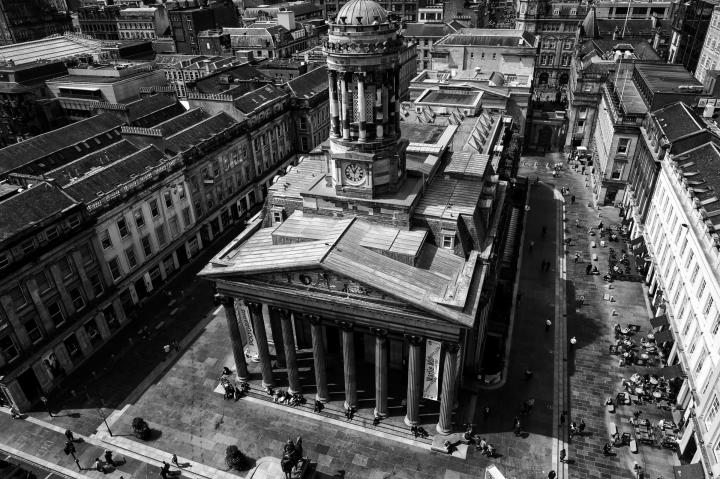
GoMA and Royal Exchange Square taken from Grant Thornton offices on the 8th floor of 110 Queen Street. Photo by Jamie Simpson.
◊ ◊ ◊ ◊ ◊
Press release (9 August 2017) from GoMA:
Stones Steeped in History
Gallery of Modern Art, Glasgow, from August 2017
As Scotland’s most popular modern art gallery and one of the country’s top ten visitor attractions, the Gallery of Modern Art, Glasgow has opened a new display charting significant dates in the development of the site, together with important milestones in the cultural development of Glasgow. Stones Steeped in History tells the story from 1777, when the original building was commissioned as a mansion for tobacco merchant, William Cunninghame, until the present day. The permanent show will inform visitors of the history of the building and is also part of the city’s ambition to aid a deeper understanding of the role slavery played in the narrative of Glasgow. Images of beautiful old photographs, watercolours, and postcards complement nostalgic images of Glasgow throughout the years, which enhance the detailed timeline on display.
Stones Steeped in History begins with a brief account of the life of William Cunninghame and moves through times of great wealth, created by international trade. The building’s first commercial purpose was as a bank some forty years later, before becoming Glasgow’s Royal Exchange in 1827, where for over 100 years businessmen gathered to trade cotton, sugar, coal, and iron. Many, like Exchange founder James Ewing of Strathleven, owned or profited from the labour of enslaved people on the sugar and tobacco plantations in the American colonies and West Indies.
The display continues with innovations such as one of Glasgow’s first telephone exchanges, housed in the building from 1880 and records the iconic Duke of Wellington statue being erected outside in 1884. Glasgow Corporation purchased the building in 1954. Its first civic use was as a library, containing both the Stirling and Commercial Library collections. Stones Steeped in History then chronicles the building’s key role in Glasgow’s rise as a centre for art and culture, which began in the 1970s.
Chair of Glasgow Life, Councillor David McDonald, said: “We are pleased to open Stones Steeped in History and share a few of this historic building’s stories, including its undeniable ties to slavery. GoMA has been a home, a bank, an exchange, a library, and is now a respected gallery of modern and contemporary art. This building’s stones really are steeped in history. This exhibition records some of the key events in the cultural development of Glasgow. Importantly it continues to tell the story of Glasgow’s links to the slave trade, by providing a fuller appreciation of the part slavery played in the narrative of the city and how important that is not only to the past, but also to the future.”
Glasgow had a reputation as a tough city, but always running alongside this has been a history of innovation and creativity. In the 1970s, Glasgow City Council recognised how culture could be used to re-frame the city’s reputation. The first major project was the creation of a new museum to hold Sir William Burrell’s gift to the city—his collection of over 9,000 objects. The Burrell Collection opened in 1983, to international acclaim. The Garden Festival followed in 1988, attracting over 4 million visitors and in 1990 Glasgow won the title of European Capital of Culture, changing its cultural standing forever. Glasgow and the artists who have emerged from it are now acknowledged around the world and the city boasts one of the finest civic art collections in Europe.
The Mitchell Library opened in 1911, incorporating much of the book collection housed in the building. Stirling’s Library remained until work began on the Gallery of Modern Art in 1994. GoMA opened in 1996, under the leadership of then Director of Museums Julian Spalding. It had six galleries, five showing works from the permanent collection, with one for exhibitions. Spalding’s vision was quite radical—to display only works by living artists—but his selection of artists was met with dismay by the artistic community. Glasgow Museums’ current approach to collecting and commissioning is quite different and now focuses on building the collection and important social justice and human rights issues. Curators continue to collect and commission work by artists with a Glasgow connection. Visitors can see displays of local and international artworks from the collection as well as temporary exhibitions and artist events across the building’s four galleries. The basement is home to a library and café; there is a shop and artists workspace on the top floor.
Stones Steeped in History is located on two balconies across level 1 and 2 at GoMA. The display covers the period from when the first building appeared in the 1700s up to the opening of the Gallery of Modern Art in 1996. It highlights some of the significant dates and functions in the history of the venue, alongside some key points in the cultural development of Glasgow. It is open now. The exhibition was made possible thanks to the generous donations from the 3.1 million visitors who visit Glasgow Museums every year.
Call for Proposals | History of Collecting Seminars
History of Collecting Seminars
The Wallace Collection, London, 2018
Proposals due by 11 September 2017
The seminar series was established as part of the Wallace Collection’s commitment to the research and study of the history of collections and collecting, especially in the eighteenth and nineteenth centuries in Paris and London. In 2018, as in previous years, we plan to organise a series of 10 seminars.
The Wallace Collection will be celebrating the bicentenary of Sir Richard Wallace’s birth in 2018. To mark the occasion we hope that the seminars will have a special emphasis on collecting in Paris and London during the second half of the nineteenth century. We are also keen, though, to encourage wider contributions for 2018, covering all aspects of the history of collecting, including:
• Formation and dispersal of collections
• Dealers, auctioneers and the art market
• Collectors
• Museums
• Inventory work
• Research resources
The seminars, which are normally held on the last Monday of every month during the calendar year, excluding August and December, act as a forum for the presentation and discussion of new research into the history of collecting. Seminars are open to curators, academics, historians, archivists, and all those with an interest in the subject. Papers are generally 45–60 minutes long, and all the seminars take place at the Wallace Collection between 5.30 and 7pm. If interested, please send a short text (500 words), including a brief CV, indicating any months when you would not be available to speak, by 11 September 2017. For more information and to submit a proposal, please contact: collection@wallacecollection.org. Please note that we are able to contribute up to the following sums towards speakers’ travelling expenses on submission of receipts:
• Speakers within the UK, £80
• Speakers from Continental Europe, £160
• Speakers from outside Europe, £250
The 2017 programme is available here»
New Book | The Museum by the Park: 14 Queen Anne’s Gate
From Paul Holberton Publishing:
Max Bryant, The Museum by the Park: 14 Queen Anne’s Gate (London: Paul Holberton Publishing, 2017), 128 pages, ISBN: 978 1911300 328, £25 / $35.
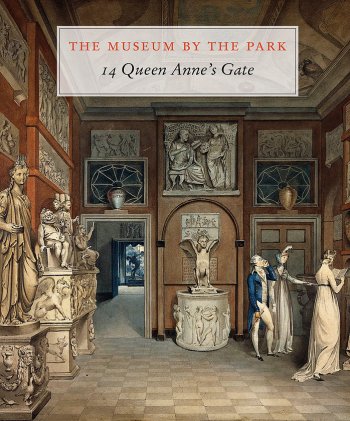 The depth of history at Queen Anne’s Gate—a handsome Baroque street overlooking St James’s Park—is unusual even in London, and few houses resonate with more memories than the extraordinary number 14. The story of the house over the centuries features political revolutionaries, occult initiations, clandestine war meetings, and a decapitated head. It begins, however, as a museum of Roman sculpture, unrivalled outside Italy, designed for connoisseur and virtuoso Charles Townley (1737–1805). Townley embodied Enlightenment values perhaps more completely than any other figure in the art world of 18th-century Britain—his portrait by Johann Zoffany is one of the iconic paintings of the period—yet remarkably he has never been the subject of a major publication.
Written with a sparkle matching Townley’s own enthusiasm, this beautiful and engaging publication tells the story of 14 Queen Anne’s Gate and examines the extraordinary life of Charles Townley and his remarkable collection of over 150 Roman marble statues (mostly now in The British Museum but captured in spectacular engravings of the period). It will be a revelation.
The house was designed as a temple to the past, reviving in the modern city the occult practices of the ancient world. Here visitors in the eighteenth century would have found an assembly of Roman sculpture unrivalled outside Italy, as well as a library and collection devoted to understanding a universal ‘generative sprit’ worshipped by early civilizations. That spirit may be found in the succession of major roles the house has continued to take through generations of dramatic change up to the present day.
Charles Townley, for whom the house was built, was a figure both marginal and emblematic. Catholic and bisexual, he forged a life literally on the borders of the Protestant British establishment. He remains little understood or appreciated in his homeland and, remarkably, has never been the subject of a major exhibition or publication. The ‘emblematic’ side of Townley’s life was dedicated to virtù, the term used for an appreciation of fine art pursued for its own sake. The ‘marginal’ side of Townley, by contrast, manifested itself in a fascination with the ancient occult, particularly the Bacchic mysteries. The house he made for himself was at once a temple to virtu and to Bacchus and contained an unprecedented programme of Bacchic iconography.
Library Research Grants from the Getty
From The Getty:
Getty Research Institute Library Research Grants
Applications due by 16 October 2017
Getty Library Research Grants provide partial, short-term support for researchers requiring the use of specific collections housed in the Getty Research Institute (GRI). The GRI’s grant budget has been generously supplemented by donations from Getty Research Institute Council members and the Getty Conservation Institute.
Specialized Library Research Grant Opportunities
In addition to the open call for applications relating to projects utilizing any specific area of the GRI’s collections, several focused grants will be awarded in the following areas of study:
• Research related to the modern commercial art market, Los Angeles modern architecture, or design
• Research in the area of 18th-century German art as it relates to the religious, philosophical, and aesthetic contextualization of the Romantic movement
• Research within the GRI’s photo archive, a collection of two million photographs of works of art and architecture providing opportunities for original pictorial research in the fine arts, including the history of photography
• Research that utilizes the Conservation Collection, specialized research materials related to the preservation and conservation of material cultural heritage
Eligibility
Library Research Grants are intended for researchers of all nationalities and at any level who demonstrate a compelling need to use materials housed in the Research Library, and whose place of residence is more than eighty miles from the Getty Center. Projects must relate to specific items in the library collection. (To search the collections, please consult the Research Library’s Search Tools and Databases.)
Terms
Library Research Grants are intended to provide partial support for costs relating to travel, lodging, and living expenses. Housing is not provided. In general, grants are awarded as follows depending upon the distance traveled:
• Within California (must be more than 80 miles away from GRI): $800
• North America, including Canada and Mexico: $1,500
• International outside of North America: $3,000
The research period may range from several days to a maximum of three months. These terms apply as of August 2017 and are subject to future changes. Please see important information about the terms of these grants here.
Notification Process
Applicants are notified of the Research Institute’s decision approximately two months following the deadline. Applicants who do not receive grant awards are still welcome to use the Research Library in accordance with its access policy.
Application Availability and Deadline
Complete application materials are now accepted through an online application process only. The next deadline to submit application materials (including letters of recommendation) for these grants is 5:00pm (PDT) October 16, 2017.
More information is available here»
The Burlington Magazine, August 2017
The eighteenth century in The Burlington:
The Burlington Magazine 159 (August 2017)
 E D I T O R I A L
• “Reflected Glory: University Art Collections in Britain,” p. 599.
O B I T U A R I E S
• Simon Jervis, “Rudolf Hermann Wackernagel (1933–2017),” p. 639. His great article, “Carlton House Mews: The State Coach of the Prince of Wales and of the Later Kings of Hanover, A Study in the Late-Eighteenth-Century ‘Mystery’ of Coach-Building, in Furniture History 31 (1995) remains the most authoritative statement on London coach building in the late eighteenth century. But his crowning achievement was the massive two-volume Staats- und Galawagen der Wittelsbacher (Stuttgart, 2002). This is a catalogue of the wonderful collection of the Marstallmuseum at Schloss Nymphenburg, outside Munich, where he generously deposited part of his own extensive and systematic archive on coaches and carriages…
R E V I E W S
• Gauvin Alexander Bailey, Review of Christine Casey, Making Magnificence: Architects, Stuccatori and the Eighteenth-Century Interior (Yale University Press, 2017), pp. 642–43.
• Ayla Lepine, Review of Julian Holder and Elizabeth McKellar, eds., Neo-Georgian Architecture, 1880–1970: A Reappraisal (Historic England, 2016), pp. 643–44.
• Michael Hall, Review of Pauline Prévost-Marcilhacy, ed., Les Rothschild: une dynastie de mécènes en France, 1873–2016 (Somogy éditions d’Art, 2016), pp. 644–46.
• Francis Russell, Review of the exhibition Canaletto and the Art of Venice (London: The Queen’s Gallery, Buckingham Palace, 2017), pp. 651–52.
• Matthi Forrer, Review of the exhibition Hokusai: Beyond the Great Wave (London, The British Museum; and Osaka: Abeno Harukas Art Museum, 2017), pp. 652–53.
•Eric Zafran, Review of the exhibition America Collects Eighteenth-Century French Painting (Washington: D.C.: National Gallery of Art, 2017), pp. 669–70.
R E C E N T A C Q U I S I T I O N S
Recent acquisitions (2007–17) by regional university collections in Britain
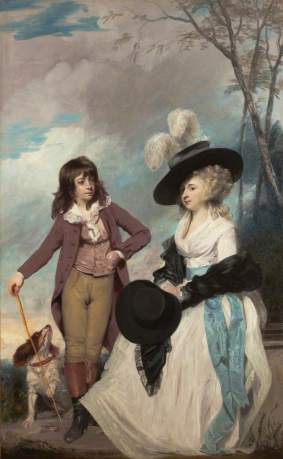
Joshua Reynolds, Maria Marow Gideon and Her Brother, William, 1786–87 (Birmingham: The Barber Institute of Fine Arts), January 2013.
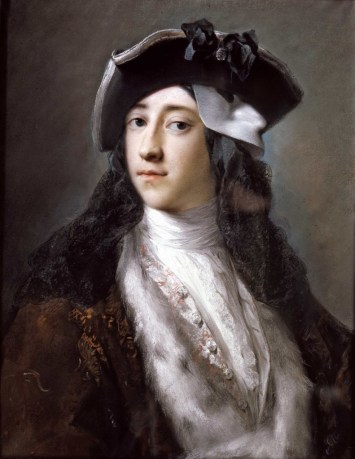
Rosalba Carriera, Portrait of Gustavus Hamilton, 2nd Viscount Boyne, ca. 1730–31; pastel, heightened with white bodycolour on paper (Birmingham: The Barber Institute of Fine Arts), 2009.
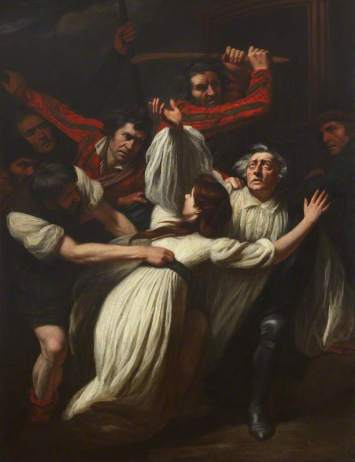
John Opie, The Death of Archbishop Sharpe, 1797; oil on canvas (University of St Andrews), 2008.
Call for Papers | Art and Work, A Graduate Symposium
Art and Work, A Graduate Symposium
Northwestern University, Evanston, 8 February 2018
Proposals due by 1 October 2017
The Department of Art History at Northwestern University will hold a one-day graduate symposium on Thursday, 8 February 2018 on the topic of art and work. The symposium will span historical periods and geographic regions to investigate the history, politics, and aesthetics of artistic labor. Our proposal is grounded by historical and theoretical concerns with the social positions of art making, the artist, and work more generally. How do the social and technical conditions of labor in a given society determine the possibilities of its art, and how do artistic imaginaries of work help shape struggles around these very social conditions? What kinds of skills, expertise, discourses, or knowledge come to distinguish an artist from an artisan, engineer, or maker, or from a teacher, political official, or social worker? How and where do these distinctions emerge or dissolve both visually and historically, and how do they relate to other predominant social markers such as race, gender, and class? We see these questions as resonating across boundaries of period and national tradition, and are excited to see what might be learned from thinking within a wide historical frame wherein both art and work are contested terms.
We welcome papers that consider, among other topics, the aesthetics of work and/or non-work; the social position of the artist; the problem of aesthetic autonomy; or spaces of production and their representations—from the artist’s studio to the collaborative workshop, the laboratory, the home, the factory, and beyond. We are also interested in how representations of artistic production and exercises in (or negations of) artistic technique mediate ongoing processes of social transformation. We invite papers from any time period or geographic region by graduate students in art history as well as related disciplines.
Possible topics might include
• Depictions of studio, workshops, factories, spaces of production
• Craft labor and handwork
• Treatises and technical manuals
• Artistic readymades or the absence of work
• Histories of deskilling and automation
• Aesthetics and political economy
• Anti-work politics and aesthetics
• Global precarity and flexible labor regimes
• Reproductive labor, domestic work
• Affective and care-based labor
• Post-Marxist approaches to ‘immaterial labor’
• Community and public art
Symposium speakers who do not reside locally will receive roundtrip economy airfare to Chicago/Evanston, accommodation for two nights in Evanston, and a travel stipend to cover ground transportation to and from the airport. Please email proposals to laurelgarber2015@u.northwestern.edu and brianleahy2020@u.northwestern.edu by October 1, 2017. Include in your proposal a 300-word abstract and a brief CV in a single PDF file. Selections will be announced in mid-October.
Keynote lecture by Jasper Bernes, author of The Work of Art in the Age of Deindustrialization (Stanford University Press, 2017).
Symposium | Saint-Cloud to Bernardaud: French Porcelain, 1690–2000
From The French Porcelain Society:
Saint-Cloud to Bernardaud: New Horizons in French Porcelain, 1690–2000
The French Porcelain Society Symposium
The Wallace Collection, London, 20–21 October 2017
Organized by Aileen Dawson

From top left: Saint-Cloud Vase, 1695–1710 (New York: The Metropolitan Museum of Art); Bastien & Bugeard Clock, 1848–58 (Paris: Musée des Arts décoratifs); Mennecy Jug, 1760 (London: Victoria and Albert Museum); Villeroy Monkey, 1745 (New York: The Metropolitan Museum of Art); Guérhard & Dihl Vase, 1797–1804 (Clandon Park, National Trust); and Bernardaud Vase, 2015, by Hervé Van Der Straeten.
The symposium will present ground-breaking new research on a broad range of French porcelain factories operating from the late 17th century up to the present day. Many of these factories have at times been unjustly neglected in favour of the royal factory at Sevres, even though their productions could at times rival its splendid output, and all were responding to the same changes in taste and fashion. Papers will focus on Saint-Cloud, Chantilly, Mennecy, and factories in Eastern France, such as Strasbourg and Niderviller, those operating in Paris in the late 18th and 19th centuries, such as Dihl, Shoelcher and Dagoty, and the Limoges factories in production in the 19th century and up to the present day. The location, capitalisation, techniques of manufacture, employment of artists, sculptors and designers, marketing and clientèle will be explored by some twenty leading international scholars.
The symposium is organized by Dr Aileen Dawson, former curator at The British Museum. It is open to members and non-members of The French Porcelain Society, and bursaries may be available for scholars who wish to attend. The registration fee is £100 (non-FPS members £110, students £70) with additional fees for lunches and an evening reception. Please contact FPSenquiries@gmail.com.
P A P E R S
17th and 18th Centuries
• Errol Manners, The Porcelain of Villeroy
• Nicole Duchon, Mennecy Villeroy: Some Surprising New Discoveries
• Pamela Roditi, Two Travellers: Robinson and Clara
• John Whitehead, The Painter Piat-Joseph Sauvage: his work on porcelain at Dihl
• Iris Moon, Use Your Illusion: Niderviller Ceramics and Rococo Aesthetics at the 18th-Century French Border
19th Century
• Tamara Préaud, Brongniart and the ‘Exposition des Produits de l’industrie (1819–1844)
• Audrey Gay-Mazuel, Parisian Porcelain Makers and the Mid-19th-Century Rococo Revival
• Sonia Banting, A Little-Known Maker of pâte-sur-pâte: Charles Pillivuyt (1810–1872) and His Porcelain Factory in the Berry Region
• Virginie Desrante, Jules Lesme and Limoges in the Style of Bernard Palissy
• Howard Coutts, Paris and Other French Porcelain in the Bowes Museum
• Régine de Plinval de Guillebon, Dagoty, Porcelain Manufacturer to the Empress Josephine: Designs and Their Realisation
20th Century
• Hélène Huret, Arists and Designers at Bernadaud, Limoges, from Kees Van Dongen to Jeff Koons, Know-How and Invention
Exhibition | Basic Instincts

Joseph Highmore, The Angel of Mercy, ca. 1746; oil on canvas, 59.7 × 48.3 cm (New Haven: Yale Center for British Art, Paul Mellon Collection, B1981.25.362).
◊ ◊ ◊ ◊ ◊
Press release from The Foundling Museum:
Basic Instincts
The Founding Museum, London, 29 September 2017 — 7 January 2018
Curated by Jacqueline Riding
A highly successful artist and Governor of the Foundling Hospital, Joseph Highmore (1692–1780) is best known as a portrait painter of the Georgian middle class. However, during the 1740s Highmore’s art radically shifted as he turned his focus to societal attitudes towards women and sexuality. Curated by Highmore expert, Dr Jacqueline Riding, Basic Instincts explores this ten-year period and his disruptive commentary, reflecting his engagement with the work of the new Foundling Hospital and its mission to support desperate and abused women. On public display in the UK for the first time is a remarkable painting that still retains the power to shock.
In 1744 Highmore created a series of 12 paintings on his own initiative inspired by Samuel Richardson’s international bestseller, Pamela, or Virtue Rewarded. First published in 1740, the novel’s sixth edition of 1742 included illustrations by Hubert Gravelot and Francis Hayman. However, unlike the commissioned illustrations, Highmore’s paintings explicitly make reference to the abuse and sexual violence at the heart of Richardson’s story of a virtuous young maidservant fighting off the unwanted advances of her predatory master. Highmore and Richardson became friends, and Highmore subsequently illustrated Richardson’s masterpiece, Clarissa, or, the History of a Young Lady, whose tragic heroine avoids a forced marriage, but dies having been abandoned by her family, duped by an admirer, drugged and raped.
Unlike William Hogarth, Highmore’s representation of Georgian society favoured realism over broad humour and theatricality, so his nuanced articulation of social attitudes towards women and sexuality means that modern audiences can miss his challenging commentary. However, at the heart of Basic Instincts is a remarkable painting that has never before been publically displayed in the UK and which does not fail to shock. The Angel of Mercy (c.1746) depicts a desperate mother in the act of killing her baby, with the distant Foundling Hospital presented as an alternative solution. This painting is unique in western art for showing maternal infanticide as a contemporary reality. The fashionably dressed mother is free from direct biblical or mythological allusion, unlike Hagar and Ishmael (1746) the large canvas Highmore donated to the newly established Hospital, which represents an Old Testament story of maternal abandonment. Instead The Angel of Mercy confronts the ‘elephant in the room’ in terms of the Hospital’s campaign; that without Christian compassion and practical support, even respectable women will be driven to murder.
Basic Instincts curator Jacqueline Riding said: “This is the first major Highmore exhibition for 50 years and nowhere can his life and work have greater resonance than at the Foundling Museum: an organisation at the forefront of the public display, interpretation and appreciation of early-Georgian art. Setting The Angel of Mercy, the Pamela paintings and Hagar and Ishmael among Highmore’s most tender portraits of mothers and children, family and friends, uniquely demonstrates the artist’s depth and variety, while indicating the true breadth of British Art in a period still labelled ‘The Age of Hogarth’.”
Foundling Museum director Caro Howell said: “Basic Instincts demonstrates that in the eighteenth century, the Foundling Hospital’s impact on contemporary artists went far beyond a simple donation of art. For Joseph Highmore it sparked a radical engagement with the issue of women’s vulnerability to sexual assault and society’s unwillingness to support them, culminating in a work of quite exceptional power.”
Basic Instincts explores the limits and narratives around female respectability in Georgian society, and reveals the complexity of Highmore’s engagement with issues surrounding women’s vulnerability to male exploitation. The first major publication dedicated to Joseph Highmore and written by Dr Riding will be published by Paul Holberton publishing to coincide with the exhibition. The exhibition is supported by the Paul Mellon Centre for Studies in British Art.
On display in the Museum’s historic rooms, a series of nine previously unseen sculptures by acclaimed contemporary artist Rachel Kneebone provide a highly charged counterpoint to Basic Instincts. Exploiting porcelain’s history as a material of refinement and rococo exuberance, Kneebone subverts viewers’ expectations by creating works that are simultaneously delicate and visceral. Raft of the Medusa’s tumbling limbs and fractured swags are at once coquettish and sinister; their gleaming white surfaces and exquisite detail belie scenes of collapse and dismemberment. Displayed amongst the Museum’s historic Collection, these works distil and abstract the Foundling Hospital’s suppressed narratives of sexual desire, emotional damage, and female strength.
Jacqueline Riding specialises in Georgian history and art. She read History and Art History at the universities of Leicester, London, and York and has over twenty-five years’ experience working as a curator and consultant within a broad range of museums, galleries, and historic buildings, including the Guards Museum, Tate Britain, and Historic Royal Palaces. From 1993 until 1999 she was Assistant Curator of the Palace of Westminster and later founding Director of the Handel House Museum in London. She has published widely on early-Georgian art and history, including her major book Jacobites: A New History of the ’45 Rebellion (Bloomsbury 2016). She is currently writing a biography of William Hogarth (Head of Zeus). She was the consultant historian and art historian on Mike Leigh’s award-winning film Mr. Turner (2014) and is the consultant historian on his next feature film, Peterloo. Jacqueline Riding is Associate Research Fellow in the School of Arts, Birkbeck College, University of London and a Fellow of the Clore Leadership Programme.
Rachel Kneebone (b. 1973) lives and works in London. Recent solo exhibitions include Rachel Kneebone at the V&A, London (2017); 399 Days, White Cube Bermondsey (2014) and London; and Regarding Rodin, Brooklyn Museum, New York (2012). Group exhibitions include Obsession, Maison Particulière, Brussels and Flesh, York Art Gallery (2016); Lust for Life, Galleri Anderson Sandstrom, Stockholm and Ceramix at Bonnefantenmuseum, Maastricht (2015); 3am: Wonder, Paranoia and the Restless Night, The Bluecoat, Liverpool and Chapter, Cardi (2013–14); The Surreal House, Barbican Centre, London (2010); Summer Exhibition, Royal Academy of Arts, London (2008); and Mario Testino at Home, Yvon Lambert, New York (2007). In 2005, Kneebone was nominated for the MaxMara Art Prize and this year has been nominated for the breakthrough award for the 2017 South Bank Show Sky Arts Award.
The accompanying book is published by PHP:
Jacqueline Riding, Basic Instincts: Love, Passion, and Violence in the Art of Joseph Highmore (London: Paul Holberton Publishing, 2017), 120 pages, ISBN: 978 1911300 281, £25.
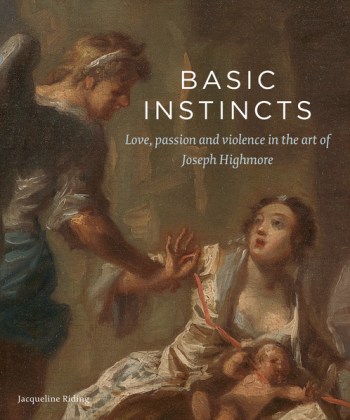 Published to coincide with the exhibition at the Foundling Museum in London, this fascinating book will re-introduce Joseph Highmore (1692–1780), an artist of status and substance in his day, who is now largely unknown. It takes as its focus Highmore’s small oil painting known as The Angel of Mercy (ca. 1746, Yale), one of the most shocking and controversial images in 18th-century British art.
The painting depicts a woman in fashionable mid-18th-century dress strangling the infant lying on her lap. A cloaked, barefooted figure cowers to the right as an angel intervenes, pointing towards the Foundling Hospital, the recently built refuge for abandoned infants, in the distance. The image attempts to address one of the most disturbing aspects of the Foundling Hospital story—certainly a subject that many (now as then) would consider beyond depiction. But if any artist of the period had attempted such a subject it would surely be William Hogarth, not the portrait painter Joseph Highmore? In fact, the painting was attributed to Hogarth for almost two centuries, until its reattribution in the 1990s. Even so, it is surprising that despite the wealth of scholarship associated with Hogarth and the ‘modern moral subject’ of the 1730s and 1740s, The Angel of Mercy has received little attention until now. The book and exhibition seeks to address this, while encouraging greater interest in, and appreciation for, this significant British artist.
Jacqueline Riding sets this extraordinary painting within the context of the artist’s life and work, as well as broader historical and artistic contexts. This includes exploration of superb examples of Highmore’s portraiture, such as his complex, monumental group portrait The Family of Sir Eldred Lancelot Lee and the exquisite small-scale ‘conversations’ The Vigor Family and The Artist and his Family, juxtaposed with analysis of key subject paintings, including the Foundling Museum’s Hagar and Ishmael and Highmore’s Pamela series, inspired by Samuel Richardson’s bestselling novel. Collectively they tackle relevant and highly contentious issues around the status and care of women and children, master/servant relations, motherhood, abuse, abandonment, infant death, and murder.
Call for Papers | New Orleans, Global City, 1718–2018

Gerard Van Keulen, Carte de la Nouvelle France ou se voit le cours des Grandes Rivieres de S. Laurens & Mississippi…
(Amsterdam, 1720)
◊ ◊ ◊ ◊ ◊
From the 18th- and 19th-Century Studies Network:
New Orleans, Global City, 1718–2018: The Long Shadow of John Law and the Mississippi Company
Inaugural Conference of the 18th- and 19th-Century Studies Network
University of Colorado Boulder, 26–28 April 2018
Proposals due by 17 September 2017
It has been almost three hundred years since the first international stock market crash took place in France, Britain, and the Netherlands. A spate of cross-disciplinary conferences and publications have added greatly to our understanding of the impact of the Mississippi and South Sea Bubbles and the Dutch windhandel (trade in wind) on European economies and cultures. The colonial, global, and oceanic dimensions of these events have not been studied as closely. Meant to coincide with the foundation of New Orleans in 1718 by the Compagnie des Indes (aka the Mississippi Company), this interdisciplinary conference will focus on the immediate to long-term impact of Law’s System and the Mississippi Company on the cultures, economies, and environments of New Orleans and surrounding areas. The focus will be on the eighteenth and nineteenth centuries, but we shall also consider proposals that deal with earlier or later developments so long as they take into account their broader historical context.
We particularly welcome proposals that
• consider the direct and indirect impact of French (and other) joint-stock companies and state-sponsored monopolies on the economies, cultures, ecologies, soundscapes, and sensescapes of New Orleans and the Mississippi River Delta;
• bring into dialogue indigenous, European, and American economic and cultural studies; and/or
• approach the history of New Orleans and the Mississippi River Delta from a global or oceanic perspective.
Sub-topics might include
• Global capitalism and the making of New Orleans
• New Orleans in the global imagination
• The impact of colonial settlements on indigenous and on metropolitan and colonial French, Spanish, and British economies and cultures
• Relations among indigenous peoples, Spaniards, Canadians, Acadians, French, Africans, and Germans
• Relations with France, Britain, Spain, and their colonies
• Trade routes and migration patterns
• Cross-cultural / comparative studies of slavery and colonialism
Linguistic creolization
• 1718 / 1720 as origin myth in French and American cultures
• The impact of the Mississippi Bubble on New Orleans, Lower Louisiana, New France, and the West Indies
• Economic, ecological, and cultural dimensions of natural and financial disasters
The deadline for the submission of individual paper proposals is September 17, 2017. Please send an abstract (300–600 words) along with a brief curriculum vitae (2–3 pages) to catherine.labio@colorado.edu. Abstracts and cv may be in English or French, although all presentations will be in English. If you do not receive an acknowledgment by September 22, please email catherine.labio@colorado.edu. Proposals will be selected by an interdisciplinary scientific committee. Notifications will go out by October 15, 2017. Papers (due April 9) will be pre-circulated. Presentations will be brief to leave plenty of time for discussion.
The 18th- and 19th-Century Studies Network was created in Fall 2016 with support from the Department of English at the University of Colorado Boulder. Its core mission is to foster intellectual exchanges within the University of Colorado and at the regional, national, and international levels. The Network is open to faculty and students from across the CU System and to all other scholars in the area. All geographical, disciplinary, and methodological approaches are welcome.
Call for Papers | Crafting an Enlightened World: Patronage & Pioneers
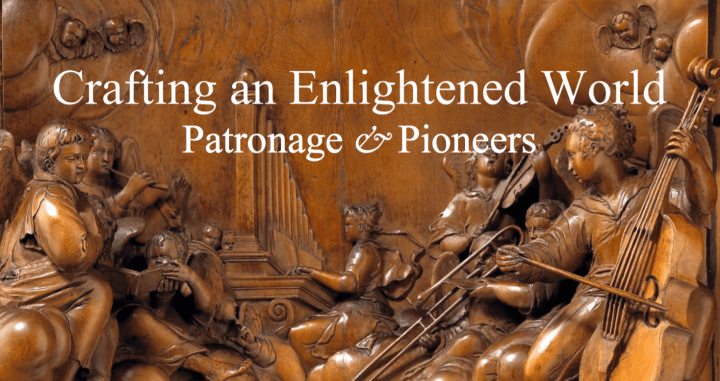
Grinling Gibbons, detail from the King David panel, ca. 1670, boxwood
(York: Fairfax House)
◊ ◊ ◊ ◊ ◊
2017 Fairfax House Georgian Studies Symposium
Crafting an Enlightened World: Patronage & Pioneers
Fairfax House, York, 19–20 October 2017
Proposals due by 8 September 2017
York, from the late seventeenth to the early nineteenth century, was amongst the key centres in Britain where ideas, innovation, experimentation, and invention flourished, contributing to what is now referred to as the ‘era of Enlightenment’. Indeed, York was to play host to nationally and internationally celebrated astronomers, historians, clockmakers, scientists, painters, sculptors, architects, and cabinet-makers, as well as leading anti-slavery campaigners and enlightened mental health providers. The interdisciplinary nature of the talent which converged in vibrant hubs across the country such as York, reflected the spirit of the age in which scholars could simultaneously delve into religion, philosophy, natural sciences, mathematics, history, and the arts, seemingly without conflict. These progressive environments were key in sustaining and nurturing talented—often providing vibrant nexus points through which talented thinkers, scientists, artists, and craftspeople traversed, trained, worked, and often decided to permanently reside.
Crafting an Enlightened World: Patronage and Pioneers will be Fairfax House’s Fifth Symposium in Georgian Studies. Held in conjunction with the exhibition Made in York: Inventing & Enlightening the Georgian City, it aims to delve deeper into the theme of ‘Crafting an Enlightened World’ during the long eighteenth century (c.1680–1830), examining its roots and legacy. The symposium will focus on the driving forces behind creating an enlightened world and in turn how the Enlightenment fed and helped forge the environment in which pioneering craftsmanship in Britain during this period took flight.
Drawing on the breadth and diversity of enlightened talent which flourished in Britain during the era, the symposium hopes to offer a re-examination of the period, moving away from the London-centric narratives which have dominated analysis of the era, to a more nuanced yet holistic view of this period which also takes account of the regional Georgian urban realm.
The symposium will take place over two days. Day One will explore the contexts which emerged and fostered ‘enlightened’ creativity in the period. Echoing the eclectic interests of enlightened polymaths, we hope this first day will be broad and varied in the range of topics discussed and may include (though not limited to): studies focusing on the ‘enlightenment’ in the public, private and urban realms, clubs and societies, intellectual networks, the tools used in the dissemination of ideas and inventions, patronal networks, collecting, connoisseur and antiquarianism, issues of class and gender in Enlightenment practice, taxonomy, the historiography of the enlightenment, or the enlightenment as a literary phenomenon.
Building upon this, Day Two will primarily focus on ‘enlightened craftsmanship’, in its many varied forms and expressions. We hope to examine the processes of invention, creation, and crafting which gave physical expression to the phenomenon of the ‘enlightenment’. Considering its pioneers and patrons, topics could include but are not limited to: the influence of ‘enlightenment’ ideas on the arts, the synergy which existed between the sciences and the arts, the emergence of academies and centres of excellence, the role of religion, and regionality.
In the light of Fairfax House’s recent acquisition of Grinling Gibbons’s first-known, made-in-York artwork, the King David panel, a key part of Day Two will be devoted to his work, and we encourage in particular papers which look at the intersection of Gibbons, pioneering craftsmanship, and the Enlightenment.
Contributions in the form of papers not exceeding 20 minutes in length are invited addressing relevant topics. We are keen to encourage participation from the widest possible range of disciplines and backgrounds: museum professionals and volunteers, scholars and students in higher education, artists, craftspeople, and other practitioners. Please send proposals of around 200 words, accompanied by a brief one-paragraph biography, to fairfaxhousesymposium@gmail.com by Friday 8 September 2017. Any queries about the symposium should be sent to the same email address.
For the past five years Fairfax House has brought together world-class researchers from the academic and museum worlds for its annual Symposium in Georgian Studies. The symposia have provided a forum for the sharing of new and emerging scholarship into the long eighteenth century and the collaboration of academics and museum professionals in presenting this research to a public audience. As part of this ongoing commitment to expanding the reach of eighteenth-century scholarship, Fairfax House is excited to present its Cabinet of Curiosities. This addition to Fairfax House’s public-facing website will encompass fully-credited scholarly articles based on content from past exhibitions held at Fairfax House as well as articles from academics and museum professionals with interests in the long eighteenth century. A wide range of aspects of eighteenth-century life are to be covered from national to regional levels including consumption, fashion, revolution, urban life, Georgian households, architecture, enlightenment, and leisure. It is anticipated that the scholarship shared at the symposia will be disseminated through this site to a broader public audience and we therefore hope that speakers will consider contributing their papers to the Cabinet of Curiosities.










 Enfilade
leave a comment