Colin Sheaf on Chinese Art for Western Interiors, 1650–1850
From the Society of Antiquaries:
Colin Sheaf | Chinese Art for Western Interiors, 1650–1850
Society of Antiquaries of London, 16 January 2018
Linking Asian craftsmanship with evolving Western tastes in interior decoration and passion for Chinoiserie, the ‘China Trade’ facilitated the arrival in London of principally Chinese artefacts and traditions like tea-drinking, which greatly enriched English polite society between about 1600 and 1850. This lecture will explore this exotic yet fundamentally commercial maritime relationship, illustrating some of the fine lacquers, ‘Export-taste’ ceramics, silks and wallpapers which the ‘Honourable East India Company’ regularly imported.
Colin Sheaf has enjoyed a distinguished 40-year career in the London art auction world after reading Modern History at Worcester College Oxford. A world authority on Asian ceramics and Chinese Art, as Chairman of Bonhams UK and Asia, and Global Head, he directs Asian Art specialist teams across four continents. He has lectured widely in the UK and Asia, and—besides publishing some 120 specialist articles—is co-author of a definitive study of Qing Dynasty Chinese ceramics. He was recently appointed Chairman of the world-famous Sir Percival David Foundation of Chinese Art, and chairs the Company running an award-winning historic London Square garden.
All lectures begin at 13.00. Doors open at 12.30 on the day of the lecture. Our Public Lectures are free and open to the public, but space is limited and reservations are strongly recommended to avoid disappointment. To book online, simply click the ‘Reserve Your Seat’ button at the Society of Antiquaries website.
Call for Papers | Fashioning the Early Modern Courtier
From the Call for Papers:
Fashioning the Early Modern Courtier
St John’s College, Cambridge, 16 May 2018
Proposals due by 22 January 2018
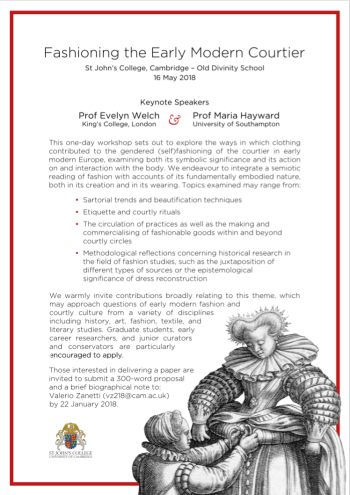 Early modern courts were crucial sites for the elaboration and diffusion of specific corporeal models aspiring to shape the ideal man and woman. Fashion, then as now, provides a very material setting that has the power to promote specific patterns of thought and action. This one-day workshop sets out to explore the ways in which clothing contributed to the gendered (self)fashioning of the courtier in early modern Europe (ca. 1500–1750), examining both its symbolic significance and its action on and interaction with the body.
Embracing a corporealist perspective, we endeavour to integrate a semiotic reading of fashion with accounts of its fundamentally embodied nature, both in its creation and in its wearing. Topics examined may range from sartorial trends and beautification techniques to issues related to etiquette and courtly rituals more broadly. The circulation of such practices as well as the making and commercialising of fashionable goods within and beyond courtly circles will also be investigated. Methodological reflections concerning historical research in the field of fashion studies are also welcome, such as the juxtaposition of different types of sources or the epistemological significance of dress reconstruction.
We are delighted to announce two keynote lectures to be delivered by leading scholars, Evelyn Welch (King’s College, London) and Maria Hayward (University of Southampton).
We warmly invite contributions broadly relating to this theme, which may approach questions of early modern fashion and courtly culture from a variety of disciplines including history, art, fashion, textile, and literary studies. Graduate students, early career researchers, and junior curators and conservators are particularly encouraged to apply. Those interested in delivering a paper are invited to submit a proposal of up to 300 words and a brief biographical note to Valerio Zanetti (vz218@cam.ac.uk) by 22nd January 2018.
New Book | Revolutionary Paris and the Market for Netherlandish Art
From Brill:
Darius Spieth, with a foreword by Marc Fumaroli, Revolutionary Paris and the Market for Netherlandish Art (Leiden: Brill, 2017), 514 pages, ISBN: 978 90043 36988, €116 / $134.
 Seventeenth-century Dutch and Flemish paintings were aesthetic, intellectual, and economic touchstones in the Parisian art world of the Revolutionary era, but their importance within this framework, while frequently acknowledged, has never attracted much subsequent attention. Darius Spieth’s Revolutionary Paris and the Market for Netherlandish Art reveals the dominance of ‘Golden Age’ pictures in the artistic discourse and sales transactions before, during, and after the French Revolution. A broadly based statistical investigation, undertaken as part of this study, shows that the upheaval reduced prices for Netherlandish paintings by about 55% compared to the Old Regime and that it took until after the July Revolution of 1830 for art prices to return where they stood before 1789.
Darius A. Spieth, PhD University of Illinois at Urbana-Champaign, is Professor of Art History at Louisiana State University. He is the editor of the Grove Guide to Art Markets and Collecting (forthcoming), and author of Napoleon’s Sorcerers: The Sophisians (2007).
C O N T E N T S
Acknowledgements
Foreword by Marc Fumaroli
List of Illustrations
A Note on Currencies
1 From Eyesores to Blue Chip Art
Origins of the Parisian Marketplace for Netherlandish Painting
Art Publications and the Dissemination of Information
France as International Tastemaker for Golden Age Art After 1740
Royal Collections and Northern Masters, 1777–1792
The Twilight of the Auction Business, 1775–1825
The Fate of Golden Age Art Under Terror and Inflation
The Louvre and the ‘Artistic Conquests’ in Belgium and the Netherlands
The Post-Revolutionary Market for Netherlandish Art
The Expanding Mass Market for Copies and the Rise of the Bourgeoisie
Golden Age Art and Popular Culture
Netherlandish versus Italian Art
The Parisian Apartment: A Bourgeois Space for Art
2 On the Art of Surviving the Revolution: Jean-Baptiste Pierre Lebrun
Art Dealer to the Ancien Régime’s Elite, 1776–1789
Painful Adjustments, 1789–1795
Co-Conspirator of Jacques-Louis David, 1792–1794
From The Ministry of Finance to the Louvre, 1794–1799
A Long Good-Bye from the Louvre, 1799–1803
A Difficult Comeback as Dealer-Expert, 1801–1804
Deceptions of the Napoleonic Age, 1807–1813
3 A Long Good Bye to the Palais Royal: The Northern Pictures in the Orléans Collection
The Art Collections in the Palais Royal until 1780
Inside the Art Deal of the Century
The Netherlandish Pictures of the Palais Royal Collection
A Look Inside the Galeries De Bois
4 Liberty’s Toll on Beauty’s Price
Myths and Realities of the Parisian Auction Market in the 1790s
Turnover of the Parisian Art Auction Market and its Economic Context, ca. 1775–1850
The Evolution of Prices for Netherlandish Art in Revolutionary Paris
Bidding Wars: The Picture Trade with Great Britain
The ‘Guilty Industry’ and Netherlandish Art
5 Netherlandish Art in France: A History of Taste and Money across Three Centuries
Poussinists versus Rubenists
The Marquis D’argens and Academic Prejudices Against Northern Art
The Re-Evaluation of Netherlandish Aesthetics from David to Thoré
The Politicization of Nehterlandish Art in the Nineteenth Century
Class, Taste, and the First Art Price Rankings
Appendix
Bibliography
Photograph Credits
Index
Frick Acquires Gérard’s Portrait of Prince Camillo Borghese
Press release (5 December 2017) from The Frick Collection:
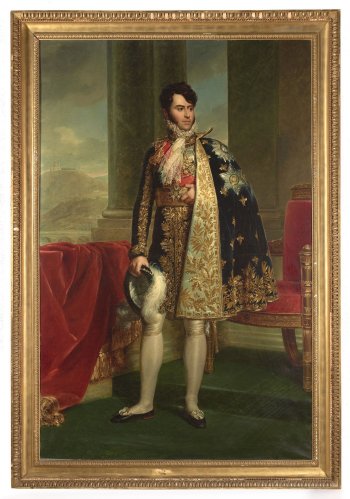
François-Pascal-Simon Gérard, Camillo Borghese, ca. 1810, oil on canvas, 84 x 55 (New York: The Frick Collection).
The Frick Collection announces its most important painting purchase since 1991 with the acquisition of François-Pascal-Simon Gérard’s full-length portrait of Prince Camillo Borghese, a notable art patron and the brother-in-law of Napoleon Bonaparte. Gérard (1770–1837) was one of the most significant French artists of the first half of the nineteenth century, and this stunning canvas will coalesce seamlessly with the museum’s holdings, which until now have not included his work. Chronologically, the painting sits between the museum’s French masterpieces by Boucher and Fragonard and later works by Ingres, Renoir, Monet, and Manet, while joining contemporaneous portraits by Chinard and David. It will, likewise, find good company in major works of portraiture by Bronzino, Rembrandt, Titian, Holbein, Van Dyck, Gainsborough, Reynolds, Romney, and Hogarth, Goya, and Whistler. Following conservation and technical study this winter and spring at The Metropolitan Museum of Art, Prince Camillo Borghese will go on view at the Frick later in 2018.
Comments Chairman of the Board of Trustees Elizabeth Eveillard, “The Frick’s holdings, as a group, have been compared to a necklace assembled one precious pearl at a time. The sentiment reflects the modest scale of the collection born of its founder’s individual taste, balanced by the absolute requirement of quality. Just as Henry Clay Frick (1849–1919) made a series of unrushed choices, the growth of the collection in nearly one hundred years since his passing has been steady but measured, including sculpture and decorative arts, always meeting the criteria of high quality. With this striking painting, coming to the Frick with an unbroken provenance from the Borghese family, still on its original, unlined canvas, and in its original frame, the Frick has found a rare masterpiece to harmonize with its esteemed holdings.” Adds Director Ian Wardropper, “The last opportunity the Frick had to purchase a major French School painting was nearly thirty years ago, with the acquisition of Watteau’s Portal of Valenciennes. Today, it is deeply rewarding to have the rare opportunity to bring to the museum such an important work as this one, a historic portrait we feel would have compelled Henry Clay Frick. While the portrait has been shown in Rome, it has never been seen publicly in America. We look forward to sharing it in the atmospheric setting of the former Frick residence and among equally well chosen works.”
About the Artist, Portraitist to the Bonaparte Family
Gérard studied with the painter Jacques-Louis David (1748–1825), becoming one of his most talented pupils. At the time of the French Revolution, Gérard produced a number of historic paintings, including his celebrated Belisarius and Cupid and Psyche. In 1796, he painted a portrait of his friend the miniaturist Jean-Baptiste Isabey (1767–1855) and his daughter (all three works can be seen at the Musée du Louvre, Paris). The latter work marked Gérard’s public success as portraitist, and it soon became the primary genre in which he worked. With the advent of Napoleon, the artist found enormous favor with the emperor and his immediate family. Made a Baron of the Empire in 1809, Gérard exhibited a vast number of portraits at the various Paris Salon exhibitions almost every year during the first quarter of the nineteenth century. Even after the fall of Napoleon, in 1815, Gérard’s stellar career continued under the Bourbon Restoration in France.
Gérard’s role as portraitist to the Bonaparte family was the apex of his career. From the early 1800s until the fall of the empire in 1815, he portrayed most members of the imperial family, works that are today highlights of major collections internationally. These include Napoleon in coronation robes (Château de Versailles), his mother, Letizia Ramolino (Scottish National Gallery, Edinburgh), and the Empress Josephine (Hermitage, Saint Petersburg). Napoleon’s brothers Joseph and Louis, brother-in-law Joachim Murat, sisters Elisa and Caroline, and sister-in-law Hortense de Beauharnais also sat at different times for him. The Metropolitan Museum of Art owns large portraits by Gérard of Madame Talleyrand and her celebrated husband, politician Charles Maurice de Talleyrand Périgord.
The Borghese Family: Aristocratic Collectors and Patrons of the Arts
Camillo Borghese was born to one of the most important families of the Roman aristocracy. The family acquired substantial works of fine and decorative arts, patronizing sculptor Giovan Lorenzo Bernini in the seventeenth century and figures such as the silversmith and decorator Luigi Valadier in the eighteenth century. They were also interested in antiquities, and today their collection remains the foundation of the Greek and Roman holdings of the Musée du Louvre. Also a patron of the arts, Prince Borghese is most famously remembered for commissioning from Antonio Canova a full-length sculpture of his wife in the nude, as Victorious Venus. One of the best-known and beloved sculptures in Rome from the moment it was carved, this marble statue of Paolina Borghese is today one of the glories of Villa Borghese.
The family was known for its Napoleonic sympathies, and Camillo moved to Paris in 1796. In 1803 he married Napoleon’s favorite sister, Paolina Bonaparte (1780–1825). It was a tempestuous marriage. At first, the couple lived in gilded splendor between Paris and Rome, where they refurbished the apartments of Camillo’s parents in the Palazzo Borghese; however, they soon became estranged and each took lovers. Paolina was still officially at her husband’s side when, in February 1808, Napoleon effectively put him in charge of Piedmont, Liguria, Parma, and Piacenza. Camillo and Paolina moved from Paris to Turin in April of that year and lived between the Piedmontese capital, Paris, and Rome until April 1814. In 1808, when Camillo and Paolina moved to Turin, they shipped most of the paintings, sculptures, silver, and porcelain from the Palazzo Borghese in Rome to their new residence. In 1814, they returned to Rome, and an inventory drafted on April 25, 1814—lists a portrait of the prince, likely this one, which has become the official and most famous image of him, and is understood from the iconography in the work to have been painted around 1810 in Paris.
Call for Essays | American Art and Economics
Special Issue of American Art: Economics, Money, and the Art Market
Edited by John Ott and Robin Veder
Proposals due by 1 February 2018; final MSS will be due 1 September 2018
American Art, the peer-reviewed journal co-published by the Smithsonian American Art Museum and the University of Chicago Press, invites historians of American art to answer the question, “What do we talk about when we talk about economics, money, and the art market?” In the spirit of the October Visual Culture questionnaire, replies may address any or all of the following questions and should take the form of brief position papers rather than intensive case studies. In the historiography of American art history, what shifts have we seen in ways of thinking about artistic production, the art market, and the visual cultures of economics? When we study financial systems, institutions, instruments, and objects, do we examine them in relation to economic power and social class, or in relation to other social phenomena, and why? To what extent have economic forces such as the art market and institutional funding shaped the field of American art, whether in terms of the objects and inquiries we pursue and neglect, or with regard to the vocabulary we use and avoid?
For consideration, submit abstracts of 250–500 words by February 1, 2018. The organizers, John Ott, professor of art history at James Madison University, and Robin Veder, executive editor of American Art at the Smithsonian American Art Museum, will review submissions and encourage selected authors to submit full manuscripts for further consideration. These should be 1,500–2,500 words including endnotes, with 1–4 images, and will be due by September 1, 2018. The journal will evaluate the manuscripts and select some for publication in a 2019 issue of American Art. Accepted authors will workshop the manuscripts together before final revision. Submit abstracts to americanartjournal@si.edu. For other inquiries, contact John Ott at ottjw@jmu.edu.
Lubaina Himid Wins the 2017 Turner Prize
◊ ◊ ◊ ◊ ◊
Lubaina Himid, this year’s Turner Prize winner, engages various themes relevant to the eighteenth century—from porcelain to slavery to Hogarth—within the larger context of African diasporan contributions “to the richness and layering of European culture.” The work is on display at Ferens Art Gallery, Hull for a few more weeks.
Turner Prize 2017
Ferens Art Gallery, Hull, 26 September 2017 — 7 January 2018
Turner Prize, one of the world’s most renowned art prizes, is awarded by Tate to an artist who has exhibited outstanding work in the previous year. The four shortlisted artists for 2017—Hurvin Anderson, Andrea Büttner, Lubaina Himid, and Rosalind Nashashibi—will exhibit their work at Ferens Art Gallery, Hull, from September with the overall winner announced in early December. Through genres such as portraiture, landscape and still life, the four artists explore how art is able to respond to political and social upheaval.
Attingham Offerings for 2018
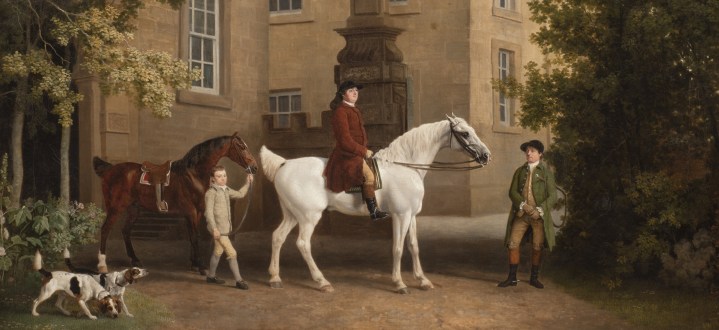
George Stubbs, 3rd Duke of Portland, Welbeck Abbey, detail, 1766
(The Portland Collection)
◊ ◊ ◊ ◊ ◊
Along with Attingham’s regular course offerings, next year’s study programme will address ‘The Horse and the Country House’. More information and application forms are available at Attingham’s website. Applicants from the U.S. may contact Mary Ellen Whitford, admin@americanfriendsofattingham.org. Applicants from outside the U.S. may contact Rita Grudzień, rita.grudzien@attinghamtrust.org.
French Eighteenth-Century Studies at The Wallace Collection, 25–29 June 2018
Applications due by 26 January 2018
French eighteenth-century studies is organised by The Attingham Trust on behalf of the Wallace Collection. Based at Hertford House, this intensive, non-residential study programme aims to foster a deeper knowledge and understanding of French eighteenth-century fine and decorative art and is intended primarily to aid professional development. A day at Waddesdon Manor, Ferdinand de Rothschild’s former country house, will help broaden the scope of the course still further. The academic programme will provide privileged access to the world-class collections of furniture, paintings, sculpture, textiles, metalwork and porcelain in these two collections. The group will be limited to a small number to allow for detailed, object-based study, handling sessions and a look at behind-the-scenes conservation. This course is primarily aimed at curators and other specialists in the fine and decorative arts.
The 67th Attingham Summer School, 12–29 July 2018
Applications due by 26 January 2018
Over the course of 18 days, the 67th Attingham Summer School will visit country houses in Sussex, Derbyshire, Nottinghamshire, County Durham, and Northumberland. The Summer School will examine the country house in terms of architectural and social history, and the decorative arts.
Royal Collection Studies, 2–11 September 2018
Applications due by 12 February 2018
Run on behalf of Royal Collection Trust, this strenuous 10-day course is based near Windsor. The school will visit royal palaces in and around London with specialist tutors (many from the Royal Collection) and study the extensive patronage and collecting of the royal family from the Middle Ages onwards.
The Attingham Study Programme: The Horse and the Country House, 19– 28 September 2018
Applications due by 12 February 2018
This intensive, 10-day study programme, will examine the country house as a setting for outdoor pursuits, such as hunting and racing, and as a focus for horse-drawn travel. The course will be based in two different locations, East Anglia and Yorkshire, and concentrate on houses where the architecture, interior design and works of art have strong equine connections. There will be visits to houses with good sporting art collections, noteworthy stable blocks, riding houses or carriage collections.
New Book | Artisanal Enlightenment
From Yale UP:
Paola Bertucci, Artisanal Enlightenment: Science and the Mechanical Arts in Old Regime France (New Haven: Yale University Press, 2017), 312 pages, ISBN: 978 03002 27413, $40.
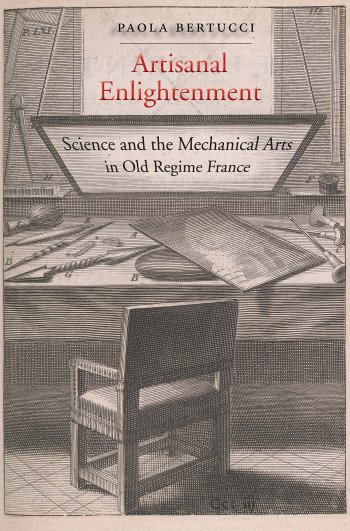 What would the Enlightenment look like from the perspective of artistes, the learned artisans with esprit, who presented themselves in contrast to philosophers, savants, and routine-bound craftsmen? Making a radical change of historical protagonists, Paola Bertucci places the mechanical arts and the world of making at the heart of the Enlightenment. At a time of great colonial, commercial, and imperial concerns, artistes planned encyclopedic projects and sought an official role in the administration of the French state. The Société des Arts, which they envisioned as a state institution that would foster France’s colonial and economic expansion, was the most ambitious expression of their collective aspirations. Artisanal Enlightenment provides the first in-depth study of the Société, and demonstrates its legacy in scientific programs, academies, and the making of Diderot and D’Alembert’s Encyclopédie. Through insightful analysis of textual, visual, and material sources, Bertucci provides a groundbreaking perspective on the politics of writing on the mechanical arts and the development of key Enlightenment concepts such as improvement, utility, and progress.
Paola Bertucci is associate professor of history at Yale University. She has published extensively on the public culture of science in eighteenth-century Europe, and is the author of prize-winning essays on secrecy, selective visibility, and industrial travel in the Enlightenment.
Exhibition | Modernity vs. Tradition: Art at the Parisian Salon
 From the Redwood Library and Athenaeum:
Modernity vs. Tradition: Art at the Parisian Salon, 1750–1900
The Redwood Library and Athenæum, Newport, 1 December 2017 – 8 April 2018
Curated by Benedict Leca
Named after the Salon carré at the Louvre, where it was held between 1725 and 1848, the Salon’s rise as the world’s preeminent regular exhibition of contemporary art was intertwined with the rise of a modern viewing public. Early presentations—first at the Palais Royal and then in the Grande Galerie of the Louvre by the 1690s (above)—were of comparatively restricted attendance. Yet already contained in them was the tension between the rule-bound tradition of academic pedagogy and the more progressive tendencies of venturesome artists pandering to popular taste.
What had begun in the 1670s as the French Académie Royale de Peinture et Sculpture’s desire to foster artistic competition and thus progress, and as an invitation to a nascent public to scrutinize and judge the products of its Academicians, had evolved by the mid-eighteenth century into one of the most charged public forums for the exchange of aesthetic and political ideas. A catalyst was the emergence of the new literary genre of art criticism in the 1740s, which from the outset contained a strongly partisan wing highly critical of official art and of the Crown’s management of national art production. Aesthetic judgements were in this way often of a piece with political critiques, thus compounding the meanings and public impact of artworks and their interpretation.
As an arm of the French Crown, the Académie suffered a similar fate during the Revolution, being abolished in 1793 only to re-emerge as the Institut national and, later, as the École des Beaux Arts. These successive institutions managed the Salon fitfully. It endured in close alliance with official arts policy during the Empire and benefited from the more permissive era of the Bourbon Restoration. Later, having fully entered the popular imaginary through the explosion of modern press coverage after mid-century, it became the defining context that gave rise to modern art. Indeed, if the number of exhibitions and visitors doubled during Napoleon’s reign, by the last quarter of the century the Salon had reached an altogether different level of impact. Now featuring thousands of works viewed by tens of thousands of visitors, the Salon as an international cultural phenomenon can be seen as the precursor of today’s many biennales.
Seminar Series | Art and the Senses

From the University of Cambridge:
Art and the Senses
Department of History of Art Graduate Research Seminar Series, University of Cambridge, Lent 2018
The work of art is more than a visual object. It has surface, texture that can be touched, and emits or evokes sounds, smells, and tastes. Recently, academic studies on the senses have flourished, especially in the context of the material approach to visual studies; meanwhile, museums and art institutions have been considering new ways to augment visitor experience through the senses, and better engage with visitors who have sensory impairments; and in contemporary art, performance, video, and sound can incorporate more than one sense at a time, and calls into question the primacy of the visual. This Graduate Seminar Series, Art and the Senses, seeks to appreciate the roles of the senses in visual culture, explore the senses’ problematic and pleasurable qualities, and ultimately offer participants the opportunity to engage with their own senses.
Wednesdays at 5pm
History of Art Graduate Centre
4a Trumpington Street, CB2 1QA
Refreshments provided, all welcome
Making
Wednesday 17 January
Nose-First: Rendering Visible the Humanist Smellscape
Kate McLean – Programme Director, Graphic Design Canterbury Christ Church University and Information Experience Design PhD Candidate RCA
Seeing
Wednesday 24 January
Investigating the Invisible: Optiques and Visual Culture in the French Merveilleux-Scientifique Genre (1880–1930)
Fleur Hopkins – History of Art PhD Candidate, Université Paris 1 Panthéon-Sorbonne and Assistant Researcher at the Bibliothèque Nationale de France, département des Sciences et Techniques
Tasting
Wednesday 31 January
Tasting Impressionism
Dr Allison Deutsch – Junior Research Fellow, Institute of Advanced Studies, University College London
Smelling
Wednesday 7 February
In Search of Lost Scents: (Re-)constructing the Aromatic Heritage of History of Art and How to Use the Nose as a Methodological Tool
Caro Verbeek – Curator and PhD Candidate, Vrije Universiteit, Amsterdam, Embedded Researcher Rijksmuseum and International Flavors & Fragrances
Hearing
Wednesday 14 February
Emergency Noises: Sound Art and Gender
Dr Irene Noy – Independent scholar
Touching
Wednesday 21 February
Touching the Renaissance: The Material Culture of Skin in Europe, 1450–1700
Professor Evelyn Welch FKC – Provost/Senior Vice President (Arts & Sciences) and Professor of Renaissance Studies in the Department of History, School of Arts & Humanities
Displaying
Wednesday 28 February
Sensory Experiences in the National Gallery
In Conversation with Dr Caroline Campbell – The Jacob Rothschild Head of the Curatorial Department, The National Gallery, London
Love Making
Wednesday 7 March
Illustration and the Erotics of Re-Use in Victorian Print Culture
Dr Sarah Bull – Wellcome Trust Research Fellow, History and Philosophy of Science, Cambridge
Convenors: Lizzie Marx and Lorraine de la Verpillière
Twitter: @ArtSensesCam | Facebook: ArtSenseCambridge










 Enfilade
leave a comment