Exhibition | La Serenissima: Celebrating Venice
From the press release for the exhibition:
Sérénissime! Venise en fête, de Tiepolo à Guardi
La Serenissima: Celebrating Venice, from Tiepelo to Guardi
Musée Cognacq-Jay, Paris, 25 February — 25 June 2017
Curated by Rose-Marie Herda-Mousseaux and Benjamin Couilleaux
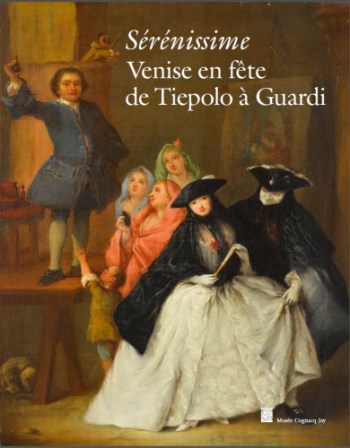 In the eighteenth century, the political and economic stability of the Serenissima Repubblica di Venezia gave rise to the last golden age of Venice, which would end with the Napoleonic conquest of 1797. This last chapter of a millenary history was marked by an unprecedented deployment of public and private events. Festivities, celebrations, regattas, and other spectacles set the tempo of city life and attracted the curious from all over Europe. Much more than simple amusements, these festivities were part of a political and religious pageant designed to promote Venice. Immortalized by some of the great names in painting—Tiepolo, Guardi, Longhi—they created a lasting impression and made known the charms of the City of the Doges throughout Europe. Over forty paintings, engravings, and drawings from prestigious French and European collections are presented to the public, bringing to life once again, for the duration of the exhibition, the opulence of the Most Serene Republic of Venice in the Age of Enlightenment.
The exhibition layout focuses on four themes related to Venetian celebrations:
Festivities Large and Small
Dance and music were highly esteemed by Venetian society, among both the aristocracy and the people.
From City to Stage
In the eighteenth century, the commedia dell’arte achieved unprecedented popularity, in particular with playwright Carlo Goldoni. Opera also benefited from majestic settings, the most famous of which is still La Fenice.
Power as Spectacle
Both secular and sacred institutions in the Most Serene Republic encouraged the crowds to attend major festivities that crystallized the image of Venice as a powerful and sumptuous city. Receptions for foreign princes, notably French, also provided an opportunity to organize extraordinary celebrations on Piazza San Marco or the Grand Canal.
At the Carnival
What would Venice be without its carnival? Dating from the Middle Ages, this colorful masked festival brought together an eighteenth-century cosmopolitan crowd that loved the open-air fairground attractions as much as it did the more discreet amusements of the Ridotto, the ancestor of the casino.
Rose-Marie Herda-Mousseaux and Benjamin Couilleaux, Sérénissime: Venise en fête, de Tiepolo à Guardi (Paris: Editions Paris Musées, 2017), 176 pages, ISBN: 978 27596 03428, 30€.
Symposium | Neo-Classical Gilt Bronze

Detail of a Table by Etienne Levasseur, ca.1785–87; gilt-bronze mounts by an unidentified maker
(London: The Wallace Collection, F319).
◊ ◊ ◊ ◊ ◊
From The Furniture History Society:
‘In the True Spirit of Corinth and Athens’: Neo-Classical Gilt Bronze
The 41st Annual Symposium of the Furniture History Society
The Wallace Collection, London, 6 May 2017
To coincide with the international interest in gilt bronze in 2016/17 and the three exhibitions devoted to Pierre Gouthière and his contemporaries in New York (The Frick Collection), Paris (Musée des Arts Décoratifs), and London (The Wallace Collection), this year’s Furniture History Society symposium is devoted to European gilt bronze of the neoclassical period (1770–1830), a time when the passion for the Antique world affected all aspects of artistic production. Speakers from the US, France, Britain, Russia, and Spain will present the latest research on a variety of topics, including aspects of design, production, and patronage. Gilt bronze is a subject that often presents more questions than answers, and recent scholarship has unearthed fascinating insights into this often overlooked art form and the symposium promises to be an important and illuminating day for anyone interested in bronze d’ameublement. It is being hosted at The Wallace Collection, which will stay open for FHS members after the symposium to allow them to see the exhibition Gilded Interiors: French Masterpieces of Gilt Bronze. The day will be chaired by Philip Hewat-Jaboor.
Tickets must be purchased in advance, and early booking is recommended. Fee: £50 for FHS members/£30 for members under 30/ All non-members: £65 with a reduction of £5 if joining the FHS, Ticket price includes morning coffee and afternoon tea. A light lunch will be available for FHS members in the Meeting Room at The Wallace Collection at a cost of £20, to include a glass of wine. Tickets for lunch must be purchased at least 7 days in advance from the Events Secretary or online. The Wallace Collection Restaurant will be open for bookings, and there are plenty of local cafés and restaurants. Tickets can be booked on-line via the FHS website (members only) or via the Events Secretary, e-mail: events@furniturehistorysociety.org.
• Joseph Godla (Chief Conservator, The Frick Collection), ‘Twenty Fingers on Each Hand’: A Study of Pierre Gouthière’s Techniques
• Charlotte Vignon (Curator of Decorative Arts, The Frick Collection), Pierre Gouthière: Bringing a Virtuoso Chaser and Gilder back into the Light
• Anne Forray-Carlier (Curator, 17th & 18th century Decorative Arts, Musée des Arts Décoratifs), In the Context of Neo-Classical Gilt Bronze: The Relationship between Gouthière and Dugourc
• Helen Jacobsen (Senior Curator, Wallace Collection), Gilded Interiors: The Antique as a Design Source for French Gilt Bronze
• Diana Davis (Independent Decorative Arts Researcher), Matt and Burnished Gold: The Regency Taste for Gilt Bronze
• Wolfram Koeppe (Curator, European Sculpture & Decorative Arts, Metropolitan Museum), An Enduring Mystery: Bronze Manufacturing in Vienna, 1775–1825
• Olga Bazhenova (Curator, Metal, Sculpture & Stone, Pavlovsk-Palace Museum, St Petersburg), The Secrets of Russian Bronze
• María Jesús Herrero Sanz (Curator of Sculpture, Patrimonio Nacional, Madrid), Between Neo-Classicism and Antiquity: French Bronzes and Palace Furnishings at the 18th-Century Spanish Court
Exhibition | Gilded Interiors: French Masterpieces of Gilt Bronze

Jean-Baptiste Lepaute, Mantel clock, detail, 1781
(London: The Wallace Collection)
◊ ◊ ◊ ◊ ◊
From the press release for the exhibition:
Gilded Interiors: French Masterpieces of Gilt Bronze
The Wallace Collection, London, 4 May — 30 July 2017
Curated by Helen Jacobsen
Often designed by leading architects and modeled by important sculptors, gilt bronze was used to create beautiful yet functional objects such as clocks, candelabras, and firedogs and to decorate and embellish highly refined furniture and porcelain. This exhibition showcases luxurious artworks commissioned and owned by the wealthiest patrons and collectors, including leading figures of pre-revolutionary France like Marie-Antoinette, the duc d’Aumont, and the comte d’Artois as well international patrons such as the Prince of Wales (later George IV). Artists such as Pierre Gouthière, François Rémond, and Claude Pition, who ran the finest chasing and gilding workshops, created beautiful works, equal in expense and craftsmanship to some of the greatest paintings and sculpture of the period.
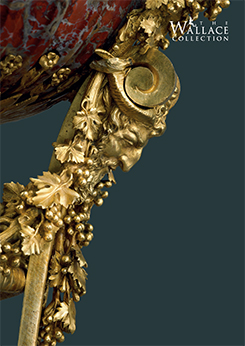 Largely drawn from The Wallace Collection, home to one of the world’s most important collections of French eighteenth-century gilt bronze, these exceptional objects include the exquisite perfume burner by Gouthière once owned by Marie-Antoinette and a pair of candlesticks made for the French Queen to celebrate the birth of her son. The Wallace Collection works will be shown alongside loans from other world-class collections including drawings from the Bibliothèque Municipale in Besançon.
The exhibition will feature drawings by Pierre-Adrien Pâris, one of the foremost architects and interior designers of the period. His highly-detailed works, never before seen in the UK, illustrate how buildings from ancient Rome were used as a fertile source of design for gilt-bronze masterpieces and reveal how the antique world provided artists with contemporary ideas for architecture and decorative art. Architects and designers who travelled to Rome took inspiration from the classical ruins with which they were surrounded and their drawings of architecture and Antique monuments provided the basis for some of the greatest gilt-bronze works ever created.
Gilded Interiors: French Masterpieces of Gilt Bronze will be an opportunity for visitors to engage more fully with these magnificent works, which will be given centre stage in the special exhibition galleries. Well-lit and with the works fully visible ‘in the round’, the exhibition will enable the viewer to experience these works of art in a different way, allowing the exquisite beauty and technical accomplishments of these pieces to be properly admired and enjoyed.
◊ ◊ ◊ ◊ ◊
From I. B. Tauris:
Helen Jacobsen, Gilded Interiors: Parisian Luxury and the Influence of Rome, 1770–1790 (London: Philip Wilson, 2017), 112 pages, ISBN: 978 178130 0589, £20 / $30.
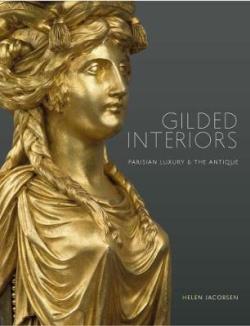 The Wallace Collection has an internationally-renowned collection of French eighteenth-century art but perhaps lesser known today is their stunning collection of gilt-bronze objects. These bronzes d’ameublement—from clocks and mounted Sevres porcelain to wall lights and candelabra—epitomise the levels of luxury achieved in Parisian interiors. Highly expensive and expertly wrought, they illustrate the heights of skilled craftsmanship achieved by French bronze workers in the eighteenth century as well as showcasing the wealth and connoisseurship of their owners. Lavishly illustrated with new photography, this publication will be a book of ‘highlights’ to include the very best of what the Wallace Collection has to offer in this field.
Helen Jacobsen is senior curator and curator of French eighteenth-century decorative arts at the Wallace Collection.
Research Seminar | Sigrid de Jong on British and French Architecture
From the Paul Mellon Centre:
Sigrid de Jong, Dialogues across the Channel: British and French
Architects on Architectural Experience, 1750–1815
Paul Mellon Centre, London, 22 March 2017

Thomas Sandby, Receipt for a Set of Six London Views (Design for a Bridge), ca. 1758, pen and black ink and gray wash, incised for transfer on medium, moderately textured, cream laid paper mounted on thick, moderately textured, cream laid paper (Yale Center for British Art, B1977.10.5).
The notion that buildings are foremost objects to be experienced and that the intended experience of buildings should guide their design became a key concept in the period 1750–1815. At that time, Paris and London, the main centres of cultural debates, went through major urban and architectural developments. In my research project, entitled “Experience and Design: The Emergence of Architectural Experience in Paris and London, 1750–1815,” I argue that architectural experience emerged there as a crucial new element. The project examines how the relationship between experience and design evolved: how eighteenth-century architects described their observations on buildings in their writings; which theoretical concepts they used to translate these into design theories for their lectures at the academies of architecture; and how they used them in their designs of buildings. This research seminar focuses on some of the dialogues of British and French architects across the Channel in the context of public architectural debates and on some key projects in eighteenth-century London and Paris that are exemplary for the interactions between experience and design. Wednesday, 22 March 2017, from 6:00 to 8:00pm. Registration information is available here.
Sigrid de Jong is an architectural historian at Leiden University, the Netherlands. Since 2016 she conducts a research project on “Experience and Design: The Emergence of Architectural Experience in Paris and London, 1750–1815,” funded by NWO (Netherlands Organisation for Scientific Research). Her previous postdoctoral research was on primitivism and architectural theory in the NWO-VIDI project “The Quest for the Legitimacy of Architecture 1750–1850,” with Maarten Delbeke. She obtained her PhD in art and architectural history at Leiden University in 2010. Her book Rediscovering Architecture: Paestum in Eighteenth-Century Architectural Experience and Theory (based on her PhD thesis) was published by Yale University Press in 2014. Together with Caroline van Eck she is the editor of the Companion to Eighteenth-Century Architecture (series editor Harry Mallgrave, Wiley-Blackwell, to be published in 2017).
Exhibition | Poussin to David: French Drawings at the Albertina

Jacques-Louis David, The Combat of Diomedes, 1776
(Vienna: Albertina)
◊ ◊ ◊ ◊ ◊
Now on view at the Albertina:
Poussin to David: French Drawings at the Albertina
Poussin bis David: Französische Zeichnungen der Albertina
Albertina, Vienna, 25 January — 25 April 2017
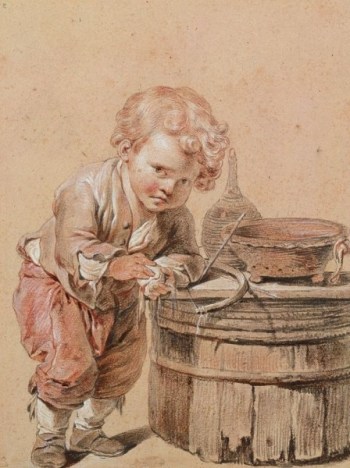
Jean-Baptiste Greuze, Boy with a Broken Egg, ca. 1756 (Vienna: Albertina).
Whether poetic love stories or mythological epics, whether atmospheric portrait studies or picturesque ruins—today, the masterpieces of French Baroque art are more enthralling than ever. 70 major works selected from the Albertina’s rich holdings of drawings sweep visitors into the dreamy and multi-layered cosmos of French art from the Baroque and Rococo periods: the works on display include Nicolas Poussin’s breath-taking free landscape studies as well as Claude Lorrain’s light-drenched depictions of nature, and playful masterpieces by François Boucher and Jean-Honoré Fragonard likewise assume their rightful places here, as do the lovely scenes of Jean-Baptiste Greuze. The crowning conclusion of this showing, which reflects two centuries of French art, is provided by the imposing creations of Jacques Louis David.
Christine Ekelhart, ed., From Poussin to David: French Drawings at the Albertina (Munich: Hirmer, 2017), 176 pages, ISBN: 978 37774 28369, $45.
Salon du Dessin 2017
From the press kit for the fair:
Salon du Dessin 2017
Palais Brongniart, Paris, 22–27 March 2017
 The Salon du Dessin is a made-in-France success that is admired around the world. For an entire week, it brings together art lovers, collectors, novices, and museum curators interested in drawings, whether old masters, modern or contemporary. During that week, the Salon du Dessin is the epicentre of Paris’s cultural scene, attracting an intellectual community delighted to share with the public its passion for knowledge and the excitement of discovery.
Even curators from major museums make discoveries at the Salon du Dessin. The art of drawing requires great connoisseurship, and it has now been rediscovered by a wider public thanks to the Salon du Dessin and its off-site events, which help neophytes acquire greater understanding by providing access to museum reserves.
The fair website is available here»
Poster Image: Anne-Louis Girodet-Trioson, Detail of a Drapery Study, 1806 (Nantes, Musée des Beaux-Arts).
◊ ◊ ◊ ◊ ◊
From H-ArtHist:
Salon du Dessin Symposium: De David à Delacroix, II
Palais Brongniart, Paris, 22–23 March 2017
Under the direction of Pierre Rosenberg and Louis-Antoine Prat
 L’exposition du Grand Palais, De David à Delacroix: La peinture française de 1774 à 1830 (1974–75), et l’exposition de dessins qui la complétait, avaient permis de redécouvrir bon nombre de peintres et d’oeuvres couvrant un pan de l’histoire de l’art, allant du Serment des Horaces de David à La Liberté guidant le peuple de Delacroix.
Depuis 1974, de multiples dessinateurs ont fait l’objet d’études novatrices que ces XIe et XIIe Rencontres du Salon du dessin se proposent d’enrichir. Sous le titre De David à Delacroix: Du tableau au dessin, les communications de cette deuxième session offrent, plus de quarante ans après cette exposition qui a fait date, une relecture de l’oeuvre graphique de plusieurs des principaux artistes français et étrangers de l’époque de Louis XVI à la Révolution de juillet.
W E D N E S D A Y , 2 2 M A R C H 2 0 1 7
• Nicole Willk-Brocard (Docteur ès lettres, Paris), Noël Hallé, F-G Ménageot, J.-A. Renard et J.-B. Restout
• Pierre Rosenberg (Président directeur honoraire du musée du Louvre, Paris), Dessins de David (II)
• Yuriko Jackall (Conservateur, National Gallery of Art, Department of French Paintings, Landover, Maryland), Greuze éclipsé?: Considérations autour de ses dernières années
• Marie Yvonneau-Fournier (Doctorante, Université Paris-Sorbonne, Paris), Jacques-Philippe Caresme (1734–1796), dessinateur licencieux?
• Andreas Stolzenburg (Chief Curator Prints & Drawings, Hamburger Kunsthalle, Hambourg), François-Marius Granet, Franz Ludwig Catel und die Mönchs-Romantik in Rom um 1815
• Jan Gorm Madsen (Historien de l’art, chercheur indépendant, Frederiksberg), Drawings by the Danish Artist C.W. Eckersberg from His Parisian Sojourn, 1810–13
• Florence Viguier-Dutheil (Conservateur en chef du Patrimoine, Directrice du musée Ingres, Montauban), Les dessins d’Ingres, un monde à part
T H U R S D A Y , 2 3 M A R C H 2 0 1 7
• Rosalba Dinoia (Docteur en histoire de l’art, chercheur indépendant, Rome), L’énigmatique Stratonice: Un cadeau inédit de Calamatta à Ingres
• Dominique de Font-Réaulx (Directrice du musée national Eugène-Delacroix, Paris), Taches colorées et notes poétiques, Eugène Delacroix dessinateur et écrivain
• Françoise Heilbrun (Conservateur en chef honoraire au musée d’Orsay, Paris), Paul-Arthur Cheramy (1840–1912) et Etienne Moreau-Nélaton (1859–1927): un collectionneur de Delacroix peut en cacher un autre
• Bénédicte Savoy (Professeure, Technische Universität Berlin) et David Blankenstein (Historien de l’art, Berlin), Paris-Berlin 1800: L’album de Frédéric Christophe d’Houdetot
• Guillaume Kazerouni (Responsable des collections anciennes de peintures et dessins, musée des Beaux-Arts de Rennes), Un carnet de calques inédit de Léon Cogniet au musée des Beaux-Arts de Rennes
Exhibition | Drawing Gold and Silver: Odiot
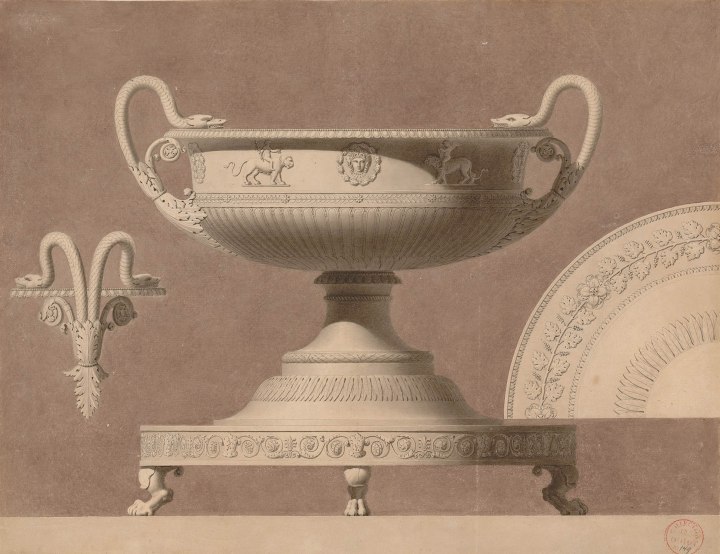
‘Snake handles’ dish, attributed to Charles-Jean-Alexandre Moreau, creator of the model; drawing attributed to Auguste Garneray, draughtsman in Jean-Baptiste-Claude Odiot’s workshop, ca. 1810; graphite, pen and grey ink, grey and sepia wash on paper (Paris: Les Arts Décoratifs).
◊ ◊ ◊ ◊ ◊
Now on view at the Musée des Arts Décoratifs:
Drawing Gold and Silver: Jean-Baptiste-Claude Odiot
Dessiner l’or et l’argent: Odiot (1763–1850), orfèvre
Musée des Arts Décoratifs, Paris, 8 March — 7 May 2017
Jean-Baptiste-Claude Odiot (1763–1850) became one of the most successful and prolific gold and silversmiths during the Empire and Restoration periods. He received several important royal commissions from the courts of Europe, including a sumptuous table service, a dressing table for empress Marie-Louise, and a cradle for the King of Rome.
The Musée des Arts Décoratifs has an exceptional collection of 33 silverware pieces and—acquired in 2009—176 original drawings from Odiot’s workshop, classified as important works of heritage by the Ministry of Culture’s Consultative Commission on National Treasures. On display for the first time, this exhibition reunites Odiot’s design drawings with the executed pieces, demonstrating his creative process, as well as his formal development and experimentation. Dating from the first quarter of the 19th century, these drawings are superbly executed in graphite and pen and enhanced with ink wash, watercolor, and gouache.
The drawings illustrate the various stages of a piece’s creation, from the initial sketches to the final detailed drawings presented to clients. On sheets of paper often measuring more than one meter high, tableware, dressing tables, and desks pieces are represented to scale, displaying the splendor and refinement of the art of living in the early 19th century. The drawings also propose different versions of the same model, offering alternatives for applied ornaments, handles, etc. Each drawing reveals an ornamental repertoire that became Odiot’s hallmark that he repeatedly employed in varying combinations from the beginning of the Empire period to the end of the Restoration. Only ten of the drawings are signed by colleagues of Odiot, including draughtsmen Auguste Garneray (1785–1824) and Adrien-Louis-Marie Cavelier (1785–1867), and the silversmith Jacques-Henry Fauconnier (1779–1839). The drawings also feature the names of prestigious clients such as Count Demidov, Countess Branicka, and members of the Imperial Family, including Madame Mère (Napoleon’s mother), Empress Marie-Louise, and Jerome I of Westphalia. These 176 drawings complement the Museum’s collection of 31 bronze models, a sugar bowl, and ‘Venus’s breast and butterfly’ bowl in vermeil, all by Odiot.

Jean-Baptiste-Claude Odiot, ‘Venus breast and butterfly’ bowl, ca. 1810–20; silver-gilt, hammered, cast, chased and engraved (Paris: Les Arts Décoratifs, Paris / photo: Jean Tholance).
The forms of the bronze models are as varied as the drawings: tea urns, soup tureens, dishes, wine coolers, oil cruets, saltcellars… Their handles, legs, and applied decoration incorporate an ornamental vocabulary derived from Antiquity. In addition to the central theme of the procession of Bacchus, Odiot’s pieces and drawings incorporates other iconographical figures such as of Hebe, Ceres, Leda, Venus, Adonis, Flora, and allegories of Victory. Snakes, swans, and mermaids lend their sinuous forms to handles, while monopod winged sphinxes and lion’s paws were better suited as legs. The foliated friezes framing the piece’s main body are decorated with panthers, reeds, vine branches, ears of wheat, and dolphins.
In 1835, Odiot donated 31 models to the Chambre des Pairs (Upper House of the French Parliament) for posterity and to serve as models for his successors. The models were initially displayed in the Musée du Luxembourg, which was, in the 19th century, devoted to painting and sculpture by living artists. In 1852, the models were transferred to the storerooms of the Louvre where they were gradually forgotten.
Simultaneously, initiatives were taking place to create the Musée des Arts Décoratifs during the second half of the 19th century. The museum of the ‘beautiful in the useful’ opened in 1882 with the goal of encouraging links between art and industry by providing models and references for workers and artisans. As there was a clear connection between Odiot’s motives and those of the new museum, Odiot’s models were put on permanent loan to the Musée des Arts Décoratifs in 1892. In 1907–08, the Musée des Arts Décoratifs commissioned Christofle to gold and silver-plate these models in order to give them the appearance of silver. In 2016, the models were officially added to the inventory of the Musée des Arts Décoratifs.
 These models were executed with great finesse. Their components, assembled by a system of nuts and bolts, were chased to heighten the relief decoration and provide contrast between matte and reflective surfaces. As a result of recent scientific analysis by the Centre de Recherche et de Restauration des Musées de France, the pieces, previously described in Odiot’s terminology as bronze, are, in fact, made of brass. The rare opportunity to showcase the Museum’s collection of Odiot silver alongside the drawings creates a unique dialogue in the history of decorative arts.
The Silversmith Jean-Baptiste-Claude Odiot’s Designs for Silver and Gold exhibition explores this dialogue between a piece’s initial conception on the drawing board and the finished work in Jean- Baptiste-Claude Odiot’s workshop. A selection of approximately 100 drawings, exhibited for the first time, will be displayed alongside 33 pieces of silver, revealing this great silversmith’s creative process. The exhibition will be accompanied by a catalogue of the collection and interactive digital media.
Audrey Gay-Mazuel and Julie Ruffet-Troussard, Odiot: Un atelier d’orfèvrerie sous l’Empire et la Restauration (Paris: Les Arts Décoratifs, 2017), 240 pages, ISBN : 978 2916914 688, 45€.
Exhibition | 18th-Century Masterpieces in the Churches of Paris
From the press release for the exhibition:
Enlightenment Baroque: 18th-Century Masterpieces in the Churches of Paris
Le Baroque des Lumières: Chefs-d’œuvre des églises parisiennes au XVIIIe siècle
Petit Palais, Paris, 21 March — 9 July 2017
Curated by Christophe Leribault and Marie Monfort
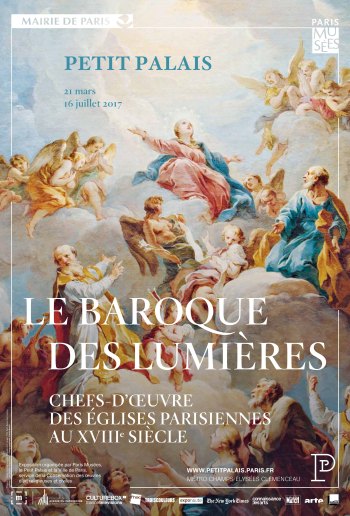 For the first time the Petit Palais is offering the public a spectacular ensemble of 18th-century religious paintings created for the churches of Paris. Through some 200 works the museum will reveal the significance and diversity of artistic output in Paris from the Regency to the French Revolution: from such heirs to the age of Louis XIV as Largillière and Restout to the exponents of rocaille, from Lemoine to Carle Van Loo, and the best of Neo-Classicism, from Vien to David. Produced in partnership with COARC (Conservation of Religious and Secular works of Art for the City of Paris), this exhibition is an extension of the one at the Musée Carnavalet (Paris) in 2012, which focused on 17th-century painting in Paris churches and the rediscovery of an enormous, little-known heritage.
The emphasis of 18th-century French painting was more on the sophistication of the fête galante and the portrait than the elaborateness of great religious art. Outside the Salon season, however, it was in the churches of Paris that art lovers could view contemporary painting, and so the city’s artists gave of their best there. Indeed, parishes and congregations bent on renovating the capital’s places of worship were among the main sponsors of history painting, and it is this forgotten segment of 18th-century art that Enlightenment Baroque aims to reassess. In a spectacular decor evocative of the inside of a church and its related spaces—the chapels and the sacristy, for example—the exhibition itinerary highlights numerous masterpieces, often very large, that have benefited from unprecedentedly thorough renovation. In addition to the pictures still to be seen in churches today, the exhibition brings together works which since the Revolution have been scattered. The masterpieces come from institutions (the Louvre, the Château de Versailles, and the art museums of Lyon, Rennes, Marseille, Brest, and elsewhere), churches and cathedrals nearby (Saint Denis and Villeneuve-Saint-Georges, for example), or further away (Mâcon, Lyon).
Divided into eight sections, the exhibition delights the eye with the finesse and varying styles of altarpieces, the colourful grace of François Lemoine, Jean-François de Troy and Noël Hallé, and the unadorned Neo-Classicism of Drouais and, of course, David, whose large portrait of Christ closes the exhibition. There are also references to ornamental ensembles, some of which, like Charles Natoire’s decor for the Chapelle des Enfants Trouvés have been lost or destroyed. Other sections are devoted to images of the new saints of the Counter-Reformation, smaller works intended for private devotion, commissioning procedures and the restorations that took place at the time in ancient buildings like the Invalides.
Along the way viewers will find two educational spaces, one given over to restoration campaigns and the other to religious imagery. Visitors will also be able to take part in guided tours of various religious edifices in Paris. This groundbreaking panorama of religious painting in 18th-century Paris is nothing short of a revelation: the pictures brought together for the occasion have been endowed with an unsuspected vividness of colour harking back to what we find so agreeable in the art of the Age of Enlightenment.
Christine Gouzi and Christophe Leribault, eds, Le Baroque des Lumières: Chefs-d’œuvre des églises parisiennes au XVIIIe siècle (Paris: Paris musées, 2017), 368 pages, ISBN : 978 27596 03442, 50€.
Curators
Christophe Leribault, Director, Petit Palais
Marie Monfort, Head of Conservation of Religious and Secular works of Art for the City of Paris
Associate Curators
Maryline Assante di Panzillo (Petit Palais), Lionel Britten (Musée d’Orsay), Jessica Degain, Nicolas Engel et Emmanuelle Federspiel (COARC), Christine Gouzi (Université de Paris- Sorbonne), et Guillaume Kazerouni (Musée des Beaux-Arts de Rennes)
Exhibition | From Watteau to David: The Horvitz Collection
From the press release for the exhibition:
From Watteau to David: The Horvitz Collection
Petit Palais, Paris, 21 March — 9 July 2017
Curated by Alvin Clark, Isabelle Mayer-Michalon, and Christophe Leribault
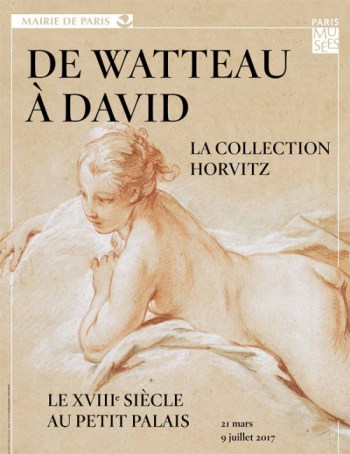 The Petit Palais is delighted to present an anthology of some 200 18th-century French paintings, sculptures, and drawings from the Horvitz Collection in Boston. The work of thirty years, this is the largest private collection of 18th-century French drawings outside of France and is home to such artists of the first rank as Watteau, Boucher, Fragonard, Greuze, and David. It also offers an overview of all the major artists of the period, ranging from Oudry to De Troy, from Natoire to Bouchardon, and from Hubert Robert to Vincent—and all of them at their best.
The exhibition offers the visitor an exhaustive panorama of French painting and drawing from the Regency to the Revolution, together with a small but impeccable selection of of sculptures, including pieces by Lemoyne, Pajou, and Houdon. It comprises fifteen chronologically organised thematic and monographic sections, whose elegant scenography provides an overview of a century rich in artistic innovation.
The exhibition opens with portraits by Rigaud, Largillière, and Jean-François de Troy, before addressing the mythological and religious painting of the early 18th century via works by François Lemoyne and Charles de la Fosse. The viewer then moves on to the fête galante, with drawings by Watteau and Lancret, and to landscape and animal painting, with Oudry and Desportes. The exhibition also takes in architecture and the triumph of ornamentation as typified by the whimsicality of Oppenord and Lajoüe. An entire section given over to François Boucher is followed by a group of academic nudes and head studies by Coypel, Lépicié, Vien, and others. Next comes mid-century history painting, represented by Natoire and Carle Van Loo, and the tour continues with drawings by sculptors like Bouchardon and Pajou. A second monographic section is dedicated to Fragonard, after which visitors are treated to views of ruins and landscapes by Hubert Robert and Joseph Vernet, and, in a more sentimental vein, works by Greuze, Prud’hon, and Boilly. The exhibition closes with an assertion of neo-Classicism by Jacques-Louis David, Perrin, and Vincent.
The Horvitz Collection—with its meticulous documentation and works in perfect condition—has become a touchstone for the period. Its presentation in Paris is a major event whose prestige and intimist character make it a perfect complement to Enlightenment Baroque: 18th-century Masterpieces in the Churches of Paris, an exhibition devoted to the big, forgotten religious paintings of the period.
Curators
Alvin L. Clark, Jr., The Horvitz Collection and The J.E Horvitz Consultative Curator Department of Drawings, Division of European and American Art, Harvard Art Museum, in association with Isabelle Mayer-Michalon, Doctor of Philosophy in Art History. Christophe Leribault, Director, Petit Palais.
Alvin Clark, ed, Tradition & Transitions: Eighteenth-Century French Art from The Horvitz Collection (Boston: The Horvitz Collection, 2017), 701 pages, ISBN: 9780991262519, $115.
Note (added 21 January 2018) — The original posting did not include information on the catalogue.
Conference | Enchanted Isles, Fatal Shores: Living Versailles

Hall of Mirrors (Galerie des Glaces), 1678–84
(Château de Versailles)
◊ ◊ ◊ ◊ ◊
From the conference programme and website:
Enchanted Isles, Fatal Shores: Living Versailles
NGA, the Australian National University, and the University of Sydney, 17–18 March 2017
Organized by Mark Ledbury, Robert Wellington, and Lucina Ward
On the occasion of the Versailles: Treasures from the Palace exhibition at the NGA, which brings major works of art from the Palace of Versailles to Canberra, this conference explores the history of art, design and architecture, and the enduring influence and resonance of Versailles, its desires and self-perceptions of modernity, from film to fashion to architecture. Gathering a generation of scholars whose work is shifting our perceptions of the art, culture and life of the ancien régime, Versailles and its reception, this is the occasion for fresh and challenging research, and new perspectives on canon-defining works.
The conference will be live streamed from the Australian National University School of Art & Design Facebook page on Friday March 17 (10:00–16:30 AEST) and Saturday March 18 (9:30–16:30 AEST). Please note the following time differences: Los Angeles -18hrs, New York -15hrs, London -11hrs, Paris -10hrs, Perth -3hrs, NZ +2hrs.
◊ ◊ ◊ ◊ ◊
F R I D A Y , 1 7 M A R C H 2 0 1 7
10.00 Director’s Welcome
10.30 Session One: Making the Palace
• Hannah Williams (London), The Other Palace: Versailles and the Louvre
• Wolf Burchard (National Trust, UK), At the Centre of the World: Charles Le Brun’s Ambassadors Staircase at Versailles
• Bénédicte Gady (Louvre), The Grands Décors of Charles Le Brun: Between Plan and Serendipity
1.00 Session Two: The Culture Industry
• Sing d’Arcy (UNSW), Heavenly Voice, Earthly Bodies: The Physical Presence of Music Making in the Architectural Space of Versailles
• Matthew Martin (NGV), Porcelain and Power: The Meaning of Porcelain in Ancien Régime France
• Florian Knothe (HKU), Artisans du Roi: Collaborations at the Gobelins, Louvre and the Academie Royale de Peinture et de Sculpture under the Influence of the Petite Académie
3.00 Session Three: Living at Versailles
• Mimi Hellman (Skidmore), (Re)Imagining the ‘Government’ of a Royal Governess
• Sarah Grant (V&A), Courting Favour: The Apartments and Residence of the Princess of Lamballe at Versailles
• Kimberly Chrisman-Campbell (LA), Bigwigs: Hair, Politics, and Power at the Court of Versailles
S A T U R D A Y , 1 8 M A R C H 2 0 1 7
9.30 Session Four: Outsiders
• David Maskill (Wellington), A Turk in the Hall of Mirrors
• Meredith Martin (NYU/IFA), From Port to Palace: Maritime Art and Mediterranean Servitude at Louis XIV’s Versailles (via video link)
• Daniëlle Kisluk-Grosheide (Met), Outside Insider: Cornelis Hop (1685–1762), Dutch Ambassador to the Court of Louis XV
11.30 Session Five: Representation
• Mark de Vitis (USyd), The Politics of Embellishment in Prints of Louis XIV
• Louis Marchesano (Getty), Strategies of Engraving and Etching in Description de la Grotte de Versailles 1676
• Sophie Matthiesson (NGV), From Fountains of Apollo to Fountains of Liberty: Artificial Landscapes as Political Spectacle in Eighteenth-Century France
2.00 Session Six: Versailles Now
• Allison Holland (Perth), Reverberations of Japanese Art at Versailles
• Jennifer Ferng (USyd), American Versailles: Kitsch Opulence, Capitalism and McMansion Dreams in Florida
• Robert Wellington (ANU), Tanned by the Sun King: Donald Trump and Louis XIV
3.30 Round Table
◊ ◊ ◊ ◊ ◊
Note (added 8 May 2017) — Video recordings of the presentations are available via YouTube.










 Enfilade
leave a comment