Exhibition | Good Hope: South Africa and the Netherlands from 1600

Installation view of the exhibition Good Hope: South Africa and The Netherlands from 1600 at the Rijksmuseum in Amsterdam, 14 February 2017; photo by Olivier Middendorp.
◊ ◊ ◊ ◊ ◊
Now on view at the Rijksmuseum:
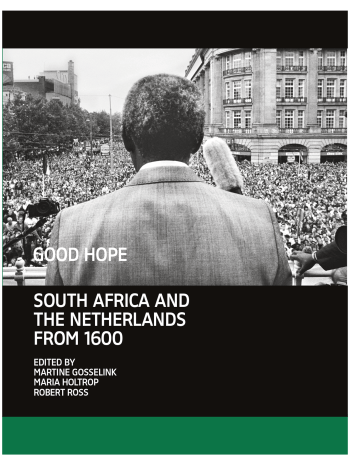
Good Hope: South Africa and the Netherlands from 1600
Rijksmuseum, Amsterdam, 17 February — 21 May 2017
Curated by Martine Gosselink
The arrival of the Dutch changed South Africa forever. The population’s composition and the introduction of slavery by the VOC (the Dutch East India Company) resulted from ties with the Netherlands. But this also applies to the language, Afrikaans, the legal system, the protestant church, the introduction of Islam, the typical façades, and Dutch names on the map. The relationship with South Africa also changed the Netherlands. The Boer Wars around 1900, countless ‘Transvaal districts’ in Dutch cities, and the violent anti-apartheid struggle of the 1980s symbolise a continuously tempestuous relationship. In this exhibition, around 300 paintings, drawings, documents, photos, items of furniture, souvenirs, tools, and archaeological discoveries give a vivid impression of the culture shared and the influence reciprocated by the two countries.
 Robert Jacob Gordon’s landscape panoramas, several metres long, occupy a prominent place in the exhibition. This Dutch traveller illustrated 18th-century South Africa, giving the country an identity. The imposing portraits of children born after 1994—when apartheid was abolished—by the South African photographer Pieter Hugo illustrate South Africa’s future. Along with the exhibition, the NTR (Dutch public-service broadcaster) will be broadcasting a seven-part TV series presented by Hans Goedkoop. The exhibition is produced under the directions of Martine Gosselink, Head of the History Department at the Rijksmuseum.
“The Good Hope exhibition illustrates a significant aspect of Dutch colonial history in all its nuances—a tale that is both painful and striking, but more especially disturbing and recognisable.”
–Adriaan van Dis, Dutch writer, Africa specialist, and the exhibition’s narrator
Symposium—Good Hope for a New Generation: Reflections on Diversity and Change in South Africa and the Netherlands, 5 April 2017
The aim of this symposium is for the Dutch and South Africans to learn from each other in building an open and diverse nation where talents can develop. For this symposium, two South African speakers are invited to reflect on the past and especially on the future of the new generation.
Martine Gosselink, Maria Holtrop, and Robert Ross, eds., Good Hope: South Africa and the Netherlands from 1600 (Amsterdam: Rijksmuseum, 2017), 376 pages, ISBN: 978 94600 43130, €35.
A richly illustrated book accompanies the exhibition, containing 56 contributions from 26 authors from the fields of literature, language, art history, archaeology, politics, and journalism.
Robert Jacob Gordon’s Drawings and Papers Now Available Online
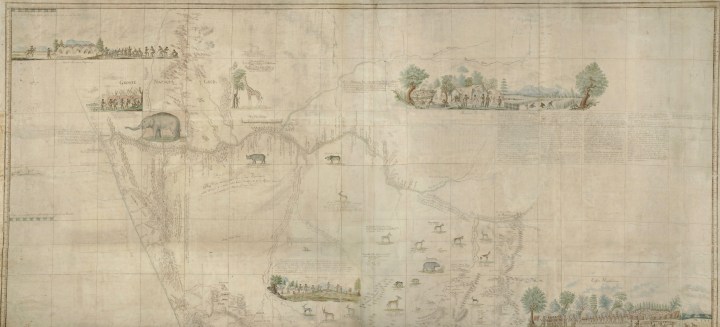
Attributed to Robert Jacob Gordon, Upper (Northern) Half of Gordon’s ‘Great Map of Southern Africa, ca. 1786; ink, pencil, and watercolor on paper, 91.5 × 203 cm (Amsterdam: Rijksmuseum, RP-T-1914-17-3-A). More information and a high resolution image is available here»
◊ ◊ ◊ ◊ ◊
Press release (14 February 2017) from the Rijksmuseum:
Today the Rijksmuseum launches www.robertjacobgordon.nl through which all of Robert Jacob Gordon’s drawings, diaries and letters are made accessible to all for the first time. The 18th-century Dutch explorer documented South Africa’s inhabitants, flora, and fauna in more than 450 detailed drawings. He meticulously noted down in his diaries and letters everything he experienced during his expeditions. The drawings, which include unique 8-metre-long panoramas, form part of the collection at the Rijksmuseum. The diaries and letters are kept in the Brendhurst Library in Johannesburg. On the occasion of the exhibition Good Hope: South Africa and the Netherlands from 1600, all of Gordon’s diaries and drawings are reunited for the first time and thus present a comprehensive view of 18th-century South Africa.
Zoom in on 18th-Century South Africa
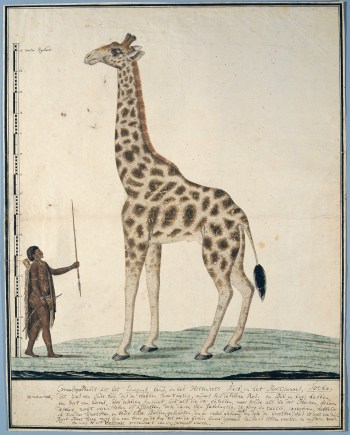
Robert Jacob Gordon, Giraffa camelopardalis (Giraffe), 1779 (Amsterdam: Rijksmuseum, RP-T-1914-17-149).
Through robertjacobgordon.nl, visitors are given a complete portrait of what Gordon encountered, and where. The site enables visitors to zoom in on the 18th-century map Gordon created alongside contemporary South Africa via Google Maps. The comparison revealed the uncanny accuracy of Gordon’s measurements. His diaries and letters are also made available digitally for the first time via the website. Gordon’s travel notes, discovered in 1960, are kept in the Brandhurst Library in Johannesburg. Through the website, these documents are made accessible for the first time. The original texts have been transcribed and translated into English for the occasion, with special functions linking Gordon’s texts to his drawings.
Robert Jacob Gordon
The 18th-century Dutch scientist Robert Jacob Gordon (1743–1795) travelled through the interior of South Africa during the second half of the 18th century. As a zoologist, cartographer, geographer, linguist, meteorologist, and anthropologist, he recorded his discoveries in an ‘Atlas’—a treasure trove of 450 drawings along with spectacular panoramas, multiple metres in length, that show precisely how Gordon portrayed the land, its inhabitants and the flora and fauna. To record all of this in words and in pictures, he made four extensive expeditions deep into the interior of South Africa, where he was frequently the mediator between the local people and the colonists, resolving conflicts arisen from arson, murders, and cattle thefts. As a representative of the European Enlightenment, Gordon poured his knowledge and expertise into the creation of ‘Great Map’, his compendium which remained unfinished due to his suicide in 1795 post the British invasion. A large number of Gordon’s drawings and metres-long, meticulously drawn panoramas can be seen in Rijksmuseum’s exhibition Good Hope: South Africa and the Netherlands from 1600 (17 February to 21 May 2017).
robertjacobgordon.nl is made possible by Cees en Ingeborg van der Burg and is created by the Rijksmuseum in association with Fabrique and Q42. The web address is obtained thanks to the Doesburgs’ Historical Society HetHuisDoesburg.
Workshop and Symposium Grants from the Terra Foundation
From the Terra Foundation:
Terra Foundation for American Art Academic Workshop and Symposium Grants
Fall 2017 Awards
Letters of inquiry due by 15 March 2017
The Terra Foundation for American Art actively supports projects that encourage international scholarship on American art topics, as well as scholarly projects with focused theses that further research of American art in an international context. Academic program funding is available for in-person exchanges such as workshops, symposia, and colloquia that advance scholarship in the field of American art (circa 1500–1980) that take place
• In Chicago or outside the United States, or
• In the United States and examine American art within an international context and include a significant number of international participants.
Additionally, the foundation welcomes applications for international research groups. Such groups should involve 2 to 4 faculty members from two or more academic institutions, at least one of which must be located outside the United States. Groups should pursue specific research questions that will advance scholarship and meet in person two or more times.
Visual arts that are eligible for Terra Foundation Academic Workshop and Symposium Grants include all visual art categories except architecture, performance art, and commercial film/animation. We favor programs that place objects and practices in an art historical perspective.
Note: The foundation funds museum-organized educational programs related to exhibitions through its Exhibition Grants; therefore only organizers from universities and research institutes may apply for exhibition-related programs through the Academic Program area.
Within a given year, the foundation seeks to support a range of topics. Please note that grants in this area are typically capped at $25,000 with exceptions only made for unusual circumstances.
While the Terra Foundation for American Art welcomes recurring requests, organizations that have submitted multiple applications should note that the foundation also attempts to fund programs at a variety of organizations. Due to the competitive nature of this program area, not every request can be funded, regardless of prior support.
New Book Series | The Material Culture of Art
New Bloomsbury Academic Book Series: The Material Culture of Art
Series Editor: Michael Yonan, University of Missouri
The Material Culture of Art is devoted to scholarship that brings art history into dialogue with interdisciplinary material culture studies. The material components of an object—its medium and physicality—are key to understanding its cultural significance. Material culture has stretched the boundaries of art history and emphasized new points of contact with other disciplines, including anthropology, archaeology, consumer and mass culture studies, the literary movement called ‘Thing Theory’, and materialist philosophy. The Material Culture of Art seeks to publish studies that explore the relationship between art and material culture in all of its complexity. The series is a venue for scholars to explore specific object histories (or object biographies, as the term has developed), studies of medium, and the procedures for making works of art and investigations of art’s relationship to the broader material world that comprises society. It seeks to be the premiere venue for publishing the growing scholarship about works of art as exemplifications of material culture.
 The series encompasses material culture in its broadest dimensions, including the decorative arts (furniture, ceramics, metalwork, textiles), everyday objects of all kinds (toys, machines, musical instruments), and studies of the familiar high arts of painting and sculpture. The series welcomes proposals for monographs, thematic studies, and edited collections.
Please direct inquiries and proposals to both Michael Yonan, series editor, yonanm@missouri.edu, and Margaret Michniewicz, Visual Arts Acquisitions Editor, Margaret.Michniewicz@bloomsbury.com.
Series Advisory Board
Wendy Bellion, University of Delaware
Claire Jones, University of Birmingham
Stephen McDowall, University of Edinburgh
Amanda Phillips, University of Virginia
John Potvin, Concordia University, Canada
Stacey Sloboda, Southern Illinois University
Kristel Smentek, MIT
Robert Wellington, Australian National University
Conference | Norwich and the Medieval Parish Church, 900–2017
Norwich and the Medieval Parish Church, ca. 900–2017: The Making of a Fine City
Norwich Cathedral Hostry, 17–18 June 2017 (with site visits on 19 June)
 A conference hosted by The Medieval Parish Churches of Norwich Research Project, undertaken at the University of East Anglia and funded by The Leverhulme Trust.
All 58 churches—whether existing, ruined, or lost—are included in the scope of the project, which seeks insight into how the medieval city developed topographically, architecturally, and socially. The project is intended to reveal the interdependent relationship between city, community, and architecture showing how people and places shaped each other during the Middle Ages. The conference—supported by the Paul Mellon Centre for British Art and Purcell—will present the medieval parish churches of Norwich in their immediate local context and in the broader framework of urban churches in Britain and northern Europe. The subject range will include documentary history, the architectural fabric of the buildings themselves and their place in the topography of Norwich, the development of the churches’ architecture and furnishings, the representation of the churches, and their post-Reformation history.
In addition to the medieval lines of inquiry, the conference will include papers addressing the churches of Norwich from a long eighteenth-century perspective. Roey Sweet will discuss the rise of the concept of the historic town, which became established in the nineteenth century. William Jacob will consider the changes that Norwich churches underwent in the Georgian period in relation to the Prayer Book and concepts of politeness. David King will address the evidence for stained glass provided by seventeenth- and eighteenth-century antiquaries, and Clare Haynes will explore the medieval imaginaries that were engaged in the antiquarian, topographical, and archaeological visual record of the churches.
Full details, including timings and costs, to be announced in the coming weeks. Bookings will be taken from early March 2017. Provisional reservations can be made by email to h.lunnon@uea.ac.uk.
New Book | Red: The History of a Color
From Princeton UP:
Michel Pastoureau, Red: The History of a Color (Princeton: Princeton University Press, 2017), 216 pages, ISBN: 978 06911 72774, $40 / £33.
 The color red has represented many things, from the life force and the divine to love, lust, and anger. Up through the Middle Ages, red held a place of privilege in the Western world. For many cultures, red was not just one color of many but rather the only color worthy enough to be used for social purposes. In some languages, the word for red was the same as the word for color. The first color developed for painting and dying, red became associated in antiquity with war, wealth, and power. In the medieval period, red held both religious significance, as the color of the blood of Christ and the fires of Hell, and secular meaning, as a symbol of love, glory, and beauty. Yet during the Protestant Reformation, red began to decline in status. Viewed as indecent and immoral and linked to luxury and the excesses of the Catholic Church, red fell out of favor. After the French Revolution, red gained new respect as the color of progressive movements and radical left-wing politics.
In this beautifully illustrated book, Michel Pastoureau, the acclaimed author of Blue, Black, and Green, now masterfully navigates centuries of symbolism and complex meanings to present the fascinating and sometimes controversial history of the color red. Pastoureau illuminates red’s evolution through a diverse selection of captivating images, including the cave paintings of Lascaux, the works of Renaissance masters, and the modern paintings and stained glass of Mark Rothko and Josef Albers.
Michel Pastoureau is a historian and director of studies at the École Pratique des Hautes Études de la Sorbonne in Paris. A specialist in the history of colors, symbols, and heraldry, he is the author of many books, including Green, Black, and Blue (all Princeton) and The Devil’s Cloth: A History of Stripes. His books have been translated into more than thirty languages.
ASECS 2017, Minneapolis: Memorial Session for Mary Sheriff
In addition to this year’s regular ASECS offerings, the schedule will include a memorial gathering dedicated to Mary Sheriff (1950–2016).
Please join us Thursday, March 30, from 6:00 to 7:00pm as we remember our colleague, dear friend, and mentor. There will be a cash bar, a short program, and an opportunity for people to share memories and celebrate Mary’s vibrant life.
The room is Lakeshore A, on the first floor of the Hyatt Regency Minneapolis. Please email Joanna Gohmann at jgohmann@thewalters.org or Hyejin Lee at hyejinlee.18e@gmail.com with any questions.
Exhibition | Splendour! Art in Living Craftsmanship
Now on at The Georgian Group:
Splendour! Art in Living Craftsmanship
The Georgian Group, Fitzroy Square, 2-25 February 2017
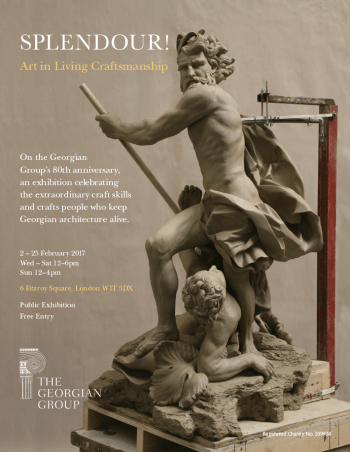 In February 2017 the Georgian Group opens its Fitzroy Square townhouse for an exhibition celebrating 80 years of conservation work by the charity. Splendour! promises to transport the visitor into a world of craftsmanship, beauty, and design. Gathering together an eclectic selection of traditional ‘Georgian’ arts and crafts practiced in the 21st century, objects range from silk wallpaper and chandeliers to carved stone sculpture and ceiling designs. Work by the most promising recent graduates features alongside the most experienced practitioners in the UK; this is an exhibition that displays talent from across the spectrum of British craftsmanship. History, architecture, art, and design come together with exciting relevance to craft today.
Details of our Tuesday talk series, Saturday demonstrations by leading practitioners, and our interactive Sunday workshops are available at The Georgian Group website.
New Book | City of Refuge: Separatists and Utopian Town Planning
From Princeton UP:
Michael Lewis, City of Refuge: Separatists and Utopian Town Planning (Princeton: Princeton University Press, 2016), 256 pages, ISBN: 978 0691 171814, $45 / £38.
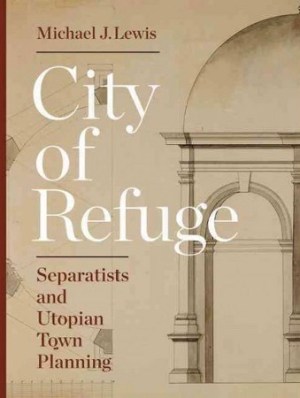 The vision of Utopia obsessed the nineteenth-century mind, shaping art, literature, and especially town planning. In City of Refuge, Michael Lewis takes readers across centuries and continents to show how Utopian town planning produced a distinctive type of settlement characterized by its square plan, collective ownership of properties, and communal dormitories. Some of these settlements were sanctuaries from religious persecution, like those of the German Rappites, French Huguenots, and American Shakers, while others were sanctuaries from the Industrial Revolution, like those imagined by Charles Fourier, Robert Owen, and other Utopian visionaries.
Because of their differences in ideology and theology, these settlements have traditionally been viewed separately, but Lewis shows how they are part of a continuous intellectual tradition that stretches from the early Protestant Reformation into modern times. Through close readings of architectural plans and archival documents, many previously unpublished, he shows the network of connections between these seemingly disparate Utopian settlements—including even such well-known town plans as those of New Haven and Philadelphia.
The most remarkable aspect of the city of refuge is the inventive way it fused its eclectic sources, ranging from the encampments of the ancient Israelites as described in the Bible to the detailed social program of Thomas More’s Utopia to modern thought about education, science, and technology. Delving into the historical evolution and antecedents of Utopian towns and cities, City of Refuge alters notions of what a Utopian community can and should be.
Michael J. Lewis is the Faison-Pierson-Stoddard Professor of Art History at Williams College. His books include Frank Furness: Architecture and the Violent Mind, The Gothic Revival, and American Art and Architecture. His essays and reviews have appeared in such publications as The Wall Street Journal and The New York Times.
C O N T E N T S
1 The Idea of the City of Refuge
2 The Sacred Squareness of Cities
3 The Protestant Tempering of Utopia
4 Christianopolis
5 The Lord’s Grove
6 Harmony
7 Economy
8 Conclusion
Notes
Selected Bibliography
Index
Illustration Credits
Acknowledgments
Mia Jackson Appointed Curator of Decorative Arts at Waddesdon
Waddesdon Manor is delighted to announce the appointment of Dr Mia Jackson as Curator of Decorative Arts. She joined Waddesdon on 1 February 2017.
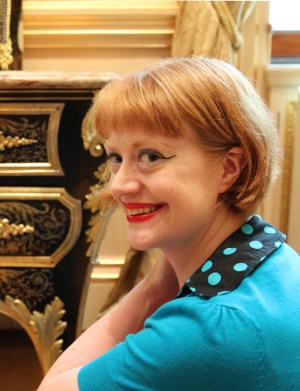 Jackson’s experience would seem tailor-made for Waddesdon. It was whilst finishing her undergraduate degree in French and philosophy that she noticed books on ceramics in her college library at Oxford. These included books on French porcelain that sparked a fascination. Jackson tracked down their author, Dr Aileen Dawson, and volunteered with her one day a week at The British Museum while studying for her MA in eighteenth-century French decorative arts at the Courtauld (2005). When a museum assistant job came open in the Prints and Drawings Department, Jackson was advised to apply. Of her four years at The British Museum, she notes, “I think I got the best art-historical education I could have dreamt of from Solander boxes and boxes of the most amazing prints and drawings.”
Returning to the decorative arts, Jackson was hired in 2008 as a museum assistant at The Wallace Collection. She spent three happy years under the directorship of Rosalind Savill, and at Savill’s encouragement, she embarked on a doctoral thesis at Queen Mary University of London on the French furniture maker André Charles Boulle and his collection of prints and drawings, finishing her PhD in 2016.
Also during her time at The Wallace Collection, Jackson participated in the Attingham Summer School, which opened her eyes to historic houses. She became Curator of Collections at English Heritage in January 2015 with curatorial responsibility for the collections at Audley End House in Essex and Wrest Park in Bedfordshire. Jackson was named the Art Fund curator of the month in November 2016.
Jackson notes, “I am hugely excited about joining the curatorial team at Waddesdon Manor, where I will be able to return to the French decorative arts that I love with such passion.”










 Enfilade
leave a comment