At Sotheby’s | Imperial Vase Sells for €16.2million

Jingdezhen Imperial Workshops, Yangcai Famille Rose Vase Depicting Five Cranes and Nine Deer, Qing Dynasty, eighteenth century, reign of the Qianlong emperor. Details are available here.
◊ ◊ ◊ ◊ ◊
Press release (12 June 2018) from Sotheby’s:
Arts d’Asie: PF1837, PF1807
Sotheby’s, Paris, 12 June 2018
The summer Sotheby’s sale dedicated to Asian Arts ended with a total of nearly €30 million ($35.4m), triple the June 2017 results and the highest total ever for an Asian art sale in France. The sale got off to an explosive start with the auction record achieved in France by the extraordinary recently-discovered treasure of Imperial China: a unique Imperial 18th-century yangcai famille rose porcelain vase, bearing a mark from the reign of the Qianlong Emperor (r. 1736–1795). After a 20-minute bidding battle, the vase sold for €16.2 million ($19m) against an estimate of €500,000–700,000.

Olivier Valmier, specialist in Asian Art, said: “The discovery of an imperial treasure like this, found in a French attic for nearly a century, was an extraordinary adventure culminating in the record price achieved today. France is full of lost treasures just waiting to be discovered. As specialists, our work is to reveal them to collectors the world over.”
Sotheby’s had unveiled this extraordinary rediscovered treasure of imperial China during a press conference in Paris. Discovered by chance in the attic of a French family home, this magnificent vase was brought into Sotheby’s Paris by its unsuspecting owners in a shoe box. When Sotheby’s specialist Olivier Valmier, opened the box to examine the vase, he was immediately struck by its quality. Further research revealed the vase to be a unique example produced by the finest craftsmen for the Qianlong Emperor.
The vase is of exceptional rarity; the only known example of its kind, it was produced by the Jingdezhen workshops for the magnificent courts of the Qianlong Emperor. Famille rose porcelains of the period (or yangcai porcelains) are extremely rare on the market, with most examples currently housed in the National Palace Museum in Taipei and other museums around the world.
 The second session (sale PF1807) continued with the sale of a group of twenty-eight Chinese paintings, calligraphies, and rubbings. Originally part of a large and important collection of Chinese art formed in China in the early 20th century, these works were only recently rediscovered. They had been passed down in the family and were originally collected by their great uncle, a prosperous German businessman and prominent member of the international foreign community in Beijing and Tianjin in the early decades of the 20th century and probably in the circle of Duan Fang (1861–1911). The collection totals €10.6 million ($12.5m), an auction record for a collection of Chinese paintings in France. During this session, two lots fetched prices of over one million euro. The most sought-after consisted of ‘regulated’ poems by Empress Yang, assembled by Qian Fu, with thirty-four collectors’ stamps (lot 34). Estimated at between €10,000 and €15,000, they inspired a battle all the way up to €2,465,450 ($2,901,761).
From the time of the First Emperor, an item bearing witness to the unification of Chinese writing, one of the most important pieces in this collection with a Duan Fang provenance is a very rare rubbing of an inscription taken from the Taishan Twenty-Nine Character Stele, mounted as a scroll and with a frontispiece by Duan Fang (lot 18). Bidders chased it all the way up to €1,929,000 ($2,270,375). It is extremely rare to find a rubbing of the Taishan stele with twenty-nine characters. Only a few have come down to us, including the example on sale today.
 The day ended with a sale dedicated to Asian art works belonging to various amateurs and European collections. Bids were competitive for a carved Zitan ‘dragon’ cabinet, Qing dynasty, a masterpiece of cabinetmaking illustrating the splendour of Qianlong imperial furniture (lot 144). Rediscovered in the collection of film producer Serge Sandberg, it was sold for €393,000 ($462,549). An important polychrome stucco figure of Guanyin, Ming dynasty, 15th century (lot 184), fetched €237,000 ($278,942). Last, an impressively large blue and white bajixiang moonflask, Qianlong seal mark and period (lot 155), provided further proof of imperial artists’ talent. Its decoration of bajixiang, the Eight Auspicious Symbols of Buddhism, framed by lotus petals, clearly appealed to collectors, who took the bidding up to €237,000 ($278,942).
New Book | Luxurious Networks
I’m a year late, but in the event that it might still comes as news to some readers, from Stanford UP:
Yulian Wu, Luxurious Networks: Salt Merchants, Status, and Statecraft in Eighteenth-Century China (Redwood City: Stanford University Press, 2017), 320 pages, ISBN: 9780804798112, $65.
 From precious jade articles to monumental stone arches, Huizhou salt merchants in Jiangnan lived surrounded by objects in eighteenth-century China. How and why did these businessmen devote themselves to these items? What can we learn about eighteenth-century China by examining the relationship between merchants and objects? Luxurious Networks examines Huizhou salt merchants in the material world of High Qing China to reveal a dynamic interaction between people and objects. The Qianlong emperor purposely used objects to expand his influence in economic and cultural fields. Thanks to their broad networks, outstanding managerial skills, and abundant financial resources, these salt merchants were ideal agents for selecting and producing objects for imperial use. In contrast to the typical caricature of merchants as mimics of the literati, these wealthy businessmen became respected individuals who played a crucial role in the political, economic, social, and cultural world of eighteenth-century China. Their life experiences illustrate the dynamic relationship between the Manchu and Han, central and local, and humans and objects in Chinese history.
Yulian Wu is Assistant Professor of History at the University of South Carolina.
C O N T E N T S
Introduction: Merchant culture in the Material World of Eighteenth-Century China
1 Courting the Court
2 Furnishing the Court
3 Collecting as a ‘Collector’
4 Luxury and Lineage
5 Materializing Morality
Conclusion: Cultured and Cosmopolitan Men (tongren): Objects, Merchants, and the Manchu Court in High Qing China
New Book | The Social Life of Inkstones
I’m a year late, but in the event that it might still comes as news to some readers, from the University of Washington Press:
Dorothy Ko, The Social Life of Inkstones: Artisans and Scholars in Early Qing China (Seattle: University of Washington Press, 2017), 330 pages, ISBN: 9780295999180, $45.
 An inkstone, a piece of polished stone no bigger than an outstretched hand, is an instrument for grinding ink, an object of art, a token of exchange between friends or sovereign states, and a surface on which texts and images are carved. As such, the inkstone has been entangled with elite masculinity and the values of wen (culture, literature, civility) in China, Korea, and Japan for more than a millennium. However, for such a ubiquitous object in East Asia, it is virtually unknown in the Western world.
Examining imperial workshops in the Forbidden City, the Duan quarries in Guangdong, the commercial workshops in Suzhou, and collectors’ homes in Fujian, The Social Life of Inkstones traces inkstones between court and society and shows how collaboration between craftsmen and scholars created a new social order in which the traditional hierarchy of ‘head over hand’ no longer predominated. Dorothy Ko also highlights the craftswoman Gu Erniang, through whose work the artistry of inkstone-making achieved unprecedented refinement between the 1680s and 1730s.
Dorothy Ko is professor of history at Barnard College. She is the author of Cinderella’s Sisters: A Revisionist History of Footbinding and coeditor of The Birth of Chinese Feminism: Essential Texts in Transnational Theory.
C O N T E N T S
Acknowledgments
Conventions
Chinese Dynasties and Periods
Map of China
Introduction
1 The Palace Workshops: The Emperor and His Servants
2 Yellow Hill Villages: The Stonecutters
3 Suzhou: The Crafts(wo)man
4 Beyond Suzhou: Gu Erniang the Super-Brand
5 Fuzhou: The Collectors
Epilogue: The Craft of Wen
Appendix 1: Inkstones Made by Gu Erniang Mentioned in Textual Sources Contemporary to Gu
Appendix 2: Inkstones Bearing Signature Marks of Gu Erniang in Major Museum Collections
Appendix 3: Members of the Fuzhou Circle
Appendix 4: Textual History of Lin Fuyun’s Inkstone Chronicle (Yanshi)
Appendix 5: Chinese Texts
Notes
Glossary of Chinese Characters
References
Index
New Book | Threads of Global Desire: Silk in the Pre-Modern World
From Boydell & Brewer:
Dagmar Schäfer, Giorgio Riello, Luca Molà, eds., Threads of Global Desire: Silk in the Pre-Modern World (Woodbridge: Boydell Press, 2018), 438 pages, ISBN: 9781783272938, $99.
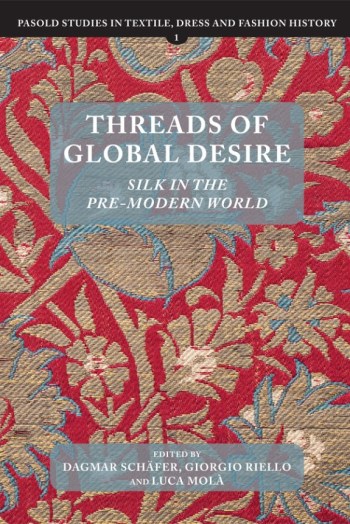 Considering silk as a major force of cross-cultural interaction, this book examines the integration of silk production and consumption into various cultures in the pre-modern world.
Silk has long been a global commodity that, because of its exceptional qualities, high value, and relative portability, came to be traded over very long distances. Similarly, the silk industry—from sericulture to the weaving of cloth—was one of the most important fields of production in the medieval and early modern world. The production and consumption of silks spread from China to Japan and Korea and travelled westward as far as India, Persia and the Byzantine Empire, Europe, Africa, and the Americas. As contributors to this book demonstrate, in this process of diffusion silk fostered technological innovation and allowed new forms of organization of labour to emerge. Its consumption constantly reshaped social hierarchies, gender roles, aesthetic and visual cultures, as well as rituals and representations of power.
Threads of Global Desire is the first attempt at considering a global history of silk in the pre-modern era. The book examines the role of silk production and use in various cultures and its relation to everyday and regulatory practices. It considers silk as a major force of cross cultural interaction through technological exchange and trade in finished and semi-finished goods. Silks mediated design and a taste for luxuries and were part of gifting practices in diplomatic and private contexts. Silk manufacturing also fostered the circulation of skilled craftsmen, connecting different centres and regions across continents and linking the countryside to urban production.
Dagmar Schäfer is Director of Department 3 ‘Artefacts, Action, and Knowledge’ at the Max Planck Institute for the History of Science in Berlin and Professor h.c. of the History of Technology at the Technical University, Berlin.
Giorgio Riello is Professor of Global History and Culture at the University of Warwick. He has published extensively on the history of material culture and trade in early modern Europe and Asia and in particular on textiles and fashion.
Luca Molà is Professor of Early Modern Europe: History of the Renaissance and the Mediterranean in a World Perspective at the European University Institute in Fiesole.
C O N T E N T S
• Luca Molà and Giorgio Riello and Dagmar Schäfer, Introduction: Silk in the Pre-Modern World
• Dagmar Schäfer, Power and Silk: The Central State and Localities in State-owned Manufacture during the Ming Reign (1368–1644)
• Angela Sheng, Why Velvet? Localised Textile Innovation in Ming China
• Rudi Matthee, The Dutch East India Company and Asian Raw Silk: From Iran to Bengal via China and Vietnam
• Amanda Phillips, The Localisation of the Global: Ottoman Silk Textiles and Markets, 1500–1790
• Suraiya Faroqhi, Ottoman Silks and their Markets at the Borders of the Empire, c. 1500–1800
• Lisa Monnas, A Study in Contrasts: Silk Consumption in Italy and England during the Fifteenth and Sixteenth Centuries
• David M. Mitchell, What d’ye lack Ladies? Hoods, Ribbands, very fine silk stockings: The Silk Trades in Restoration London
• Lesley Ellis Miller, From Design Studio to Marketplace: Products, Agents, and Methods of Distribution in the Lyons Silk Manufactures, 1660–1789
• José L. Gasch-Tomás, The Manila Galleon and the Reception of Chinese Silk in New Spain, c. 1550–1650
• Ben Marsh, ‘The Honour of the Thing’: Silk Culture in Eighteenth-Century Pennsylvania
• Karolina Hutková, A Global Transfer of Silk Reeling Technologies: The English East India Company and the Bengal Silk Industry
• Fujita Kayoko, Changing Silk Culture in Early Modern Japan: On Foreign Trade and the Development of ‘National’ Fashion, from the Sixteenth to Nineteenth Century
• Giorgio Riello, Textile Spheres: Silk in a Global and Comparative Context
Glossary
Bibliography
Notes on Contributors
Index
Call for Articles | Metropolitan Museum Journal
Manuscript Guidelines for the Metropolitan Museum Journal:
Metropolitan Museum Journal
Submissions for Volume 54 are due by 15 October 2018
The Editorial Board of the peer-reviewed Metropolitan Museum Journal invites submissions of original research on works of art in the Museum’s collection. There are two sections: Articles and Research Notes. Articles contribute extensive and thoroughly argued scholarship. Research Notes typically present a concise, neatly bounded aspect of ongoing investigation, such as a new acquisition or attribution, or a specific, resonant finding from technical analysis. All texts must take works of art in the collection as the point of departure.
Articles and Research Notes in the Journal appear both in print and online, and are accessible via MetPublications and the Journal’s home page on the University of Chicago Press website.
Manuscripts are reviewed by the Journal Editorial Board, composed of members of the curatorial, conservation, and research science departments. To be considered for the following year’s volume, an article must be submitted, complete including illustrations, by October 15. Once an article is accepted for publication, the author will have the opportunity to review it after it has been edited and again after it has been laid out in pages. The honorarium for publication is $300, and each author receives a copy of the Journal volume in which his or her article appears.
Additional information is available here»
Symposium | L’art de l’Ancien Régime: Sortir du rang
From the conference programme:
L’art de l’Ancien Régime: Sortir du rang / Die Kunst des Ancien Régime: Jenseits des Kanons
Deutsches Forum für Kunstgeschichte Paris / Centre allemand d’histoire de l‘art, Paris, 14–15 June 2018
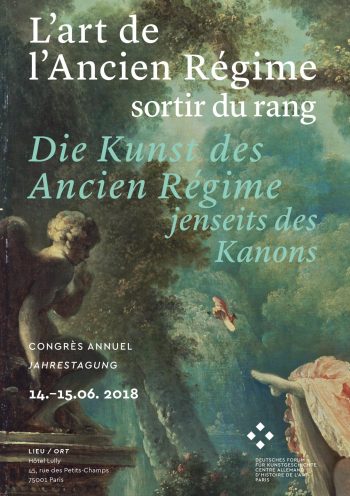 L’histoire des productions artistiques de l’Ancien Régime s’est principalement focalisée sur les grands acteurs, les « beaux-arts », les institutions les mieux documentées, Paris, d’autres capitales et les cours, pour lesquels nous disposons désormais de solides connaissances. En revanche, les artistes, œuvres, techniques et foyers qui échappent aux grands courants historiographiques restent peu étudiés, ou ont été traités sous forme d’études de cas isolées. À cette histoire de l’art « par le haut » commence à se substituer une histoire plus attentive aux acteurs secondaires, aux médiateurs, aux effets et aux modes de circulation des personnes, des objets et des savoirs. Celle-ci nous place face à d’importants défis méthodologiques, nous invitant à appréhender de nouveaux thèmes, à renouveler les approches.
Ce colloque vise à décentrer le regard sur les phénomènes artistiques de l’Ancien Régime afin de mieux saisir la complexité de la culture visuelle et matérielle de l’époque. L’attention sera portée sur les circulations artistiques et la mobilité des objets et des acteurs selon une perspective européenne et globale. À l’échelle de la France, il s’agira d’interroger la diversité des pratiques artistiques sur l’ensemble du territoire et les interactions entre « centre » et « périphérie ». La construction des savoirs artistiques sera abordée selon la dynamique des transferts entre savoirs pratiques, techniques et scientifiques. Il s’agira également d’étudier la participation du fait artistique au fait social, et de réviser les hiérarchies établies par l’historiographie concernant les acteurs des mondes de l’art. Revisiter l’histoire de l’art de l’Ancien Régime nécessite enfin une approche critique des objets : les arts « décoratifs » et les genres « mineurs » seront à examiner en rapport avec les discours théoriques, l’évolution du marché ainsi que les pratiques de collection et d’aménagement domestique comme urbain, afin de privilégier une lecture qui souligne l’importance de l’expérience vécue et des propriétés matérielles des œuvres dans les différents contextes de production et de réception.
Conception
Matthieu Creson, Pascale Cugy, Sarah Grandin, Ulrike Keuper, Thomas Kirchner, Déborah Laks, Camilla Pietrabissa, Sophie Raux, Marlen Schneider, Caroline Soppelsa, Maël Tauziède-Espariat, Sarah Ubassy-Catala, Hadrien Volle
J E U D I , 1 4 J U I N 2 0 1 8
9.00 Accueil des intervenants
9.30 Introduction, Thomas Kirchner (DFK Paris) et Sophie Raux (Université Lumière Lyon 2 – LARHRA)
10.00 1. Relocaliser l’ « Ancien Régime »
• Sarah Catala et Matthieu Creson, Introduction et modération
• Anne Lafont (EHESS, Paris), Quelle histoire de l’art africain sous l’Ancien Régime? Sources, méthodes, perspectives
• Hendrik Ziegler (Philipps-Universität Marburg), Exposer les armes de l’autre: quelques réflexions sur la présentation d’objets turcs dans les collections européennes à l’époque moderne
• Anne Perrin Khelissa et Émilie Roffidal (Laboratoire FRAMESPA UMR 5136, Université Toulouse – Jean Jaurès), Réseaux des académies d’art provinciales et dynamiques des circulations au XVIIIe siècle
12.45 Pause déjeuner
14.00 2. Dépasser les hiérarchies
• Caroline Soppelsa, Hadrien Volle, Introduction et modération
• Valérie Nègre (Université Paris 1 Panthéon-Sorbonne), Architectes et entrepreneurs: se défaire des catégories ?
• Charlotte Guichard (CNRS / ENS, Paris), L’art et la marchandise: Signer le tableau dans le Paris des Lumières
• Carl Magnusson (The Getty Research Institute / Université de Lausanne), Entre centre et périphérie: les discours sur la décoration dans la France du XVIIIe siècle
17.30 Visite dans le quartier Richelieu, Isabella di Lenardo (École Polytechnique Fédérale de Lausanne)
V E N D R E D I , 1 5 J U I N 2 0 1 8
9.30 3. (Dé)construire l’ordre social
• Ulrike Keuper, Camilla Pietrabissa, Maël Tauziède-Espariat, Introduction et modération
• Fanny Cosandey (EHESS, Paris), Reproduire et déplacer: La répétition cérémonielle, entre fixation des places et dynamiques sociales
• Melissa Hyde (University of Florida), In Recovery: Some Forgotten Women of the Académie and Beyond
• Mechthild Fend (University College London), Marguerite Le Comte’s Smile: Portrait of an Amatrice
12.15 Pause déjeuner
13.30 4. Appréhender l’objet
• Pascale Cugy et Sarah Grandin, Introduction et modération
• Peter Fuhring (Fondation Custodia, Paris), L’aiguière en jaspe sanguin du XIVe siècle et sa monture en or du XVIIIe siècle de la collection du musée Gulbenkian: l’appréciation des matériaux, du travail de l’orfèvre et du « dessein »
• David Pullins (The Frick Collection, New York), A Boucher Room: Time, Authorship, and Medium
• Katie Scott (The Courtauld Institute, London), Objects of Learning: Oppenord’s Ripa and Saint Aubin’s Pernety
16.45 Sophie Raux et boursiers du sujet annuel, Conclusion du colloque
Cocktail de clôture
Journal18, #5 Coordinates (Spring 2018)
The fifth issue of J18 is now available:
Journal18, Issue #5: Coordinates (Spring 2018)
Digital Mapping & Eighteenth-Century Visual, Material, and Built Cultures
Issue Editors: Carrie Anderson and Nancy Um
 Spurred by the collection, preservation, and distribution of spatial data—practices that have both collapsed and expanded our own discursive geographies—art historians are poised to harness fully the potential of geospatial analysis for the study of visual, material, and built cultures. This issue of Journal18 features current scholarship that relies on the analytical power provided by digital mapping interfaces for the study of the long eighteenth century. As Hannah Williams shows in her article on the locations of eighteenth-century artists’ studios in Paris, georectification tools can reconcile historical figurations of space with the present urban fabric, while digital mapping applications have made it possible to visualize patterns of artists’ stasis and movement. These platforms can also show the dynamic lives of mobile and fungible objects along circuitous, and sometimes unknowable, trajectories, as discussed in Catherine Walsh’s treatment of the “unsettled” parts of Bartolomeo Ammannati’s Juno Fountain that travelled around Florence for over four hundred years. Sophie Raux has made clear the possibilities afforded by mapping the Pont Notre-Dame, enhanced by 3D architectural reconstructions that allow her to address long-standing questions about Antoine Watteau’s painting of one of its shops. The interdisciplinary team of Michael Simeone, Christopher Morris, Kenton McHenry, and Robert Markley have demonstrated how computational methods can be used to analyze large datasets drawn from historical maps of the Great Lakes, thus offering new modes of seeing that exceed the human eye’s perceptive capabilities. But, even as these articles display the possibilities opened up by mapping tools, data-driven methods, and digital technologies, each author is deeply aware of their limitations. As the essays in this issue demonstrate, computational approaches to the spatial humanities—which are marked by intellectual decisions, obstacles, and quandaries—must join rather than replace or supersede an existing toolkit of historically grounded methods that are based on critical analysis, close looking, and a deep skepticism about the transparent meaning of any image or map.
In addition to these four full-length articles, this issue contains three shorter “Compass Points,” which reflect on projects in progress or already implemented, including the legacy of the famous Nolli map of Rome, the distribution of Baroque-period continent allegories found in buildings in Germany and Austria, and a planned database of Caribbean architecture. This issue also includes a roundtable that features contributions from faculty and students who worked on Itinera, a digital project that traces historical networks of cultural mobility and travel, housed in the Visual Media Workshop at the University of Pittsburgh.
Supported by a Digital Development Award for Art History Publishing from the Association of Research Institutes in Art History (ARIAH), this issue showcases two different electronic publishing interfaces, in addition to the WordPress platform on which Journal18 is currently offered. Williams’ article is presented on Quire, a static-site publication framework that features a durable and media-rich environment with enhanced discoverability, currently under development by Getty Publications. The roundtable is presented on Scalar, developed by the Alliance for Networking Visual Culture at the University of Southern California, which facilitates non-linear, multi-vocal, and multi-modal digital presentations. Through these varied modes of output and presentation, this issue thus also engages with the ongoing question of how to best present current digital scholarship, while highlighting interactivity and integrating new modes of expression and sources of evidence.
A R T I C L E S
Artists’ Studios in Paris: Digitally Mapping the 18th-Century Art World
Hannah Williams
Unsettled Sculptures: Mapping the Afterlife of Ammannati’s Juno Fountain
Catherine Walsh
Virtual Explorations of an 18th-Century Art Market Space: Gersaint, Watteau, and the Pont Notre-Dame
Sophie Raux
The Canoe and the Superpixel: Image Analysis of the Changing Shorelines on Historical Maps of the Great Lakes
Michael Simeone, Christopher Morris, Kenton McHenry, and Robert Markley
C O M P A S S P O I N T S
A Digital Extension of a Roman Cartographic Classic: The 1748 Nolli Map and its Legacy
James Tice
Continent Allegories in the Baroque Age – A Database
Marion Romberg
R O U N D T A B L E
Itinera’s Displacements: A Roundtable
Christopher Drew Armstrong, Lily Brewer, Jennifer Donnelly, Alison Langmead, Vibeka McGyver, and Meredith North
Workshop | Digital Mapping
From Eventbrite:
Hannah Williams and Chris Sparks, Digital Mapping: Introductory Workshop
Queen Mary University of London, 2–6pm, 12 July 2018
Digital mapping technologies have led to exciting recent shifts in humanities research. Rather than treating maps as mere illustrations, historians and art historians are making spatial analysis and cartographic visualisations fundamental to their inquiries and yielding fascinating insights as a result.
Yet humanities researchers often lack technical training and can be daunted by the logistics of experimenting with digital methods. This Introductory Digital Mapping Workshop aims to provide basic skills for humanities researchers who want to get started with digital mapping. In an informal setting, we will introduce some key concepts and useful resources, and run two practical sessions to develop valuable skills for undertaking your own mapping project. By the end of the day, you will have georeferenced a historical map, started devising a project brief, and prototyped a web app.
Following the workshop, we invite you to join us for the website launch of Artists in Paris: Mapping the 18th-Century Art World, a digital mapping project by Hannah Williams and Chris Sparks, funded by The Leverhulme Trust and supported by Queen Mary University of London.
This workshop is aimed especially at early career researchers, postdocs, and PhD students in humanities disciplines, but it is open to researchers at any level. Places for the workshop are limited. If after booking you are unable to attend, please let us know so that your place can be given to someone else. After booking your place at the workshop, please email the organisers with a brief description of your research interests in digital mapping and, if applicable, some of the sources you might be using. This is only for our information in planning the workshop and will not be distributed.
Website Launch – Artists in Paris: Mapping the 18th-Century Art World
Queen Mary University of London, 12 July 2018
Join us to celebrate the launch of Artists in Paris: Mapping the 18th-Century Art World, a digital mapping project by Hannah Williams and Chris Sparks, funded by The Leverhulme Trust and supported by Queen Mary University of London. Find out more about the project with a website demo and informal discussion. Drinks and snacks will be served.
These events have been made possible with support from The Leverhulme Trust.
Symposium | Water in Historic Gardens
From H-ArtHist:
Water in Historic Gardens as an Aesthetic Category and Natural Resource
Berlin-Brandenburg Academy of Sciences and Humanities, 19 June 2018
Registration due by 13 June 2018
In historic gardens and parks, water is both an essential aesthetic category and an indispensable natural resource. Water appears in a wide range of forms: outstretched lakes, bubbling fountains, or gentle ponds. Exploring a garden from its waterways optimally complements a stroll through the grounds—something visitors still love to do up to the present day.
Historic gardens—traditionally created as a Gesamtkunstwerk, embracing architecture, architectural staffages, and monuments within a natural setting—are highly dependent on the supply of water for very different types of vegetation. Consequently, the increasing number of drought events in the growing season and extreme summer heat as well as rapidly sinking groundwater tables may seriously affect the vitality of plants and trees. Likewise, raising groundwater can also be a major threat by impeding trees to grow roots into the deeper soil, hence, losing anchorage and thus becoming more susceptible to windthrow during storms.
This international symposium provides an opportunity to discuss such impacts and possible solutions to safeguard our historic parks and gardens with experts from Eastern Europe, with special focus on their relevance and applicability to the region of Berlin-Brandenburg.
Registration is available here»
P R O G R A M M E
2.00 Christoph Markschies (Vice-President of the Academy, HU Berlin), Introduction
2.15 Session 1
• Alexandra Veselova (Russian Academy of Sciences, St. Petersburg), The Water System of the 18th-Century Garden in Bogoroditsk (Tula region)
• Andrej Reyman (St. Petersburg), Water Fantasy in the Neva Delta: A Variety of Water Devices in the Gardens of St. Petersburg, 18th–20th Centuries
4.00 Coffee break
4.25 Session 2
• M. Norton Wise (University of California, Los Angeles), On the Social Aesthetics of Water and Steam in the Landscape Gardens of 19th-Century Berlin
• Vela Portugalskaya (The State Russian Museum, St. Petersburg), Hydrosystem of the Gardens of the Russian Museum in St. Petersburg: Its Transformation and Impact
• Boris Sokolov (Russian State University for the Humanities, Moscow), Aesthetics and Sustainability in the Russian Water Parks, from the Baroque to 21st Century
7:00 Closing Discussion
Chair: Christoph Markschies (Vice-President of the Academy, HU Berlin)
New Book | Jacques Pierre Jean Rousseau
From GHAMU and available from ArtBooks.com:
Jean-Loup Leguay, Jacques Pierre Jean Rousseau (1733–1801): Ingénieur et architecte en Picardie au siècle des lumières (Heule: Snoeck, 2018), 256 pages, ISBN: 978-9461614445, 32€ / $55.
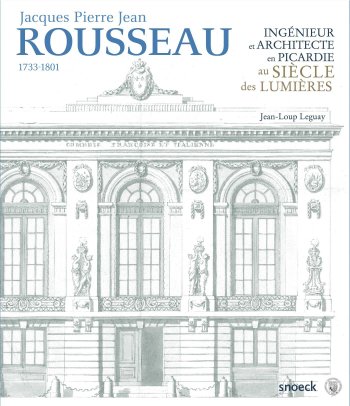 La monographie que Jean-Loup Leguay a consacré à Jacques Pierre Jean Rousseau (1733–1801), ingénieur et architecte en Picardie au Siècle des lumières, fera sa sortie en librairie au début du mois de mai 2018 ; il s’agira là du nouveau volume de la collection des Mémoires de la Société des Antiquaires de Picardie, publié en partenariat avec les éditions Snoeck.
Né à Saumur, Jacques Pierre Jean Rousseau arrive à Paris en 1752 et entre à l’École des ponts et chaussées. Formé au métier d’ingénieur des routes, il est désigné en 1757 pour servir en Picardie, région qu’il ne quittera plus. Vingt ans plus tard, il démissionne des Ponts et Chaussées et devient ingénieur municipal d’Amiens où il construit, tout comme à Abbeville, les derniers grands édifices publics du XVIIIe siècle. L’extraordinaire château de Saint-Gratien témoigne, quant à lui, de sa contribution à l’architecture privée.
Membre résidant de la Société des Antiquaires de Picardie, Jean-Loup Leguay est historien de l’art, spécialiste de l’architecture française au Siècle des lumières. Auteur de nombreux articles, il participe régulièrement aux différents colloques et publications organisés sur le sujet. Il a publié en 2010 le Guide de l’hôtel Biron : Musée Rodin.










 Enfilade
leave a comment