Exhibition | Blast from the Past: Artillery in the War of Independence
Along with artillery objects, the exhibition includes British paintings of arms manufacturing on loan from the National Maritime Museum in Greenwich and the Musée de l’Armée at Les Invalides in Paris.
Blast from the Past: Artillery in the War of Independence
American Revolution Museum, Yorktown, 10 June 2018 — 5 January 2019
Curated by Sarah Meschutt
 As the last great victory of the American Revolution, the 1781 Siege at Yorktown is known for the use of artillery by General George Washington’s Continental Army. Through interactive elements and artifact displays, Blast from the Past: Artillery in the War of Independence features artillery used on all fronts of the American Revolution by the American, French, and British forces. This special exhibition explores a range of topics from innovations in artillery design and technology to the individual roles of an artillery crew. Topics examine artillery deployment and transport, as well as the range of fire and science behind these powerful weapons.
Blast from the Past highlights the chronology of the weapons and reveal the technology and innovation that delivered the last great victory of the Revolution—a victory that forever made Yorktown, Virginia, the place where the subjects of a king became the citizens of a nation.
American, French and British artillery pieces include:
• British Light 3-pounder bronze field cannon, cast by Jan and Pieter Verbruggen, ca. 1776, on loan from the U.S. Army Center of Military History
• ‘La Perileuse’ French 4-pounder bronze field cannon, cast by Jean Bérenger at Strasbourg, ca 1758, on loan from the National Park Service Springfield Armory National Historic Site
• British 12-pounder bronze ‘Lafayette’ cannon, cast by William Bowen, ca. 1759, on loan from the National Park Service, Colonial National Historical Park, Yorktown Collection
• American 6-pounder iron cannon, cast by Samuel and Daniel Hughes, ca. 1775–83, on loan from the Mayor and Council of Boonsboro, Maryland
• ‘La Bellone’ French 4-pounder bronze battalion cannon, cast by D.E. Dupont at Rochefort, ca. 1773, on loan from the National Park Service, Home of Franklin D. Roosevelt National Historical Site
Visitors can take in the size and scope of American, French, and British artillery and then explore the museum for a range of hands-on experiences.
• Discover types of artillery—cannons, mortars and howitzers—and types of ammunition, from shot and shell to canister and grape.
• Figure out the right artillery tool for the job—types of shot and essential implements of rammer, sponge and linstock—in a hands-on display.
• How does one move a gun? Lift a door to determine the strength by men and horses to advance a light or heavy gun.
• Examine an artilleryman’s pocket guide; see interactive 18th-century artillery field manuals that served as reference to determine tasks such as how to draw a 6-pounder up a steep cliff or bluff.
New Book | George Washington’s Washington
From the University of Georgia Press:
Adam Costanzo, George Washington’s Washington: Visions for the National Capital in the Early American Republic (Athens: University of Georgia Press, 2018), 264 pages, ISBN: 978-0820352855 (hardcover), $75 / ISBN: 978-0820353890 (paperback), $30.
 This book traces the history of the development, abandonment, and eventual revival of George Washington’s original vision for a grand national capital on the Potomac. In 1791 Washington’s ideas found form in architect Peter Charles L’Enfant’s plans for the city. Yet the unprecedented scope of the plan; reliance on the sale of city lots to fund construction of the city and the public buildings; the actions of unscrupulous land speculators; and the convoluted mixture of state, local, and federal authority in effect in the District all undermined Federalist hopes for creating a substantial national capital.
In an era when the federal government had relatively few responsibilities, the tangible intersections of ideology and policy were felt through the construction, development, and oversight of the federal city. During the Washington and Adams administrations, for example, Federalists lacked the funds, the political will, and the administrative capacity to make their hopes for the capital a reality. Across much of the next three decades, Thomas Jefferson and other Jeffersonian politicians stifled the growth of the city by withholding funding and support for any project not directly related to the workings of the government. After decades of stagnation, only the more pragmatic approach begun in the Jacksonian era succeeded in fostering development in the District. And throughout these decades, driven by a mixture of self-interest and national pride, local leaders worked to make Washington’s vision a reality and to earn the respect of the nation.
George Washington’s Washington is not simply a history of the city during the first president’s life but a history of his vision for the national capital and of the local and national conflicts surrounding this vision’s acceptance and implementation.
Adam Costanzo is a professional assistant professor of history at Texas A&M University, Corpus Christi.
Exhibition | The American Revolution: A World War

Louis-Nicolas Van Blarenberge, The Siege of Yorktown, 1786; gouache on panel, 24 × 37 inches
(Private Collection of Nicholas Taubman)
◊ ◊ ◊ ◊ ◊
Van Blarenberghe’s two Yorktown paintings were on view last year at Philadelphia’s Museum of the American Revolution. Press release (21 June 2018) from The National Museum of American History:
The American Revolution: A World War
Smithsonian’s National Museum of American History, Washington, D.C., 26 June — 9 July 2019
Curated by David Allison
A global lens is placed on the story of American independence in the exhibition The American Revolution: A World War, open June 26 through July 9, 2019, at the Smithsonian’s National Museum of American History. The focal point of this one-year exhibition, on view in The Nicholas F. and Eugenia Taubman Gallery, centers on two historical paintings that depict the culminating events at Yorktown in 1781, which ended the war on American soil, and a portrait of General George Washington.

Charles Willson Peale, Washington at Yorktown, 1780–82, painted for French General Comte de Rochambeau.
The American Revolution: A World War explores the Franco-American partnership during the Revolution and the extent to which international relations shaped the formation of the United States. General Jean-Baptiste Donatien de Vimeur, Comte de Rochambeau, led the French forces at Yorktown. Two of the paintings were created by Louis-Nicolas Van Blarenberghe and are copies he made for Rochambeau of paintings presented to King Louis XVI. The Washington portrait is by Charles Willson Peale. All three once hung in Rochambeau’s home as reminders of his partnership with Washington that resulted in the American victory.
“The American colonies had no hope of winning their independence alone,” said David Allison, project director and senior curator of the exhibition. “They had to gain support from other European powers, most importantly from France and Spain and the involvement of these nations would affect not only the history of the new United States of America, but their own histories as well.”
The Siege of Yorktown and The Surrender of Yorktown, both painted in 1786, and the Washington portrait painted in 1780–82 are united for the first time in a national museum since they were displayed together in the 1700s in Rochambeau’s chamber. The Van Blarenberghe paintings will each be augmented by an interactive computer, allowing visitors to examine enlargements of the paintings and to read eyewitness accounts of the events.
Other artifacts to be displayed include a pistol given to Washington by British General Edward Braddock during the Seven Years War; a cannon used at Yorktown, representing how the French supplied weapons, soldiers, funding and warships to America; Washington’s Yorktown siege map drawn after the conflict; a ship model of Admiral de Grasse’s Ville de Paris, which led the French fleet that blocked British ships; and an almanac and memorabilia commemorating the Marquis de Lafayette’s visit to the United States near the 50th anniversary of Independence. In addition to Peale’s Washington, images of the other three leaders involved in the American Revolution will be on display: Rochambeau, the Marquis de Lafayette of France and General Charles Cornwallis of Great Britain.
Americans often think that the American Revolution ended with the Siege of Yorktown in 1781, but, in fact, war continued around the world as European powers fought to defend their interests. These wider conflicts ultimately determined the terms Britain accepted in the 1783 treaty granting the United States its independence. Britain also had to negotiate treaties with France, Spain and the Dutch Republic before the wider war connected to the American Revolution finally concluded in 1784.
The exhibition is made possible through the generous support of Ambassador Nicholas F. and Eugenia L. Taubman with additional support from Jeff and Mary Lynn Garrett and Susan and Elihu Rose. A number of objects are on loan from private collections, museums and other institutions, including the Society of the Cincinnati, Winterthur and the Musée de l’Armée in Paris. The exhibition will open in the recently transformed wing of the museum’s second floor, which is themed The Nation We Build Together and features exhibitions that tell the story of America’s founding and future as a country built on the ideals and ideas of freedom and opportunity.
A book to accompany the exhibition will be published in November:
David Allison and Larrie Ferreiro, eds., The American Revolution: A World War (Washington, D.C.: Smithsonian Books, 2018), 272 pages, ISBN: 978-1588346339, $30.
 The American Revolution: A World War argues for the importance of understanding the American Revolution in a global context. The illustrated companion volume to the Smithsonian National Museum of American History exhibition of the same name, this book posits that it is not possible to fully understand the Revolution if it is seen as a solely American conflict. Instead, American motivations and contributions must be considered alongside those of the British, French, Spanish, and Dutch. Highlighting the often overlooked international nature of the Revolution while grounding it in its origins—the fight for independence from Great Britain—this collection of essays from leading writers on the Revolution touches on such topics as European diplomacy, overseas empires, economic rivalries, supremacy of the seas, and more. Together the book’s incisive text, full-color images, and topical sidebars underscore that America’s fight for independence is most clearly comprehended as one of the first global struggles for power.
David K. Allison is Senior Scholar at the Smithsonian’s National Museum of American History. Larrie D. Ferreiro teaches history and engineering at George Mason University in Virginia, Georgetown University in Washington, D.C., and the Stevens Institute of Technology in New Jersey. He is the author of Brothers at Arms: American Independence and the Men of France and Spain Who Saved It, a finalist for the Pulitzer Prize.
New Book | Committed to Memory: The Art of the Slave Ship Icon
From Princeton UP:
Cheryl Finley, Committed to Memory: The Art of the Slave Ship Icon (Princeton: Princeton University Press, 2018), 320 pages, ISBN: 978-0691136844, $50 / £40.
 How an eighteenth-century engraving of a slave ship became a cultural icon of black resistance, identity, and remembrance
One of the most iconic images of slavery is a schematic wood engraving depicting the human cargo hold of a slave ship. First published by British abolitionists in 1788, it exposed this widespread commercial practice for what it really was—shocking, immoral, barbaric, unimaginable. Printed as handbills and broadsides, the image Cheryl Finley has termed the ‘slave ship icon’ was easily reproduced, and by the end of the eighteenth century it was circulating by the tens of thousands around the Atlantic rim. Committed to Memory provides the first in-depth look at how this artifact of the fight against slavery became an enduring symbol of black resistance, identity, and remembrance.
Finley traces how the slave ship icon became a powerful tool in the hands of British and American abolitionists, and how its radical potential was rediscovered in the twentieth century by black artists, activists, writers, filmmakers, and curators. Finley offers provocative new insights into the works of Amiri Baraka, Romare Bearden, Betye Saar, and many others. She demonstrates how the icon was transformed into poetry, literature, visual art, sculpture, performance, and film—and became a medium through which diasporic Africans have reasserted their common identity and memorialized their ancestors.
Beautifully illustrated, Committed to Memory features works from around the world, taking readers from the United States and England to West Africa and the Caribbean. It shows how contemporary black artists and their allies have used this iconic eighteenth-century engraving to reflect on the trauma of slavery and come to terms with its legacy.
Cheryl Finley is associate professor of art history at Cornell University. She is the coauthor of Harlem: A Century in Images and the coeditor of Diaspora, Memory, Place: David Hammons, Maria Magdalena Campos-Pons, Pamela Z.
Installation | Brian Tolle’s Eureka

Press release, via ArtDaily (30 June 2018). . .
Brian Tolle’s Eureka
Federal Hall National Memorial, Wall Street, New York, 27 June — 8 September 2018
The National Parks of New York Harbor Conservancy, in partnership with the National Park Service, announces the presentation of Brian Tolle’s Eureka, on view from June 27 until September 8, 2018, in Federal Hall, the iconic memorial to democracy on Wall Street. Eureka is part of a new art initiative, curated by Bonnie Levinson, inviting contemporary artists to investigate themes that resonate with the history and legacy of Federal Hall, melding the past and present, to serve as a catalyst toward the reinvigoration of civic life and a platform for free expression.
 For this presentation of Eureka, Tolle has chosen to exhibit his work alongside a rare viewing of the Flushing Remonstrance, the 1657 New Netherland petition for “liberty of conscience” that served as the precursor to religious freedom, as cemented in the First Amendment written at Federal Hall over a century later. Not seen in Manhattan in over 30 years, the Remonstrance shares a room with the Bible from President Washington’s 1789 inauguration at Federal Hall.
Tolle’s 40-foot tall sculpture, reflecting a rippling and distorted facade of a 17th-century Dutch canal house, pays homage to the legacy of 40 years of Dutch rule in New York. Originally created for Jan Hoet’s city-wide exhibition, Over the Edges, 2000, in Ghent, Belgium, its re-presentation in Federal Hall blurs the site’s architectural and political history with the contemporary in the conceptual artwork.
Brian Tolle describes the work: “Eureka is a sculptural play with illusion—a facade of a facade. Its Dutch-inspired form points to New York’s early history and its fluid, but troubled, transformation from a Dutch seat of power to British colony, to an American platform for diversity and democracy. The sculpture is an apparition, a mirage of a building that has been displaced and no longer exists. Like the Dutch buildings of lower Manhattan and the canal that was once Broad Street—erased with only the street names lingering as a reminder of their existence—Eureka serves as a marker of Federal Hall’s complex history. Its thin veil floats upwards, into the neoclassical dome of Federal Hall, evoking the strife between form and object, as well as the tension between political volley and social action.”
The artwork’s title is inspired by the brilliant Greek polymath Archimedes’s exploration of displacement. After finding the upward pressure on a submerged object created buoyant force, Archimedes ran through the streets of Syracuse, Sicily, shouting, “Eureka! Eureka!” or “I found it! I found it!” Tolle envisioned Eureka as a metaphor for Archimedes’s principle of leverage. With the right tools, Archimedes believed all was possible. “Give me a lever long enough and a fulcrum on which to stand,” he said, “and I shall move the world.”
The nation’s Founders leveraged principles as powerful as Archimedes’s when they codified the historic events that occurred at Federal Hall, including: the acquittal in 1735 of the newspaper publisher John Peter Zenger for libel, after he exposed government corruption, which established the foundation for freedom of the press; the 1765 Stamp Act Congress, which protested taxation of then British colonies without representation, and sowed the seeds for the union to come; and the passing of the first amendments to the Constitution, which cemented in perpetuity individual rights.
“The National Park Service is honored to host Tolle’s magnificent edifice Eureka and the Flushing Remonstrance, a transformational document to establishing the governing principles of the United States,” said Shirley McKinney, Superintendent for Federal Hall National Memorial. “As the site where George Washington took the oath of office as our first President and the site of the first Congress, Supreme Court, and Executive Branch offices, Federal Hall is the appropriate venue to bring the two together to spark conversations about history through a contemporary lens.”
“As we embark on a new day for Federal Hall, this installation highlights this historic site’s potential as an ever-evolving arena for public discourse through the arts,” said Marie Salerno, President of the Harbor Conservancy. “Federal Hall must be steeped, but not stuck in the past. This will be a place where artists with diverse perspectives will be invited to interpret the ideas, ideals and flaws of our democracy forged here.
Brian Tolle’s sculptures and installations emphasize a formal and iconographic dialog with history and context. Using a variety of media, his work draws from the scale and experience of its surroundings, provoking a rereading by cross-wiring reality and fiction. Drawing ideas from a broad-based conceptual analysis, Tolle blurs the border between the contemporary and the historical. His approach involves in-depth research, which is then distilled and directed creating an intuitive personal response.
Tolle is acclaimed for his major permanent public artworks including the Irish Hunger Memorial in Battery Park City, New York; Miss Brooklyn and Miss Manhattan at the entrance of the Manhattan Bridge, Flatbush, Brooklyn; and his recent appointment as the lead artist of the East Midtown Waterfront Project, an esplanade between East 53rd and East 59th Streets along New York City’s East River. Tolle’s works have been exhibited in the Whitney Biennial; the Tate Modern; the S.M.A.K.; the Institute of Contemporary Art, Philadelphia; the Queens Museum of Art, New York; and the Invitational Exhibition at the American Academy of Arts. The artist is currently represented by C24 Gallery.
Lecture | David Saunders on Museum Lighting
From the Eventbrite page:
David Saunders | A Clearer View: New Thinking on Lighting in Museums and Galleries
21st Annual Plenderleith Memorial Lecture, Icon Scotland Group
Dundee, 29 November 2018
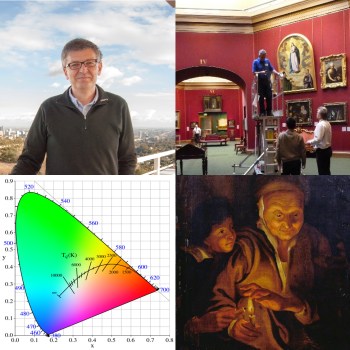 Lighting in museums and galleries has long been a contentious subject. Too much light can cause damage to artworks, too little creates a poor visitor experience. In the forty years since The Museum Environment by Garry Thomson was first published, much has changed in the field of museum lighting. David Saunders will discuss how our understanding of the effects of light on collections and the lighting needs of our visitors have changed. He will explore how new approaches and developments in museum lighting affect practices and strategies for both display and conservation. The talk will be followed by a drinks reception and preceeded by the Icon Scotland Group Annual General Meeting between 5.00 and 5.45pm to which Icon members are invited to attend.
Dr. Saunders was recently Keeper of Conservation, Science and Documentation at the British Museum (and previously, Principle Scientist the Scientific Department of the National Gallery, London). He is presently writing a major work on lighting in museums and galleries which is expected to be published in 2018.
Exhibition | Storytelling: French Art from the Horvitz Collection
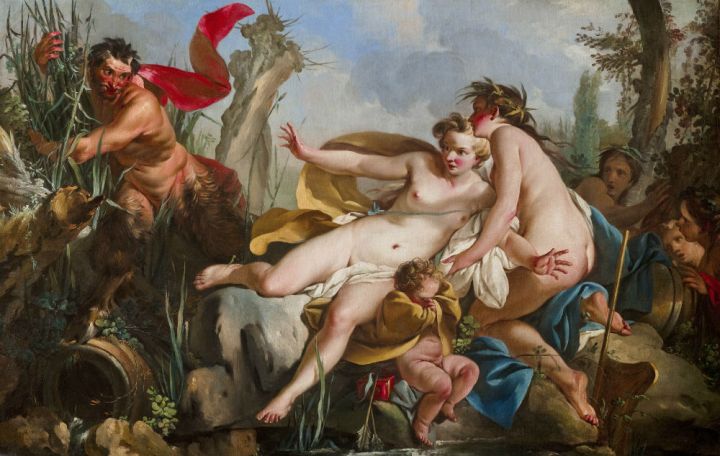
Jean-Baptiste-Marie Pierre, Pan and Syrinx, 1746, oil on canvas, 90 × 141 cm
(Boston: The Horvitz Collection, P-F-57).
◊ ◊ ◊ ◊ ◊
Now on view at the Cummer Museum:
Storytelling: French Art from the Horvitz Collection
Cummer Museum of Art & Gardens, Jacksonville, Florida, 25 May — 29 July 2018
John and Marble Ringling Museum of Art, Sarasota, Florida, 9 September — 2 December 2018
Fairfield University Art Museum, Fairfield, Connecticut, 25 January — 29 March 2019
Curated by Alvin Clark
Storytelling: French Art from the Horvitz Collection combines two exhibitions: Imaging Text: Drawings for French Book Illustration and Seventeenth- and Eighteenth-Century French Paintings, from one of the world’s finest private collections of French art. Created between the 16th and 19th centuries, and ranging from mythological and biblical studies to more playful imagery, the 80 works included in the exhibition vary in terms of style, genre, and period. Captured in crisp and swift pen strokes, finely modulated chalk, or brilliant colors, these captivating compositions were produced by some of the most prominent artists of their time, such as Charles Le Brun (1619–1690), Charles-Nicolas Cochin, the younger (1715–1790), and Jean-Honoré Fragonard (1732–1806).
The exhibition is curated by Alvin L. Clark, Jr, Curator, The Horvitz Collection, Department of Drawings, Division of European and American Art, Harvard Art Museums.
Alvin Clark and Elizabeth M. Rudy, Imaging Text: French Drawings for Book Illustration from The Horvitz Collection (Boston: The Horvitz Collection, 2018), 76 pages, ISBN: 978-0991262533, $15.
◊ ◊ ◊ ◊ ◊
Note (added 10 January 2018) — The posting was updated to included Fairfield University Art Museum.
Colonial Williamsburg Acquires Portrait by William Dering
Press release (2 July 2018) from Colonial Williamsburg:

William Dering, Portrait of Joyce Armistead Booth (Mrs. Mordecai Booth), oil on canvas, ca. 1745 (Colonial Williamsburg, Gift of Julia Miles Brock, Edward Taliaferro Miles and Georginana Serpell Miles in memory of their mother, Alice Taliaferro Miles, 2018-165, A&B).
In the first half of the 18th century, William Dering was a well-connected dancing master and artist who lived and worked in Williamsburg, Virginia. Today, only six of Dering’s paintings are known to survive; four, including the artist’s only known signed and dated portrait, are in Colonial Williamsburg’s collection, the largest assemblage of his work. Now, through a generous gift from the sitter’s descendants, Joyce Armistead Booth (Mrs. Mordecai Booth), ca. 1745, a large-scale, oil on canvas, joins Dering’s other works at Colonial Williamsburg, including the well-known portrait of the subject’s son, George Booth. Until now, the painting of Mrs. Booth, which is in remarkable condition and survives in its original frame, has descended through the Booth family.
“Rare early works by local artists such as William Dering expand the depth and breadth of our collections and better enable us to share America’s enduring story,” said Mitchell Reiss, the Colonial Williamsburg Foundation’s president and CEO. “We are particularly grateful for gifts such as this since they allow us to teach history in a very human and personal way.”
“Executed in saturated, well-preserved reds, blues, and golds, and measuring more than four feet in height, this likeness of Joyce Armistead Booth is visually arresting,” said Ronald Hurst, the foundation’s Carlisle H. Humelsine chief curator and vice president for collections, conservation and museums. “The portrait commands the viewer’s attention, and in so doing, provides a window into the goals and aspirations of early Virginia’s planter aristocracy.”
This Dering portrait is significant to ongoing research that Colonial Williamsburg’s experts are undertaking. Laura Barry, Juli Grainger curator of paintings, drawings and sculpture, and Shelley Svoboda, senior conservator of paintings, are at work on a comprehensive study of the artist and his work from both historical and technical perspectives. The portrait of Joyce Armistead Booth, especially due to its pristine condition, informs this research and will help the experts to better understand the nuances in Dering’s other canvases.
“This generous gift gives us an extraordinary opportunity to reunite two family portraits, more fully tell the story of this important Virginia artist and to better understand the context of William Dering’s body of work,” said Ms. Barry. Along with the additional works by this artist in the collection, including the portrait of Elizabeth Buckner Stith (an oil on canvas dating from 1745–49, the only signed and dated Dering example and for years was the only means by which to measure his work), Ms. Barry and Ms. Svoboda are able to study the individual qualities of each painting as well as to examine them together as a group.
Little is known about William Dering in his early years, but he arrived in Williamsburg from Philadelphia in 1737. He advertised in the Virginia Gazette that same year, the first of several occasions he did so, to announce the opening of a dancing school at the College of William and Mary. By 1744 his success enabled him to purchase two lots and move into the Thomas Everard House on Palace Green. The following year, Dering advertised twice to promote “an assembly at the Capitol… during the Court,” a ball held when the capital city was busy with visiting elected representatives from across the colony. During his time in Williamsburg, Dering also befriended William Byrd II, a Virginia planter and Renaissance man who owned one of the largest art collections in the American colonies. During his many visits to Byrd’s James River estate, Dering painted his daughter Anne Byrd Carter. (Her portrait is also in the Colonial Williamsburg collection.) The artist’s extravagant lifestyle led to debt, however, and he was twice forced to mortgage his property. Ultimately, Dering departed Williamsburg for Charleston, South Carolina, leaving his wife and son behind for a year to handle the public sale of his possessions. Little is known about Dering or his family after 1750.
The portrait of Joyce Armistead Booth is a gift from Julia Miles Brock, Edward Taliaferro Miles and Georginana Serpell Miles in memory of their mother, Alice Taliaferro Miles. It will be included in a future exhibition of the artist’s portraits to be held at the Art Museums of Colonial Williamsburg.
“The painting of Joyce Armistead Booth, my five-times great-grandmother, has been a part of my life for all 74 years, but Miss Joyce (as we were taught to call her) is nearly 300 years old,” said Julia Miles Brock of Virginia. “My brother, sister, and I decided it was time she was in a museum with its attendant care, proper storage, and an appreciative audience.”
Call for Papers | Reading the Country House

From the CFP:
Reading the Country House
Manchester Metropolitan University, 16–17 November 2018
Proposals due by 31 August 2018
County houses were made to be read—as symbols of power, political allegiance, taste and wealth. This places emphasis on the legibility of their architecture and decorative schemes, and the paintings, collections and even the furniture they contained. It also draws our attention to the skills required to decode—to read—these signs and symbols. The messages and processes of reading were carried further by the growing number of images of country houses produced through the eighteenth and nineteenth centuries: in private sketchbooks and journals and as engravings published as collections or incorporated into written guidebooks. These allowed the country house to be read in very different ways, as did its appearance in the pages of novels, sometimes as the backdrop or stage for the action, but also symbolic of social structures and relations. This conference seeks to explore all of these perspectives on reading the country house and links them to how the country house is read today, by house managers and visitors and by viewers of period dramas.
We invite papers on any aspect of reading the country house, but we especially welcome papers which examine:
• The country house and the novel
• The presentation of country houses guidebooks and gazetteers
• Visitors perceptions and readings of the country house, both historic and present day
• Processes of reading the architecture and aesthetics of the country house
• Engravings and paintings, both as representations of the country house and as collections in the country house
We are particularly keen to encourage contributions that take a comparative approach: national, international and across time.
Keynote Speakers
Prof. Phillip Lindley (Loughborough) and Prof. Kathryn Sutherland (Oxford)
If you would like to present a paper, then please send a title and 200-word abstract together with a very brief biography to Prof. Jon Stobart: j.stobart@mmu.ac.uk by 31 August 2018.
Exhibition | 18th-Century Baltic Faience

Dish, eighteenth century, faience, Rörstrand
(Stockholm: Nationalmuseum)
◊ ◊ ◊ ◊ ◊
On view this summer in Sweden:
Colour and Form: 18th-Century Baltic Faience
Färg och form: Östersjöfajanser från 1700-talet
Läckö Castle, Lidköping, 10 June — 26 August 2018
Curated by Micael Ernstell
Eighteenth-century pieces of faience from the Baltic region seduced the market with their rich decoration and fine design. This exhibition presents faience artefacts from Nationalmuseum’s amazing collection of ceramics from the 18th century that were manufactured in the countries around the Baltic Sea.
The items in the exhibition, which Nationalmuseum is presenting in partnership with the Läckö Castle Foundation, have a vibrancy and joy that combine with the manufacturers’ ambitions for good design, both aesthetically and technically. The colour palette used by the pattern painters was a rich one, and it seduced the market for much of the 18th century. There has been strong interest among collectors since then.
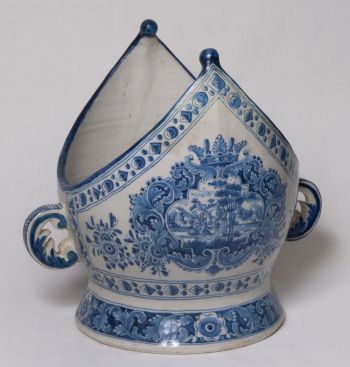
Bowl, so called ‘Bispebolle’, unknown Danish artist active during the 18th century, faience (Stockholm: Nationalmuseum).
The exhibition is dominated by Swedish faience, with the Rörstrand and Marieberg factories as the most important actors. The factories had their own designers, who created many inspirational models and patterns. Production resulted in many examples of international influences. There was also movement of labour between the factories. This saw patterns and designs moving between the competitors.
The manufacturing of faience in Sweden during the 18th century was one element of the national leadership’s desire to develop the nation’s economy and avoid expensive imports. Tax rules and other privileges created the economic preconditions for Swedish faience. Another major factor in helping the Swedish factories was the Manufactory Office (Manufakturkontoret), which aimed to provide manufacturers with both economic and artistic guidance.
“We’re delighted about the long-term and rewarding partnership with the Nationalmuseum. The fact that artefacts from Rörstrand are included feels especially pleasing for Lidköping. One of the financiers of the Rörstrand faience factory was Carl-Gustaf Tessin, the owner of Läckö from 1752 until 1770,” says Magnus Lönnroth, CEO of the Läckö Castle Foundation.
There were almost 40 faience factories around the Baltic Sea in the 18th century. Although production reached a high level, the factories were mostly unprofitable. This meant that many factories only existed for a few years. The ones that started up first were the factories of Store Kongensgade in Copenhagen and Rörstrand in Stockholm. They started in the 1720s, both with a dream of being able to produce the same kind of porcelain as in China or at the Meissen factory in Dresden.
Apart from examples of Swedish manufacturing, the exhibition features artefacts from ten or so factories around the Baltic. There are examples from the Store Kongensgade factory in Copenhagen, which was founded in 1722 and is the oldest faience factory in the Nordic region. Johan Wolff came from that factory to Stockholm and founded the Rörstrand factory in 1726. Norway is also represented, as that was part of Denmark at the time.
“It’s wonderful that we can also use the exhibition to highlight the 100th anniversary of the Baltic States as independent nations with colourful pieces of faience from the factory in Reval, the modern-day Tallinn in Estonia,” says Micael Ernstell, curator of the exhibition and director of the National Museum.










 Enfilade
leave a comment