New Book | Treasures Afoot
From Johns Hopkins UP:
Kimberly Alexander, Treasures Afoot: Shoe Stories from the Georgian Era (Baltimore: Johns Hopkins University Press, 2018), 248 pages, ISBN: 978-1421425849, $40.
 In Treasures Afoot, Kimberly Alexander introduces readers to the history of the Georgian shoe. Presenting a series of stories that reveal how shoes were made, sold, and worn during the long eighteenth century, Alexander traces the fortunes and misfortunes of wearers as their footwear was altered to accommodate poor health, flagging finances, and changing styles. She explores the lives and letters of clever apprentices, skilled cordwainers, wealthy merchants, and elegant brides, taking readers on a colorful journey from bustling London streets into ship cargo holds, New England shops, and, ultimately, to the homes of eager consumers.
We trek to the rugged Maine frontier in the 1740s, where an aspiring lady promenades in her London-made silk brocade pumps; sail to London in 1765 to listen in as Benjamin Franklin and John Hose caution Parliament on the catastrophic effects of British taxes on the shoe trade; move to Philadelphia in 1775 as John Hancock presides over the Second Continental Congress while still finding time to order shoes and stockings for his fiancée’s trousseau; and travel to Portsmouth, New Hampshire, in 1789 to peer in on Sally Brewster Gerrish as she accompanies President George Washington to a dance wearing a brocaded silk buckle shoe featuring a cream ground and metallic threads.
Interweaving biography and material culture with full-color photographs, this fascinating book raises a number of fresh questions about everyday life in early America: What did eighteenth-century British Americans value? How did they present themselves? And how did these fashionable shoes reveal their hopes and dreams? Examining shoes that have been preserved in local, regional, and national collections, Treasures Afoot demonstrates how footwear captures an important moment in American history while revealing a burgeoning American identity.
Kimberly S. Alexander, a former curator at the MIT Museum, the Peabody Essex Museum, and Strawbery Banke, teaches material culture and museum studies at the University of New Hampshire.
C O N T E N T S
Acknowledgments
Introduction
1 The Cordwainers
2 Wedding Shoes
3 The Value of a London Label
4 Coveting Calamancos: From London to Lynn
5 The Cordwainer’s Lament: Benjamin Franklin and John Hose Testify on the Effects of the Stamp Act
6 ‘For My Use, Four Pair of Neat Shoes’: George Washington, Virginia Planter, and Mr. Didsbury, Boot- and Shoemaker of London
7 Boston’s Cordwainers Greet President Washington, 1789
Conclusion
Epilogue
Appendixes
Glossary
Notes
Bibliography
Index
New Book | European Silver in the Collection of Her Majesty The Queen
Distributed in the USA and Canada by The University of Chicago Press:
Kathryn Jones, European Silver in the Collection of Her Majesty The Queen (London: Royal Collection Trust, 2018), 552 pages, ISBN: 978-1909741379, £95 / $145.
 The Royal Collection contains one of the finest ensembles of pre-twentieth-century European silver in the world. More than 350 works are catalogued in this volume, the majority being manufactured in France, Germany, Russia, and the Netherlands, with a smaller number of pieces from Italy, Spain, Portugal, Scandinavia, and the Austro-Hungarian Empire. An introduction on the history of collecting European silver is followed by catalogue entries on silver objects used for dining; serving and drinking tea, coffee, and chocolate; personal grooming; as well as desk accessories and church plates. Highlights include unusual German Kunstkammer objects acquired by George IV. A fascinating and beautifully illustrated survey, this is the first study of European silver in the Royal Collection for more than a hundred year, bringing together research and new information on the subject. It will be an invaluable resource for students and collectors alike.
Kathryn Jones is Curator of Decorative Arts, Royal Collection Trust.
C O N T E N T S
Preface by Jonathan Mardsen
Acknowledgements
Notes for the reader
Genealogical table
Maps
Introduction by Kathryn Jones
The Catalogue
Germany (cats 1–101)
Austria (cats 102–09)
The Netherlands (cats 110–34)
France (cats 135–202)
Italy (cats 203–08)
Sweden (cats 209–18)
Denmark (cats 219–49)
Russia (cats 250–304)
Other European Locations (cats 305–10)
Composite Pieces or Works of Unknown Origin (cats 311–35)
Concordance
Appendix: Coats of Arms, Crests, Ciphers, and Other Initials
Unpublished Manuscript Sources
Abbreviations and Bibliography
Exhibitions
Indexes
Photographic Acknowledgements
Call for Papers | Beyond the Singular Artist, RSA 2019, Toronto
There are, of course, lots of RSA sessions that include an end date of 1700 (a larger list of sessions is available here); Sarah Grandin, however, notes that she and her co-chair Victoria Addona would particularly welcome late seventeenth- and early eighteenth-century proposals addressing artistic collaboration.
Beyond the Singular Artist: A Critical Assessment of Collaboration, ca. 1400–1700
The Renaissance Society of America
Sheraton Centre, Toronto, 17–19 March 2019
Proposals due by 5 August 2018
Sponsored by the American Academy in Rome — Society of Fellows
This panel takes collaboration as a widespread condition of artistic practice and as a necessary strategy in the face of large, complex, and ambitious projects that exceeded the physical and technical capacities of a single individual. Early modern art history has often cast contemporary artists as antagonists, recounting the friendly competition that stimulated artistic virtuosity, invention, and ‘progress’, alongside anecdotes about more violent and secretive enmities on shared work sites. In a break from this discourse, we seek to challenge notions of the autonomous artist by shifting our focus away from a discussion of independent genius and towards the reality of interdependent and collective practices. Understanding the exigencies of works that employed multiple hands also allows us to be critical of and sensitive to the limits of looking for unilateral artistic identity in the resultant work, when authorship is so often a plural affair. This is not to suggest that collaboration did not bring about its own challenges: issues of translation and coordination could lead all too easily to stalls in process or even visible fissures in the resultant work.
We welcome papers that do not merely describe instances of artists working together but that seek to engage critically with the concepts and practices of artistic collaboration. How was labor divided or delegated in collaborative projects? Did collaboration foster the development of artistic specialization or attract generalists? How do multiple hands manage to create artistic unity? How do we understand the split between design and technical execution, and, relatedly, the translation between media (i.e. from painting to print, from cartoons to tapestries)? Is the visible coordination of accomplished artists and diverse resources ever a desirable effect, as may perhaps be the case in multimedia works such as the retablo, the grotto, and ephemeral architecture? Are conventional discourses on artistic media such as the paragone still useful as we think about collaboration and its products, or do collaborative practices challenge the limits of theory?
Topics might address:
• collaboration between a diverse array of actors, from artists to architects, artisans, apprentices, printers, laborers, furnishers of tools and materials, patrons, foremen, and site managers
• strategies of transfer and translation across surfaces and scales that facilitate intermedial and transmedial projects
• papers that result from the collaborations of practitioners and researchers across specialties (i.e. restoration, conservation, and practicing artists) and disciplines (i.e. history of art and history of science)
• the aesthetic particularities of works of art that result from collaboration
• the development of a critical vocabulary of terms to assess artistic collaboration
Please submit proposals, which should include a paper title (15-word max), abstract (150-word max), and a brief CV (300-word max) to Victoria Addona (vaddona@fas.harvard.edu) and Sarah Grandin (sgrandin@fas.harvard.edu) no later than August 5, 2018.
Exhibition | On a Pedestal
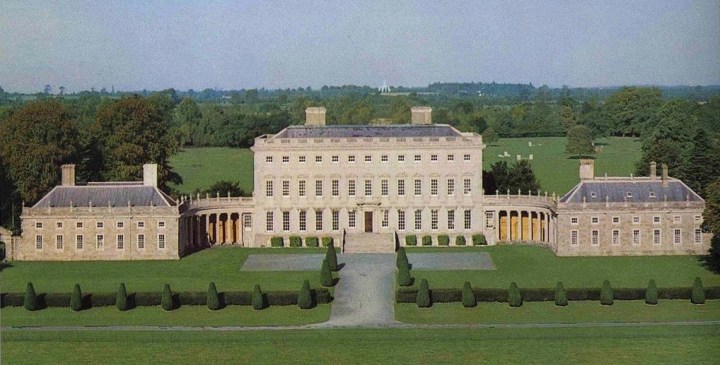
Alessandro Galilei and Edward Lovett Pearce, Castletown House, Celbridge, County Kildare, ca. 1722–29, built for William Conolly, Speaker of the Irish House of Commons; extensive rennovations were made by Lady Louisa Conolly starting in 1759 (Photo: Wikimedia Commons).
◊ ◊ ◊ ◊ ◊
Now on view at Castletown:
On a Pedestal: Celebrating the Contemporary Portrait Bust
Castletown House, Celbridge, County Kildare, 1 July – 31 August 2018
Dublin Castle, 8 September — 4 November 2018
Curated by Mary Heffernan, Hélène Bremer, and Nuala Goodman
Inspired by the classical busts in Castletown’s Long Gallery, this exhibition brings together works from an international group of contemporary artists who explore the genre of the portrait bust in a variety of media: from wood to stone, from marble to ceramics, from stainless steel to more ephemeral materials such as sugar. Initiating a dialogue between past and present, classic and modern art, the diversity of materials and techniques used by the artists represented in the exhibition will inspire visitors this summer.
Among those included in the exhibition are Irish artists Ursula Burke, Janet Mullarney and Kevin Francis Gray. International artists include Sir Tony Cragg, Giulio Paolini, and Ah Xian. Curated by Mary Heffernan, General Manager Castletown House; Helene Bremer, Dutch art historian and curator; and Nuala Goodman, Milan-based Irish artist and curator.
Mary Heffernan, Hélène Bremer, and Nuala Goodman, eds., On a Pedestal: Celebrating the Contemporary Portrait Bust in the 21st Century (Dublin: Office of Public Works, 2018), 95 pages, ISBN: 978-1406429862.

Installation view of the exhibition On a Pedestal: Celebrating the Contemporary Portrait Bust at Castletown House.
◊ ◊ ◊ ◊ ◊
From Aidan Dunne’s article for The Irish Times (3 July 2018). . .
This year, observes Mary Heffernan, the general manager of Castletown House, is the 275th anniversary of the birth of “the great heroine of the story of Castletown,” Lady Louisa Connolly. On a Pedestal, an exhibition of portrait busts at Castletown, is intended as an homage to Louisa, and “the magical Long Gallery she created.”

Anne Valerie Dupond, ‘Lady Louisa Connolly’, 2018.
In 1743 Louisa was born into privileged circumstances: her father was the second Duke of Richmond, and her childhood was spent in great houses, including Richmond House in Whitehall, Goodwood House in Sussex and, after her parents died within a year of each other, Carton House in Co Kildare. She married Thomas Connolly of Castletown, the wealthiest man in Ireland, in 1758.
Inspired by the many houses she knew and loved, she set about making changes to Castletown, including a new cantilevered staircase, La Franchini plasterwork, the print room, diningroom and the Long Gallery. The gallery, which she referred to as her livingroom, housed her library with busts and murals of classical writers, philosophers, gods and goddesses, including the nine muses. Compare it to the collection in the Long Gallery in Trinity College Dublin, initiated in 1743, which historian Hélène Bremer describes as the most significant single influence on Louisa’s project .…
The full article is available here»
◊ ◊ ◊ ◊ ◊
Note (added 24 August 2018) — The original posting did not include details of the catalogue.
Call for Articles | Fall 2019 Issue of J18: Self/Portrait
From J18:
Journal18, Issue #8 (Fall 2019) — Self/Portrait
Edited by Melissa Hyde and Hannah Williams
Proposals due by 21 September 2018; finished articles will be due by 7 April 2019
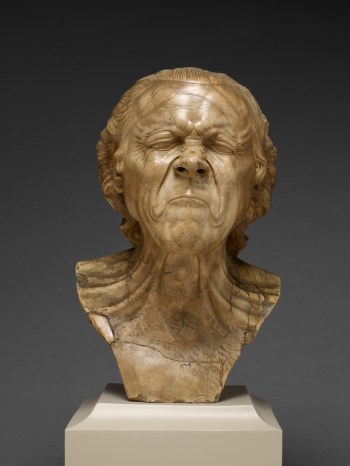
Franz Xaver Messerschmidt, The Vexed Man, 1771–83, alabaster, 39 × 27 × 26 cm (Los Angeles: The J. Paul Getty Museum).
This issue of Journal18 explores artworks, objects, spaces, performances and other visual or material productions that engaged with the self during the long eighteenth century. Rather than a study of ‘self-portraits’ per se, this issue is concerned with expanded definitions of both the ‘self’ and the ‘portrait’, seeking to deepen our sense of how self-expression, self-perception, and self-representation were understood in the long eighteenth century.
Enlightenment philosophy defined modern conceptions of the individual and the self. Not coincidentally, the eighteenth century was also a period in which representations of the self took on a new prominence in artistic practice, becoming sites of innovation and experimentation in a range of visual and material forms. Across the long eighteenth century, self-representation emerged as a crucial space for navigating the individual’s place in society, for pushing the boundaries of artistic convention, and for exploring perceptions of the corporeal self. As institutional restrictions on art were challenged, as new movements redefined who and what the artist was, and as a new emphasis on introspection and subjectivity developed, the eighteenth century witnessed a shift in the artist’s relationship with the self.
We invite proposals for articles that explore artistic engagements with the self in any media, from any cultural context, at any moment across the long eighteenth century. How was art used to explore the self? Beyond mere self-fashioning, how did eighteenth-century artists use portraits (in whatever shape or form) to interrogate, examine, relate, express and communicate? Outside of conventional self-portrayals, how did artists inscribe themselves in their works (e.g. through signatures or self-referential codings)? Of particular interest are proposals that explore unexpected modes or materials of self-portrayal (e.g. architectural self-portraits, porcelain self-portraits, or combinations of word and image) or that take up pertinent issues of methodology (e.g. questions of biography and its problematic place in art-historical writing).
Issue Editors
Melissa Hyde, University of Florida
Hannah Williams, Queen Mary University of London
Proposals for issue #8 Self/Portrait are now being accepted. Deadline for proposals: September 21, 2018. To submit a proposal, send an abstract (250 words) and brief biography to editor@journal18.org and mlhyde@ymail.com. Articles should not exceed 6000 words (including footnotes) and will be due on April 7, 2019. For further details see Information for Authors.
Exhibition | Woven Strands: The Art of Human Hair Work
The exhibition, now on view at The Mütter Museum, presents mainly nineteenth-century objects, though there are several striking eighteenth-century works, too; it’s a fascinating exploration of palette, table work, dissolving hair, and gimp techniques.
Woven Strands: The Art of Human Hair Work
The Mütter Museum, The College of Physicians of Philadelphia, 19 January — 16 September 2018
Curated by Emily Snedden Yates, John Whitenight, and Evan Michelson
 A favored folk art of the 18th and 19th centuries, hair art was a sentimental expression of grief and love, usually created by women whose identities have become anonymous over time. Human hair—from both living and deceased persons—was used to form flower bouquets, wreaths, braided jewelry chains, weeping willows, and painted scenes of mourning. Considered to be a form of portraiture, these were cherished tokens to preserve the memory of a deceased loved one, chart a vibrant family tree of the living, or to be traded as friendship keepsakes. It is rare to view such pieces publicly as they were created in domestic settings, for home display. Drawing from six private collections, the Mutter Museum together with John Whitenight and Evan Michelson has assembled an exquisite group of hair art and jewelry as well as accompanying materials that discuss the social expectations of Victorian-era mourning rituals that ruled 19th-century society with strict standards.
A Brief History of Hair Art as Seen in Woven Strands: The Art of Human Hair Work at the Mütter Museum (Philadelphia: Mütter Museum, 2018), 80 pages, $17.
New Book | Chippendale’s Classic Marquetry Revealed
From Jack Metcalfe’s website, Marquetry Matters:
Jack Metcalfe, Chippendale’s Classic Marquetry Revealed (CreateSpace Independent Publishing Platform, 2018), 304 pages, ISBN: 978-1720881131, $65.
 In this lavishly illustrated, wide-ranging volume, expert marqueteur Jack Metcalfe gives fascinating insights into all aspects of eighteenth-century marquetry, gained from close first-hand examination of Chippendale’s original pieces. Using his insider’s knowledge and skills as a practitioner, he investigates the materials, dyes, tools, and techniques used to create Chippendale’s polychromatic pieces. With its lively, engaging narrative and over 700 colour images, this book is essential reading for marqueteurs, cabinet makers, dyers, furniture historians, and anyone interested in the work of Britain’s supreme furniture maker, Thomas Chippendale.
Separate chapters cover:
• Materials and tools used in Chippendale’s time
• Techniques of eighteenth-century marquetry
• Dyes and dyeing techniques, including the scientific analysis of dyes used on Chippendale’s furniture
• Detailed step-by-step descriptions of the construction of three replica pieces by the author
• A detailed illustrated gallery of all the known marquetry commissions made by Thomas Chippendale.
With over 20 years’ experience as a marqueteur, Jack Metcalfe has devoted himself to uncovering and mastering the techniques of marquetry as practised by Chippendale’s skilled artisans in the eighteenth century. Using equipment, materials, dyes and techniques as close to the original as possible, Jack has created striking replicas of marquetry panels from Chippendale furniture, including the famous Diana and Minerva Commode. His careful research into the use of dyes, including ground-breaking scientific analysis of coloured veneers used, has enabled him to reveal the often startlingly fresh colours that Chippendale’s furniture would have displayed when first constructed.
Exhibition Chippendale: The Man and the Brand
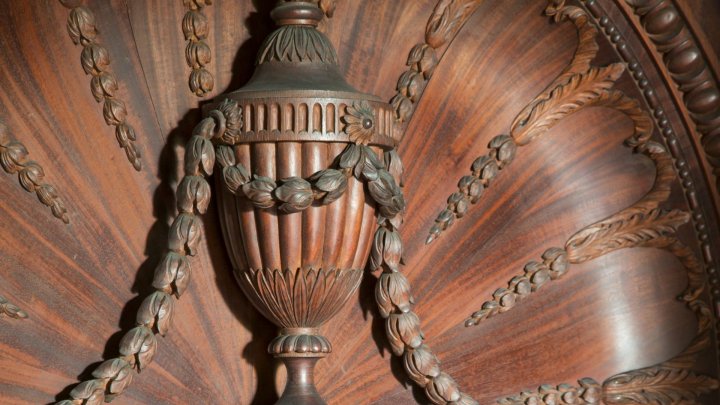
Chippendale firm, Medal Cabinet at Nostell.
◊ ◊ ◊ ◊ ◊
Now on view at Nostell in West, in conjunction with the Chippendale 300 partnership:
Chippendale: The Man and the Brand
Nostell, Wakefield, West Yorkshire, 2 May — 28 October 2018
Nostell is home to a world-class collection of over 100 items supplied by Chippendale and a unique archive of letters, providing an insight into the man behind the famous brand. Visit this new exhibition to discover how a humble cabinet-maker from Otley made a name that has lasted nearly 300 years.
Chippendale is celebrated today by many as the ‘Shakespeare of furniture’; however, he died in relative obscurity. Chippendale: The Man and the Brand tells the story of the 18th-century designer, furniture-maker, and entrepreneur, setting the scene for visitors explore the elaborate showrooms he helped create on Nostell’s first floor.
Born into a Yorkshire family of carpenters and joiners, Thomas Chippendale’s entrepreneurial spirit and talent led him to build a business in London’s St Martins Lane, supplying the 18th-century elite with the most fashionable domestic items. Chippendale’s brand was launched by the publication of The Gentleman and Cabinet-Maker’s Director in 1754, the most luxurious and comprehensive book of furniture designs yet created, covering the full range of objects that an aspiring house owner would want and in all of the on-trend styles of the day. Chippendale had cleverly seen a gap in the market and this must-have catalogue of designs proved a valuable marketing tool to build his business.
Chippendale didn’t just provide high-end design pieces for 18th-century showrooms, his firm also supplied less glamorous items to help with the running of the house. Visitors can explore the full range of products and services supplied for Nostell, from classic Chippendale chairs and elaborate cabinets to a mangle for the domestic quarters as well as dying old fabrics and fixing jammed doors.
Providing a full fit-out service to prestigious clients required a team of skilled employees and a wide range of specialist tools. In the exhibition, you’ll see a selection of 18th-century joiner’s tools from a spokeshave and mortice guage to a veneer hammer and cock bead plane, which were supplied by Christopher Gabriel & Sons, a leading London dealer. A selection of the letters, invoices, and drawings—normally looked after by the West Yorkshire Archives—will also be on display, allowing visitors to discover the challenging relationship Chippendale had with his client, Rowland Winn, including arguments over faulty goods and late payments.
Exhibition | Celebrating 300 Years of Thomas Chippendale
From the Chippendale 300 website:
Celebrating 300 Years of Thomas Chippendale
Nostell, Wakefield, 13 July — 28 October 2018
The Hepworth Wakefield, until 25 February 2019
 To celebrate the 300th anniversary of the birth of Thomas Chippendale, the Hepworth Wakefield in West Yorkshire is working with one of the finest treasure houses in the North of England: Nostell, a National Trust house with over 100 pieces of Chippendale furniture. The role of artists in influencing interiors will be explored through key loans from both collections and special commissions by contemporary artists. Visitors will see modern and contemporary artworks in Nostell’s historic rooms and the most fashionable furniture of the 18th century within the 21st-century gallery spaces of The Hepworth Wakefield. Contemporary responses will be on display at Nostell until 28th October and at The Hepworth Wakefield until 25th February 2019.
Exhibition | From Tiepolo to Canaletto and Guardi
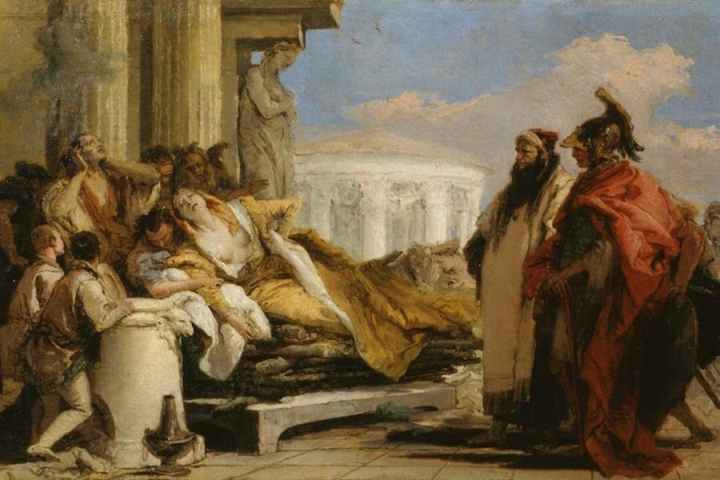
Giambattista Tiepolo, The Death of Dido, detail, 1729
(Moscow: The Pushkin State Museum of Fine Arts)
◊ ◊ ◊ ◊ ◊
Now on view at The Pushkin State Museum of Fine Arts:
From Tiepolo to Canaletto and Guardi
The Pushkin State Museum of Fine Arts, Moscow, 24 July — 14 October 2018
Palazzo Chiericati and Palazzo Leoni Montanari, Vicenza, 23 November 2018 — 10 March 2019
Curated by Victoria Markova and Giovanni Villa
With the exhibition From Tiepolo to Canaletto and Guardi, the Pushkin State Museum of Fine Arts proudly presents paintings by eighteenth-century Venetian masters from the collections of the Museo Civico di Palazzo Chiericati in Vicenza (23 pieces), the Intesa Sanpaolo Collection – Gallerie d’Italia, Palazzo Leoni Montanari in Vicenza (9 pieces), and The Pushkin State Museum of Fine Arts, Moscow (25 pieces). These works of art are shown for the first time together in one space, enabling visitors to see for themselves the full range of Venetian rococo paintings. Artworks on display are by outstanding Italian painters such as Giambattista Tiepolo, Giovanni Battista Pittoni, Luca Carlevarijs, Giovanni Battista Piazzetta, Giovanni Antonio Canal (Canaletto), Francesco Guardi, and Pietro Longhi.
Curators: Victoria E. Markova, Chief Researcher of the Pushkin State Museum of Fine Arts, Custodian of Italian paintings; Giovanni C. F. Villa, Director Emeritus of Vicenza’s civic museums.
◊ ◊ ◊ ◊ ◊
Note (added 13 January 2019)— The posting was updated to include Vicenza as a venue; more information is available here. There, the exhibition is entitled The Triumph of Color: From Tiepolo to Canaletto and Guardi.










 Enfilade
leave a comment