Lectures | ‘Orientalism’ after 40, with Elisabeth Fraser and Mary Roberts
During the two-year, £50-million renovation of Somerset House, classes and lectures at The Courtauld are held at Vernon Square, near King’s Cross.
Orientalism after 40, with Elisabeth Fraser and Mary Roberts
The Courtauld Institute of Art, Vernon Square, London, 25 April 2019
This term’s Visiting Expert series is a joint collaboration with Professor Mary Roberts (University of Sydney) and Professor Elisabeth Fraser (University of South Florida). This series of events was curated by The Courtauld Institute of Art’s Dr Sussan Babaie. Whilst our Visiting Experts are here, we will reflect upon the 40th anniversary of the publication of Edward Said’s seminal text Orientalism on Thursday, 25 April, 6:00–7:00pm. The event consists of two separate lectures.
Elisabeth Fraser, The Ottoman Costume Album as Collaborative Object and Agent of Contact
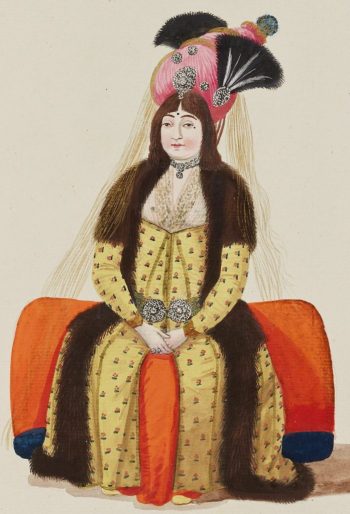 The Ottoman costume album served as a vital agent of contact in the early modern world. Conceived and collected through the movement of people, bound, rebound, sold, gifted, copied and reworked, Ottoman costume albums—produced from the sixteenth through nineteenth centuries—are mobile objects constituted by a flexibility that lends itself to reinvention and reconfiguration. The costume album transcended geographic points of origin, connecting artisans of the book and diverse audiences across time and space in unforeseeable ways. Composed of individual sheets, each bearing a single costumed figure representing variously the Ottoman court, military, professions, and civil society, a costume album was custom made and inflected according to the interests of the owner; the collector and professionals of the book trade determined sequence, thematic emphasis, presentation, and numbers of folios to include. The Ottoman costume album is defined by an essential mutability.
This talk will explore these ideas in relation to one particular eighteenth-century album, Costumes turcs, now in the British Museum, and its connection to a network of other albums and books. Containing 225 costume images painted in Istanbul in the 1780s, this magnificent album was transported to Berlin and then London; at each stop on its journey the album was added to, modified, and redefined. Following the trail of this object reveals the essentially collaborative nature of costume albums.
Elisabeth Fraser is Professor of Art History at the University of South Florida. A specialist of European art and interactions between European and Islamicate cultures, she is the author of Mediterranean Encounters: Artists between Europe and the Ottoman Empire, 1774–1839 and Delacroix, Art and Patrimony in Post-Revolutionary France. She has recently published an essay, “The Color of the Orient: On Ottoman Costume Albums, European Print Culture, and Cross-Cultural Exchange,” in Visual Typologies from the Early Modern to the Contemporary (T. Zanardi and L. Klich, eds., 2018), and edited a volume of essays The Mobility of People and Things in the Early Modern Mediterranean, which will be published by Routledge in 2019. A recipient of an International Scholarship from the Staatliche Museen in Berlin in 2018, she is writing a book on Ottoman costume albums and their relationship to European print culture, Dressing the Ottoman Empire: Early Modern Costume Albums and Transculturation.
Mary Roberts, Edward Said and the Epistolary Interior
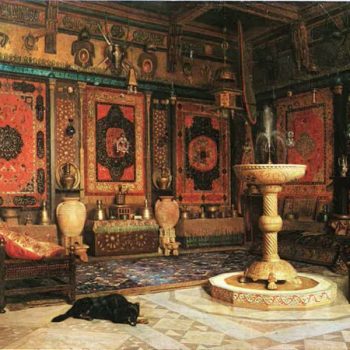 “to [some] theorists of civilization identity is a stable and undisturbed thing, like a room full of furniture at the back of your house. This is extremely far from the truth, not just in the Islamic world but throughout the entire surface of the globe.” –Edward Said, 1996
In histories of modernism the orientalist interior has been consigned like furniture at the back of the house. I resist this formulation by addressing the life of Islamic art as it moved into and out of these spaces. Commencing with Duranton’s painting of Albert Goupil’s Oriental Salon in Paris before the 1888 sale that catalysed movement of his Islamic art into collections across Europe, including the Louvre’s inaugural acquisitions. It is a foundational interior for the history of Islamic art. Goupil’s acquisition channels reveals this interior as the tip of an iceberg that exists in a set of linked relations with Ottoman and Orientalist interiors in Istanbul and Kraków with Polish artist Stanisław Chlebowski as the linchpin. The iceberg, with its north/south axis proves a limited geographic metaphor. It is tempting to construe these Islamic art supply lines through a network model, but that too fails to capture the way these interiors were imagined or lived. In letters to his family in Kraków, written inside the Ottoman Sultan’s Beaux-Arts Palace, Chlebowski articulated one interior within others. I propose that Chlebowski’s epistolary Ottoman and Orientalist interiors exist according to a logic of enfolding. It’s a model for construing the role of historic Islamic art in multiple modernities.
Mary Roberts is John Schaeffer Professor of Art History at the University of Sydney. She specialises in late Ottoman visual culture, British art, and the art of empire and has published extensively on the history of artistic exchanges between the Ottoman Empire and Europe. Her book Istanbul Exchanges: Ottomans, Orientalists and Nineteenth-Century Visual Culture, published by the University of California Press in 2015, was awarded the Art Association of Australia and New Zealand’s Book Prize in 2016 and translated into Turkish the same year. She is also the author of Intimate Outsiders: The Harem in Ottoman and Orientalist Art and Travel Literature (Duke, 2007) and four co-edited books. Mary has been a Getty Scholar, CASVA senior fellow, YCBA fellow, and Clark-Oakley fellow and is currently completing her next book Inside Networks: Orientalist Interiors and Islamic Art in Transit.
Concert and Symposium | Black Music in Eighteenth-Century London
This Thursday at YCBA:
Black Music in Eighteenth-Century London
Yale Center for British Art, New Haven, 25 April 2019

Tunde Jegede (Photo by Yoshitaka Kono).
This concert will feature Tunde Jegede, a renowned cellist and master kora player who specializes in the West African classical music tradition; Robin Jeffrey, a versatile performer on instruments of the lute and guitar families; Corey Shotwell, a celebrated vocalist; and Nathaniel Mander, an exciting young harpsichordist. The performances are free and open to all.
In October 2017, the Yale Center for British Art, Paul Mellon Centre for Studies in British Art (PMC), Historic Royal Palaces (HRP), and Handel & Hendrix in London (HHL) co-hosted a scholarly workshop entitled Black Music: Its Circulation and Impact in Eighteenth-Century London. The program was produced in association with Enlightened Princesses: Caroline, Augusta, Charlotte, and the Shaping of the Modern World, an exhibition that had been co-organized by the Center and HRP, and which then was on display at Kensington Palace. Moderated by Michael Veal (Professor of African Music, African American Studies, and American Studies at Yale) and attended by scholars from around the world, the workshop opened with a series of concerts and performances held throughout HHL, which set the stage for a rich and productive exchange the following day at the PMC. Thanks to the generosity of Laura and James Duncan, Yale BA 1975, Friends of the Center who underwrote the original workshop, this program will be reconstituted for a New Haven audience on Thursday, April 25, at 5:30pm. The performance will be followed on Friday, April 26, by a daylong symposium Black Music: Its Circulation and Impact in Eighteenth-Century London, also at the Center.
This Friday at YCBA:
Black Music: Its Circulation and Impact in Eighteenth-Century London
Yale Center for British Art, New Haven, 26 April 2019
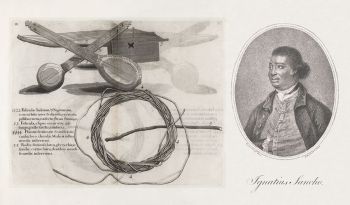 This daylong symposium, which follows the musical performance Black Music in Eighteenth-Century London at the Center on Thursday, April 25, will explore the complex, long-standing relationship between African and Western musical traditions, especially within London metropolitan society, and to recognize the brilliance of black composers and performers who, against great odds, contributed to the musical culture of the age. The program is hosted by the Yale Center for British Art and co-organized with Historic Royal Palaces, Handel & Hendrix in London, and the Paul Mellon Centre for Studies in British Art, with generous support from Laura and James Duncan, Yale BA 1975. Admission is free, though space is limited.
New Book | Joseph Rose: Working Drawings. Facsimile of a Sketchbook
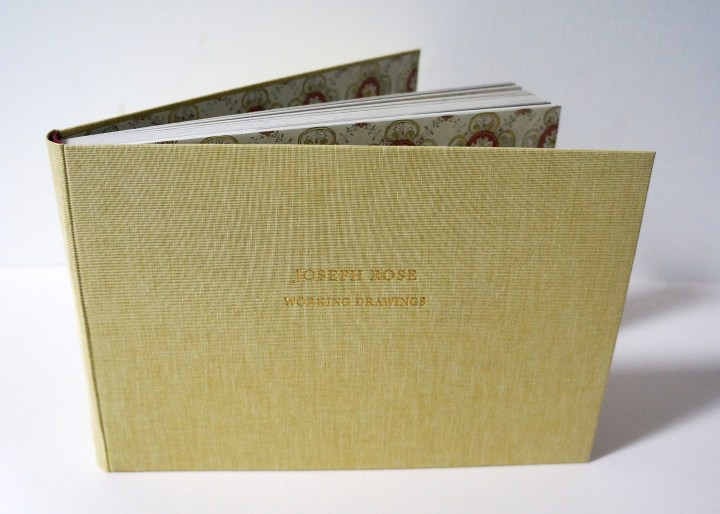
Joseph Rose: Working Drawings. Facsimile of a Sketchbook at Harewood House, with an introduction by Ashleigh Murray (Frome, Somerset: Kate Holland, 2019). Limited edition of 50, of which 48 are ‘ordinary’ (£150) and 2 ‘extraordinary’ (£3000).
The two extraordinary copies are bound in full alum tawed calfskin with hand dyed calfskin inlays and blind and gold tooling. A plasterwork rosette by Hayles and Howe, gilded by Glenny Thomas, is inset into the front board. Hand coloured edges. Hand sewn silk endbands. Printed endpapers from an original watercolour.
This book came about following an invitation to Kate Holland to exhibit as one of the 26 makers selected to feature in the inaugural celebration of contemporary craft at Harewood House, Useful/Beautiful: Why Craft Matters, on view from 23 March until 1 September 2019. A preliminary visit to the house culminated in a behind-the-scenes tour of the archives. In one drawer was a small, nondescript, slightly battered book that revealed a series of working drawings by both Joseph Rose Senior (ca. 1723–1780) and Joseph Rose Junior (1745–1799).
The Roses were the pre-eminent master plasterers of their day and worked closely with Robert Adam (1728–1792) on the ceilings at Harewood in the 1760s as well as on many other big houses, several of which feature in this book. The sketchbook gives a fascinating glimpse into the minds of two incredible craftsmen working on highly significant commissions with some of the foremost architects and interior designers of their time. It is the perfect record of the link between commissioner, designer, and craftsman. Particularly because craftsmen too often fade into the background, Holland wanted to celebrate them especially for this celebration of craft.
As well as the facsimile sketchbook, there is also included an introduction by Ashleigh Murray, currently the academic expert on Joseph Rose in the UK. There are also contemporary images from the workshop floor of Hayles and Howe in Bristol, who still use the same techniques as Joseph Rose today—as well as a full list of plates, transcribed from the manuscript titles, as written by Joseph Rose.
This book is intended to serve not only as an important reference tool for those researching ornamental plasterwork or the work of Robert Adam but also to appeal to a wider audience with an interest in Georgian architecture or the history of interior design and craftsmanship.
For those visiting Harewood House, copies are available at the gift shop. Mail order copies can be arranged by contacting Kate Holland directly, katehollandbookbinder@gmail.com.
More information on the exhibition Useful/Beautiful: Why Craft Matters is available here.

Portrait of James Adam Acquired by NGS and V&A
Press release (18 April 2019) from the National Galleries of Scotland:

Antonio Zucchi, Portrait of James Adam, oil on canvas, 173 × 123 cm (Purchased jointly by the National Galleries of Scotland and the Victoria and Albert Museum, with assistance from the Art Fund, 2019).
The National Galleries of Scotland (NGS) and the Victoria and Albert Museum (V&A) have jointly acquired the most ambitious and splendid surviving portrait of a member of the Adam family, the great eighteenth-century Scottish architectural dynasty.
The portrait of James Adam (1732–1794) by the Italian artist Antonio Zucchi (1726–1795) becomes the third outstanding artwork to be jointly-acquired by the V&A and NGS after together securing two exceptional sculptures, Antonio Canova’s The Three Graces (purchased 1994) and Lorenzo Bartolini’s The Campbell Sisters (purchased 2015). The Zucchi portrait has been purchased thanks to a major grant from national charity Art Fund.
The newly acquired portrait of James Adam will be shown among the great eighteenth-century collection at the Scottish National Portrait Gallery (SNPG), Edinburgh before going on display in the V&A’s British Galleries in London later this year. It will remain on display at the V&A for one year before returning to be shown in Edinburgh. Thereafter, it will be shown at each institution for a period of seven years, on rotation.
Christopher Baker, Director of European and Scottish Art and Portraiture for the National Galleries of Scotland, commented: “James Adam’s portrait is a work of great swagger and refinement that demonstrates the confidence of the Scottish Adam family as seminal taste makers for eighteenth-century Europe. It represents a splendid addition to the collection of the National Galleries of Scotland and we are immensely grateful to both the Victoria and Albert Museum and the Art Fund for making its joint purchase possible.”
Julius Bryant, Keeper of Word and Image at The Victoria and Albert Museum, said: “Zucchi’s portrait of James Adam depicts one of the leading Scottish exponents of the European Neoclassical movement who played a formative role in developing British architecture. It is an ideal portrait for the Neoclassicism section of the V&A’s British Galleries. We are delighted that it joins the V&A’s collection, together with the two sculptures previously purchased with the National Galleries of Scotland. We are enormously grateful to both the NGS and Art Fund for enabling this joint acquisition.”
Stephen Deuchar, Director of the Art Fund, added: “We are very pleased to be helping both National Galleries Scotland and the V&A in acquiring this fine and important portrait of James Adam. It is fitting addition to both collections, marking the sitter’s legacy as a highly influential Scotsman with great significance to the history of British architecture and design, and we know it will enjoyed by a wide public in both locations.”
The painting depicts James Adam during his grand tour of Italy in 1763, before he returned to London to work with his brother, Robert Adam (1728–1792). Dramatically posed and luxuriously dressed, he is surrounded by objects that refer to the study of the ancient world that inspired the neo-classical designs for which the Adam were renowned.
Robert and James Adam, along with their brothers John and William, were the sons of the mason-architect and entrepreneur William Adam (1689–1748). Together the family enjoyed the status of being Scotland’s foremost architects of the eighteenth century. Their role as designers of neo-classical buildings and interiors was to prove profoundly influential not only in Edinburgh and London but all across Europe, North America and Russia.
Robert and James established their architectural practice in 1758. They not only excelled at designing elegant Palladian buildings but also entire interior decorative schemes, including furniture, so ensuring a unity to their immensely popular neo-classical vision. Between 1773 and 1779 the brothers published The Works in Architecture of Robert and James Adam which played a key role in spreading knowledge of their work internationally.
James undertook a Grand Tour of Italy, to seek inspiration for his work, between 1760 and 1763. This impressive portrait was painted in the final year of his tour. It refers to his profession as an architect, and sees him hold dividers in one hand and paper in the other. However, he is also presented as a man of wealth and discrimination, dressed in a silk and fur trimmed gown, at ease with his knowledge of the remains of the classical world that surround him. This type of magnificent portraiture was commonly associated with travelling aristocrats, rather than architects.
The portrait has the distinction of being the only known work of such a subject by the painter Zucchi, who was born in Venice and later worked on a number of decorative paintings for major interior schemes designed by the Adam brothers, before marrying the painter Angelica Kauffmann (1741–1807) in 1781 and settling with her in Rome.
The sculptures depicted in the painting behind James include the Medici Vase and a variant of the Giustiniani Minerva—revered examples of ancient art which could be studied in Rome and, it was felt, could inspire contemporary design. Panels of so-called grotesque ornament frame the niche in which Minerva stands.
The most significant object depicted is the capital (the sculpted top of a column) in the foreground, on which James rests his left arm. It looks at first like a work from antiquity, but is in fact taken from a sculpture design by James Adam. While in Italy he made detailed plans for re-building the Houses of Parliament in London in a neo-classical style, a project that was never realised. As part of this scheme, he produced detailed drawings for a new British architectural order of columns, and combined on them the Scottish unicorn (clearly visible here) with an English lion. The drawings he made were used as the basis for creating a model made of wax that was coloured bronze—and it is this object, which sadly no longer survives, that is depicted by Zucchi. It acted as an extraordinary advertisement for Adam’s ingenuity as a designer and through the prominence of the unicorn, reminded his clientele of his Scottish heritage.
Until now James Adam has only been represented in the collection of the National Galleries of Scotland through a modest and informal drawing by Allan Ramsay (1713–1784), while Robert Adam is the subject of two paste medallions by James Tassie (1735–1799). Zucchi’s unique painted portrait complements his work as an engraver and decorative painter held in the V&A’s collection.
Exhibition | Souvenirs of Italy: An English Family Abroad
Now on view at Audley End:
Souvenirs of Italy: An English Family Abroad
Library at Audley End House, Essex, 1 April — 31 October 2019
Curated by Peter Moore, Abigail Brundin, and Dunstan Roberts
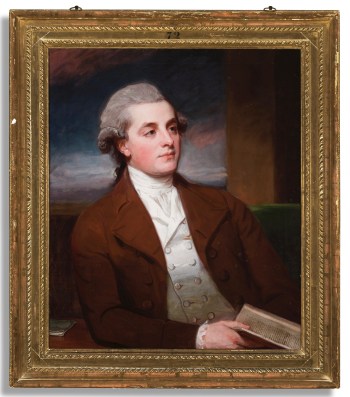
George Romney, Portrait of Richard Aldworth Neville, later 2nd Baron Braybrooke, oil on canvas, ca.1779 (On loan from a private collection; photograph by Mark Asher).
We learn relatively little about Richard Griffin (formerly Richard Aldworth Neville, 1750–1825), second Baron Braybrooke, when we visit or read about Audley End House. He seems to have spent limited time at the house and left it largely unchanged on his death. Recent research in the Library has thrown fascinating new light on this family member, including a European tour that was initiated in the wake of a bereavement and left a lasting personal and cultural legacy at Audley End. Richard’s experiences abroad have much to tell us about the importance of multiculturalism and multilingualism in eighteenth-century England.
The exhibition revolves around the European tour undertaken by Richard Aldworth Neville from 1771 until 1774, when he was in his early twenties. It focuses on the family circumstances that led to the tour, the family’s multilingualism, Richard’s experiences in France, Switzerland, and Italy and what he brought home with him—both materially and culturally—which later found its way into Audley End House and its library. Books, manuscripts, paintings, drawings, and personal items from the house are brought into conversation through the exhibition with archival loans from Essex Record Office that shed light on Richard’s upbringing, his family relationships, and his reactions to his experiences abroad.
The broad aim is twofold. First the exhibition will help to bring into a focus a member of the family and owner of Audley End House who currently does not feature very much in the existing public engagement materials. Second the focus on the Grand Tour allows us to build a narrative about European engagement, through language learning, travel and the consumption of foreign literature and material culture, which enriched the lives of those who lived in and passed through Audley End.
The exhibition is curated by Dr Peter Moore (Curator of Collections & Interiors, Audley End); Dr Abigail Brundin (Reader in Early Modern Literature and Culture, Department of Italian, University of Cambridge); and Dr Dunstan Roberts (Postdoctoral Researcher, Department of English, University of Cambridge). The exhibition is funded by the University of Cambridge and the Friends of Audley End.
New Book | Romantic Legacies
From Routledge:
Shun-liang Chao and John Michael Corrigan, eds., Romantic Legacies: Transnational and Transdisciplinary Contexts (London: Routledge, 2019), 336 pages, ISBN: 978-0367076726, £115 / $145.
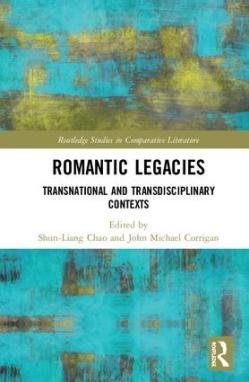 Romantic Legacies: Transnational and Transdisciplinary Contexts presents the most wide-ranging treatment of Romantic regenerations, covering the cross-pollination between the arts or between art and thought within or across the borders of Germany, Britain, France, the US, Russia, India, China, and Japan. Each chapter examines a legacy or afterlife in a comparative context to demonstrate ongoing Romantic legacies as fully as possible in their complexity and richness. The volume provides a lens through which to understand Romanticism not merely as an artistic heritage but as a dynamic site of intellectual engagement that crosses nations and time periods and entails no less than the shaping of our global cultural currents.
Shun-liang Chao is Associate Professor of English and Comparative Literature at National Chengchi University, Taiwan. He’s the author of Rethinking the Concept of the Grotesque: Crashaw, Baudelatire, Magritte (Legenda/Routledge, 2010) and co-editor of Humour in the Arts: New Perspectives (Routledge, 2018).
John Michael Corrigan is Associate Professor of English and Digital Humanities at National Chengchi University, Taiwan. He’s the author of American Metempsychosis: Emerson, Whitman, and the New Poetry (Fordham UP, 2012).
C O N T E N T S
Foreword, James Engell
Introduction, Shun-liang Chao and John Michael Corrigan
I. Realist Romanticism
1 Romantic Walking and Railway Realism, Rachel Bowlby
2 The Use and Abuse of Romance: Realist Revisions of Walter Scott in England, France, and Germany, Geoffrey Baker
3 Chekhov on the Meaning of Life: After Romanticism and Nihilism, Yuri Corrigan
II. Fin-de-Siècle Romanticism
4 Keats Gone Wilde: Wilde’s Romantic Self-Fashioning at the Fin de Siècle, Ya-Feng Wu
5 Delacroix, Signac, and the Aesthetic Revolution in Fin-de-siècle France, Shao-Chien Tseng
6 Mediating Richard Wagner and Henry Bishop: Frederick Corder and the Different Legacies of German and English Romantic Opera, David Chandler
III. (Post)Modern Romanticism
7 Platonism, Its Heirs, and the Last Romantic, Arthur Versluis
8 Vexed Meditation: Romantic Idealism in Coleridge and Its Afterlife in Bataille and Irigaray, Justin Prystash
9 ‘You have to be a transparent eyeball’: Transcendental Afterlives in Matthew Weiner’s Mad Men, John Michael Corrigan
IV. Environmental Romanticism
10 Tracing Romanticism in the Anthropocene: An Ecocritical Reading of Ludwig Tieck’s Rune Mountain, Caroline Schaumann
11 The Eye of the Earth: Nonhuman Vision from Blake to Contemporary Ecocriticism, Sophie Laniel-Musitelli
12 ‘Indistinctness is my forte’: Turner, Ruskin, and the Climate of Art, Carmen Casaliggi
V. Oriental Romanticism
13 ReOrienting Romanticism: The Legacy of Indian Romantic Poetry in English, Steve Clark
14 Grafting German Romanticism onto the Chinese Revolution: Goethe, Guo Morou, and the Pursuit of Self-Transcendence, Johannes Kaminski
15 Two Chinese Wordsworths: The Reception of Wordsworth in Twentieth-Century China, Li Ou
16 ‘The world must be made Romantic’: The Sentimental Grotesque in Tetsuya Ishida’s ‘Self-Portraits of Others’, Shun-liang Chao
Index
Two New HECAA Positions, Now Open
At this year’s annual HECAA business meeting, held in Denver on 22 March 2019, the membership discussed and gave general approval to the creation of a HECAA website and social media presence. The executive board is now eager to receive applications for these two positions. Although Enfilade was originally conceived as a ‘newsletter’ for HECAA, it was apparent within weeks of the site’s launch in 2009 that the readership would be much broader than the organization’s membership and thus the site has always had a somewhat peculiar relationship to the organization. As described in the recently updated constitution & bylaws, Enfilade will continue to be affiliated with HECAA—much like Journal18—but now seems to be a good time for developing distinct web and social media presences. These promising initiatives have my full support, and I look forward to what emerges. And no worries: I’ve no plans to discontinue Enfilade any time soon! The familiar format of a decade-old blog will scroll into the future as well. –Craig Hanson
HECAA Website Designer
$2500–$3000 for an estimated 60–80 hour project,
using Wix, Weebly, or WordPress
Desired Features
• home page + interior pages, some with password-protected access for members only
• ability to add special events page (for future conferences, etc)
• portal page should be mobile-responsive
• integrated donation/payment system, with PayPal or similar to facilitate membership renewals, donations, other payments
• event calendar
• social photo gallery, integrated with social media posts
Qualifications
• a demonstrated competency with web design and familiarity with at least one of the possible software platforms
• a vision for the look and feel of HECAA’s web presence
• strong visual/writing skills
• an ability to work independently and to teach yourself/acquire new technical skills as needed
To apply, send CV, cover letter, and examples of past work in web design or content creation to Amelia Rauser arauser@fandm.edu. The HECAA Executive Board will review applicants beginning 15 May 2019.
HECAA Social Media Manager
$1500 stipend for one year, 1 July 2019 — 30 June 2020
about 10 hours/week expected
Establish and maintain two social media accounts on behalf of HECAA (Instagram + either Twitter or a Facebook Group). Create HECAA’s social media tone and look. Support website maintenance, once the HECAA website is completed.
Expectations
• make/oversee/coordinate at least one social media post per week, more during times of peak HECAA activity
• generate content for posts
• use accounts to highlight the work of HECAA members, build community, and increase visibility of eighteenth-century art history
• using Instagram as the chief platform, create content that is both aesthetically pleasing and informational
• may coordinate different HECAA members for temporary account takeovers
• coordinate with Enfilade and Journal18 to mutually enhance each other’s social media presence
• keep website up to date and in sync with social media and Enfilade: update calendar, sync photo gallery with social posts, etc.
Qualifications
• familiarity with Instagram plus either Facebook or Twitter
• a vision for HECAA’s social media identity and presence
• good people/ networking skills
• good research skills (for content generation purposes)
• strong visual/writing skills
To apply, send CV, cover letter, and two sample posts (geared to a platform of your choice) to Amelia Rauser arauser@fandm.edu. The HECAA Executive Board will review applicants beginning 1 June 2019.
New Book | Restoration
The publication resulting from the 64th annual Mellon Lectures in the Fine Arts delivered at the National Gallery of Art in 2015 by Thomas Crow is now available from Princeton UP:
Thomas Crow, Restoration: The Fall of Napoleon in the Course of European Art, 1812–1820 (Princeton: Princeton University Press, 2018), 208 pages, ISBN: 978-0691181646, $40 / £30.
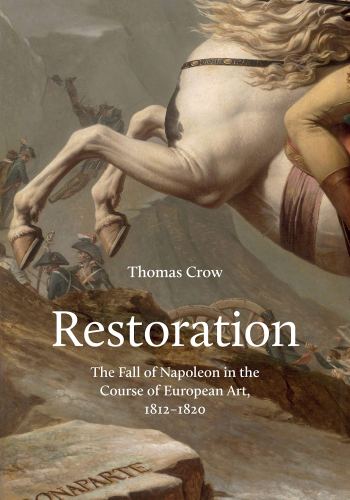 As the French Empire collapsed between 1812 and 1815, artists throughout Europe were left uncertain and adrift. The final abdication of Emperor Napoleon, clearing the way for a restored monarchy, profoundly unsettled prevailing national, religious, and social boundaries. In Restoration, Thomas Crow combines a sweeping view of European art centers—Rome, Paris, London, Madrid, Brussels, and Vienna—with a close-up look at pivotal artists, including Antonio Canova, Jacques-Louis David, Théodore Géricault, Francisco Goya, Jean-Auguste-Dominique Ingres, Thomas Lawrence, and forgotten but meteoric painters François-Joseph Navez and Antoine Jean-Baptiste Thomas. Whether directly or indirectly, all were joined in a newly international network, from which changing artistic priorities and possibilities emerged out of the ruins of the old.
Crow examines how artists of this period faced dramatic circumstances, from political condemnation and difficult diplomatic missions to a catastrophic episode of climate change. Navigating ever-changing pressures, they invented creative ways of incorporating critical events and significant historical actors into fresh artistic works. Crow discusses, among many topics, David’s art and influence during exile, Géricault’s odyssey through outcast Rome, Ingres’s drive to reconcile religious art with contemporary mentalities, the titled victors over Napoleon all sitting for portraits by Lawrence, and the campaign to restore art objects expropriated by the French from Italy, prefiguring the restitution controversies of our own time.
Beautifully illustrated, Restoration explores how cataclysmic social and political transformations in nineteenth-century Europe reshaped artists’ lives and careers with far-reaching consequences. Published in association with the National Gallery of Art, Washington, D.C.
Thomas Crow is the Rosalie Solow Professor of Art History at the Institute of Fine Arts, New York University. His many books include Emulation: David, Drouais, and Girodet in the Art of Revolutionary France; The Long March of Pop: Art, Music, and Design 1930–1995; and No Idols: The Missing Theology of Art. He lives in New York City and in Old Saybrook, Connecticut.
Exhibition | Prospects of India

Thomas Daniell (British, 1749–1840), On the Ganges, ca. 1788, watercolor (San Marino: The Huntington Library, Art Collections, and Botanical Gardens, Gilbert Davis Collection).
◊ ◊ ◊ ◊ ◊
Now on at The Huntington:
Prospects of India: 18th- and 19th-Century British Drawings from The Huntington’s Art Collections
The Huntington Library, Art Collections, and Botanical Gardens, San Marino, 2 March — 10 June 2019
The drawings in this exhibition take as their subject the landscape of India. They were made by British artists, some of whom traveled there on their own in hopes of finding new and ‘exotic’ subject matter. As these drawings attest, the history of Britain’s engagement with South Asia is a complicated one. It covers a spectrum of motivations that ranges from trade and mutually beneficial cultural exchange to violent imperial conquest. The fifteen images on view hint at this complexity, revealing a fascination and admiration for the Indian landscape and the people who lived there, as well as attitudes of cultural superiority and ownership. Works by professional artists such as George Chinnery and Thomas and William Daniell, hang alongside examples by accomplished, though amateur, draftsmen like Col. George Francis White, revealing both the range of artists who sought to depict the scenery of India and the diversity of the landscape itself.
Conference | Stereotypes
This week at The Huntington:
Stereotypes and Stereotyping in the Early Modern World
The Huntington Library, Art Collections, and Botanical Gardens, San Marino, 19–20 April 2019
 The use and abuse of stereotypes is not limited to present-day politics. In this conference, experts in British and American history examine stereotypes related to such vital issues as race, religion, gender, nationality, and occupation. The program explores how stereotyping then, as now, persisted across different spheres of life; how individuals and groups responded; and with what consequences.
Funding provided by The Huntington’s William French Smith Endowment.
F R I D A Y , 1 9 A P R I L 2 0 1 9
8:30 Registration and coffee
9:15 Welcome by Steve Hindle (The Huntington) and opening remarks by Koji Yamamoto (University of Tokyo)
9:30 Session 1: Popery and Religious Stereotypes
Moderator: Koji Yamamoto
• Jennifer Anderson (California State University, San Bernardino), Controversial Figures as Synecdoches: Thomas Nash’s Distorted Snapshots of Puritans and Catholics
• Peter Lake (Vanderbilt University), Puritans and Projectors in the Plays of Ben Jonson
• Abigail Swingen (Texas Tech University), Whigs, Tories, and Jacobites: Stereotypes and the Financial Revolution
12:30 Lunch
1:30 Session 2: Economy, Occupations, and Gender
Moderator: Peter Lake
• Koji Yamamoto, Beyond ‘Keywords’: History Plays, Stereotypes, and the Staging of Political Economy in Late Elizabethan England
• Jane Whittle (University of Exeter), The Early Modern Housewife: A Positive Stereotype of the Working Woman?
• Lisa Cody (Claremont McKenna College), Mind, Body, Soul, and Mirrors: Stereotyping Women in Early Modern England
S A T U R D A Y , 2 0 A P R I L 2 0 1 9
9:00 Registration and coffee
9:30 Session 3: Colonies and Empire
Moderator: Koji Yamamoto
• Kristen Block (University of Tennessee, Knoxville), Creating and Fighting Stereotypes of Sin and Sexual Excess: Leprosy and Race in the Eighteenth-Century Caribbean
• Valerie Forman (New York University), Managing Slave Plantation Labor: Or, How Productivity Became Beautiful and Accumulation Anti-tyrannical. A Study of the Political Economy of Sugar in the Early Modern Transatlantic World
• Sharon Block (University of California, Irvine), Daily Descriptions as Racemaking in Colonial North America
12:30 Lunch
1:30 Session 4: Stereotypes in Archives and on Stage
Moderator: Peter Lake
• Bridget Orr (Vanderbilt University), Re-presenting Character: Dramaturgy Versus Performance in Eighteenth-Century Stereotypes
• Miles Parks Grier (Queens College, City University of New York), Staging the Transferable Stigma of Early Modern Blackness
• Brendan Kane (University of Connecticut), Explicit Bias and the Politics of Difference in Irish-English Encounter
4:30 Closing Remarks










 Enfilade
leave a comment