Call for Papers | At CAA 2020, Historic Libraries & Art Historiography
Dr. Musto plans to submit this proposal to CAA as a fully-formed, ‘complete session’, and she welcomes eighteenth-century submissions:
Historic Libraries and Art Historiography
College Art Association Conference, Hilton Chicago, 12–15 February 2020
Organized by Jeanne-Marie Musto
Proposals due by 22 April 2019
Currently seeking papers for a session exploring the potential of historic libraries to deepen and broaden our understanding of art historiography and its relationship to social, intellectual and geo-political currents. Such libraries include those not specifically intended for the study of art. This session will build on a theme introduced at CAA 2019, where a wide range of art-historical themes emerged from diverse libraries. These libraries range from early modern through twentieth century, across several continents, and survive intact or through inventories. Xu Bo’s library inventory, for example, offers a view into the role of art history in Ming dynasty regionalism, while the history of an individual Mexican codex within the National Library of Spain tells of the shifting winds of colonial and post-colonial cultural authority. But these libraries also tell of more than geopolitical concerns. They underline efforts to define the inchoate discipline of art history through a wide spectrum of materials. At the same time, they demonstrate active participation in art historical debates, and connections with artists and arts administrators. Papers that examine any aspect of the historiography of art emerging from the analysis of historic libraries will be welcomed. Please send proposals for a paper including title, abstract (250 words) and CV to Dr. Jeanne-Marie Musto, musto.jeannemarie@gmail.com. Additional information concerning the 2020 conference is available here.
Exhibition | Éloge du sentiment et de la sensibilité
From the Musée des Beaux-Arts de Rennes:
Éloge du sentiment et de la sensibilité: Peintures françaises du xviiie siècle des collections de Bretagne
Musée des Beaux-Arts de Rennes et le Musée d’Arts de Nantes, 15 February — 12 May 2019
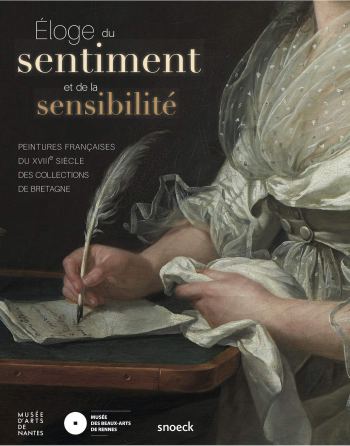 Dans le cadre des collaborations entre musées du Grand-Ouest, le Musée des Beaux-Arts de Rennes et le Musée d’Arts de Nantes présentent de février à mai 2019 une exposition en coproduction intitulée Éloge du sentiment et de la sensibilité: Peintures françaises du xviiie siècle des collections de Bretagne. Cet événement présente l’originalité de se dérouler simultanément dans les deux institutions avec un catalogue commun.
Le propos général de l’exposition est une découverte de l’ensemble de la production picturale du Siècle des Lumières à travers le prisme du sentiment et de la sensibilité. Dans la seconde moitié de ce siècle, littérature et peinture reflètent une nouvelle vision de l’Homme et de son environnement. Sentiment et sensibilité deviennent de nouvelles qualités de l’âme, donnant une liberté inédite de ressentir le monde. Diderot s’interroge sur le sentiment dans la peinture et au théâtre, Rousseau porte aux nues la sensibilité dans la Nouvelle Héloïse et théorise une nouvelle forme d’éducation dans l’Émile, Voltaire s’émerveille de l’impact de la nature sur ses sens et son âme… La peinture offre un écho enthousiaste et inspiré à ces préoccupations inédites.
Le choix des oeuvres a été réalisé essentiellement dans les riches collections conservées aux musées de Brest, Nantes, Quimper et Rennes avec des compléments apportés par les collections publiques (musées, églises, bâtiments municipaux) de Morlaix et de Lamballe. La réunion de ces collections permet de représenter l’ensemble des grands artistes du siècle tels qu’Antoine Watteau, François Boucher, Carle Vanloo, Charles Joseph Natoire, Jean Siméon Chardin, Hubert Robert, Jean-Baptiste Greuze ou Jean Honoré Fragonard.
L’exposition en deux parties organisée à Rennes et à Nantes, Éloge du sentiment et Éloge de la sensibilité, permet d’embrasser l’évolution de la peinture française sur un siècle, depuis Antoine Watteau jusqu’au début du xixe siècle. À Rennes s’expose la grande histoire, antique, religieuse et mythologique. Nantes met à l’honneur les différents genres, du grand portrait d’apparat aux sensibles natures mortes. Ce partage des oeuvres s’appuie sur une division ancienne bien connue, que les hasards des collections semblent avoir reproduite dans nos musées : Rennes conserve davantage de peintures d’histoire que Nantes, qui s’illustre plus dans la peinture de genres.
Un premier ensemble d’environ 70 tableaux, réuni à Rennes autour de la notion de sentiment, évoquera en quatre sections l’évolution de la peinture à sujet historique (biblique, mythologique, antique et contemporaine).
Un second ensemble d’environ 70 oeuvres présente en six sections au Musée d’arts de Nantes un parcours autour de la notion de sensibilité à travers la peinture de genre (portraits, scènes galantes, paysage, natures mortes…).
Cet événement inédit fait suite à l’organisation en 2013, par les musées de Quimper et de Rennes, de l’exposition De Véronèse à Casanova, qui, selon le même principe faisait le bilan des richesses des musées bretons dans le domaine de la peinture italienne. Les restaurations et les recherches menées à l’occasion de cet événement ont permis d’apporter un éclairage nouveau sur de nombreuses oeuvres et quelques découvertes importantes dans les réserves de certains musées.
Guillaume Kazerouni and Adeline Collange-Perugi, Éloge du sentiment et de la sensibilité: Peintures françaises du xviiie siècle des collections de Bretagne (Paris: Snoeck, 2019), 367 pages, ISBN: 978-9461615138, 35€.
Exhibition | Bernard Picart (1673–1723)
Now on view at the Musée National de Port-Royal des Champs, near Versailles:
Bernard Picart (1673–1723), Dessinateur, de Paris à Amsterdam
Musée National de Port-Royal des Champs, Magny-les-Hameaux, 21 March — 23 June 2019
Curated by Corentin Dury and Philippe Luez
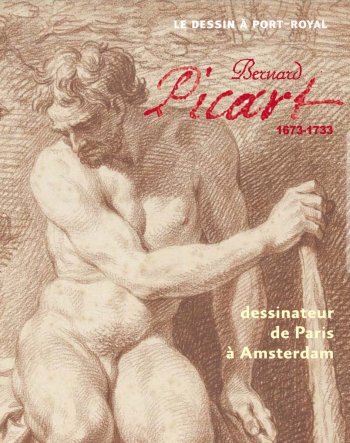 Bernard Picart (1673–1723), issu d’une famille janséniste, s’installe à Amsterdam en 1710 et y occupe une place majeure dans l’édition hollandaise illustrée. Mais on le connaît moins comme dessinateur. La présente exposition permet de découvrir ce pan inconnu de son activité et lui rend sa place parmi les grands dessinateurs des débuts du règne de Louis XV.
En collaboration avec le Salon international du dessin de Paris et avec la participation du Rijksmuseum d’Amsterdam
Commissaires
Corentin Dury, conservateur du patrimoine, musée des Beaux-arts d’Orléan, et Philippe Luez, conservateur général du patrimoine, directeur du musée national de Port-Royal des Champs
Corentin Dury and Philippe Luez, Bernard Picart (1673–1723), Dessinateur, de Paris à Amsterdam (Paris: Snoeck, 2019), 175 pages, ISBN: 978-9461615459, €25.
Williamsburg Acquires Its First Judaica Objects

Torah Pointer (Yad), Birmingham, England, 1843–44, silver and gold (gilding) (Courtesy of the Colonial Williamsburg Foundation, Museum Purchase and Hugh Trumbull Adams Fund, 2018-326).
◊ ◊ ◊ ◊ ◊
Press release (2 April 2019) from Colonial Williamsburg:
The Colonial Williamsburg Foundation has recently added several important objects of Judaica to its collections: a sterling silver and gold Kiddush cup and a silver and gold yad (or Torah pointer). These mark the first such objects in the Foundation’s holdings and exemplify the concerted efforts in recent years by the curators to acquire objects and address the stories of all early Americans while remaining true to their long-standing strength in British and American decorative arts. Additionally, objects that represent the early Anglo-American experience have also been acquired. These include an alphabet sampler created by a Jewish schoolgirl that is unique both for who made it and where it was created, as well as Chinese porcelain pieces that were owned by prominent London Jewish families.
“The Colonial Williamsburg Foundation sees the objects in its collections as documents of the people, places, and events of the past,” said Ronald L. Hurst, the Foundation’s Carlisle Humelsine Chief Curator and Vice President for Collections, Conservation, and Museums. “Because we use these objects to tell the compelling stories of early Americans, we seek to acquire things that speak to the full range of their experiences, whatever their race, religion, gender, age, or cultural ethnicity may have been. These latest acquisitions mark important steps toward that goal.”
The silver objects are noteworthy additions to the collections as they represent a faith that was more prevalent in early America than most people realize today. They also span the realms of public and private worship in the Jewish religion. Kiddush cups are used both as part of family worship at home and as part of congregational worship, while the yad is used in congregational worship in a synagogue. The Colonial Williamsburg curators know that these specific examples are representative of what was owned and used in early America.

Kiddush Cup, probably by William Harrison I (active ca. 1758–81), London, ca. 1775, silver (sterling) and gold (Courtesy of the Colonial Williamsburg Foundation, Museum Purchase, The Antique Collectors’ Guild, 2016-1).
The Kiddush cup, which is used while reciting the blessing over wine (the Kiddush), is part of the commandment from the Torah to sanctify the Sabbath (Shabbat). Before the Friday night meal on the eve of Shabbat, the tradition dictates that a family’s Kiddush cup is filled with wine and held as the blessing is spoken, usually by the head of the household. Few ceremonial Jewish objects from the early Anglo-American world are known today. This Kiddush cup, probably made by William Harrison I (active ca. 1758–1781) in London about 1775, was the first piece of silver Judaica to be added to the Colonial Williamsburg collection. It is an elegant example with a circular stepped foot and a tapered stem that supports an egg-shaped cup with a gilded interior. It is engraved with three lines of Hebrew, “Remember the Sabbath day, and sanctify it,” within a shield suspended from a bow-knot and flanked by slender foliate sprays.
The yad, which literally means “hand,” can be interpreted as a representation of the hand of God and is used as a pointer during Torah readings, which allows the rabbi to follow the text without physically touching the sacred scrolls. The chain on the yad was used to suspend it from the Torah scrolls when not in use. This example, made in Birmingham, England, between 1843 and 1844, is made of silver with gilding, which was the predominant material used to make yads since the early 1600s. It features a long wand of quadrangular shape that is engine-turned and engraved with foliage and has a media band also flanked by foliage. One end of the yad has a foliate-engraved knop with a suspension ring and hanging chain. The other end has an applied cast hand with an extended index finger wearing a ring. There are traces of gilding on the hand.
Also providing a glimpse into the Jewish experience in the early Anglo-American world, are a recently acquired schoolgirl sampler and Chinese porcelain objects:

Stand, Jingdezhen, ca. 1795, hard-paste porcelain (Courtesy of the Colonial Williamsburg Foundation, Museum Purchase, The Buddy Taub Foundation, Dennis A. Roach and Jill Roach Directors, 2016-116).
The alphabet sampler by Rachel Cole (1854–1922) is an important addition to the textile collections. The most significant facet of this unique object’s story is its maker. Rachel Cole, who was born on August 18, 1854, in Chicago, was the daughter of one of the city’s earliest Jewish families. Her mother, Sarah Frank, was an immigrant from Germany, her father, Samuel Cole, was an immigrant from Austria who was a co-founder of the Kehilath Anshe Ma’ariv (K.A.M.) congregation, which became Chicago’s first Jewish synagogue. Samuel Cole was also the president of the congregation for approximately one year. The sampler, which Rachel may have made at the K.A.M. school where she studied after graduating from one of Chicago’s public schools, is also unique as it is the only identified sampler marked “Chicago,” and one of just a handful of known samplers created by Jewish schoolgirls. The colorful sampler is marked with the place name of Chicago, Illinois, and with the date 1868. Few, if any, samplers from Chicago are known to survive, probably because of the Great Chicago Fire of 1871, which destroyed much of the city. Ms. Cole lived within just blocks of the approximately 3.3 miles of area consumed by the conflagration.
The prominent Sephardic Jewish D’Aguilar family were London merchants and sugar planters in the eighteenth century. This hard-paste porcelain stand, made in Jingdezhen, China, around 1795, is decorated with the family’s crest and is from just one of several armorial services that was ordered by the family. Most likely it was owned by Solomon, the fifth son of Don Diego D’Aguilar.
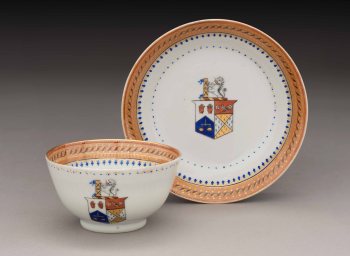
Cup and Saucer, Jingdezhen, ca. 1805, hard-paste porcelain (Courtesy of the Colonial Williamsburg Foundation, Museum Purchase, The Buddy Taub Foundation, Dennis A. Roach and Jill Roach Directors, 2016-117, A&B).
Also made in Jingdezhen, China, around 1805, is this hard-paste porcelain cup and saucer, decorated with the coat of arms of Neilson impaling Goldsmid. Aaron Goldsmid was a merchant in Hamburg and left there in 1765 to settle in London and establish the firm of Aaron Goldsmid & Son. Aaron’s second son, Asher, helped establish Mocatta & Goldsmid, which was a bullion-brokerage firm to the Bank of England. The Goldsmid family was known for its philanthropy and financier endeavors throughout the eighteenth and nineteenth centuries. It is most likely that this cup and saucer were made for a daughter or niece of Asher Goldsmid.
The Kiddush cup was purchased with funds from The Antique Collectors’ Guild. The yad was purchased through the generosity of the Hugh Trumbull Adams Fund. The Chinese porcelain objects were acquired with funds from The Buddy Taub Foundation, Dennis A. Roach and Jill Roach Directors.
Call for Panel Chair(s) | HECAA at ASECS, 2020
HECAA New Scholars Session at ASECS 2020
American Society for Eighteenth-Century Studies Conference, St. Louis, 24–28 March 2020
Chair nominations due by 20 April 2019
As part of its long-standing commitment to supporting the work of graduate students and younger scholars, HECAA has for many years used its panel at ASECS as a New Scholars Session. Since 2013, the session has been named in honor of Anne Schroder (1954–2010), a former HECAA president who was especially known for the interest she took in graduate students’ research. As we continue the tradition into 2020, the HECAA panel committee invites nominations (including self-nominations) for someone to chair the session (co-chairs are welcome). Please send a note of interest and a CV to Michael Yonan, convener of the HECAA panel committee, at yonanm@missouri.edu, by 20 April 2019. Questions may be directed to either Michael or Amelia Rauser at arauser@fandm.edu.
Call for Panel Proposals | HECAA at CAA, 2020
HECAA Panel and ASECS Panel at College Art Association, 2020
College Art Association Conference, Chicago, 12–15 February 2020
Proposals due by 10 April 2019
HECAA will submit two panels for the annual meeting of the College Art Association in 2020 (one panel belongs to ASECS but is delegated to us), and the panel committee now welcomes your proposals. Please send the title, a brief description (150–200 words), and a CV to Michael Yonan, convener of the HECAA panel committee, at yonanm@missouri.edu, by 10 April 2019. Please note if you have a preference for whether the session is assigned to HECAA or ASECS (in terms of the affiliate label); the ASECS session should—in keeping with the organization’s mission—open up broad, interdisciplinary possibilities. Questions may be directed to either Michael or Amelia Rauser at arauser@fandm.edu.
Details for submitting panel proposals for CAA 2020 as individuals (rather than with the support of an affiliate society) are available here; the due date is 30 April 2019.
◊ ◊ ◊ ◊ ◊
Note (added 1 April 2019) — The original posting did not include the note regarding the interdisciplinary scope of the ASECS panel.
Exhibition | Tiepolo in Milan
Press release from The Frick:
Tiepolo in Milan: The Lost Frescoes of Palazzo Archinto
The Frick Collection, New York, 16 April — 14 July 2019
Curated by Xavier Salomon, with Andrea Tomezzoli and Denis Ton
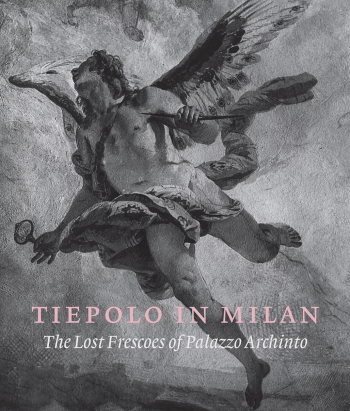 This spring and summer, The Frick Collection presents paintings, drawings, prints, and photographs related to Giambattista Tiepolo’s (1696–1770) first significant project outside of Venice, a series of ceiling frescoes painted in 1730–31 for Palazzo Archinto in Milan. Commissioned by Count Carlo Archinto, one of the city’s most influential patrons and intellectuals, the frescoes were tragically destroyed when the palazzo was bombed by the Allies during World War II. Tiepolo in Milan: The Lost Frescoes of Palazzo Archinto brings together more than fifty works from collections in the United States and Europe to tell the story of this important commission. Five preparatory paintings and drawings are featured, among them the oil sketch Perseus and Andromeda, acquired by Henry Clay Frick in 1916. As the Frick does not loan objects purchased by the institution’s founder, the New York museum is the only place where these works can be displayed together. Several complementary drawings and books illustrated by Tiepolo are included, alongside documentary photographs, taken between 1897 and the early 1940s, which are the only surviving records of the finished frescoes. The exhibition is organized by The Frick Collection in collaboration with the Azienda di Servizi alla Persona Golgi-Redaelli, Milan, and curated by Xavier F. Salomon, the Frick’s Peter Jay Sharp Chief Curator, with Andrea Tomezzoli, Professor at the University of Padua, and Denis Ton, Curator of the Musei Civici in Belluno.
Comments Salomon, “At a moment in history when wars are destroying art and culture in many parts of the world, it is worth pausing to consider, through an exhibition like this, the tragic, irreparable effects caused by violence throughout the centuries on great works of human creativity.”
Tiepolo and the Archinto Family
Palazzo Archinto belonged to one of Milan’s most prominent aristocratic families, documented in the city since at least the twelfth century. In the eighteenth century, the Archinto were described as one of those Milanese families who had always owned “highly admired treasures.” In addition to Tiepolo’s frescoes, the palazzo contained extensive collections of artworks and a renowned library. Carlo Archinto (1670–1732), Tiepolo’s patron, was at the center of Milan’s intellectual circles and was especially recognized for his interest in philosophy, mathematics, and science. During the mid-eighteenth century, he lived in the family palazzo, located on Via Olmetto, near Porta Ticinese, in one of the oldest parts of the city.
The palazzo’s library, overseen by librarian Filippo Argelati, filled five rooms and was open to scholars. Together with Carlo Archinto and other patrons, Argelati founded the Società Palatina, a publishing enterprise. Between 1723 and 1751, the Società published Ludovico Antonio Muratori’s Rerum Italicarum Scriptores. Archinto financed the project and contributed notes to one of the volumes. Tiepolo provided a number of designs for books published by the Società Palatina (five are included in the exhibition) and thus became acquainted with the aristocratic family. About 1730, when Archinto decided to redecorate his palazzo, he commissioned eight frescoed ceilings: five from Tiepolo and three from the Bolognese painter Vittorio Maria Bigari (1692–1776).
The Commission
The substantial commission was Tiepolo’s first outside the Veneto, and it marked the beginning of his international career. According to the Tiepolo scholar, Michael Levey, the frescoes at Palazzo Archinto “must have been sumptuously rich and impressive. Tiepolo never received a commission for a private palace of comparable extent and rarely of such splendour.” The ceilings, in part to celebrate the wedding of Carlo’s son Filippo to Giulia Borromeo, were meant to underscore the status of the Archinto family and were Carlo’s spiritual and visual testament, blending allegorical and mythological scenes.
Of the preparatory works that survive from the commission, three painted sketches on canvas provide the most important visual record of the lost frescoes: Triumph of Arts and Sciences (Museu Nacional de Arte Antiga, Lisbon), Perseus and Andromeda (The Frick Collection), and Apollo and Phaëton (Los Angeles County Museum of Art).
The largest and most elaborate fresco at Palazzo Archinto was the Triumph of the Arts and Sciences, which decorated one of the main rooms on the palace’s principal floor, or piano nobile. In it, Tiepolo depicted a resplendent sky with an assembly of allegorical figures, including Architecture, Painting, Sculpture, Music, and Mathematics, under the aegis of Apollo and Minerva. The ceiling’s decoration surely related to Carlo’s intellectual pursuits and to his library. When Tiepolo created the sketch (modello) for the ceiling, the fictive architectural scheme (quadratura) that was to frame the fresco had not yet be finalized; he therefore depicted his figures hovering in a cloudy sky, surrounded only by an area of brown ocher. In preparation for his fresco cycles, Tiepolo executed numerous drawings. Two surviving drawings related to Triumph of the Arts and Sciences are included in the exhibition, together with the related Lisbon modello and black-and-white photographs of the finished fresco in situ.

Giambattista Tiepolo, Perseus and Andromeda, ca. 1730–31, oil on canvas (New York: The Frick Collection).
The fresco of Perseus and Andromeda was likely envisioned as a celebration of the wedding of Filippo Archinto and Giulia Borromeo. Book IV of Ovid’s Metamorphoses recounts the tale of the young and beautiful Andromeda, daughter of the Aethiopian king Cepheus and Cassiopeia. Boasting that Andromeda is more beautiful than the Nereids, Cassiopeia angers Neptune, who, in revenge, sends a monster to ravage the cost of Aethiopia. Told that the only way to save their country is to sacrifice their daughter to the monster, Andromeda’s parents chain her to a rock by the sea. The hero Perseus, son of Jupiter and Danaë, sees Andromeda while flying over Aethiopia and falls in love with her. He asks her parents for permission to marry her if he is able to save her; he subsequently kills the sea monster and rescues Andromeda. Tiepolo took liberties with Ovid’s Metamorphoses in showing Perseus riding the winged horse Pegasus instead of flying by way of a pair of winged sandals. As evidenced in the archival photographs, the overall configuration of the Perseus and Andromeda fresco in Palazzo Archinto was almost identical to the one visible in the oil sketch (page one), which was likely presented to Carlo Archinto for approval.
Tiepolo faithfully followed another passage from Ovid’s Metamorphoses in the fresco depicting Phaëton, the son of Apollo and Clymene. Uncertain about his divine origins, the youth questions Clymene about the identity of his father, and Clymene encourages him to visit Apollo in his heavenly palace. To prove his paternity, Apollo grants Phaëton a single wish, which is to drive the sun god’s chariot for a day. Apollo provides the exact course he should take across the sky and warns his son about the dangers of such a trip, particularly from specific constellations such as Scorpio. Once guiding the chariot, however, Phaëton is terrified by Scorpio and quickly loses control. Despite Apollo’s instructions and warnings, Phaëton flies too close to earth and scorches it. Incensed, Jupiter hits him with a thunderbolt, hurling him out of the chariot and to his death in the river Po. In the modello for the fresco, the artist set the scene in the dwelling of the Sun, described by Ovid as decorated with columns and bathed in golden light. Carlo’s choice of this father-son myth as the fresco’s subject may have been meant to serve as a warning to his children—Filippo especially—about life’s dangers. The exhibition provides a unique opportunity to compare the Los Angeles modello and related archival photographs of the original fresco with three other works previously associated with Palazzo Archinto: two paintings by Tiepolo (now at the Akademie in Vienna and the Bowes Museum) and a drawing from the British Museum, all of which depict Apollo and Phaëton.
Tiepolo’s other two ceilings in the palazzo represented Juno, Venus, and Fortune, probably painted for Giulia Borromeo’s private apartments, and an allegory of Nobility, which most likely decorated the ceiling of a relatively small room. Unfortunately, no related preparatory drawings or modelli have been identified. The two frescoes are represented in the exhibition by archival photographs.
The Fate of Palazzo Archinto
The palazzo belonged to the Archinto family for more than a century, until 1825, when the family sold it. In 1853, it was purchased by the current owner, Luoghi Pii Elemosinieri, a charitable institution (now called the Azienda di Servizi alla Persona Golgi-Redaelli). On the night of August 13, 1943, Allied bombs hit Palazzo Archinto, destroying its interior, including Tiepolo’s frescoes. (The interior was rebuilt between 1955 and 1967, following the general structure of its previous architectural form.) During World War II, sixty-five percent of Milan’s historic monuments were damaged or destroyed. Tiepolo’s frescoes at Palazzo Archinto were among the most tragic losses.
Fortunately, a number of black-and-white photographs were taken in Palazzo Archinto at different points before 1943. In 1897, Attilio Centelli and Gerardo Molfese published a large volume dedicated to Tiepolo’s frescoes in Lombardy. The book includes a series of fifty photographs of frescoes by—or attributed at the time to—Tiepolo. These photographs are the oldest surviving images of the Palazzo Archinto frescoes and remain vital documents of their original appearance. Only three copies of the book survive (one in Milan, one in Rome, and one in Venice). The Milan copy is preserved, unbound, in the archive of the Azienda di Servizi alla Persona Golgi-Redaelli. The exhibition includes ten plates from this copy, as well as twenty photographs documenting the palace before the war, Tiepolo’s finished frescoes, and the ruins of the palace after 1943.
Major support for the exhibition is provided by an anonymous gift in memory of Melvin R. Seiden and by Margot and Jerry Bogert. Additional funding is generously provided by the David L. Klein, Jr. Foundation, Julie and David Tobey, an anonymous gift in memory of Charles Ryskamp, Dr. Tai-Heng Cheng and Cole Harrell, Mr. and Mrs. Hubert L. Goldschmidt, and The Krugman Family Foundation.
Xavier Salomon, Andrea Tomezzoli, and Denis Ton with Alessandra Kluzer, Tiepolo in Milan: The Lost Frescoes of Palazzo Archinto (London: Paul Holberton, 2019), 224 pages, ISBN: 978-1911300526, £45 / $50.
The Frick Collection, in association with Paul Holberton Publishing, has produced a fully illustrated catalogue to accompany the exhibition. Included are essays about Tiepolo’s work in Palazzo Archinto (Xavier F. Salomon), the architectural history of the palace (Alessandra Kluzer), the role of the Archinto frescoes in Tiepolo’s career (Andrea Tomezzoli), and the intellectual world of the Archinto family (Denis Ton).
Call for Papers | Above and Beyond: Ceiling Painting in the History of Art
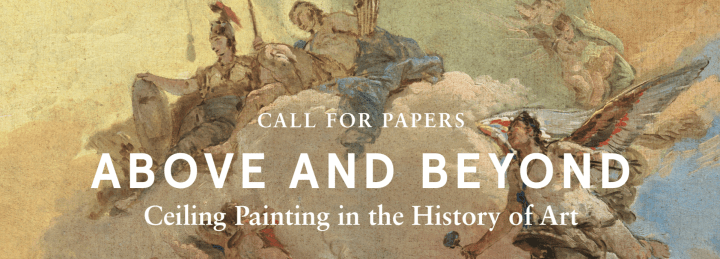
From the Call for Papers:
Above and Beyond: Ceiling Painting in the History of Art
The Frick Collection, New York, 27 June 2019
Proposals due by 2 May 2019
The Frick Collection is pleased to invite submissions for Above and Beyond: Ceiling Painting in the History of Art, a public symposium organized in conjunction with the special exhibition Tiepolo in Milan: The Lost Frescoes of Palazzo Archinto (April 16 to July 14, 2019). Tragically destroyed during World War II, Giambattista Tiepolo’s ceiling paintings for Palazzo Archinto (1730–31) represented allegorical and mythological scenes in magnificent, light-filled skies. The in situ effects of these grand frescoes may forever be lost, but the related oil sketches and drawings assembled for the exhibition provide insight into the absent originals—and into the particular challenges the ceiling poses as a site for painting.
Ceiling paintings tested early modern artists’ abilities to realize complex projects, demanding collaboration among painters, architects, carpenters, and legions of assistants on some of the largest paintings ever created. Seen from below, subjects such as triumphs and apotheoses required artists to resolve tensions between naturalism and abstraction in picturing the firmament, and to engage space in ways wholly foreign to easel painting.
An heir to the illusionistic tradition of Correggio, Charles Le Brun, and Baciccio, Tiepolo has long been recognized for his ‘pictorial intelligence’. Yet the practice of ceiling painting has an even longer history—from the miniaturist figuration of the Alhambra’s Sala de los Reyes to the historiated ceiling of the ex-monastery at Tecamachalco in Puebla to Yoko Ono’s Ceiling Painting, Yes Painting of 1966. Inspired by this expansive history, we welcome proposals for twenty-minute papers on the making and reception of ceiling paintings across time and place. Please send a CV and 250-word abstract by Thursday, 2 May 2019, to academic@frick.org. Submissions from emerging scholars, including early-career university and museum professionals and advanced doctoral students, are encouraged.
Possible topics and lines of inquiry include, but are not limited to:
• Issues of site and execution, from technologies of transfer to the collaborations and workshop models that facilitated projects of such a large scale and long duration
• Often-vexed connections between ceiling painting and theatricality, trompe l’oeil and architecture
• Modes of spectatorship; the impact of light and movement and liturgical or court activities on the viewer’s perception and circulation
• The sky as subject in both ecclesiastic and secular contexts
• Ceiling sculpture, particularly the role of stuccowork and coffering
• Ceiling painting’s place in art-critical discourse and treatises (Bosse, Lomazzo, de Piles); its status vs. that of easel painting
• Perspectival theories and techniques
• Ceiling paintings as vehicles for glorification of absolute rule, familial pride, the divine
• Challenges to the critical fortune of ceiling paintings, such as the difficulty of reproduction
Lecture | Adrian Seville on Georgian Board Games
From the Society of Antiquaries of London:
Adrian Seville, The Shows and Sights of Georgian London: A Board Game Tour of the Metropolis
Society of Antiquaries of London, Burlington House, 7 May 2019
Printed board games—race games, played with dice or a teetotum and offering no choice of move—are a well-recognised feature of Victorian childhood. Yet similar games were also significant in late Georgian England. Of such games printed from 1790 to 1830, over 100 different examples have survived, covering a wide range of cultural themes. The presentation will highlight a group of these games, all with themes relevant to the shows and sights of Georgian London.
A short introduction will trace the history of spiral race games in England, beginning with John Wolfe’s registration of the Game of the Goose at Stationers’ Hall in 1596 up to the publication by John Wallis and Elizabeth Newbery of the New Game of Human Life in 1790, shamelessly copied from the French original, but with variations to suit the English market.
Of the games then to be presented in detail, the earliest is concerned with the first English pantomime, Harlequin and Mother Goose: or, The Golden Egg, first performed in 1806. The others, with dates from 1809 to 1825, each propose a ‘virtual’ sight-seeing tour of London. All these games present finely-detailed hand-coloured engravings of their shows and sights, the choice of subjects indicating the main public attractions of the time. Their rules often hint at how the various attractions were regarded in the affluent society in which these expensive games circulated. And several of the games have booklets giving detailed descriptions and observations, not commonly found elsewhere. Somteimes, as in the games published by the Dartons, a Quaker family, these booklets contain strongly-expressed moral views on such controversial matters as war, colonial exploitation, and wealth: all are the subject of polemics aimed at a junior audience.
This lecture will demonstrate how these simple games, played in the nursery or at the fireside, serve as mirrors of the real world outside, so contributing to the understanding of cultural history in late Georgian England.
Lecture | Robin Myers on Andrew and James Ducarel
From Eventbrite:
Robin Myers, Dr Andrew Ducarel, Lambeth Librarian 1757–85, Seen through His Brother’s Eyes
Lambeth Palace, London, 8 May 2019
 Andrew Ducarel (1713–1785), the eldest of three Huguenot brothers, was a successful ecclesiastical lawyer, Librarian at Lambeth, historian of the palaces of Lambeth and Croydon and of the architecture of Normandy. In Robin Myers’s new book The Two Brothers, it is Andrew’s younger brother James who takes centre stage, writing letters to Andrew in London about his life in France. Wednesday, 8 May 2019, 6pm (admittance not before 5.30pm). Guests should arrive via the main Gatehouse of Lambeth Palace. For any queries, please email melissa.harrison@churchofengland.org.
Robin Myers is a Past President of the Bibliographical Society and Archivist Emeritus of the Worshipful Company of Stationers. Her principal research interests are the history of the Company and its archive, on which she has published widely. She has also worked on Andrew Ducarel for more than twenty years. Her edition, with Gerard de Lisle, of Two Huguenot Brothers: Letters of Andrew and James Coltee Ducarel (1732–1773) has recently been published by Bernard Quaritch.










 Enfilade
leave a comment