Symposium | London Art Week: Conversations on Collecting
In conjunction with London Art Week:
London Art Week Symposium: Conversations on Collecting
Sainsbury Wing Theatre, The National Gallery, London, 2 December 2019
This December, London Art Week (1–6 December) launches the inaugural LAW Winter Symposium to foster debate and learning among the public, international collectors, members of the art trade, and museum professionals. Held in collaboration with our partner museum, The National Gallery, the 2019 Symposium will consist of three panel discussions, with our eminent speakers discussing different aspects of collecting. Attendance is free, but places must be registered and booked in advance.
P R O G R A M M E
2.30 Introduction and welcome by Gabriele Finaldi (Director, The National Gallery)
2.35 Returning Home: The Significance and Challenges of Exhibitions that Reunite Historic Collections in Their Original Settings
Moderator: Tom Stammers (Assistant Professor of Modern European Cultural History, Durham University)
• Toto Bergamo Rossi (Curator, Domus Grimani; Director, Venetian Heritage Foundation)
• Silvia Davoli (Curator, Lost Treasures of Strawberry Hill; Paul Mellon Research Curator, Strawberry Hill House; Associate Researcher, University of Oxford)
• Thierry Morel (Curator, Houghton Revisited; Director and Curator at Large, Hermitage Museum Foundation USA; and Trustee of the Sir John Soane’s Museum, London)
3.30 Collecting Today: What Motivates Private Collectors and How Do They Envisage the Future of Their Collections
Moderator: Justin Raccanello (Specialist dealer in Italian ceramics)
• Katrin Bellinger (Collector and Founder, Tavolozza Foundation)
• Claudio Gulli (Curator, Valsecchi Collection at Palazzo Butera, Palermo)
• Keir McGuinness (Collector)
4.30 Changing Questions: The Role of Museums in 2020 and How They Can Better Engage with the Public
Moderator: Martin Bailey (The Art Newspaper)
• Ketty Gottardo (Martin Halusa Curator of Drawings, The Courtauld Gallery)
• Luke Syson (Director and Marlay Curator, Fitzwilliam Museum, University of Cambridge)
• Nicholas Thomas (Director, Museum of Archaeology and Anthropology, and a Fellow of Trinity College, Cambridge)
Exhibition | Thomas Jefferson, Architect

Model of Jefferson’s Design for the President’s House Competition, designed by Simone Baldissini and constructed by Ivan Simonato, 2015, scale 1:66, wood, resin, and tempera (Vicenza: Palladio Museum; photo by Lorenzo Ceretta).
◊ ◊ ◊ ◊ ◊
Press release (18 April 2019) for the exhibition:
Thomas Jefferson, Architect: Palladian Models, Democratic Principles, and the Conflict of Ideals
Chrysler Museum of Art, Norfolk, Virginia, 19 October 2019 — 19 January 2020
Curated by Erik Neil, Lloyd DeWitt, and Corey Piper
Thomas Jefferson (1743–1826) was Governor of Virginia, Secretary of State, President of the United States, and author of the Declaration of Independence. The most important architectural thinker of the young American republic, Jefferson conveyed ideals of liberty and democracy in his designs. He was also a slave owner. A new exhibition from the Chrysler Museum of Art titled Thomas Jefferson, Architect: Palladian Models, Democratic Principles and the Conflict of Ideals explores this divergence alongside his extraordinary architectural influence.
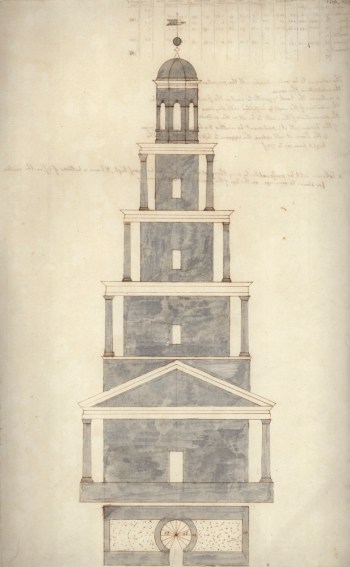
Thomas Jefferson, Monticello: Observation Tower, recto, ca. 1771, pen and Ink with gray wash (Boston: Massachusetts Historical Society, Coolidge Collection of Thomas Jefferson Manuscripts).
Organized by the Chrysler Museum of Art in collaboration with the Palladio Museum in Vicenza, Italy, the exhibition focuses on the ideas, formation, and key monuments of the Founding Father who dramatically influenced the architectural profile of the young republic. It will also confront the inherent conflict between Jefferson’s pursuit of contemporary ideals of liberty and democracy and his use of slave labor to construct his monuments.
The Chrysler Museum’s exhibition will follow Jefferson’s evolution as an architect with nearly 130 objects, including models, rare books, paintings, drawings, early photographs, and architectural elements. Visitors will see objects from the Chrysler’s rich collection, as well as loans from the Library of Congress, the National Gallery of Art, Jefferson’s residences at Monticello and Poplar Forest in Virginia, the University of Virginia, and other museums and libraries.
The Palladio Museum will provide 14 models, including 10 newly created models of Jefferson’s buildings and four models displaying the key architecture of Renaissance master Andrea Palladio (1508–1580). The exhibition will feature models of Monticello and Jefferson’s design for the U.S. president’s house, which was not selected, as well as numerous representations of the Pantheon that will highlight its architectural influence on the University of Virginia’s Rotunda. The Chrysler will also display the only autographed drawing by Palladio in an American collection as well as various editions of his treatise, The Four Books of Architecture.
Visitors will also see bricks, nails, and other components from Jefferson’s buildings that were created by enslaved laborers and craftsmen, as well as two rare images of enslaved and formerly enslaved people who can be linked directly to Jefferson and his buildings. These include Isaac Granger Jefferson, an artisan who was a tinsmith and blacksmith and labored in the nailery as an enslaved worker at Jefferson’s Monticello.
“Thomas Jefferson engaged with the most advanced ideas of architecture and city planning of his era. He was also a slave owner who failed to resolve his ideals about freedom and democracy with his reliance upon the institution of slavery. We will examine these facets of Jefferson’s architectural formation and practice to foster a new and fuller understanding of his accomplishments,” said Museum Director Erik H. Neil.
Through his education in Virginia, travels in the colonies and Europe and extensive library, Thomas Jefferson engaged with both classical and contemporary ideas about architecture. His projects frequently referenced ancient models or those of established authorities such as Palladio. He pursued forms that were both aesthetic models and expressive of the new republic’s democratic ideals. He employed those influences in his designs for the Virginia State Capitol, the University of Virginia, buildings in Washington, D.C. and his own residences, Monticello and Poplar Forest.
“For both Jefferson and Palladio, the architecture of the ancients was the key model with regard to functionality, style and meaning,” Neil said. “We see evidence of Thomas Jefferson’s influence in the architecture throughout our region, and we are excited to share the history and influence of these designs with our visitors to present important elements of Virginia’s history.”
Thomas Jefferson, Architect: Palladian Models, Democratic Principles and the Conflict of Ideals is curated by the Chrysler Museum’s Erik Neil, director; Lloyd DeWitt, chief curator and Irene Leache curator of European art; and Corey Piper, Brock curator of American art.
Lloyd DeWitt and Corey Piper, with an introduction by Erik Neil and contributions by Guido Beltramini, Barry Bergdoll, Howard Burns, Lloyd DeWitt, Louis P. Nelson, Mabel O. Wilson, and Richard Guy Wilson, Thomas Jefferson, Architect: Palladian Models, Democratic Principles, and the Conflict of Ideals (New Haven: Yale University Press, 2019), 208 pages, ISBN: 978-0300246209, $45.
 A richly illustrated catalog published by Yale University Press will accompany the exhibition. A team of leading international scholars will offer new scholarship and a fresh appraisal of Jefferson’s formation and career as an architect, engage the impact and legacy of his status as a slave owner and highlight the work and contributions of enslaved laborers and artisans. Contributors include Lloyd DeWitt, the Chrysler Museum’s chief curator, and Irene Leache, curator of European art; Howard Burns, president of the Centro Palladio, Scuola Normale Pisa; Guido Beltramini, director of the Palladio Museum; Richard Guy Wilson and Louis P. Nelson, both from the University of Virginia; and Barry Bergdoll and Mabel O. Wilson of Columbia University.
S E L E C T E D P R O G R A M M I N G
Mabel O. Wilson and Louis P. Nelson in Conversation
Saturday, 2pm, 26 October 2019
Renowned scholars Mabel O. Wilson and Louis P. Nelson will discuss the contributions and legacy of enslaved craftsman on the architecture of Thomas Jefferson. Wilson is a professor of architectural design at Columbia University Graduate School of Architecture, Planning and Preservation. She is also a Senior Fellow at the Institute for Research in African American Studies and co-directs Global Africa Lab. Nelson is the Vice Provost for Academic Outreach and Professor of Architectural History at the University of Virginia. Register at chrysler.org.
Travis McDonald, Thomas Jefferson’s Poplar Forest
Sunday, 2pm, 1 December 2019
Travis McDonald, the Director of Architectural Restoration at Poplar Forest, will offer insight into the restoration of Thomas Jefferson’s personal retreat and plantation and the work of enslaved craftspeople.
Visitors to Versailles Database
From the Centre de recherche du château de Versailles:
Visitors to Versailles Database
Accessible since October 2019
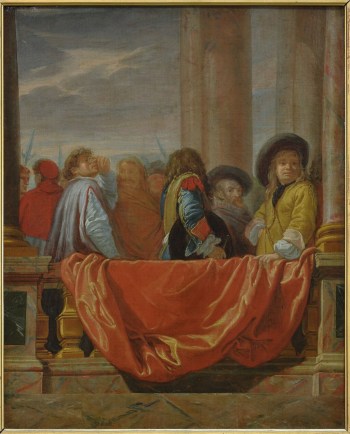
After Charles Le Brun, The Different Nations of Europe, oil on canvas, 17th century (Château de Versailles, MV 5778).
The Visiteurs database is part of the research programme Court Identities and the Myth of Versailles in Europe: Perception, Adherence and Rejection (18th–19th Centuries), led by the Centre de recherche du château de Versailles and directed by Gérard Sabatier.
The purpose of this tool is to draw up a list of the personal accounts of foreign visitors to the domain, palace and court of Versailles, in order to examine how the ‘Versailles myth’ was disseminated throughout Europe. The period in question will extend from the reign of Louis XIV to the end of the 19th century, in order to establish how opinions about this place evolved, from the moment it established itself as the centre of royal power to when it became a testimony to a monarchical past. The corpus will bring together a variety of texts: memoirs, travel accounts, letters and even diaries, written by authors of diverse social and geographical origins. To make these more easily accessible, several thematic filters will be put in place, such as the period of the trip, places visited, people encountered and the occasions at court when the observations were made. The database has been accessible since October 2019 through the resources portal of the Centre.
Access the Visiteurs Database (in French).
Conference | The Pictorial Evidence of Ruins
From ArtHist.net:
The Pictorial Evidence of Ruins: From Rome to Homs
Istituto Svizzero di Roma / Academia Belgica, Rome, 14–15 November 2019
The questions of ruins and their images oscillate in the history of art between the vanitative interpretations related to the early modern period and the aesthetic categories of romanticism, while for the cultural studies the theoretical reflection on the ambiguities of memory and oblivion stands in the foreground. The conference goes beyond this topic range and raises questions about the importance of a ruin as an anachronistic symbol, a visual indicator of historical difference, and a critical touchstone of modernity.
How did ruins turn into an independent figurative metaphor regarded as the epitome of transience? To what extent were the ancient Roman ruins transformed in the early modern period into iconic images of symbolic and aesthetic value and what is the relevance of this long process of transference—the elevation of the ruin to a sovereign image—for the way in which we view today’s Syrian war ruins from a distance? In this context, one needs to differentiate between natural disintegration and planned ruination: what distinguishes the archaeological from the iconoclastic dimension of a ruin?
The instrumentalization of the ruins of Palmyra which themselves became victim to a media-related iconoclasm in 2015 and the elevation of their void space after devastation into a social icon give reason to think critically about how the reception of ruins and the depiction of ruination combine anachronism with aesthetics and affect. Following these issues, we shall ask: What is the pictorial evidence of ruins and that of their images? In how far can images of ruins iconically convey or translate the nature of a catastrophe? To what extent does the aesthetic familiarity of the ruins of Rome as a visual paradigm of a ruined city raised by art since the 16th century contribute to our understanding of the new media-related impact of factual destruction today? Does aesthetics have an anaesthetic effect in this case?
With these questions, the conference seeks to contribute to the critical analysis of a pictorial concept of ruins from the early modern period to the present—spanned between destruction, restoration, and construction—and to ask how the issue of the media topicality of ruins can be dealt with today.
T H U R S D A Y , 1 4 N O V E M B E R 2 0 1 9
Istituto Svizzero di Roma
15.00 Welcome by Adrian Brändli (Istituto Svizzero di Roma))
15.15 Afternoon Session
• Mateusz Kapustka (University of Zurich/FU Berlin), Ruins, Ruination, and Anachronism: An Introduction
• Henri de Riedmatten (University of Geneva), Recoding Fragmented Figures: Dynamics of Restoration in Early Sixteenth-Century Rome
• Jumana Al Asaad (University of Heidelberg), The Iconization and Medialisation of the Syrian Cultural Heritage in the Ongoing Armed Conflict
F R I D A Y , 1 5 N O V E M B E R 2 0 1 9
Academia Belgica
9.00 Welcome by Sabine van Sprang (Academia Belgica)
9.15 Morning Session
• Maarten Delbeke (ETH Zurich), Getting Rid of the Ruins.: Remnants as Sources of Knowledge and Confusion in the Late Seventeenth Century
• Dirk De Meyer (Ghent University), Palmyra to Europe and Back: Architectural Ruins and their Mediatization
• Stanislaus von Moos (University of Zurich/Getty Research Institute), Constructivist Ruins? On Frank Lloyd Wright and Peter Blume
12.00 Lunch break
13.00 Closing Session
• Robert Harbison (London), Ruins and Fragments in Modern Sculpture
Concept
Mateusz Kapustka
Organization
Adrian Brändli
Ralph Dekoninck
Mateusz Kapustka
Tristan Weddigen
Contacts
Istituto Svizzero di Roma
Via Ludovisi 48, 00187 Rome
Adrian Brändli, info@stitutosvizzero.it
Academia Belgica
Via Omero 6, 00196 Rome
Charles Bossu, info@academiabelgica.it
Bibliotheca Hertziana – Max Planck Institute for Art History
Via Gregoriana 28, 00187 Rome
Mara Freiberg Simmen, freiberg@biblhertz.it
Lecture | Tom Almeroth-Williams on Animals and the West End
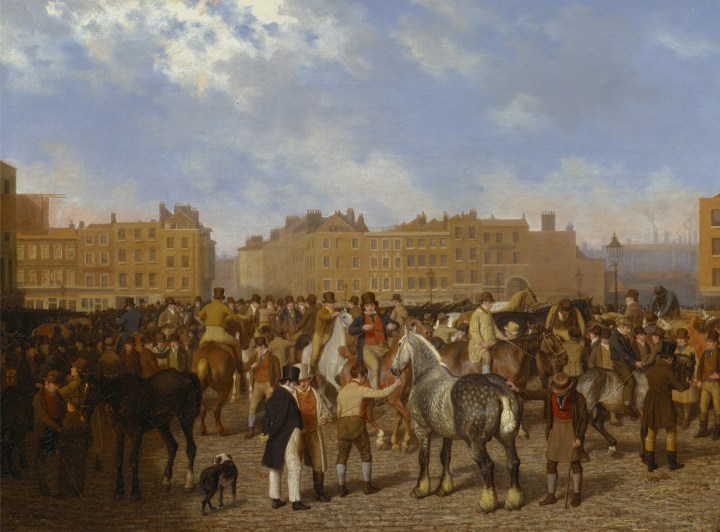
Jacques-Laurent Agasse, Old Smithfield Market, 1824, oil on canvas (New Haven: Yale Center for British Art, Paul Mellon Collection, B2001.2.252).
◊ ◊ ◊ ◊ ◊
Next month at Spencer House:
Tom Almeroth-Williams, Animals and the Rise of the West End
Spencer House, London, 11 November 2019
A lecture at Spencer House exploring the dramatic role played by horses, livestock and dogs in West End life in the Georgian period and their representation in art, presented by Dr Thomas Almeroth-Williams, author of City of Beasts.
Spencer House once stood at the gateway to a horse-powered metropolis, an equestrian paradise and a city brimming with farm animals. The Georgian West End contained the largest concentration of elite riding and carriage horses in the world; and Spencer House is a stone’s throw from Hyde Park, then Europe’s most famous riding venue. At the same time, the building is a monument to the huge contribution made by working horses in the city. Most of the materials used to build Spencer House were hauled there by draught horses, while some were also manufactured with horse-powered machinery. Once the Spencers were in residence, they could also depend on being served the nation’s finest meat thanks to the gargantuan Smithfield livestock trade.
This lively and richly illustrated lecture will discuss the many ways in which animals shaped the West End’s dramatic expansion and daily life in the eighteenth and early nineteenth centuries, covering everything from art and architecture, to industry and crime prevention. Warning: enraged bullocks and fierce dogs will make their presence felt.
There will be an opportunity at the event to buy signed copies of City of Beasts at a discounted price. Monday, 11 November; doors open at 6pm for the 6:30 lecture. Tickets £15, include a glass of wine and an opportunity to view the State Rooms. Booking information is available here.
Tom Almeroth-Williams is a Research Associate of the University of York’s Centre for Eighteenth Century Studies and a Research Communications Manager at the University of Cambridge. In addition to human–animal interactions, his main interests lie in urban life and the world of work in Georgian Britain. His first book, City of Beasts: How Animals Shaped Georgian London, was published by Manchester University Press in May 2019.
New Book | City of Beasts
From Manchester UP:
Thomas Almeroth-Williams, City of Beasts: How Animals Shaped Georgian London (Manchester: Manchester University Press, 2019), 328 pages, ISBN: 978-1526126351, £25.
 This book explores the role of animals—horses, cattle, sheep, pigs and dogs—in shaping Georgian London. Moving away from the philosophical, fictional, and humanitarian sources used by previous animal studies, it focuses on evidence of tangible, dung-bespattered interactions between real people and animals, drawn from legal, parish, commercial, newspaper, and private records. This approach opens up new perspectives on unfamiliar or misunderstood metropolitan spaces, activities, social types, relationships, and cultural developments. Ultimately, the book challenges traditional assumptions about the industrial, agricultural, and consumer revolutions, as well as key aspects of the city’s culture, social relations, and physical development. It will be stimulating reading for students and professional scholars of urban, social, economic, agricultural, industrial, architectural, and environmental history.
Tom Almeroth-Williams is Research Associate in the Centre for Eighteenth Century Studies at the University of York
C O N T E N T S
Introduction
1 Mill Horse
2 Draught Horse
3 Animal Husbandry
4 Meat on the Hoof
5 Consuming Horses
6 Horsing Around
7 Watchdogs
Conclusion
Index
Exhibition | The Splendor of Germany: Eighteenth-century Drawings
From PHP and the Crocker Art Museum:
The Splendor of Germany: Eighteenth-century Drawings from the Crocker Art Museum
Crocker Art Museum, Sacramento, 16 February — 10 May 2020
The Crocker Art Museum has one of the finest and earliest German drawings collections in the United States. Featuring artists such as Johann Wolfgang Baumgartner, Anton Raphael Mengs, and Johann Heinrich Wilhelm Tischbein, The Splendor of Germany examines the major developments in German draughtsmanship over the course of the eighteenth century. Published to coincide with the collection’s 150th anniversary.
 In the twenty-first century, the collecting and study of eighteenth-century German drawings has become a major focus for American museums. One of the finest collections of them, however, has been in California for 150 years. The superb drawings at the Crocker Art Museum, from a Baroque altarpiece design by Johann Georg Bergmüller to a Neoclassical mythology by Johann Heinrich Wilhelm Tischbein, provide a panorama of German draughtsmen and draughtsmanship throughout the century.
Many of the drawings are remarkable for their modernity. A self-portrait by Johann Gottlieb Prestel bypasses convention to achieve a direct, unmediated likeness. Well-placed slashes with brush and black ink define the features below his peruke outlined in black chalk. Other drawings encapsulate specific developments and styles, such as Johann Wolfgang Baumgartner’s Lazarus and the Rich Man, which shows the florid dynamism of the Augsburg Rococo. A full range of eighteenth-century German artists are represented here, from the satirizing moralists Johann Elias Ridinger and Daniel Chodowiecki to the Classicist and friend of the art theorist Johann Joachim Winkelmann, Anton Raphael Mengs. Landscape artists are especially well represented, such as the key figure Johann Georg Wille, printmaker to the French king Louis XV, and generations of artists he taught and influenced all the way to the early Romantic landscapists.
The exhibition and catalogue gather together a variety of dynamic and sensitive portraits, charming scenes of daily life, and often humorous moralizing subjects, as well as narratives, both religious and mythological, from the late Baroque to Neoclassicism. In the realm of landscape, the depth of the collection allows the exhibition to trace schools and influences—in addition to Wille’s mentioned above—even in families such as that of Prestel, whose wife and daughter were both landscapists. It also allows it to demonstrate the great variety of works by single artists such as Christoph Nathe, represented by four landscapes in four different genres including a splendid scene near Görlitz. Some artists, in fact, work in several genres as in the case of Johann Christian Klengel, whose works include the scene of a family by candlelight, a farmstead landscape, and a sketchbook that he carried through the countryside to record picturesque views.
This is a rare opportunity for the public and for drawings enthusiasts. Two-thirds of the drawings in the exhibition have not been shown before; most of the exceptions have not been seen since 1989. Because of the drawings’ 150-year history of limited exposure, the state of preservation of the collection is exceptional, as is the condition of the new acquisitions included in the exhibition.
William Breazeale and Anke Fröhlich-Schauseil, The Splendor of Germany: Eighteenth-century Drawings from the Crocker Art Museum (London: Paul Holberton Publishing, 2020), 144 pages, ISBN: 978-1911300779, £40.
Immanuel Kant PhD Scholarship
From ArtHist.net:
Immanuel-Kant-Promotionsstipendium der Beauftragten der Bundesregierung für Kultur und Medien (BKM), July 2020 — June 2022
Applications due by 31 December 2019
Die Kulturstaatsministerin fördert mit dem Immanuel-Kant-Stipendium den hervorragend qualifizierten wissenschaftlichen Nachwuchs in den Geschichts-, Kultur- und Gesellschaftswissenschaften. Das Stipendium richtet sich an Doktorandinnen und Doktoranden, die sich mit transnationalen und transkulturellen Bezügen oder Verflechtungen im östlichen Europa vom Mittelalter bis in die Gegenwart unter besonderer Berücksichtigung der deutschsprachigen Bevölkerung befassen. Dazu gehören auch die Themenkomplexe Flucht, Vertreibung und Aussiedlung sowie die Integrationsprozesse nach 1945.
Gefördert werden u. a. Vorhaben aus den Bereichen Geschichte und Politik, Europäische Ethnologie/Volkskunde, Kunstgeschichte, Literatur- und Sprachgeschichte, Migrationsforschung und Sozialwissenschaft. Der regionale Fokus liegt auf den historischen preußischen Ostprovinzen (Schlesien, Ostbrandenburg, Pommern, Ost- und Westpreußen) in den heutigen Staaten Polen und Russland sowie den früheren und heutigen Siedlungsgebieten von Deutschen in Ost-, Ostmittel- und Südosteuropa (vornehmlich in Tschechien und der Slowakei, in der ehemaligen Sowjetunion und in den baltischen Staaten sowie in Ungarn, Rumänien und dem ehemaligen Jugoslawien).
Das für zwei Jahre gewährte Grundstipendium beträgt monatlich 1.300 Euro. Dazu können Zuschläge für Verheiratete, für Kinder sowie für einen Forschungsaufenthalt kommen. Eine Verlängerung ist möglich. Anträge können von in- und ausländischen Bewerbern und Bewerberinnen oder den sie betreuenden Hochschullehrerinnen und Hochschullehrern an einer Universität in der Bundesrepublik Deutschland gestellt werden.
Zu den Antragsunterlagen gehören:
• Lebenslauf und Zeugnisse,
• Thema, Fragestellung, Forschungsstand, Ziel und Zeitplan der geplanten Arbeit,
• Nachweis der Zulassung als Doktorand/in an einer deutschen Universität oder der Anbindung an eine deutsche Universität bei bi-nationalen Promotionsverfahren (Cotutelle-Verfahren),
• Gutachten der die Dissertation betreuenden Hochschullehrenden, Zweitgutachten eines weiteren Hochschullehrenden.
Stipendienanträge sind bis zum 31. Dezember 2019 digital im pdf-Format an die Geschäftsstelle des Imma-nuel-Kant-Stipendiums im Bundesinstitut für Kultur und Geschichte der Deutschen im östlichen Europa zu richten: bkge@bkge.uni-oldenburg.de
Stipendienbeginn ist der 1. Juli 2020. Die Entscheidung über die Stipendienvergabe trifft ein von der Beauftragten der Bundesregierung für Kultur und Medien berufener wissenschaftlicher Auswahlausschuss. Förderrichtlinien, Angaben zu Antragsunterlagen, zu Auswahl- und Bewilligungskriterien sowie eine Übersicht über die geförderten Dissertationsvorhaben (ab 2013) sind über die Homepage des Bundesinstituts unter http://www.bkge.de/Foerderungen-Stipendien-BKM/Immanuel-Kant-Stipendium/ abrufbar.
Kontakt
Bundesinstitut für Kultur und Geschichte der Deutschen im östlichen Europa
Geschäftsstelle des Immanuel-Kant-Stipendiums
Dr. Cornelia Eisler
Johann-Justus-Weg 147 a
D-26127 Oldenburg
+ 49 (0) 441 961 95-0
bkge@bkge.uni-oldenburg.de
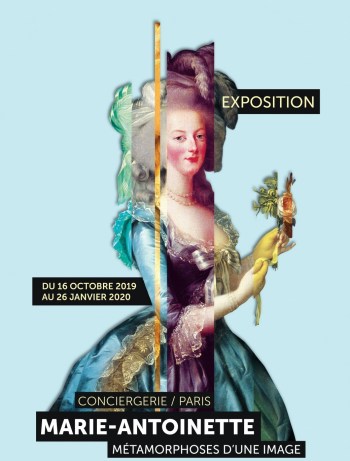
Exhibition | Marie-Antoinette: Metamorphosis of an Image
The exhibition opens today, 226 years after Marie-Antoinette was executed (the press release is available here). . .
Marie-Antoinette: Métamorphoses d’une Image
Conciergerie, Paris, 16 October 2019 — 26 January 2020
Only a handful of historic figures have been the subject of such an abundance of representations: Marie-Antoinette is one of these, both during her lifetime and more notably after her death on 16 October 1793. Even today, this queen-turned-icon is still a key emblem in popular culture. The exhibition illustrates the many representations of Marie-Antoinette through almost 200 works, artefacts, heritage and contemporary archives, never-before-seen interviews, film extracts, and fashion accessories—shining a light on this worldwide phenomenon of media overkill through both a historic approach and a critical and comparative examination of forms.
 Marie-Antoinette at the Conciergerie
This section illustrates the final ten weeks that saw the most dramatic moments experienced by the queen in the ‘corridor of death’, during her trial by the Revolutionary Tribunal. A number of memorial fetishes testify to this: shirt, shoe, belt, and archival documents from the trial and execution of the Queen
The Histories
Marie-Antoinette’s life has been transformed since her death through numerous accounts and biographies, as well as testimonies and memories, from the Restoration to the present day, and from all points of view. The exhibition illustrates twenty events, both public and private, in Marie-Antoinette’s life, from her birth to her death, and including her official funeral in 1814.
The Image of the Queen
The figure of Marie-Antoinette is a veritable ‘expanse of images’, which can quickly be packaged to suit an event, a commemoration, the latest cultural trend or fashionable motif. Thus, according to the era, this proliferation affected the official image of the queen, particularly the portraits of her by Elisabeth Louise Vigée Le Brun, the political images of the ‘martyred’ queen, the historical imagery, the character portrayed on-screen, and in Japanese manga.
Fetishes of the Queen
The relationship with Marie-Antoinette has often been passionate, creating cults, tributes, or, on the contrary, provoking violent attacks. Furthermore, it has often been subject to fantasy and imagination, on a level where intimacy can overlap with mythology. The exhibition here displays a selection of images and objects, based on three motifs, symbolising Marie-Antoinette throughout history and the world.
• The Hair
• The Body
• The Severed Head
The Return of the Queen
Marie-Antoinette is experiencing a surprising revival, due to the modernization of the character, who has become a young woman of hers, and our time. The revival is illustrated by Japanese manga, which reinvented Marie-Antoinette in Riyoko Ikeda’s The Rose of Versailles; the biography of the English writer Antonia Fraser, Marie-Antoinette: The Journey; and its Hollywood adaptation by Sofia Coppola. Fashion has also appropriated the phenomenon associating the queen with several contemporary supermodels. A fan cult has appropriated the figure of Marie-Antoinette, a phenomenon of globalised post-modernism, as commercial as it is cultural and ideological. The overriding style of this onslaught is a popularised form of pop art, and its diffusion affects all genres, every type of consumerism and every country. The exhibition highlights this great blend of genres and objects, while revealing its commercial aspect.
A cycle of Marie-Antoinette films will be screened at the Le Champo cinema from 5 November to 3 December.
◊ ◊ ◊ ◊ ◊
The catalogue is published by Éditions du Patrimoine:
Antoine de Baecque, ed., Marie-Antoinette: Métamorphoses d’une image (Paris: Éditions du Patrimoine, 2019), 215 pages, ISBN: 978-2757706817, 39€.
 Un très beau livre qui donne à voir et à comprendre les multiples visages de la figure historique française la plus connue à travers le monde. De la princesse idéale à la ‘reine scélérate’, de la traîtresse étrangère à la figure martyre, de l’héroïne adolescente à la mère bigote, de la femme de culture à l’icône de mode, l’image de la reine Marie-Antoinette, tour à tour adorée ou honnie, n’a cessé d’évoluer au cours des siècles.
En suivant le fil de l’exposition qui se tiendra à la Conciergerie du 16 octobre 2019 au 26 janvier 2020, cet ouvrage, à travers 14 essais et 16 notices, commentera les multiples représentations de la reine et montrera comment le rapport à Marie-Antoinette a souvent été passionnel, déterminant des cultes, des hommages, ou au contraire de violentes attaques.
Historien, spécialiste de la culture des Lumières et de la Révolution française, Antoine de Baecque a entre autres publié Le Corps de l’histoire. Métaphores et politique 1770–1800 (Calmann-Lévy, 1993), La Gloire et l’effroi (Grasset, 1996) sur la Terreur, puis Les Eclats du rire (Calmann-Lévy, 2000), sur la culture des rieurs au XVIIIe siècle. Il a également écrit le volume sur les Lumières de l’Histoire culturelle de la France en 1998 aux éditions du Seuil, et participé aux volumes collectifs, Histoire du corps, Histoire de la virilité, Histoire des émotions. Antoine de Baecque est également commissaire de nombreuses expositions, membre du comité de rédaction de la revue L’Histoire, du conseil scientifique de la BNF, président de la commission d’aide à l’écriture documentaire au CNC et professeur d’histoire du cinéma à l’École normale supérieure de la rue d’Ulm.
S O M M A I R E
La tradition royale
• Marie-Antoinette, reine de France, Fanny Cosandey
• Marie-Antoinette et ses soeurs : portrait de groupe, Mélanie Traversier
• La fabrique de la célébrité, Antoine Lilti
• La reine des modes, du chic au kitsch, Catriona Seth
> Notices : Les colliers de la reine. Gravures de mode royale
Face à la Révolution
• Une reine traînée dans la boue : les caricatures contre Marie-Antoinette, Annie Duprat
• Un fantasme de reine, entretien avec Chantal Thomas
> Notices : Une Autrichienne en goguette. Archives du procès et dernière lettre de Marie-Antoinette. La chemise de Marie-Antoinette. Soulier « à la Saint-Huberty » dit de Marie-Antoinette. Marie-Antoinette conduite à son exécution. Le peintre David dessinant Marie-Antoinette conduite au supplice.
Le culte de Marie-Antoinette
• « C’était là »… », l’ombre tutélaire de la Conciergerie, Guillaume Mazeau
• L’impératrice Eugénie et le culte visuel de Marie-Antoinette, Clémence Poupin
• Pierre de Nolhac, le chevalier servant des images, Baptiste Roger-Lacan
• Deux clés biographiques : des Goncourt à Stefan Zweig, Cécile Berly
> Notices : la cellule de la reine, oratoire de la Conciergerie. La châtelaine-reliquaire de la duchesse de Tourzel. La Chapelle expiatoire. Marie-Antoinette à la basilique-cathédrale de Saint-Denis.
Métamorphoses et revival
• Marie-Antoinette à l’écran, François Huzar
• Marie-Antoinette, héroïne manga-pop, fille d’Ikeda, Cyril Triolaire
• Effigie en série, trajectoire iconique d’une reine de France dans la pop culture internationale, Martial Poirson
• Marie-Antoinette en quelques clics…, Cécile Berly
> Notices : Les collections de la Cinémathèque française. Anne Seibel, chef décoratrice. Œuvres contemporaines. Michèle Lorin, collectionneuse passionnée.
Biographie des auteurs
Exhibition | The Moon
From the press release (4 April 2019) for the exhibition:
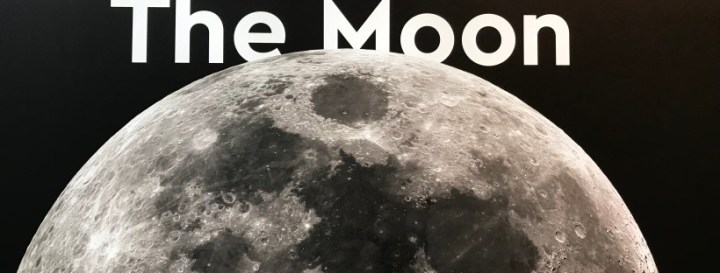
The Moon
National Maritime Museum, Greenwich (London), 19 July 2019 — 5 January 202
Curated by Melanie Vandenbrouck, Megan Barford, Louise Devoy, and Richard Dunn
To celebrate 50 years since NASA’s Apollo 11 mission landed the first humans on the Moon, the National Maritime Museum (NMM) stages The Moon, the UK’s biggest exhibition dedicated to Earth’s nearest celestial neighbour. Featuring over 180 objects from national and international museums and private collections, the exhibition presents a cultural and scientific story of our relationship with the Moon over time and across civilisations. Through artefacts, artworks and interactive moments, the exhibition will enable visitors to reconnect with the wonders of the Moon and discover how it has captivated and inspired us.
The exhibition will explore how humans have used, understood and observed the Moon from Earth. Visitors will get the chance to relive the momentous events of the Space Race and the Moon landings before discovering the motivations behind 21st-century lunar missions.
 Significant objects on display include Apollo mission artefacts that travelled to the Moon, loaned from the Smithsonian National Air and Space Museum in Washington D.C. The ‘Snoopy Cap’ Communications Carrier, worn by astronaut Edwin ‘Buzz’ Aldrin during Apollo 11, will be exhibited alongside the Hasselblad camera equipment that captured some of the most recognisable and iconic images of the 20th century.
Lunar samples collected from NASA’s Apollo missions and the Soviet Union’s Luna programme, will be accompanied by a rare lunar meteorite from the Natural History Museum’s collection. This will give visitors to the NMM’s exhibition a unique opportunity to get close to such a diverse range of moon rocks and discover how researching these specimens continues to advance our understanding of the Moon.
Historical and contemporary artworks will illustrate how the Moon has long inspired artists, acting as a metaphor for the human condition. Moonlit scenes by J.M.W. Turner and John Constable will be displayed alongside contemporary pieces by Katie Paterson, El Anatsui, Chris Ofili, and Leonid Tishkov. Artworks by Cristina De Middel, Aleksandra Mir, and Larissa Sansour will consider our relationship with the Moon through the lenses of gender and nationhood.
In the exhibition’s opening section, visitors will discover ways in which the Moon has been embedded in human culture, spiritually, practically, and artistically, with its changing phases used to mark time in religion, navigation, and medicine. The oldest object on display, a Mesopotamian Tablet from 172 BCE on loan from the British Museum, shows how lunar eclipses were considered to be bad omens. Detailed Islamic and Chinese calendars highlight the continuing importance of using the Moon to set the date for key festivals such as Chinese New Year and Ramadan. Examples of historic medical texts, such as a 1708 pamphlet by the English Doctor Richard Mead show how the position of the Moon was once believed to influence our physical and mental health.
The exhibition will explore how new technologies, such as 17th-century telescopes, 19th-century cameras and remote equipment for space photography and mapping in the 20th century brought increasing understanding of the lunar surface and the Moon’s origins. A selection of maps, paintings, photographs, models, and drawings from the 17th century to the present will emphasise humanity’s continuing desire to understand more about the Moon. Examples include the earliest-known drawing of the lunar surface made from telescopic observations by British astronomer Thomas Harriot in 1609 and the detailed pastel drawings of the Moon by 18th-century Royal Academician John Russell.
From classic science fiction through to the defining events of the Space Race, visitors will see how the Moon went from being a distant object of observation and place of imagination to a destination that was within human reach. The Moon looks at key moments within the Space Race, highlighting how a number of Soviet ‘firsts’ were ultimately overshadowed by Neil Armstrong’s century-defining ‘one small step’ in July 1969. Video artist Christian Stangl will show a new and exclusive version of his film ‘Lunar’, in which animated photographs from Apollo missions allow visitors to experience the Moon landings through the eyes of the astronauts. Apollo objects will sit alongside film posters, books, comics, and magazines that celebrated and questioned these momentous events.
In 1969, the Apollo 11 astronauts left a plaque on the Moon claiming, “we came in peace for all mankind.” Today, there is renewed drive to return to the Moon, reflected in future projects from China, Europe, India, Israel, Japan, Russia, and the United States. No longer the domain of superpowers, international space agencies, private companies, and entrepreneurs are all part of this 21st-century race for the Moon. Scientists, lawyers, artists, and architects are considering the practical, psychological, and ethical implications of human exploration and settlement on the Moon. The closing chapter of the exhibition will look at these contemporary motivations for Moon travel, leaving visitors to contemplate whether the Moon will become a theatre for exploitation and competition or remain a peaceful place for all humankind.
Melanie Vandenbrouck, Megan Barford, Louise Devoy, and Richard Dunn, eds., The Moon: A Celebration of Our Celestial Neighbour (London: Collins, 2019), 256 pages, ISBN: 978-0008282462, £20.
From ArtHist.net:
Art and Science of the Moon
Royal Museums Greenwich, London, 14–15 November 2019
With contributions from academics, artists, and curators exploring the interface between art, in its widest sense, and science, this conference will consider various creative responses to our cosmic companion. In keeping with RMG’s interest in interrogating the collision of science, history and art, The Art and Science of the Moon will explore how the Moon’s motions and phases have influenced human activities, beliefs, and behaviours; how sustained scrutiny of the lunar surface have enabled us to understand more about ourselves; how attempts, imaginary and real, to reach this other world have fostered creativity and technological progress; and how in the 21st century we are rethinking our relationship with the Moon.
The provisional programme is available here»










 Enfilade
leave a comment