New Book | The Barbarian Invasions
Newly published English translation of the original French edition of 2015, from October Books and MIT Press:
Éric Michaud, The Barbarian Invasions: A Genealogy of the History of Art (Cambridge: MIT Press, 2019), 280 pages, ISBN: 9780262043151, $35 / £28.
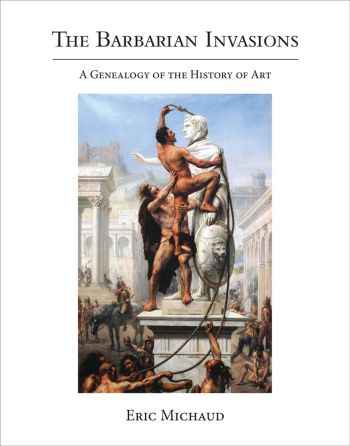 How the history of art begins with the myth of the barbarian invasion—the romantic fragmentation of classical eternity.
The history of art, argues Eric Michaud, begins with the romantic myth of the barbarian invasions. Viewed from the nineteenth century, the Germanic-led invasions of the Roman Empire in the fifth century became the gateway to modernity, seen not as a catastrophe but as a release from a period of stagnation, renewing Roman culture with fresh, northern blood—and with new art that was anti-Roman and anticlassical. Artifacts of art from then on would be considered as the natural product of ‘races’ and ‘peoples’ rather than the creation of individuals. The myth of the barbarian invasions achieved the fragmentation of classical eternity.
This narrative, Michaud explains, inseparable from the formation of nation states and the rise of nationalism in Europe, was based on the dual premise of the homogeneity and continuity of peoples. Local and historical particularities became weapons aimed at classicism’s universalism. The history of art linked its objects with racial groups—denouncing or praising certain qualities as ‘Latin’ or ‘Germanic’. Thus the predominance of linear elements was thought to betray a southern origin, and the ‘painterly’ a Germanic or northern source. Even today, Michaud points out, it is said that art best embodies the genius of peoples. In the globalized contemporary art market, the ethnic provenance of works—categorized, for example, as ‘African American’, ‘Latino’, or ‘Native American’—creates added value. The market displays the same competition among ‘races’ that was present at the foundation of art history as a discipline.
Éric Michaud is Directeur d’études at the École des hautes études en sciences sociales, Paris, and a 2018–19 Fellow at the Italian Academy at Columbia University.
Exhibition | Open-Air Painting in Europe, 1780–1870
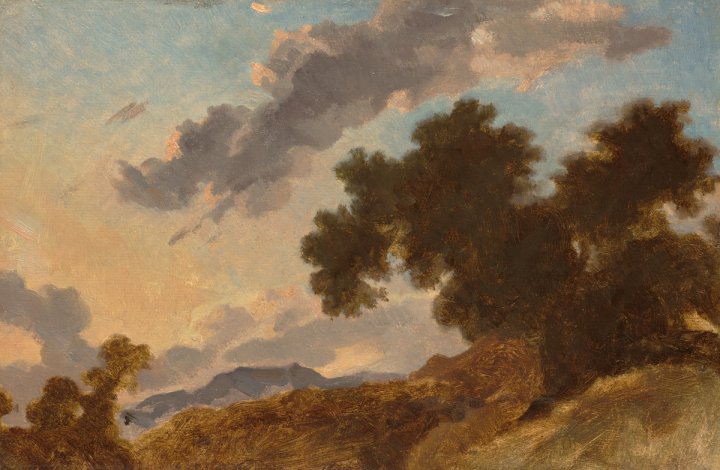
Jean Honoré Fragonard, Mountain Landscape at Sunset, ca. 1765, oil on paper, 8 × 13 inches
(Washington, D.C.: National Gallery of Art, Chester Dale Fund, 1997.22.1)
◊ ◊ ◊ ◊ ◊
From the press release (6 December 2019) for the exhibition:
True to Nature: Open-Air Painting in Europe, 1780–1870
National Gallery of Art, Washington D.C., 2 February — 3 May 2020
Fondation Custodia, Paris, 13 June — 13 September 2020
Fitzwilliam Museum, Cambridge, 3 May — 29 August 2022
Curated by Mary Morton, Ger Luijten, and Jane Munro
An integral part of art education in the late 18th and early 19th centuries, painting en plein air (‘in the open air’) was a core practice for artists in Europe. Intrepid painters—developing their abilities to quickly capturing effects of light and atmosphere—made sometimes arduous journeys to study landscapes at breathtaking sites, ranging from the Baltic coast and Swiss Alps to the streets of Paris and ruins of Rome. True to Nature: Open-Air Painting in Europe, 1780–1870 presents some 100 oil sketches made outdoors across Europe by artists such as Carl Blechen, Jules Coignet, André Giroux, Anton Sminck Pitloo, Carl Frederik Sørensen, and Joseph Mallord William Turner. On view in the West Building of the National Gallery of Art, Washington, from February 2 through May 3, 2020, the exhibition presents dozens of recently discovered studies and explores issues of attribution, chronology, and technique.
 “The Gallery is fortunate to have one of the finest public collections of landscape sketches by 18th- and 19th-century European painters, largely due to acquisitions made by the late Philip Conisbee during his time as the Gallery’s senior curator of European paintings from 1993 to 2008,” said Kaywin Feldman, director, National Gallery of Art, Washington. “True to Nature builds on recent scholarship as well as the discovery of paintings that have come to light since the 1996 exhibition organized by Conisbee, In the Light of Italy: Corot and Early Open-Air Painting. That exhibition sparked curatorial and collector interest in this genre, and True to Nature continues to expand our understanding of this relatively unstudied, yet central, aspect of European art history. The Gallery is grateful to work with the Fondation Custodia, Collection Frits Lugt, and the Fitzwilliam Museum to bring together highlights from the best collections of European landscape sketches from this period.”
True to Nature begins as European artists would have in the late 18th and early 19th century—in Rome. The study of ancient sculpture and architecture, as well as of Renaissance and baroque art, was already a key part of an artist’s education, but Pierre-Henri de Valenciennes’s influential treatise on landscape painting, published in 1800, went further to recommended that young artists develop their skills by painting oil sketches out of doors. Valenciennes advised exploring the Roman countryside, as he had in Study of Clouds over the Roman Campagna (c. 1782/1785). This section includes examples by a range of European artists who followed his advice, such as Michel Dumas, Christoffer Wilhelm Eckersberg, and Johan Thomas Lundbye. Also included is The Island and Bridge of San Bartolomeo, Rome (1825/1828) by Jean-Baptiste-Camille Corot. Corot was a key figure in 19th-century landscape painting, bringing the practice of open-air painting back to France and inspiring a younger generation of impressionist painters.
Other sections focus on both natural and man-made features that proved challenging to painters, such as waterfalls, trees, skies, coastlines, and rooftops. Examples include rare studies by well-known artists such as John Constable’s Sky Study with a Shaft of Sunlight (c. 1822, Fitzwilliam Museum), Jean Honoré Fragonard’s Mountain Landscape at Sunset (c. 1765), and Odilon Redon’s Village on the Coast of Brittany (1840–1916, Fondation Custodia) as well as sketches by lesser-known painters like Louise-Joséphine Sarazin del Belmont, one of the few known women artists active during this period. True to Nature illustrates how pervasive plein-air painting became across Europe with examples by many Belgian, Danish, Dutch, German, Swiss, and Swedish artists who studied in Italy before returning home to paint their native surroundings. Sketches by Carl Blechen include an example from his time in Italy, View of the Colosseum in Rome (1829, Fondation Custodia), as well as a study made at home in Germany, View of the Baltic Coast (1798-1840), Fondation Custodia).
The exhibition is organized by the National Gallery of Art, Washington, the Fondation Custodia, Collection Frits Lugt, Paris, and the Fitzwilliam Museum, Cambridge. The exhibition is curated by Mary Morton, curator and head of the department of French paintings, National Gallery of Art, Washington; Ger Luijten, director, Fondation Custodia, Collection Frits Lugt, Paris; and Jane Munro, keeper of paintings, drawings and prints, Fitzwilliam Museum, Cambridge.
Ger Luijten, Mary Morton, and Jane Munro, eds., with additional contributions by Michael Clarke, Ann Hoenigswald, and Anna Ottani Cavina, True to Nature: Open-Air Painting in Europe, 1780–1870 (London: Paul Holberton Publishing, 2020), 256 pages, ISBN: 978-1911300786, £45 / $55.
◊ ◊ ◊ ◊ ◊
Note (added 29 June 2022) — The original Fitzwilliam dates (6 October — 31 January 2021) were updated.
Exhibition | Witnessing Terror: French Revolutionary Prints, 1792−94

Jean-Joseph-François Tassaert, after Fulchran Jean Harriet, The Night of the 9 and 10 Thermidor, Year II, ca. 1794–1805
(London: UCL Art Museum, LDUCS-10581)
◊ ◊ ◊ ◊ ◊
Opening next week at UCL:
Witnessing Terror: French Revolutionary Prints, 1792−94
UCL Art Museum, London, 14 January — 12 June 2020
Curated by David Bindman, Colin Jones, and Richard Taws
The period of the French Revolution known as the Terror, which lasted from 1792 until 1794, gave rise to many of the most memorable and dramatic images of this crucial moment in modernity. These images were central to revolutionary attempts to regenerate all aspects of life—from clothing and speech to money and maps, and with the introduction of the Republican Calendar, to remake even time itself. In our contemporary political context, in which ‘Terror’ has taken on a variety of disturbing meanings, and in which the proliferation of images plays an increasingly significant role in how we comprehend acts of political violence, it is ever more important to examine this radical period in French history.
 Tracing the tumultuous period from the trial and execution of Louis XVI to the fall of Robespierre, Witnessing Terror includes a variety of printed images representing key events and personae. From portraits of revolutionary martyrs to dramatic scenes of Parisian crowds, these prints give us insight into how people understood life during the Terror. As well as a number of caricatures, street scenes, and more overtly artistic prints, the exhibition displays everyday objects, such as paper money, well-worn passports, and playing cards. Drawing out the contemporary relevance of this revolutionary iconography, Witnessing Terror also shows work by the renowned conceptual artist, poet, and gardener Ian Hamilton Finlay (1925−2006) that engages with the long-term legacy of the Terror.
The Terror remains a vexed term that has for many become synonymous with the French Revolution, clouded by myths that emerged in the years that followed. A system of political institutions and practices, the Terror was accompanied by new rhetorical and cultural strategies. It did not happen overnight but developed as a tactical response to a series of military crises, rumours, and fears. Images played a crucial role in the operation of Terror, as well as in its subsequent representation. This exhibition considers what it means to witness Terror, then and now. In particular, it features extracts from the recently discovered letters of Catherine-Innocente de Rougé, duchesse d’Elbeuf (1707−1794), who maintained a correspondence with an unknown friend throughout the Revolution. Living in her private residence, the Hôtel d’Elbeuf, which was located only metres from government offices during the Terror, the duchesse d’Elbeuf commented freely on the situation in Paris in a way that would have sent her to the guillotine, had her correspondence been found.
This exhibition is part of a programme of ongoing engagement with UCL Art Museum’s unique holdings of prints related to the French Revolution, acquired via the Cultural Gifts Scheme. It follows Revolution under a King: French Prints, 1789−92 (UCL Art Museum, 2016) and Rousseau 300: Nature, Self and State, an exhibition in collaboration with UCL Centre for Transnational History (UCL Art Museum, 2012).
Exhibition | Dutch Drawings of the Eighteenth Century
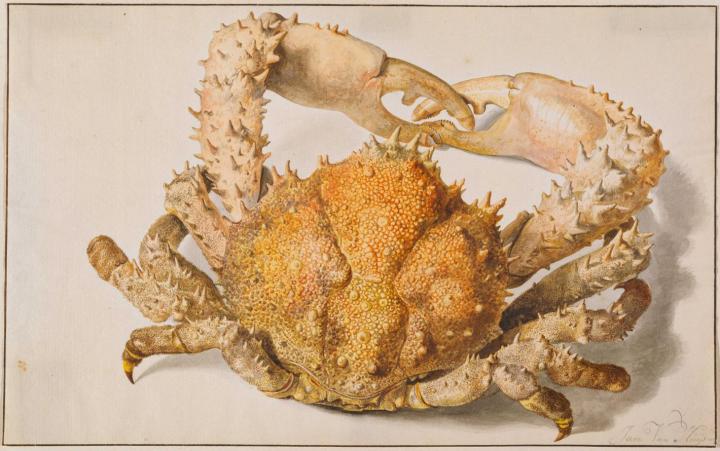
Jan van Huysum (1682–1749), A Crab, 18th century, watercolour and pencil on laid paper, 18 × 29 cm
(Frankfurt am Main: Städel Museum)
◊ ◊ ◊ ◊ ◊
Opening in the fall at the Städel Museum:
Passion for Pictures: Netherlandish Drawings of the Eighteenth Century
Städel Museum, Frankfurt am Main, 1 October 2020 — 10 January 2021
Curated by Annett Sandfort
With nearly 600 works, the Städel Museum has one of the most extensive and artistically significant collections of eighteenth-century Dutch drawings outside the Netherlands. From 1 October 2020 to 10 January 2021, the Stadel is for the first time dedicating an exhibition to this valuable collection. On display will be eighty representative drawings by artists who are hardly known today, but who were often very successful in their time, as well as by art-loving amateurs who drew at a high level. The exhibition will bring together preparatory drawings for large-format wall and ceiling decorations by Jacob de Wit; book illustrations by Bernard Picart; Dutch topographies by Cornelis Pronk, Paulus Constantijn la Fargue, and Hendrik Schepper; atmospheric landscape drawings by Jacob Cats, the brothers Jacob and Abraham van Strij, and Franciscus Andreas Milatz; decorative floral and fruit still lifes by Jan van Huysum and his numerous successors; as well as depictions of exotic animals by Aert Schouman and satirical genre scenes by Cornelis Troost and Jacobus Buys. The selected works impressively illustrate the revaluation and emancipation of the drawing in the Netherlands in the eighteenth century, as well as the preference for picturesquely executed, coloured drawings and the repeatedly sought-after examination of the art of the seventeenth century, the Netherlands’ Golden Age. The exhibition and accompanying catalogue of holdings impressively illustrate the spectrum and quality of the collection of eighteenth-century Dutch drawings in the Städel Museum.
The exhibition was curated by Annett Sandfort (Collection of Prints and Drawings, Städel Museum), with support from the Stiftung Gabriele Busch-Hauck.
Note (added 7 October 2020) — The original version of this posting included the provisional titles: Dutch Drawings of the Eighteenth Century / Niederländische Zeichnungen des 18. Jahrhunderts. The exhibition press release is available here.

Cornelis Troost (1696/1697–1750), Suijpe Steijn, 1742, gouache paint on laid paper, 41 × 62 cm
(Frankfurt am Main: Städel Museum, photo by U. Edelmann)
Exhibition | The Gosford Wellhead
Opening in the summer at The Met:
The Gosford Wellhead: An Ancient Roman Masterpiece
The Metropolitan Museum of Art, New York, 1 June 2020 — 14 February 2021
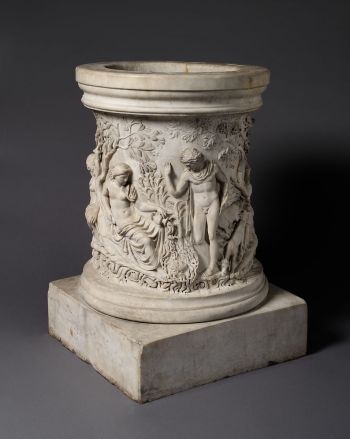
Puteal (wellhead) with Narcissus and Echo, and Hylas and the Nymphs, 2nd century, Roman, marble, 41 inches hight (New York: The Metropolitan Museum of Art, 2019.7).
An ancient Roman marble wellhead (puteal) of the second century AD is the focus of an exhibition—along with some two dozen works, primarily from The Met collection—that will explore a wide range of topics, including virtuoso Roman sculpture; the Roman adaptation of Greek art and mythology; Greek and Latin literature; early excavations of Rome and its port; the restoration of antiquities in the late eighteenth century; the Grand Tour and the British collecting of antiquities in the late eighteenth and nineteenth centuries; and the rediscovery of a masterpiece that was lost to scholars for centuries. Excavated in the Roman port of Ostia in 1797, the wellhead entered a private collection in the nineteenth century and was recently acquired by The Met. The acquisition is part of The Met’s 2020 Collections Initiative in celebration of the Museum’s 150th anniversary.
The press release (17 May 2019) announcing the acquisition is available here»
New Book | The Irish Aesthete: Ruins of Ireland
From Simon & Schuster:
Robert O’Byrne, The Irish Aesthete: Ruins of Ireland (London: CICO Books, 2019), 176 pages, ISBN: 978-1782496861, $25.
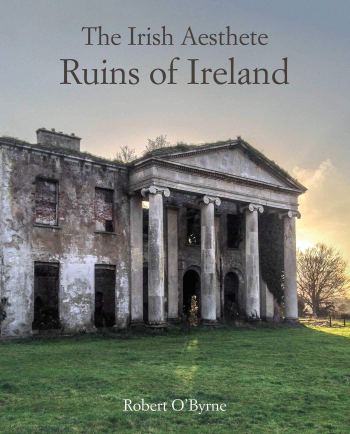 Fantastical, often whimsical, and frequently quirky, these atmospheric ruins are beautifully photographed and paired with fascinating text by Robert O’Byrne. Born out of Robert’s hugely popular blog, The Irish Aesthete, there are Medieval castles, Georgian mansions, Victorian lodges, and a myriad of other buildings, many never previously published. Robert focuses on a mixture of exteriors and interiors in varying stages of decay, on architectural details, and entire scenarios. Accompanying texts tell of the Regency siblings who squandered their entire fortune on gambling and carousing, of an Anglo-Norman heiress who pitched her husband out the window on their wedding night, and of the landlord who liked to walk around naked and whose wife made him carry a cowbell to warn housemaids of his approach. Arranged by the country’s four provinces, the diverse ruins featured offer a unique insight into Ireland and an exploration of her many styles of historic architecture.
Robert O’Byrne is a writer and lecturer specialising in the fine and decorative arts. He is the author of more than a dozen books, among them Luggala Days: The Story of a Guinness House, The Last Knight: A Tribute to Desmond FitzGerald, 29th Knight of Glin, Romantic Irish Homes, and Romantic English Homes. A retired Vice-President of the Irish Georgian Society and trustee of the Alfred Beit Foundation, he is currently a trustee of the Apollo Foundation and the Artists Collecting Society. Among other work he writes a monthly column for Apollo magazine, and is also a regular contributor to The Burlington Magazine and the Irish Arts Review. For the past five years, O’Byrne has written an award-winning blog, www.theirishaesthete.com.
Exhibition | Goya: Avant-Garde Genius, the Master and His School

Francisco José de Goya y Lucientes, Woman with a Fan, detail, ca. 1805–10
(Paris: Musée du Louvre)
◊ ◊ ◊ ◊ ◊
Now on view in Agen, as described in the press kit:
Goya: Avant-Garde Genius, the Master and His School
Musée des Beaux-Arts, Agen, 8 November 2019 — 10 February 2020
Curated by Adrien Enfedaque, Juliet Wilson-Bareau, and Bruno Mottin
The City of Agen and its Fine Arts Museum, located between Bordeaux and Toulouse in the southwest of France, will present, over the winter of 2019–2020, an outstanding exhibition with a fresh and unexpected view on Francisco de Goya y Lucientes (1746–1828) and his work. Through a selection of works in several media (paintings, drawings, engravings), the exhibition will demonstrate the essential characteristics that remain constant in Goya’s work and reveal the role played by his collaborators in his studio.
The Museum’s scientific team is assisted in this project by one of the specialists of Goya’s work Juliet Wilson-Bareau and the event has received personal support from the French Minister of Culture. Nearly 90 works loaned by museums and private collections around the world (France, Germany, Hungary, Spain, Switzerland, UK, USA) will be on display in the Jacobins’ Church (Église des Jacobins), an Agen architectural jewel and an emblematic place for the Museum’s temporary exhibitions.
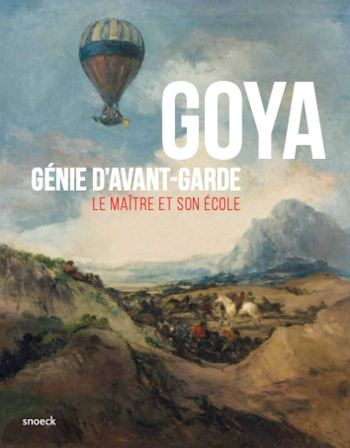 In the late nineteenth-century, Count Damase de Chaudordy (1826–1889) bequeathed a substantial collection to his birthplace Agen. As French ambassador to the court of Madrid, he bought many works, such as five of six paintings by Goya from the private collection of Federico de Madrazo, former first painter of the queen and director of the Prado Museum. These paintings had already been catalogued by Charles Yriarte in 1867 and came directly from the collections of Goya’s son Don Xavier (1784–1854) and grandson Don Mariano (1806–1874) Marquis of Espinar.
This ambitious project is reminiscent of the blockbuster exhibition organized in 1993 From Fortuny to Picasso, which attracted more than 25,000 visitors. It was the first major exhibition at the Jacobins’ church and the result of a collaboration with the Prado Museum in Madrid. It has been the origin of precursory research on Spanish painters of the 19th century. The curator at the time, Yannick Lintz, now Head of the Department of Islamic Arts at the Louvre museum, keeps a benevolent eye on Agen’s projects and supports this exhibition.
As part of the Catalog of Desires, a device set up by the Ministry of Culture to facilitate the circulation in France of iconic works of national collections, the Agen Museum has been designated as a pilot museum. It has the honour to present to the public Woman with a Fan, a famous painting by Goya which has been on loan from the Louvre since April 27, 2019. In the picture, the artist depicts a buxom young woman with great subtlety. The minimalist shades of gray, celadon greens, and whites are remarkable, especially in the delicate work of the long mittens. The identity of the young woman remains uncertain today. The painting is original in its intimate approach focusing on the character’s psychology.
Goya: Avant-Garde Genius, the Master and His School is based on research from the Louvre and the Research and Restoration Centre of the Museums of France (C2RMF). The exhibition benefits from the technical and scientific advice of this latter institution, where two paintings of Goya’s followers (Goyesques) from the Museum of Agen are currently being studied and restored for the exhibition. It is a new approach to Goya’s work that will be proposed to better underline the singularity of his art and his way of working, from drawing to painting. This project could, in the long term, better define the artistic approach of Goya and the implication of the collaborators in his workshop. The aim of the exhibition is to provide both the large public and the painting connoisseurs with a unique opportunity to enjoy and admire many masterpieces that will also be analyzed in detail (through documentation and technical analysis).
General Commission
Adrien Enfedaque (Curator of the Museum of Fine Arts)
Scientific Advisers
Juliet Wilson-Bareau (Art Historian, London)
Bruno Mottin (Chief Curator of Heritage, Research and Restoration Centre of the Museums of France)
Goya: Génie d’avant-garde, le maître et son école (Paris: Snoeck Édition, 2020), 224 pages, ISBN: 978-9461615602, 25€.
For additional coverage, see Dalya Alberge’s article from The Observer (28 December 2019), available here»
Exhibition | A Grand Tour: Images of Italy from the Jundt Art Museum
From the Jundt Art Museum:
A Grand Tour: Images of Italy from the Permanent Collection of the Jundt Art Museum
Jundt Art Museum, Gonzaga University, Spokane, Washington, 18 January — 9 May 2020
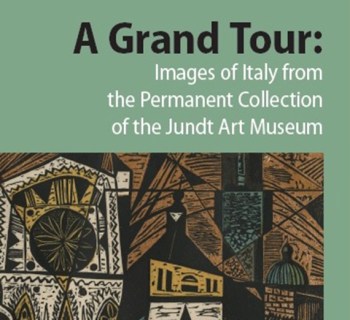 In his book Italian Hours, Henry James often commented on the tourist sites of urban Italy. In 1882, he noted, “The only way to care for Venice as she deserves it is to give her a chance to touch you often—to linger and remain and return.” James and other late-nineteenth-century Americans were continuing the British tradition of the Grand Tour in Italy, centered on its most important cultural cities and historic sites. This exhibition functions as a visual travelogue of the Italian peninsula using works of art from the collection of the Jundt Art Museum at Gonzaga University.
Both the exhibition and an accompanying book begin with sixteenth-, seventeenth-, and eighteenth-century European prints, byproducts of artists’ visits mostly to the urban centers of Rome and Florence, and conclude with twenty-first-century images. Significant portions of the objects in this exhibition result from the Bolker Collection and from the Fredrick and Genevieve Schlatter Endowed Print Fund. A Grand Tour utilizes the Jundt Art Museum’s collection to present artistic imagery of the canals of Venice, the Renaissance architecture of Florence, and the classical remains of Rome, but also sites in Milan, Pisa, Assisi, Naples, and Palermo as well as other cities and towns. We hope that this selection of 76 images of Italy will give pleasure as one introduction to a wide-ranging and astonishing topic and as an opportunity, as James writes, “to linger and remain and return.”
Exhibition | Master, Pupil, Follower

Pietro Giacomo Palmieri (1737–1804), Two Figures in a Landscape, red chalk on cream paper, 18 × 24 inches
(Collection of Jeffrey E. Horvitz, Boston, inv. no. D-I-43)
◊ ◊ ◊ ◊ ◊
From the Georgia Museum of Art:
Master, Pupil, Follower: 16th- to 18th-Century Italian Works on Paper
Georgia Museum of Art, University of Georgia, Athens, 21 December 2019 — 8 March 2020
Curated by Randy Coleman, Nelda Damiano, and Benedetta Spadaccini

Circle of the Gandolfi, Standing Academic Male Nude, Seen from the Rear, ca. 1775, charcoal on white paper with some foxing and repairs, 17 × 12 inches (Athens: Georgia Museum of Art, University of Georgia; extended loan from the collection of Giuliano Ceseri. GMOA 1995.184E).
This exhibition showcases approximately 30 drawings and prints dating from the 16th to the 18th centuries and drawn from the collections of Giuliano Ceseri of Lafayette, Louisiana, the Georgia Museum of Art, and the Jeffrey Horvitz Collection. Curators selected drawings and prints to represent specific artistic styles and Italian regional schools. An examination of the drawings has revealed some previously erroneous assumptions. In a few cases, new attributions have resulted; in others, authorship remains unresolved. The museum will publish a fully illustrated exhibition catalogue containing this scholarship and publishing important drawings by Giulio Romano, Claudio Ridolfi, Palma il Giovane, and Guercino for the first time. Other artists include Giulio Benso, Giovanni Battista Tiepolo, Giovanni Benedetto Castiglione, Salvatore Rosa, and followers of Veronese and Tintoretto. The exhibition is curated by Robert Randolf Coleman, professor emeritus, Renaissance and Baroque art history, University of Notre Dame; Nelda Damiano, Pierre Daura Curator of European Art, Georgia Museum of Art; and Benedetta Spadaccini, Biblioteca Ambrosiana, Milano.
◊ ◊ ◊ ◊ ◊
Robert Randolf Coleman, Nelda Damiano, Benedetta Spadaccini, William Eiland, Master, Pupil, Follower: 16th- to 18th-Century Italian Works on Paper (Athens: Georgia Museum of Art, University of Georgia, 2020), 138 pages, ISBN: 978-0915977185.
This catalogue accompanied the exhibition on view at and the Georgia Museum of Art at the University of Georgia from 21 December 2019 to 8 March 2020. Co-curators Robert Randolf Coleman (professor emeritus of Renaissance and baroque art history, University of Notre Dame), Nelda Damiano (Pierre Daura Curator of European Art, Georgia Museum of Art), and Benedetta Spadaccini (Biblioteca Ambrosiana, Milano) contributed entries on each of the 32 works in the exhibition, all of which are illustrated in color. Coleman also provided an introductory essay, and museum director William Underwood Eiland wrote a preface and a brief essay on collector Giuliano Ceseri, from whose collection many of these works come. Curators selected drawings and prints by artists including Giulio Benso, Giovanni Battista Tiepolo, Giovanni Benedetto Castiglione, Salvatore Rosa, and followers of Veronese and Tintoretto to represent specific artistic styles and Italian regional schools. The catalogue is organized by region. An examination of the drawings revealed some previously erroneous assumptions, resulting in new attributions in some cases. Drawings by Giulio Romano, Claudio Ridolfi, Palma il Giovane, and Guercino are published here for the first time.
◊ ◊ ◊ ◊ ◊
Note (added 16 August 2023) — The posting was updated to include information on the catalogue.










 Enfilade
leave a comment