Call for Essays | Transitioning Historic Houses to a Virtual Experience
From ArtHist.net (8 October 2020). . .
Edited Volume, History Dis-placed: Transitioning Historic Houses to a Virtual Experience
Proposals due by 30 November 2020; final papers will be due by 15 June 2021
History Displaced: Transitioning Historic Houses to a Virtual Experience concentrates on the unique histories and challenges of house-museums. In addition to being historic landmarks, house-museums can be sites of civic engagement and reflection; centers for activism and cultural discourse; and places for public events and gatherings. In the digital age, house-museums have had to renegotiate these identities and interactions with contemporary audiences through innovative practices. This was further challenged when museums across the globe were suddenly forced to pivot to, for many, an unfamiliar online discourse during the 2020 Covid-19 crisis. Many of the educational tropes utilized to great affect by house-museums—including living history and other direct contact strategies with an active audience—had to be jettisoned for online engagement. Museum staff were challenged to create content, develop educational recourses, and provide access to collections with little preparation and amidst severe budget cuts. There has, perhaps, never been a greater challenge to museums around the globe, and historic homes are among the hardest hit in these unprecedented times.
This edited volume asks for submissions that address, but are not limited to, the tactics taken by house-museums after February 2020, when it was clear that closing was imminent and re-opening in the near future was not an option. How do museums that strive to bring in-person encounters to life continue to do so through an online presence? How can these site-specific museums re-create or re-produce an aura or indexicality of space and place—a interaction that differs somewhat from other types of museums? What types of decisions need to be made when re-creating the museum collection for online perusal, which, for most house museums, are traditionally and fully experienced through the domestic spaces in which the collection is housed and the site-specificity of the museum? How do those at house-museums envision these decisions to move content online affect the future engagement of the museums with visitors and educators?
We invite submissions for scholars, students, and those personally involved with the day-to-day operations of a house-museum that reflect upon of the strategies undertaken for both historical and financial survival in the precarious position that house-museums find themselves during and after 2020.
Please send abstracts of no more than 500 words to Karen Shelby (karen.shelby@baruch.cuny.edu) and Emily Stokes-Rees (ewstokes@syr.edu) by 20 November 2020 with the subject heading “House Museum Submission.” Abstracts and a two-page CV should be sent as one PDF and titled with the author’s last name. Editors will respond to submissions by 15 December. Final papers will be due 15 June 2021. Papers should be 6,000–8,000 words in length.
Exhibition | Promoting America: Maps

A MAP OF NORTH AMERICA; Henry Schenck Tanner, cartographer, engraver, and publisher; Philadelphia, 1822; line engraving on laid paper with hand-coloring (Colonial Williamsburg Foundation, 1997-5).
◊ ◊ ◊ ◊ ◊
Press release (8 September 2020) from Colonial Williamsburg for the exhibition:
Promoting America: Maps of the Colonies and the New Republic
DeWitt Wallace Decorative Arts Museum, Williamsburg, Virginia, 17 October 2020 — 27 March 2022
Curated by Margaret Beck Pritchard and Katie McKinney
Ever since the first attempts by the English to colonize America, artists and mapmakers used maps as a savvy marketing tactic to portray the New World as both abundant and rich in land and resources, often portraying America as a latter-day Garden of Eden. A new exhibition, Promoting America: Maps of the Colonies and the New Republic will open on 17 October 2020, at the DeWitt Wallace Decorative Arts Museum, one of the Art Museums of Colonial Williamsburg, and will shed new light on this topic. Through 21 extraordinary objects, including maps (several of which have never before been exhibited in Colonial Williamsburg and a few of which are recent acquisitions), prints, glass transfers, books and more, visitors will gain insights into how the promise of a good and prosperous life in the New World was communicated. The exhibition, the first in a new gallery dedicated to maps, prints, and drawings in the recently expanded Art Museums building, will remain on view through 27 March 2022.
“More than cartographic records, early maps are often pieces of propaganda,” said Roald L. Hurst, the foundation’s Carlisle H. Humelsine chief curator and vice president for museums, preservation, and historic resources. “This exhibition allows guests to see how subtle messages were embedded into these everyday objects.”

Adriaen Collaert, after Maerten de Vos, America, from the Four Continents, late sixteenth century, engraving.
At first, mapmakers included iconographic images of the flora, fauna as well as images of the native population of America as decorative elements to promote the promise of a life of opportunity there. By the 17th and 18th centuries, however, mapmakers used a variety of visual strategies to promote ideas and values intended to encourage laying claim to land in the New World.
“My favorite maps in the collection are the ones that tell us a much larger story rather than those that simply record the geography of a particular region. Each of the maps chosen for this exhibition was designed either to encourage immigration to America or to promote the vastness of America’s natural resources,” said Margaret Beck Pritchard, deputy chief curator at Colonial Williamsburg.
Among the highlights of the exhibition is a map of New England by Captain John Smith, its cartographer, and William Hole, its engraver. Originally published in 1616, this line engraving on laid paper was printed in London in 1624. After charting the New England coastline, Smith returned to England with valuable geographic information and great enthusiasm for establishing a colony at Plymouth. As English interests had moved from one of discovery and exploration of the New World to establishing settlements and claiming land there, Smith labeled this map with recognizable English names rather than meticulously identified Indian towns as he used six years earlier in his map of Virginia (also included in the exhibition). Instead of illustrations of Natives as seen in the Virginia map, this chart of New England featured an impressively large self-portrait of Smith.
“The decorative details on these maps sometimes contradict the conflicted and often violent colonization of North America, but they made Europeans familiar with and curious about the “New World,” encouraging settlement and investment,” said Katie McKinney, Colonial Williamsburg’s Margaret Beck Pritchard assistant curator of maps and prints. “The evolution of the symbols over time tells a powerful story about how iconography can reflect and embody cultural ideas and ambitions.”
Another featured map in Promoting America is Herman Moll’s A New and Exact MAP of the DOMINIONS of the KING of GREAT BRITAIN on ye Continent of NORTH AMERICA, published after 1753, and first published by Thomas and John Bowles in 1715. Map decoration was often used to reflect the economic potential for prospective settlers through depiction of America’s abundant natural resources. From the early 17th century, beaver pelts were the primary commodity for trade and a main source of competition between the French and the English in America. Moll’s illustration of the Industry of ye Beavers promoted American settlement. Since industry was known to create wealth and beavers were known to be industrious, the animals represented the potential for American success with “great order and wonderfull Dexterity.” The scene also features an early view of Niagara Falls, which would come to symbolize pride in America’s vast untamed wilderness and promote a vision for its future. After the American Revolution, the falls became a nationalistic symbol for the New Republic.

A MAP of the BRITISH EMPIRE in AMERICA with the FRENCH and SPANISH SETTLEMENTS adjacent thereto; Henry Popple, cartographer; Bernard Baron, William Henry Toms, and Richard William Seale, engravers; London, 1733; line engraving on laid paper with hand-coloring; pasted to linen and attached to a roller and ledge (Colonial Williamsburg Foundation, 1955-408).
In the early 18th century, English concern over French exploration of the Mississippi Valley encouraged new North American map production as officials and colonists alike needed accurate records of the continent’s land, waterways, forts, and settlements. Maps were also essential for domestic political reasons because they delineated and legitimized boundaries and helped to define British economic interests. Illustrating these points in the exhibition is A MAP of the BRITISH EMPIRE in AMERICA with the FRENCH and SPANISH SETTLEMENTS adjacent thereto made by London cartographer Henry Popple in 1773. Several features of Popple’s map reveal the motivation behind its production. The sheer size of the map suggested England’s dominant role in America. It was the largest printed map of North America made before the Revolution. The title appears to be etched onto a stone tablet upon which British holdings were identified as part of her “empire,” but French and Spanish holdings were described as “settlements.” The Native American on the left of the decorative cartouche points to the title as if to confirm the assertion that the area represented belonged to Britain, while the figure on the right points to the thriving commercial activity along the shore.
The latest dated map in Promoting America is another highlight of the exhibition: Henry Schenck Tanner’s A MAP OF NORTH AMERICA, made in Philadelphia in 1822. This map, considered to be the most significant of the American West produced during the early 19th century, incorporated information from discoveries made by Merriwether Lewis and William Clark (1804–06), Zebulon Pike (1806), and Stephen H. Long (1819–20). The Lewis and Clark expedition following the purchase of the Louisiana Territory in 1803, and Thomas Jefferson’s commission for the men to map the region and find a route across the continent furthered the belief that success of the new nation was tied to exploration and cultivation of the frontier. As Herman Moll’s decorative details in his map of North America showed a century earlier, by early in the 19th century, natural wonders were regarded as symbols of Americans’ national pride. The cartouche on Tanner’s map combined images of both Niagara Falls and Virginia’s Natural Bridge along with other symbolic forms of American fauna such as a rattlesnake, a beaver, and an eagle.
Promoting America: Maps of the Colonies and the New Republic is co-curated by Ms. Pritchard and Ms. McKinney. It will be on view in the The Michael L. and Carolyn C. McNamara Gallery and was generously funded by Rex and Pat Lucke.
Colonial Williamsburg reopened at reduced capacity and has followed site-specific safety guidelines as part of the foundation’s COVID-19 business resumption plan and in accordance with the state’s plans for reopening. During Colonial Williamsburg’s reopening, most interpretive programming has been moved outdoors. For the safety of employees and the public, ticketed guests can expect limited interaction with interpretive staff. Site entry is limited by state-mandated capacity guidelines for social gatherings, and guests are encouraged to proceed quickly through interpretive sites to accommodate as many visitors as possible. Face coverings are required while inside foundation-owned buildings and their use is encouraged outdoors as well. Guests are also asked to adhere to social distancing guidelines during their visit to Colonial Williamsburg sites, when walking along Duke of Gloucester Street and in other publicly accessible areas. Most doors, faucets and other high-traffic touchpoints are now touchless, and there are significantly enhanced cleaning protocols throughout the foundation’s open locations.
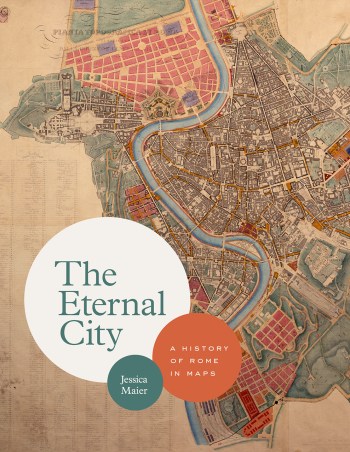
New Book | The Eternal City: A History of Rome in Maps
From the University of Chicago Press:
Jessica Maier, The Eternal City: A History of Rome in Maps (Chicago: University of Chicago Press, 2020), 240 pages, ISBN: 978-0226591452, $40.
One of the most visited places in the world, Rome attracts millions of tourists each year to walk its storied streets and see famous sites like the Colosseum, St. Peter’s Basilica, and the Trevi Fountain. Yet this ancient city’s allure is due as much to its rich, unbroken history as to its extraordinary array of landmarks. Countless incarnations and eras merge in the Roman cityscape. With a history spanning nearly three millennia, no other place can quite match the resilience and reinventions of the aptly nicknamed Eternal City.
In this unique and visually engaging book, Jessica Maier considers Rome through the eyes of mapmakers and artists who have managed to capture something of its essence over the centuries. Viewing the city as not one but ten ‘Romes’, she explores how the varying maps and art reflect each era’s key themes. Ranging from modest to magnificent, the images comprise singular aesthetic monuments like paintings and grand prints as well as more popular and practical items like mass-produced tourist plans, archaeological surveys, and digitizations. The most iconic and important images of the city appear alongside relatively obscure, unassuming items that have just as much to teach us about Rome’s past. Through 140 full-color images and thoughtful overviews of each era, Maier provides an accessible, comprehensive look at Rome’s many overlapping layers of history in this landmark volume.
The first English-language book to tell Rome’s rich story through its maps, The Eternal City beautifully captures the past, present, and future of one of the most famous and enduring places on the planet.
Jessica Maier is associate professor of art history at Mount Holyoke College. She is the author of Rome Measured and Imagined: Early Modern Maps of the Eternal City, also published by University of Chicago Press.
 C O N T E N T S
Introduction: Rome as Idea and Reality
Further Reading
1 Rome Takes Shape
Rome before Rome
A Walled City
Urban Districting
Further Reading
2 Rome of the Caesars
Destination Rome
An Incomplete Puzzle
Making Sense of the Shattered Past
Filling in the Gaps
A Model City
Further Reading
3 Rome of the Popes
Sacred Buildings and Secular Symbols
The Medieval Cityscape
Pathos and Wonder
Further Reading
4 Rome Reborn
A City Ready for Its Close-Up
The City Seen through a Wide-Angle Lens
The City Measured
A Panoramic View of Urban Revitalization
Further Reading
5 Rome of the Scholars
Archaeology in Its Infancy
An Ancient Roman Theme Park
A Ghostly Fantasy
Further Reading
6 Rome of the Saints and Pilgrims
The Way of the Faithful
Scenes from a Pilgrimage
A Pilgrimage Map for the Modern Era
Further Reading
7 Rome of the Grand Tourists
Rome as Theater
The Origins of the Tourist Plan
Rome Surveyed
A Panoramic Vision
Further Reading
8 Rome of the Mass Tourists
The Guidebook Impresario’s Rome
Rome for a Rather Important Woman Traveler
Rome in Your Pocket
Rome for Italian Tourists
Further Reading
9 Rome Enters the Modern Age
2,500 Years in, a Master Plan for Rome
When Trams Ruled Rome
An Olympic City, and a New Beginning
Further Reading
10 Rome Past, Present, and Future
Rapid Transit for a Rapidly Changing City
A Master Plan for the Third Millennium: (Un)sustainable Rome
Further Reading
Acknowledgments
Index
Exhibition | The Piranesi Principle

Giovanni Battista Piranesi, Colosseum in Rome, Bird’s Eye View from the North, ca. 1760–70
(Staatliche Museen zu Berlin, Kunstbibliothek / Dietmar Katz)
◊ ◊ ◊ ◊ ◊
A very brief posting appeared here at Enfilade in February. Here’s the expanded version; from the Staatliche Museen zu Berlin:
The Piranesi Principle: Marking the 300th Birthday of the Great Italian Master
Das Piranesi-Prinzip: Zum 300. Geburtstag des großen italienischen Meisters
Kunstbibliothek, Berlin, 4 October 2020 — 7 February 2021
Giovanni Battista Piranesi (1720–1778) was one of the great polymaths of the 18th century. He carved out an international career as an archaeologist, artist, collector, designer, publisher and author. The principle behind his success was to grasp the multifaceted nature of reality and transform it into something new. He found inspiration everywhere: in the artifacts of bygone epochs and faraway regions, in images from science, technology and opera, and even in denunciations and defeats. This exhibition celebrating the 300th anniversary of his birth brings this Piranesi principle back to life in all its creativity. It is centred around Piranesi’s masterpieces of engraving, his books, pamphlets, satirical illustrations, and drawings from the collections of the Kunstbibliothek and the Kupferstichkabinett, some of which are being shown for the very first time.
Piranesi’s Rome
The exhibition begins with a trip back through time to Piranesi’s Rome. While today’s tourists marvel at the city’s ancient ruins in an urban setting, in the 18th century the Venetian-born artist lived and worked in a city surrounded by a landscape of ruins, in which monuments overgrown by plants protruded from the ground. It was in this context that Piranesi found the motifs for his images and architectural visions, collected artefacts for his ‘Museo’, and conducted research into art and architectural history—the results of which he published in monumental works such as the Antichità Romane (1756). And it was here that he found his clientele and his audience: artists, art scholars, archaeologists, antiques and art dealers came from all over the world to make their fortune in the ‘eternal city’—or, like Piranesi himself—to earn their immortality.
Piranesi’s Stage
Opera and theatre have been influential mass media since the Baroque era. Performances took place not only in private residences, but also on the street and in public squares, where religious festivities were staged as elaborate spectacles. In the 18th century, theatre was a big business, for which artists designed stage sets and decorations, and in doing so revolutionised the viewing habits of their audiences. Piranesi, who had already become acquainted with this scene in Venice, picked up on these ideas and used them to dramatise his compositions. Both his Vedute (Views) and his famous Carceri (Prisons) largely owe their magic to the influence of the theatre of the time.
Piranesi’s Laboratory
As well as the dream factory of theatre, the technical imagery of the sciences was another a source of great fascination for Piranesi. Imagining his workshop as a laboratory, he experimented with creating futuristic images in order to find ways to communicate the findings of his research on archaeology and art with scholars and the public alike. In the section Piranesi’s Laboratory, the exhibition focuses on the monumental display panels, reconstructions and maps that made him famous within the sciences far beyond Italy, and saw him named a member of the Society of Antiquaries in London in 1757 and an honorary member of the Accademia di San Luca in Rome in 1761. His images are ground-breaking and ahead of their time above all because of their resemblance to a computer desktop featuring a multitude of windows open simultaneously. They succeeded in sealing Piranesi’s status as a pioneer of visual communication.
Piranesi’s Palazzo
This section takes viewers to the central site of his work: Palazzo Tomati, not far from the Spanish steps, where Piranesi resided from 1761 onwards, ran a large workshop, and opened his ‘Museo’ (a warehouse of antiques and self-manufactured objects) to tourists and art scholars. The drawings by Piranesi that are held by the Kunstbibliothek, including his renowned fireplace designs, provide important information about his work process. Piranesi was open to everything: he drew on both Roman and Egyptian antiquity, Etruscan and Greek art, and often came up with daring hybrid forms. Even the wastepaper in his studio provided points of departure and stimulus for his creative processes. Recycling and re-using were part of his daily routine in the workshop, especially as paper was a valuable resource. The exhibition makes evident how the recto and verso of his prints, drawings and notes were used over and over again for new sketches.
Piranesi’s Arena
Finally, in the section Piranesi’s Arena, the exhibition presents Piranesi as a polarising figure in the international art scene. Four people in his life are presented to exemplify this tension, beginning with fellow Venetian Pope Clement XIII (1693–1769), who was particularly important due to his role as a patron, and then looking at three antagonists who infuriated Piranesi to such an extent that he resorted to unusual artistic weapons. He dedicated an entire publication to taking down the argument of French art scholar Pierre-Jean Mariette (1694–1774), who had questioned the significance of Roman antiquity, with words and pictures. The name of his Irish patron, Lord Charlemont (1728–1799), who had withdrawn funding for one of his largest projects, was visually erased from public memory. And to express his displeasure in a dispute with French archaeologist Bertrand Capmartin de Chaupy (1720–1798), he produced a detailed and masterfully elaborate depiction of his own excrement.
An exhibition of the Kunstbibliothek – Staatlichen Museen zu Berlin and the Humboldt-Universität zu Berlin, in cooperation with the Kupferstichkabinett – Staatlichen Museen zu Berlin
The exhibition and catalogue were jointly conceived by students, curators, and researchers at the Kunstbibliothek and the Department for Art and Visual History at the Humboldt-Universität zu Berlin. An exhibition catalogue, edited by Georg Schelbert and Moritz Wullen, will be published by E.A. Seemann Verlag, Leipzig, 144 pages, 135 colour illustrations, ISBN 978-3865024435 (German edition), 978-3865024442 (English edition), €27.

Giovanni Battista Piranesi, Vignette: Satire targeting Bertrand Capmartin De Chaupy, 1769
(Staatliche Museen zu Berlin, Kunstbibliothek / Dietmar Katz)
Online Conference | Ecologies of Paper
From The Huntington:
Ecologies of Paper in the Early Modern World
Online, 5-6 November 2020
Registration due by 30 October 2020
 Presented by The Huntington Library, Art Museum, and Botanical Gardens, Ecologies of Paper in the Early Modern World will explore the transmutation, preservation, and loss of paper as a cycle of archiving and forgetting that defined early modern artistic practice, economic transaction, and political statecraft. Speakers will map paper’s various guises, its ability to retain meanings associated with its material origins, as well as its desire to conceal its former states or to encourage belief in a value beyond its material reality. Charting the journeys of early modern paper in drawing, print, and document, this program will not only restructure our understanding of paper’s importance in early modern artistic practice and political life but also reconstruct the governing roles of environment, place, and origin in modes of making and address. If you would like to receive a copy of the speakers’ papers for this event, please register here by October 30. All times are Pacific Standard Time (PST).
T H U R S D A Y , 5 N O V E M B E R 2 0 2 0
9:00 Welcome and Introduction
• Steve Hindle (The Huntington), Shira Brisman (University of Pennsylvania), and Caroline Fowler (Clark Art Institute)
9:15 Session 1: Documents and Foundations
• Asheesh Kapur Siddique (University of Massachusetts-Amherst), Documenting the Body of State: Paper, Early Modernity, and the Matter of the U.S. Constitution
• Cheryl Finley (Cornell University and the Atlanta University Center Collective for the Study of Art History & Curatorial Studies), Paper, Print, and Activism
• John Gagné (University of Sydney), Toward a History of the Conservation of the Premodern Documentary Heritage
10:30 Break
10:45 Session 2: Backgrounds and Foregrounds
• Jennifer Chuong (Harvard University), Overmarbling and Paper’s Disorderly Metamorphoses
• Iris Brahms (Freie Universität Berlin), Blue Paper as Metaphor and Efficient Solution
• Caroline Fowler (Clark Art Institute), The Matrix and The Mould: Counter-Histories of Reproduction
• Heather Wolfe (Folger Shakespeare Library), Interpreting the Materiality of Paper through Digital Images
12:15 Discussion, led by Shira Brisman (University of Pennsylvania)
F R I D A Y , 6 N O V E M B E R 2 0 2 0
9:15 Session 3: Scarcity
• Joshua Calhoun (University of Wisconsin-Madison), The Transformation of a Plant; or, Rags Do Not Make Paper
• Shira Brisman (University of Pennsylvania), Contriving Scarcity in Early Modern Art and Law
10:15 Break
10:30 Session 4: The Paper Age
• Esther Chadwick (The Courtauld Institute of Art), Material Sinews of the Paper Age
• Nina Dubin (University of Illinois-Chicago), Rags to Riches: Paper Culture in the Age of Bubbles
• Richard Taws (University College London), Laissez-passer: Afterimages of Revolutionary France
11:45 Break
12:30 Discussion, led by Caroline Fowler (Clark Art Institute)
New Book | Women and the Art and Science of Collecting
From Routledge:
Arlene Leis and Kacie Wills, eds., Women and the Art and Science of Collecting in Eighteenth-Century Europe (New York: Routledge, 2020), 212 pages, ISBN 978-0367856663, $160.
 Through both longer essays and shorter case studies, this book examines the relationship of European women from various countries and backgrounds to collecting, in order to explore the social practices and material and visual cultures of collecting in eighteenth-century Europe. It recovers their lives and examines their interests, their methodologies, and their collections and objects—some of which have rarely been studied before. The book also considers women’s role as producers, that is, creators of objects that were collected. Detailed examination of the artefacts—both visually, and in relation to their historical contexts—exposes new ways of thinking about collecting in relation to the arts and sciences in eighteenth-century Europe. The book is interdisciplinary in its makeup and brings together scholars from a wide range of fields. It will be of interest to those working in art history, material and visual culture, history of collecting, history of science, literary studies, women’s studies, gender studies, and art conservation.
Arlene Leis is an independent art historian who received her PhD from the University of York. Kacie L. Wills received her PhD in English from the University of California, Riverside, and is Assistant Professor of English at Illinois College.
C O N T E N T S
Part I: Artificialia and Naturalia
1 Anne Harbers and Andrea Gáldy, Science, Gender and Collecting: The Dutch Eighteenth-Century Ladies’ Society for Physical Sciences of Middelburg
2 Irina Schmiedel, Between Art and Science: Portraits of Citrus Fruit for Anna Maria Luisa de’ Medici
3 Kelsey Brosnan, Anne Vallayer-Coster’s Still Life with Sea Shells and Coral
Part II: Travel, Borders, and Networks
4 Katharina Schmidt-Loske, Maria Sibylla Merian: A Woman’s Pioneering Work in Entomology
5 Erica Hayes and Kacie L. Wills, Sarah Sophia Banks’s Coin Collection: Female Networks of Exchange
6 Lizzie Rogers, Conversing with Collecting the World: Elite Female Sociability and Learning through Objects in the Age of Enlightenment
7 Maria Antonietta Spadero, Portrait of Charlotte de France: from Naples to Sicily, a Collection in Transit
8 Charis Ch. Avlonitou, The Collecting Activity of Catherine II in Eighteenth-Century Russia: Pioneering Action or Sheer Demonstration of Power?
Part III: Displaying, Recording, and Cataloguing
9 Madeleine Pelling, ‘I made memorandums’: Mary Hamilton, Sociability, and Antiquarianism in the Eighteenth-Century Collection
10 Nicole Cochrane, Eleanor Coade, John Soane, and the Coade Caryatid
11 Ryna Ordynat, Anne Wagner’s Album (1795–1805): Collecting Feminine Friendship
12 Hanneke Grootenboer, An Art Cabinet in Miniature: The Dollhouse of Petronella Oortman
Part IV: Beyond the Eighteenth Century
13 Anna Frances O’Regan, Collection, Display, and Conservation: The Print Room at Castletown House
14 Arlene Leis, Olivia Lanza di Mazzarino (1893–1970): A Lady’s Collection of Eighteenth-Century Folding Fans
Online Talks | Riesener at The Wallace
This fall at The Wallace Collection (the Riesener project has been underway since June 2012 as curators and conservators at The Wallace Collection have worked alongside colleagues from Waddesdon Manor and the Royal Collection to better understand these extraordinary objects).
Alex Collins and Jurgen Huber | Riesener at The Wallace Collection
In conjunction with London Craft Week
Online, Thursday, 8 October 2020, 17.30–18.30 (BST)
Jean-Henri Riesener, along with Thomas Chippendale and David Roentgen, was one of the greatest furniture-makers of the eighteenth century. Born in Gladbeck, Germany, Riesener emigrated to Paris early in his career and became a highly successful cabinetmaker who supplied luxurious furniture to Louis XVI, Marie-Antoinette, and the French court. Join this free online talk (via Zoom) during London Craft Week 2020 to explore the designs, materials, and techniques Riesener used to create his masterpieces. Please click here to register.
Alex Collins is the former Riesener Project Leverhulme Fellow at The Wallace Collection. Jurgen Huber is Senior Furniture Conservator at The Wallace Collection.
◊ ◊ ◊ ◊ ◊
Helen Jacobsen | Creating a Market: Dealers, Auctioneers, and the Passion for Riesener Furniture, 1800–1882
Seminar in the History of Collecting
Online, Monday, 30 November 2020, 17.30–19.00 (BST)
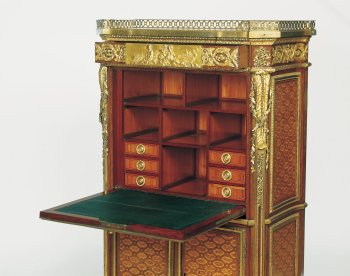
Jean-Henri Riesener, Secretaire, 1783, 140 × 81 × 42 cm (London: The Wallace Collection).
Jean-Henri Riesener (1734–1806), cabinetmaker to Louis XVI, was one of the most celebrated cabinetmakers of the French eighteenth century. He was also a phenomenon in the history of British art collecting, becoming a byword in the nineteenth century for all that was admired in French furniture. Before the French Revolution we have no evidence of a British patron, yet just fifty years later collectors like William Beckford, George IV and the 4th Marquess of Hertford had contributed to both his celebrity and the prices his furniture achieved. The nineteenth-century popularity of Riesener furniture was more than just an appreciation of the cabinetmaker’s designs and the quality of their execution; it was driven by a fascination for the ancien régime and romanticized views of the doomed Bourbon Court. It was also an indication of the resourcefulness of the innovative entrepreneurs and dealers in France and England who helped establish Riesener’s reputation in the decades following the Revolution. Through clever marketing techniques and a certain amount of ‘enhancement’, they educated a new generation of buyers and established Riesener’s name alongside that of André-Charles Boulle as being worthy of connoisseurs.
This paper will analyze the rise of Riesener’s celebrity and the dealers who made it happen. It will discuss the sales techniques of the early nineteenth-century auctioneers, the role played by connoisseurs such as Lord Hertford, and the democratization of Riesener furniture through the market for copies and reproductions. It will end with the Hamilton Palace sale of 1882, which opened up yet another new market for Riesener: the Americans.
Helen Jacobsen is Curator of French 18th-Century Decorative Arts at The Wallace Collection.
This seminar series in the History of Collecting was established in 2006 as part of the Wallace Collection’s commitment to the research and study of the history of collections and collecting, especially in the eighteenth and nineteenth centuries in Paris and London. The seminars, which are normally held on the last Monday of every month during the calendar year, excluding August and December, act as a forum for the presentation and discussion of new research into the history of collecting. Seminars are open to curators, academics, historians, archivists and all those with an interest in the subject.
This online seminar is also the first of three evening talks on Riesener held in collaboration with the Furniture History Society. Please click here to register.
◊ ◊ ◊ ◊ ◊
Rufus Bird, Mia Jackson, and Helen Jacobsen | Riesener Masterpieces: Royal Furniture in Britain
Online, Monday, 7 December 2020, 17.30–19.00 (BST)
Three of the most important collections of Riesener furniture in the world are in Britain. In the second talk in our series, speakers from the Wallace Collection, Royal Collection and Waddesdon Manor will discuss some of the 30 pieces in their care. These include celebrated works made for Marie-Antoinette, Louis XVI, and the French royal family that demonstrate the extraordinary levels of skilled craftsmanship achieved in the Riesener workshop and the design sophistication of which Riesener was capable. Our speakers will consider the popularity of French royal furniture in Britain in the 19th century and will illustrate the talk with stunning new photography from all three collections, revealing findings from the collaborative Riesener Project and shedding new light on both Riesener’s techniques and the provenance of some of the furniture.
Rufus Bird is Surveyor of The Queen’s Works of Art at The Royal Collection. Mia Jackson is Curator of Decorative Arts at Waddesdon Manor. Helen Jacobsen is Curator of French 18th-Century Decorative Arts at The Wallace Collection.
This online seminar is the second of three evening talks on Riesener held in collaboration with the Furniture History Society. Please click here to register.
◊ ◊ ◊ ◊ ◊
Alexander Collins | Mémoires for the Garde-Meuble: Riesener’s Perspective on Royal Furniture
Online, Monday, 14 December 2020, 17.30–19.00 (BST)
Riesener was court cabinetmaker for over ten years, supplying over 700 pieces to the French royal household. The details of these commissions were recorded in the Journal of the Garde-Meuble (the department of the royal household responsible for ordering and managing furnishings), as well as Riesener’s mémoires. These were invoices which contained detailed descriptions of the furniture, as well as the materials and techniques used to make them. Many of Riesener’s invoices survive and can be found in the collections of the Archives nationales and Bibliothèque nationale de France. This final talk in the series will explore a selection of invoices for pieces of royal furniture at Waddesdon Manor and the Royal Collection. They will tell us more about Riesener’s design and workshop processes, as well as the challenges he encountered during exceptionally ambitious projects.
Alexander Collins is the former Riesener Project Leverhulme Fellow at The Wallace Collection.
This online seminar is the third of three evening talks on Riesener held in collaboration with the Furniture History Society. Please click here to register.
Online ASECS Session | Rethinking Turquerie
From ASECS:
Rethinking Turquerie: New Definitions and Approaches
ASECS Virtual Session, Tuesday, 13 October 2020, 10am (EDT)
Organized by Ashley Bruckbauer
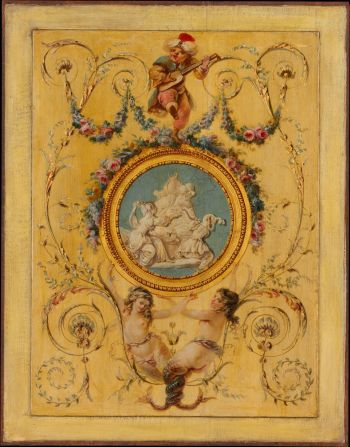
Attributed to Jules-Hugues Rousseau, Door panel from the ‘Cabinet Turc’ of Comte d’Artois at Versailles, 1781, oil on oak; overall painted surface: 32 × 24 inches (New York: The Met, Gift of J. Pierpont Morgan, 1906, 07.225.458a).
A vogue for all things ‘Turkish’ spread throughout Europe during the eighteenth century. Trade and travel between the Ottoman Empire and European states enabled Ottoman goods, including coffee, textiles, and costume albums, to flow into Europe. Likewise, artists living in the Levant, such as Jean-Baptiste Vanmour, produced numerous prints and paintings of Ottoman society for European audiences. Such objects inspired Turkish-themed masquerades in Rome, London, and Paris as well as portraits of European elites dressed à la turque. French nobles built cabinets turcs furnished with divans, sophas, and ottomans, while British and Polish monarchs erected Turkish-style tents and kiosks. Despite its immense popularity, European visual and material culture related to the Ottoman Empire remains underanalyzed. Like other forms of exoticism, turquerie has often been trivialized as a ‘decorative’ style lacking both veracity and substance. This panel aims to critically rethink eighteenth-century objects and images categorized as turqueries. In line with recent reassessments of chinoiserie and the rococo, it seeks to explore new definitions and approaches that recognize the diversity and complexity of these works of art.
Chair: Ashley Bruckbauer (Independent Scholar)
• Jonathan Haddad (University of Georgia), Cooking the Books: The Marquis de Caumont’s Turkish Cauldrons and the Ottoman Incunabula
• Mandy Paige-Lovingood (North Carolina State University), Dislocating Tradition: Eighteenth-Century Artists, Drawing, and Turquerie
• Katherine Arpen (Auburn University), The Hammam as a Model for Public Bathing in Late Eighteenth-Century France
All participants must fill out this form in order to receive the session link and password. Also, for security reasons, your Zoom profile name/phone number must match the name/phone number you register with or you will not be admitted to the session. Registration closes at noon (EDT) on 12 October 2020.
Please email asecs2020virtual@gmail.com with questions. More information on ASECS 2020 Virtual Sessions is available here.
Gothic Architecture and Sexuality in the Circle of Horace Walpole
From Penn State UP:
Matthew Reeve, Gothic Architecture and Sexuality in the Circle of Horace Walpole (University Park: The Pennsylvania State University Press, 2020), 280 pages, ISBN: 978-0271085883, $75.
 Gothic Architecture and Sexuality in the Circle of Horace Walpole shows that the Gothic style in architecture and the decorative arts and the tradition of medievalist research associated with Horace Walpole (1717–1797) and his circle cannot be understood independently of their own homoerotic culture. Centered around Walpole’s Gothic villa at Strawberry Hill in Twickenham, Walpole and his ‘Strawberry Committee’ of male friends, designers, and dilettantes invigorated an extraordinary new mode of Gothic design and disseminated it in their own commissions at Old Windsor and Donnington Grove in Berkshire, Lee Priory in Kent, the Vyne in Hampshire, and other sites.
Matthew Reeve argues that the new ‘third sex’ of homoerotically inclined men and the new ‘modern styles’ that they promoted—including the Gothic style and chinoiserie—were interrelated movements that shaped English modernity. The Gothic style offered the possibility of an alternate aesthetic and gendered order, a queer reversal of the dominant Palladian style of the period. Many of the houses built by Walpole and his circle were understood by commentators to be manifestations of a new queer aesthetic, and in describing them they offered the earliest critiques of what would be called a ‘queer architecture’.
Exposing the role of sexual coteries in the shaping of eighteenth-century English architecture, this book offers a profound and eloquent revision to our understanding of the origins of the Gothic Revival and to medievalism itself. It will be welcomed by architectural historians as well as scholars of medievalism and specialists in queer studies.
Matthew M. Reeve is Associate Professor of Art History at Queen’s University and Fellow of the Society of Antiquaries of London.
C O N T E N T S
List of Illustrations
Preface: Medievalism, Modernity, and the History of Sexuality
Abbreviations
Introduction
1 The New Medievalism: Constructing the Gothic in the Circle of Horace Walpole
2 Horace Walpole’s Strawberry Hill
3 Queer Family Romance in the Strawberry Hill Collection
4 Dicky Bateman and the Gothicization of Old Windsor
5 ‘The Spirit of Strawberry-Castle’: Donnington Grove, The Vyne, and Lee Priory
6 From Strawberry Hill Gothic to the Gothic Revival
Notes
Bibliography
Index
Exhibition | A Superb Baroque: Art in Genoa, 1600–1750
The exhibition was scheduled to be on view at the NGA this past summer; it will now arrive in Washington after appearing in Rome. From the NGA:
A Superb Baroque: Art in Genoa, 1600–1750 / La Superba e il Barocco
Scuderie del Quirinale, Rome, 25 March — 1 August 2021
National Gallery of Art, Washington, D.C., 26 September 2021 — 9 January 2022
Curated by Jonathan Bober, Piero Boccardo, and Franco Boggero
 By the 17th century, Genoa was the banking center of Europe with a functioning republican government and enormous wealth that enabled its artists and their patrons to create a singularly rich and beautiful expression of baroque style, with works of extraordinary material sumptuousness, visual splendor, and exuberant feeling. The first major presentation of the Genoese baroque in the United States, this landmark exhibition—accompanied by a fully illustrated catalog—presents some 130 paintings, sculptures, decorative arts, drawings, and prints ranging from 1600 through 1750.
Forming the core of the exhibition are works by the school’s well-known painters—Bernardo Strozzi, Giovanni Benedetto Castiglione, and Alessandro Magnasco—as well as key works by other Italians and foreigners drawn to the city’s flourishing environment—Peter Paul Rubens, Giulio Cesare Procaccini, Orazio Gentileschi, Anthony van Dyck, and Francesco Solimena. Some of the very finest works by such native painters as Valerio Castello, Domenico Piola, and Gregorio De Ferrari are also on view. Monumental decorative ensembles from churches and residences are represented by corresponding oil sketches and presentation models, several grand in scale themselves. Also included are full-size statues by masters—Pierre Puget, Filippo Parodi, and Anton Maria Maragliano—terracotta sketches, and exquisite bronze repetitions of monumental groups, as well as spectacular ceremonial silver from early in the period.
Among the drawings and prints featured are many by the same artists who executed the paintings and objects, with some connected to them. These works reveal the striking characteristics of Genoese draftsmanship: complex techniques, pictorial elaboration, and autonomous function. In fantasy and fluency, the etchings—particularly those of Castiglione and Bartolomeo Biscaino—surpass those of any other Italian school.
The exhibition is curated by Jonathan Bober, Andrew W. Mellon Senior Curator of Prints and Drawings, National Gallery of Art; Piero Boccardo, Superintendent of the City Collections of Genoa; and Franco Boggero, director, historic and artistic heritage section, Soprintendenza Archeologia, Belle Arti e Paesaggio, Genoa.
The exhibition is organized by the National Gallery of Art, Washington, and the Scuderie del Quirinale, Rome, with special cooperation from the City and Museums of Genoa. The exhibition is made possible by the Robert Lehman Foundation. Additional funding is provided by The Exhibition Circle of the National Gallery of Art.
The catalogue is now available from Princeton UP:
Jonathan Bober, Piero Boccardo, Franco Boggero, Peter Lukehart, and Andrea Zanini, A Superb Baroque: Art in Genoa, 1600–1750 (Princeton: Princeton University Press in association with the National Gallery of Art, Washington, DC, 2020), 384 pages, ISBN: 978-0691206516, $65 / £54.
Genoa completed its transformation from a faded maritime power into a thriving banking center for Europe in the seventeenth century. The wealth accumulated by its leading families spurred investment in the visual arts on an enormous scale. This volume explores how artists both foreign and native created a singularly rich and extravagant expression of the baroque in works of extraordinary variety, sumptuousness, and exuberance. This art, however, has remained largely hidden behind the facades of the city’s palaces, with few works, apart from those by the school’s great expatriates, found beyond its borders. As a result, the Genoese baroque has been insufficiently considered or appreciated.
Lavishly illustrated, A Superb Baroque is comprehensive, encompassing all the major media and participants. Presented are some 140 select works by the celebrated foreigners drawn to the city and its flourishing environment—from Peter Paul Rubens, Anthony van Dyck, and Giulio Cesare Procaccini to Pierre Puget, Marcantonio Franceschini, and Francesco Solimena; by the major Genoese masters active for much of their careers in other settings—Bernardo Strozzi, Giovanni Benedetto Castiglione, Filippo Parodi, and Alessandro Magnasco; and above all by the brilliantly synthetic but unfamiliar masters who worked primarily in Genoa itself—Gioacchino Assereto, Valerio Castello, Domenico Piola, and Gregorio De Ferrari. Offering three levels of exploration—essays that frame and interpret, section introductions that characterize principal currents and stages, and texts that elucidate individual works—this volume is by far the most extensive study of the Genoese baroque in the English language.










 Enfilade
leave a comment