FPS Online Symposium | The Art of the Dealer
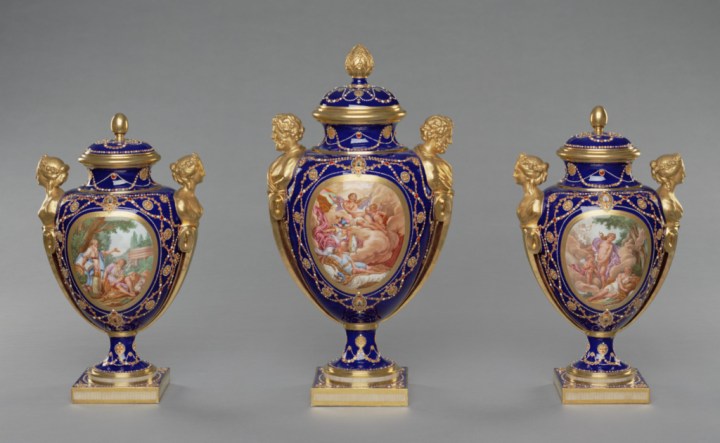
Garniture of Three Vases (vases des âges), Sèvres, 1781
(Los Angeles: J. Paul Getty Museum, 84.DE.718).
◊ ◊ ◊ ◊ ◊
From the FPS:
The Art of the Dealer: Selling Antique Ceramics, 1850 to 2000
Online, 12–13 June 2021
The French Porcelain Society is delighted to announce a two-day webinar on selling antique ceramics in the pre-digital age from 1850 to 2000.
The first day will focus on the dealer in the long nineteenth century, emerging from his chrysalis as a seller of ‘curiosities’ and ‘Old Sèvres porcelain’ to modern scholar-dealer, trading on an international stage, selling to museums through antiques fairs, themed exhibitions, lectures, specialist monographs, and catalogues devoted to ceramics. Papers will consider the Parisian dealer Beurdeley, the furnishing of J. Pierpont Morgan’s London home and the dealers who supplied him, and the rising market for oriental ceramics popularised by Edgar Gorer.
On day two, speakers will consider the legacy and change that characterised porcelain dealing in the twentieth century with papers on Marjorie Merriweather Post and French & Company in the United States, the activities of Hanns Weinberg in the 1950s for the Antique Porcelain Company, and finally Robert Williams at Winifred Williams Antiques. Each day will conclude with a panel discussion.
Zoom link for both days on our website soon. The full programme, with abstracts, is available here. Registration in advance is required. This symposium is free and open to all, but donations (here) are appreciated.
The programme is made possible with the generous support of Richard Baron Cohen.
All times are BST/UK
S A T U R D A Y , 1 2 J U N E 2 0 2 1
17.00 Session 1
• Caroline McCaffrey-Howarth (Visiting Research Fellow, History of Art and Museum Studies, University of Leeds and Curator, 17th- and 18th-Century Ceramics and Glass, V&A Museum), Marks, Monographs, and Mediators: The Long Nineteenth Century
• Camille Mestdagh (Associate Researcher, LARHRA), The Importance of Porcelain in the Business of a Parisian Curiosity Dealer: The Beurdeley Dynasty, a Case Study
17.50 Break
17.55 Session 2
• Linda H. Roth (Director of Special Projects/Curatorial and Charles C. and Eleanor Lamont Cunningham Curator of European Decorative Arts, Wadsworth Atheneum Museum of Art, Hartford, Connecticut), Mr. Morgan’s London House
• Nick Pearce (Richmond Chair of Fine Art, School of Culture & Creative Arts, University of Glasgow), ‘Sheer Cleverness and Courage’: Edgar Gorer (1872–1915) and the Rise of the Specialist Dealer in Chinese Art
19.00 Panel discussion and Q&A
S U N D A Y , 1 3 J U N E 2 0 2 1
17.00 Session 3
• Diana Davis (Independent researcher), The Twentieth Century: Legacy and Change
• Rebecca Tilles (Associate Curator of 18th-Century French and Western European Fine and Decorative Arts, Hillwood Estate, Museum and Gardens) Marjorie Merriweather Post and the Role and Influence of French & Company
17.50 Break
17.55 Session 4
• John Whitehead, FSA (Antique dealer and author), The Antique Porcelain Company: Porcelain Dealing in the Post-war Period
• Errol Manners, FSA (Antique dealer and author), Robert Williams of Winifred Williams Antiques
19.00 Panel discussion and Q&A
Online Conference | Finding Shakespeare in the Royal Collection
Begun in September 2018, ‘Shakespeare in the Royal Collection’ is a three-year AHRC funded project, focusing primarily on the period 1714–1945. From the project website:
Finding Shakespeare in the Royal Collection
Online, 17–19 June 2021
The Royal Collection contains Shakespeare-related items collected by generations of British monarchs, stretching back as far as Charles I, though principally concentrated in the eighteenth and nineteenth centuries. Including paintings, rare books, prints, watercolours, furniture, decorative objects, and photographs, these items tell a fascinating and overlapping set of stories about Shakespeare’s afterlife, the history of collecting, the histories of royalty and empire, and the histories of elite and popular culture. This conference brings together an international group of experts from fields including Shakespeare studies, history of art, collection studies, Romantic literature, and royal history.
Participants are invited to attend live online panels, or to view recorded panels for a limited time afterwards. We have speakers from Singapore to Texas, and the panels are timed across the day to maximise the possibility of attendance worldwide. A full conference programme, including abstracts and speaker bios, can be downloaded here.
The online conference platform is Zoom webinar, registered attendees will be emailed details of how to join the day before the event. To join, simply click on the join link in the email, your web browser will open up and you may be prompted to open Zoom. For further details of how to join Zoom meetings, see the company’s webpage. Live panels will be recorded, by attending you consent to the filming of the event and to being filmed yourself should you ask questions and in any other way participate live.
The conference is free to attend, but registration is essential. Tickets are available from Eventbrite. By registering, you agree to abide by the conference’s Code of Conduct. Participants violating the Code of Conduct will be removed from the event and will not be able to rejoin. For further information please email sharc@kcl.ac.uk.
All times are BST/ UTC+1 and subject to confirmation
T H U R S D A Y , 1 7 J U N E 2 0 2 1
Panel 1 | Exhibiting Shakespeare 10.00–11.30am
Chair: Gordon McMullan
• Michael Dobson (Shakespeare Institute), Hamlet Disowned: Kemble, Lawrence, and Royal Legitimacy
• Kate Retford (Birkbeck University of London), ‘A Wild and Unruly Youth’: Princes of Wales and The Harry the Fifth Club
• Shormishtha Panja (University of Delhi), ‘Moral Painting’: Nathaniel Dance Holland’s Timon of Athens, c. 1765–70
• Rosie Dias (University of Warwick), Personalising Public Art: Royal Narratives in Boydell’s Shakespeare Prints
Panel 2 | Shakespearean Relics 1.00–2.30pm
Chair: Kirsten Tambling
• Anna Myers (University of Edinburgh), David Garrick and the President’s Chair: Embodying Shakespeare through Intermedial Adaptation
• Mark Westgarth (University of Leeds), ‘Well-authenticated Blocks’: Materiality and the Market for Shakespearean ‘Mulberry Tree’ Relics in the Late Eighteenth and Early Nineteenth Centuries
• Simon Spier (University of Leeds), For Leisure or Learning?: An As You Like It Make-up Box by Hester Marian Wagstaff
Panel 3 | Shakespearean Reputations 4.00–5.30pm
Chair: Elizabeth Eger
• Kate Heard (Royal Collection Trust), ‘Pistol’s a Cuckold – or Adultery in Fashion’: Following a Print from Performance to Portfolio
• Arthur Burns (King’s College London), George III and the Other ‘Mad King’
• Essaka Joshua (University of Notre Dame), ‘I Only Change When I Die’: Gainsborough’s Portrait of Mary Robinson and Mutable Spectatorship
• Fiona Ritchie (McGill University), Fake and Authentic Shakespeare in the Diaries of Joseph Farington
F R I D A Y , 1 8 J U N E 2 0 2 1
Panel 4 | Shakespearean Books 10.00–11.30am
Chair: Sally Barnden
• Emma Stuart (Royal Collection Trust), Why did George IV Own a First Folio?
• Gordon McMullan (King’s College London), The ‘Disappointment’ of Charles I’s Second Folio
• Eleine Ng-Gagneux (National University of Singapore), Crossing Straits with Shakespeare Translation
‘Shakespeare in the Royal Collection’ Project Overview 12.00–1.00pm
Gordon McMullan, Kate Retford, Kirsten Tambling, Sally Barnden, and Felicity Roberts
Panel 5 | Shakespearean Interiors 2.00–3.30pm
Chair: Gail Marshall
• Elizabeth Clark Ashby (Royal Collection Trust), Shakespeare in Miniature: Shakespeare, Queen Mary, and Books for Dolls
• Kirsten Tambling (King’s College London), ‘All England in Warm Sepia’: Queen Mary and the Church of the Holy Trinity
• Morna O’Neill (Wake Forest University), Much Ado about Tapestry: Shakespeare, the Royal Family, and National Identity
S A T U R D A Y , 1 9 J U N E 2 0 2 1
Panel 6 | Mementoes of Performance 3.00–4.30pm
Chair: Richard Schoch
• Karen Harker (Shakespeare Institute), Remediation and Memory: Egron Sellif Lundgren’s Watercolours of The Winter’s Tale in Queen Victoria’s Theatrical Album
• Sally Barnden (King’s College London), Monument and Montage: Horatio Saker’s Visual History of the Stage
• Éilís Smyth (King’s College London), The Politics of Shakespeare at Windsor Castle in Louis Haghe’s The Performance of Macbeth in the Rubens Room
• Martin Blazeby (Blazebuild), Visualising Shakespearean Spaces and Stages of Performance at Windsor Castle
Panel 7 | Education and Performance 6.00–7.30pm
Chair: Kate Retford
• Lynne Vallone (Rutgers University), Princess Victoria and the Cult of Celebrity
• Gail Marshall (University of Reading), Puck and the Prince of Wales
• Vijeta Saini (Northeastern University), Disappearances and the Durbar: The Hidden Colonial Legacy of Queen Victoria’s Shakespearean Tableaux Vivants
• Kathryn Vomero Santos (Trinity University), ‘In Shakespeare’s Land’: Education, Cultural (Dis)inheritance, and the Decline of Empire in and around The Prince’s Choice
Call for Papers | New Approaches to Piranesi
The first installment of HECAA’s Zoom Event Series will feature a roundtable on Piranesi studies, moderated by Jeanne Britton and Zoe Langer, both affiliated with the Digital Piranesi Project at the University of South Carolina.
New Approaches to Piranesi: A Virtual Roundtable
Online, 16 July 2021
Organized by Jeanne Britton and Zoe Langer
Proposals due by 16 June 2021
We are seeking proposals for a virtual roundtable of lightning talks on interdisciplinary approaches to the works of Giovanni Battista Piranesi (1720–1778). Recent scholarship by Heather Hyde Minor, Carolyn Yerkes, and Susan Dixon, as well as the current bestselling novel Piranesi by Susanna Clarke, have started to open the field of Piranesi Studies to new avenues of research and potentially wider audiences. This roundtable will consist of short presentations of 5–7 minutes followed by ample time for discussion. We hope the proposed format will encourage lively conversation and prompt new critical perspectives that will continue to broaden the interpretation of Piranesi’s works. We welcome topics that include but are not limited to eclecticism, globalism, reception, book history, biographical studies, cartography, collecting, translation, digital humanities, theater, fashion, music, archaeology, and the history of science. We are especially interested in hearing from graduate students, early-career scholars, and professionals engaged in a wide range of disciplinary fields and methods.
Please send an abstract of 150 words, a brief biography, and current contact information. Submissions should be sent to digitalpiranesi@gmail.com by Wednesday, 16 June 2021. Decisions will be sent on Friday, 18 June.
Sponsored by HECAA (Historians of Eighteenth-Century Art & Architecture)
Story of Yanxi Palace
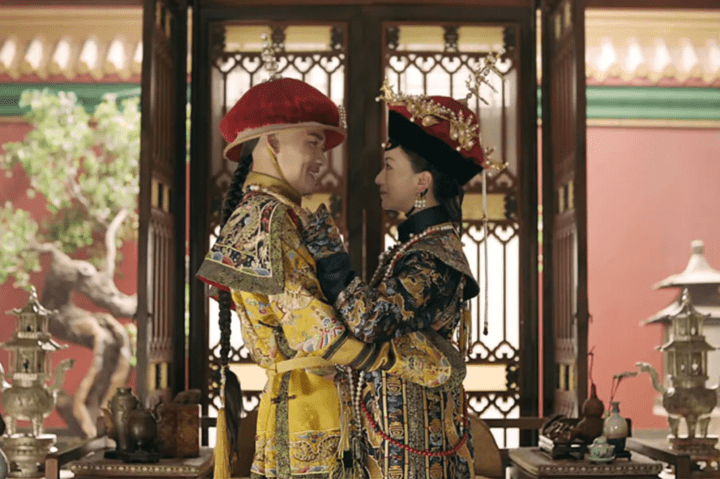
Still from Story of Yanxi Palace (2018), with the empress wearing a replica of a fengguan (phoenix crown) now in the Palace Museum, Beijing.
◊ ◊ ◊ ◊ ◊
I’m at least two years overdue with this posting—the series appeared in 2018—but I learned of it only recently thanks to Isabella Smith’s essay in the May issue of Apollo. I’m just three episodes in, but totally entranced. –CH
Isabella Smith, “An Audience with the Qianlong Emperor, via the Small Screen,” Apollo Magazine (May 2021).
It’s like Game of Thrones, but with art instead of sex. I’ve found myself repeating that summary frequently while evangelising about Story of Yanxi Palace (2018), a Chinese period drama loosely based on historic figures in the Qing dynasty court of the Qianlong Emperor (1711–1799)—and one of my lockdown obsessions. The tale begins in 1741, when our Cinderella-like heroine Wei Yingluo (Wu Jinyan) enters the Forbidden City, ostensibly to work as an embroidery maid at the palaces, but with a secret mission: to uncover the perpetrator behind her beloved sister’s rape and murder. It’s a suitably knotty start to a narrative as labyrinthine as it is long; the series comprises 70 episodes at 45 minutes apiece.
Besides the intricacies of its intrigues, what has kept me enthralled is the sheer spectacle of the thing. From its heavily embroidered robes and carved jade to lavish lacquerwork and pottery, Story of Yanxi Palace is a feast for the eyes. In 2018, the show was streamed more than 15 billion times on the Chinese video platform iQiyi, before falling foul of government censors and being pulled from TV screens. The charge? Its ‘negative influence on society’, promoting admiration for imperial China and its luxurious lifestyles, an argument initially set out in Theory Weekly (a magazine affiliated with the Chinese Communist Party’s newspaper, the Beijing Daily).
What sets Story of Yanxi Palace apart from similar historical dramas—and China boasts a rich roster of such shows—is its devotion to the decorative arts. . . .
The full essay is available here»
For the wider media context of the series in China, see Jiayang Fan’s essay, “In China, Shows Like ‘Story of Yanxi Palace’ Go Viral, and the Party Is Not Amused,” The New Yorker (23 April 2019).










 Enfilade
leave a comment