Online Colloquium | Celebrating the Illustrious in Europe, 1580–1750
From the programme for the conference:
La célébration des Illustres en Europe (1580-1750) : vers un nouveau paradigme?
Celebrating the Illustrious in Europe, (1580–1750): Towards a New Paradigm?
Online, 25–26 November 2021
Organized by Antoine Gallay, Carla Julie, and Matthieu Lett
Colloque organisé conjointement par l’UNIL (Section d’Histoire de l’art) et par l’Université de Bourgogne (LIR3S CNRS UMR 7366) avec le concours de la Conférence universitaire de Suisse occidentale (CUSO)
Le colloque se propose d’explorer une partie des productions biographiques d’une période usqu’alors peu étudiée sous cet angle. Les deux journées ont pour objectif de mieux comprendre comment se transformèrent, entre 1580 et 1750, les modes de célébration de la gloire des illustres, tant par l’écrit que par l’image, en tenant compte de l’ensemble des médiums que constituent le livre, l’estampe, la peinture, la sculpture ou encore la médaille.
Organisation
• Antoine Gallay (Université de Tel Aviv – The Cohn Institute), antgallay@hotmail.com
• Carla Julie (Université de Lausanne – Université de Bourgogne), carla.julie@unil.ch
• Matthieu Lett (Université de Bourgogne – LIR3S), matthieu.lett@u-bourgogne.fr
Comité scientifique
• Jan Blanc, professeur d’histoire de l’art de la période moderne (Université de Genève)
• Estelle Doudet, professeure de littérature française (Université de Lausanne)
• Laurence Giavarini, maîtresse de conférences HDR en littérature des XVIe et XVIIe siècles (Université de Bourgogne – LIR3S)
• Christian Michel, professeur d’histoire de l’art de la période moderne (Université de Lausanne)
• Frédéric Tinguely, professeur de littérature française (Université de Genève)
Lien du colloque:
https://unil.zoom.us/j/92708025500
ID de réunion : 927 0802 5500
J E U D I , 2 5 N O V E M B R E 2 0 2 1
9.15 Accueil
9.30 Introduction
• Antoine Gallay, Carla Julie, Matthieu Lett
10.00 Session 1: Nouveaux Illustres
Président de séance : Matthieu Lett
• Rémi Jimenes (Université de Tours) et Estelle Leutrat (Université Rennes 2) — Gabriel-Michel de La Rochemaillet, Jean Le Clerc et Les pourtraicts de plusieurs hommes illustres qui ont flory en France depuis l’an 1500
• Paula Almeida Mendes (CITCEM – Université de Porto) — Les ‘femmes illustres’: représentations littéraires et culturelles au Portugal, XVIe–XVIIIe siècles
• Malcolm Baker (University of California, Riverside) — How did images make modern authors illustrious?
12.30 Pause déjeuner
14.00 Session 2: Nouveaux Régimes de Célébration
Président de séance : Frédéric Tinguely
• Marion Deschamp (Université de Lorraine) — En être, ou pas. Conversions, redéfinitions et exclusions de l’économie des grandeurs dans les recueils protestants d’hommes illustres, XVIe– XVIIe siècles
• Pascale Cugy (Université Rennes 2) — Le monde du spectacle dans les portraits en mode parisiens (1690–1710) : à propos de la célébration gravée de quelques noms de la Comédie-Française et de l’Opéra
• Sophie-Luise Mävers (Universität zu Köln) — A faceless gallery of illustrious scientists and artists? Sébastien Leclerc’s orchestration of an institutional utopia
• François Lavie (Université Paris 8) — Recueillir les bons mots des « personnes illustres » dans la France moderne : pratiques de compilation et célébration de l’esprit des grands hommes, 1680–1750
V E N D R E D I , 2 6 N O V E M B R E 2 0 2 1
9.30 Session 3: Desseins Politiques
Président de séance : Laurence Giavarini
• Stanis Perez (Maison des sciences de l’homme Paris-Nord) — La Gallerie des femmes fortes : de la collection historiographique au miroir politique
• Margaux Prugnier (Université Paris Nanterre) — De la célébration des Grands à celle des Lorrains : les œuvres de Dom Calmet (1672–1757) au gré des évolutions de la France de la première moitié du XVIIIe siècle
• Craig Hanson (Calvin University, Grand Rapids) — Thomas Birch’s Heads of Illustrious Persons (1743–1751). Collecting Art, Collecting National Histories
12.00 Pause déjeuner
13.30 Session 4: De la Collection à la Célébration
Président de séance : Antoine Gallay
• Clarisse Evrard (Université de Lille) — Regard d’un illustre sur ses pairs : l’Armamentarium Heroicum, de la collection d’armures au théâtre de papier
• Carla Julie (Université de Lausanne – Université de Bourgogne) — Curieux d’estampes et Illustres dans la France du XVIIe siècle : autour de Michel de Marolles
• Maxime Martignon (Université Paris Nanterre) — Choisir les Illustres : Michel Bégon et le projet biographique
16.00 Conclusion
• Christian Michel (Université de Lausanne)
University of California Press FirstGen Program
From UC Press:
University of California Press FirstGen Program
 At UC Press, we aim to publish and support bold, diverse perspectives that are representative of an inclusive spectrum of voices. This mission informs not only the scholarship we publish, but how we support the community of scholars and authors. We know that book publishing can be difficult to navigate for many scholars, and we’re dedicated to making it a more equitable process for all.
Our FirstGen Program seeks to cultivate and support the work of first-generation scholars—those who are the first in their fam ily to receive a college degree. As we know from research and the University of California’s own FirstGen program, first-gen students often confront a range of intersecting inequalities across race, class, immigration status, and more. First-gen scholars who have gone on to attain advanced degrees and become faculty must navigate additional barriers within the academy. In our role as a non-profit, progressive press within the public UC system, we aim to extend the UC’s efforts by more effectively cultivating, publishing, and promoting the work of first-gen scholars.
Our program includes:
• Financial support to help eliminate costs associated with book publishing, support the writing process, and maximize the reach and impact of the author’s scholarship (e.g. developmental editing, indexing, permissions, etc)
• Publishing workshops and webinars to help demystify the book publishing process for first-gen scholars, and provide opportunities for community-building and networking
• Online resources about book publishing, to enable accessible information for the first-gen scholar community
• Data and findings from the research phase of our program, to raise awareness about the first-gen publishing experience and provide information to the academic and publishing community about how to support these scholars
• A FirstGen Program email list to establish regular communication with first-gen scholars about relevant publishing resources, events, program updates, and to gather feedback that will improve our program and our publishing
More information is available here»
The Burlington Magazine, October 2021
The eighteenth century in October’s issue of The Burlington . . . Rado’s article is not an eighteenth-century essay, but she is a HECAA member (!), and she briefly frames the material in terms of a longer history; the theme for the October issue is ‘art in twentieth-century China’. –CH
The Burlington Magazine 163 (November 2021)
 E D I T O R I A L
• “Art History in the Anthropocene” p. 883.
A R T I C L E S
• Mei Mei Rado, “The Empress Dowager Cixi’s Japanese Screen and Late Qing Imperial Cosmopolitanism,” pp. 886–97.
R E V I E W S
• Arthur Bijl, Review of the exhibition catalogue Kjeld von Folsach, Joachim Meyer, and Peter Wandel, Fighting, Hunting, Impressing: Arms and Armour from the Islamic World, 1500–1850 (Copenhagen: David Collection / Strandberg Publishing, 2021), pp. 946–47.
• Kee Il Jr Choi, Review of John Finlay, Henri Bertin and the Representation of China in Eighteenth-Century France (Routledge, 2020), pp. 966–67.
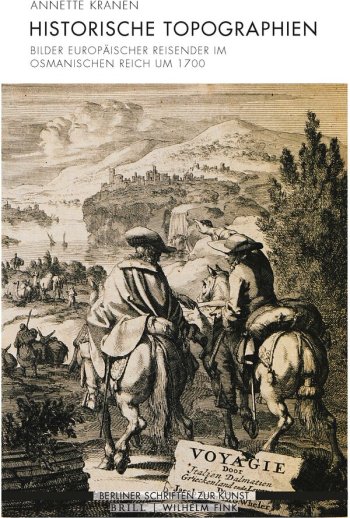
• Mirjam Hähnle, Review of Annette Kranen, Historische Topographien: Bilder europäischer Reisender im Osmanischen Reich um 1700 (Brill, 2020), pp. 971–72.
Online Book Launch | Enlightened Eclecticism
This Friday at 6.30pm (GMT) via Zoom:
Adriano Aymonino, Enlightened Eclecticism: The Grand Design of the 1st Duke and Duchess of Northumberland
Online Book Launch, Sir John Soane’s Museum, London, 19 November 2021
 Hosted by Sir John Soane’s Museum in their beautiful library, and presented in collaboration with the Society for the History of Collecting, this virtual event will celebrate the publication of Adriano Aymonino’s new book, Enlightened Eclecticism: The Grand Design of the 1st Duke and Duchess of Northumberland.
The central decades of the eighteenth century in Britain were crucial to the history of European taste and design. One of the period’s most important campaigns of patronage and collecting was that of the 1st Duke and Duchess of Northumberland: Sir Hugh Smithson (1712–86) and Lady Elizabeth Seymour Percy (1716–76). This book examines four houses they refurbished in eclectic architectural styles—Stanwick Hall, Northumberland House, Syon House, and Alnwick Castle—alongside the innumerable objects they collected, their funerary monuments, and their persistent engagement in Georgian London’s public sphere. Over the years, their commissions embraced or pioneered styles as varied as Palladianism, rococo, neoclassicism, and Gothic revival. Patrons of many artists and architects, they are revealed, particularly, as the greatest supporters of Robert Adam. In every instance, minute details contributed to large-scale projects expressing the Northumberlands’ various aesthetic and cultural allegiances. Their development sheds light on the eclectic taste of Georgian Britain, the emergence of neoclassicism and historicism, and the cultures of the Grand Tour and the Enlightenment.
S C H E D U L E
18.30 Introduction by Frances Sands (Curator of Drawings and Books, Sir John Soane’s Museum)
18.40 Talk by Kate Retford (Professor of Art History, Birkbeck, University of London)
19.10 Talk by Adriano Aymonino (Senior Lecturer and Director of Undergraduate Programs, Department of History and History of Art, University of Buckingham)
19.30 Conversation and questions moderated by Adriana Turpin (Director of Institut Des Etudes Superieurs Des Arts UK)
Fellowships | Ecology, Ephemeral Architecture, and Imperialism

The William Andrews Clark Memorial Library underwent a major renovation between 2015 and 2017, carried out by the Architectural Resources Group. As noted at the ARG website, “Donated to the University of California in 1926 during its construction, the William Andrews Clark Memorial Library was one of the earliest locally designated historic landmarks for the City of Los Angeles and has also been listed on the California Register of Historic Places. ARG served as Prime Architect for a rehabilitation of the building, which included a seismic retrofit, accessibility and fire-safety upgrades, and a new entry pavilion.” The project earned a Preservation Design Award from the California Preservation Foundation in 2018. Photograph by Stephen Schafer, from the ARG website.
◊ ◊ ◊ ◊ ◊
As noted at ASECS:
The Forgotten Canopy: Ecology, Ephemeral Architecture, and Imperialism in the Caribbean, South American, and Transatlantic Worlds
Ahmanson-Getty Postdoctoral Fellowships, 2022–2023
Center for 17th- and 18th-Century Studies and William Andrews Clark Memorial Library, UCLA
Organized by Stella Nair and Paul Niell
Proposals due by 1 February 2022
The 2022–23 core conference program to be held by the Center for 17th– & 18th-Century Studies at UCLA’s William Andrews Clark Memorial Library will convene scholars around the topics of “Ecology,” “Ephemeral Architecture,” and “Imperialism” in the early modern (16th–19th- century) world. The circum-Caribbean is our starting point, specifically we use this term to refer to the deep connections between the peoples and places of the Caribbean and South America, along with parts of North America. Due to national politics, language barriers, and scholarly divisions that have their roots in the European colonization of the Americas, the long and complex history of exchange among these regions and peoples have been greatly understudied. In truth, this history of entanglement across water and land stretches back millennia, resulting in a rich and diverse built environment that is deeply tied to ecological change. This dynamic did not end with the invasion of 1492, but rather continued to expand and accelerate when people, plants, and empires came from across the Atlantic. Using ephemeral architecture—in particular the complex and exquisite creation of thatch roofs as the leading thread in these tapestries of exchange—this series of conferences highlights the profound ways in which environmental practices, botanical knowledge, technological development, architectural innovation, and creative expression were deeply tied across these distinct regions and peoples, and impacted by imperial actions. This conference series brings an unusually diverse number of disciplines together in order to unpack these complex dynamics, which challenge how we understand the built environment, the early modern Atlantic world, and the intersections between the local and the global.
Topic 1: Ecologies
4–5 November 2022
Topic 2: Ephemeral Architectures
10–11 February 2023
Topic 3: Imperialism
14–15 April 2023
The theme-based resident fellowship program, established with the support of the Ahmanson Foundation and the J. Paul Getty Trust, is designed to promote the participation of junior scholars in the Center’s yearlong core program. Awards are for three consecutive quarters in residence at the Clark. Scholars must have received their doctorates in the last six years (2016–2022), and their research should pertain to the announced theme. Fellows are expected to make a substantive contribution to the Center’s workshops and seminars. The deadline for fellowship applications for the 2022–2023 year is 1 February 2022. Further details and a link to our online application can be found at the Center’s website.
The Center for 17th- and 18th-Century Studies provides a forum for the discussion of central issues in the field of seventeenth- and eighteenth-century studies. It organizes academic programs, bringing together scholars from the region, the nation, and the world, with the goal of encouraging research from as early as the time of Lope de Vega and William Shakespeare to the defeat of Napoléon and the death of Lord Byron. Established in 1985, the Center also administers the William Andrews Clark Memorial Library, located on a historic property in the West Adams neighborhood of Los Angeles. The Clark serves as the research laboratory for a distinguished array of fellows working either in early modern studies or the fin-de-siècle world of Oscar Wilde. The Center also offers a range of cultural programs, including chamber music concerts, theatrical performances, and lectures.
UK Export Ban Placed on Tipu Sultan Throne Finial
Press release (12 November 2021) from Gov.UK’s Department for Culture, Media & Sport:
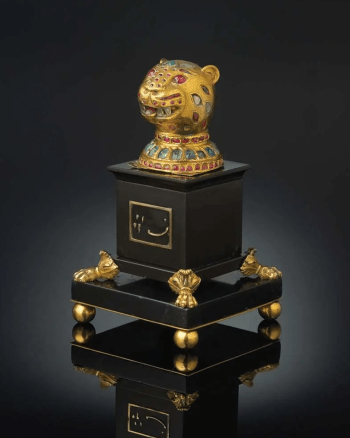
Tiger’s Head Finial from the throne of Tipu Sultan of Mysore, 1787–93, with the plinth possibly made in Madras or Calcutta, ca. 1799–1800. Gold over a lac core; set with rubies, diamonds, and emeralds. The head is mounted on a black marble pedestal with gilt metal inscription and mounts, with four gilt metal feet and four gilded balls. The head is 6.9cm high; the total height is 17.5cm.
Valued at £1.5 million, a gold jewelled tiger head, which in the late 18th century adorned the gold-covered throne of Tipu Sultan, is at risk of leaving the UK unless a UK buyer can be found. Tipu Sultan (1750–1799), the ‘Tiger of Mysore’, was regarded as the greatest threat to the British East India Company until his defeat and death in 1799. As ruler of Mysore, Tipu identified himself and his personal possessions with tiger imagery, and this finial offers scholars the opportunity to illustrate the vibrant culture of Tipu’s court and closely examine British imperial history. Three surviving contemporary images of the throne are all in the UK. The finial is one of eight gold tiger heads that adorned the throne.
The finial—made of gold and set with rubies, diamonds, and emeralds—is a rare example of fully documented 18th-century South Indian goldsmiths’ work, and its existence was unknown until 2009. Its marble pedestal is unique among the five surviving finials known, and the meaning of its gold inscription is still a mystery. Following Tipu’s defeat, many objects from his treasury arrived in Britain, where they influenced poetry (John Keats), fiction (Charles Dickens and Wilkie Collins), and artists (J.M.W. Turner), and were generally met with huge public interest.
Arts Minister Lord Parkinson of Whitley Bay said: “This fascinating finial illustrates the story of Tipu Sultan’s reign and leads us to examine our imperial history. I hope a UK-based buyer comes forward so that we can all continue to learn more about this important period in our shared history with India.”
The Minister’s decision follows the advice of the Reviewing Committee on the Export of Works of Art and Objects of Cultural Interest (RCEWA). The Committee agreed that it is an important symbolic object in Anglo-Indian history in the last years of the 18th century, with Tipu’s defeat having great historical importance to Britain’s imperial past and leading to a contemporary fascination with Tipu’s story and objects.
Committee Member Christopher Rowell said: “Tipu Sultan’s golden and bejewelled throne (c.1787–93) was broken up by the British army’s Prize Agents after Tipu’s defeat and death in defence of his capital, Seringapatam, in 1799. This tiger’s head is one of the original eight which were placed on the balustrade of the octagonal throne. Each gold tiger’s head from the railing is slightly differently set with gemstones, which makes this example both part of a set and unique in its design. Its quality attests to the expertise of Tipu’s goldsmiths and jewelers, in whose productions he took a close personal interest. The head of the large gold rock crystal tiger that supported the throne and a bejewelled huma bird that perched on the pinnacle of its canopy were presented to George III and Queen Charlotte (Royal Collection Trust). The tiger and its stripes were Tipu’s personal symbols. “Better to live one day as a tiger than 1,000 years as a sheep” he famously declared. His flirtation with Napoleonic France led to his downfall at British hands. This tiger’s head, one of four throne finials to survive, including a head in the Clive Museum at Powis Castle (NT), should remain in the country together with the other fragments of the throne, and I hope that every effort will be made to achieve this.”
The Committee made its recommendation on the grounds that the finial’s departure from the UK would be a misfortune because it is so closely connected with our history and national life and is of outstanding significance for the study of royal propaganda and 18th-century Anglo-Indian history. The decision on the export licence application for the finial will be deferred until 11 February 2022. This may be extended until 11 June 2022 if a serious intention to raise funds to purchase it is made at the recommended price of £1.5 million.
Provenance: Tipu Sultan of Mysore (1787–1799); Thomas Wallace, Baron Wallace of Knarsdale (ca.1800 or later)—listed in an 1843 inventory of the contents of Featherstone Castle (Northumberland), the family seat, and thence by descent; Bonhams, London, 2 April 2009 (lot 212); private collection.
Literature: Bonhams, London: 2 April 2009, lot 212; A Jaffer, ed., Beyond Extravagance (New York, 2013), pp. 189–90, cat. 61; N. N. Haidar, ed., Treasures from India (New York, 2014), pp. 46–7; Export of Objects of Cultural Interest 2010/11 (2011): Case 1, p. 23.
Exhibition | Hogarth and Europe

William Hogarth, The March of the Guards to Finchley, 1749–50
(London: The Foundling Museum)
◊ ◊ ◊ ◊ ◊
From the press release (1 November 2021) for the exhibition:
Hogarth and Europe
Tate Britain, London, 3 November 2021 – 20 March 2022
Curated by Alice Insley and Martin Myrone
Few artists have defined an era as much as William Hogarth (1697–1764), whose vivid, satirical depictions of 18th-century England continue to capture the imagination today. Tate Britain’s major exhibition Hogarth and Europe presents his work in a fresh light, seen for the first time alongside works by his continental contemporaries. It explores the parallels and exchanges that crossed borders and the cosmopolitan character of Hogarth’s art. Hogarth’s best-known paintings and prints—such as Marriage A-la-Mode (1743), The Gate of Calais (1748), and Gin Lane (1751)—are shown alongside works by famed European artists, including Jean-Siméon Chardin in Paris, Pietro Longhi in Venice, and Cornelis Troost in Amsterdam. Together they reveal how changes in society took art in new directions, both in Britain and abroad.
 Featuring over 60 of Hogarth’s works, brought together from private and public collections around Europe and North America, the exhibition draws decades of research to show Hogarth in all his complexity—whether as staunch patriot or sharp critic, bawdy satirist or canny businessman. It also examines the shifting status of artists in the 18th century, from workshop artisans and court painters to independent freelancers enjoying prominence alongside actors, musicians, and writers. The rapid expansion of urban centres like London, Paris, Amsterdam, and Venice also saw the city itself become a major subject in art for the first time. Tate Britain juxtaposes these metropolitan scenes from across Europe, showing the bustling London streets of Hogarth’s Southwark Fair (1733) and The March of the Guards to Finchley (1749–50) together with vibrant depictions of Étienne Jeaurat’s Paris and Longhi’s Venice.
This was an age of opportunity and innovation, but also materialism, self-delusion, exploitation, and injustice. In Europe, new heights of luxury emerged with extreme poverty, while growing cities saw overcrowding and disease. The rising demand for consumer goods at home came at the expense of the labour and lives of enslaved and colonised people overseas. Against the backdrop of this changing world, artists like Hogarth pioneered a new painting of modern life, revealing its pleasures and dynamism but also its dangers and stark inequalities. In the 1730s he began his ‘modern moral series’: frank and engaging narratives charting the rise and fall of everyday characters corrupted by immorality and vice. Hogarth and Europe includes these celebrated series, including A Rake’s Progress (1734), which were immediately popular and widely circulated through print. At Tate Britain they are shown alongside paintings by the Italian Giuseppe Crespi, including The Flea (1707–09), and the Parisian Nicolas Lancret, to show how this new artistic genre of urban storytelling developed across Europe.
The 18th century also saw greater informality and ease in portraiture, expressing the new ideas emerging around individuality and personal freedom that remain familiar today. The exhibition culminates in a room focussing on such pictures, including Miss Mary Edwards (1742)—a painting not seen in the UK for over a century—depicting the eccentric, wealthy patron who commissioned many of Hogarth’s best-known works. Additional highlights include paintings of his sisters Mary and Anne Hogarth, as well as Heads of Six of Hogarth’s Servants (c.1750–55). Through juxtapositions with European artworks, the exhibition looks afresh at these and many other works by one of Britain’s most important artists, giving visitors a chance to see Hogarth’s position on the international stage in a new light.
Hogarth and Europe is curated by Alice Insley, Curator, British Art c 1730–1850 and Martin Myrone, former Senior Curator, pre-1800 British Art, Tate Britain (now Convenor, British Art Network at the Paul Mellon Centre). The exhibition is accompanied by a fully illustrated catalogue featuring essays by eminent scholars and artists including Lubaina Himid and Sonia E. Barrett.
Martin Myrone and Alice Insley, eds., Hogarth and Europe (London: Tate, 2021), 208 pages, ISBN: 978-1849767682, £40 / $55.
The exhibition guide is available here»
New Book | Hogarth: Life in Progress
From Profile Books:
Jacqueline Riding, Hogarth: Life in Progress (London: Profile Books, 2021), 544 pages, ISBN: 978-1788163477, £30 / $40.
 On a late spring night in 1732, a boisterous group of friends set out from their local pub. They are beginning a journey, a ‘peregrination’ that will take them through the gritty streets of Georgian London and along the River Thames as far as the Isle of Sheppey. And among them is an up-and-coming engraver and painter, just beginning to make a name for himself: William Hogarth.
Hogarth’s vision, to a vast degree, still defines the eighteenth century. In this, the first biography for over twenty years, Jacqueline Riding brings him to vivid life, immersing us in the world he inhabited and from which he drew inspiration. At the same time, she introduces us to an artist who was far bolder and more various than we give him credit for: an ambitious self-made man, a devoted husband, a sensitive portraitist, an unmatched storyteller, philanthropist, technical innovator, and author of a seminal work of art theory.
Following in his own footsteps from humble beginnings to professional triumph (and occasional disaster), Hogarth illuminates the work and life of a great artist who embraced the highest principles even while charting humanity’s lowest vices.
Jacqueline Riding is a historian and art historian specialising in British history and art of the long eighteenth century. Former curator of the Palace of Westminster and Director of the Handel House Museum, she is an award-winning author as well as a consultant for museums, galleries, historic buildings, and feature films. She was the adviser on Mike Leigh’s Mr. Turner (2014) and Peterloo (2018) and Wash Westmoreland’s Colette (2018).
Lecture | Frédéric Ogée, Pleasures of the Senses and the Imagination
From the conference series Sociabilité et libertinage au siècle des Lumières, organized at the Cognacq-Jay Museum in conjunction with this year’s summer exhibition Realm of the Senses, from Boucher to Greuze / L’ Empire des sens, de Boucher à Greuze (19 May — 18 July 2021), curated by Annick Lemoine . . .
Frédéric Ogée | Plaisirs des sens, plaisirs de l’imagination dans l’art et la littérature anglaise du 18ème siècle
Online and In-Person, Musée Cognacq-Jay, Paris, 26 November 2021, 17.00
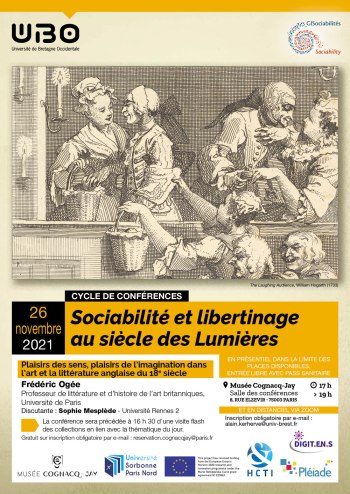 Dans le sillage de sa « Glorieuse Révolution » de 1688, l’Angleterre inaugura le siècle des Lumières en découvrant le plaisir d’un certain nombre de libertés : « régler le pouvoir des rois en leur résistant » (Voltaire), publier sans entrave, ré-évaluer l’héritage des Anciens, regarder la Nature à travers le prisme de Newton plutôt que celui des prêtres, entreprendre à crédit, célébrer la sensibilité et l’imagination. Les Anglais ont ainsi cherché de nouveaux équilibres entre la liberté de l’individu—son goût, sa subjectivité, sa perception du monde, son « progrès » —et les nécessités de la sphère collective, qu’elle soit publique ou privée. Ecrivains et artistes se sont vite employés à représenter cette nouvelle sociabilité, pour la modéliser et la polir autant que pour la promouvoir, au travers de remarquables expériences littéraires et picturales où les personnages se meuvent et s’émeuvent sous l’œil complice du spectateur-lecteur. Influencés par la philosophie empiriste ils font l’expérience du plaisir des sens pour accéder à la connaissance, d’eux-mêmes et du monde. La présente conférence permettra d’évoquer cette remarquable période de créativité qui, de Daniel Defoe et William Hogarth à Jane Austen et Thomas Lawrence, contribua au triomphe de la Grande-Bretagne sur la scène du monde.
Discutante: Sophie Mesplède (Université Rennes 2)
Frederic Ogee est professeur de littérature et d’histoire de l’art britanniques à l’Université de Paris. Ses principaux domaines de recherche sont l’esthétique, la littérature et l’art au cours du long 18ème siècle (1660–1815), sur lesquels il a souvent donné des conférences dans des universités européennes, nord-américaines et asiatiques. Commissaire de l’exposition sur le peintre anglais William Hogarth au Musée du Louvre en 2006, il est l’auteur de plusieurs ouvrages, notamment Diderot and European Culture, un recueil d’essais (Oxford: 2006, réédité 2009), J.M.W. Turner : Les paysages absolus (Hazan, 2010), et Jardins et Civilisations (Valenciennes, 2019), suite à une conférence organisée à l’Institut Européen des Jardins et Paysages de Caen. Il écrit actuellement une série de quatre monographies sur quelques grands artistes anglais (Thomas Lawrence, J.M.W. Turner, Thomas Gainsborough et William Hogarth) pour les éditions Cohen & Cohen (Paris), à paraître entre 2022 et 2025. De 2014 à 2017, il a été membre du conseil scientifique du musée Tate Britain à Londres et, depuis 2014, est membre du Conseil Scientifique de la Ville de Paris.
Conférence en présentiel dans la limite des places disponibles, entrée libre avec pass sanitaire ET en distanciel via Zoom. Participation libre sur inscription obligatoire: reservation.cognacqjay@paris.fr et alain.kerherve@univ-brest.fr. La conférence sera précédée à 16h30 d’une visite flash des collections en lien avec la thématique du jour.
Emmanuelle Brugerolles, Marine Carcanague, Marie-Anne Dupuy-Vachey, Guillaume Faroult, Yuriko Jackall, F. Joulie, É. Kerner, A. Laing, C. Le Bitouzé, A. Le Brun, A. Lemoine, N. Lesur, H. Meyer, L-A. Prat, S. de Saint-Léger, M. Szanto, L’ Empire des sens, de Boucher à Greuze (Paris Musées / Musée Cognac-Jay, 2020), 152 pages, ISBN: 978-2759605002, €30.
Call for Papers | English and Irish Crystal Drinking Glass, 1640–1702
From ArtHist.net:
English and Irish Crystal Drinking Glass, 1640–1702
Victoria and Albert Museum, London, 6 October 2022
Proposals due by 1 March 2022
Writing the translation of Neri’s The Art of Glass in 1662 Christopher Merret declared that English glassmakers had “these twenty years last past much improved themselves.” Similarly, in 1672 the glass-seller John Green claimed that “we now make very good drinking glasses in England.” Undoubtedly, the latter half of the seventeenth century was a period of material, technical, and aesthetic development, which saw the vessel-glass industry in England and Ireland reach maturity. The V&A Museum in partnership with the Association for the History of Glass is delighted to announce a conference entitled Celebrating the Birth of English and Irish Crystal Drinking Glass, 1640–1702 as part of the UN International Year of Glass to be held at the V&A on Thursday, 6 October 2022. This study day aims to explore the evolving story of the birth of these sophisticated products a century before the ‘industrial revolution’ began. We invite contributions that draw on a range of methodological perspectives including art history, history, archaeology, science technology, conservation, curatorial praxis, and historic making practices.
2022 has recently been designated by the United Nations as International Year of Glass. 2022 also marks 125 years since the publication of Albert Harshorne’s Old English Glasses, the first serious study of the history of English and Irish glass, and additionally represents 350 years since 1672, a pivotal year in the development of crystal glass. Thirty years earlier had seen the closure of the only crystal glass factory in these isles, but twenty years later there were approximately thirty glasshouses producing flint and crystal glass and the industry was the envy of our continental rivals. Such a growth rate was probably unprecedented, yet it was encouraged by a range of key events including: the publication of Merrett’s translation of Neri’s Art of Glass at the request of the newly-formed Royal Society (1662); the establishment of The Worshipful Company of Glass Sellers of London, who received their Royal charter which, among other things, enabled them to assume responsibility for drinking glass designs (1664); and the decision taken by the King to allow saltpetre imported from India to be sold at public auctions, removing the last barrier to the economic production of a high-quality British flint glass (1672). By the 1670s, the quality and value of English crystal drinking glass was even acknowledged by the Venetian secretary in London, to have exceeded that from Venice. During this time two significant patents were also given, the first a seven-year patent to George Ravenscroft to produce a “glass resembling rock crystal,” and the second an almost identical patent which was granted in Ireland to the Altarese glassmaker Jon Odacio Formica and two others, but for a duration of fourteen years. Odacio had worked previously in Nijmegen, the Netherlands. It is important to emphasise the European context at play here. For example, we know that many Italian glassmakers played key roles in the development of our industry, and several worked for Ravenscroft in the 1670s.
Frequently, this area of study in historical glass has been dominated by attributions based solely on aesthetic appearance and an overemphasis on the singular figure of Ravenscroft. However, more recent research including that by Mike Noble, Colin Brain, David Dungworth, Peter Francis, and Franc Myles has confirmed that the development of lead crystal glass vessels in England and Ireland was a much more multifarious and complex process. Furthermore, there is currently an exciting field of emerging research which brings together documentary and visual evidence, along with non-destructive analysis (XRF, PXRF, UV-Fluorescence, etc). As such, this study day seeks to bring together scholars, curators, makers, and collectors to explore crystal glass vessels and review previous historiographical assumptions.
We invite submissions for 20-minute or 30-minute illustrated papers on any aspect of the supply, design, production, consumption, and analysis of British and Irish crystal glass drinking vessels, 1642–1702
Topics could also include:
• Museum display and interpretation
• Documentary evidence of crystal glass vessels
• Studies of non-destructive analysis for crystal drinking vessels
• Influence of alchemy and scientific discovery
• Difference between English and Irish production
• Design, consumption patterns, dining culture
• Influence of the European glass vessel industry
• Historiography of the crystal glass vessel industry, especially how the story of the birth of English and Irish crystal glass has been told previously
Please send your submission, of no more than 300 words, together with a brief biography to: Colin Brain (cjsm132@gmail.com); Reino Liefkes (r.liefkes@vam.ac.uk); Dr Caroline McCaffrey-Howarth (c.mccaffreyhowarth@vam.ac.uk) by 1 March 2022.










 Enfilade
leave a comment