Opinion | Time to Rethink Chinoiserie

Thomas Chippendale, Chinese Chairs, 1753; black ink, gray ink, and gray wash (New York: The Metropolitan Museum of Art, 20.40.1.23). From The Met’s online description: “Preparatory drawing for Thomas Chippendale’s Gentleman and Cabinet Maker’s Director. Published in reverse as plate XXIII in the 1754 and 1755 editions. The plate is reworked and renumbered as plate XXVII in the 1762 edition. In the new version the arm chair on the right (left in the print) is left unaltered, while the chair back of the chair in the middle is changed and the chair on the left (right in the print) is changed completely.”
◊ ◊ ◊ ◊ ◊
The following op-ed was published online at Elle Decor in May with a version also appearing in the October issue of the print magazine. It’s the sort of essay that I’ve been hoping to find for a few years now, one that bridges the scholarship of the past two decades with contemporary design practice, particularly as promoted by shelter magazines. I suspect that it could be useful pedagogically as a way to connect the historical origins of the material to present-day decorating trends. –CH
Aileen Kwun, “Opinion: It’s Time to Rethink Chinoiserie,” Elle Decor (27 May 2021). From pagoda motifs to floral wallpaper, chinoiserie has always openly borrowed from Asian visual culture. But is it harmful? A design writer and reporter asks the AAPI design community to weigh in.
Foo dogs. Ginger jars. Yin-yang tables. Pagoda motifs, fiery dragons, and bamboo stalks. See it in architecture, gardens, interiors, furnishings, products, graphic motifs, and at just about every scale of design. Chinoiserie, a genre of reproduction design dating back to 17th- and 18th-century Western Europe, has had a long history. From Louis XIV’s decor at Versailles to Ettore Sottsass’s pagoda-topped postmodern shelving, Westernized versions of Asian motifs have long been a mainstay of interior design. . . .
As a style of decor, chinoiserie is ubiquitous, even beautiful. But as an Asian American, chinoiserie has never sat well with me—as a motif or as a word—and, to varying degrees, I’m not the only one. “My reading of chinoiserie is that it’s ‘Asian’ in facsimile,” the architect Michael K. Chen says. “The way that chinoiserie is deployed in interiors is something that I am a little reflexively allergic to. As a component of a ‘traditional’ interior, it seems to highlight the question: Whose tradition are we talking about?” . . .
The full essay is available here»
Call for Papers | Water / Landscapes: Ecologies of the Fluid
From the posting at ArtHist.net (which includes the German version) . . .
Water / Landscapes: Ecologies of the Fluid, circa 1800
Wasser / Landschaften: Ökologien des Fluiden um 1800
A Conference of the Rhine-Main-Universities Initiative Romantische Ökologien
7–9 July 2022, Research Center, Bad Homburg
Proposals due by 30 November 2021
Wherever literary, pictorial, musical, or even horticultural depictions of the landscape are to be found in the Romantic period, there too, is the element of water: whether in sweeping and meandering streams or artfully arranged ponds and waterfalls within landscape gardens; mirror-smooth coastal and lake-surfaces reflecting the sun- or moonlight (either with summer brightness or in eerier shades); from wind-whipped sea tides and ocean waves; whispering brooks brimming with whimsical trout, or rivers like the Rhine, Main, Neckar, Thames, Seine, or Nile, welcome-beacons to all prospective barge- and ship-farers and invitations to imagine, paint, and compose poetry. Water-surfaces, water elements, and water spectacles are constitutive to a Romantic understanding of ‘landscape’.
Through these waterscapes of Romanticism—and more generally, those from the years around 1800—a (proto-)ecological understanding of the interplay between inorganic and organic entities in locally defined spaces comes into view and is first articulated. The connection nonetheless remains to be investigated further. To be sure, the Environmental Humanities have recognized the literature, philosophy, and science around 1800 as originators of modern ecological theorems and environmental consciousness. Nonetheless, the role that can be attributed to water—to the biotopes and conditions of existence attached to it—is still unclear. This is all the more astonishing as discussions and imaginations of the significance of water for life and the living in general, and specifically for the reciprocal, developmental, and transformative relationships between organisms and water (and hydrogen), was certainly encouraged by both the natural sciences (physics, geology, and in philosophy/ies of nature) as well as in literature and the arts around 1800 more generally. In particular, the realization that life and living forms not only consolidate in water, but that medial approaches are simultaneously necessary to make these interdependencies and interrelationships visible is decisive—Andersen’s fairy tale of water drops (Danish: Vanddraaben, 1847) beneath the magnifying glass brings this into view in a particularly impressive way.
Moreover, water landscapes help bring together the constantly interwoven levels of the semiotic and the material, of sonic and the phonetic (linguistic), and of literal and metaphorical meaning: Within landscape poems, the splash, bubble, spring, flood, flow, rush, and surge are not only the acts of waterworks and water surfaces; rather, diverse actors, their distinct modes of being and movement, become entangled and affected by each other, as they converge, mingle, and disperse again. Animals, plants, air, soil, and light make up an ensemble, which is brought into contact and co-constituted by water. Its activity and vitality, much like any form of landscape, is made possible only through water. More pointedly, the period from about 1750 to 1850 launches epistemological and aesthetic formations which recognize that without water, landscapes and living forms are unthinkable and unrepresentable.
The conference explores the ecological dimensions of the fluid in the period around 1800, taking the concept ‘water|landscapes’ as its point of departure. The focus will consist of various ‘water sites’, ranging from rain-bearing cloud formations to water puddles and bogs to river courses and marine spaces. It will bring into play extremely heterogenous aesthetic programs (e.g., the sublime or the locus amoenus), genres (idylls, river and seafaring ballads, garden poems, landscape prose and landscape painting discourse, nature essays, etc.) places (national and international, fantastic and realistic etc.), times, and traditions (Greek and Germanic mythology, Middle Ages). The basic thesis of the conference is that Romantic literatures and images stage, reflect, and negotiate the interplay of (living) elements and beings around/in water.
We are interested in contributions that inquire into historical knowledges about and aesthetic approaches to water, aquatic habitats, and habitats in the period around 1800, especially as relating to theories, figures of thought, and forms of representation of the ecological. Points of departure and catalysts for research can be found not only in the field of Romantic Ecocriticism but also in Hydro-Criticism and the Blue Humanities. European and International Romanticism is thereby an important, though not exclusive, reference point. Our interest is in the diversity of representations and theories surrounding water and its proto-ecological dimensions around 1800; all proposals that focus on water|scapes in text, as image, or as a jumping-off point for discussions between 1750 and 1850 are welcome.
Please send your abstract (max. 500 words) for a 25-minute talk and short bio and bibliographical notes in one single document to all three organisers (borgards@lingua.uni-frankfurt.de; middelhoff@em.uni-frankfurt.de; thums@uni-mainz.de) until 30 November 2021. A publication of selected talks is planned. The conference is scheduled as an in-presence event at the Research Center’s Villa Reimers in Bad Homburg. Travel and accommodation costs can—if needed—be reimbursed.
Organisers
Prof. Dr. Roland Borgards (Goethe-University Frankfurt)
Prof. Dr. Frederike Middelhoff (Goethe-University Frankfurt)
Prof. Dr. Barbara Thums (Johannes Gutenberg-University Mainz)
Contact
Frederike Middelhoff (W1-Professur für Neuere Deutsche Literatur mit dem Schwerpunkt Romantikforschung)
Goethe-Universität Frankfurt
Institut für deutsche Literatur und ihre Didaktik
Campus Westend // IG-Farben-Haus // Postfach 17
Norbert-Wollheim-Platz 1
60323 Frankfurt am Main
middelhoff@em.uni-frankfurt.de
Selected Bibliography
Alaimo, Stacy. “Oceanic Origins, Plastic Activism, and New Materialism at Sea.” In Material Ecocriticism, ed. Serenella Iovino, Serpil Oppermann. Bloomington 2014, pp. 186–203.
Böhme, Hartmut (ed.). Kulturgeschichte des Wassers. Frankfurt am Main 1988.
Böhme, Hartmut. “Wolken, Wasser, Stein. Zur Ästhetik der Landschaft, in: semina rerum (1999), pp. 1–7.
Briški, Javor und Irna Marija Samide (eds.). The Meeting of Waters: Fluide Räume in Literatur und Kultur. Munich 2015.
Bunzel, Wolfgang (ed.). Romantik an Rhein und Main: Eine Topographie. Darmstadt 2014.
Costlow, Jan, Yrjö Haila, Arja Rosenholm (eds.). Water in Social Imagination: From Technological Optimism to Contemporary Environmentalism. Ann Arbor 2017.
Cohen, Margaret and Killian Quigley (eds.). The Aesthetics of the Undersea. London, New York 2019.
Davies, Jeremy. “Romantic Ecocriticism: History and Prospects.” In Literature Compass (2018), pp. 1–15.
Deloughrey, Elisabeth. “Towards a Critical Ocean Studies for the Anthropocene.” In English Language Notes 57:1 (2019), pp. 22–36.
Detering, Heinrich. “Der Weiher als Ökosystem.” In: id.: Holzfrevel und Heilsverlust: Die ökologische Dichtung der Annette von Droste-Hülshoff. Göttingen 2021, pp. 46–60.
Goodbody, Axel and Berbeli Wanning (ed.). Wasser – Kultur – Ökologie: Beiträge zum Wandel mit dem Wasser und zu seiner literarischen Imagination. Göttingen 2008.
Garde-Hansen, Joanne. Media and Water: Communication, Culture, and Perception. London, 2021.
Görner, Rüdiger. “‘Hörst du das Alphorn überm blauen See?’ Aquafine Zeichen in der Lyrik Anette von Droste-Hülshoffs.” In Jahrbuch des Franz-Michael-Felder Archivs 20 (2019), pp. 16–29.
Häusler, Wolfgang. “Zwischen Naturwissenschaft, Heiliger Schrift und Historie. Beobachtungen zur Funktion des Wassers im Wer Adalbert Stifters.” In Jahrbuch des Adalbert-Stifter-Instituts 16 (2009), pp. 101–114.
Honold, Alexander. “Zwischen Wasser und Poesie. Brentanos Stromkreislauf.” In Gabe, Tausch, Verwandlung. Übertragungsökonomien im Werk Clemens Brentanos, ed. Ulrike Landfester. Würzburg 2009, pp. 127–141.
Jacobs, Mary. Romantic Things: A Tree, a Rock, a Cloud. Chicago 2012.
Jue, Melody. Wild Blue Media: Thinking through Seawater. Durham 2020.
Kramer, Anke. “Hydrographie der Zeit. Erlebte Zeit bei Annette von Droste-Hülshoff, Henri Bergson und Johannes Müller.” In ZwischenZeiten. Zur Poetik der Zeitlichkeit in der Literatur der Annette von Droste-Hülshoff und der ‚Biedermeier‘-Epoche, ed. Cornelia Blasberg and Jochen Grywatsch. Hannover 2013, pp. 189–209.
Kramer, Anke. “Elementargeister und die Grenzen des Menschlichen. Agierende Materie in Fouqués Undine.” In: Mensch – Maschine – Tier: Entwürfe posthumaner Interaktionen (= Beiheft PhiN 10/2016), ed. Christa Grewe-Volpp, Evi Zemanek, pp. 104–124. http://web.fu-berlin.de/phin/beiheft10/b10t08.pdf.
Kraß, Andreas. Meerjungfrauen: Geschichten einer unmöglichen Liebe. Frankfurt am Main 2010.
McKusick, James. Green Writing: Romanticism and Ecology. Basingstoke 2000.
Pape, Walter (ed.). Romantische Metaphorik des Fließens: Körper, Seele, Poesie. Tübingen 2007.
Ritson, Katie. “The View from the Sea: The Power of a Blue Comparative Literature.” In Humanities 9/3/68 (2020) https://doi.org/10.3390/h9030068.
Ritson, Katie. The Shifting Sands of the North Sea Lowlands: Literary and Historical Imaginaries. London 2018.
Robbins, Nicholas. “Ruskin, Whistler, and the Climate of Art in 1884.” In Ruskin’s Ecologies: Figures of Relation from Modern Painters to the Storm-Cloud, ed. Kelly Freeman Thomas Hughes. London 2021, pp. 203–223.
Exhibition | Simon Watson: Portrait of a House

From Dublin’s Kevin Kavanagh gallery and Dürer Editions:
Simon Watson: Portrait of a House
Kevin Kavanagh, Dublin, 14–30 October 2021
In Portrait of a House, Watson explores an eighteenth-century Georgian house on Dublin’s storied Henrietta Street. The house (Number Twelve) has a history of transformation, from the grand city home of wealthy merchants to the inner-city tenement dwelling for the poverty stricken. In a gentle Proustian fashion, the house reveals a quiet melancholy and the slow passing of time. The photographs were made over several years. The work is intended to be a poetic and intimate portrait.
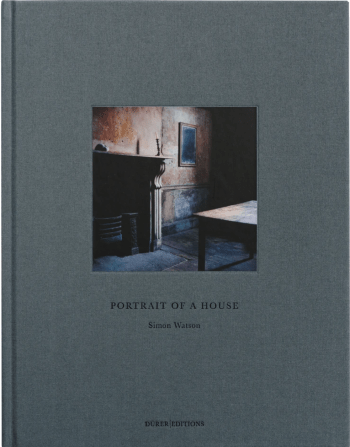 For over 30 years Simon Watson has exhibited his photographs in Europe and the U.S. including solo shows at the late Richard Anderson Gallery in New York and the Auschwitz Museum in Poland. More recently he has shown his paintings at the Galerie Rideau de Fer in France. His work is included in museums and in public and private collections worldwide. Watson has been a regular contributor to The New York Times T Magazine, W Magazine, Vogue, and Vanity Fair. His recent book The Lives of Others was published by Rizzoli in 2020.
Simon Watson, Portrait of a House (Dürer Editions, 2021 ), 64 pages, ISBN: 978-1838314309 , first edition of 1000 copies, €45; special edition of 50, €350; limited edition of 10, €750; collector edition of 5, €1850.
New Book | The Best Address in Town: Henrietta Street
From Four Courts Press:
Melanie Hayes, The Best Address in Town: Henrietta Street, Dublin and Its First Residents, 1720–80 (Dublin: Four Courts Press, 2021), 312 pages, ISBN: 978-1846828478, €30 / $40.
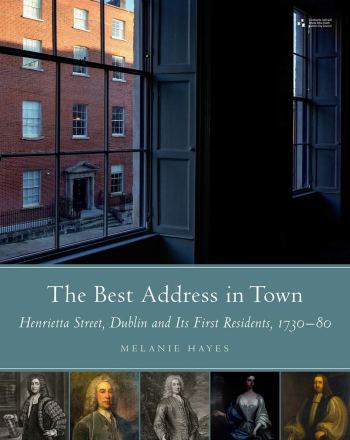 Once Dublin’s most exclusive residential street, Henrietta Street was, throughout the eighteenth century, home to the country’s foremost figures from church, military, and state. Here, in this elegant setting on the north side of the city, peers rubbed shoulders with property tycoons, clerics consorted with social climbers, and celebrated military men mixed with the leading lights of the capital’s beau monde, establishing one the principle arenas of elite power in Georgian Ireland. Looking behind the red-brick facades of the once-grand Georgian town houses, this richly illustrated volume—commissioned by Dublin City Council Heritage Office in conjunction with the 14 Henrietta Street museum—focuses on the people who originally populated these spaces, delineating the rich social and architectural history of Henrietta Street during the first fifty years of its existence. By weaving the fascinating and often colourful histories of the original residents around the framework of the buildings, in repopulating the houses with their original occupants, and by offering a window into the lives carried on within, this book presents a captivating portrait of Dublin’s premier Georgian street, when it was the best address in town.
Melanie Hayes is an architectural historian, specialising in Ireland’s eighteenth-century architectural and social history. She was an academic researcher during the development of the 14 Henrietta Street museum by Dublin City Council, and continues to be involved with the museum. Melanie currently works as a research fellow on an Irish Research Council laureate project, CRAFTVALUE, at Trinity College Dublin, exploring a new skills-based perspective on the architecture of Britain and Ireland from 1680 to 1780.
New Book | 14 Henrietta Street: Georgian Beginnings, 1750–1800
From the 14 Henrietta Street museum:
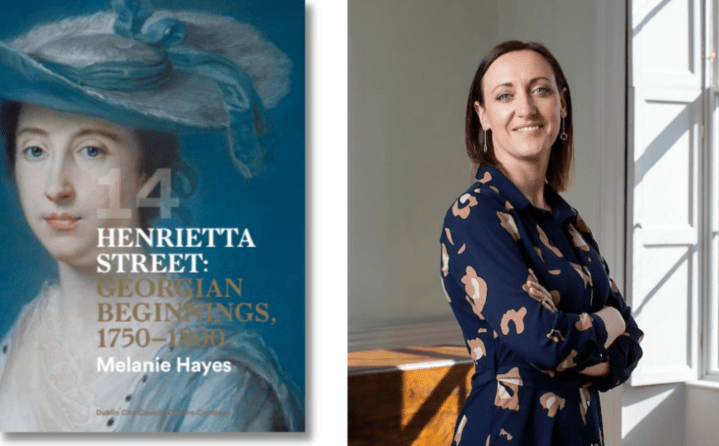
Melanie Hayes, 14 Henrietta Street: Georgian Beginnings, 1750–1800 (Dublin: Dublin City Council Culture Company, 2021), ISBN: 978-0995744660, €18.
In 1800 Henrietta Street was one of the most elegant and elite addresses in all of Georgian Dublin, home to some of the most powerful members of the Anglo-Irish ruling class. 14 Henrietta Street: Georgian Beginnings explores the early history of the house, its first residents—the Molesworths, Bowes, and O’Brien families—and the lives lived behind the red brick facade. This book is one of three new publications commissioned by the 14 Henrietta Street museum that uncover the lives of the people who lived at the house and the surrounding areas.
Melanie Hayes is an architectural and cultural historian, specialising in Ireland’s eighteenth-century architectural and social history. Melanie was part of the historian research team at 14 Henrietta Street, and continues to be involved as a historian for the museum. Dr Hayes currently works as a post-doctoral research fellow, on an Irish Research Council advanced laureate project, CRAFTVALUE, at Trinity College Dublin.










 Enfilade
leave a comment