At Sotheby’s | In an Indian Garden: Company School Paintings
From the press release (via Art Daily) for the sale:
In an Indian Garden: The Carlton Rochell Collection of Company School Paintings
Sotheby’s, London, 27 October 2021
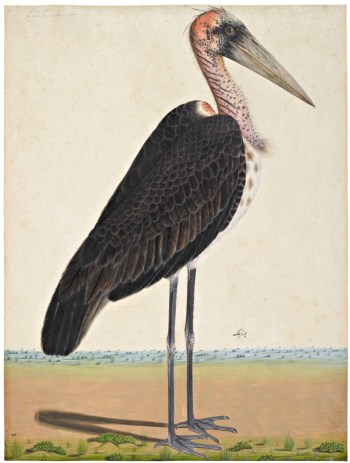
Lot 3: A Lesser Adjutant Stork (Leptoptilos Javanicus) in a Landscape, Company School, Lucknow, ca. 1775–85 (est. £60,000–80,000). The painting was included in The Wallace Collection’s 2020 exhibition Forgotten Masters: Indian Painting for the East India Company.
In October Sotheby’s will hold the first auction dedicated solely to Company School paintings, the work of Indian master artists who were commissioned by East India Company officials in the 18th and 19th centuries. Ranging in their subject matter from individual animal and human studies to complex architectural panoramas, the remarkable corpus of paintings encapsulates on paper the rich fauna, flora, and architecture of the Indian subcontinent. The 29 works in the auction are being offered by the American collector and art dealer Carlton C. Rochell, Jr., who spent the first 18 years of his career at Sotheby’s, where he founded the Indian and Southeast Asian Art Department in 1988. He was on the Board of Directors and served as Managing Director of Sotheby’s Asia. In 2002, Rochell opened his own gallery in New York.
In 2019 and 2020, The Wallace Collection presented Forgotten Masters: Indian Painting for the East India Company, curated by renowned writer and historian William Dalrymple. The ground-breaking exhibition brought to the fore the names of some of the finest Indian painters working on paper during the late Mughal period, introducing the public to the names of these truly great artists. Many of those same names—Shaykh Zayn al-Din, Ram Das, Bhawani Das, and Ghulam Ali Khan—are represented in this sale, with seven of the works having been loaned to The Wallace Collection exhibition. Most of the others have never been on public view and are emerging for the first time in decades.
“I first began to collect these lesser-known masterpieces over two decades ago simply for my personal enjoyment, my imagination having been captured by their ‘East meets West’ aesthetic. When they were painted, these works were the principal way in which India could be revealed to those in Great Britain, who otherwise could only hear stories about this sumptuous land. The meticulous ‘miniature’ style was scaled up to depict birds, animals, and botanical studies with remarkable lifelike detail, with the results rivalling any Western artists who recorded natural history and travel. Many years on, as they are beginning to take their rightful place in world art, these pieces can now inspire a new generation of collectors who, I hope, will cherish them as I have.” —Carlton C. Rochell, Jr.
“This remarkable collection contains quite simply some of the great masterpieces of Indian painting, brought together by a collector with an incredibly fine eye. This is a unique opportunity to purchase some of the greatest masterpieces of a genre that is only now beginning to receive its full credit.” —William Dalrymple, Writer, Historian, and Curator of Forgotten Masters
“These delightful paintings reflect a fascination and passion for India’s culture and history, from Lucknow to Calcutta to Delhi and Agra, and showcase a remarkable hybrid style merging Mughal and European elements. Both the patronage and the painters provide a great deal of interest to viewers, no more so than now, when this genre of painting is finally receiving the full attention it deserves. These works are the product of true collaboration—not grand portraits of the patrons themselves, but tableaux of everyday human activity, as well as meticulous studies of nature and vernacular architecture.” —Benedict Carter, Sotheby’s Head of Sale
In An Indian Garden features many works from the most renowned series of Company School paintings, including albums commissioned by Sir Elijah and Lady Impey, the Fraser brothers, Viscount Valentia, and Major General Claude Martin. The most famous is that of the Impey family, who created an enchanting menagerie of animals in their gardens in Calcutta and hired local artists to paint the surrounds, with more than half of their over 300-strong collection depicting birds. The Impey Collection was sold at auction in London in 1810, with several pieces held in international institutions, including The Metropolitan Museum of Art in New York—with a similar dramatic image of the Great Indian Fruit Bat—and the Victoria and Albert Museum in London. Perhaps the person who sparked the fashion for such commissions was merchant, soldier, architect, hot air balloonist, and collector Major General Claude Martin, and the sale offers a Lesser Adjutant Stork from his collection, which survives as a masterpiece of the genre. More recently, these works have passed through such hands as those of Jacqueline Kennedy Onassis, who for many years owned the arresting study of a Stork Eating a Snail; renowned South Asian paintings collector Edwin Binney 3rd; leading scholar and curator Stuart Cary Welch; and former United States Ambassador to Morocco, The Hon. Joseph Verner Reed, Jr.
Prior to the stand-alone auction in London on 27 October, highlights of In an Indian Garden went on view in Sotheby’s galleries in New York (17–20 September), Hong Kong (7–11 October), and London (22–26 October).
Online Lecture | Yuriko Jackall, The Fragonard Project
From The Wallace Collection:
Yuriko Jackall, The Fragonard Project
Zoom Webinar and YouTube, The Wallace Collection, London, 18 November 2021, 13.00 GMT
Between 2019 and 2021, five of the Wallace Collection’s eight paintings by Jean-Honoré Fragonard were cleaned and restored. This project has led to new discoveries about Fragonard’s working methods and provides the possibility for new interpretations of his work. Join our Head of Curatorial and Curator of French Paintings, Dr Yuriko Jackall, as she discusses this project and gives her reading of The Swing and its place in Fragonard’s career. She will also describe the long shadow of Fragonard’s influence, and how the ups and downs of his glittering career indelibly shaped the way in which we understand his art and the rococo aesthetic today. Thursday, 18 November 2021, 13.00 GMT.
This talk will be hosted online through Zoom and YouTube. Please click here to register for Zoom.
◊ ◊ ◊ ◊ ◊
From the press release for the project:

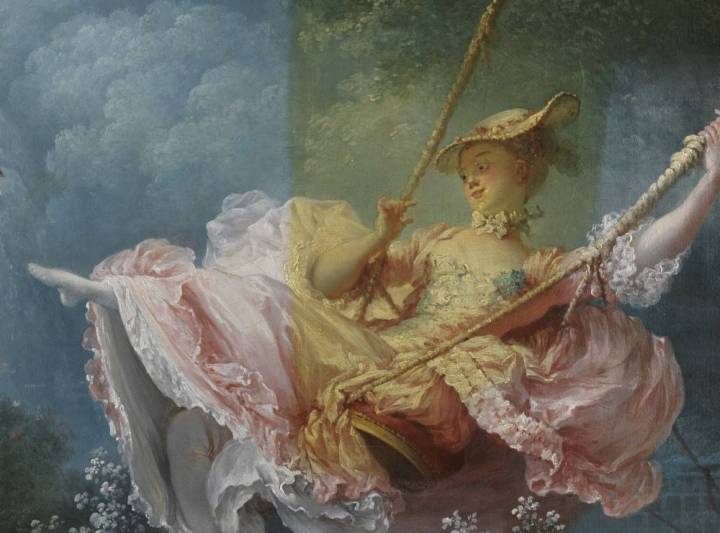
Jean-Honoré Fragonard, Les hasards heureux de l’escarpolette (The Swing), detail, after conservation, 1767–68, oil on canvas, 81 × 64 cm (London: The Wallace Collection).
Jean-Honoré Fragonard’s painting, The Swing, is the most iconic painting of the entire Rococo movement and one of the Wallace Collection’s most famous works of art. It has been admired for centuries for its romantic composition, skilful brushwork, and masterly use of colour. References to The Swing can be found in literature, contemporary art, design, and cinema. It is sought out and admired by thousands of visitors to the museum each year.
Despite its fame, relatively little is known about the painting. The circumstances of its commission are vague, with Fragonard opting to undertake a painting that other ‘academic’ painters had refused on account of its scandalous theme. Fragonard’s methods in building the composition are also unclear. In addition to this, the paint surface was previously obscured by yellowed varnish and old retouching had become visible.
Thanks to a generous grant from the Bank of America Art Conservation Project, throughout the summer of 2021 The Swing underwent intricate, sensitive highly skilled conservation and technical analysis for the first time. Uniquely, the conservation treatment has taken place in house at the Wallace Collection, with one of its conservation studios temporarily transformed especially for the purpose. The work has been undertaken by Martin Wyld, former Head of Conservation at the National Gallery, where he worked for more than 40 years restoring works by artists such as Leonardo and Velazquez.
Investigations have shed light on the mysteries surrounding The Swing and developed our understanding of Fragonard and his methods as an artist. The removal of the yellowed varnish has transformed the painting. The white lace of the young girl’s dress is now crisp, the composition has taken on a new sense of depth, background details are now apparent, and the overall freshness and texture of the artist’s paint surface has been restored. Little underdrawing or preparatory studies have been identified. Fragonard appears to have worked confidently and skilfully, directly on the canvas, to create The Swing, his finest masterpiece. The painting is being reinstalled in the specially relit galleries in November 2021, alongside the other seven Fragonard works in the Wallace Collection, allowing visitors to see for the first time how the artist developed across his career.
The return of The Swing is accompanied by a special season of events, which encompasses free public talks with special guests, a focused study course, and a book signing. The Collection has documented the conservation process and commissioned an insightful film exploring Fragonard and The Swing’s influence.
Online Conversations | Swing Time
A series of five conversations hosted by The Wallace Collection:
Swing Time: Serendipitous Conversations about the Rococo
Zoom Webinar and YouTube, The Wallace Collection, London, 8 November — 6 December 2021
Fragonard’s Les hasards heureux de l’escarpolette, known in English as The Swing, is a revered painting in the Wallace Collection and one of the most representative works of art of the entire French 18th century. To celebrate the gentle cleaning and restoration of this rococo icon, we have invited five art practitioners and five scholars to participate in a series of virtual conversations inspired by its key themes: Pink, Identity, Fashion, Play, and The Libertine. Join Dr Yuriko Jackall, Head of Curatorial and Curator of French Paintings at the Wallace Collection, to discover the influence of rococo art, and The Swing in particular, on artistic production today. The series will be recorded and made available on the Wallace Collection YouTube channel. Register for any of the five free talks here.
P I N K | Yuriko Jackall in conversation with Flora Yukhnovich and Valerie Steele
Monday, 8 November 2021, 19.00 GMT
Why is the colour pink so often associated with the frivolous, the dainty, and the overtly feminine? A plethora of images—of pink babies, pink flowers, pink fashion accessories—has cemented the gendering of pink in our collective imagination. Such is the case of Fragonard’s Swing, which displays at its centre a young woman in a billowing pink dress. Yuriko Jackall, artist Flora Yukhnovich, and curator Valerie Steele explore the widespread perception of the colour pink as particularly representative of femininity and the Rococo. See full event details here.
I D E N T I T Y | Yuriko Jackall in conversation with Catherine Yass and Rosalind McKever
Monday, 22 November 2021, 19.00 GMT
The name and motivations of the person who commissioned The Swing remain obscure. So do the identities of the three people depicted. Only the painter, Jean-Honoré Fragonard, is known to us. In cases like these, art historians rely upon visual clues to understand what is being represented. Yuriko Jackall is joined by artist Catherine Yass and curator Rosalind McKever in a conversation about how visual codes—dress, gesture, and representation of place—shape the way in which we read and perceive identity. See full event details here.
F A S H I O N | Yuriko Jackall in conversation with Sami Nouri and Jessica Degain
Monday, 29 November 2021, 19.00 GMT
During the last decades of the ancien régime (1760–1789), Paris became the epicentre of the fashion world. Vogues for hairstyle, dress shape, fabric patterns, or silk colour came and went, with the vertiginous rapidity associated to today’s ever-evolving fashion industry. Like his teacher, François Boucher, Fragonard excelled in putting his protagonists in the latest fashions. The fabrics, trimmings, and garments flowing from the brushes of these painters have, in turn, inspired fashion designers for the last 250 years. Join Yuriko Jackall, haute-couture fashion designer Sami Nouri, and curator Jessica Degain as they explore how 18th-century fashions continue to resonate today. See full event details here.
P L A Y | Yuriko Jackall in conversation with Monster Chetwynd and Alice Strang
Monday, 6 December 2021, 19.00 GMT
In sharp opposition to the architectural and rectilinear motifs of Classicism, the rococo aesthetic is populated by sinuous forms inspired by nature. Rocks, shells, leafy branches and sprigs of flowers introduce novelty and a sense of surprise into the furniture, wall panels and textiles of the eighteenth century. In turn, the unexpected playfulness of these rococo interiors encouraged a certain theatricality and whimsy in the demeanour of those who inhabited them. Yuriko Jackall, artist Monster Chetwynd, and curator Alice Strang discuss the resonance of rococo playfulness in contemporary practice, with special attention to layering, unusual juxtapositions, and the role of performance art as a means for exploring the eccentricities of everyday life. See full event details here.
T H E L I B E R T I N E | Yuriko Jackall in conversation with Simon Bejer and Chantal Thomas
Monday, 6 December 2021, 19.00 GMT
After enduring years of tight control under Louis XIV, the 18th-century privileged classes enjoyed unprecedented freedom during the Regency and the reign of Louis XV. In Paris, their lives unfolded at the opera, the theatre, and the masked ball. In their country estates and suburban maisons de plaisance, they tasted the escapist delights of the French pleasure garden. The intimacy of these environments invited a relaxation of etiquette and, occasionally, the transgression of moral codes. In the final conversation of our series, Yuriko Jackall, artist and theatre designer Simon Bejer, and writer Chantal Thomas, discuss how changes in moral codes in 18th-century France impacted the arts and literature. See full event details here.

Exhibition | La Surprise: Watteau in Los Angeles
Opening next month at the The Getty:
La Surprise: Watteau in Los Angeles
The Getty Center, Los Angeles, 23 November 2021 — 20 February 2022
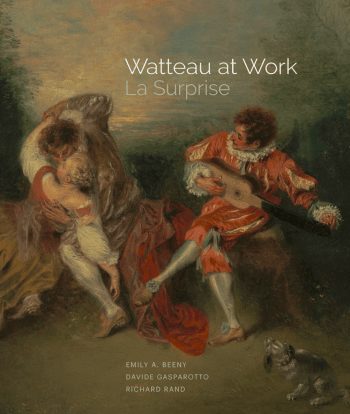 Graceful scenes of courtship, music and dance, strolling lovers and theatrical characters: this is the imaginary world conjured by the greatest French painter and draftsman of the 18th century, Antoine Watteau (1684–1721). Los Angeles is home to an extraordinary group of Watteau’s works. This focused exhibition, marking the 300th anniversary of the artist’s death, brings together a dozen of them from public and private collections and celebrates the Getty’s recent acquisition of an exquisite example: the painting La Surprise. The picture belongs to what was a new genre of painting invented by the artist himself—the fête galante. These works do not so much tell a story as set a mood: one of playful, wistful, nostalgic reverie. Esteemed by collectors in Watteau’s day as a work that showed the artist at the height of his skill and success, La Surprise vanished from public view in 1848, reemerging only in 2007. The Getty Museum acquired the painting in 2017.
Emily Beeny, Davide Gasparotto, and Richard Rand, Watteau at Work: La Surprise (Los Angeles: J. Paul Getty Museum, 2021), 88 pages, ISBN: 978-1606067352, $25.
La Surprise by Antoine Watteau has never before been the subject of a dedicated publication. Marking the three hundredth anniversary of Watteau’s death, this book considers the painting within the context of the artist’s oeuvre and discusses the surprising history of collecting works by the artist in Los Angeles.
Emily A. Beeny, former associate curator of drawings at the J. Paul Getty Museum, is curator in charge of European paintings at the Fine Arts Museums of San Francisco. Davide Gasparotto is senior curator of paintings and chair, curatorial affairs, at the J. Paul Getty Museum. Richard Rand is associate director for collections at the J. Paul Getty Museum.
C O N T E N T S
Timothy Potts, Director’s Foreword
Acknowledgments
Richard Rand, Jean Antoine Watteau, Three Hundred Years Later
Davide Gasparotto, Rediscovering a Masterpiece: Watteau’s La Surprise
Emily Beeny, Quelle Surprise! Watteau in Los Angeles
Plates
Works in the Exhibition
References
Index
Colloquium | Watteau and His Universe: Networks and Influences

Jean-Antoine Watteau / Jean-Baptiste Pater, Fête champêtre (Pastoral Gathering), 1718–21, oil on panel, 49 × 65 cm
(Art Institute of Chicago, Max and Leola Epstein Collection, 1954.295)
◊ ◊ ◊ ◊ ◊
From Fine Arts Paris:
L’univers de Watteau: Réseau(x) et influence(s) autour d’Antoine Watteau (1684–1721)
Auditorium du Petit Palais, Musée des Beaux-Arts de la Ville de Paris, 6–7 November 2021
This symposium, Watteau and His Universe: Networks and Influences of Antoine Watteau (1684–1721), aims to study the figures gravitating around the painter who made him a central figure in eighteenth-century century French art. Close investigation of fellow painters, printmakers, merchants, collectors, amateurs, and friends is necessary in order to further our knowledge of Watteau.
Réservation conseillée par email à rsvp@finearts-paris.com. Les personnes ayant réservé auront accès en priorité aux sièges disponibles. Pass sanitaire requis et port du masque obligatoire dans l’auditorium.
S A M E D I , 6 N O V E M B R E 2 0 2 1
10.00 Introduction
• Louis de Bayser (Président de Fine Arts Paris) et Pierre Rosenberg (de l’Académie française)
10.15 Conférence inaugurale
• Martin Eidelberg (Pr. Emeritus, Rutgers University, New Jersey), Watteau and His Circle
10.45 Réseaux artistiques autour de Watteau, Premières formations
• Jennifer Tonkovich (Eugene and Thaw Curator of Prints and Drawings, The Morgan Library & Museum, New York), When Watteau Met Gillot
• Bruno Guilois (Centre André Chastel, Paris Sorbonne Université), “De ce nombre sont, entre autres, MM. de Saint-Pol, du Mesnil, Dieu, Spoede […]” : cercles et réseaux parisiens autour du jeune Watteau, dans les premières années du XVIIIe siècle
• Turner Edwards (collaborateur scientifique, musée des Arts Décoratifs, Paris), Watteau, Gillot, Lancret et les femmes graveuses de la rue Saint-Jacques : dans la sphère du clan Cochin
• Christophe Guillouet (Chercheur indépendant, Paris), Scènes militaires et figures de fantaisie : Watteau, Bonnart et les genres mineurs à Paris
13.00 Déjeuner
14.30 Réseaux artistiques autour de Watteau, Collaborateurs directs et indirects
• Hugo Coulais (Doctorant, Paris Sorbonne Université), Les paysages oubliés de Jean Forest
• Gérard Migliore (Chercheur indépendant), “Acis et Galathé”, hypothèse de rapprochement avec un dessin de Michel Corneille le Jeune
• Marianne Paunet (Galerie Descours, Paris), Antoine Dieu, Antoine Watteau et le milieu de l’image imprimée pour point de contact
• Maud Guichané (assistante de conservation, Fondation Custodia, collection Frits Lugt), “Watho pour peindre les figures” : les peintres d’architecture Philippe Meusnier et Michel Boyer, collaborateurs d’Antoine Watteau ?
16.10 Réseaux artistiques autour de Watteau, Juste après Watteau
• Margaret Morgan Grasselli (Visiting Senior Scholar for Drawings, Harvard University), The Use of Wash in Drawings by Watteau
• Florence Raymond (attachée de conservation, Palais des Beaux-Arts, Lille), Dessiner d’après les maîtres : Antoine Watteau, Jean-Baptiste Pater et Nicolas Lancret, une culture matérielle au service de l’art de la citation ?
• Mary Tavener Holmes (chercheuse indépendante, New York), The Portraits of Nicolas Lancret
• Yuriko Jackall (Head of Curatorial & Curator of French Paintings, The Wallace Collection, Londres), On Influence and Inspiration: Watteau and Pater
D I M A N C H E , 7 N O V E M B R E 2 0 2 1
9.45 Accueil des participants
10.00 Réseaux artistiques autour de Watteau, Juste après Watteau
• Christoph Martin Vogtherr (directeur général, Stiftung Preussische Schlösser und Gärten Berlin-Brandenburg), Watteau, Caylus et le principe de hasard
• Franziska Windt (conservatrice des peintures françaises et italiennes, Stiftung Preussische Schlösser und Gärten, Berlin- Brandenburg), Antoine Watteau in Prussia: Object of Collection and Model for Painting
• Sarah Sylvester Williams (Visiting Assistant Professor of Art History, Director, Museum Studies Program, Millsaps College, Jackson, Mississippi), Watteau, Lancret, and the Château de Condé
• Remi Freyermuth (chercheur indépendant, Paris), Boucher, élève de Watteau
11.40 Watteau et sa société – Regards culturels
• David Pullins (Associate Curator, The Metropolitan Museum of Art, New York), African Figures in Watteau’s Circle
• Yohan Rimaud (conservateur des collections Beaux-Arts, Besançon, musée d’art et d’archéologie), Réception de la chinoiserie dans le premier tiers du XVIIIe siècle
• Guillaume Faroult (conservateur en chef en charge des peintures françaises du XVIIIe siècle et des peintures britanniques et américaines, musée du Louvre, Paris), L’iconographie libertine de Watteau et ses émules
13.00 Déjeuner
14.30 Watteau et sa société – Watteau et l’Europe
• Enrico Lucchese (professeur d’histoire de l’art, Univerza v Ljubljani et Università degli Studi di Udine), Celestial Conjunctions in Watteau’s Universe: A Perusal on Relations with « Venetians »
• Nicolas Lesur (chercheur indépendant, Paris), Une diffusion italienne de Watteau : le cas de Carlo Spiridione Mariotti
• Christophe Janet (Marchand d’art et chercheur indépendant, Bruxelles), Le séjour de Watteau à Londres : nouveautés, précisions et questions
• Louis-Antoine Prat (Président de la Société des Amis du Louvre, Paris), Dessins de Watteau : des attributions erronées aux faux intentionnels
• Lionel Sauvage (collectionneur), Collectionner et mécéner Watteau
16.30 Conclusions générales
• Axel Moulinier (doctorant en histoire de l’art, École du Louvre, Paris, Université de Bourgogne-Franche-Comté, Dijon)
Colloquium | Sculpteurs et sculptures du XVIe au XIXe siècle
From Fine Arts Paris:
Du palais au jardin, de l’atelier au cabinet de l’amateur : Sculpteurs et sculptures du XVIe au XIXe siècle / Hommage au travail de Geneviève Bresc-Bautier
Auditorium du Petit Palais, Musée des Beaux-Arts de la Ville de Paris, 8 Novembre 2021
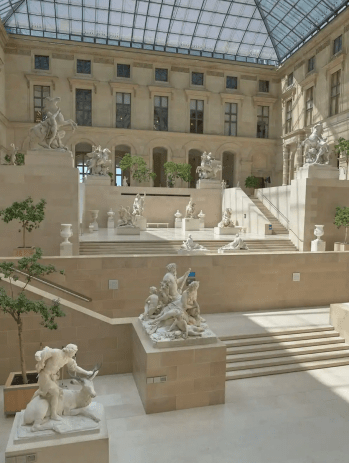 Fine Arts Paris organise en collaboration avec le département des Sculptures du musée du Louvre un colloque et une publication en hommage au travail de Mme Geneviève Bresc-Bautier.
Des historiens de l’art qui comptent pour Geneviève Bresc-Bautier, pour avoir été ses élèves ou pour avoir été associés à ses recherches ou à ses expositions, lui présentent un ensemble de communications en écho à ses centres d’intérêt : la Renaissance française, la sculpture de jardin, les bronzes, les moulages d’après l’Antique, le décor du palais du Louvre, le statut et la formation des sculpteurs…
Ce premier florilège préfigure les futurs Mélanges offerts à Geneviève Bresc-Bautier, dont la souscription sera ouverte à cette occasion et dont la parution est prévue en 2022. Cet ouvrage, coordonné par le département des Sculptures du musée du Louvre, réunira les textes présentés le 8 novembre et bien d’autres, proposés par des conservateurs, universitaires, restaurateurs et historiens de l’art de diverses générations, dont les recherches sur la sculpture du Moyen Âge au XIXe siècle et sur l’histoire du Louvre, ont été marquées par son exemple.
Réservation conseillée par email à rsvp@finearts-paris.com. Les personnes ayant réservé auront accès en priorité aux sièges disponibles. Pass sanitaire requis et port du masque obligatoire dans l’auditorium.
P R O G R A M M E
14.00 Accueil et introduction, présentation du volume d’articles réédités
• Sophie Jugie, directrice du département des Sculptures du musée du Louvre
14.15 Sculpture du XVIe au XVIIIe siècle
• Marion Boudon-Machuel (professeur d’histoire de l’art moderne à l’Université de Tours), Geneviève Bresc-Bautier, le ciseau sous la plume : contributions à l’Histoire de la sculpture de la Renaissance en France
• Pascal Julien (professeur d’Histoire de l’Art moderne à l’Université de Toulouse II), Satyres en Arcadie : méditation et séductions dans la sculpture de jardin, XVIe–XVIIe siècles
• Françoise de La Moureyre (historienne de l’art), Un portrait du roi sculpté à Rome par Clérion
• Sophie Mouquin (maître conférences en histoire de l’art moderne à l’Université de Lille), « Cette piété là est le véritable amour » : une allégorie virtuose et savante d’Aubert Parent
15.45 Pause
16.15 Histoire des moulages
• Elisabeth Le Breton (conservatrice au département des Antiquités grecques, étrusques et romaines, chargée de la gypthotèque du musée du Louvre), Académie de France à Rome : un plâtre daté de 1686
16.35 Histoire du Louvre
• Guillaume Fonkenell (conservateur en chef au musée de la Renaissance à Ecouen), Scibec de Carpi au Louvre
• Sophie Picot-Bocquillon (responsable du pôle documentaire de la Conservation des Œuvres d’Art Religieuses et Civiles de la Ville de Paris), Un sculpteur à l’ombre du Louvre : Francisque Duret et les décors architecturaux du palais
17.30 Conclusions et remerciements
Un ouvrage est consacré à la réédition d’un ensemble d’articles consacrés, entre 1979 et 2012, à ces sculpteurs méconnus que Geneviève Bresc-Bautier s’est attachée à faire connaître, en l’occurrence des sculpteurs actifs à Paris dans la première moitié du XVIIe siècle : Francesco Bordoni (1574–1654), Jean Séjourné (mort en 1614), Christophe Cochet (connu depuis 1606- mort en 1634), Hubert Le Sueur (connu de 1596 à 1658), Toussaint Chenu (connu depuis 1621-mort en 1666) et Thomas Boudin (vers 1570–1637). Une édition de Fine Arts Paris et In Fine Éditions, 25€.
Online Talk | Ann-Sophie Lehmann, Object Biography
From the BGC:
Ann-Sophie Lehmann, Object Biography: The Life of a Concept
Online, Seminar in Museum Conversations, Bard Graduate Center, New York, 2 November 2021

Jan Luyken, Design for frontispiece, Het Leerzaam Huisraad, 1709, 14 × 90 cm (Amsterdam: Rijksmuseum, RP-T-1989-183).
The object biography has gained popularity in art history, material culture studies, archaeology, history, conservation and restoration, and museum studies. As a concept, the biography creates attention for the individual trajectories of objects and how these change over time; it enables the connection of different approaches, usually dealt with by sub-disciplines (i.e. research into making, provenance, exhibition history, conservation, reception); it offers entry points even if no information is available and encourages interdisciplinarity as objects straddle many fields. Finally, the object biography stimulates new forms of writing because it lends the object a voice and foregrounds narrative.
But the concept’s anthropocentric foundations also raise questions. To have a ‘biography’ implies biological and mental development, which objects typically do not have. Are young objects less settled and do objects grow wiser the older they get? Metaphors of birth, maturing, and death might cover up exclusively thing-specific characteristics. Likewise, the proposed ‘life’ implies agency, but do objects really speak for themselves? Who actually tells their story, and would objects be better if we used concepts such as itineraries or necrographies to capture their histories?
This talk presents a brief history and theory of the concept of the object-biography, from its literary and didactic origins in the eighteenth-century to its recent critics, asking what the concept can help us see, which we otherwise would not. This free talk takes place, via Zoom, on Tuesday, November 2, at 5.00pm. Registration information is available here.
Ann-Sophie Lehmann is chair of art history & material culture at the University of Groningen. She recently published Lessons in Art: Art, Education, and Modes of Instruction, edited with E. Jorink and B. Ramakers (Leiden 2019). For an overview of her publications and activities is available here.
Online Series | The Museum and Gallery Today
From the PMC:
The Museum and Gallery Today: Paul Mellon Lectures 2021
Six Online Lectures, 20 October — 11 February 2022
Established in 1994, this lecture series was named in honour of Paul Mellon (Yale College, class of 1929), the philanthropist, collector of British art, and founder of both the Yale Center for British Art (YCBA) in New Haven and the Paul Mellon Centre for Studies in British Art (PMC) in London. Co-organised by the two institutions, these biennial lectures have traditionally been given by a specialist in British art, first at the National Gallery, London, and again at the YCBA in New Haven.
This year’s series, entitled The Museum and Gallery Today, is exclusively online and features individual talks from some of the world’s most distinguished museum and gallery directors. The lectures are presented as free live webinars. Registration is required (for each lecture, individually).
20 October 2021
Gabriele Finaldi (Director of the National Gallery)
3 November 2021
Kaywin Feldman (Director of the National Gallery of Art, Washington, DC)
10 November 2021
Thelma Golden (Director and Chief Curator of the Studio Museum in Harlem)
11 November 2021
Iwona Blazwick (Director of the Whitechapel Gallery)
24 November 2021
Maria Balshaw (Director of Tate)
11 February 2022
Eve Tam (Former Director of the Hong Kong Museum of Art)
New Book | My Monticello
From Macmillan:
Jocelyn Nicole Johnson, My Monticello: Fiction (New York: Henry Holt and Co., 2021), 224 pages, ISBN: 978-1250807151, $27.
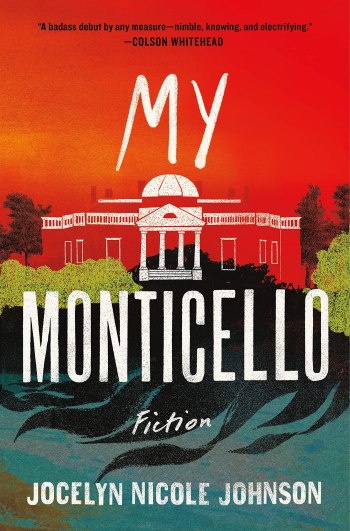 A young woman descended from Thomas Jefferson and Sally Hemings driven from her neighborhood by a white militia. A university professor studying racism by conducting a secret social experiment on his own son. A single mother desperate to buy her first home even as the world hurtles toward catastrophe. Each fighting to survive in America.
Tough-minded, vulnerable, and brave, Jocelyn Nicole Johnson’s precisely imagined debut explores burdened inheritances and extraordinary pursuits of belonging. Set in the near future, the eponymous novella, “My Monticello,” tells of a diverse group of Charlottesville neighbors fleeing violent white supremacists. Led by Da’Naisha, a young Black descendant of Thomas Jefferson and Sally Hemings, they seek refuge in Jefferson’s historic plantation home in a desperate attempt to outlive the long-foretold racial and environmental unravelling within the nation.
In “Control Negro,” hailed by Roxane Gay as “one hell of story,” a university professor devotes himself to the study of racism and the development of ACMs (average American Caucasian males) by clinically observing his own son from birth in order to “painstakingly mark the route of this Black child too, one whom I could prove was so strikingly decent and true that America could not find fault in him unless we as a nation had projected it there.” Johnson’s characters all seek out home as a place and an internal state, whether in the form of a Nigerian widower who immigrates to a meager existence in the city of Alexandria, finding himself adrift; a young mixed-race woman who adopts a new tongue and name to escape the landscapes of rural Virginia and her family; or a single mother who seeks salvation through “Buying a House Ahead of the Apocalypse.”
United by these characters’ relentless struggles against reality and fate, My Monticello is a formidable book that bears witness to this country’s legacies and announces the arrival of a wildly original new voice in American fiction.
Jocelyn Nicole Johnson’s writing has appeared in Guernica, The Guardian, Kweli, Joyland, phoebe, Prime Number Magazine, and elsewhere. Her short story “Control Negro” was anthologized in Best American Short Stories 2018, guest edited by Roxane Gay, and read live by LeVar Burton as part of PRI’s Selected Shorts series. Johnson has been a fellow at Hedgebrook, Tin House Summer Workshops, and VCCA. A veteran public school art teacher, Johnson lives and writes in Charlottesville, Virginia.
Lecture Series | Printing Abolition, 1783–1807

Fold-out engraving in Charles Crawford, Observations on Negro-Slavery (Philadelphia: Eleazer Oswald, 1790)
(Philadelphia: Penn Libraries, Kislak Center for Special Collections, Rare Books and Manuscripts)
◊ ◊ ◊ ◊ ◊
From Penn Libraries:
Michael Suarez, Printing Abolition: How the Fight to Ban the British Slave Trade Was Won, 1783–1807
The A.S.W. Rosenbach Lectures in Bibliography
Online and In-person, University of Pennsylvania, Philadelphia, 25, 26, and 28 October 2021
In this series of highly illustrated lectures (originally scheduled for March 2020), Michael Suarez offers a fresh perspective on British abolition, richly informed by political prints and personal correspondence, newspapers and pamphlets, account books and committee minutes, parliamentary reports and private diaries. Suarez’s revisionist history not only traces the production and distribution of abolitionist print, but also reveals the hidden networks that variously sustained the first humanitarian mass media campaign. Abolition forces brilliantly exploited the power of print to contend with the complex legacies of the American and French Revolutions, the slave revolt in present-day Haiti, and the Napoleonic Wars. Seeking to understand how both abolitionists and their foes exploited systems of influence through printed words and images in many forms, Suarez delineates the strategies that abolitionists devised to overcome accusations of religious fanaticism, economic malfeasance, and political sedition. Exploring the first author’s book tour in the UK, a consumer boycott fostered by the radical press, and the fashionable publisher who clandestinely worked as press agent for the pro-slavery interest, these lectures will demonstrate the power of bibliography and book history to rewrite established narratives and to recover lives and labors typically left out of conventional accounts.
These three lectures will be held in person and also livestreamed via Zoom webinar (advance registration required to receive Zoom link). In addition, the lectures will be recorded and available for viewing and as podcasts approximately several weeks after being presented.
Michael F. Suarez, S.J. has served as Director of Rare Book School, Professor of English, University Professor, and Honorary Curator of Special Collections at the University of Virginia since 2009. Professor Suarez serves as Editor-in-Chief of Oxford Scholarly Editions Online. His recent books include The Cambridge History of the Book in Britain, Volume V, 1695–1830 (Cambridge University Press, 2009), co-edited with Michael Turner, and The Oxford Companion to the Book (Oxford University Press, 2010), a million-word reference work co-edited with H. R. Woudhuysen. The Book: A Global History, also co-edited with H. R. Woudhuysen, first appeared in 2013. In 2014, Oxford University Press published his edition of The Dublin Notebook, co-edited with Lesley Higgins, in the Collected Works of Gerard Manley Hopkins. He delivered the 2015 Lyell Lectures in Bibliography at the University of Oxford.
Feeding the Machine: A Triple System of Networks
Monday, 25 October 2021, 5.30pm (EST)
Register for this lecture (attending in person or attending virtually, via Zoom webinar).
Commodity Culture and the Political Economies of Print
Tuesday, 26 October 2021, 5.30pm (EST)
Register for this lecture (attending in person or attending virtually, via Zoom webinar).
Beyond Westminster: Toward More Global Forms of Knowing
Thursday, 28 October 2021, 5.30pm (EST)
Register for this lecture (attending in person or attending virtually, via Zoom webinar).










 Enfilade
leave a comment