Digital Tools for Better Understanding Jean-Henri Riesener
From Art Daily (17 October 2021) . . .

Jean-Henri Riesener, Fall-front desk with trellis marquetry and gilt-bronze mounts, 1783 (London: The Wallace Collection, F302).
Jean-Henri Riesener (1734–1806)—the German cabinetmaker who emigrated to Paris in the mid-eighteenth century and became supplier of furniture to Louis XVI, Marie Antoinette, and their court—has been the subject of an extensive research project undertaken by the Wallace Collection, Waddesdon Manor, and the Royal Collection. Over the past six years, the Project has investigated Riesener’s career, craft, and legacy, which has helped develop a greater understanding of his cabinetmaking materials and techniques, as well as his innovations in furniture design. Many of the Project’s discoveries were incorporated into cutting-edge 3D furniture models, the first monograph on Riesener, and a display at the Wallace Collection. This display focused on the furniture that Riesener made for Marie-Antoinette as well as his lasting influence on later cabinetmakers.
Although this display at the Wallace Collection has now drawn to a close, much of the Project’s work, as well as the pieces of furniture themselves, can still be explored through a comprehensive microsite dedicated to Riesener, in addition to the book. The detailed technical examination of the materials, structure, and condition of the objects that took place during the Project, along with scientific analysis, allowed accurate digital models to be created in SketchUp. These are hosted on Sketchfab for a fully interactive experience that allows users to gain an appreciation of the complexity of Riesener’s work and his virtuosity as a craftsman and designer. These models on the microsite are enriched by isometric drawings and catalogue entries that examine the history of the furniture and the characteristics of their production, along with essays that explore Riesener’s life, craft, patrons, and collectors.
A Riesener trail has also been created on the Royal Collection’s website. This draws together all the Riesener furniture from the three collections, along with their digital models, short catalogue entries, and an interactive timeline of Riesener’s life and key commissions, interspersed with events in French national history.
Many aspects of the Riesener Project were pioneering, from its focus on the materiality of Riesener’s furniture to his workshop processes and the business of furniture-making. However, perhaps the Project’s most ground-breaking achievement was sharing its research results with as wide an audience as possible, through multiple media, on an open-access online platform.
Rosenberg Lecture | Jessica Fripp, The French Academy in Rome
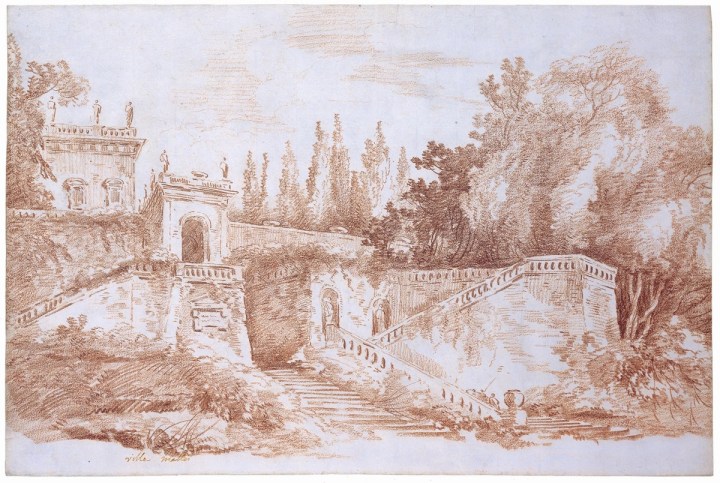
Hubert Robert, View of the Gardens at the Villa Mattei, 1761, red chalk on paper
(Dallas Museum of Art, fractional gift of Charlene and Tom Marsh, 2006.17)
◊ ◊ ◊ ◊ ◊
From the DMA:
Jessica Fripp, The French Academy in Rome: Adventures in Bromance
Annual Rosenberg Lecture
Online and In-Person, Dallas Museum of Art, 11 November 2021, 7.00pm
Presented by the Michael L. Rosenberg Foundation
Winning the Royal Academy’s prix de Rome was a major accomplishment for aspiring painters and sculptors in 18th-century France. The prize came with a three-year funded stay in Rome, and provided an opportunity for artists to finish their education by viewing firsthand antique, Renaissance, and Baroque works of art in the Eternal City. But, much like students who study abroad today, their time in Rome involved just as much play as work.
In this lecture, Jessica L. Fripp, Associate Professor of Art History and Undergraduate and Graduate Coordinator at Texas Christian University, will talk about works of art that provide a view into the less studious side of artists’ time in Rome: caricatures. What can these ‘silly’ drawings tell us about life in Rome as a young artist and the role of friendship and play in academic artistic training?
This talk will be livestreamed on the DMA’s YouTube channel, with limited in-person seating available. Dr. Fripp’s recent book Portraiture and Friendship in Enlightenment France will be available for purchase at the DMA Store, and a book signing will follow the event on-site.
To register (for either in-person or virtual attendance), click here»
Online Conference | Buying Art and Antiquities in 18th-Century Italy
From the conference program:
Buying Art and Antiquities in Eighteenth-Century Italy
La compra de arte y antigüedades en la Italia del siglo XVIII
Online, UNED, Madrid, 4, 11, 18, 23 November and 2 December 2021
Organized by Pilar Diez del Corral Corredoira and David Ojeda Nogales

Jean-François Sablet, In the Antiquities Shop, Rome, 1788 (Private Collection)
The third meeting of the international conference series Transnational Relations and the Arts will address the issue of art and antiquities markets in eighteenth century. With the Grand Tour at its peak, men from all over Europe and beyond flooded into the cities of Italy, mainly Rome but also Naples, Venice, and Florence. These grand tourists fed an already flourishing art market and were also active agents of the spread of ancient marbles and vases, Old Master paintings, ancient coins, and medals back to their homelands, not to mention the diffusion of an international ‘buon gusto’ among the middling and upper classes. For virtual access via Zoom, please email dojeda@geo.uned.es and diezdelcorral@geo.uned.es. The conference is also available for streaming (without registration) here.
This conference is part of the results of the I+D+i project (PID2020-117326GB-I00), FAKE- La perdurabilidad del engaño: Falsificación de Antigüedades en la Roma del siglo XVIII, and the Ramón y Cajal research Project (2017-22131), Academias artísticas, diplomacia e identidad de España y Portugal en la Roma de la primera mitad del siglo XVIII, both funded by the Ministerio de Ciencia e Innovación.
First Session — Agents and Art Markets
4 November 2021, 15.00 (Madrid Time)
• Sascha Kansteiner (Curator of Greek and Roman sculpture, Staatliche Kunstsammlungen, Dresden), Cavaceppi: Sculptor, Restorer, Dealer, Publisher, and Forger
• Jeffrey Laird Collins (Professor of Art History and Material Culture, Bard Graduate Center, New York), The Pope, the Curator, the Milord, and his Dealer: Rome’s Red-Hot Antiquities Market in Theory and in Practice.
• Heiner Krellig (Independent Scholar, Venice and Berlin), Preliminary Notes for a History of the Art Market in Eighteenth-Century Venice
• Paola D’Alconzo (Universidad de Nápoles Federico II), Il mercato di antichità nel Regno di Napoli nel XVIII secolo: quadro normativo e alcuni casi esemplari
• Alexandre Vico Martori (Universidad de Gerona), ‘Quattro quadri dipinti per il traverso dipinti in tavola’: El redescubrimiento de Sandro Botticelli y la adquisición de las spalliere del Palazzo Pucci
Second Session — Agents and Art Markets, part 2
11 November 2021, 15.00 (Madrid Time)
• Paweł Gołyźniak (Institute of Archaeology, Jagiellonian University), Philipp von Stosch (1691–1757) and His Dominant Position in Terms of Trade, Collecting, and Research of Engraved Gems in Eighteenth-Century Italy
• Tara Zanardi (Hunter College of the City University of New York), Isabel de Farnesio, Filippo Juvarra, and the Modern Interior at La Granja
• Mercedes Simal (Unversidad de Jaén), Troiano Acquaviva y el mercado artístico romano: un agente al servicio de los reyes de España y Nápoles
• Elena Dmitrieva (Department of the Classical Antiquities, The State Hermitage Museum), Russian Buyers of Antique and Modern Gems in the Italian Art Market in the Second Half of the Eighteenth Century
• Odile Boubakeur (Ecole du Louvre / Université Paris-Saclay), ‘Italy, Garden of the World’…or ‘jardin à l’anglaise’? British Supremacy on the Italian Antique Art Market through the Eighteenth Century
Third Session — Collectors and Their Collections
18 November 2021, 15.00 (Madrid Time)
• Tracy L. Ehrlich (Associate Teaching Professor, Parsons School of Design / The New School, New York), Alessandro Albani and European Practices of Collecting and Display in the Era of the Grand Tour
• Fabrizio Federici (Independent Scholar), Dispersing a Collection in Eighteenth-Century Italy: The Paintings and Statues of the Cybo Malaspina Family
• John E. Davies (FRHistS, former County Archivist Carmarthenshire Archive Service, independent scholar), An Examination of the Art Collecting of the First Baron Cawdor
• Theresa Kutasz Christensen (Exhibitions Researcher, Prints, Drawings, and Photographs, Baltimore Museum of Art), The King is Dead, Long Live the King’s Things: The Transformation of Private Pleasures into Public Propaganda in Gustav III of Sweden’s Museum of Antiquities
• Alexander V. Kruglov (Independent Scholar, New York), The Russian Grand Tour: Sculptures Purchased by Count and Countess of the North in Rome in 1782
Fourth Session — Collectors and Collections
23 November 2021, 15.00 (Madrid Time)
• Daniela Roberts (Assistant Professor, Institute of Art History, University of Würzburg), Grand Tour Pickings: Antiquities for Georgian Gothic Houses
• Maureen Cassidy-Geiger (Independent Scholar), Bringing Rome Home: Souvenirs and Gifts for Crown Prince Friedrich Christian of Saxony/Poland during His Sojourn in the Eternal City, 1738–39
• José Antonio Vigara Zafra (UNED), El Grand Tour del VI conde de Fernán Núñez: un ejemplo de cultura cortesana en la Europa de la Ilustración
• Domenico Pino (University College London), Gems Never Seen Before: William Hamilton, Vesuvius, and the Rising Taste for Precious Marble in Europe, c. 1770
• Ginevra Odone (Université de Lorraine / La Sapienza Università di Roma / Society for the History of Collecting, Italian Chapter), From Rome to London: Expertise, Dealer, and Buyer for Two Antique Hands
Fifth Session — Works of Art
2 December 2021, 15.00 (Madrid Time)
• Max Kunze (Professor at the University of Mannheim), Winckelmann and the Venus Menophantus or Emphatic Aspects of Restored Sculptures in the Eighteenth Century
• Alexis R. Culotta (Professor of Practice, Tulane University), Commemorating Italy?: The Walpole and Brand Cabinets as Grand Tour Souvenirs of Elsewhere
• David Ojeda (UNED), Forgeries in the Eighteenth Century and Classical Art: A Methodological Conundrum
• Julio C. Ruiz (Universidad Rovira i Virgili, Tarragona), Sobre un torso masculino con indumentaria militar en el Museo del Prado
• Lorenzo Ebanista (Independent Scholar), La felloplastica napoletana nel XVIII secolo tra scenografie presepiali, souvenirs del Grand Tour e rappresentazioni naturalistiche
• Eliška Petřeková (Masaryk University Brno), Between a Souvenir and Archeological Documentation: The Cork Model of the Paestum Temple in the Chancellor Metternich‘s Collection
New Book | Nicolas Party: Pastel
The catalogue for the exhibition is now available:
Nicolas Party, ed., Pastel (New York: The FLAG Art Foundation, 2021), 216 pages, ISBN: 978-1949172522, $50. Contributions by Nicolas Party and Dodie Kazanjian; conversation with artists Louis Fratino, Loie Hollowell, Billy Sullivan, Robin F. Williams, moderated by FLAG Founder Glenn Fuhrman; essay by Melissa Hyde, “‘Dust From a Butterfly’s Wing’: The Gentle Art of Pastel, A Short History.”
 In 2019, Nicolas Party transformed The FLAG Art Foundation in New York into a rose-colored stage set for a suite of soft pastel, Rococo-inspired murals that serve as a foil to, and occasional backdrop for, a selection of pastels from the 18th century to the present. Pastel commemorates the exhibition, its celebration of the pastel medium, and the range of contemporary artists who are giving new energy to this uniquely fragile medium. Artists in the exhibition included Rosalba Carriera, Mary Cassatt, Edgar Degas, Louis Fratino, Marsden Hartley, Loie Hollowell, Julian Martin, Toyin Ojih Odutola, Chris Ofili, Jean-Baptiste Perronneau, Billy Sullivan, Wayne Thiebaud, and Robin F. Williams.
Nicolas Party (b. 1980, Lausanne, Switzerland) is an artist living and working in Brussels and New York. He earned a BA in Fine Art at the Lausanne School of Art in 2004 and an MA at The Glasgow School of Art in 2009. More information is available here.
Exhibition | Writing History: Voltaire and the Kings

Jean César Macret, Réception de Voltaire aux Champs Elisées par Henri Quatre.
◊ ◊ ◊ ◊ ◊
Now on view at the Château de Voltaire:
Ecrire l’histoire: Voltaire et les rois
Château de Voltaire à Ferney, 16 septembre 2021 — 5 janvier 2022
Organized by Andrew Brown and François Jacob
On a parlé, de manière facétieuse, du « roi Voltaire » : sans être roi, Voltaire (1694–1778) n’en a pas moins fréquenté de nombreuses têtes couronnées. On le rencontre à la cour, que ce soit celle de Louis XV ou de Frédéric II de Prusse. Il entretient avec nombre de monarques une importante correspondance. Désireux de se faire apprécier par les souverains, attendant beaucoup d’eux, il met sa plume au service de leur gloire et de leur postérité : n’est-il pas l’auteur de La Henriade ? Ne le considère-t-on pas, avec l’Histoire de Charles XII et Le Siècle de Louis XIV, comme un des fondateurs de l’historiographie moderne ? Ses ouvrages, tout autant que ses amis influents, lui permettent d’être promu « Historiographe de France » en 1744–45 et d’entrer à l’Académie française en 1746.

Château de Voltaire is located in Ferney-Voltaire (Ain) in France, close to the Swiss border and Geneva. It was Voltaire’s home between 1761 and 1778. Acquired by the French State in 1999, it came under the care of the Centre des monuments nationaux in 2007. After a series of restoration projects, including a three-year closure, the house reopened in May 2018 (Photo: Wikimedia Commons, 2018).
L’exposition Écrire l’histoire : Voltaire et les rois propose de redécouvrir les relations que Voltaire entretint, tout au long du Siècle des Lumières, avec les cours européennes. Familier des princes, le philosophe utilise en effet sa plume pour servir les monarchies et sa propre renommée dans toutes les cours éclairées. À celle des rois de France, qu’il fréquenta avec les péripéties que l’on connait, sous le Régent, Louis XV et Louis XVI, il connut toutes les situations d’un courtisan, l’intérêt, l’affection, les grandes dignités, la prison, l’exil. Mais Voltaire ne se contente pas d’être conteur, poète ou philosophe : il entretient avec les souverains des relations parfois mouvementées, voire passionnelles. C’est ainsi que si Frédéric II le nomme d’abord Chambellan en récompense de son art et de ses conseils, il rompt ensuite brutalement avec lui.
Le Siècle de Louis XIV, l’Histoire de Charles XII ou l’Essai sur les mœurs et l’esprit des nations connurent des succès d’édition durables : Voltaire fut rapidement considéré comme un des principaux historiens de l’Ancien Régime, celui grâce à qui on a pu repenser l’écriture de l’histoire. Certaines de ses œuvres furent copiées, ou imitées par des opposants : il n’est que de songer à La Beaumelle et à ses Mémoires de Madame de Maintenon.
L’exposition débutera dans le circuit de visite ordinaire du château, les appartements de Voltaire et de sa nièce, Madame Denis, où sont conservés des portraits royaux ayant appartenu à Voltaire : Catherine II, Frédéric II, Marie-Thérèse. Elle se poursuivra dans les salles d’exposition du rez-de-jardin pour évoquer Stanislas, le Sultan et bien d’autres.
Exposition présentée par le Centre des monuments nationaux, en partenariat avec les Associations voltairiennes de Ferney-Voltaire.
Online Seminar | The Perth Literary and Antiquarian Society, 1784–1914
From The Wallace Collection:
Mark Hall, The Perth Literary and Antiquarian Society, 1784–1914: Collecting Scotland, Collecting the World
Wallace Collection Seminars on the History of Collections and Collecting
Online, Monday, 25 October 2021, 5.30pm
Perth Museum & Art Gallery, Scotland, is currently managed on behalf of Perth & Kinross Council by the cultural trust, Culture Perth & Kinross. The Museum’s history as a local authority service dates back just over a century, to the first decade of the twentieth century. It is part of a history of collecting spanning four centuries, beginning in the late eighteenth century. Its formative iteration, both in terms of a collection and a physical museum, was the Perth Literary and Antiquarian Society, founded in 1784.
The Museum is looking back at this history as part of its project to create a new museum in Perth. In the context of that project, this contribution will summarise the collecting significance and history of the Perth Literary and Antiquarian Society from its Enlightenment origins and including its colonial legacy. In the presentation a range of collecting case studies will be discussed to further emphasis the local and international network of collectors and donors the Society relied on and to demonstrate the rich range of the collections. The case studies will include the Cambus Bronze Age sword, collecting John Knox, and the collectors Colin Robertson (1783–1842), David Ramsay (1794–1860), and the Riach Brothers—active respectively in America, Oceania, and the Middle-East.
Dr Mark Hall is Collections Officer for Culture Perth & Kinross, Perth Museum & Art Gallery, Scotland.
Please note that this seminar will take place on Zoom and YouTube, and will not be held at the Wallace Collection. Admission is free, and registration is required. More information and details of future seminars can now be found here.
New Book | Iconotypes: A Compendium of Butterflies and Moths
From the University of California Press:
William Jones, with an introduction by Richard Vane-Wright, Iconotypes: A Compendium of Butterflies & Moths, Jones’ Icones Complete (Berkeley: University of California Press, 2021), 688 pages, ISBN: 978-0520386501, $85.
 William Jones’s Icones is one of the most scientifically important and visually stunning works on butterflies and moths ever created. Icones contains finely delineated paintings of more than 760 species of Lepidoptera, many of which it described for the first time, marking a critical moment in the study of natural history. Yet until now, it has never been published—the only existing manuscript copy is housed in the archives of the Oxford University Museum of Natural History. With Iconotypes, Jones’s work is published for the first time, accompanied by expert commentary and contextual essays, and featuring annotated maps showing where each specimen was discovered.
Between the early 1780s and 1810, Jones, a wine merchant, painted in painstaking detail hundreds of species of Lepidoptera, drawing from his own collection and the collections of prominent amateur naturalists. For every specimen, Jones included the known species name, the collection, and the geographical location in which it was found. In this enhanced facsimile, Jones’s historical references are clarified and modern taxonomic names are provided together with notes on which paintings serve as iconotypes. Contextual commentary by specialist entomologist Richard Vane-Wright gives an account of Jones’s life, his motivation for collecting butterflies and creating the Icones, and evaluates the significance of Jones’s work. This lavish volume intersperses contemporary maps showing the locations of each specimen, expert essays on the study of lepidoptery since ancient Egyptian times, the development of taxonomy after Linnaeus, the roles of collectors and natural history artists during the late 1700s to mid-1800s, and the steep decline of butterflies and moths over the last fifty years. Iconotypes is a beautiful collector’s object for fans of natural history and illustrations of butterflies and moths, as well as artists, designers, and bibliophiles.
Richard I. Vane-Wright is an entomologist and taxonomist who has been associated with London’s Natural History Museum for nearly sixty years. A specialist on butterflies, he retired from the museum in 2004 as Keeper of the Department of Entomology. He is the author of three books, most recently Butterflies: A Complete Guide to Their Biology and Behavior. He is also involved with biodiversity conservation and local entomological projects.
New Book | Conchophilia
From Princeton UP:
Marisa Anne Bass, Anne Goldgar, Hanneke Grootenboer, and Claudia Swan, with contributions by Stephanie Dickey, Anna Grasskamp, and Róisín Watson, Conchophilia: Shells, Art, and Curiosity in Early Modern Europe (Princeton: Princeton University Press, 2021), 224 pages, ISBN: 978-0691215761, £40 / $50.
 Among nature’s most artful creations, shells have long inspired the curiosity and passion of artisans, artists, collectors, and thinkers. Conchophilia delves into the intimate relationship between shells and people, offering an unprecedented account of the early modern era, when the influx of exotic shells to Europe fueled their study and representation as never before. From elaborate nautilus cups and shell-encrusted grottoes to delicate miniatures, this richly illustrated book reveals how the love of shells intersected not only with the rise of natural history and global trade but also with philosophical inquiry, issues of race and gender, and the ascent of art-historical connoisseurship.
Shells circulated at the nexus of commerce and intellectual pursuit, suggesting new ways of thinking about relationships between Europe and the rest of the world. The authors focus on northern Europe, where the interest and trade in shells had its greatest impact on the visual arts. They consider how shells were perceived as exotic objects, the role of shells in courtly collections, their place in still-life tableaus, and the connections between their forms and those of the human body. They examine how artists gilded, carved, etched, and inked shells to evoke the permeable boundary between art and nature. These interactions with shells shaped the ways that early modern individuals perceived their relation to the natural world, and their endeavors in art and the acquisition of knowledge. Spanning painting and print to architecture and the decorative arts, Conchophilia uncovers the fascinating ways that shells were circulated, depicted, collected, and valued during a time of remarkable global change.
Marisa Anne Bass is Professor of Northern European Art, 1400–1700 at Yale University. Her books include Insect Artifice and Jan Gossart and the Invention of Netherlandish Antiquity. Anne Goldgar is the Garrett and Anne Van Hunnick Professor of European History at the University of Southern California. Her books include Tulipmania and Impolite Learning. Hanneke Grootenboer is Professor of the History of Art and Chair of the department at Radboud University Nijmegen. Her books include Treasuring the Gaze and The Pensive Image. Claudia Swan is the Mark S. Weil Professor of Art History and Archaeology at Washington University in St. Louis. Her books include Art, Science, and Witchcraft in Early Modern Holland and Rarities of These Lands.
C O N T E N T S
Anne Goldgar — Introduction: For the Love of Shells
Part I: Surface Matters
1 Claudia Swan — The Nature of Exotic Shells
2 Anna Grasskamp — Shells, Bodies, and the Collector’s Cabinet
Part II: Microworlds of Thought
3 Marisa Anne Bass — Shell Life, or the Unstill Life of Shells
4 Hanneke Grootenboer — Thinking with Shells in Petronella Oortman’s Dollhouse
Part III: The Multiple Experienced
5 Róisín Watson — Shells and Grottoes in Early Modern Germany
6 Stephanie S. Dickey — Shells, Prints, and the Discerning Eye
Acknowledgments
Notes
Bibliography
Contributors
Index
Illustration Credits
Print Market | Mad about Mezzotint at the Court of George III
From Isaac and Ede:
Mad about Mezzotint at the Court of George III
Reindeer Antiques, London, 6 October — 5 November 2021
 This exhibition organized by David Isaac of Isaac and Ede celebrates the bicentenary of the 60-year reign of King George III (1738–1820) through one mezzotint portrait for each year of his reign. Meet the movers and shakers, the courtiers and courtesans, the duchesses and dandies of the period. Each mezzotint was printed in the year it represents, so there are 61 prints to cover the years 1760–1820 with a couple of extras thrown in for good measure. Royalty and aristocracy dominate throughout the opening decades, but as the country finds itself increasingly at war with America, France, Spain (and practically everyone else), we see a predominance of naval and military heroes taking centre stage. Towards the end of our period, we begin to see the emergence of the self-made man, and the entrepreneurial spirit of that would come to symbolize the Victorian era. To be held at Reindeer Antiques, 81, Kensington Church Street, London W8 4BG.
Printed catalogues are available: UK £30 including P&P / USA £47 including P&P. View a PDF of the catalogue on Issuu. The catalogue is also distributed by Paul Holberton Publishing:
David Isaac, Mad about Mezzotint at the Court of George III (London: Isaac and Ede, 2022), 148 pages, ISBN 978-1913645359, £30.
◊ ◊ ◊ ◊ ◊
Note (added 6 July 2022) — The original posting did not include catalogue details from PHP.
Exhibition | Aquatint: From Its Origins to Goya
From the NGA:
Aquatint: From Its Origins to Goya
National Gallery of Art, Washington, D.C., 24 October 2021 — 21 February 2022
Curated by Rena Hoisington
 A new printmaking technique—aquatint—swept through 18th-century Europe, yielding an extraordinary range of works, from images of erupting volcanoes, amorous couples, and mysterious tombs, to Russian exotica, biting caricatures, and moonlit vistas. The first American exhibition to survey the medium’s development in France, England, Italy, Germany, the Netherlands, and Spain, Aquatint: From Its Origins to Goya presents some 100 early and exceptional impressions, many of which have recently been acquired by the National Gallery of Art. By supplementing the line work of etching, aquatint offered an exciting method for multiplying ink-and-wash drawings that render tone in subtle ways.
Aquatint flourished outside the official circles of European art academies in the hands of three kinds of artists—professional printmakers, amateurs (art lovers), and peintre-graveurs (painter-printmakers). Each played a distinctive and significant role in publicizing, disseminating, and advancing the aquatint medium. Professional printmakers combined it with other intaglio printmaking techniques to reproduce highly prized drawings by old master and contemporary artists. Amateurs, an elite group of like-minded collectors, embraced drawing, etching, and aquatint to not only expand their art-historical and connoisseurial knowledge, but also cultivate relationships with artists. Peintre-graveurs revisited, re-created, and circulated their designs through aquatint to build their reputations and broaden their audiences, dramatically expanding the formal vocabulary and expressive potential of the medium.
Rena Hoisington, Aquatint: From Its Origins to Goya (Princeton: Princeton University Press, 2021), 288 pages, ISBN: 978-0691229799, $60.
Supported by the Eugene V. and Clare E. Thaw Charitable Trust and written by Rena M. Hoisington, curator and head of old master prints at the National Gallery of Art, a book illustrated with rare works from the National Gallery’s collection of early aquatints accompanies the exhibition. It provides an engaging narrative about the medium’s flourishing as a cross-cultural and cosmopolitan phenomenon that contributed to the rise of art publishing, connoisseurship, leisure travel, and drawing instruction as well as the spread of neoclassicism.










 Enfilade
1 comment