Online Lecture | Guillaume Nicoud on The Hermitage, 1770
From the lecture series Collecting Art in Imperial Russia, organized by Princeton’s REEES program:
Guillaume Nicoud (Mendrisio, Archivio del Moderno), The Hermitage, or a ‘Museum’ in 1770 according to Catherine the Great
Online, Thursday, 18 February 2021, 12.00–1.30pm (ET)
 Why did Catherine the Great build the entire complex of the Hermitage ? This question could constitute the main thread in our presentation. Behind the origins of the Hermitage was the initial idea of creating a hanging garden and additional apartments outside the Winter Palace, although linked to it by a bridge. It quickly faded in the face of Catherine II’s social and cultural intense practices. One should consider that everything she created there aimed at influencing in one way or another the Russian aristocracy as well as at showing to the rest of Europe that she could be, in addition to being an empress, a woman of letters and taste.
Then can we define the Hermitage as a whole? Certainly, its name suggests that it was a place to retreat, at least from the court, and thus a space where to behave under her own rules. In fact, the answer is probably contained in letters written in the 1780s by Catherine herself to Friedrich Melchior Grimm, her commissioner based in Paris, where she calls her Hermitage her own ‘museum’. What does a museum mean for Catherine? And for the Hermitage in terms of architectural typology? Can we in this case consider the paintings gallery of the Hermitage as a ‘museum’? After tracing the history of the construction of the building complex, in order to highlight its architectural characteristics, the presentation will try to summarize how this place and the collections it holds were described during Catherine’s reign, including her very own point of view. Her use of the term ‘museum’ must be related to the definition of the term in Diderot’s and Alembert’s Encyclopedia, that is to say the ‘museum of a woman of letters’. What if the Hermitage, even if it was not a ‘museum’ in the way we conceive it today until the middle of the 19th century, has nevertheless been ‘Catherine’s museum’?
Registration is available here»
Guillaume Nicoud is a postdoc researcher in art history and architecture at the Swiss National Science Foundation in the Archivio del Moderno, University of the Italian Switzerland, involved in the program “Milan and Ticino (1796–1848), Shaping the Spatiality of a European Capital” (FNS Sinergia n°177286 ; and from 2016 to 2019 in the program “The Architecture of ‘Moskovskij stil’Ampir’,” n°IZLRZ1_164062). He specializes in the history of European cultural relations and interactions around 1800. His doctoral thesis, defended at the EPHE, EPSL, Paris in 2016, is entitled “A Gallery Stemming from the Enlightenment: The Imperial Gallery of the Hermitage and France from Catherine the Great to Alexander the Great, 1762–1825” (to be published). He is also a member of the SAPRAT team (EPHE/PSL, EA 4116), co-directs with Dr. Markus Castor the research program “Collecting in the 18th Century: On the Archeology of a Perfect Collection” at the German Center for Art History (Paris) and participates meanwhile in the publication of the First Catalogue of the Hermitage Paintings Gallery (Vol. I, St. Petersburg, Hermitage Museum, 2018). His publications include the exhibition catalog Jérôme Napoleon, King of Westphalia (Château de Fontainebleau, 2008, in coll. with Chr. Beyeler); Jérôme Napoléon et l’art et la culture dans le Royaume de Westphalie (Dfk Paris, 2 vol, in press, in coll. with J. Ebeling and Th. Smidt); and L’empire de Catherine la Grande: nouvelles approches (symposium proceedings, SPM, Paris, publication scheduled for spring 2021, in coll. with J. Kusber, K.S. Jobst, Fr.-D. Liechtenhan and A. Pufelska).
CAA, 2021
With this year’s CAA conference now underway, a quick reminder of two HECAA-sponsored sessions, one today and one tomorrow!
109th Annual Conference of the College Art Association
Online, 10–13 February 2021
The ‘Long’ Eighteenth Century?
Live Q & A online, Friday, 12 February 2021, 2.00–2:30pm (ET)
Chairs: Sarah Betzer (University of Virginia) and Dipti Khera (New York University)
• Sussan Babaie (The Courtauld Institute of Art), Architectural ‘Worlding’: Fischer von Erlach and the Eighteenth-Century Fabrication of an History of Architecture
• Andrei Pop (University of Chicago), Enlightenment as Thought Made Public: A Philosophy and a Portrait
• Meredith Gamer (Columbia University), Britain, Empire, and Execution in the Long Eighteenth Century
• Maggie Cao (University of North Carolina at Chapel Hill), Maritime Media and the Long Eighteenth Century
• Bart Pushaw (University of Copenhagen), Poq’s Temporal Sovereignty and the Inuit Printing of Colonial History
Eco Deco: Art and the Environment in the Long Eighteenth Century
Live Q & A online, Saturday, 13 February 2021, 2.00–2.30pm (ET)
Chairs: Wendy A. Bellion (University of Delaware) and Kristel Smentek (Massachusetts Institute of Technology)
• Freya Gowrley, Fragmented Histories, Imperial Objects: The Specimen Table across Time and Space
• Shweta Raghu, Ebony Clothes / Ebony Bodies: Negotiating Ornament in Coromandel Coast Furniture
• Sarah Simpson Grandin (Harvard University), Trees, Orphans, and the Forgotten Figures of Savonnerie Carpet Manufacturing, 1662–1688
• Philippe Halbert (Yale University), ‘A Toilette in their Fashion’: Indigenizing the Dressing Table in France and New France
New Book | Living with Architecture as Art
The exhibition is scheduled to open this spring, with the catalogue now available via Paul Holberton Publishing:
Architectural Training and Practice in Paris in the 19th and Early 20th Century:
Selected French Drawings from the Peter May Collection
New-York Historical Society, 9 April — 13 June 2021
Living with Architecture as Art: The Peter May Collection of Architectural Drawings, Models, and Artefacts (London: Ad Ilissum, 2021), 2 vols., 352 pages each, ISBN: 978-1912168194, £260 / $325.
Introduction by the collector peter may; catalogue by Maureen Cassidy-Geiger; essays by Maureen Cassidy-Geiger, Charles Hind, Basile Baudez, Matthew Wells; afterwords by architect Mark Ferguson and interior designer Bunny Williams.
 This stunning two-volume publication introduces readers to one of the largest private collections of architectural drawings in the world. Showcasing drawings and related models and artefacts dating from 1691 to the mid 20th century, this lavish tome includes both a catalogue and new texts by leading authorities and provides a fascinating look at these often very beautiful by-products of architectural training and practice.
One of the largest private collections of architectural drawings in the world has been assembled over 30 years by investor and philanthropist Peter May. Comprising more than 600 sheets that have all been carefully preserved and handsomely framed, the drawings and related models and artefacts date from 1691 to the mid 20th century. This handsome two-volume publication will introduce amateurs and specialists alike to the largely unknown collection. The book includes a catalogue and innovative texts by leading authorities that present the raison-d’être for the production and preservation of these sometimes neglected by-products of architectural training and practice that have been collected off-and-on through history by individuals and institutions.
The architectural sheets acquired for the collection are principally 19th- or early 20th-century competition or certification drawings by design students. Others are presentation drawings for public commissions, reconstruction studies or interior designs. The catalogue is arranged by category, to demonstrate May’s inclination towards specific building types such as commercial or cultural institutions, train stations and spas, landmarks and monuments, private and royal residences, and cast-iron architecture. Also included is a category for landscape designs and garden architecture, reflecting May’s experience as a gentleman farmer with a predilection for building.
Peter May informs the reader about his history as a collector and builder. Maureen Cassidy-Geiger discusses the formation of the collection and with Basile Baudez introduces the French system of architectural education, from which some of the finest drawings come. Charles Hind offers a history of design training in Britain and writes about patterns of collecting and the market for architectural drawings. Matthew Wells’s subject is the history of architectural models.
Maureen Cassidy-Geiger is a curator and scholar with special expertise in European decorative arts, patterns of collecting and display and the history of architecture, court culture, gardening and travel. Her most recent book on architecture was The Philip Johnson Glass House: An architect in the Garden (Rizzoli, 2016). Charles Hind, FSA, is Chief Curator of Drawings at RIBA in London. A Palladio specialist, he was with Sotheby’s, 1986–93, as their expert in architectural drawings and British watercolors. Basile Baudez is Assistant Professor in the Department of Art & Archaeology, Princeton University, previously at Paris-Sorbonne University, University of Pennsylvania and at the Pratt Institute. Matthew Wells is Lecturer in the Department of Architecture at the ETH (Eidgenössische Technische Hochschule) in Zurich. His dissertation “Architectural Models and the Professional Practice of the Architect, 1834–1916” was awarded the Theodor-Fischer Prize from the Zentralinstituts für Kunstgeschichte in Munich.
New Book | Oriental Networks
Distributed by Rutgers University Press:
Bärbel Czennia and Greg Clingham, eds., Oriental Networks: Culture, Commerce, and Communication in the Long Eighteenth Century (Lewisburg, PA: Bucknell University Press, 2020), 340 pages, ISBN: 978-1684482726 (cloth), $120 / ISBN: 978-1684482719 (paperback), $45 / ISBN: 978-1684482757 (pdf), $45 / ISBN: 978-1684482733 (ebook), $45.
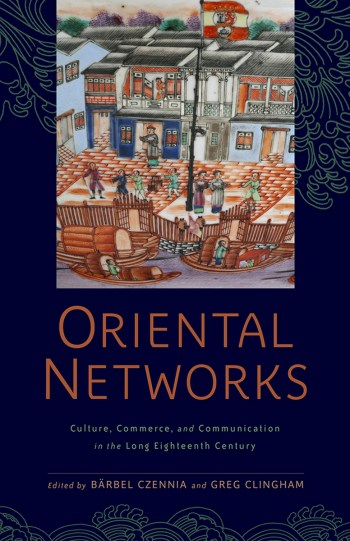 Oriental Networks explores forms of interconnectedness between Western and Eastern hemispheres during the long eighteenth century, a period of improving transportation technology, expansion of intercultural contacts, and the emergence of a global economy. In eight case studies and a substantial introduction, the volume examines relationships between individuals and institutions, precursors to modern networks that engaged in forms of intercultural exchange. Addressing the exchange of cultural commodities (plants, animals, and artifacts), cultural practices and ideas, the roles of ambassadors and interlopers, and the literary and artistic representation of networks, networkers, and networking, contributors discuss the effects on people previously separated by vast geographical and cultural distance. Rather than idealizing networks as inherently superior to other forms of organization, Oriental Networks also considers Enlightenment expressions of resistance to networking that inform modern skepticism toward the concept of the global network and its politics. In doing so the volume contributes to the increasingly global understanding of culture and communication.
Bärbel Czennia has served as associate professor of English at McNeese State University in Lake Charles, Louisiana, and as tenured senior lecturer of English literature at Georg-August-Universität Göttingen, Germany, for more than 25 years. She is the author or editor of many essays and two books, including Celebrities: The Idiom of a Modern Era.
Greg Clingham is emeritus professor of English at Bucknell University, a life member of Clare Hall, Cambridge, and the author or editor of ten books, including Johnson, Writing, and Memory. From 1996 to 2018, he was director of the Bucknell University Press.
C O N T E N T S
List of Illustrations
Acknowledgments
Introduction: Bärbel Czennia — Oriental Networks in the Long Eighteenth Century
1 Richard Coulton — Knowing and Growing Tea: China, Britain, and the Formation of a Modern Global Commodity
2 Stephanie Howard-Smith — China-Pugs: The Global Circulation of Chinoiseries, Porcelain, and Lapdogs, 1660–1800
3 Barbel Czennia — Green Rubies from the Ganges: Eighteenth-Century Gardening as Intercultural Networking
4 Samara Anne Cahill — The Blood of Noble Martyrs: Penelope Aubin’s Global Economy of Virtue as Critique of Imperial Networks
5 Jennifer L. Hargrave — Robert Morrison and the Dialogic Representation of Imperial China
6 James Watt — At Home with Empire? Charles Lamb, the East India Company, and ‘The South Sea House’
7 Greg Clingham — Commerce and Cosmology on Lord George Macartney’s Embassy to China, 1792–94
8 Kevin L. Cope — Extreme Networking: Maria Graham’s Mountaintop, Underground, Intercontinental, and Otherwise Multidimensional Connections
Bibliography
Index
Online Talk | Duncan Macmillan on French Art and Scotch Ideas
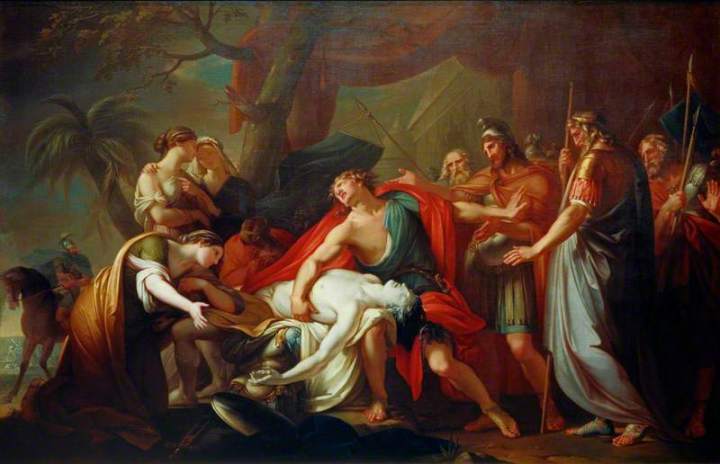
Gavin Hamilton, Achilles Lamenting the Death of Patroclus, 1760–63
(National Galleries of Scotland)
◊ ◊ ◊ ◊ ◊
From the Paul Mellon Centre:
Duncan Macmillan, French Art and Scotch Ideas: The Scottish Enlightenment and The Dawn of Modernity in French Art
Zoom, Wednesday, 10 February 2021, 2.00–3.30pm (GMT)
This online event is part of a collaboration between the Paul Mellon Centre and the Fleming Collection that will focus on aspects of Scottish art, both current and neglected. As a charity, the Fleming Collection promotes Scottish art and creativity through exhibitions, loans, and education, inspired by its own collection, deemed the finest outside institutions. Recently, the Fleming Collection gifted its specialist library to PMC as a contribution to building an unrivalled resource for British art studies open to all.
The Scottish philosophy of moral sense established the supremacy of the imagination which became one of the a priori of art. So too did its corollary, the idea that the imagination flourished more freely in the primitive condition of humanity, either in the remote past or among unsophisticated people in the present. In Rome, Gavin Hamilton pioneered these ideas in the visual arts and an international community of younger artists, including Canova and David, followed his lead. James Macpherson’s Ossian drew on the same ideas.
Later in the eighteenth century and well into the nineteenth, Thomas Reid’s philosophy of common sense enjoyed international currency. It also had particular appeal to artists as Reid argued that only they are aware of the raw sensations from which intuitively our perceptions are formed and that they must record these signs, not what they signify. This radical idea echoed through the nineteenth century. Reid also presented the same argument for expression and again gave artists privileged vision. His principal interpreter, Dugald Stewart, was a close friend of Henry Raeburn who was clearly influenced by Reid’s ideas. David Wilkie also followed Reid to make expression the basis of his art. His contemporary, the surgeon Charles Bell, made it the centre of his medical studies and his eventual identification of the function of the nervous system. Bell influenced Géricault.
Wilkie also responded to Reid’s ideas on perception, however, and also to how his arguments replaced imagined objectivity with actual subjectivity: art is personal and particular, not general. From this Archibald Alison developed an aesthetic theory of association. Drawing on these ideas, in Chelsea Pensioners reading the Waterloo Dispatch Wilkie quite consciously knocked history painting off its perch atop the hierarchy of painting. Wilkie also followed Burns and certainly influenced Constable. Along with Walter Scott, he was greatly admired in France where concurrently Reid’s philosophy became a fashionable topic amongst the artists in Delacroix’s circle. In Le Chef d’oeuvre inconnu, Balzac parodied its consequences for painting. Delacroix, Bonington and others were also deeply influenced by Wilkie and followed his example to explore a more personal and subjective kind of painting. Courbet also followed Wilkie, particularly in the idea reiterated by Reid that art is expressive, but to recover the simplicity of response, for both Wilkie and Courbet epitomised by folk music, artists must unlearn what they have learnt. Reid’s Works became a school text book for the Impressionist generation and his ideas on perception still find echoes in their work and that of Cézanne.
Online Talk | British Encounters with Indigenous Slavery, Nootka Sound
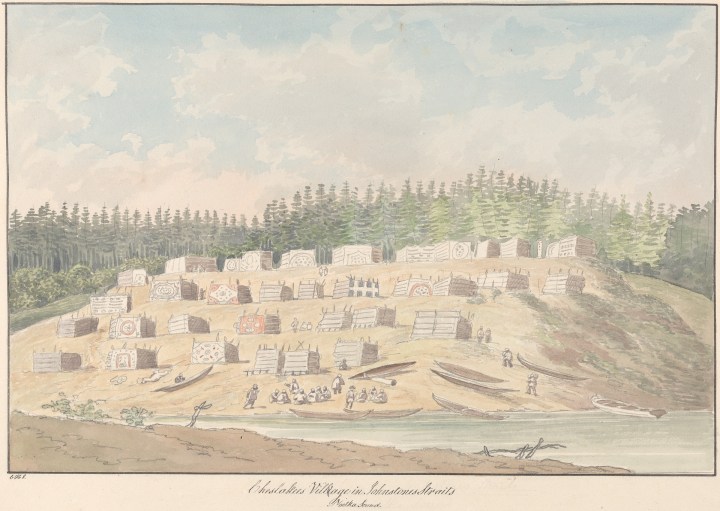
Charles Hamilton Smith (1776–1859, Belgian), Cheslakee’s Village in Johnstone’s Straits, undated, watercolor and graphite on moderately thick, moderately textured, cream wove paper; 41 × 33 cm; inscribed in pen and black ink, lower center: “Cheslakee’s Village in Johnstones Straits | Nootka Sound.” Signed in pen and black ink, lower right: “CHS” (New Haven: Yale Center for British Art, Paul Mellon Collection, B1978.43.1820(26)).
◊ ◊ ◊ ◊ ◊
Later this month, from YCBA:
Adam Chen, British Encounters with Indigenous Slavery at Nootka Sound
Online, Yale Center for British Art, New Haven, 23 February 2021, 12.30–1.00pm (ET)
At the end of the eighteenth century, British and Spanish mercantile expeditions descended upon an inlet known as Nootka Sound, on what is now the coast of Vancouver Island in British Columbia. Their reactions to the native Nuu-chah-nulth people and to the well-established indigenous slave trade on the Pacific Northwest Coast reveal the dissonance and nuances of eighteenth-century European attitudes toward slavery. Adam Chen will share several images of works from Yale and other collections to illustrate his talk.
Art in Context, the Center’s gallery talk series, is now online. Presented by faculty, staff, visiting scholars, and student guides, these lectures are held on the last Tuesday of each month during the academic year. Each talk focuses on a particular work of art in the Center’s collections, or a special exhibition, and takes an in-depth look at its style, subject matter, technique, or time period. The last ten minutes are reserved for conversation and will allow for participants to ask questions.
Adam Chen (TD 2022) is a Yale undergraduate majoring in the history of art and a Bartels Scholar at the Yale Center for British Art. He has previously worked in the European art departments of the Yale University Art Gallery and Seattle Art Museum. His historical interests include the eighteenth century and art of the British Empire. Chen is from the Pacific Northwest, and the topic of this talk is of personal significance. Chen is also an oil painter and carillon player.
Online Lecture | Jason Farago, A Global Criticism for a Global Art World
This Wednesday, from YCBA:
Jason Farago, Lytton Lecture: A Global Criticism for a Global Art World
Online, Yale Center for British Art, New Haven, 10 February 2021, 12.00–1.00pm (ET)
In the last 30 years, museums, galleries, fairs, and publications have taken a worldwide approach to art—but how can an art critic make substantive judgements when his or her beat spans the entire globe? In this talk, Jason Farago, art critic for the New York Times, considers how museums should approach the art of foreign cultures, how viewers can appreciate things they don’t fully understand, and how criticism can offer a view of art as a continuous flow of people, images, and ideas.
Generous support for this program has been provided by the Norma Lytton Fund for Docent Education, established in memory of Norma Lytton by her family. Lytton was an active docent at the Center for more than twenty years and subsequently spent a decade engaged in research for the Center’s Department of Paintings and Sculpture.
Jason Farago (Yale BA 2005) has served as an art critic for The New York Times since 2017. Before that, he was the first US-based art critic for The Guardian, and he has been a regular contributor to The New Yorker, The New York Review of Books, and other publications. Farago was also the editor and co-founder of the art and culture magazine Even, whose run is anthologized in Out of Practice: Ten Issues of Even, 2015–18 (Motto Books). He has published catalogue essays on the art of Sheila Hicks, Simon Hantaï, Kishio Suga, Julia Dault, Meleko Mogkosi, and others. In 2017 he was awarded the inaugural Rabkin Prize for art criticism.
Please register for the program here»
Painting Edo: Japanese Art from the Feinberg Collection
The exhibition Painting Edo: Japanese Art from the Feinberg Collection opened briefly at Harvard, before the museum was forced to close due to the pandemic. The catalogue of the collection, however, is scheduled to be published next month, and online programming continues, including a discussion of the film Edo Avant Garde.
Film Discussion: Edo Avant-Garde
Online, Tuesday, 9 February 2021, 7pm (EST)
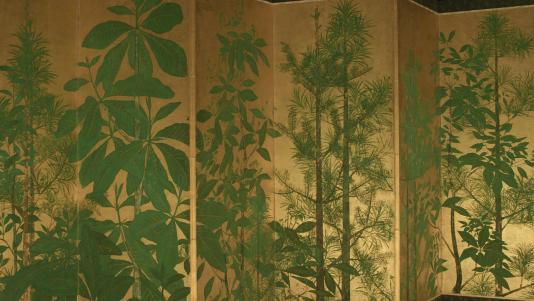
Still from ‘Edo Avant-Garde’ (2019). Master of the I’nen Seal (1600–1630), Sōtatsu school, Trees, Japanese, Edo period, mid-17th century; pair of six-panel folding screens; ink, colors, and gold on paper (Washington, D.C.: Freer Gallery of Art, F1962.30).
Join us on Zoom for a discussion of the film Edo Avant-Garde with curator Rachel Saunders and director Linda Hoaglund, presented in conjunction with the special exhibition Painting Edo: Japanese Art from the Feinberg Collection.
Edo Avant-Garde (2019) reveals the story of how Japanese artists of the explosively creative Edo period (1615–1868) pioneered innovative approaches to painting that many in the west associate most readily with so-called modern art of the 20th century. Through groundbreaking interviews with scholars, priests, art dealers, and collectors in Japan and the United States, the film explores how the concepts of abstraction, minimalism, and surrealism are all to be found in Edo painting. The film’s exquisite cinematography and outstanding original soundtrack, composed in response to individual paintings, present a remarkable immersive experience of some of Japan’s most celebrated and yet least-filmed paintings, many of them outside traditional museum and gallery settings. Simultaneously dynamic and mesmerizing, at its heart Edo Avant-Garde offers a unique opportunity to look closely and see differently.
This conversation will take place online via Zoom. Free admission, but registration is required. To register, please complete this online form.
Edo Avant-Garde will be available to stream for free through the Harvard Art Museums from Friday, February 5 to Friday, February 12. Upon registration, you will receive a link and password to access the film. We encourage you to view the film in advance of the discussion! The film is also available to rent through the Pacific Film Archive at the Berkeley Art Museum (BAMPFA). Please click here for further details.
If you have any questions, please contact am_register@harvard.edu.
◊ ◊ ◊ ◊ ◊
Distributed by Yale University Press:
Rachel Saunders, ed., Catalogue of the Feinberg Collection of Japanese Art (Cambridge: Harvard Art Museums, 2021), 264 pages, ISBN: 978-0300250909, $65.
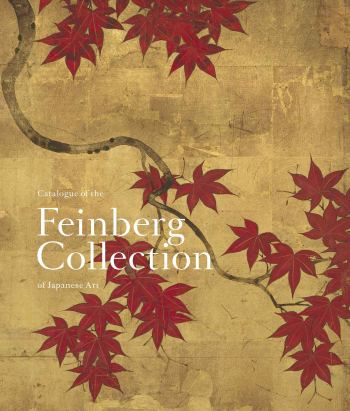 The sophistication and variety of painting in Japan’s Edo period, as seen through a preeminent US collection.
Over more than four decades, Robert and Betsy Feinberg have assembled the finest private collection of Edo-period Japanese painting in the United States. The collection is notable for its size, its remarkable quality, and its comprehensiveness. It represents virtually every stylistic lineage of the Edo-period (1615–1868)—from the gorgeous decorative works of the Rinpa school to the luminous clarity of the Maruyama-Shijo school, from the ‘pictures of the floating world’ (ukiyo-e) to the inky innovations of the so-called eccentrics—in addition to sculpture from the medieval and early modern periods. Hanging scrolls, folding screens, handscrolls, albums, and fan paintings: the objects are as breathtaking as they are varied. This catalogue’s twelve contributors, including established names in the field alongside emerging voices, use the latest scholarship to offer sensitive close readings that bring these remarkable works to life.
Rachel Saunders is the Abby Aldrich Rockefeller Associate Curator of Asian Art at the Harvard Art Museums.
Online Talks | HECAA Emerging Scholars Showcase
HECAA Emerging Scholars Showcase
Online, Saturday, 6 February 2021, 2:00–3:30pm (EST)
Our next HECAA Emerging Scholars Showcase is on Saturday, February 6, 2–3:30pm (EST). Please join us via Zoom (link below) to hear our next seven emerging scholars present their research. Each participant will present for 3–5 minutes, and after the presentations, we will host a question-and-answer session. If you have any questions or concerns, please contact Dani Ezor (dezor@smu.edu).
Best regards,
HECAA Board
◊ ◊ ◊ ◊ ◊
Zoom: https://smu.zoom.us/j/98321231325
• Priscilla Sonnier (University College, Dublin), ‘Ierne’s Ladies of Quality’: Self-Fashioning Elite Female Social Identity in Ascendancy Ireland, 1730–90
• Jennifer Laffick (Southern Methodist University), Sentimentalizing Soldiers: Lamentation and Theatricality in Jean Broc’s Death of General Desaix
• Emily Peikin (University of Delaware), Rubens Peale with a Geranium: Botanical Science and Slavery in the Early Republic
• Damiët Schneeweisz (Rijksmuseum), Coloured Ivory: Portrait Miniatures in the Dutch Atlantic World
• María del Castillo García Romero (University of Seville), Feminae devotae: Artistic Portraits on Religious Female Culture in Baja Andalusia during the 18th Century
• Leo Stefani (Courtauld Institute of Art), Surface Learning: Tables, Royal Education, and Louis XV’s Pavilion at the Tuileries
• Joseph Litts (Princeton University), Afterlives and Francis Parsons’s 1762 Painting of Cherokee Diplomat Cunne Shote
Call for Papers | The Sources of Colour: The Gobelins Dyeing Workshop
From ArtHist.net:
The Sources of Colour: The Gobelins Dyeing Workshop
Institut national d’histoire de l’art (INHA), Paris, 7–8 Octotber 2021
Proposal due by 12 March 2021
The National Institute of Art History (Institut National d’Histoire d’Art, INHA), in conjunction with the Archives Nationales and the Mobilier National, will be holding two study days specifically devoted to the Gobelins dyeing workshop.
Jehan Gobelin, a dyer from Reims, set up a workshop in the mid-fifteenth century not far from the Bièvre River, whose water was particularly suitable for dyeing purposes. His descendants, who were experts in the dyeing of wool in Venice scarlet, soon acquired vast stretches of land that ran alongside the Bièvre and constructed large workshops. Henri IV rented them and had tapestry workshops installed on the sites. In 1662, Colbert acquired the property for the Crown, and he brought together and placed the various workshops under the direction of Charles Le Brun. To reorganise the dyeing workshop, Le Brun solicited the help of a Dutch master dyer, Josse Kerchove. Since this time, the Gobelins dyeing workshop, which is the oldest European workshop of its kind that has been operating continuously since its foundation, has remained in the same place inside the Gobelins enclosure, to the north of the chapel.
This rich diachronic and multidisciplinary history is the topic of these study days, the first ever devoted to the Gobelins dyeing workshop, in its long history. Based on unprecedented sources or sources seen from a fresh perspective, these study days aims to focus on the latest knowledge concerning the dyeing workshop. Using new research findings and sources compiled since 2015 by the teams working at the Mobilier National and made available to researchers, various themes will be addressed during these study days:
• The role of the dyeing workshop in the evolution of regulatory texts relating to the métier of dyer, from Colbert’s reorganisation to the beginning of the twentieth century
• The contributions made by the successive directors of the dyeing workshop; generally speaking, all prosopographical research into the staff working in the dyeing workshop is welcome
• The contributions made by industrial chemistry to all of the fabric preparatory and dyeing processes
• The school of dyeing founded at the beginning of the nineteenth century by the Gobelins and the courses held by Chevreul, which were replaced by instruction in dyeing in Paris, throughout the nineteenth century (similar training was provided by Payen and Persoz at the Centre National des Arts et Métiers (CNAM), and in the 1830s in Lyon, Mulhouse, and Rouen)
• The status of national laboratory of expertise acquired by the dyeing workshop in the nineteenth century, initially during the First Empire in relation to the manufacture of Lyon silks, and subsequently in the context of the development of the dyeing industries in the colonies (madder and cochineal in Algeria; indigo in Senegal), and more generally in the Western world
For each of these themes, information about other dyeing workshops or other international experiences involving the transmission of knowledge and dyeing techniques is very welcome, from a comparative viewpoint. Likewise, the participation of researchers conducting studies into the history of the sciences, history, literature, textile design, and colour, or in the conservation sciences is particularly welcome.
The conference will be held both online and face-to-face, requiring particular care with regard to the way in which the discussions are conducted. We will ask participants to focus on their statements very precisely for fifteen minutes to optimise the discussion times. Participants may communicate in French or in English. Contributions (2,000 characters), accompanied by a short biography/bibliography, must be sent before 12 March 2021 to marie-anne.sarda@inha.fr and alexia.raimondo@culture.gouv.fr.
Sources on the Gobelins dyeing workshop
(More detailed information about the collection may be obtained from the members of the scientific and study day organisation committee)
• The Archives Nationales, the Pierrefitte-sur-Seine site:
Sub-series AF/IV (the Secretariat of State)
Sub-series F/12 (commerce and industry), here and here
Sub-series F/21 (fine arts)
Sub-series O/2, O/3, O/4, and O/5 (the Maison de l’Empereur or Maison du Roi)
• The Mobilier National, Paris (online search tools)
• Several digital sources are currently being published online
• The Bibliothèque Centrale du Muséum National d’Histoire Naturelle, Paris (online Calames union catalogue)
An inventory of the Eugène Chevreul collection is currently being compiled, so any requests for information or requests to view the archives must be sent to patrimoinedbd@mnhn.fr.
• The Manuscript Department of the Bibliothèque Nationale de France (online catalogue)
Scientific and organisational committee
Muriel Barbier (the Mobilier National)
Anne-Laure Carré (the Conservatoire National des Arts et Métiers, CNAM)
Hélène Cavalié (the Mobilier National)
Claude Coupry (the Centre National de la Recherche Scientifique, CNRS)
Joëlle Garcia (the Muséum National d’Histoire Naturelle)
Clémence Lescuyer (the Archives Nationales)
Alexia Raimondo (the Archives Nationales)
Charlotte Ribeyrol (Paris-Sorbonne University)
Marie-Anne Sarda (Institut National d’Histoire d’Art, INHA)










 Enfilade
leave a comment