Print Quarterly, March 2022
The long eighteenth century in the latest issue of Print Quarterly:
Print Quarterly 39.1 (March 2022) . .
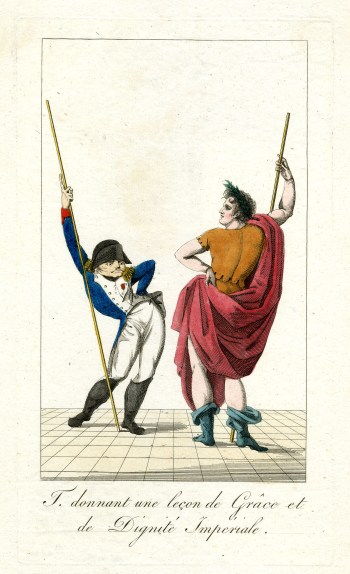
Charles Elie, T[alma] donnant une leçon de grâce et de dignité impériale (T[alma] giving a lesson in grace and imperial dignity), 1814, hand-coloured etching, 244 x 142 mm (London: British Museum).
A R T I C L E S
Antony Griffiths, “The Publication of Caricatures in Paris in 1814 and 1815, Part I: The Established Printsellers, Genty and Martinet,” pp. 31ff.
Two articles by Antony Griffiths on ‘The Publication of Caricatures in Paris in 1814 and 1815’—Part 1 in the March 2022 issue and Part 2 forthcoming—discuss the publication of caricatures in Paris during two years in which there were four regimes in power, and two occupations by foreign armies—a period which led to an unprecedented outpouring of social and political satire. Many works of great quality were produced, but most have only a title and do not reveal the names of the producers. The articles discuss how publishers and artists dealt with the political upheavals and identify some of the many participants who entered the field in these years. Part 1 deals with the caricatures published by members of the established print trade in Paris, and in particular Aaron Martinet and the newcomer Genty, who has previously been misidentified.
R E V I E W S
• Mark McDonald, Review of Juan Agustín Ceán Bermúdez, El Churriguerismo: discurso inédito (Alicante: Biblioteca Virtual Miguel de Cervantes, 2019), p. 79.
• Diana Greenwald, Review of Madeleine Viljoen, Nina Dubin and Meredith Martin, Meltdown! Picturing the World’s First Bubble Economy (Turnhout: Harvey Miller, 2020), p. 80.
• Ann V. Gunn, Review of John Bonehill, Anne Dulau Beveridge, and Nigel Leask, eds., Old Ways New Roads: Travels in Scotland 1720–1832 (Edinburgh: Birlinn, 2021), p. 81.
• Marcia Reed, Review of Troy Bickham, Eating the Empire: Food and Society in Eighteenth-Century Britain (London: Reaktion, 2020), p. 84.
• Nigel Tattersfield, Review of Graham Williams, Thomas Bewick Engraver & the Performance of Woodblocks (Kent: Florin Press, 2021), p. 86.
• Janis A. Tomlinson, Review of Mark McDonald et al., Goya’s Graphic Imagination (New York: The Metropolitan Museum of Art, 2021), p. 102.
Exhibition | A Shared Passion for Drawing
From:
Le partage d’une passion pour le dessin
Palais des Beaux-Arts, Paris, 22 March — 30 April 2022

Jean-Baptiste Greuze, Head of a Frightened Child, red chalk on beige paper (Beaux-Arts de Paris, acquired in 2013).
L’exposition dévoile un ensemble de 90 dessins, entrés dans les collections de l’École grâce à la générosité de l’association « Le Cabinet des amateurs de dessins des Beaux-Arts de Paris ». Le parcours, organisé à l’occasion des 15 ans de l’association, est présenté par écoles (italienne, nordique et française) à travers les siècles. Des œuvres d’Eugène Delacroix, Jean-Honoré Fragonard, Jean-Baptiste Greuze, Gerrit Van Honthorst, Giuseppe Penone ou encore Simone Peterzano sont ainsi à découvrir.
Les Beaux-Arts de Paris conservent la plus belle collection de dessins de France, après celle du musée du Louvre. Cette collection continue aujourd’hui encore de s’enrichir grâce à une politique d’acquisitions conçue à des fins pédagogiques ; ainsi que par des dons de professeurs, de jeunes artistes, et de l’association « Le Cabinet des amateurs de dessins des Beaux-Arts de Paris ».
Le partage d’une passion pour le dessin (ENSBA, 2017), 282 pages, ISBN: 978-2840565093, 39€.
5th Annual Ricciardi Prize from Master Drawings
From Master Drawings:
Fifth Annual Ricciardi Prize from Master Drawings
Submissions due by 15 November 2022
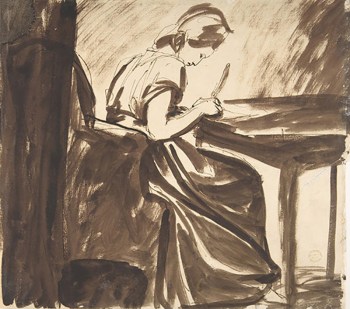
George Romney, Lady Seated at a Table (recto); pen and brown ink, brush and brown wash (NY: The Metropolitan Museum of Art, 11.66.3).
Master Drawings is now accepting submissions for the Fifth Annual Ricciardi Prize for Young Scholars. The winner will receive a cash award of $5,000. The prize is given for the best new and unpublished article on drawings (of any period) by a scholar under the age of 40. The winning submission will be published in a 2023 issue of Master Drawings and will be featured at our annual symposium.
For additional information about essay requirements and how to apply, visit the Master Drawings website, where you can also learn about the broad range of research by past winners of the prize.
Exhibition | Piranesi: A Dream of Stone and and Ink
Now on view at the Mazarin Library:
Piranèse et son empreinte : un rêve de pierre et d’encre
Bibliothèque Mazarine, Paris, 1 March — 14 May 2022
Curated by Yoann Brault with Olivier Thomas and Érik Desmazières
 Figure emblématique de cette « Académie de l’Europe » qu’est Rome au 18e siècle, Piranèse (1720–1778) occupe une place singulière dans notre héritage artistique et notre culture visuelle. Certes, il n’est pas seul à avoir fait accéder l’architecture figurée, réelle ou fictive, à un genre de plein droit. Mais cet artiste au génie impétueux et tourmenté, par la souplesse de sa technique, par ses effets dramatiques dans l’arrangement des lumières, ses disproportions et perspectives inattendues, a produit un univers visuel d’une puissance poétique inégalée.
Piranèse a nourri la veine française du néoclassicisme, et les efforts redoublés de ses fils ont permis de diffuser son oeuvre et d’étendre son influence depuis Rome ou Paris. Mais, après un demi-siècle de fascination, les productions de son génie n’ont pas échappé à l’usure de la curiosité et du goût. Dès la Restauration, les artistes du nouveau siècle se détournent de son empreinte. Bien qu’ici ou là tel amateur célèbre encore la « vigueur » de sa manière, on brocarde bientôt un oeuvre « improvisé avec facilité par l’imagination plutôt que produit par l’étude et par le temps » (Alfred Maury).
Cette déprise n’est pourtant pas totale. La poésie de ses planches, qui a tant et si précocement influencé l’art et la littérature préromantique, fait de Piranèse un passeur inopiné et, de ses Prisons, un motif obsédant que l’on retrouve en Angleterre puis en France, de Thomas De Quincey à Théophile Gautier. Il faut attendre l’entre-deux-guerres pour que le graveur recouvre la faveur des spécialistes, du public et des artistes qui y puisent à nouveau. Peut-être parce que son exploration inquiète du passé, son attrait pour le sublime et la démesure, pour la perte et la détresse, rejoignent les obsessions de notre temps.
Exposition organisée par les bibliothèques Mazarine et de l’Institut de France
Commissariat : Yoann Brault, avec la collaboration d’Olivier Thomas (bibl. de l’Institut)
Conseiller artistique et scientifique : Érik Desmazières (Académie des Beaux-Arts)
New Book | Animating the Antique
From Penn State UP:
Sarah Betzer, Animating the Antique: Sculptural Encounter in the Age of Aesthetic Theory (University Park: Pennsylvania State University Press, 2022), 272 pages, ISBN: 978-0271088839, $125.
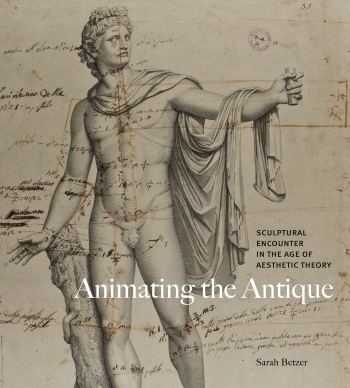 Framed by tensions between figural sculpture experienced in the round and its translation into two-dimensional representations, Animating the Antique explores enthralling episodes in a history of artistic and aesthetic encounters. Moving across varied locations—among them Rome, Florence, Naples, London, Dresden, and Paris—Sarah Betzer explores a history that has yet to be written: that of the Janus-faced nature of interactions with the antique by which sculptures and beholders alike were caught between the promise of animation and the threat of mortification.
Examining the traces of affective and transformative sculptural encounters, the book takes off from the decades marked by the archaeological, art-historical, and art-philosophical developments of the mid-eighteenth century and culminates in fin de siècle anthropological, psychological, and empathic frameworks. It turns on two fundamental and interconnected arguments: that an eighteenth-century ontology of ancient sculpture continued to inform encounters with the antique well into the nineteenth century, and that by attending to the enduring power of this model, we can newly appreciate the distinctively modern terms of antique sculpture’s allure. As Betzer shows, these eighteenth-century developments had far-reaching ramifications for the making and beholding of modern art, the articulations of art theory, the writing of art history, and a significantly queer Nachleben of the antique.
Bold and wide-ranging, Animating the Antique sheds light upon the work of myriad artists, in addition to that of writers ranging from Goethe and Winckelmann to Hegel, Walter Pater, and Vernon Lee. It will be especially welcomed by scholars and students working in eighteenth- and nineteenth-century art history, art writing, and art historiography.
Sarah Betzer is Professor of Art History at the University of Virginia and the author of Ingres and the Studio: Women, Painting, History, also published by Penn State University Press.
Exhibition | Antoine Coypel and the Theater of Troy
Now on view at the Musée des Beaux-Arts de Tours:
Le Théâtre de Troie: Antoine Coypel, d’Homère à Virgile
Musée des Beaux-Arts de Tours, 22 January — 17 April 2022
 L’exposition, présentée au musée des Beaux-Arts de Tours, en partenariat avec la Bibliothèque nationale de France, est une invitation à redécouvrir Antoine Coypel (1661–1722), peintre du roi Louis XIV et du régent Philippe d’Orléans. Aucune exposition monographique concernant Coypel n’a vu le jour jusqu’à présent, mais la connaissance de l’artiste a été récemment enrichie grâce à l’apparition sur le marché de l’art d’oeuvres inédites, à la redécouverte de tableaux que l’on croyait perdus et à la restauration de décors monumentaux, tel le plafond de l’hôtel d’Argenson, sur le point d’être révélé au public aux Archives Nationales. Sans prétendre à l’exhaustivité, l’exposition est une invitation à redécouvrir la personnalité attachante et la carrière prolifique d’Antoine Coypel, ainsi que les grands textes de l’Antiquité, d’Homère et de Virgile, ayant nourri son inspiration.
Autour de La Colère d’Achille et des Adieux d’Hector et Andromaque de Tours, une cinquantaine d’oeuvres des XVIIIᵉ et XIXᵉ siècles (tableaux, estampes, dessins, sculptures, objets d’art et planches gravées) sont réunies, grâce au prêt exceptionnel de la Bibliothèque nationale de France, du château de Versailles, des musées du Louvre, de Rennes, d’Angers, d’Arles, du Mobilier national et de l’École des Beaux-Arts de Paris.
Point d’orgue de l’exposition, la galerie d’Énée du Palais-Royal, chef-d’oeuvre d’Antoine Coypel aujourd’hui disparu, renaît au travers d’estampes spectaculaires de la Bibliothèque nationale de France. Les recherches approfondies menées pour reconstituer ce grand décor ont également permis de concevoir une maquette numérique de la galerie, en partenariat avec le musée Fabre de Montpellier, qui offre pour la première fois une proposition de reconstitution virtuelle en 3D très aboutie.
Une riche programmation culturelle (cycle de conférences, visites, spectacles de danse, musique, théâtre, cycle de péplums à la cinémathèque de Tours, cours d’histoire de l’art tout public, etc.) accompagnera toute la durée de cette exposition.
Le théâtre de Troie: Antoine Coypel, d’Homère à Virgile (Paris: Lienart éditions, 2022), 192 pages, ISBN: 978-2359063547, 23€.
Exhibition | La Fabrique des passions
Now on view at the Musée des Beaux-Arts de Tours:
La Fabrique des passions
Musée des Beaux-Arts de Tours, 17 December 2021 — 28 March 2022
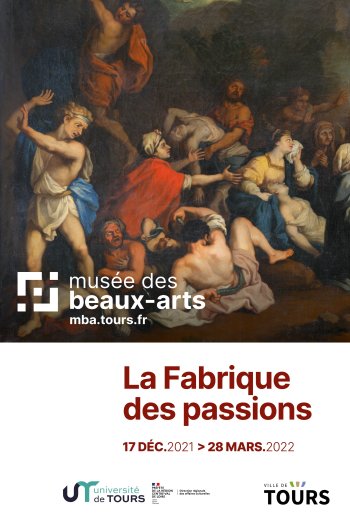 À partir du Serpent d’Airain (anonyme, 17ᵉ siècle) d’après Charles Le Brun, l’exposition La Fabrique des passions propose d’appréhender ce thème dans les arts du 17ᵉ au 19ᵉ siècle. Conformément à la pensée de René Descartes (Traité des passions, 1649), dont Charles Le Brun s’est inspiré, la passion—aujourd’hui synonyme d’émotion—se traduit comme l’expression incontrôlable d’un état affectif qui soumet l’âme et le corps. En 1668, Charles Le Brun, peintre du roi Louis XIV, donne une conférence à l’Académie royale de peinture et de sculpture dans laquelle il définit des modèles types d’expression des différentes passions.
Le parcours de l’exposition construit à partir d’oeuvres issues des réserves comporte trois entrées thématiques :
• les origines des passions dans les sources bibliques et mythologiques
• le théâtre comme nouvelle source d’inspiration des passions héroïques
• l’individualité des passions à travers les portraits et les études de têtes.
Origines des passions
Les origines des passions, observées à la fois d’un point de vue théorique, esthétique, religieux et historique, sont illustrées par trois oeuvres. Le Serpent d’Airain d’après Charles Le Brun, oeuvre maîtresse de l’exposition, présente les prémisses de la codification des passions. Les émotions—telles que l’admiration, l’effroi ou le ravissement—sont mises au service de la narration pour toucher le spectateur. Outre le travail sur l’expressivité des visages et des corps, l’intensité des couleurs participe à cette exaltation des émotions. Les origines des passions sont explorées à travers les thèmes fondateurs de la Bible. Aussi, pour mieux émouvoir, les artistes puisent-ils dans la culture du spectateur. Caïn et Abel (anonyme, 19ᵉ siècle), qui décrit le premier meurtre de l’histoire de l’humanité dans l’Ancien Testament, montre la brutalité de la passion débordante assimilée à la jalousie. La mythologie fournit d’autres sujets iconographiques propices à la mise en scène des passions à l’instar d’histoires légendaires de la Rome antique. L’Enlèvement d’une Sabine (anonyme, 19ᵉ siècle) d’après le chef-d’oeuvre du maniériste Jean de Bologne (16ᵉ siècle), sert ainsi de support plastique à la fabrique moderne d’une nouvelle esthétique des passions. Ici, la peur et la violence charnelle sont évoquées avec force.
Passions héroïques
Le théâtre, qui revisite la culture littéraire classique et savante aux 17ᵉ et 18ᵉ siècles, s’impose comme une nouvelle source d’inspiration de la figuration des passions héroïques. Les scènes de groupe, comme Les Funérailles de Pallas d’après Antoine Coypel (Louis Desplaces, 17ᵉ siècle), présentent une multitude de personnages qui incarnent le deuil, la tristesse et la désolation. Avec sa composition du dessin Briséis enlevée à Achille (18ᵉ siècle), Gaudar de Laverdine sublime les passions par un jeu de théâtralité des corps et des mouvements. Cléopâtre (huile sur toile, anonyme, 17ᵉ siècle) représente quant à elle la passion héroïque des femmes fortes, tout comme Polyxène (gouache, Guillaume Goudin, 18e siècle), princesse troyenne qui se sacrifie à la suite de la disparition de son bien-aimé.
Portraits et passions
Les portraits favorisent la focalisation progressive sur l’individualisation des émotions. À la suite du concours de têtes ouvert à l’initiative du Comte de Caylus (membre de l’Académie né en 1692 et mort en 1765), les études se consacrent désormais à la seule expressivité du visage. Jean-Baptiste Greuze apparaît comme l’archétype de l’artiste traitant de la tête d’expression (Tête de jeune femme, 18ᵉ siècle, copie), thème qui eut un grand succès à Paris et qui trouva également un écho à Tours comme en témoigne l’oeuvre d’Auguste Vinchon (Étude de femme, épisode de l’histoire de Venise, 19ᵉ siècle). L’exposition se conclut par un dessin d’Étienne-Pierre-Adrien Gois (plume et encre, 2ᵉ moitié du 17e siècle). L’autoportrait central, affichant une profonde expression méditative et introspective, est entouré de douze visages féminins et masculins, montrant la diversité des passions humaines. Les caricatures associées aux citations apportent un caractère comique et moralisateur à la lecture de l’image.
Entre théorie académique, théâtralisation et interprétation plus personnelle de la palette des émotions, ces oeuvres illustrent donc la manière dont les artistes se sont confrontés à la difficile codification des passions.
Commissariat
Andy Bodin, Alice Brozzoni, Emeline Chassine, Zoé Machado-Formiga, Marine Nabon, Elodie Poinha, Jurgen Poirier, Clara Roig, étudiant.e.s en Master 2 histoire de l’art, séminaire Pratique de l’exposition, à l’Université de Tours.
Lucie Gaugain, Maître de conférences en Histoire de l’art médiéval à l’Université de Tours, membre du CeTHiS, EA 6298
Delphine Rabier, ATER en Histoire de l’art moderne à l’Université de Tours, chercheur associé au CESR, UMR 7323
Coordination
Hélène Jagot, directrice des Musées-Château de Tours
Virginie Dansault, médiatrice, chargée des publics
Jessica Degain, conservatrice du patrimoine en charge des collections XVIIᵉ–XIXᵉ siècles
Catherine Pimbert, régisseuse des collections
New Book | Queen Hedwig Eleonora and the Arts
From Routledge:
Kristoffer Neville and Lisa Skogh, eds., Queen Hedwig Eleonora and the Arts: Court Culture in Seventeenth-Century Northern Europe (New York: Routlege, 2021), 248 pages, ISBN: 978-1472489609 (hardback), $160 / ISBN: 978-1032097244 (paperback), $49.
 As queen consort and dowager, Hedwig Eleonora (1636–1715) held a unique position in Sweden for more than half a century. As the dominant collector and patron of art and architecture in the realm, she left a strong mark on Swedish court culture. Her dynastic network among the Northern European courts was extensive, and this helped to make Sweden a major cultural center in Northern Europe in the later seventeenth century. This book represents the first major scholarly publication on the full range of Hedwig Eleonora’s endeavours, from the financing of her court to her place within a larger princely network, to her engagements with various cultural pursuits, to her public image. As the contributors show, despite her high profile, political position, and conspicuous patronage, Hedwig Eleonora experienced little of the animosity directed at many other foreign queens and regents, such as the Medici in France and Henrietta Maria in England. In this way, she provides a model for a different and more successful way of negotiating the difficulties of joining a foreign court; the analysis of her circumstances thus adds a substantial dimension to the study of early modern queenship. Presenting much new scholarship, this volume highlights one extremely significant early modern woman and her imprint on Northern European history, and fosters international awareness of the importance of early modern Scandinavia for European cultural history.
Kristoffer Neville is Associate Professor of Art History at the University of California, Riverside. Lisa Skogh is Project Co-Investigator in the Research Department at the Victoria and Albert Museum in London.
C O N T E N T S
1 Kristoffer Neville (University of California, Riverside) and Lisa Skogh (Victoria and Albert Museum), Introduction: Queen Hedwig Eleonora and the Arts
2 Jill Bepler (Herzog August Library, Wolfenbüttel), ‘The Queen of the North’: Hedwig Eleonora and Her German Family in Paint and Print
3 Gabriele Ball (Herzog August Library, Wolfenbüttel), Queen Hedwig Eleonora’s Societal Network within the Tugendliche and the Fruchtbringende Gesellschaft
4 Björn Asker (National Archives, Stockholm), Hedwig Eleonora as Dowager Queen and Administrator
5 Lisa Skogh (V&A Museum), The Pretiosa Cabinet at Ulriksdal Palace
6 Kjell Wangensteen (Princeton University), Hedwig Eleonora as Patron of David Klöcker Ehrenstrahl
7 Mikael Ahlund (Uppsala University Art Museums), The Wilderness inside Drottningholm: David Klöcker Ehrenstrahl and the Northern Nature at the Court of Hedwig Eleonora
8 Lars-Olof Larsson (Christian-Albrecht-University, Kiel), David Klöcker Ehrenstrahlʼs Portraits of Hedwig Eleonoraʼs Siblings: Invention and the Presentation of the Family
9 Lars Ljungström (Royal Collections, Stockholm), Hedwig Eleonora and Building as a Princely Pursuit
10 Kristoffer Neville (University of California, Riverside), Hedwig Eleonora and the Practice of Architecture
11 Anders Jarlert (Lund University), Hedwig Eleonora, Lund University, and the Learned
12 Mara Wade (University of Illinois, Urbana-Champaign), Ballet, Kunstkammer, and the Education of Princess Hedwig Eleonora at the Gottorf Court
13 Maria Schildt (Uppsala University), Hedwig Eleonora and Music at the Swedish Court, 1654–1726
14 Helen Watanabe-O’Kelly (Oxford University), Hedwig Eleonora in Print: From ‘Citronat’ to ‘Wundermutter’
New Book | The Art and Culture of Scandinavian Central Europe
A book that I should have noted several years ago; the ebook appeared in 2021. –CH. From Penn State UP:
Kristoffer Neville, The Art and Culture of Scandinavian Central Europe, 1550–1720 (University Park: Pennsylvania State University Press, 2019), 256 pages, ISBN: 978-0271082257, $90.
 Politically and militarily powerful, early modern Scandinavia played an essential role in the development of Central European culture from the sixteenth to the eighteenth century. In this volume, Kristoffer Neville shows how the cultural ambitions of Denmark and Sweden were inextricably bound to those of other Central European kingdoms. Tracing the visual culture of the Danish and Swedish courts from the Reformation to their eventual decline in the eighteenth century, Neville explains how and why they developed into important artistic centers. He examines major projects by figures largely unknown outside of Northern Europe alongside other, more canonical artists—including Cornelis Floris, Adriaen de Vries, and Johann Bernhard Fischer von Erlach—to propose a more coherent view of this part of Europe, one that rightly includes Scandinavia as a vital component. The seventeenth century has long seemed a bleak moment in Central European culture. Neville’s authoritative and unprecedented study does much to change this perception, showing that the arts did not die in the Reformation and Thirty Years’ War but rather flourished in the Baltic region.
Kristoffer Neville is Associate Professor of Art History at the University of California, Riverside. He is the author of Nicodemus Tessin the Elder: Architecture in Sweden in the Age of Greatness and coeditor of Queen Hedwig Eleonora and the Arts: Court Culture in Seventeenth-Century Northern Europe.
C O N T E N T S
List of Illustrations
Preface and Acknowledgments
Introduction
1 Gothicism in Germania
2 Reform and Reformation
3 Frederik II and the Arts in Denmark in the Later Sixteenth Century
4 Christian IV
5 Minerva’s World
6 Two Queens
7 Absolutism
Epilogue: The Romantic North
Notes
Bibliography
Index
Call for Papers | Marine Worlds of the 18th Century

After Jacques Étienne Victor Arago, Vue de Notre-Dame De bon Voyage (Rade de Rio de Janeiro), 1825
(Wikimedia Commons)
◊ ◊ ◊ ◊ ◊
From the Call for Papers:
18th DNS Seminar: The Marine Worlds of the Long Eighteenth Century
Australian Catholic University, Melbourne, 7–9 December 2022
Proposals due by 1 August 2022
The Australian and New Zealand Society for Eighteenth-Century Studies (ANZSECS) and the Australian Catholic University invite you to the 18th David Nichol Smith (DNS) Seminar for Eighteenth-Century Studies.* In 2022, the DNS will be held on 7–9 December at the ACU Fitzroy Campus in Melbourne. It will convene in-person, but will also feature a digital hub hosting a suite of provocations from colleagues around the world. We are delighted to announce that the seminar will include three keynotes: Lynette Russell, ARC Laureate Professor at Monash University; Kevin Dawson, Associate Professor of History at UC Merced; and Miranda Stanyon, ARC DECRA Research Fellow in the School of Culture and Communication at the University of Melbourne.
We welcome proposals that address our theme The Marine Worlds of the Long Eighteenth Century. We seek to explore and understand the experiences, knowledges, and spaces of the sea and undersea from 1650 to 1850. We are particularly keen to highlight and interrogate how the ‘blue humanities,’ and the environmental humanities in general, are in conversation with the study of the eighteenth century across disciplines.
Topics may include
• human-animal relationships in eighteenth-century oceans
• more-than-human oceans
• ideas and practices exploring ocean depths and sea surfaces
• oceanic lives: Indigenous, Black, gendered, plebeian, mercantile, imperial
• queering the eighteenth-century ocean
• feminist, subaltern, or decolonial knowledges of the marine
• seacraft design and representation
• maritime wrecks, disasters, and salvage operations
• reinterpretations of piracy and seaborne conflict
• marine and maritime labours, both free and unfree
• sensing seascapes: sights, sounds, tastes, and smells
• marine genres / oceanic forms
• aquatic sports, leisure, and culture
• relations between eighteenth-century studies and the blue humanities
• marine geographies, or ‘thalassographies,’ in formation, relation, and conflict
• philosophies and practices of sub/marine science
• sea-languages of the long eighteenth century
• submergence, diving, and drowning
• marine worlds of coasts and shores
• objects, things, and oceanic materialisms
• marine memories, testimonies, and archives
We are seeking proposals for panels, workshops, and roundtables (see below). We are happy to help prospective applicants make connections between people in order to form or participate in a session. If this proves impossible, we will of course then accept a 200-word abstract for an individual paper. We are pleased to offer some travel bursaries to postgraduate students or unemployed scholars to assist in the cost of travel to Melbourne. If you would like to be considered for a travel grant, please indicate so in your proposal and include a three-page CV. Please email proposals to dns.xviii@gmail.com by Monday, 1 August 2022.
S E S S I O N V A R I E T I E S
Panel of 90 minutes — 4 × 15-minute papers with a chair. Please submit a proposal with a title that covers your broad topic, the name and email of the main correspondent for the panel, the names of the four speakers, and 4 × 100-word abstracts (one for each prospective paper). You are welcome also to include a chair, or we can arrange one for you.
Panel of 60 minutes — 2 × 15-minute papers with a commentator. Please submit a proposal with a title that covers your broad topic, the name and email of the main correspondent for the panel, the names of the two speakers, and 2 × 100-word abstracts (one for each prospective paper). Please also arrange for a commentator who will reflect for 10 minutes on the paired papers.
Workshop of 60 minutes — This will involve group discussion of 2 × pre-circulated new works-in-progress. Please submit a proposal with a title, the name and email of the main correspondent for the workshop, and the names of the two scholars who will pre-circulate their article/chapter-length drafts for discussion, as well as a 100-word abstract for each. You are welcome also to include a chair-discussant, or we can arrange one for you.
Roundtable of 90 or 60 minutes — This has an open format but must include only short talks by participants that all speak to a central question or issue within the field of eighteenth-century marine studies. Please submit a proposal with a title that signals the key problem, a 200-word abstract for the roundtable, the name and email of the main correspondent/moderator for the roundtable, and the names of all the other participants.
As with previous DNS conferences, we aim to pursue a publication of some work arising from the seminar. We are already in talks with two interested publishers.
Convenors: Kristie Flannery, Kate Fullagar, Killian Quigley
* Inaugurated in 1966 by the National Library of Australia, the DNS is the leading forum for eighteenth-century studies in Australasia. It brings together scholars from across the region and internationally who work on the long eighteenth century in a range of disciplines, including history, literature, Indigenous studies, art and architectural history, philosophy, theology, the history of science, musicology, anthropology, archaeology, and studies of material culture.










 Enfilade
leave a comment