New Book | The Sun King at Sea
From The Getty:
Meredith Martin and Gillian Weiss, The Sun King at Sea: Maritime Art and Galley Slavery in Louis XIV’s France (Los Angeles: Getty Research Institute, 2022), 256 pages, ISBN 978-1606067307, $60.
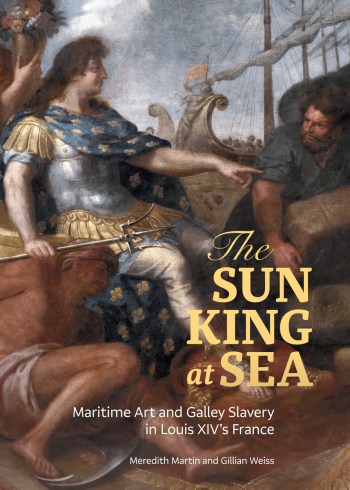 This richly illustrated volume, the first devoted to maritime art and galley slavery in early modern France, shows how royal propagandists used the image and labor of enslaved Muslims to glorify Louis XIV.
Mediterranean maritime art and the forced labor on which it depended were fundamental to the politics and propaganda of France’s King Louis XIV (r. 1643–1715). Yet most studies of French art in this period focus on Paris and Versailles, overlooking the presence or portrayal of galley slaves on the kingdom’s coasts. By examining a wide range of artistic productions—ship design, artillery sculpture, medals, paintings, and prints—Meredith Martin and Gillian Weiss uncover a vital aspect of royal representation and unsettle a standard picture of art and power in early modern France.
With an abundant selection of startling images, many never before published, The Sun King at Sea emphasizes the role of esclaves turcs (enslaved Turks)—rowers who were captured or purchased from Islamic lands—in building and decorating ships and other art objects that circulated on land and by sea to glorify the Crown. Challenging the notion that human bondage vanished from continental France, this cross-disciplinary volume invites a reassessment of servitude as a visible condition, mode of representation, and symbol of sovereignty during Louis XIV’s reign.
Meredith Martin is associate professor at New York University. She is an art historian specializing in French art, architecture, empire, and intercultural exchange from the late seventeenth to early nineteenth centuries. Gillian Weiss is professor at Case Western Reserve University. She is a historian specializing in early modern France, its relations with the Islamic world, and Mediterranean slavery.
C O N T E N T S
Acknowledgments
Author’s Note
Abbreviations
Introduction
1 Turks at Work: Building the Marseille Arsenal
2 Port to Palace: Mediterranean Dominance at Paris and Versailles
3 Civility and Barbarism: Enslaved Turks in Maritime Ceremonies and Manuals
4 Spectacles of Suffering: Galley Slaves and Plague
Epilogue
Illustration Credits
About the Authors
Index
Exhibition | Arte Sacra: Roman Catholic Art from Portuguese India
Now on view at NOMA:
Arte Sacra: Roman Catholic Art from Portuguese India
New Orleans Museum of Art, 13 March 2020 — 15 May 2022
Curated by Robert J. Del Bontà

Our Lady of the Rosary, 18th century, wood, with polychrome and gilt, 36 inches high (Collection Dr. Siddharth K. Bhansali).
In the centuries following the arrival of Francis Xavier, a Catholic missionary, in 1542, the state of Goa in western India became the administrative and economic center of a Portuguese empire that extended west to Africa and east to Malaysia, China, and Japan. The vast trade networks established by the Portuguese and Spanish allowed not only for the spread of Christianity, but also an unprecedented artistic exchange within these colonial empires. Works of art and valuable materials traveled between Spain, Portugal, and their colonies, leading to the development of new visual traditions informed by European imagery and local idioms.
European missionaries brought with them paintings, sculpture, and devotional objects for use in their evangelization efforts. Sculptures of saints and apostles, the Virgin Mary, Christ, and angels, made of wood and ivory, such as those seen in Arte Sacra, were created by Goan artists from Hindu and convert families. Initially based upon European prototypes, over time many works came to marry Christian imagery and symbols with local traditions. These works not only graced the interiors of European-style churches in Goa, but were also exported to Europe for use in religious establishments and for private devotion.
This exhibition, from the collection of Dr. Siddharth Bhansali, a New Orleans-based physician, reveals both the global influence of European seventeenth- and eighteenth-century styles, as well as the transformation of these styles in the hands of local artists creating a new visual tradition.
Robert J. Del Bontà, guest curator of Arte Sacra: Roman Catholic Art from Portuguese India, is an independent scholar of Indian art, who received his PhD from the University of Michigan in 1978. He has published numerous articles, contributed to scholarly publications, and curated exhibitions for the Berkeley Art Museum, the Portland Art Museum, and the University of Michigan Museum of Art. He provides a video tour of the exhibition here.










 Enfilade
leave a comment