Online Workshop | Making Masculinities

From ArtHist.net:
Making Masculinities: Material Culture and Gender in the 17th and 18th Centuries
Online and In-Person, University of Edinburgh, 6 May 2022
Research into the intersection of material culture and masculinity has steadily increased as scholars across disciplines choose to use material culture as a conceptual point of departure. The Material and Visual Culture in the Seventeenth and Eighteenth Centuries Research Cluster aims to provide a space to continue the conversation. The cluster will host a one-day workshop fostering interdisciplinary discussion on the material approaches to historic ideas about gender through material culture. The workshop is spread over a series of formats to diversify how participants may interrogate this material. All sessions, except for the 3.20 workshop, are hybrid. The link to join the sessions will be provided via email the day before. Contact materialcultureresearcheca@ed.ac.uk with questions.
Registration is available here»
Abstracts are available here»
P R O G R A M M E
(British Standard Time)
9:30 Welcome and Introduction
9:45 Fashioning Masculinity
Chair: Georgia Vullinghs (National Museums Scotland)
• Ben Jackson (University of Birmingham), Making a Figure in 18th-Century England: Elite Masculinity, Social Expectation, and Material Goods.
• Maria Gordusenko (Ural Federal University), Self-Representation through Artworks as a Way of Life: Count Gustav Adolf von Gotter (1692–1762)
11.00 Break
11.20 Making Masculinities Roundtable
Chair: Emily Taylor (National Museums Scotland)
• Timothy Somers (Newcastle University), The Materiality of Men’s Practical Jokes
• Alysée Le Druillenec (Université Paris 1 – Panthéon- Sorbonne/Université Catholique de Louvain), Carrying the Holy Child as a Depiction of Masculinity in Christian Counter-Reformation Materiality
• Élise Urbain Ruano (Université de Lille), How Does Softness Affect Masculinity? The Paradox of 18th-Century Dressing Gowns
• Alexandra Atkins (Birkbeck), The Classical Portrait Bust and Masculinity in 18th-Century Country Houses
• Nicholas Babbington (University College London), The Royal Family and Domestic Disorder: The Satirization of George III’s Patriarchal Virtues in British Caricature, c.1785–1795
12.50 Lunch Break
1.50 Keynote
Chair: Meha Priyadarshini (University of Edinburgh)
• Sarah Goldsmith (University of Edinburgh), Hercules Himself? Materiality, Masculinity, and the Body in the Long 18th Century
3.00 Break
3.20 PhD / ECR Workshop
Fort Ross in the News
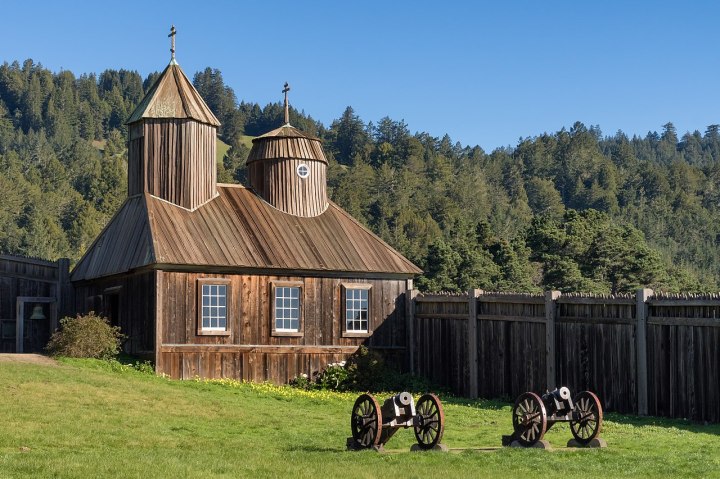
Orthodox Holy Trinity St. Nicholas Chapel at Fort Ross State Historic Park, Sonoma County, California. Occupying historic lands of the Kashaya Pomo tribe, the site’s first chapel, built in the mid-1820s, was destroyed in the 1906 earthquake. In 1970, a reconstructed version burned. Shown here is the latest chapel, built in 1973, which continues to be used for Orthodox worship services. (Photo by Frank Schulenburg, via Wikimedia Commons, December 2016). For how the Russian invasion of Ukraine is dividing leaders of the Russian Orthodox church, see Jeanne Whalen’s recent reporting for The Washington Post.
◊ ◊ ◊ ◊ ◊
From The Washington Post:
Jason Vest, “‘Russia’s Jamestown in America’—and the Oligarch Who Has Helped Fund It,” The Washington Post Magazine (12 April 2022).
Since Vladimir Putin loosed Russian troops on Ukraine, there hasn’t been much pity for Russian oligarchs, who have seen their funds seized with alacrity. But there exists in America, thanks in part to a now-sanctioned Putin-allied billionaire, the most genuinely Russian landmark in the Lower 48. It’s called Fort Ross—or Fort Russ, as the Russians called it, way back in 1812, when it was founded. Today it’s a California state park and on the National Register of Historic Places. Overlooking the Pacific Ocean from high, craggy cliffs, the nigh-forgotten outpost—a challenging two-hour drive north from San Francisco—has lately garnered more attention than usual as something of a historic curiosity. . . .
Established in 1909 as one of the first entries into the California State Park system, today Fort Ross scrapes by with a staff of 11 and a budget of about $500,000. It is, in tandem with nearby Gerstle Cove in Salt Point State Park, long a favored family or school field-trip destination for Northern Californians. . . .
Sarah Sweedler, chief executive of the Fort Ross Conservancy notes at the end of the article:
“We have gotten a few weird emails,” she says. “But we’ve also gotten some supportive emails. Hopefully common sense will prevail. . . . Fort Ross is a rich story that goes way beyond the Russians. It’s a part of California history that’s ours—everyone’s.”
From Wikipedia:
Fort Ross is a former Russian establishment on the west coast of North America in what is now Sonoma County, California. It was the hub of the southernmost Russian settlements in North America from 1812 to 1841. Notably, it was the first multi-ethnic community in northern California, with a combination of Native Californians, Native Alaskans, and Russians. It has been the subject of archaeological investigation and is a California Historical Landmark, a National Historic Landmark, and on the National Register of Historic Places. . . .
Online Lecture | Tessa Murdoch on Huguenot Art and Culture
This afternoon from the YCBA:
Tessa Murdoch, Huguenot Refugee Art and Culture through the YCBA Collections
Online, Yale Center for British Art, New Haven, 21 April 2022, noon

William Hogarth, Mr. Garrick in the Character of Richard III, 1746, engraving (New Haven: Yale Center for British Art).
The Yale Center for British Art is pleased to present an online lecture on Thursday, 21 April 2022, at 12pm by Tessa Murdoch about Huguenot artistic production in early modern London. Focusing on the museum’s collections, Murdoch examines an array of paintings, prints, drawings, maps, and sculpture with notable examples including François Gasselin’s 1692 drawing View of the Royal Hospital, Chelsea, and William Hogarth and Charles Grignion’s 1746 engraving Mr. Garrick in the Character of Richard III. This talk is based on research completed for her recent book Europe Divided: Huguenot Refugee Art and Culture (V&A publishing, 2021), which traces the international networks and artistic products created by French Protestant artists and craftsman in the wake of the Huguenot diaspora in the late seventeenth century.
Registration is available here»
Tessa Murdoch PhD FSA worked at the Museum of London (1981–1990) and at the Victoria and Albert Museum (1990–2021) where she was the Rosalinde and Arthur Gilbert Research Curator from 2019. She is an adviser for the National Trust and the National Heritage Memorial Fund, a board member of the Idlewild Trust, and chair of trustees of the Huguenot Museum, Rochester. Murdoch’s most recent book, Europe Divided: Huguenot Refugee Art and Culture, was published by the V&A in 2021. She is currently consulting on the forthcoming publication Great Irish Households: Inventories from the Long Eighteenth Century (2022), and is co-editing, with Heike Zech, A Cultural History of Craft in the Age of Enlightenment (expected 2024).
RA Short Course | Art and Society in 18th-Century Britain
This summer from the RA:
Art and Society in 18th-Century Britain
RA Summer School Course, Royal Academy of Arts, London, 2–6 August 2022

Angelica Kauffmann, Portrait of Lady Georgiana, Lady Henrietta Frances, and George John Spencer, Viscount Althorp, 1774, oil on canvas, 127 × 102 cm (Althorp House, Northamptonshire).
Immerse yourself in the Age of Enlightenment—its art, culture and society—at the historic Royal Academy.
The week-long course offers a grand tour of British art and society, with introductions to the artists, sitters, and collectors who defined the period. We look at the work of Hogarth, Reynolds, Kauffmann, and Turner, their impact on British society, and their lasting legacies. We meet some of the famous characters that defined the first age of celebrity via their portraits: Lord Burlington, the Duchess of Devonshire, the Prince of Wales, and Emma Hamilton.
We start the tour in London and look at the factors that resulted in the creation of the Royal Academy of Arts itself in 1768 and then widen our reach to explore ideas of Britishness and the English landscape; British relationships with its European neighbours, most notably their old enemy, France; and finishing at the dawn of the 19th century, embracing a newly global perspective, encompassing ideas of empire, travel, and exploration. The course covers numerous mediums and genres—from architecture to landscape—and the great European movements of the period: Baroque, Rococo, Neo-Classicism, and Romanticism. The week is comprised of talks, seminars, and discussions based at the Royal Academy’s iconic 18th-century home, Burlington House, and will include access to many of London’s greatest art collections. The course is led by a broad range of experts and encourages a collaborative and discursive environment. After completing the course, participants will have a strong understanding of both the art and culture of the 18th century and the lasting impact that the Age of Enlightenment had on future generations of artists and their works.
Covid-19 update: We are looking forward to welcoming you back in a way that ensures everyone’s safety. Numbers will be limited to allow for social distancing, and we will be following the latest government guidelines. In the event of another national lockdown or enforced closure, we reserve the right to move this event online or to a future date. If you have any questions or concerns, or would like to discuss any accessibility needs, please contact academic.programmes@royalacademy.org.uk.
The course fee is £1,800, which includes all materials, light refreshments each day, and drinks receptions throughout the week. Minimum age 18.
Speakers
Dan Cruickshank is a writer, art historian, architectural consultant, and broadcaster who has made numerous history and culture programmes and series for the BBC including Around the World in Eighty Treasures, Adventures in Architecture, and Britain’s Royal Palaces. His books include London: The Art of Georgian Building, Life in the Georgian City, and The Secret History of Georgian London: How the Sex Industry Shaped the Capital. Dan is an Honorary Fellow of the Royal Institute of British Artists, a member of the Executive Committee of the Georgian Group, and on the Architectural Panel of the National Trust, and is an Honorary Fellow of RIBA.
Jacqueline Riding is the author of Jacobites (2016), Peterloo (2018), and the major biography Hogarth: Life in Progress (2021). She was the historical and art historical adviser on Mike Leigh’s Mr. Turner (2014) and Peterloo (2018) and is a trustee of JMW Turner’s House, Twickenham.
Charles Saumarez Smith was Secretary and Chief Executive of the Royal Academy from 2007 to 2018 and is now Professor of Architectural History. He was trained as an architectural historian at King’s College, Cambridge and did a PhD at the Warburg Institute on the architecture of Castle Howard, published in 1990 as The Building of Castle Howard. He has been Slade Professor at Oxford University, is an Honorary Professor at Queen Mary University, and architecture correspondent for The Critic.
Mark Pomeroy has been Archivist of the Royal Academy since 1998. He completed post-graduate training in Archive Administration at Aberystwyth University in 1996 and was then appointed the first ever records manager to the UK Parliament. Mark has written extensively on subjects bearing on the history of the Royal Academy, most recently making contributions to the History of the Royal Academy and the Paul Mellon Centre’s Summer Exhibition Chronicle. His edited Letters of James Northcote (co-authored with Jonathan Yarker) is forthcoming. Mark sits of the Archives & Heritage Committee of BAFTA and is a regular lecturer for The Archives Skills Consultancy.
Martin Postle is Senior Research Fellow Paul Mellon Centre, and formerly the Deputy Director for Grants and Publications. Between 1998 and 2007 he worked at Tate as Senior Curator and Head of British Art to 1900. Martin’s publications include Sir Joshua Reynolds: The Subject Pictures (1995), Gainsborough (2002), and, with David Mannings, Sir Joshua Reynolds: A Complete Catalogue of his Paintings (2000). Among the exhibitions he has curated are Joshua Reynolds: The Creation of Celebrity (Tate Britain and Palazzo dei Diamanti, Ferrara 2005) and Johan Zoffany, RA: Society Observed (Yale Center for British Art and the Royal Academy of Arts, London 2011–12). Martin is currently in the early stages of preparing a catalogue raisonne of the oil paintings of Joseph Wright of Derby, to be published by the Paul Mellon Centre.
Rebecca Lyons is the Director of Collections & Learning at the Royal Academy with a remit covering the Collection, Library & Archive, Learning and Academic Programmes. For the last three years Rebecca has been Director of the Attingham Trust’s prestigious Royal Collection Studies for museum directors, curators, and art-world professionals based at Windsor Castle. She was Curator for the National Trust at Knole and Ightham Mote. Prior to this, Rebecca was Director of the Fine & Decorative Art MLitt and MA programmes at Christie’s Education, London/University of Glasgow where she taught for fifteen years. Rebecca sits on the steering committee for the Society for the History of Collecting and is chair of a large Academy Trust in East London. Educated at Oxford, the Courtauld, and Cambridge, Rebecca is the author most recently of an essay on 18th-century collector Welbore Ellis Agar for Getty Publications (2019) and a chapter for the Royal Collection exhibition catalogue George IV: Art and Spectacle (2019).
Will Iron is a cultural historian with interests in the fashion, art, and literature of the eighteenth century. He is Academic Programmes Manager at the Royal Academy of Arts, where he leads the ongoing series of art and cultural history courses, lectures, and academic conferences. Previously he worked at the British Fashion Council. He studied at Central Saint Martins and King’s College London.
Anne Lyles, an expert on British landscape painting, worked at Tate Britain for 25 years. Co-curator of the RA’s Late Constable exhibition, Anne also co-curated Constable: The Great Landscapes (Tate Britain and other venues, 2006–07) and Constable Portraits (National Portrait Gallery and Compton Verney, 2009), as well as advising on Constable and Brighton (Brighton Museum and Art Gallery, 2017).
Marcia Pointon is Professor Emerita in History of Art at the University of Manchester and Research Fellow at the Courtauld Institute of Art. She is author of Brilliant Effects: A Cultural History of Gem Stones and Jewellery (2009) and Rocks, Ice, and Dirty Stones: Diamond Histories (2017). Her work on portraiture has appeared in a wide number of scholarly journals over many years as well as in three monographs: Hanging the Head: Portraiture and Social Formation in Eighteenth-Century England (1993, now available on open access on the YUP A&Ae portal), Strategies for Showing: Women, Possession, and Representation 1665–1800 (1997), and Portrayal and the Search for Identity (2013). Marcia is also author of a popular guide to art history for students, now in its fifth edition: History of Art: A Students’ Handbook.
S.I. Martin works with museums, archives, and the education sector to bring diverse histories to wider audiences. As a museums consultant and curator he has worked with and for the Black Cultural Archives, National Maritime Museum, the V&A, Tate Britain, London Metropolitan Archives, National Portrait Gallery, Horniman Museum, the National Archives, RAF Museum, Wellcome Trust, and others. He has published five books of historical fiction and non-fiction for adult and teenage readers.
Clare Brant is Professor of Eighteenth-Century Literature and Culture at King’s College London, where she co-directs the Centre for Life-Writing Research. Her most recent scholarly book is Balloon Madness: Flights of Imagination in Britain, 1783–1786 (2017). She has co-edited nine essay collections and published widely on eighteenth-century and contemporary subjects. She has a Leverhulme Major Research Award (2022–25) for a forthcoming book, Underwater Lives: Humans, Species, Oceans. Clare is also a poet; her fourth collection, Breathing Space, was published by Shoestring Press in 2020.
Jonny Yarker, a leading dealer in British art, has written extensively on British art of the eighteenth century and the Grand Tour in particular. He is currently working on a book-length study of the British community in Rome entitled Savage Pilgrims: Rome and the Grand Tour, 1750–1798.
Christo Kefalas is a cultural anthropologist and art history researcher. Since 2018, she has worked for the National Trust, currently as the Senior Curator of Global and Inclusive Histories. She leads on institutional advice for the care and display of collections originating outside of Europe, while also promoting the greater global connectivity of all Trust collections. Christo was an editor and author of the Interim Report on the Connections between Colonialism and Properties Now in the Care of the National Trust, Including Links with Historic Slavery (2020). Her PhD from the University of Oxford focused on 19th-century Māori artefacts and a photography collection at the Pitt Rivers Museum. Christo brings an anthropological perspective on history and diverse cultural experiences to her public curation practice, acknowledging the importance of identity and power in society. She has worked as a curator for collections at The British Museum, Great North Museum Newcastle, and the Horniman Museum, where she managed the curatorial delivery of the permanent World Cultures Gallery in South London.
Call for Papers | Slave Dwelling Project Conference
Overlapping with The Stono Legacy Project, a month-long commemoration of the 1739 Stono Rebellion, this year’s Slave Dwelling Project Conference will take place in a hybrid format, with in-person activities in and around Charleston as well as live-streamed virtual events. From the Call for Papers:
The 1739 Stono Rebellion and the Atlantic World
Seventh National Slave Dwelling Project Conference
College of Charleston, 8–10 September 2022
Proposals due by 1 May 2022
 The Stono Rebellion, a transformative event in the history of enslavement in the Americas, tells a powerful story of resistance and resilience. In September 1739, against near-impossible odds, a group of enslaved South Carolinians south of Charleston armed themselves and set out to make their way to freedom in Spanish Florida. As they marched through the countryside, they were confronted by an armed white militia and engaged in bloody combat. Many of the rebels were murdered; others faced execution after the fighting or were re-enslaved. Only a handful survived into freedom. In its immediate aftermath, the 1739 Stono Rebellion led to restrictive slave codes in South Carolina, which quickly spread throughout the American South. At the same time, word of the courageous rebellion spread throughout the Atlantic world, inspiring multiple acts of defiance.
This early-American story of rebellion, resistance, and resilience powerfully impacted the 18th- and 19th-century Atlantic world, and continues to wield power today as we seek to unearth the full story of African American resistance to enslavement, and to celebrate the extraordinary legacy of African American resilience. The 2022 Slave Dwelling Project Conference: The Stono Rebellion and the Atlantic World seeks to examine not only the 1739 rebellion but also its remarkable legacy—one that continues to resonate throughout the world today in the ongoing fight for racial justice.
The conference will take place 8–10 September 2022, at the College of Charleston in Charleston, South Carolina. Concurrent with The Stono Legacy Project, a month-long commemoration of the 1739 Stono Rebellion, this 7th national SDP conference will employ a hybrid format, with in-person activities in and around Charleston as well as a number of live-streamed virtual events.
Conference organizers welcome proposals for both 60-minute and 90-minute sessions on the Stono Rebellion itself as well as other important rebellions by enslaved Africans throughout the Atlantic World. We are also seeking sessions on the subsequent legacy of these events—up to and including the present day. We welcome both scholarly presentations, panels, and round-tables as well as sessions on historic sites and interpretation, and cultural offerings. Proposals will be accepted between 15 March 15 and 1 May 2022. Questions should be directed to the Slave Dwelling Project at slavedwellingproject@gmail.com.
Key partners in the 2022 Slave Dwelling Project Conference are the Carolina Lowcountry and Atlantic World (CLAW) Program at the College of Charleston, the National Underground Railroad Network to Freedom Program, and the Slave Dwelling Project. Major funding for the conference has been generously provided by the 1772 Foundation.
Developed by a collective of cultural organizations, the Stono Legacy Project includes a month-long series of public programming surrounding South Carolina’s Stono Rebellion, its impact on antislavery and Civil Rights activism, and its contemporary relevance. Key partners in the Project are the Carolina Lowcountry and Atlantic World (CLAW) Program at the College of Charleston; the Caw Caw Interpretive Center in Ravenel, SC; Charleston County Parks; the Fort Mose Historical Society in St. Augustine, FL; the Gullah Geechee Cultural Heritage Corridor; the International African American Museum in Charleston, SC; the National Underground Railroad Network to Freedom Program; the Slave Dwelling Project; and historians Jane Landers of Vanderbilt University and Peter H. Wood, professor emeritus of Duke University.
◊ ◊ ◊ ◊ ◊
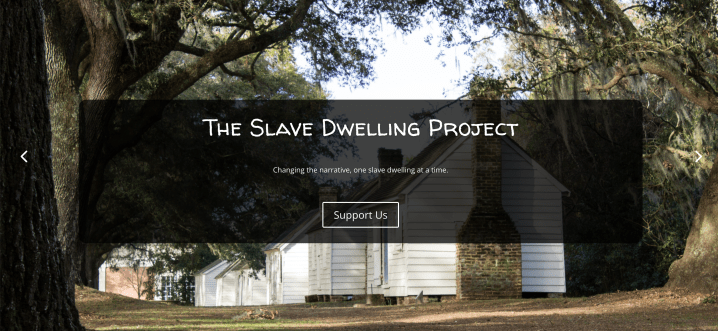
The Slave Dwelling Project envisions a future in which the hearts and minds of Americans acknowledge a more truthful and inclusive narrative of the history of the nation that honors the contributions of all our people, is embedded and preserved in the buildings and artifacts of people of African heritage, and inspires all Americans to acknowledge their Ancestors.
Mission
1 Raise awareness and organize resources to preserve, interpret, maintain and sustain extant slave dwellings and other structures significant to the stories of the enslaved Ancestors.
2 Bring together scholars and practitioners, preservationists, students and educators, writers, artists, legislators, organizations and businesses with the general public to:
• Change the narrative of American history and address the legacies of slavery,
• Preserve and sustain slave dwellings,
• Promote education about slavery and the contributions of African Americans,
• Engage in conversation about all these matters.
3 Support and encourage individuals and organizations to preserve and mark sites related to the institution of slavery and the legacy of slavery.
4 Educate ourselves and others about the intertwined history of Americans of African and European origins, from the country’s founding to the present, to help us rewrite the narrative of history, preserve slave dwellings, and have dialogue about the legacies of slavery.
5 Engage people in honest conversations about slavery, race, racism and racial equity in search of improved racial relations.
What We Do: The Slave Dwelling Project . . .
• Gives talks and presentations.
• Organizes and conducts overnight stays at sites associated with slavery.
• Presents living history programs, “Inalienable Rights: Living History through the Eyes of the Enslaved.”
• Holds a major conference annually and at least one mini-conference each year.
• Provides consultation and networking support for those interested in preserving an extant slave dwelling.
The Burlington Magazine, April 2022
The eighteenth century in the April issue of The Burlington . . .
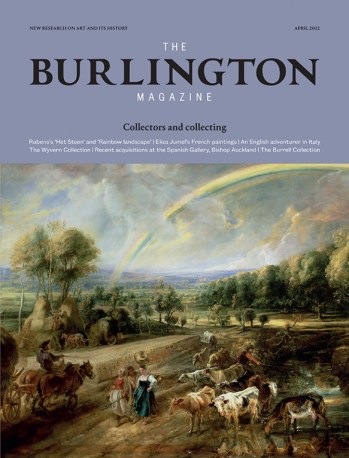
The Burlington Magazine 164 (April 2022)
 A R T I C L E S
• Lucy Davis and Natalia Muñoz-Rojas, “The Provenance of Het Steen and The Rainbow Landscape by Rubens,” pp. 333–41. New documentary evidence elucidates the hitherto uncertain history of these two celebrated landscapes painted by Peter Paul Rubens ca. 1636. Having remained with this family after his death, they were purchased by the Marquess of Caracena, Governor of the Spanish Netherlands, and taken to Madrid. By 1706 they were in Genoa, in the collections of successively Bartolomeo Saluzzo (1652–1705) and Costantino Balbi (d. 1740). This article assimilates a number of archival discoveries that shed light not only on the provenance of these two paintings but also on two important Genoese collections.
• Lucia Bonazzi, “Richard Vickris Pryor in the Art Market of Napoleonic Europe,” pp. 342–49. The son of a Quaker family of brewers and wine merchants, Richard Vickris Pryor (1780–1807) spent his brief adult life in pursuit of paintings. A characteristic example of the sort of entrepreneur who sought to exploit the release of works of art onto the market in the wake of Napoleon’s campaigns, he scored his greatest success with the purchase of the Lechi collection in Brescia in 1802.
• Margaret Oppenheimer, “From Paris to New York: French Paintings from the Collection of Eliza Jumel,” pp. 350–61. Eliza Jumel (1775–1865), born in poverty, was one of New York’s richest women at her death in 1865. While in Paris in 1815–17 she formed the largest collection of European paintings yet assembled by an American, the largest part of them French. Sold in 1821, the collection has been all but forgotten, but it has proved possible to trace a number of the works she owned.
R E V I E W S
• Noémi Duperron, Review of the exhibition Le Théâtre de Troie: Antoine Coypel, d’Homère à Virgile (Musée des Beaux-Arts de Tours, 2022), pp. 394–96.
• Eric Zafran, Review of the exhibition Paintings on Stone: Science and the Sacred, 1530–1800 (Saint Louis Art Museum, 2022), pp. 396–99.
• Peter Y. K. Lam, Review of the exhibition catalogue Sarah Wong and Stacey Pierson, eds., Collectors, Curators, Connoisseurs: A Century of the Oriental Ceramic Society, 1921–2021 (Oriental Ceramic Society, 2021), pp. 402–03.
• Rowan Watson, Review of Richard Rouse and Mary Rouse, Renaissance Illuminators in Paris: Artists and Artisans, 1500–1715 (Harvey Miller, 2019), pp. 418–19.
• Richard Wrigley, Review of Iris Moon and Richard Taws, eds., Time, Media, and Visuality in Post-Revolutionary France (Bloomsbury, 2021), pp. 423–24.
• Philip Ward-Jackson Review of Bayerische Staatsgemäldesammlungen / Neue Pinakothek: Katalog der Skulpturen; Volume I: Die Sammlung Ludwigs I, Volume II: Adolf von Hildebrand (Deutscher Kunstverlag, 2021), pp. 424–25. “This is a vital link in the chain between Enlightenment celebrations of worthies and grand hommes and such later nineteenth-century sculptural pantheons as those on the Musée du Louvre, Paris, and the Albert Memorial, London . . .” (424).
O B I T U A R I E S
• Peter Cherry, Obituary for Jonathan Brown (1939–2022), pp. 427–28. As well as bringing many fresh insights to the study of the major Spanish artists from El Greco to Picasso, with a particular focus on Velázquez, Jonathan Brown made important contributions to the study of patronage and collecting and of the diffusion of the images and ideas in the wider Hispanic world. Much honoured in Spain as well as in his native America, he will also be remembered as a dedicated and assiduous teacher.
Online Talk | Paweł Gołyźniak on Philipp von Stosch

From The Wallace Collection:
Paweł Gołyźniak, Philipp von Stosch and His Circle: Collecting and Studying of Ancient Engraved Gems, from Antiquarianism to Proto-Archaeology
Online, The Wallace Collection, London, 25 April 2022, 17.30 (BST)
Paweł Gołyźniak’s research traces and examines Philipp von Stosch’s (1691–1757) collecting, antiquarian, and scholarly activities in terms of engraved gems on the basis of the unknown pictorial (drawings) and archival sources. The discovery of nearly 2300 unknown gem drawings in the Princes Czartoryski Museum in Krakow gives an opportunity to present him as one of the most instrumental figures of 18th-century antiquarianism. The seminar will discuss Stosch’s outstanding collection of intaglios and glass gems, and most importantly his scholarly projects: starting from his celebrated book Gemmae antiquae caelatae published in 1724 in Amsterdam, through to his attempts to write a supplement to that study, documentation of his own collection of gems and other European gem cabinets, and, finally, the virtually unknown project Histoire universaille, meant to reflect history, mythologies, and customs of the ancient Egyptians, Etruscans, Greeks, and Romans, combined with a reconstruction of the history of glyptic art.
For all his enterprises, Stosch commissioned large quantities of drawings that were produced in a truly archaeological vein with attention paid to such issues as material, form, right proportions, state of preservation, provenance, etc. of the reproduced gems. Often the gems received extensive commentaries explaining their iconography and providing analogies in sculpture, reliefs, wall paintings, and coins. Relevant passages in ancient literary sources were also referenced. The study of Stosch’s scholarly activities advances our understanding of emergence of archaeology as a scientific discipline. The discovered pictorial documentation provokes us to hypothesise that Stosch, his collecting, and scholarly enterprises greatly inspired and influenced Johann Joachim Winckelmann (1717–1768) in writing his first synthesis of ancient art (Geschichte der Kunst des Alterthums) published in 1764.
This talk will be hosted online through Zoom and The Wallace Collection’s YouTube channel.
Pawel Golyzniak is a Research Fellow in the Institute of Archaeology at Jagiellonian University in Krakow.
Lecture Series | 2022 Wallace Seminars on Collections and Collecting
This year’s Wallace Seminar Series on Collections and Collecting:
2022 Wallace Collection Seminars on the History of Collections and Collecting
Online and/or In-Person (depending upon session), The Wallace Collection, London, last Monday of most months
Established in 2006, The Seminars in the History of Collecting series helps fulfil The Wallace Collection’s commitment to the research and study of the history of collections and collecting, especially in the 18th and 19th centuries in Paris and London. Seminars are normally held on the last Monday of each month, excluding August and December. They act as a forum for the presentation and discussion of new research into the history of collecting, and are open to curators, academics, historians, archivists and all those with an interest in the subject. Each seminar is 45–60 minutes long, with time for Q&A.
Book your place via the Wallace Collection website. Bookings will open a few weeks before each seminar. A detailed summary of each forthcoming seminar will be provided around the same time. Please also check the website nearer the time to find out whether the seminar will be held in person at the Wallace Collection, or online via Zoom.
Monday, 17 January
Lelia Packer (Curator of Dutch, Italian, Spanish, German, and Pre-1600 Paintings, The Wallace Collection), The Laughing Cavalier, the ‘Mad Marquis’, and the Revival of Frans Hals
Monday, 28 February
Malika Zekhni (PhD Candidate, Faculty of History, University of Cambridge), Between Empires and beyond Labels: Collecting and Presenting Central Asia in British Museums
Monday, 28 March
John D. Ward (Head of Silver and Vertu Department, Sotheby’s, New York), The Lost George J. Gould Collection and the Beginning of Duveen Taste in America
Monday, 25 April
Paweł Gołyźniak (Research Fellow, Department of Classical Archaeology, Institute of Archaeology, Jagiellonian University, Krakow, Poland), Philipp von Stosch (1691–1757) and His Circle: Collecting and Studying of Ancient Engraved Gems, from Antiquarianism to Proto-Archaeology
Monday, 30 May
Simon Kelly (Curator and Head of Department of Modern and Contemporary Art, Saint Louis Art Museum), Collector, Photographer, Art Critic: The Multiple Roles of Paul Casimir-Périer (1812–1897)
Monday, 27 June
John E. Davies (Independent Scholar), Ancient and Modern: The Collecting Habit of John Campbell, First Baron Cawdor (1755–1821)
Monday, 25 July
Felicity Myrone (Lead Curator, Western Prints and Drawings, British Library, London), Prints and Drawings at the British Library: Revealing Hidden Collections
Monday, 26 September
Feng Schöneweiß (PhD Candidate, University of Heidelberg), Provenancing the Dragoon Vases: Porcelain, Architecture, and Monumentality in German Antiquarianism, 1700–1933
Monday, 31 October
Rosie Razzall (Curator of Prints and Drawings, Royal Collection Trust, London), Paul Sandby’s Collection of Drawings
Monday, 28 November
Tom Hardwick (Consulting Curator of Egyptology, Houston Museum of Natural Science), Wonderfully Expensive Things: Howard Carter and the Market for Egyptian Art, 1920–1940
Paul Mellon Centre Rome Fellowship, 2022–23
From the Paul Mellon Centre:
Paul Mellon Centre Rome Fellowship
The British School at Rome, three months between September 2022 and July 2023
Applications due by 29 April 2022
 The Rome Fellowship offers one individual the opportunity to research in Rome for three months, whilst being hosted by the British School at Rome (BSR). Whilst based at the BSR the Fellow will have access to their have a specialist library with c. 110,000 volumes, their rich collection of maps and rare prints, as well as the photographic archive which includes prints and negatives of rare and unique collections.
The Fellowship provides residential accommodation and meals at the BSR, which hosts some 35 individuals at any one time, from academics and fine artists who have all won awards to spend an extended period in Rome. There is a big sense of community at the BSR with fellows and residents encouraged to take part in the vibrant life, from communal dining to events. A recent Rome Fellow said that his time in Rome was enhanced by the “the extraordinary intellectual, creative, and supporting environment of the BSR.”
To be eligible to apply for the Rome Fellowship you must be an individual who is working on a topic British-Italian art or architectural history and who requires dedicated time in Rome to visit collections, libraries, archives, or historic sites. The scope is relatively wide, please contact the Fellowships & Grants Manager with any questions regarding topic eligibility.
The individual needs to be able to take up the Fellowship for three months between September 2022 – July 2023 and applications are open to scholars, researchers, curators, archivists and GLAM professionals from any country but who must be willing to engage with the Italian language (lessons will be included if needed). Alongside receiving free accommodation and meals, there will be an honorarium awarded to the individual.
Applications are now open and will close at midnight on 29 April. References are due by Thursday, 5 May. The successful applicant will be notified by the end of May.
Online Talks | HECAA Emerging Scholars Showcase, Spring 2022
HECAA Emerging Scholars Showcase
Online, Saturday, 23 April 2022, 12.30–2.00pm (ET)
Please save the date for HECAA’s Spring 2022 Emerging Scholars Showcase, scheduled for Saturday, 23 April 2022. The showcase will take place from 12.30 to 2pm Eastern Time (a time slot that allows us to accommodate presenters from five different time zones). Registration is available here.
We hope you’ll join us for eight exciting presentations:
1 Chiara Betti (SAS: Institute of English Studies), Richard Rawlinson (1690–1755) and His Printing Plates
2 Demetra Vogiatzaki (Harvard University), On Marvels and Stones: Architecture and Virtuality in Late Eighteenth-Century France
3 Nandita Punj (Rutgers University), Jain Artistic Practices and Visual Culture in Eighteenth-Century Bikaner
4 Tamara Ambramovitch (Hebrew University, Jerusalem), Cutting Edges: The Symbolic and Social Role of Frames in Eighteenth-Century France
5 Jean Chistensen (Southern Methodist University), ‘In the Style of a Sovereign’: The Politics of Beauty and Disability in Queen Anne’s Portraiture
6 Aubrey Hobart (Savannah College of Art and Design), Reading Inhumanity in the Casta Paintings of New Spain
7 Felix Martin (RWTH Aachen University), The Inhabited Monument: Sir William Chambers’s Casino at Marino in Dublin
8 Anastasia Michopoulou (University of Crete), Aedes Pembrochianae: Displaying and Publishing the Collections in Wilton House
Please note that the order of presenters is subject to change.
◊ ◊ ◊ ◊ ◊
Note (added 16 April)— The original posting, based on a ‘save-the-date’ email sent to HECAA members, included nine speakers. The updated posting reflects the latest program, along with the registration link. –CH










 Enfilade
leave a comment