Call for Papers | Fashioning Masculinities: The Art of Menswear
From ArtHist.net:
Fashioning Masculinities: The Art of Menswear
Victoria and Albert Museum, London, 13–14 October 2022
Proposals due by 19 June 2022
The exhibition Fashioning Masculinities: The Art of Menswear (V&A, 19 March — 6 November 2022) serves as a catalyst for a two-day symposium exploring how masculinity has been fashioned and refashioned from Renaissance Europe to the global contemporary.
The symposium—organised by the V&A Research Institute in collaboration with the Centre for Fashion Curation and the Masculinities Research Hub at London College of Fashion, University of the Arts London— invites scholars, curators, and practitioners from the fields of fashion, art history, performance, material culture, and gender studies to propose papers that respond to the themes and key concepts addressed in the exhibition. We welcome proposals from researchers at all stages of their career and practitioners engaging with the themes expressed in the call. Proposals comprising a 250-word abstract and 150-word biography should be sent to m.franceschini@vam.ac.uk by 19th June 2022.
Online Conference | Periodization of the History of Art
From ArtHist.net:
Le parole della periodizzazione della storia dell’arte: Epoche, stili, maniere nei testi di guidistica e storiografia del Seicento e del Settecento
Online / Palazzo Barberini, Roma, 25–27 May 2022
Le giornate di studio Le parole della periodizzazione della storia dell’arte: epoche, stili, maniere nei testi di guidistica e storiografia del Seicento e del Settecento si inseriscono all’interno delle attività di ricerca sulla storiografia artistica e sul lessico dell’arte che da molti anni sono condotte presso il Dipartimento di studi letterari, filosofici e di storia dell’arte dell’Università degli studi di Roma “Tor Vergata” sotto il coordinamento del prof. Carmelo Occhipinti. Questi incontri sono incentrati sull’esame di una o più parole, attestate negli scritti d’arte tra XVII e XVIII secolo, con particolare riguardo alla focalizzazione delle epoche della storia della pittura, scultura e architettura, ovvero alla percezione delle maniere e delle rispettive fasi di sviluppo, e alla caratterizzazione stilistica delle opere ad essa riferite.
Alle giornate di studio seguirà una tavola rotonda conclusiva e per l’occasione sarà presentato il progetto «Titi Online», edizione digitale delle guide romane di Filippo Titi (1639–1702) incluse nello scaffale elettronico di Horti Hesperidum, unitamente ad altri testi tra i quali si segnalano quelli di Francesco Scannelli, Luigi Scaramuccia, Giovan Battista Passeri e Lione Pascoli.
L’accesso è regolamentato nel rispetto delle norme di prevenzione del contagio disposte dalla legge. Per accedere è necessario indossare la mascherina. Per partecipare via TEAMS: https://bit.ly/3vKiQBe
2 5 M A G G I O 2 0 2 2
9.30 Carmelo Occhipinti (Università degli Studi di Roma Tor Vergata’), Saluti e introduzione alla giornata di studi
9.40 Damiano Delle Fave (Università degli Studi di Roma ‛Tor Vergata’), Presentazione
9.50 Carmelo Occhipinti (Università degli Studi di Roma Tor Vergata’), Periodizzazione e prospettive storiografiche tra Sei e Settecento
10.10 Session 1
Chair Maria Giulia Aurigemma
• Paolo Pastres (Storico dell’arte), Scuola pittorica: un concetto ambiguo
• Chiara Dominioni (Università degli studi di ‛Roma Tre’), Il lessico d’arte nel Discorso sopra la pittura (1776) di Giovanni Battista Giovio
• Daniela Caracciolo (Università degli Studi del Salento), «Le varie maniere de’ Pittori, o antichi, o moderni». Concetti di storia, origine e progresso nelle Vite di De Dominici
• Ilaria Serati (Fondazione 1563 per l’Arte e la Cultura della Compagnia di San Paolo), La periodizzazione storiografica delle Vite de’ pittori, scultori e architetti bergamaschi (1793) di Francesco Maria Tassi: cause metodologiche di un’assenza
• Francesca Daniele (Università degli Studi di Padova), Il concetto di “patina” pittorica nella letteratura artistica veneziana del Seicento
12.10 Pausa pranzo
13.10 Session 2
Chair Cristiano Giometti
• Mariaceleste Di Meo (Università degli Studi di Udine), Il concetto di “ordine” per Baldinucci: cronologia e storiografia nei primitivi delle Notizie
• Francesco Freddolini (Università degli Studi di Roma ‘La Sapienza’), Filippo Baldinucci, Gian Lorenzo Bernini e la “tenerezza” del marmo
• Chiara Carpentieri (Università degli Studi di Firenze), Il concetto di “pittoresque”: sfumature e usi nella letteratura artistica francese del XVIII secolo
• Violeta Kovalenko (Università degli Studi di Roma ‘La Sapienza’), “Vigor piccante da fissar lo sguardo”. Riflessioni sulla ricezione del rilievo in pittura nel Settecento
14.50 Coffee Break
15.10 Session 3
Chair Carmelo Occhipinti
• Eliana Monaca (Università degli Studi di Roma ‛Tor Vergata’), La nozione di “riforma” nella letteratura artistica di Sei e Settecento. Alcuni esempi a partire dal Microcosmo della pittura di Francesco Scannelli
• Maria Giulia Cervelli (Università degli Studi di Roma ‛Tor Vergata’), Un «mirabile giardino fiorito»: le epoche della storia dell’arte ne Le Finezze de’ pennelli italiani di Luigi Scaramuccia
• Marina Cafà (Università degli Studi di Roma ‛Tor Vergata’), La nozione del “ben inteso misto” nelle Vite di Lione Pascoli, con uno sguardo al passato
• Emanuela Marino (Università degli Studi di Roma ‛Tor Vergata’), Attestazioni e uso dei termini “barbaro” e “gotico” nella letteratura artistica di Sei e Settecento. Alcuni esempi
• Lucrezia Lucchetti (Università degli Studi di Roma ‛Tor Vergata’), Il “Gotico” nella storiografia inglese del Settecento tra Hogarth, Reynolds e Ramsay
2 6 M A G G I O 2 0 2 2
14.10 Session 4
Chair Francesco Grisolia
• Floriana Conte (Università degli Studi di Foggia), “Età”: la storia dell’arte in volgare coincide con la vita delle opere
• Marco Massoni (Scuola Normale Superiore di Pisa), Il lessico artistico nelle fonti giuridico-agiografiche: il caso delle Positiones dei Servi di Maria
• Nadia Raimo (Università degli Studi di Genova), L’evoluzione del linguaggio dell’arte nel patrimonio genovese: analisi delle guide e diari di viaggio
• Luca Pezzuto (Università degli Studi dell’Aquila), Stefania Ventra (Università ‘Ca’ Foscari’ di Venezia), Fachinademie e capoccioni «innalzati con non più intese iperboli alle stelle». La Roma di primo Settecento negli scritti polemici di Lodovico Antonio David pittore ticinese
15.50 Coffee Break
16.10 Session 5
Chair Claudio Castelletti
• Paolo Bertoncini Sabatini (Università degli Studi di Pisa), Il “carattere” dell’architettura secondo Quatremère de Quincy: il “più, il meno e il medio” dell’ordre nell’Encyclopédie Méthodique Architecture (1788)
• Elisa Bastianello (Bibliotheca Hertziana), «Della Basilica di Vicenza Opera moderna non inferiore all’antiche romane»: Vicenza romana e palladiana negli scritti di Ortensio Zago (1654–1737)
• Elena Granuzzo (Università ‘Ca’ Foscari’ di Venezia), “Gusto”, “manierismo” e “natura” nella periodizzazione della storia dell’architettura: Le Vite di Tommaso Temanza
2 7 M A G G I O 2 0 2 2
15.00 Tavola rotonda aperta al pubblico
Palazzo Barberini, Sala conferenze
Introduce
• Carmelo Occhipinti (Università degli Studi di Roma ‛Tor Vergata’)
Intervengono
• Damiano Delle Fave (Università degli Studi di Roma ‛Tor Vergata’)
• Eliana Monaca (Università degli Studi di Roma ‛Tor Vergata’)
• Maria Giulia Cervelli (Università degli Studi di Roma ‛Tor Vergata’)
• Stefano Pierguidi (Università degli Studi di Roma ‘La Sapienza’)
• Raffaella Morselli (Università degli Studi di Teramo)
• Maria Giulia Aurigemma (Università degli Studi ‛Gabriele d’Annunzio’ di Chieti-Pescara)
• Alessandro Zuccari (Università degli Studi di Roma ‘La Sapienza’)
• Marzia Faietti (Kunsthistorisches Institut in Florenz – Max-Planck-Institut)
Convegno promosso da
• Horti Hesperidum
• Università degli Studi di Roma ‛Tor Vergata’
• Gallerie Nazionali Barberini Corsini
• MANT (Nuove tecnologie per la comunicazione, il cultural management e la didattica della storia dell’arte: per una fruizione immersiva e multisensoriale dei Beni Culturali)
Curatela scientifica
• Damiano Delle Fave (Università degli Studi di Roma ‛Tor Vergata’)
Comitato scientifico
• Carmelo Occhipinti (Università degli Studi di Roma Tor Vergata’)
• Barbara Agosti (Università degli Studi di Roma Tor Vergata’)
• Eliana Carrara (Università degli Studi di Genova)
• Alessandro Zuccari (Università degli Studi di Roma ‘La Sapienza’)
• Marzia Faietti (Kunsthistorisches Institut in Florenz – Max-Planck-Institut)
Conference | Networks and Practices of Connoisseurship
From ArtHist.net:
Networks and Practices of Connoisseurship in the Global 18th Century
Warburg-Haus, Hamburg, 2–4 June 2022
Organized by Valérie Kobi and Kristel Smentek
A collaboration between faculty from the Art History Department at Universität Hamburg and the History, Theory, and Criticism Program of the Department of Architecture at Massachusetts Institute of Technology, Cambridge, MA
T H U R S D A Y , 2 J U N E 2 0 2 2
3.00 Welcome and Introduction
• Valérie Kobi and Kristel Smentek
3.30 Panel 1: Networks
• Maureen Cassidy-Geiger (Independent Scholar), ‘Tout Rome veut vendre’: Raymond LePlat, King August the Strong, and the Sale of the Gualtieri Collection in Rome, 1728–1729
• Émilie Roffidal (CNRS, Laboratoire FRAMESPA-UMR5136, Toulouse), The Connoisseurship Practices of the ‘Levantines’ of Marseille, or When Trade Meets Art
• Mrinalini Sil (Jawaharlal Nehru University), Jean Baptiste Gentil’s Album of Peintures Orientales: A Study in the Visual Nodes and Aesthetic Modes of Firangee Paintings in 18th-Century India
5.00 Coffee Break
5.30 Discussion
7.00 Keynote Lecture
• Charlotte Guichard (École Nationale Supérieure, Paris), Connoisseurship at Large: Art and Expertise in Global Cities in the Eighteenth Century
F R I D A Y , 3 J U N E 2 0 2 2
10.00 Panel 2: Transmission
• Friederike Weis (Museum für Asiatische Kunst, Berlin), The Appropriation of Mughal Albums by European Collectors in India
• Caitlin E. Karyadi (Princeton University), A Collision of Signifiers: Chinese Painting, Criticism, and the Contours of Canonical Knowledge in Early Modern Japan
• Maria Gabriella Matarazzo (Scuola Normale Superiore, Pisa), Vicente Victoria and the Problem of the Origin of Printmaking between Europe and China
11.30 Coffee Break
12.00 Discussion
Lunch Break
2.00 Panel 3: Practices
• Gabriel Batalla (Université de Bourgogne), The Practice of Drawing as a Connoisseurship Tool in 18th-Century Europe
• Julia Kloss-Weber (Universität Hamburg), Fragonard’s Pendants for the Marquis de Véri: A Painted Narrative of Modern French Painting as Result of Transcultural Negotiations
3.00 Coffee Break
3.30 Discussion
S A T U R D A Y , 4 J U N E 2 0 2 2
10.00 Panel 4: Appropriation
• Domenico Pino (University College London), Breaking Grounds: Print Connoisseurship and Resurfacing Antiquities in Naples
• Kit Brooks (National Museum of Asian Art, Smithsonian Institution), Treasured Textures: Japanese Still Life Surimono as Artefacts of 18th-Century Treasure Gatherings
• Michele Matteini (New York University), Western Painting Inside Out: Pak Chiwon and the Connoisseurship of Western Painting in 18th-Century East Asia
11.30 Coffee Break
12.00 Discussion
Contact and Information
Valérie Kobi, valerie.kobi@uni-hamburg.de
Kristel Smentek, smentek@mit.edu
With thanks to our sponsors:
Universität Hamburg
Fritz Thyssen Stiftung
Hamburgische Wissenschaftliche Stiftung
Call for Papers | Early Modern Women on Politics and Ethics
From ArtHist.net:
Early Modern Women on Politics and Ethics
University of Gothenburg, Sweden, 5–7 October 2023
Proposal due by 1 February 2023
In Nicomachean Ethics and Politics, Aristotle conceived ethics and politics to be both interrelated and exclusively male endeavors. This notion continued to be influential in the early modern period (c. 1500–1800). Yet in recent decades, feminist scholarship has showed that throughout the early modern world numerous women nonetheless discussed, developed, and challenged politics and ethics in profound and often surprising ways.
The conference Early Modern Women on Politics and Ethics is organized by the Early Modern Seminar and the research network Philosophy in Other Words, at the University of Gothenburg, Sweden. It is dedicated to early modern women’s engagement with politics and ethics as philosophers, authors, critics, translators, editors, artists, patrons, salonnières, pamphleteers, political agents, letter writers, etcetera. Multidisciplinary in scope, the conference will bring together scholars working in various scientific fields. We especially welcome contributions that concern underexplored geographical contexts, languages, and traditions.
Suggested topics include, but are not limited to
• Marginalized voices in politics and ethics
• Genres of political and ethical writing
• Representations of political and moral authority
• Subversive political and ethical thought
• Global perspectives on politics and ethics
• Public and private agency
• Material aspects of politics and ethics
• Reception and circulation of political and ethical thought
• Ethics and politics of sexuality
• Politics and ethics in religious contexts
Confirmed Keynotes
• Unn Falkeid, University of Oslo
• Carin Franzén, Stockholm University
• Dena Goodman, University of Michigan
• Marie-Frédérique Pellegrin, Jean Moulin Lyon 3 University
• Melissa E. Sanchez, University of Pennsylvania
To submit, please send a 300-word proposal for a 20-minute paper and a brief biographical note to earlymodern@lir.gu.se by 1 February 2023. Notice of acceptance will be given by 1 March 2023.
Organizing Committee
Maria Johansen, Cecilia Rosengren, Matilda Amundsen Bergström, Alexandra Herlitz, Philip Lavender
Online Course | Furnishing the British Country House
From The Furniture History Society:
Furnishing the British Country House, 1700–1900
Online Course, BIFMO-FHS, 14–16 June 2022
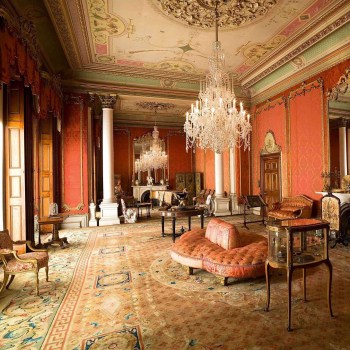
Restored Drawing Room at Brodsworth Hall, Doncaster, South Yorkshire, 1860s (Photo: Historic England Archive).
British and Irish Furniture Makers Online (BIFMO) is delighted to partner with the Furniture History Society (FHS) to offer an online course that looks at the evolution of the British country house from 1700 to 1900.
For two hours on three consecutive days, curators and historians will consider the furniture and designs commissioned for the interiors of specific country houses. They will touch upon the relationships between the architects and the craftsmen as well as the networks of furniture makers and the impact of the changing clientele. Over the course of these two centuries, the industrial revolution and social reform recast British society, creating new groups of wealthy property owners. By the nineteenth century the British stately home was no longer exclusively the domain of the aristocracy but a haven for the successful businessman and his family. The course speakers will consider the fashions and styles used to furnish these properties set against the backdrop of the changing role of the British country house.
The three sessions on 14th, 15th and 16th June, will be held on Zoom between noon and 14.00 GMT (7.00–9.00 EDT). All three days will be introduced by Dr Megan Aldrich who will provide an historic and stylistic context for the case studies of houses presented by the curators. These sessions will be recorded and links to the recordings will be sent to ticketholders shortly after the event.
Each day BIFMO will also offer the opportunity to participate in an additional online session in the form of a seminar where a much smaller group will be able to discuss the points raised by the presentations. These seminars will follow the course each day and will be guided by experts, who will also give further short presentations on a theme. Ticketholders for the seminars will be able to turn on their microphones and videos to fully participate in the discussion. Tickets for these seminars are available on the course Eventbrite page but must be bought in addition to the main session. Places are extremely limited and are allocated on a first come first served basis. These seminars will not be recorded.
To purchase tickets for this course and additional seminars on Eventbrite, please click here.
◊ ◊ ◊ ◊ ◊
Day 1: Tuesday, 14 June — Early 18th-Century Country Houses
Course
12.00 Introduction — Megan Aldrich
12.45 James Pascall in London and Temple Newsam — Tessa Murdoch
13.15 The Early Furnishing at Holkham Hall — Katherine Hardwick
13.45 Panel Discussion and Q&A
Seminar
14.20 The Country Seat: Researching the Country House: History, Architecture, and Furniture — Jeremy Musson with Adriana Turpin
Day 2: Wednesday, 15 June — Historicism and Revival in the British Country House
Course
12.00 Introduction — Megan Aldrich
12.45 Increasingly Aspirational: 18th-Century Nostell, Robert Adam and the Winn Family — Kerry Bristol
13.15 A Mid-Victorian Vision of a Comfortable Country House: The Furnishings of Brodsworth Hall by Lapworths of Bond Street — Eleanor Matthews
13.45 Panel Discussion and Q&A
Seminar
14.20 Looking at Furniture in the Context of the Country House — Peter Holmes with Adriana Turpin
Day 3: Thursday, 16 June — Tradition and Innovation: Different Approaches to Late 19th-Century Interior Design
Course
12.00 Introduction — Megan Aldrich
12.45 Furnishing the Arts and Crafts Interior: Morris & Co at Standen — Caroline Ikin
13.15 Mackintosh and the Design of Hill House — Joseph Sharples
13.45 Panel Discussion and Q&A
Seminar
14.20 Researching the Furniture Trade — Clarissa Ward with Adriana Turpin
◊ ◊ ◊ ◊ ◊
Megan Aldrich will introduce all three days of the course, setting out an outline for the two-hour session while providing an historical context. Dr Aldrich is a part-time tutor in the Department of Continuing Education, University of Oxford, and Hon. Editorial Secretary of the Furniture History Society. She researches aspects of antiquarian design and historicism across the areas of architecture, interiors, decorative art and design, and garden history, and has published widely in these areas. She is a Fellow of the Society of Antiquaries and formerly Academic Director, Sotheby’s Institute of Art, London
Information about the other speakers is available here»
New Book | The Soho Manufactory, Mint, and Foundry
From Historic England and Liverpool UP:
George Demidowicz, The Soho Manufactory, Mint, and Foundry, West Midlands: Where Boulton, Watt, and Murdoch Made History (Liverpool: Liverpool University Press, 2022), 296 pages, ISBN: 978-1800349285 £40.
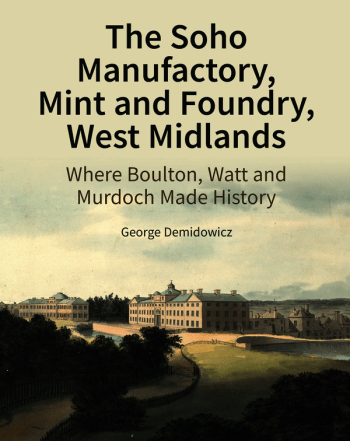 This volume provides a comprehensive analysis of the ground-breaking historic industrial complex created to the west of Birmingham in the eighteenth century and associated with Matthew Boulton, James Watt, and William Murdoch. The Soho Manufactory (1761–1863) and Soho Mint (1788–1850s) were both situated in the historic parish of Handsworth, now in the city of Birmingham, and the Soho Foundry (1795–1895) lay in the historic township of Smethwick, now within Sandwell Metropolitan Borough. Together they played a key role in the Industrial Revolution, achieving many world ‘firsts’: the first working Watt steam engine, the first steam-engine powered mint, and the first purpose-built steam engine manufactory (the Soho Foundry), to name but a few. Existing literature focuses largely on the biography of the people, primarily Boulton and Watt, or the products they manufactured. The place—the Soho complex—has attracted very little attention. This volume is the first to concentrate on the buildings themselves, analysing not only their physical origins, development, and eventual decline but also the water and steam power systems adopted. An interdisciplinary approach has been employed combining archival research in the magnificent Soho collection at the Library of Birmingham with the results of archaeological excavations. The volume is profusely illustrated with archival material, most published for the first time, and contains a large number of reconstruction plans and drawings by the author.
George Demidowicz, FSA, is an Honorary Research Fellow in the Department of History, University of Birmingham.
C O N T E N T S
List of Illustrations
List of Abbreviations
1 Introduction
2 A Short History of the Soho Manufactory and Mint
3 The Soho Mill
4 The Manufactory Engine Works
5 The Soho Mint
6 The Soho Manufactory and Mint Site After
7 The Soho Foundry
9 The Significance of the Three Sohos
Appendix 1 The Archaeological Excavations, 1994–1996
Appendix 2 The Soho Businesses
Appendix 3 Biographies
Acknowledgements
Bibliography
Index
Sweden Nationalmuseum Acquires Four Figurative Table Clocks
Press release (5 May 2022) from Sweden’s Nationalmuseum in Stockholm:

Antoine-André Ravrio, Table Clock with Allegory of the Poet’s Art, ca.1810, gilt and patinated bronze, griotte d’Italie marble (Stockholm: Nationalmuseum, photo by Viktor Fordell).
Nationalmuseum has recently acquired several significant French figurative table clocks dating from the early 19th century. These were an obligatory feature of the interior decoration style that developed during the Empire period, adorning many a mantelpiece and console table. Their primary function was not timekeeping, but rather to serve as covert but elegant propaganda for the French Empire and, later, for the restored Bourbon monarchy. They are described as figurative because the clock forms part of an ensemble including sculptures and decorative elements in gilt bronze.
A taste for bronze ostentation of this kind, which first developed in Paris in the second half of the 18th century, flourished in the Empire period. The luxury goods industry employed over 10,000 people in the French capital. For Napoleon, this was a source of pride for France, demonstrating its superiority to other European nations. But the emperor’s ambitions were equally motivated by economic gain: “Every time you beautify a palace, you should consider how this can benefit the arts and manufacturing.” The year after making this pronouncement, Napoleon launched the Continental Blockade. Although Britain was the target of this trade embargo, the French luxury goods industry was severely affected, and costly state subsidies were needed to prevent the Parisian bronze manufacturers from going out of business.
Prominent manufacturers included Antoine-André Ravrio (1759–1814), one of the bronze founders who had started out before the French Revolution of 1789. Despite difficulties during the revolution, he soon established a successful bronze foundry, specialising in gilt bronze. His table clocks often formed part of a set with other components such as candelabras, urns and perfume burners. The interior decoration style of the time prized the mass effect of brilliant metal artefacts placed in close proximity.
One of Nationalmuseum’s new acquisitions, Table Clock with Allegory of the Poet’s Art, dating from around 1810, is a product of Ravrio’s firm. It is made of gilt and patinated bronze, with a base of red griotte d’Italie marble. The clock features the well-known ancient Greek bust of Homer incorporated into a narrative tableau along with the Roman poet Virgil.
Ravrio often took inspiration from the classical world for both form and subject matter, but in other cases ancient Rome merely served as a disguise for the contemporary world. The anonymous maker of the table clock depicting Caesar made no attempt to conceal the fact that the figure was more like Napoleon than Caesar. Despite the 1814 regime change, table clocks of this kind seem to have been so popular that they remained in production, albeit with the eagles removed and replaced with a wreath of stars, as in this case.
In other cases, the figure of the emperor was simply switched out for the new regime’s mascot, King Henri IV of the House of Bourbon. In troubadour-style painting and the decorative arts, Henri was a popular figure, symbolising a return to the ‘good old days’.
The last of the figurative table clocks portrays another misfortune that befell the House of Bourbon. It features a tableau of Carolina, Duchess of Berry, with her newborn son Henri, Duke of Bordeaux, and her daughter Louise, saying their evening prayers. Atop the clock sits a weeping putto, reminding us of the absent father, the Duke of Berry, who was murdered seven months before his son’s birth. The infant duke, better known as the Count of Chambord, was a pretender to the French throne until his death in 1883. The clock was made by Jean-André Reiche (1752–1817), originally from Leipzig, who opened a bronze foundry in Paris in 1785.
“By acquiring these four superb figurative table clocks, all of which are outstanding examples of the French Empire style of interior decoration, we have significantly enhanced the museum’s collection of a genre that straddles the boundaries between sculpture and applied art, between art and politics,” said Magnus Olausson, head of collections at Nationalmuseum.
The newly acquired mantel clocks are on view in one of the galleries of 19th-century art at Nationalmuseum.
New Book | The Museum
Happy International Museum Day (18 May)! From the Quarto Group:
Owen Hopkins, The Museum: From its Origins to the 21st Century (London: Frances Lincoln, 2021), 320 pages, ISBN: 978-0711254565, $60.
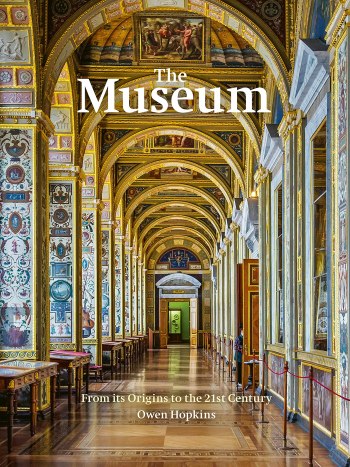 Using examples of the greatest cultural institutions to shape the narrative, this book outlines the history of the museum movement, tracking the evolution from princely collections in Europe and the Enlightenment’s classically inspired temples of curiosities, via the public museums of the late nineteenth century, on to today’s global era of iconic buildings designed by the world’s leading architects.
Owen Hopkins is an architectural historian and Director of the Farrell Centre at Newcastle University. He was previously Senior Curator of Exhibitions and Education at Sir John Soane’s Museum and before that Architecture Programme Curator at the Royal Academy of Arts, both in London. He has written six books, including Reading Architecture: A Visual Lexicon and Lost Futures, an examination of the disappearing architecture of post-war Britain. He is also a regular commentator on architecture in newspapers, magazines, radio, and television.
C O N T E N T S
Preface
Introduction: The Age of Museums
1 Origins
2 The Enlightenment Museum
3 The Public Museum
4 The Modern Museum
5 The Global Museum
6 The Museum Now
Notes
Index
Further Reading
Picture Credits
Acknowledgments
Sneak Preview | Seven Works from the Van Caloen Collection
On view this week in Bruges:
Seven Works from the Van Caloen Collection
Groeninge Museum, Bruges, 17–22 May 2022

François Boucher, Young Woman with a Lace Cap, 24 × 18 cm (Musea Brugge, 2022.GRO0326.II).
On 17 May, the Jean van Caloen Foundation transferred the administration of 1,920 drawing masterpieces and 25 sketchbooks by world famous artists like Michelangelo, Jordaens, and Boucher to the Bruges Print Room. To celebrate this exceptional transfer, we are exhibiting seven top works from the collection during an exclusive sneak preview in the Groeninge Museum together with the Caloen Foundation.
Discover The Priest’s Blessing by Jacques Jordaens and a fine depiction of a young woman by the French master François Boucher. The highlight of the collection is the magnificent Stoning of St. Stephen by Michelangelo Buonarotti. The only drawing of the celebrated Italian Renaissance artist currently held in Belgium, it is a remarkable piece, not least because it is a composition study: a drawing in which Michelangelo set down some of his ideas on paper. Drawings of this kind were used by artists as preparatory sketches for larger final works, such as paintings or sculptures.
The works will be on display from 17 to 22 May, after which they will be given a place with all the collection’s other works in the Bruges Print Room. Once there, they will be registered and digitalized in high resolution, before being made freely available to the public via Musea Brugge’s digital collection database. We will also thoroughly investigate and study the drawings. This research will result in the publication of a scientific catalogue for the collection and an exhibition of works from the collection in the new exhibition space at BRUSK.
New Book | Trading Freedom
From The University of Chicago Press:
Dael Norwood, Trading Freedom: How Trade with China Defined Early America (Chicago: The University of Chicago Press, 2022), 312 pages, ISBN: 978-0226815589, $45.
 Trading Freedom explores the surprisingly rich early history of US-China trade and its unexpected impact on the developing republic.
The economic and geographic development of the early United States is usually thought of in trans-Atlantic terms, defined by entanglements with Europe and Africa. In Trading Freedom, Dael A. Norwood recasts these common conceptions by looking to Asia, making clear that from its earliest days, the United States has been closely intertwined with China—monetarily, politically, and psychologically. Norwood details US trade with China from the late eighteenth through the late nineteenth centuries—a critical period in America’s self-definition as a capitalist nation—and shows how global commerce was central to the articulation of that national identity. Trading Freedom illuminates how debates over political economy and trade policy, the building of the transcontinental railroad, and the looming sectional struggle over slavery were all influenced by Sino-American relations. Deftly weaving together interdisciplinary threads from the worlds of commerce, foreign policy, and immigration, Trading Freedom thoroughly dismantles the idea that American engagement with China is anything new. Publication supported by the Bevington Fund.
Dael A. Norwood is assistant professor of history at the University of Delaware.
C O N T E N T S
Introduction: America’s Business with China
1 Founding a Free, Trading Republic
2 The Paradox of a Pacific Policy
3 Troubled Waters
4 Sovereign Rights, or America’s First Opium Problem
5 The Empire’s New Roads
6 This Slave Trade of the Nineteenth Century
7 A Propped-Open Door
8 Death of a Trade, Birth of a Market
Acknowledgments
Appendix: Accounting for the China Trade
Notes
Index










 Enfilade
leave a comment