New Book | Clothing the New World Church
From the University of Notre Dame Press:
Maya Stanfield-Mazzi, Clothing the New World Church: Liturgical Textiles of Spanish America, 1520–1820 (South Bend: University of Notre Dame Press, 2021), 400 pages, ISBN: 978-0268108052, $50.
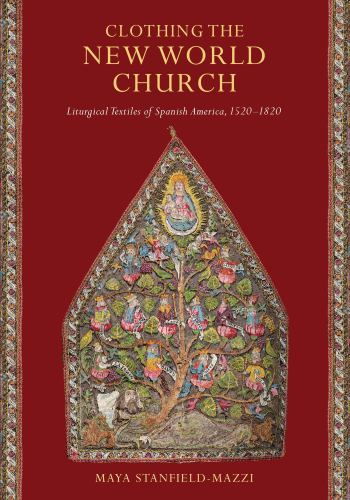 The first broad survey of church textiles of Spanish America, demonstrating that, while overlooked, textiles were a vital part of visual culture in the Catholic Church.
When Catholic churches were built in the New World in the sixteenth century, they were furnished with rich textiles known in Spanish as ‘church clothing’. These textile ornaments covered churches’ altars, stairs, floors, and walls. Vestments clothed priests and church attendants, and garments clothed statues of saints. The value attached to these textiles, their constant use, and their stunning visual qualities suggest that they played a much greater role in the creation of the Latin American Church than has been previously recognized. In Clothing the New World Church, Maya Stanfield-Mazzi provides the first comprehensive survey of church adornment with textiles, addressing how these works helped establish Christianity in Spanish America and expand it over four centuries. Including more than 180 photos, this book examines both imported and indigenous textiles used in the church, compiling works that are now scattered around the world and reconstructing their original contexts. Stanfield-Mazzi delves into the hybrid or mestizo qualities of these cloths and argues that when local weavers or embroiderers in the Americas created church textiles they did so consciously, with the understanding that they were creating a new church through their work.
The chapters are divided by textile type, including embroidery, featherwork, tapestry, painted cotton, and cotton lace. In the first chapter, on woven silk, we see how a ‘silk standard’ was established on the basis of priestly preferences for this imported cloth. The second chapter explains how Spanish-style embroidery was introduced in the New World and mastered by local artisans. The following chapters show that, in select times and places, spectacular local textile types were adapted for the church, reflecting ancestral aesthetic and ideological patterns. Clothing the New World Church makes a significant contribution to the fields of textile studies, art history, Church history, and Latin American studies, and to interdisciplinary scholarship on material culture and indigenous agency in the New World.
Maya Stanfield-Mazzi is an associate professor of art history at the University of Florida. She is the author of Object and Apparition: Envisioning the Christian Divine in the Colonial Andes.
Exhibition | Faith and Fortune: Art across the Global Spanish Empire

Attributed to Manuel Chili, known as Caspicara, Four Fates of Man: Death, Hell, Purgatory, and Heaven, ca. 1775
(New York: The Hispanic Society of America)
◊ ◊ ◊ ◊ ◊
From the press release (18 May 2022) for the exhibition:
Faith and Fortune: Art across the Global Spanish Empire
Art Gallery of Ontario, Toronto, 8 June — 10 October 2022
Curated by Adam Harris Levine, with Tahnee Ann Macabali Pantig
This summer, the Art Gallery of Ontario (AGO) presents Faith and Fortune: Art across the Global Spanish Empire, an eye-opening exhibition of sumptuous paintings, maps, textiles, jewels, rare daguerreotypes, and religious objects from Europe, the Americas, and the Philippines from the collection of the Hispanic Society Museum & Library of New York.
Curated by the AGO’s Assistant Curator of European Art, Adam Harris Levine, the exhibition presents artworks by revered and unknown Latin American, Filipino, and Spanish artists and explores the colonial frameworks that shaped their production and reception. A consultation panel of Toronto-based Latinx and Filipinx scholars and artists worked with the curator to help shape an exhibition that both highlights the beauty of these objects and the reality of their creation. Their voices are heard throughout the exhibition as part of the exhibitions extensive audio guide.
For nearly four centuries, between 1492 and 1898, the kings and queens of Spain controlled large parts of the world. Their pursuit of gold, gemstones, and natural resources created an empire that for a time spanned both oceans. Art, books, and religious imagery were a powerful means of unifying their vast and varied empire, and the Spanish empire encouraged artistic production across its territories. Painters, sculptors, printers, and other artisans travelled extensively, creating a rich and complex visual culture.
“These sumptuous and stirring works reveal cross-cultural exchange—of ideas, of people, of materials—on a global scale. As historic as these artworks were, embedded in their creation are issues that we continue to confront today: the persistence of anti-Indigenous stereotypes, of racial categories, of flawed legal systems, of pollution from resource extraction. In them, and in the context of their making, we better understand our present condition,” says Levine. “These four centuries of art provide a unique perspective on the lasting legacies of colonization and the role of art.”
Filipino-Canadian artist and designer Tahnee Ann Macabali Pantig joins the exhibition as guest curator, overseeing the installation of 15 never before exhibited daguerreotypes from the Philippines, dating from ca. 1840–45. Only recently rediscovered, these significant images offer says Pantig “a rare window into the Philippines at a critical time of political and cultural change and an opportunity for those in the Filipinx community to reclaim these images as our own and to consider how colonialism has shaped how we see our history.”
◊ ◊ ◊ ◊ ◊

Anonymous Spanish artist, The Silver Mine at Potosí, ca. 1585, watercolor on parchment, 28 × 22 cm (New York: The Hispanic Society of America). More information is available here»
Organized chronologically, the exhibition begins with the earliest episode of colonization: Columbus’s arrival in the Americas. Illustrating the formation of the Empire is a selection of ceramics, textiles, and religious paintings—objects all made in Spain with materials from the Americas and Asia, reflecting the dominant styles and techniques of European art. A gold pendant in the shape of a centaur made of sapphires, rubies, and pearls (ca. 1580–1620) and a disc of gold bullion, dated 1622, from the Thomson Collection of European Art are just a few of the glittering examples of the gold trade that fueled the Spanish Empire’s expansion.
Impassioned representations of Saint Jerome (1600) and Saint Sebastian (1603–07) by El Greco and Alonso Vázquez highlight a section dedicated to Catholic imagery and its role in empire building. From Peru, a processional shield from ca. 1620–50 depicting the Virgin Mary and the Nativity, of oil on copper and wrought iron, demonstrates the local adoption of and market for religious icons.
Anonymous Spanish artist, The Silver Mine at Potosí, ca. 1585, watercolor on parchment, 28 × 22 cm (New York: The Hispanic Society of America). More information is available here»
Sculpture, ranging from gilded wooden figures to a lacquered portable writing desk and elaborately carved wooden boxes, features prominently in the exhibition. Ecuadorean Indigenous sculptor Manuel Chili’s striking series of four wood carvings The Fates of Man (ca. 1775) presents in feverish detail the potential rewards and pains of the afterlife.
A section dedicated to seafaring and map-making features some of the oldest objects in the exhibition, including a series of five charts illustrating the Atlantic Ocean from Iceland to Port of Good Hope from 1558. Diego Velázquez’s full sized portrait of Gaspar de Guzmán, Count-Duke of Olivares (1625–26), is one of many works showcasing the Spanish Empire at the height of its power in the 17th century.
Pottery and lacquer ware from Mexico and Columbia exemplify how Indigenous artisans working for settler patrons and drawing upon examples and artistic traditions imported from across Asia, the Americas, and Europe created their own recognizable styles. These works reflect the importance of the Spanish trade routes between Acapulco and Manila.
The exhibition concludes with a selection of never-before exhibited daguerreotypes dating from ca. 1840–45. An early form of photography using silvered copper plates, daguerreotypes were popular in the mid-19th century. Guest curated by Filipino-Canadian artist and designer Tahnee Ann Macabali Pantig, these images offer stunning views of Manila and its surroundings, including the Marikina River and Laguna province, and are thought to be the work of Jules Alphonse Eugene Itier (1802–1877), a French government official whose career took him around the world.
Programming Highlights
• On Saturday, June 11, exhibition curators Adam Harris Levine and Tahnee Ann Macabali Pantig join interpretive planner Gillian McIntyre for a free conversation about Faith and Fortune: Art across the Global Spanish Empire. For more details and to register, visit ago.ca/events/faith-and-fortune-curators-talk.
• Celebrate the sounds of the Americas and Philippines! Beginning Friday, June 17 and continuing on select Fridays through July, Small World Music presents free live musical performances by Latinx and Filipinx performers in Walker Court from 5 to 9pm.
• On Thursday, June 23 at 4pm, exhibition curator Adam Harris Levine joins Florina Capistrano-Baker, a curator and expert on the art history of the Philippines, in conversation. The two will highlight objects from Faith and Fortune: Art across the Global Spanish Empire, addressing the Philippines’ era of Spanish colonisation and local hybrid art forms. Free via Zoom. For more details about this free Zoom talk, visit ago.ca/events.
• Opening on 25 June 2022, on level 1 of the AGO, also from the Hispanic Society Museum & Library, comes Treasures of Ancient Spain, a selection of 28 objects from three important periods in Spanish history, dating as far back as 2500 BCE. Featuring, metalwork, rare Bell Beaker ceramics, Celtic jewellery, and marble sculpture, these artifacts attest to Spain’s long history as a home to many cultures. Archer M. Huntington, the founder of the Hispanic Society Museum & Library was a passionate collector of ancient Spanish artifacts, funding numerous archeological digs.
Exhibition | Paintings from South America
Now on view at the Nelson-Atkins:
Paintings from South America: The Thoma Collection, 1600–1800
Nelson-Atkins Museum of Art, Kansas City, 12 February — 4 September 2022
Organized by the Thoma Foundation

Unidentified artist (Perú), The Mystical Winepress, 18th century, oil and gold on canvas, 49 × 43 inches (Collection of the Carl & Marilynn Thoma Foundation, 2019.71; photo by Jamie Stukenberg).
This exhibition presents fifteen works made by artists in present-day Ecuador, Peru, and Bolivia during Spanish colonial rule. One of the largest and longest-lasting European empires, the Spanish realms spanned from South Asia to South America and lasted nearly 500 years. Spanish South American art is a dynamic, unique combination of styles and influences from visiting Italian artists and imported European prototypes translated and adapted by local hands. The works on view represent primarily Roman Catholic subjects. Paintings and sculptures adorned churches and convents across Spanish America, but most of the paintings in this exhibition originally hung in private homes where they both gave pleasure and invited contemplation and prayer. The works belong to the Carl & Marilynn Thoma Foundation, which is committed to promoting the art of the Spanish Americas through scholarship and exhibition of its extensive collection from South America and the Caribbean.
The Burlington Magazine, May 2022
The eighteenth century in the May issue of The Burlington . . .
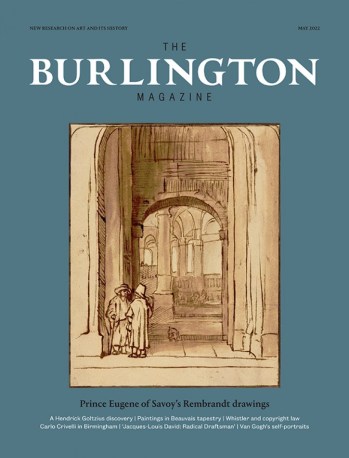
The Burlington Magazine 164 (May 2022)
 E D I T O R I A L
• “The Rustat Memorial,” p. 443.
When the statue of Edward Colston was defaced and thrown into Bristol harbour on 7th June 2020 the resulting publicity was so enormous that it seemed likely that a wholesale assault on memorials to men who took part in the slave trade or were racist would inevitably follow. In fact, remarkably little has happened. . . .
Little more has been done in the case of church monuments. . . . Only one such case is outstanding, an application by St Peter’s church, Dorchester, to move a late eighteenth-century wall memorial to the slave owner John Gordon from the church to Dorchester Museum. If such an application is contested the matter is referred to the judgment of a diocesan Chancellor in a Consistory Court. This was the result of the ecclesiastical case that has attracted most attention, the application by the Master and governing body of Jesus College, Cambridge, to remove the monument to Tobias Rustat (1608–94) from the college chapel, which was opposed by a group of former members of the college. The case was heard in February by David R. Hodge, Deputy Chancellor of the Diocese of Ely, who in March dismissed the application. Last month the college announced that it would not appeal against his decision. . .
A R T I C L E S
• Antoinette Friedenthal, “Prince Eugene of Savoy’s Rembrandt Drawings: A Newly Discovered Provenance,” pp. 450–61.
• Pascal-François Bertrand and Charissa Bremer David, “Paintings in Beauvais Tapestry, 1764–67,” pp. 462–72. In 1764, at a time when the Royal Tapestry Manufactory at Beauvais was short of work, its directors, Laurent and André Charlemagne Charron, initiated the weaving of small tapestry panels based on designs by François Boucher. Intended as inexpensive, independent works of art, they were in essence a short-lived marketing venture. Records of their weaving in the firm’s payment registers allow a number of surviving examples to be identified.
• Sofya Dmitrieva, “Carle Van Loo at the 1737 Salon,” pp. 473–77. Although not pendants in the traditional sense, since they were painted for different patrons, it is argued here that Carle Van Loo’s A Pasha Having His Mistress’s Portrait Painted and The Grand Turk Giving a Concert to His Mistress, shown at the Salon of 1737, were meant to be read as a pair|—as portraits of the artist and his wife and as allegories of Painting and Music. By linking the paintings, Van Loo, may have intended them to make a statement on the changing relations between art and patronage.
R E V I E W S
• Duncan Robinson, Review of Susan Sloman, Gainsborough in London (Modern Art Press, 2021), pp. 478–85.
• Satish Padiyar, Review of the exhibition Jacques-Louis David: Radical Draftsman (The Metropolitan Museum of Art, 2022), pp. 492–95.
• Kee Il Choi, Jr., Review of the exhibition Inspiring Walt Disney: The Animation of French Decorative Arts (The Metropolitan Museum of Art, The Wallace Collection, and The Huntington, 2022–23), pp. 504–07.
• Camilla Pietrabissa, Review of the re-installation of seventeenth- and eighteenth-century Venetian paintings at the Gallerie dell’Accademia in Venice (from August 2021), pp. 507–09.
• Stefania Girometti, Review of Joachim Jacoby, Städels Erbe: Meisterzeichnungen aus der Sammlung des Stifters (Sandstein Verlag, 2020), pp. 529–30. Comprehensive analysis of “the collection of drawings assembled by Johann Friedrich S (1728–1816), the founder of the art institute and museum in Frankfurt that bears his name.”
• Christoph Martin Vogtherr, Review of the exhibition catalogue Watteau at Work: La Surprise (Getty, 2021), pp. 530–31.
• Hugo Chapman, Review of Cristiana Romalli, Cento Disegni dalla Collezione della Fondazione Marco Brunelli (Ugo Bozzi, 2020), pp. 531–32.
Masterpiece London Programming | Serious Fun / Stones of Rome
In conjunction with this year’s Masterpiece London, which runs from 30 June to 6 July:
Serious Fun: The Masterpiece Museum Symposium
Royal Hospital Chelsea, London, Saturday, 2 July 2022

Unknown maker, candlestick, France, ca. 1745–49, gilt bronze and silvered bronze, 25 cm high (London: The Wallace Collection, F79).
Masterpiece London is delighted to host a morning of debate and discussion, co-organised by the Fair and the writer and critic Thomas Marks, to bring together preeminent museum curators and conservators with the leading figures in the art and antiques trade, with the aim of encouraging constructive discussion, networking and the exchange of knowledge and practical advice. Serious Fun is the seventh in a series of events that Masterpiece London launched in 2018—with recent online events focusing on conservation, artistic materials and the role of research in museums. This summer the Masterpiece Symposium returns to an in-person format at the Fair in London for the first time since 2019, with the focus turning to museums of places of pleasure, wonder, surprise—and even fun. The subject has been chosen to pay tribute to the late Philip Hewat-Jaboor, Chairman of Masterpiece London from 2012 to 2022, who consistently took delight in museum collections around the world and generously shared that joy with friends, colleagues, and the wider public.
It is a truism to describe museums as places of education but perhaps less common to celebrate how they ought to provide diversion too. Certainly, many great civic museums, and particularly those founded during the 19th century, once shared with the popular spectacles of the time the desire to entertain their audiences while pursuing their educational purposes (some Victorian museums had an ‘almost carnival atmosphere’, the late Giles Waterfield wrote). It is now sometimes assumed, however, that seriousness and levity cannot coexist in museums. But whyever not?
Over the course of a morning at Masterpiece London, experts will offer a range of perspectives on the role of leisure and pleasure in museums, exploring historical attempts to associate learning with enjoyment and considering what might be gained by doing so today. How have museums historically had fun? Could enjoyment be more central to how we discuss, design, and experience museums, and to what purpose? How can wonder or pleasure be fostered through collection displays, exhibitions, and other museum activities? As ever at the Masterpiece Symposium, attendees will be invited to participate in the discussion in Q&As with panellists and in break-out sessions during the course of the event—with the aim of sharing knowledge and ideas.
P R O G R A M M E
10.00 Registration and coffee
10.15. Panel Discussion: The Museum at Play
Moderated by Thomas Marks
• Dinah Casson | Museum and exhibition designer, and co-founder, Casson Mann
• Jane Munro | Keeper of Paintings, Prints, and Drawings, the Fitzwilliam Museum, Cambridge
• Ben Street | Art historian, lecturer, and writer (How to Enjoy Art; How to Be an Art Rebel)
This discussion will focus on the current situation in museums, exploring how they might enable and harness enjoyment among their audiences. The conversation will explore how museum architecture, exhibitions, and displays succeed in kindling imaginative wonder; surprise, wit, even comedy (or comic art) as modes of engagement; how artist interventions might provoke meaningful diversion; and the balance between encouraging delight and offering interpretation in the display of works of art.
11.15 Coffee Break
11.30 Break-out Sessions
Attendees will be invited to join small discussion groups (6–8 people) for conversation, drawing on their own ideas and experience, and prompted by the first panel discussion and wider theme of the symposium.
12.00 Panel Discussion: Historical Entertainments
Moderated by Thomas Marks
• Helen Dorey | Deputy Director and Inspectress, Sir John Soane’s Museum
• Ella Ravilious | Architecture and Design, Victoria & Albert Museum
• Mark Westgarth | Associate Professor in Art History and Museum Studies, University of Leeds
This discussion will explore how museums have historically sought to enlist types of enjoyment as a mode of fulfilling their wider mission. It will encompass the relationship between leisure and education in Victorian civic museums, including the South Kensington Museum; how surprise and wonder have historically played a role in museum architecture and display, such as at Sir John Soane’s Museum; early attempts to ‘activate’ collections; and the emergence of displays, tours and other activities aimed at children. How might we borrow from such institutional legacies to the benefit of the 21st-century museum?

Many Enfilade readers will also find this session on Friday, 1 July interesting:
Stones of Rome
Royal Hospital Chelsea, London, 1 July 2022, 12.30
Adriano Aymonino is Programme Director of the MA in the Art Market and the History of Collecting at the University of Buckingham. He has curated several exhibitions, including Drawn from the Antique: Artists and the Classical Ideal. His book Enlightened Eclecticism was published by Yale University Press in June 2021, and he is currently working on a revised edition of Francis Haskell and Nicholas Penny’s Taste and the Antique (2022). He is also associate editor of the Journal of the History of Collections.
Silvia Davoli specializes in the history of collections and patronage with particular focus on the eighteenth and nineteenth centuries. She is a research associate at Oxford University and Curator at Strawberry Hill House (the Horace Walpole Collection). Silvia is also associate editor of the Journal of the History of Collections.
Fabio Barry studied architecture at the University of Cambridge (MA, Dip Arch), and briefly practiced before receiving his PhD in art history from Columbia University. He has taught at the University of St. Andrews and Stanford University, and is currently Samuel H. Kress Senior Fellow at The Centre for Advanced Study in the Visual Arts at The National Gallery of Art in Washington, D.C. His research has often concentrated on art in Rome, particularly Baroque architecture, but recent publications have ranged farther afield and dwell on medieval and antique art, especially sculpture. An ongoing concern has been the imagery of marble in the visual arts and literature, especially the evocative qualities of the medium before the era of mass production distanced it from the realm of nature and myth. His book Painting in Stone Architecture and the Poetics of Marble from Antiquity to the Enlightenment was published by Yale University Press in 2020, awarded the 2021 PROSE Award in Architecture and Urban Studies by the Association of American Publishers, and is currently shortlisted for the Alice Davis Hitchcock Medallion of the Society of Architectural Historians of Great Britain.
New Book | Survey: Architecture Iconographies
Distributed by The University of Chicago Press:
Matthew Wells, Survey: Architecture Iconographies, edited by Sarah Handelman (Zurich: Park Books, 2021), 176 pages, ISBN: 978-3038602507, $50.
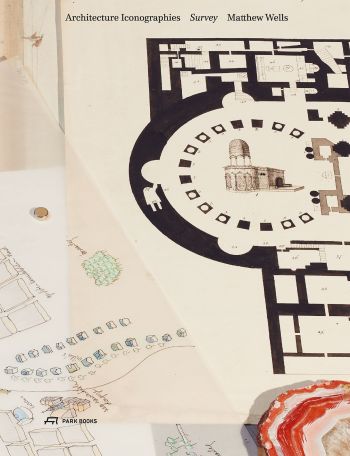 An exploration of the history and significance of the architectural survey drawing through focused studies on John Soane, Charles Robert Cockerell, Detmar Blow, Louis-Hippolyte Lebas, Henri Labrouste, Eugène Viollet-le-Duc, and Peter Märkli.
When architects visit a building and want to record or identify what they see, they take out a bundle of folded sheets in search of a blank piece of paper. These sheets may be ground plans, diagrams, sketches, or ordnance maps. In one way or another, all are survey drawings, operating as both documentation and analysis, enabling an architect to examine certain conditions of the built environment, whether geometric, relational, material, or technical.
This book explores the history of the survey and its multiple forms in order to understand how the methods of recording what already exists can also be used to imagine what might be. Lavishly illustrated, with works from the collection of Drawing Matter and beyond, it addresses the multiple forms of the survey through focused studies—on John Soane (1753–1837), Charles Robert Cockerell (1788–1863), and Detmar Blow (1867–1939); French architects Louis-Hippolyte Lebas (1782–1867), Henri Labrouste (1801–75), and Eugène Viollet-le-Duc (1814–79); and Swiss-based Peter Märkli (born 1953)—and an extensive section of plates with commentaries by contemporary architects. In doing so, it maintains that while all surveys begin with the site, the outcomes are as idiosyncratic as their authors—and their methods have much to offer as tools in design practice.
Survey is the first volume of Architecture Iconographies, a series that considers architecture through its typologies and unique approaches to drawing, aiming to open up further possibilities for their contemporary use in design and teaching. The series is published in collaboration with Drawing Matter, based in Somerset, England, which is committed to exploring the role of drawing in architectural thought and practice.
Matthew Wells is a lecturer and postdoc researcher at ETH Zurich’s Institute for the History and Theory of Architecture. The focus of his research and writing is on representational techniques, environmental technologies, and professionalism in the built environment of the 19th and 20th centuries.
Call for Articles | Fall 2023 Issue of J18: Cold

Victor Marie Picot, after Philippe de Loutherbourg, Winter, 1784, stipple and etching
(London: The British Museum)
◊ ◊ ◊ ◊ ◊
From the Call for Proposals for J18:
Journal18, Issue #16 (Fall 2023) — Cold
Issue edited by Michael Yonan, University of California, Davis
Proposals due by 15 September 2022; finished articles will be due by 31 March 2023
Feeling cool is increasingly a great privilege in our warming world. Cold weather arrives later each winter and departs sooner, lengthening warm seasons across the globe and reducing the cooler periods necessary to the planet’s healthy functioning. One need not be terribly old to have recollections of cooler times. Accompanying changes to global mean temperatures are erratic and often dangerous weather patterns, melting icecaps, rising seas, stronger storms, droughts, and other environmental transformations that, in sum, represent an existential problem for humankind.
The cause of these changes is the consumption of fossil fuels, which transformed human life profoundly in the pursuit of modernity. The origin of this transformation falls squarely in the eighteenth century; indeed the terminus post quem for measuring human effects on global temperatures is the year 1800. Recognizing this draws attention to a truth little noticed in art-historical scholarship: eighteenth-century art was made for a colder world than the one we now inhabit.
This special issue of Journal18 invites contributions that address the relationship between temperature and the art of the long eighteenth century. It seeks to insert eighteenth-century visual and material culture into the growing literature on historical climatology. The 1700s are the final century of the Little Ice Age, a climatological phenomenon characterized by lower global mean temperatures that took place between the late sixteenth and early nineteenth centuries. What are the implications of this climatological context for the narratives we tell about eighteenth-century art? How did an Enlightenment understanding of temperature inflect the period’s art? And do the conditions of eighteenth-century life, as filtered through the period’s artistic production, help us understand why the world became warmer?
Potential topics include the relationship between architecture and temperature, including the technologies used to keep buildings warm or cool; the material culture of gauging temperature (thermometers, barometers, hygrometers, etc.); pictorial representations of extreme climates, e.g., the tropics or the Arctic; the relationship between theories of climate and the representation of peoples; clothing and body temperature; the sub-Arctic north as a cultural space; and the visualization of industrialization. Particularly welcome are essays from a technical art history perspective that address challenges to conserving eighteenth-century things in a warming world.
To submit a proposal, send an abstract (250 words) and brief biography by 15 September 2022 to the following two addresses: editor@journal18.org and meyonan@ucdavis.edu. Articles should not exceed 6000 words (including footnotes) and will be due by 31 March 2023 for publication later that year. For further details on submission and Journal18 house style, see Information for Authors.
New Exhibition | Governing the Nation from Fraunces Tavern, 1785–88
From the press release from the Fraunces Tavern Museum:
Governing the Nation from Fraunces Tavern, 1785–88
Fraunces Tavern Museum, New York, opening 22 June 2022
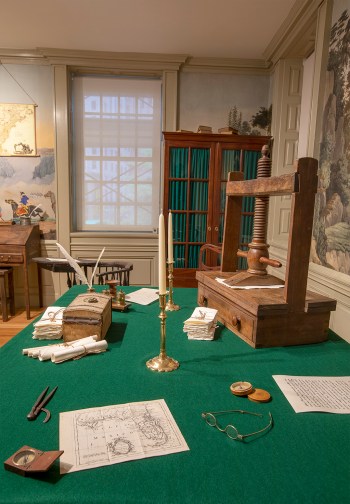
View of the negotiation table inside the Department of Foreign Affairs at Fraunces Tavern with map of east and west Florida in the foreground. Photo: Courtesy of Fraunces Tavern® Museum.
While Fraunces Tavern in New York City is one of the 18th century’s best-known taverns and the site of General George Washington’s famous farewell to his officers at the end of the American Revolution, it is less known that in the late 1700s, the site at 54 Pearl Street in lower Manhattan was also home to the nation’s first executive governmental building that housed three offices of the Confederation Congress. (Although Congress met in City Hall, the space was too small for the government’s departments and other office space had to be leased.) In 1785, the Department of Foreign Affairs, Department of War and offices of the Board of Treasury leased space at the Tavern and remained tenants there until 1788. Thanks to an extraordinary document—a cashbook that detailed the purchases for the Department of Foreign Affairs during its time at the Tavern that is now housed at the National Archives—the Department’s office will be recreated in a new permanent exhibition, Governing the Nation from Fraunces Tavern, set to open on June 22, 2022. Featuring approximately 60 objects, most of which are authentic to the period and many of which have never before been on public display, including tables, chairs, desks, maps, newspapers and other items, visitors will have the opportunity to travel back to post-colonial New York City and enter the Department of Foreign Affairs office as it appeared during a fascinating period in the nation’s history when John Jay was the first Secretary of Foreign Affairs. Visitors will learn about the diplomatic, military and financial challenges that all three departments faced after the Revolutionary War and how those challenges affected the formation of the U.S. Constitution.
“We are in the unique position of having access to a rare, surviving cashbook from the Department of Foreign Affairs,” explains Craig Hamilton Weaver, co-chairman of the Museum and Art Committee at Fraunces Tavern Museum. “We diligently researched each object in the cashbook and acquired authentic items to create an accurate setting that allows the visitor to step back into history. This is indeed a magnificent gift to the nation.”
 After an exhaustive search to locate objects that would have been found in the original office, visitors will not only see an extraordinary assemblage of fine American and British decorative arts, many pieces of which have been donated from private collections, but they will also gain insights into an often-overlooked period in American history. Objects such as A New and Accurate Map of East and West Florida Drawn from the best Authorities, a circa 1700s map engraved by J. Prockter, London, highlighting Spanish-controlled West Florida; a rare copy of the French-language newspaper Courier de L’Europe published in London on 29 September 1786, reporting on America’s diplomatic activities with Prussia and Spain; and an array of directional and mapping compasses will help to illustrate the Department’s first two pressing matters. The Barbary Pirate Crisis, which led to the 1787 diplomatic treaty with Morocco to end pirate seizures of American vessels in the Mediterranean Sea, and negotiations with Spain regarding control of the Mississippi River will be examined in the exhibition to offer visitors insights into what it took to form a new government as well as a deep appreciation for those individuals who rose to the challenge to do so.
“We want visitors to have an immersive experience,” said Scott Dwyer, director of Fraunces Tavern Museum. “The exhibition room was designed and will be arranged to give the sense that John Jay, his under secretary, diplomats, translators, clerks and messengers might enter and resume work at any moment.”
Additionally, the office’s furnishings will illuminate the socioeconomic stratification of the staff who worked in the room. From Henry Remsen, Jr., Jay’s undersecretary for foreign affairs, to the two clerks, a part-time French translator and a messenger, the hierarchy of those employed there will be clearly seen through the caliber of each staffer’s work space in his desk, chair and even desk set; the seniority of the employee’s position correlated to the finery of his work area and accoutrements. For example, Under Secretary Remsen’s desk has a full writing set made of late 18th-century fused Sheffield plate while the clerk’s desk has a pewter inkstand and the messenger’s station has a simple stoneware inkwell. The under secretary’s desk also features examples of Chinese porcelain that would have come to New York aboard the Empress of China, the first American ship to trade with China. The ship returned to New York Harbor and distributed its cargo for local merchants the same year the Department of Foreign Affairs office opened at Fraunces Tavern. Aboard was Samuel Shaw, who would become America’s first Consul to Canton (now Guangzhou), China.

Tea Table, New York, 1770–85, mahogany (New York: Fraunces Tavern Museum, 2022.01.007, gift of Craig Hamilton Weaver; photo by John Bigelow Taylor).
Assembling as many New York- or mid-Atlantic-made furnishings as possible to be seen in Governing the Nation from Fraunces Tavern was another goal in organizing the exhibition to ensure that the room would be authentic to what would likely have been in the original space. One example to be seen at the messenger’s station is a circa 18th-century, brace-back Windsor chair made by Walter MacBride, who worked at 63 Pearl Street in the vicinity of the Tavern. Another such object is a circa 1770–85, mahogany tilt-top tea table, which was likely made in the vicinity of lower Manhattan where many furniture makers were known to have worked at the time. The table features details characteristic of New York style, such as a flat top (rather than the dish top that was popular in other regions), a vase-form pedestal with a cup and square, webbed feet, all of which are typical of New York-made furniture. Although made later than the time period for the office (circa early 19th century), a pair of brass andirons with the rare mark of New York City craftsman David Phillips is included in the exhibition to exemplify other common, locally produced objects during that period. Phillips may have been working earlier as an apprentice near the neighboring South Street Seaport. In a small yet authentic homage to the important document that guided the reconstruction of the office, a leather-bound account book with entries dating from 1765 at the Garret Abel Company of South Street in lower Manhattan, will be seen placed on the clerk’s desk, representing the Foreign Affairs cashbook that informed the object selection for the exhibition. In addition, a facsimile of a page from the actual Foreign Affairs cashbook from 1785 will hang on the wall near the visitor area.
Other featured objects in the exhibition include the negotiation table, made in New York of mahogany and pine in the Chippendale style, circa 1780. The table has carved knees and claw-and-ball legs and is composed of three heavy, solid boards. The strongly carved, original legs have fully developed shells and robust feet. Placed centrally in the room, this is where much of the official business would have been conducted, maps examined and debate likely to have occurred. Another highlight of Governing the Nation from Fraunces Tavern will be found hanging above the clerk’s desk: British engineer Bernard Ratzer’s engraved map, Plan of the City of New York in North America, published in 1776 by Jeffreys & Faden, London, commonly referred to as the ‘Ratzer Map’. One of the best depictions of the city before the Revolutionary War, it was originally issued in 1770 and was heavily influenced by a 1767 map of New York by British engineer John Montresor. The map offers a bird’s-eye view of lower Manhattan Island, eastern New Jersey, and western Brooklyn and includes the city’s important landmarks, many of which are listed in the legend or key. Additionally, an excellent example of a late-18th-century book press with the rare feature of a built-in drawer will also be seen in the office. Such pieces of equipment were used to copy the multitude of correspondence and documents generated by the office.
Governing the Nation from Fraunces Tavern is made possible through a major gift from Stanley and Elizabeth Scott who are longtime supporters of the Museum.
Fraunces Tavern Museum’s mission is to preserve and interpret the history of the American Revolutionary era through public education. This mission is fulfilled through the interpretation and preservation of the Museum’s collections, landmarked buildings, and varied public programs that serve the community. Visit the rooms where General George Washington said farewell to his officers and where John Jay negotiated treaties with foreign nations. Explore six additional galleries focusing on America’s War for Independence and the preservation of early American history.
Online Talk | Disaster on the Spanish Main
From the Fraunces Tavern Museum:
Craig S. Chapman, The American Experience in the West Indies, 1740–42
Online, Fraunces Tavern Museum, New York, Thursday, 16 June 2022, 6.30pm (ET)
 Thirty-five years before the battles of Lexington and Concord, the British colonies in North America raised a regiment to serve in the British Army for an expedition to seize control of the Spanish West Indies. The expedition marked the first time American soldiers deployed overseas. In this lecture, Craig Chapman will discuss the Americans’ role in the conflict, their terrible suffering, and the awful results of the expedition. This lecture will be held via Zoom. Registration ends at 5.30pm on the day of the lecture.
The talk is based on the author’s recent book, published by Potomac, an imprint of the University of Nebraska Press:
Craig Chapman, Disaster on the Spanish Main: The Tragic British-American Expedition to the West Indies during the War of Jenkins’ Ear (Lincoln, Nebraska: Potomac Books, 2021), 426 pages, ISBN: 978-1640124318, $30.
Disaster on the Spanish Main unveils and illuminates an overlooked yet remarkable episode of European and American military history and a land-sea venture to seize control of the Spanish West Indies that ended in ghastly failure. Thirty-four years before the Battles of Lexington and Concord, a significant force of American soldiers deployed overseas for the first time in history. Colonial volunteers, 4,000 strong, joined 9,000 British soldiers and 15,000 British sailors in a bold amphibious campaign against the key port of Cartagena de Indias. From its first chapter, Disaster on the Spanish Main reveals a virtually unknown adventure, engrosses with the escalating conflict, and leaves the reader with an appreciation for the struggles and sacrifices of the 13,000 soldiers, sailors, and marines who died trying to conquer part of Spain’s New World empire. The book breaks new ground on the West Indies expedition in style, scope, and perspective and uncovers the largely untold American side of the story.
Craig S. Chapman spent thirty years managing dual careers in telecom network sales and the U.S. Army and National Guard. He is the author of Battle Hardened: An Infantry Officer’s Harrowing Journey from D-Day to VE Day and More Terrible Than Victory: North Carolina’s Bloody Bethel Regiment, 1861–65. Chapman lives and writes in Raleigh, North Carolina.
Conference | Grinling Gibbons and the Story of Carving

From the V&A:
Grinling Gibbons and the Story of Carving
Victoria and Albert Museum, London, 24–25 June 2022
Organized by Jenny Saunt, Kira d’Alburquerque, and Ada de Wit
Grinling Gibbons (1648–1721) is the most celebrated carver in British history. His closely observed depictions of full-bodied natural forms, executed in hyperreal detail, captivated audiences of his own time as much as they captivate audiences today. But how much is really known about this man, his work, and its implications in terms of the way we think about carving now? As part of the year-long Gibbons tercentenary celebrations of 2021/22, the V&A is hosting a two-day conference to explore the story of Gibbons and to investigate broader themes around the subject of carving in late seventeenth- and early eighteenth-century Britain and Europe. On day one of the conference, an invited panel of speakers will present the latest research on Grinling Gibbons and his work. On the second day, international scholars, across disciplines, will consider the broader story of carving in this period, exploring themes of design, production, materials, and techniques, and how these interacted to create the type of physical forms so recognizable as the product of Gibbons’s world. Registration £15–35.
F R I D A Y , 2 4 J U N E 2 0 2 2
10.00 Registration
10.30 Welcome and Introduction
10.40 Session 1: Introducing Mr Gibbons
• Ada de Wit, Gibbons’s Dutch Roots and Early Career
• David Luard, Development of a Style
• Alan Lamb, An Extension of his Hand: Gibbons’s Technique and Workshop Practice
12.25 Lunch
14.00 Session 2: Processes and Commissions
• Frances Sands, Gibbons as a Master of Two Dimensions
• Gordon Higgott, Gibbons and the Choir of St Paul’s Cathedral
15.20 Break
15.50 Session 3: Wood and Stone
• Kira d’Alburquerque, Gibbons’s Stone Monuments and Bronze Sculptures
• Lee Prosser, The Transition from Wood to Stone: Gibbons’s Work for the Crown after 1706
S A T U R D A Y , 2 5 J U N E 2 0 2 2
10.00 Registration
10.30 Welcome
10.35 Screening of V&A film: How It Was Made: Grinling Gibbons’s Cravat
10.45 Session 4: Investigating Mr Gibbons
• Nick Humphrey, ‘Even unto deception’: Re-examining Gibbons’s Cravat
• Jonathan Taveres and Lisa Akerman, Retracing the Master’s Gouge: Recovering the Art Institute of Chicago’s Gibbons Overmantel
• Sandra Rossi and Maria Cristina Gigli, Two Masterpieces by Gibbons: Notes on Restoration Work
12.30 Lunch
14.00 Session 5: Gibbons from Other Perspectives
• Ada de Wit, Floating Splendour: Dutch and English Ship Carving, 1650–1700
• Lauren R. Cannady, Gibbons, Naturally
15.20 Break
15.50 Session 6: Beyond Gibbons
• Wendy Frère, In the Shadow of Grinling Gibbons: Arnold Quellinus and His Stay in Britain, 1678–1686
• Tessa Murdoch, Carvers at Court: Gibbons’s Huguenot Contemporaries
Speaker biographies are available on the full programme. Also, please note that the schedule is subject to change.










 Enfilade
leave a comment