Call for Papers | CAA 2023, New York
I’ve highlighted here a selection of panels related to the eighteenth century; but please consult CAA’s full listing for additional possibilities. –CH
111th Annual Conference of the College Art Association
New York Midtown Hilton, 15–18 February 2023
Proposal due by 31 August 2022
CAA’s 111th Annual Conference will be held 15–18 February 2023 at the New York Midtown Hilton. Most sessions will be held in person, and some will be convened virtually (Zoom). The full conference schedule will be posted on 1 October 2022.
◊ ◊ ◊ ◊ ◊
Accessorizing the Medieval and Early Modern World
Chairs: Kristin M. O’Rourke and Jane Carroll (Dartmouth College), kristin.o’rourke@dartmouth.edu and jane.l.carroll@dartmouth.edu
Queen Elizabeth I would not hold an audience without her ropes of pearls, nor would a nineteenth-century dandy stroll the boulevards without his top hat and cane. This session hopes to go beyond the fabric of fashion to explore how carefully chosen accessories of dress allow subjects to add successive layers of signification to their costume. How accessories were worn or handled also carried meaning, as we see reflected in art. We seek papers that explore through case studies, theoretical, or historical discussions how items such as lace, buttons, ribbons, jewelry, umbrellas, gloves, fans, shoes, wigs, and so forth, transformed basic costumes into successive, diverse self-presentations.
Did accessories retain stable meanings over time and place? What forces influenced change and rupture? Beyond the elite consumer, can we trace a history of accessories, like aprons or caps? What is the gendered history of particular objects and were those lines ever transgressed? Additionally, we encourage work that explores how global trade or colonialism impacted material and fashion history over time. This panel sits at the intersection of art history, material culture, fashion history, cultural anthropology, among other disciplines. We hope to tease out the visual and iconic meanings of accessories over the centuries.
◊ ◊ ◊ ◊ ◊
Atlantic/Pacific: American Art Between Ocean Worlds (AHAA)
Chairs: Caitlin Meehye Beach and Katherine Fein (Columbia University), cbeach1@fordham.edu and katherine.fein@columbia.edu
The Americas have long been traversed by circuits of cultural and commercial exchange linking both ocean worlds, including long-distance Indigenous trade routes in the pre- and extra-colonial world, the Manilla Galleon Trade (1565–1815), the transcontinental railroad (completed 1869), and the Panama Canal (opened 1914). While studies frequently highlight the interconnectedness of the Americas in relation to land, this panel asks what happens when we orient the study of ‘American art’—broadly conceived—around not continental landmasses but bodies of water: namely, the Atlantic and Pacific Oceans. As Paul Gilroy, Tiffany Lethabo King, Robbie Shilliam, and others suggest, watery spaces— oceans, littorals, shoals, archipelagos—can open onto innovative and essential ways of thinking about cultural production and critique.
This panel invites contributions that foreground the role of visual and material culture in forging, revealing, and/or problematizing the interconnectedness of the Atlantic and Pacific worlds. How were these spaces linked through the movement of people, materials, objects, and ideas in the wake and apart from slavery, colonialism, forced migration, and exclusion? How might recent scholarship about the fraught connections across these spaces reframe narratives of American art history? What might the methods and objects of American art offer to broader investigations of oceanic networks? And finally, how can we find ways to think about trans- and inter-oceanic exchanges that acknowledge their interrelation while also holding space for local specificity? We welcome research-in-progress, curatorial projects, and artistic interventions that engage these and other questions as they position American art at the confluence of ocean worlds.
◊ ◊ ◊ ◊ ◊
Drawing as an Art: Invention and Innovation in Britain (HBA)
Chair: Laurel Peterson (Yale Center for British Art), laurel.peterson@yale.edu
In 1715, the artist and art theorist Jonathan Richardson described the practice of drawing as “the very spirit, and quintessence of art.” Drawing’s accessibility and speed primes it for innovation. Artists such as Thomas Gainsborough, J.M.W. Turner, Elizabeth Siddal, and Sonia Boyce have turned to drawing as a site of experimentation. Indeed, the utility, accessibility, and ease of drawing mean that it is practiced by painters, printmakers, sculptors, architects, scientists, administrators, and craftspeople alike. Despite its importance to the history of British art and architecture, rarely is drawing satisfactorily integrated into canonical histories, whether on its own terms or as a key link between mediums. This panel invites papers that identify drawings as sites of innovation and invention, produced across time, throughout Britain and its former empire. Panelists might consider the role played by drawings in the development of artistic composition, as a means of knowledge production, as studied and practiced within academic contexts, or as an end in itself. Papers might also consider the role played by collections of drawings and their impact on art making in Britain.
◊ ◊ ◊ ◊ ◊
Eighteenth-Century Atmospheres: Science, Politics, Aesthetics (ASECS)
Chairs: Cigdem Talu (McGill University) and Dimitra Vogiatzaki (Harvard University), merve.talu@mail.mcgill.ca and vogiatzaki@g.harvard.edu
First used in English in Rev. John Wilkins’s Discovery of New World (1638) as a climatic term, the word atmosphere came to gradually yield its literal meaning to a figurative one over the course of the eighteenth century; by 1817 we find it in Coleridge’s Biographia Literaria denoting a ‘moral environment.’ Drawing from twentieth-century phenomenology, new aesthetics, and affect studies, contemporary theories of the atmospheric seem to oscillate between the two approaches in an attempt to map it in conceptual, aesthetic and philosophical terms, whether defining it as the intangible space that opens up ‘in-between’ the individual and the collective, or as a space that is increasingly conceived in its comprehensive ecological, racial, and gendered dimensions.
This session seeks to retrace the origins of an ideologically tense atmosphere by exploring how scientists, philosophers, artists, and architects—among others—began to envision and visualize the world ‘in-between’ in the Age of Reason. From the materialist contig/nuities of Diderot’s rêve to Mesmeric utopianism; from Bernulli’s Hydrodynamica to the urban response to the threat of miasma; and from Montesquieu’s political theory of climates to the climactic articulation of sensational interiors: what were the figurative, conceptual, and even material means mobilized to grasp the shifting notion of atmospheres in the eighteenth century? What was the role of non-Western perspectives and the agency of marginalized individuals or groups in its shaping? We particularly invite proposals that foreground the ideological repercussions of this atmospheric awareness in the arts and sciences of the time.
◊ ◊ ◊ ◊ ◊
Environmental Crises and Their Impact on the Arts and Architecture of the Eighteenth-Century Atlantic World (HECAA)
Chairs: Luis J. Gordo Peláez and C. C. Barteet (The University of Western Ontario), luisgordopelaez@csufresno.edu and cbarteet@uwo.ca
Over the past decades, our global society has begun to document the undeniable impact of global warming. Extreme weather patterns are bringing about more severe flooding, fires, droughts, epidemics, and so on that at times coincide with volcanic eruptions and earthquakes that exacerbate already dire situations. As we are also recognizing the roots of our increasingly desperate global condition has its roots in the rise of Christian European colonialism that spread across the earth; an enterprise based on conquest and an extraction economy and the exploitation of resources and peoples. By the eighteenth century, signs of environmental crises were appearing across the Atlantic world, as peoples responded to severe droughts, deforestation, floods, hurricanes, epidemics, and other natural disasters and the challenges they posed for colonial and early independent societies. Not unexpectedly art and architecture responded to these events. Through art and architecture peoples explored new forms of engineering, building, religiosity, environmental studies, and etc. In this panel we seek to explore the impact of environmental crises on the art and architecture of the eighteenth-century Atlantic world. Papers that explore new technologies, architectural and engineering projects, artistic representations, and the like are welcomed.
◊ ◊ ◊ ◊ ◊
Ethics and Social Justice in Early Modern Iberian Global Art, 1492–1811 (virtual session)
Chair: Lisandra Estevez, estevezl@wssu.edu
The dual paradigms of ethics and social justice in early modern global Iberian art (1492 to 1811) are the foci of this session. The bracketed date is significant as it opens it up with the hallmark year of transatlantic Spanish colonization and concludes with the year that Spain officially banned slavery on the peninsula and in its colonies (although the practice remained in territories such as Cuba). The geographic scope of this panel includes Iberia (both Spain and Portugal), Mexico, the Caribbean, Central America, South America, the Philippines, and Goa.
Many of the artists whom we esteem and study as the ‘greats’ of the Spanish Golden Age enslaved Africans or had praxes that necessitated exploitative labor and social hierarchies, with Velázquez as the best-known example. Papers that focus on the writing of art histories that reevaluate the ethics entailed in canon formation as well on the art and agency of Afro-Iberian and Indigenous/First Nations artists in view of social justice methods are especially welcome. The role played by specific subjects, art genres, art practices, and institutions such as portraiture, still-life paintings, collecting, and the Holy Office of the Inquisition as arbiters of cultural control add layers of complexity to the reappraisal of ethics and social justice in the arts of the early modern Iberian world. Ethics and social justice are jointly considered to reevaluate both visual and art historical praxes as manifested in diverse art media that include architecture, books, drawing, manuscripts, painting, printmaking, and sculpture.
◊ ◊ ◊ ◊ ◊
Iberian Art in a Global Context: A Tribute to Jonathan Brown (Society for Iberian Global Art)
Chair: Edward J. Sullivan, edward.sullivan@nyu.edu
This panel honors the legacy of Jonathan Brown (1939–2022), one of the founding members of the American Society for Hispanic Art Historical Studies, the predecessor of the Society for Iberian Global Art (SIGA). Though perhaps best known for his scholarship on Diego Velázquez and Spain’s Golden Age, Brown’s extensive bibliography also encompasses the history of collecting; the critical fortunes of seventeenth-century Spanish art in the modern world; and viceregal painting, which he explored during the latter part of his career. Papers that touch on any aspect of Jonathan Brown’s wide-ranging interests, including those that reflect on his impact on the study of global Iberian art in the United States, are welcome. Topics could include:
• Patronage studies across imperial Spain
• Art and architecture at the early modern European court
• European sources of the painting of New Spain
• Transnational collecting in the early modern world
• The meaning of Las Meninas
• Interactions between conservation studies and art history
• Intersections of memoir and scholarship
◊ ◊ ◊ ◊ ◊
Illustrated Albums as Sites for Knowledge Production, Commercial Mediation, and Technological Investigation
Chair: Paulina Banas (University of Alabama at Birmingham), pbanas@uab.edu
Illustrated albums, from small travel publications to larger encyclopedias, while often consulted by scholars and the larger public for their appealing illustrations, textual information, or the scientific or artistic value of images, have a largely forgotten and complex history of production that requires further investigation. Since many of these books included illustrations executed on various media and reproduced through diverse traditional and modern printmaking techniques, these books often relied on greater financial investments and a higher number of contributors than many other non-illustrated publications. Additionally, the production of multi-volume books with hundreds of expensive plates, such as the Dutch collector Albertus Seba’s Thesaurus (1734–65), or La Description de l’Égypte (1809–22), written by the French scholars who accompanied Napoleon to Egypt, could take decades and involve temporary suspensions of the publication process, sometimes affected by the death of the author(s) or the change of direction in the publishing process. Finally, the production of illustrated albums could also call for well-measured marketing strategies (for instance, commercial prospectuses), and the preparation of various editions with differentiated formats and quality of prints thus responding to the changing public demand.
This panel seeks papers that bring light to the structural aspects of the book market and the production of illustrated albums across time and location. It particularly welcomes researchers who examine the process of production of illustrated books as dependent on technical and commercial aspects associated with publication and printmaking, that could affect the conceptualization of these books and the knowledge emerging from these products.
◊ ◊ ◊ ◊ ◊
Implicit Lessons: The Sociality of Instructional Texts from 1793 to 1993
Chairs: Colleen M. Stockmann (Gustavus Adolphus College) and Aleisha Elizabeth Barton (University of Minnesota), cstockmann@gustavus.edu and barto392@umn.edu
Artists and amateurs have long absorbed the lessons of art-making through the distribution of printed instruction, from the first American type foundry to the invention of the portable document format (PDF). This session examines technical manuals as objects of study in their own right, specifically in the context of the United States. With a focus on praxis and pedagogy as sites of social transformation, we seek to center the under-examined arena of creative instruction. As recent studies within American art and material culture suggest, process manuals and design guides can be interrogated as an archive of the social, political, and aesthetic philosophies of making. Scholarship such as Elizabeth Bacon Eager’s work on nineteenth-century technical drawing and Kristina Wilson’s study of racialized midcentury design directives suggest the implicit politics present within instructive texts that often remain undetected in discussions of completed works and compositions. Panelists may consider a wide range of materials, including: pattern book templates, photography manuals, advice columns for interior design, papermaking guides, and drawing manuals. This session seeks papers that, for example: theorize notions of directional versus didactic, dissect the interplay of handwork and vocational training, and/or provide a critical interpretation of instructional messaging. We invite elaborations on the theme that center the imaginative potential of instructive texts via experimentation and improvisation. Papers that tell the stories of unexpected interpretations of manuals and technical lessons are encouraged, especially as they pertain to marginalized makers and mediums underrepresented in the archives.
◊ ◊ ◊ ◊ ◊
Liquidities: Seascapes as Subject and Method
Chair: Kelly Presutti, kelly.presutti@gmail.com
When Joseph Vernet painted France’s ports in an array of grand canvases in the eighteenth century, the result was so effective that it countered the nation’s actual naval shortcomings—Louis XV declared, “there can be no navy other than that of Vernet.” When the sea is vast, unknown, and elsewhere, representation takes on an expanded capacity to stand in for, and alter, the real. As such, seascapes offer unique insight into commerce, conflict, and ways of controlling distant lands; oriented outward, they exemplify a tension between here and elsewhere; their subject demands a fluid response at odds with any fixed interpretation. Further, from early modern trade to contemporary flows of capital, water permeates the history of art. In an age when we look increasingly to both transcend national and disciplinary limitations and to contend with the global impact of rising tides, the time is ripe to revisit the seascape.
This panel calls for new approaches to studying the sea in art. Beyond the potential for metaphor, how have artists historically addressed liquidity? In what ways has the sea been rendered, claimed, and marked by visual representation? How have seascapes contended with the sweeping expanse of the world’s oceans, and what lessons might they impart for making distant waters more palpably present today? Open to a wide geographical and chronological scope, we seek novel ideas for situating seascapes in a global perspective, illuminating environmental issues related to waterways, and tracing fluidity as a potential methodological model.
◊ ◊ ◊ ◊ ◊
The Art of Sleeping in Early Modern and Modern Western World
Chairs: Guy Tal and Gal Ventura, guy1tal1@hotmail.com and galventura1@gmail.com
Both the historical and art-historical dimensions of human sleep were largely disregarded until the end of the twentieth century. Indeed, as a foremost physiological necessity, sleep was initially regarded as a ‘non-social’ experience: a natural rather than a culturally dictated event. Nonetheless, sociologist Marcel Mauss argues in a well-known essay that our movements, gestures, and the other ways in which we use our bodies are in themselves a product of socio-cultural learning processes. The meanings, methods, motives, and management of sleep thus vary culturally, socially, and historically. One should therefore distinguish between the biological notion of ‘being asleep’ and the cultural and historical implications of sleeping, or what sociologist Brian Taylor calls ‘doing sleeping’, referring to the techniques, rituals, and regulations forming our social conception of sleep.
In addressing this understudied topic, this session seeks to explore perspectives on sleep and sleeplessness through visual representations and artifacts ranging from the cultural, societal, medical, and psychological in the early modern and modern Western world (from 1500 to the present). This session includes studies on sleeping environments, sleeping postures, clothing, beds, and daily objects designated to produce or facilitate sleep, the psychology of sleep manifested in toys and transitional objects, and occurrences when sleep is obstructed by dreams and nightmares. How, for example, do images echo theories and common beliefs concerning sleep, dreams, and nightmares? And what can be learned from artifacts—whether real or representational—regarding sleep?
◊ ◊ ◊ ◊ ◊
The Art of the Periodical
Chair: Max Koss (Leuphana University Lüneburg), maxkoss@uchicago.edu
The recent effervescence of periodical studies has led to a renewed interest in the role of periodicals in the history of art, not only as platforms for the dissemination of text and image but as objects with artistic qualities in and of themselves. This panel seeks to address this ontological duality of periodicals by soliciting papers dealing with the material nature of periodicals, their design, their production, and the circumstances of their reception, as they relate to the periodicals’ dimension as artworks.
As a quintessentially modern medium, periodicals occupy a liminal position in many humanities disciplines but are at the same time only graspable in their totality with the application of a multi-perspectival methodology that takes into account their multimodal nature as a medium combining text with image in potentially endless variations.
This panel, however, wants to approach periodicals with an art historical eye, a hitherto neglected angle from which to describe and analyze this form of printed matter. A particular focus is the ‘facture’ of periodicals, specifically the sources and origins of their materials, not least paper, and their relative expense or cheapness, as well as the economy of reproductive technologies used to print and illustrate periodicals.
The panel welcomes contributions that address any kind of periodical or group of periodicals from the late eighteenth century onwards. The panel particularly welcomes proposals on periodicals produced and distributed in the global South, as well as those produced by marginalized groups, including, but not limited to women, BPoC, and LGBTQIA.
◊ ◊ ◊ ◊ ◊
The Dutch Americas (HNA)
Chairs: Stephanie C. Porras (Tulane University) and Aaron M. Hyman (Johns Hopkins University), sporras@tulane.edu and ahyman6@jhu.edu
Porcelain, lacquerware, carved ivory, sea shells, aromatic spices: even just a list of goods portered from the East to the Dutch Republic evokes a multi-faceted and multi-sensorial history. The last thirty years have seen a staggering amount of work on the material culture and artistic production enabled by the long-distance trade of the Dutch East India Company (VOC). With a few notable exceptions, far less art historical attention has been paid to the activities of the Dutch West Indian Company, the WIC. With footholds in North America, the Caribbean, South America, and the west coast of Africa, the company played a vital role in the shaping of the Americas and the transatlantic traffic of raw materials (tobacco, pearls, sugar, gold), refined artistic products, and people (both willing settlers and enslaved laborers).
This session aims to begin the process of assembling and reassessing the visual and material corpus related to Dutch trading companies in the Americas and is part of a larger, multi-year project that aims to redress this historiographic imbalance between east and west. Papers are welcome that treat any facet of Dutch artistic culture as it was inspired by the Americas or took shape in these geographies. Potential topics include: botanical expeditions and illustrations, plantation architecture, the material culture of slavery, mapping and navigation (particularly of complex waterways), engineering projects, inter-imperial artistic influence (critical to zones of contact and piracy like the Caribbean), the collection of Americana in the Netherlands, the mobilization of artistic resources (pearls, shells, pigment, etc.).
◊ ◊ ◊ ◊ ◊
Note (added 4 August 2022) — The original posting did not include information for Accessorizing the Medieval and Early Modern World. But certainly should have!
Call for Essays | The Académie Royale Art Collection
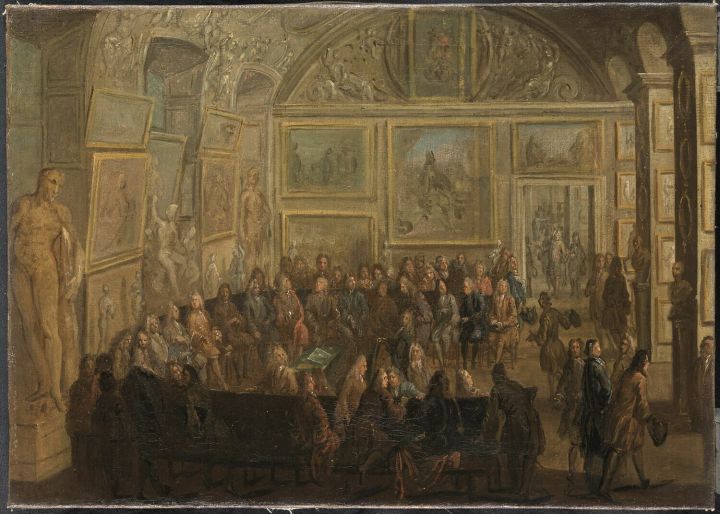
Jean-Baptiste Martin, View of the Salon of Diana at the Louvre, a Gathering of the Académie Royale de Peinture et de Sculpture (Séance de l’Académie royale de peinture et de sculpture au Louvre), ca. 1712–21, oil on canvas, 30 × 42 cm (Paris: Musée du Louvre, RF 1998-36).
◊ ◊ ◊ ◊ ◊
From ArtHist.net:
The Académie Royale Art Collection
Edited by Markus Castor, Sofya Dmitrieva, and Anne Klammt
Proposals due by 30 September 2022; selected contributions will be due 31 March 2023
Our book aspires to highlight the importance of the art collection that the Académie royale de peinture et de sculpture assembled in the century and a half of its existence (1648–1793) and show that this unique, yet almost entirely unstudied, body of works is essential to our understanding of eighteenth-century art and institutional practices.
The Académie royale art collection consisted mainly of reception pieces—the works that young artists submitted for examination by the academic jury to become full members of the institution. It also included miscellaneous donated artworks as well as portraits of the Académie’s patrons that the institution frequently commissioned from current members. Around 300 paintings and some 30 sculptures were on display in the Académie’s rooms at the Louvre and daily surrounded the artists who lived and worked there. The latter could also consult a rich collection of engravings at the Académie’s print room.
The collection was a unique corpus for multiple reasons. Firstly, as almost all the prominent old regime artists were members of the Académie royale, it united such iconic reception pieces as Watteau’s Pilgrimage to the Isle of Cythera (1717), Chardin’s Ray (1728), and Greuze’s Septimius Severus and Caracalla (1769). Secondly, these and other examinational works now offer invaluable insights into academic reception practices and aesthetic values as much as the commissioned portraits of the Académie’s patrons—into its behind-the-scenes personal networks. Finally, the hang of the works in the Louvre is an outstanding example of eighteenth-century curatorial work: since the collection’s arrangement was decided upon by academicians themselves, it stands an important ‘internal’ counterpart to the Académie’s public display, the Salons.
After the French Revolution, this one-of-a-kind body of works got dispersed and is shared today by the Louvre, the Versailles, the ENSBA, and several French regional museums. Thankfully, however, two detailed descriptions are still extant: in 1715, when the collection was housed on the Louvre’s ground floor, it was documented by Nicolas Guérin (Paris: J. Collombat), and in 1781, when it moved to the first floor, it was recorded by Antoine-Nicolas Dezallier d’Argenville (Paris: De Bure). In 1893, the two descriptions were republished as one volume by Anatole de Montaiglon. Two key critical works on the collection are the exhibition catalogue Les peintres du roi, 1648–1793 (Paris: Réunion des musées nationaux, 2000) and Hannah Williams’s monograph Académie Royale: A History in Portraits (Farnham: Ashgate, 2015).
The present book is part of the project run by the DFK Paris in collaboration with the Centre Dominique-Vivant Denon (Louvre) and the INHA that aspires to reconstruct the collection digitally and build a database of the works that constituted it.
We invite contributions that define the role of the Académie royale art collection and discuss its history and arrangement. Issues of our interest include but are not limited to:
• Collection arrangement: How did the hangs of the collection on the first and the ground floor of the Louvre differ? What were the guiding principles of the collection’s arrangement? What role did genre play in it? What was the function of different rooms and how did the works adorning the room reflect it? Did the arrangement reflect the Académie’s institutional hierarchy? How did prints, sculptures, and paintings that formed the collection work together?
• Instructive function of the collection: How did these sculptures, paintings, and prints, seen by the Académie’s students on day-to-day basis, influence their work? What message (if any) did they convey?
• Reception pieces: What role did the reception play in the artist’s career? What was the canon of academic reception pieces? How did it help crystallise the academic genre classification?
• Commissioned portraits: Who were the Académie’s patrons whose portraits the institution commissioned from its members? What role did these patrons play in the history of the Académie royale? How were they related to each other and what was their specific interest in sponsoring the institution?
• Conférences de l’Académie royale: How do the lectures that the members regularly delivered at the Académie royale relate to the collection? How do both reflect the Académie’s institutional and aesthetic values? What is the significance of the Salle d’Assemblée as the centre of the institutional life of the Académie royale?
• Dispersal of the collection: How were the works constituting the collection distributed after the French Revolution? What were the unique stories of these paintings, prints, and sculptures post-1793?
Contributions are welcome in English or French and are expected to be between 5,000 and 15,000 words in length. If you are interested, please send a short 300-word abstract and a brief 50-word biography to Sofya Dmitrieva sofya.k.dmitrieva@gmail.com by 30 September 2022. The deadline for selected contributions will be 31 March 2023.
◊ ◊ ◊ ◊ ◊
Note (added 12 August 2022) — The posting has been updated to include the editors and the painting by Jean-Baptiste Martin (from the PDF file of the Call for Essays)
Call for Papers | Boiseries: Decoration and Migration

From the Call for Papers:
Boiseries: Decoration and Migration from the Eighteenth Century to the Present
Camden Place, Chislehurst (Kent), 12–13 January 2023
Organized by Lindsay Macnaughton and Laura Jenkins
Proposals due by 9 September 2022
This conference investigates the cultural and commercial migrations of French eighteenth-century boiseries from their places of production in Paris and the Bâtiments du Roi to the drawing rooms of Britain and the United States.
From an historical perspective boiseries have always, in a sense, been mobile. In the eighteenth century, Paris joiners and carvers travelled to locations outside the city to install panelling, and entire decorative schemes were sent abroad to Germany, Spain, and Latin America. Accompanied by mirrors and tapestries from royal manufactories, these panels disseminated French style in accordance with the diplomacy of the monarch and the desires of foreign courts. Boiseries executed for particular sites but not installed were also sometimes reused elsewhere: failed deliveries and changes in taste during the period from commission to installation occasioned opportunities for buyers, and sets of panelling conceived as complete ensembles were broken up and dispersed for use in multiple locations, or disused altogether. Shifting fashions and continual reallocations of appartements at Versailles set into motion near-ceaseless rotations of décors, including boiseries. And, notwithstanding the legal categorisations of panels, once fixed, as immeubles, removals were negotiated by tenants during their lease of, and on their departure from, urban hôtels.
In the nineteenth century, the pace and directionality of movement changed, as elements of interior decoration began to be acquired for their own merit and eighteenth-century boiseries became the relics of a physically and culturally disappearing French national history as well as the trophies of an international collecting elite. Elements of woodwork, disassembled from demolished châteaux or reproduced in survey drawings and plaster casts, made their way into rooms in Britain and the United States, their proportions and ornament amplified and metamorphosed—to borrow terms used by John Harris and Bruno Pons—to match the pitch of the French Second Empire and later living.
Professional interior decorators and commercial dealers in decorative arts were largely to credit, providing channels by which goods could easily be transported from place to place. However, boiseries also emigrated, as it were, with exiles of the Republic, extending the presence of French style to less-cosmopolitan regions and adding geopolitical to social and architectural concerns.
Camden Place, where the conference will be held, is an English country house whose history and interiors have been shaped by the migration of people and decoration for over 300 years. Home to Chislehurst Golf Club, the Grade II* listed building features architectural elements by the British architects George Dance the Younger (1741–1825) and James ‘Athenian’ Stuart (1713–1788), and played host to the French Imperial court after the fall of the Empire in 1870. French chimney pieces, boiseries from the eighteenth-century Château de Bercy (demolished in 1862), and heavily carved oak panelling are among the elements that make up the house’s many layers, testifying both to the eclectic tastes of its nineteenth-century occupants and to the multifaceted, and multinational, histories of many English country houses.
This conference provides a unique opportunity for cultural historians of France, art and architectural historians, historians of collecting, curators, and heritage professionals to meet in a room reassembled following the landmark Château de Bercy sale (1860) and to meditate on the finer points of its significance in the dispersal of French cultural patrimony.
The organisers invite abstracts for 20-minute papers on topics engaging with, but not limited to:
• The relative mobility (meubles/immeubles) of boiseries in the 18th century
• Collecting, architectural salvage, and markets for boiseries in the 19th and 20th centuries
• Exchanges of taste and culture as a result of political displacement, in particular the influence of French émigrés
• Memory and the material traces of Empire
• Documentary and curatorial challenges posed by collections of boiseries
• The management of architectural heritage in private and commercial spaces today
Confirmed speakers include Dr Lee Prosser (Historic Royal Palaces), Frédéric Dassas (Musée du Louvre), Dr Ulrich Leben (German Ambassador’s residence, Paris), Dr Mathieu Deldicque (Musée Condé, Château de Chantilly), and Dr Tom Stammers (University of Durham).
Some funds will be available to support travel and accommodation for speakers. The conference is generously supported by the University of Buckingham, The Chislehurst Society, and Chislehurst Golf Club as part of a programme of events marking the 150th anniversary of the death of Napoleon III at Camden Place.
Submissions for 20-minute papers (300 words) should be sent to lindsay.macnaughton@buckingham.ac.uk and laura.jenkins@courtauld.ac.uk by Friday, 2 September 2022. We look forward to receiving your abstracts.
For more information, please visit: boiseriescamdenplace.wordpress.com (coming soon).
With thanks from the organisers: Dr Lindsay Macnaughton (University of Buckingham) and Laura C. Jenkins (The Courtauld Institute of Art).
◊ ◊ ◊ ◊ ◊
Note (added 31 August 2022) — The posting was updated with the new due date, extended from the original deadline of 2 September 2022.










 Enfilade
leave a comment