Exhibition | Threads of Power
 Opening this week at BGC:
Threads of Power: Lace from the Textilmuseum St. Gallen
Bard Graduate Center, New York, 16 September 2022 — 1 January 2023
Curated by Emma Cormack, Ilona Kos, and Michele Majer
“I love lace for evening dresses … for a cocktail frock … or for a blouse… . When a fabric is fancy in itself it needs simplicity of design to show it to its best advantage.” —Christian Dior
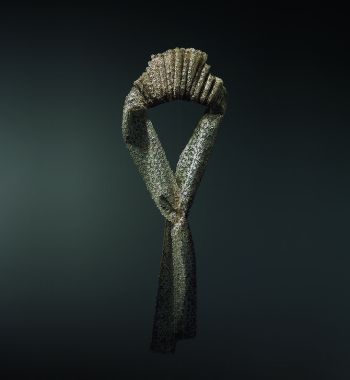
Point de France needle-lace frelange with lappets, Orne, France, ca. 1695, linen (Textilmuseum St. Gallen, acquisition from the John Jacoby Collection, 1954,01246; photo by Michael Rast).
Lace—delicate, sumptuous, enigmatic—takes over the Bard Graduate Center Gallery this fall. Trace the development of European lace from its sixteenth-century origins to the present day. See more than 150 examples of lace from the renowned collection of Switzerland’s Textilmuseum St. Gallen, including some of the world’s finest examples of handmade needle and bobbin lace that were favored by the wealthy and powerful of Bourbon France and Habsburg Spain. Learn about the women who crafted this sought-after status symbol by hand and about the evolution of Swiss chemical lace, known as guipure lace, made on embroidery machines. Explore new innovations in lace production, like laser-cut and 3D-printed lace, used in contemporary haute couture.
Curated by Emma Cormack, associate curator, Bard Graduate Center; Ilona Kos, curator, Textilmuseum St. Gallen; and Michele Majer, assistant professor, Bard Graduate Center. Threads of Power: Lace from the Textilmuseum St. Gallen is organized by Bard Graduate Center and the Textilmuseum St. Gallen. The exhibition will open at Bard Graduate Center Gallery in New York in September 2022 and will be available to tour after closing in January 2023.
◊ ◊ ◊ ◊ ◊
Emma Cormack and Michele Majer, eds., Threads of Power: Lace from the Textilmuseum St. Gallen (New York: Bard Graduate Center, 2022), 432 pages, ISBN: 978-0300263497, $75.
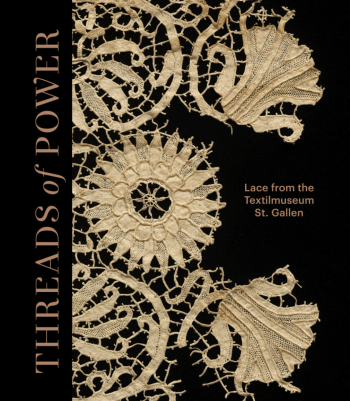 Tracing the history of lace in fashion from its sixteenth-century origins to the present, Threads of Power: Lace from the Textilmuseum St. Gallen offers a look at one of the world’s finest collections of historical lace. The book explores the longstanding connections between lace and status, addressing styles in lace worn at royal courts, including Habsburg Spain and Bourbon France, as well as lace worn by the elite ruling classes and Indigenous peoples in the Spanish Americas. Featuring new research, the publication covers a range of topics related to lace production, lace in fashion and portraiture, lace revivals, the mechanization of the lace industries in the nineteenth and twentieth centuries, and contemporary innovations in lace. With a focus on lace techniques, women lace makers, and lace as a signifier of wealth and power, this richly illustrated book includes wide-ranging contributions by curators and experts from major museums and academic institutions.
C O N T E N T S
Director’s Foreword, Susan Weber
Editor’s Note
Introduction, Emma Cormack and Michele Majer
The Emergence of Lace in Early Modern Europe
1 Barbara Karl — Lace and Status: Luxury, Power, and Control in Early Modernity
2 Femke Speelberg — Putting a Name to Lace: Fashion, Fame, and the Production of Printed Textile Pattern Books
3 Paula Hohti Erichsen — ‘Monstrous’ Ruffs and Elegant Trimmings: Lace and Lacemaking in Early Modern Italy
4 Frieda Sorber — Antwerp, A Center of Lace Making and Lace Dealing, 1550–1750
Lace in Spain and the Americas, 1500–1800
5 Amalia Descalzo Lorenzo — The Triumph of Lace: Spanish Portraiture of the Sixteenth and Seventeenth Centuries
6 Mariselle Méléndez — ‘A desire of being distinguished by an elegant dress is universal’: Clothing, Status and Convenience in Eighteenth-Century Spanish America
7 James Middleton — A Prodigious Excess: Lace in New Spain and Peru, ca. 1600–1800
8 Laura Beltrán-Rubio — ‘Covered in much fine lace’: Dress in the Viceroyalty of New Granada
The Dominance of France, 1660–1790
9 Denis Bruna — Lace and Economy under Louis XIV
10 Lesley Miller — Lace à la Mode, ca. 1690–1790
Mechanization and Revivalism: The Nineteenth Century Lace Industries
11 Emma Cormack and Michele Majer — Fashion and the Lace Industries in France, Belgium, and England, 1800–1900
12 Annabel Bonnin Talbot — Ahead of the Curve: A. Blackbourne & Co. and the Late-Nineteenth Century British Lace Industry
13 Emily Zilber — Italy to New York: Making Historic Textiles Modern at the Scoula d’Industrie Italiane
14 Anne Wanner-JeanRichard and Ilona Kos — Imitation and Inspiration: The Leopold Iklé Collection in St. Gallen
Innovations in Lace, 1900 to Today
15 Catherine Örmen — Fashion and Lace since 1900
16 Annina Dosch, Interview with Tobias Forster, Hans Schreiber, and Martin Leuthold — Lace in St. Gallen Today: Tradition and Innovation at Forster Rohner and Jakob Schlaepfer
Illustrated Checklist of the Exhibition
Glossary, compiled by Kenna Libes
Bibliography
Contributors
Index
Lecture | Charles Kang on Antoine Benoist’s Portraits of Louis XIV
From BGC:
Charles Kang | From Wax to Paper: Antoine Benoist’s Portraits of Louis XIV
A Françoise and Georges Selz Lecture on Eighteenth- and Nineteenth-Century French Decorative Arts and Culture
Bard Graduate Center, New York, 28 September 2022, 6.00pm
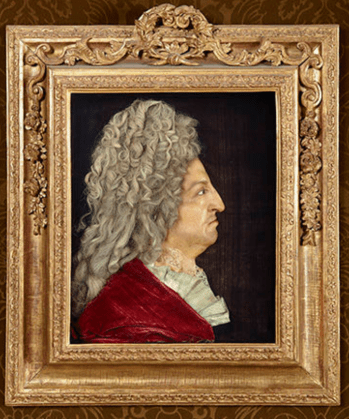
Antoine Benoist (1632–1717), Portrait of Louis XIV, ca. 1705, colored wax with a natural wig. 52 × 42 cm (Musée national des châteaux de Versailles et de Trianon).
Painter and sculptor Antoine Benoist is best known for a profile relief portrait of Louis XIV in polychrome wax. The striking verisimilitude of this work and his other wax creations readily evoke the popular wax statues at Madame Tussauds. In this lecture, Charles Kang explores the outer limits of royal portraiture at the time of Louis XIV, beyond oil paintings, marble busts, bronze statues, and medals. Kang also looks at two other works that Benoist produced towards the end of his career: a group of grisaille miniature portraits in elaborate gilt bronze frames and a manuscript biography of Louis XIV decorated with similar miniatures in gouache. Through these works, Benoist attempted to reposition himself as a chronicler of royal likeness rather than as a wax portraitist.
Charles Kang is Curator of Eighteenth- and Nineteenth-Century Drawings at the Rijksmuseum Amsterdam. Responsible for the museum’s collection of Dutch and European drawings, he is currently working on several projects, including one on the rise of private drawing societies in the Netherlands and another on the relationship between artistic drawing and early ethnography. He trained in eighteenth-century French art and visual culture and holds a PhD from Columbia University and an MA from Williams College in the history of art.
The Burlington Magazine, August 2022
The August issue of The Burlington is rich for the eighteenth century, including Karin Wolfe’s obituary for Christopher Johns (details for his memorial service, on 17 September, are emerging here).
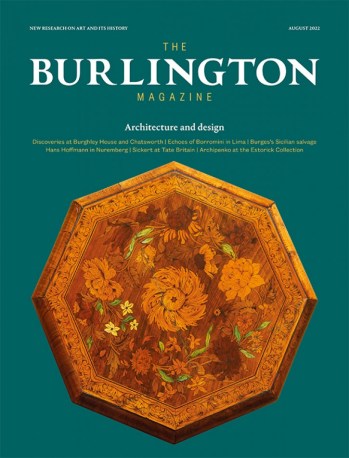
The Burlington Magazine 164 (August 2022)
 A R T I C L E S
• Gauvin Alexander Bailey, “A Borromini-Inspired Church Plan in Eighteenth-Century Lima,” pp. 740–51.
Built in 1758–66, the Church of Los Huérfanos, Lima, is unique in Spanish South America for its oval plan. Its designer is her identified as a master builder, Cristóbal de Vergas, who was inspired by prints of Francesco Borromini’s S. Carlo alle Quattro Fontane, Rome, exemplifying the revival of interest during the Rococo perios in Roman Baroque precedents.
• Adam Bowett, “The Floral Marquetry Floor at Burghley House,” pp. 752–59.
The possibility that five pieces of eighteenth-century furniture at Burghley House, Stamford, incorporate maquetry made for a floor in the house c.1685 is here confirmed by references in inventories. The marquetry can be linked to furniture in the Royal Collection, raising the possibility that the floor was mdade by Gerrit Jensen incorporating marquetry supplied by Jasper Braems.
• François Marandet, “A Modello by Louis Laguerre and the Programme of the Painted Hall at Chatsworth,” pp. 760–67.
With the help of a recently discovered modello, the subject of Louis Laguerre’s monumental painting on the east wall of the Painted Hall, Chatsworth, is here identified as Augustus Ordering the Closing of the Doors of the Temple of Janus. This allows the political allegory of the room’s decoration, completed in 1694, to be fully understood for the first time.
R E V I E W S
• Neil Jeffares, “Pastels in the Pandemic,” pp. 780–87.
The notoriously fragile medium of pastel has not been out of the public eye during the difficult circumstances of the past two years. Exhibition in San Francisco and Munich and a biography of Rosalba Carriera invite comparisons between the major pastellists of the eighteenth century: Joseph Vivien, Maurice-Quentin de La Tour, and Jean-Étienne Liotard, as well as Carriera.
• Reinier Baarsen, Review of Calin Demetrescu, Les ébénistes de la Couronne sous le règne de Louis XIV (La Bibliothèque des Arts, 2021), pp. 818–19.
• Daniel Fulco, Review of Andreas Schumacher, ed., Venezianische Malerei: Staatsgalerie in der Residenz Würzburg (Schnell & Steiner, 2021), pp. 819–21.
• Howard Coutts, Review of Patricia Ferguson, ed., Pots, Prints, and Politics: Ceramics with an Agenda, from the 14th to the 20th Century (British Museum Press, 2021), pp. 821–22.
• Sophie Rhodes, Review of Tessa Murdoch, Europe Divided: Huguenot Refugee Art and Culture (V&A Museum, 2021), pp. 827–28.
• Patrick Bade, Review of Charles Dellheim, Belonging and Betrayal: How Jews Made the Art World Modern (Brandeis University Press, 2021), p. 828.
O B I T U A R I E S
• Karin Wolfe, Obituary for Christopher M.S. Johns (1955–2022), pp. 829–31.
Professor of History of Art at Vanderbilt University, Nashville, since 2003, Christopher M.S. Johns published widely on Italian art of the seventeenth and eighteenth centuries. His determination to demonstrate the falsity of the belief that the settecento was a period of cultural decline had a substantial influence on both scholarship and academic curricula.
Material and Visual Culture Seminar Series, Fall 2022
From ArtHist.net:
Material and Visual Culture Seminar Series, 17th and 18th Centuries
Online, University of Edinburgh, 28 September — 7 December 2022
Each session we’ll hear from two speakers, sharing their research on, and approaches to, the study of 17th- and 18th-century material and visual culture. From reassessing how the work of female artists is read, to European visualisation of Latin America, and the exchange of objects, this year’s programme covers a broad range of topics. We aim to make a space in which these rich histories can be explored from varied disciplines to enhance our research practices. We’ll be meeting on Wednesdays, 5–6pm GMT, online using Zoom. See Eventbrite to register, view speaker abstracts, receive the joining link and reminders. Registration closes 40 minutes before seminar start time. Please contact materialcultureresearcheca@ed.ac.uk with any queries.
28 September | Approaching Identities
Chair: Georgia Vullinghs
• Emma Pearce
• Ailsa Maxwell
12 October | Patronage and Person under the Stuarts
Chair: Catriona Murray
• Sarah Hutcheson
• Megan Shaw
26 October | Baroque Devotional Visual Culture
Chair: Carol Richardson
• Lucía Jalón Oyarzun
• Sandra Costa Saldanha
9 November | Pasteboard and Printing Plates: Elusive Objects
Chair: Molly Ingham
• Chiara Betti
• Lucy Razzall
23 November | The Social Life of … Tea
Chair: Caroline McCaffrey-Howarth
• Anna Myers
• Lucy Powell
7 December | The Materiality of Making
Chair: Viccy Coltman
• Kerry Love
• Alejandro Octavio Nodarse
Exhibition | Dare to Know

Alexandre-Evariste Fragonard, A Centurion Begging for Protection from Marc Antony during a Seditious Revolt, ca. 1800, black ink and black and gray wash, probably over graphite, framing lines in black ink, on off-white antique laid paper (laid down), 20 × 48 cm (Harvard Art Museums, 2018.210).
◊ ◊ ◊ ◊ ◊
Opening this week at Harvard:
Dare to Know: Prints and Drawings in the Age of Enlightenment
Harvard Art Museums, Cambridge, MA, 16 September 2022 — 15 January 2023
Curated by Elizabeth Rudy and Kristel Smentek
See how the graphic arts inspired, shaped, and gave immediacy to new ideas in the Enlightenment era, encouraging individuals to follow their own reason when seeking to know more.
 What role did drawings and prints play during the Enlightenment era, from roughly 1720 to 1800? Dare to Know explores many nuances of this complex time—when political and cultural revolutions swept across Europe and the Americas, spurring profound shifts in science, philosophy, the arts, social and cultural encounters, and our shared sense of history. Indeed, the Enlightenment itself has been described as a “revolution of the mind.” Novel concepts in every realm of intellectual inquiry were communicated not only through text and speech, but in prints and drawings that gave these ideas a visual, concrete form. They made new things visible—and familiar things visible in powerful new ways. They wielded the potential to visually articulate, reinforce, or contradict beliefs as well as biases, while also arguing for social action and imagining new realities.
In 1784, in response to a journal article asking “What Is Enlightenment?,” German philosopher Immanuel Kant argued that the Enlightenment’s main impulse was to “dare to know!”: to pursue knowledge for oneself, without relying on others to interpret facts and experiences. But is this ever truly possible?
Bringing together 150 prints, drawings, books, and other related objects from Harvard as well as collections in the United States and abroad, this exhibition offers provocative insights into both the achievements and the failures of a period whose complicated legacies reverberate still today. Dare to Know asks new and sometimes uncomfortable questions of the so-called age of reason, inviting visitors to embrace the Enlightenment’s same spirit of inquiry—to investigate, to persuade, and to imagine.
Curated by Elizabeth M. Rudy, Carl A. Weyerhaeuser Curator of Prints, Harvard Art Museums, and Kristel Smentek, Associate Professor of Art History, Massachusetts Institute of Technology. With special thanks to Heather Linton, Curatorial Assistant for Special Exhibitions and Publications, Division of European and American Art, and Christina Taylor, Associate Paper Conservator, Straus Center for Conservation and Technical Studies. Research contributions by Austėja Mackelaitė, Stanley H. Durwood Foundation Curatorial Fellow (2016–18), and by PhD candidates in Harvard’s Department of History of Art and Architecture and former graduate interns in the Division of European and American Art: J. Cabelle Ahn, Thea Goldring, and Sarah Lund.
This project is supported in part by an award from the National Endowment for the Arts. Support for the exhibition is provided by the Melvin R. Seiden and Janine Luke Fund for Publications and Exhibitions, the Robert M. Light Print Department Fund, the Stanley H. Durwood Foundation Support Fund, the Catalogues and Exhibitions Fund for Pre-Twentieth-Century Art of the Fogg Museum, and the Gladys Krieble Delmas Foundation. The accompanying catalogue was made possible by the Andrew W. Mellon Publication Funds, including the Henry P. McIlhenny Fund. Related programming is supported by the M. Victor Leventritt Lecture Series Endowment Fund.
The catalogue is distributed by Yale UP:
Edouard Kopp, Elizabeth Rudy, and Kristel Smentek, eds., Dare to Know: Prints and Drawings in the Age of Enlightenment (Cambridge: Harvard Art Museums, 2022), 334 pages, ISBN: 978-0300266726, $50.
Are volcanoes punishment from God? What do a fly and a mulberry have in common? What utopias await in unexplored corners of the earth and beyond? During the Enlightenment, questions like these were brought to life through an astonishing array of prints and drawings, helping shape public opinion and stir political change. Dare to Know overturns common assumptions about the age, using the era’s proliferation of works on paper to tell a more nuanced story. Echoing the structure and sweep of Diderot’s Encyclopédie, the book contains 26 thematic essays, organized A to Z, providing an unprecedented perspective on more than 50 artists, including Henry Fuseli, Jean-Honoré Fragonard, Francisco Goya, Jean-Baptiste Greuze, William Hogarth, Giovanni Battista Piranesi, and Giambattista Tiepolo. With a multidisciplinary approach, the book probes developments in the natural sciences, technology, economics, and more—all through the lens of the graphic arts.
Edouard Kopp is the John R. Eckel, Jr., Foundation Chief Curator at the Menil Drawing Institute in Houston; Elizabeth M. Rudy is the Carl A. Weyerhaeuser Curator of Prints at the Harvard Art Museums, Cambridge, MA; and Kristel Smentek is associate professor of art history in the Department of Architecture at the Massachusetts Institute of Technology, Cambridge, MA.
With contributions by J. Cabelle Ahn, Elizabeth Saari Browne, Rachel Burke, Alvin L. Clark, Jr., Anne Driesse, Paul Friedland, Thea Goldring, Margaret Morgan Grasselli, Ashley Hannebrink, Joachim Homann, Kéla Jackson, Penley Knipe, Edouard Kopp, Ewa Lajer-Burcharth, Heather Linton, Austėja Mackelaitė, Tamar Mayer, Elizabeth Mitchell, Elizabeth M. Rudy, Brandon O. Scott, Kristel Smentek, Phoebe Springstubb, Gabriella Szalay, and Christina Taylor.
R E L A T E D E V E N T S
Dare to Know: An Introduction
15 September 2022, 5.30pm
Join us for a series of brief presentations and a discussion about the special exhibition Dare to Know: Prints and Drawings in the Age of Enlightenment, with curators Elizabeth Rudy and Kristel Smentek, along with several contributors to the exhibition catalogue.
Exhibition Tours by Elizabeth Rudy
18 September, 2 and 23 October, 11 December, and 15 January, noon
Join exhibition co-curator Elizabeth Rudy for a tour of the exhibition. She will share insights about how works on paper played a critical role in the 18th century, wielding the power to visually articulate, reinforce, or contradict beliefs as well as biases.
Gallery Talk by Morgan Grasselli
22 September 2022, 12.30pm
Join Margaret Morgan Grasselli for a discussion about the 18th-century invention of the multicolor, multiplate printing technique that laid the foundation for today’s CMYK process.
Gallery Talk by Sam Nehila
30 September 30, 2022, 12.30pm
Join Sam Nehila, curatorial assistant in the Division of European and American Art, for a discussion of William Hogarth’s print series The Four Stages of Cruelty.
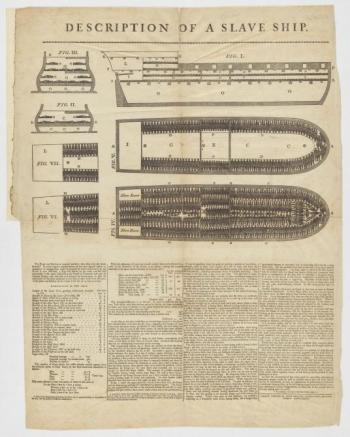
Printed by James Phillips, Description of a Slave Ship, 1789, engraving (Harvard University, Houghton Library, Gift of O. Peck, 1845, p EB75 A100, TL42422.5).
Gallery Talk by John Overholt
25 October 2022, 12.30pm
Join Houghton Library curator John Overholt for a discussion of one of the most important and consequential prints of the 18th century, Description of a Slave Ship.
Gallery Talk by Joachim Homann
27 October 2022, 12.30pm
Join curator Joachim Homann for a discussion about a rare, intact example of French inventor Louis Carrogis de Carmontelle’s multi-sheet drawings on translucent paper. The work was originally attached to rollers, lit from behind with candles, and unfurled for a captive audience.
Gallery Talk by Horace Ballard
3 November 2022, 12.30pm
Join curator Horace Ballard for an exploration of the observation and documentation of astronomical events in the 18th century as exemplified in a drawing by British artist Paul Sandby.
Gallery Talk by Ben Sibson
5 November 2022, 12.30pm
Join Ben Sibson, PhD candidate in Harvard’s Department of Human Evolutionary Biology, for a discussion about the depiction of the human body in selected works on view in the exhibition.
Gallery Talk by Paris A. Spies-Gans
6 November 2022, 12.30pm
Join art historian Paris A. Spies-Gans, of the Harvard Society of Fellows, for a discussion about works of art made by women in the exhibition. Spies-Gans will examine objects by a range of artists, with particular attention given to Marguerite Gérard and Marie-Gabrielle Capet.
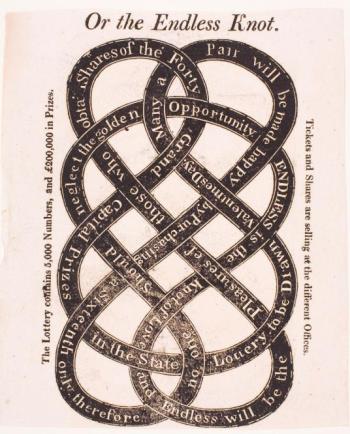
Unidentified artist, American, Lottery Ticket: The Endless Knot, ca. 1785–95, woodcut (Harvard Art Museums/Fogg Museum, Gift of Walter S. Poor, Class of 1905, M20297).
Gallery Talk by Casey Monahan
8 November 2022, 12.30pm
Join curatorial assistant Casey Monahan for a discussion of a dynamic display of ball invitations, advertisements, trade cards, and currency notes in the exhibition. Monahan will share insights about the acquisition of these small prints and the story behind their creative installation.
Gallery Talk by Joachim Homann
10 November 2022, 12.30pm
Join curator Joachim Homann for a discussion of Jean-Honoré Fragonard’s drawing The Girls’ Dormitory.
Gallery Talk by Sarah Mallory
20 November 2022, 12.30pm
Join Sarah Mallory, PhD candidate in Harvard’s Department of History of Art and Architecture, for a discussion of the emergence of the modern notion of ecology in the 18th century as articulated in selected works in the exhibition.
Gallery Talk by Yi Bin Liang
6 December 2022, 12.30pm
Join conservation technician Yi Bin Liang for an exploration of 18th-century methods and techniques of book binding in a close examination of works on view.
Online Workshop around Simon Burrows’ Oeuvre

From the Pamphlets and Patrons project:
18th-Century Libelles, Libellistes, and Book Trade
Workshop around Simon Burrows’ Oeuvre
Online and in-person, 22 September 2022
Organised by Damian Tricoire and the Pamphlets and Patrons (PAPA) project at the University of Trier
All times are Central European Time
13.00 Introduction — Damien Tricoire (Universität Trier)
13.15 Where’s Marie-Antoinette? Pamphlets, Politics, and French Enlightenment Print Culture — Simon Burrows (Western Sydney University)
14.00 The Palais-Royal Style of Revolution: Brissot, Secretary General of the Chancellery of the Duc d’Orléans — Damien Tricoire (Universität Trier)
14.45 Break
15.15 Political Pamphlets and Print Culture in Liège from the Triumph of Enlightenment to Revolution, 1764–1790 — Daniel Droixhe (Université de Liège)
16.00 Persecuting Printers in France before and after 1789 — Jane McLeod (Brock University)
16.45 Break
17.15 Round Table Discussion
• Simon Burrows (Western Sydney University)
• Edmond Dziembowski (Université de Franche-Comté)
• Olivier Ferret (Université de Lyon)
• Julian Swann (Birbeck University of London)
If you wish to attend online through Zoom or in person, please write to doering@uni-trier.de.
22 September 2022, 12.45pm Paris
Zoom-Meeting
https://uni-trier.zoom.us/j/87391514608?pwd=MlMxYzFsU1hUNFM0OUhndzMwZXBYUT09
Meeting-ID: 873 9151 4608
Passcode: dbjpxFg1
New Book | Against Sex
From UNC Press:
Kara French, Against Sex: Identities of Sexual Restraint in Early America (Chapel Hill: The University of North Carolina Press, 2021), 232 pages, ISBN: 978-1469662138 (hardcover), $95 / ISBN: 978-1469662145 (paperback), $30 / ISBN: 978-1469662152 (ebook), $25.
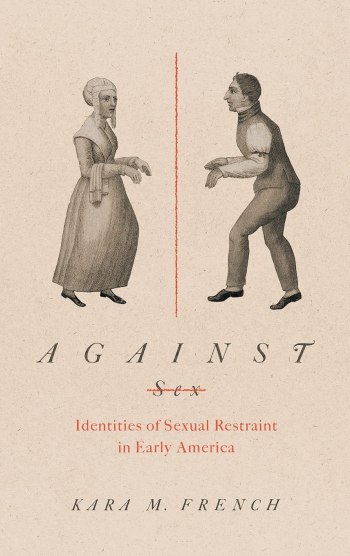 How much sex should a person have? With whom? What do we make of people who choose not to have sex at all? As present as these questions are today, they were subjects of intense debate in the early American republic. In this richly textured history, Kara French investigates ideas about, and practices of, sexual restraint to better understand the sexual dimensions of American identity in the antebellum United States. French considers three groups of Americans—Shakers, Catholic priests and nuns, and followers of sexual reformer Sylvester Graham—whose sexual abstinence provoked almost as much social, moral, and political concern as the idea of sexual excess. Examining private diaries and letters, visual culture and material artifacts, and a range of published works, French reveals how people practicing sexual restraint became objects of fascination, ridicule, and even violence in nineteenth-century American culture.
Against Sex makes clear that in assessing the history of sexuality, an expansive view of sexual practice that includes abstinence and restraint can shed important new light on histories of society, culture, and politics.
Kara M. French is associate professor of history at Salisbury University.
C O N T E N T S
Acknowledgments
Introduction
1 Vinegar-Faced Sisters and Male Monsters: The Gender of Sexual Restraint
2 Identities of Sexual Restraing
3 Breaking and Remaking the Family
4 Alternative Extracts: Sexual Retraint in the Antebellum Marketplace
5 Performing Sexual Restraint
Conclusion
Notes
Bibliography
Index
Call for Papers | Gender and Otherness in the Humanities
From the Call for Papers
Gender and Otherness in the Humanities: Drama, Literature, and Visual Culture
3rd Annual GOTH Symposium
The Open University, Milton Keynes, 18–20 May 2023
Proposals due by 30 November 2022
The annual GOTH Symposium welcomes scholars from within and outside The Open University for three days of productive interdisciplinary discussion and debate. The program committee invites proposals for 20-minute papers focusing on the following aspects of gender and otherness in drama, literature, and visual culture:
1. Gender and/or otherness in pre-1800 images of drama and literature, with topics including but not limited to:
• images by or relating to William Hogarth, and especially to his early career and book illustrations
• the anti-hero: Don Quixote and Hudibras illustrations at Littlecote House and elsewhere
• any aspect of the Littlecote House murals
2. Gender and/or otherness in modern performance receptions of ancient Greek drama, possibly addressing topics including but not limited to:
• new versions of rarely staged or fragmentary texts
• innovative or non-traditional modes of performance
• productions engaging with intersecting identities
3. Race, disability, and/or otherness in early modern theatre, with topics including but not limited to:
• depictions of otherness in dramatic writing and staging practices
• historical receptions of race and disability
• the significance of gender in representations of race and disability
4. ‘Collectible Otherness’, 1500–1800, with topics including but not limited to:
• dwarfs, conjoined twins, the abnormally hirsute
• genre: visual culture, drama, and literature
• contextualizing agency and Intersectionality of otherness: court, theatre, fairground, curiosity cabinet (Wunderkammer)
Please submit your proposal (300 words max) and academic bio (150 words max) on or before 30 November 2022, to m.a.katritzky@open.ac.uk and FASS-GOTH-Admin@open.ac.uk. Presenters will be provided with one night of accommodation. A limited number of travel bursaries will be awarded; if you wish to be considered please include a brief statement explaining what sum is required and why. Inquiries on any aspect of the symposium can be emailed to FASS-GOTH-Admin@open.ac.uk. Further information will be posted on the GOTH website as it becomes available.
GOTH Committee
• M. A. Katritzky – GOTH director / Barbara Wilkes Research Fellow in Theatre Studies
• Christine Plastow – GOTH web and media manager / Lecturer in Classical Studies
• Molly Ziegler – Lecturer in Drama and Performance Studies
Guest Co-Organizer
• Birgit Ulrike Münch, Rheinische Friedrich-Wilhelms-Universität Bonn
Exhibition | Feminine Power: The Divine to the Demonic
Closing this month at The British Museum:
Feminine Power: The Divine to the Demonic
The British Museum, London, 19 May — 25 September 2022
Curated by Belinda Crerar and Lucy Dahlsen
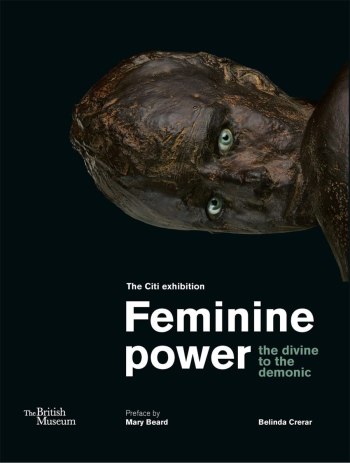 The first exhibition of its kind, Feminine Power takes a cross-cultural look at the profound influence of female spiritual beings within global religion and faith. Explore the significant role that goddesses, demons, witches, spirits and saints have played—and continue to play—in shaping our understanding of the world.
How do different traditions view femininity? How has female authority been perceived in ancient cultures? For insights, the exhibition looks to divine and demonic figures feared and revered for over 5,000 years. From wisdom, passion and desire, to war, justice and mercy, the diverse expression of female spiritual powers around the world prompts us to reflect on how we perceive femininity and gender identity today.
Worship of Pele, the Hawaiian goddess of volcanoes, reveals how her destructive capacity is venerated alongside her ability to create. The Buddhist bodhisattva of compassion, who transcends gender and is visualised in male form in Tibet and female in China and Japan, uncovers the importance of gender fluidity in some spiritual traditions. And the terrifying Hindu goddess Kali, depicted in art carrying a severed head and bloodied sword, is honoured as the Great Mother and liberator from fear and ignorance.

Porcelain Figure of Guanyin, China, 18th century, 41 cm high (London: The British Museum, 1980,0728.93).
Enhanced by engagement with contemporary worshippers, faith communities and insights from high-profile collaborators Bonnie Greer, Mary Beard, Elizabeth Day, Rabia Siddique, and Deborah Frances-White, the exhibition considers the influence of female spiritual power and what femininity means today.
Bringing together sculptures, sacred objects and artworks from the ancient world to today, and from six continents, the exhibition highlights the many faces of feminine power—ferocious, beautiful, creative or hell-bent—and its seismic influence throughout time.
Belinda Crerar, Feminine Power: The Divine to the Demonic (London: The British Museum, 2022), 272 pages, ISBN: 978-0714151304, £30 / $45.
C O N T E N T S
Introduction
1 Forces of Nature
2 Passion and Desire
3 Evil
4 Justice and Defence
5 Compassion and Salvation
Conclusion
Notes and Bibliography
Acknowledgements and Credits
Exhibition | Fuseli and the Modern Woman
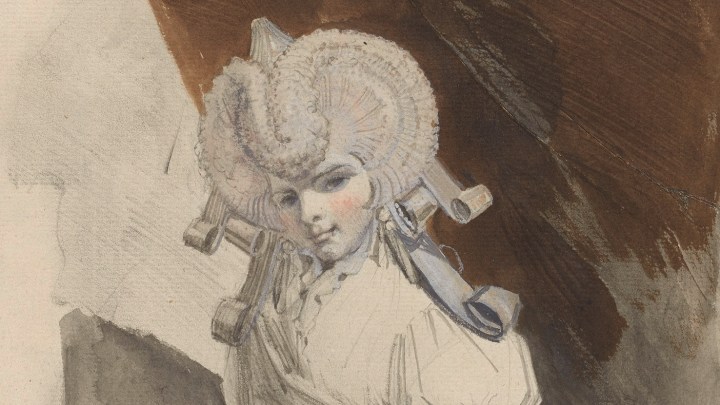
Henry Fuseli, Sophia Fuseli, Her Hair in Large Rolls, with Pink Gloves, in Front of a Brown Curtain, detail, 1790
(Kunsthaus Zürich, Collection of Prints and Drawings)
◊ ◊ ◊ ◊ ◊
From The Courtauld:
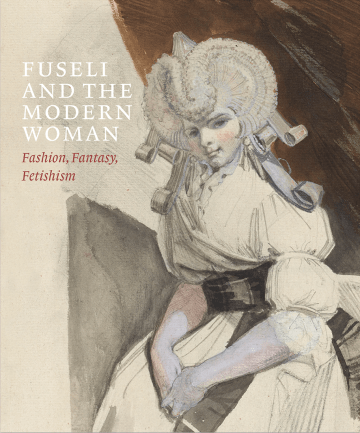
Fuseli and the Modern Woman: Fashion, Fantasy, Fetishism
The Courtauld Gallery, London, 14 October 2022 — 8 January 2023
Kunsthaus Zürich, 24 February – 21 May 2023
One of the most original and eccentric artists of the 18th century, Henry Fuseli (1741–1825) will be the subject of a new exhibition at The Courtauld, opening 14 October 2022.

Henry Fuseli, Half-length Figure of a Courtesan with Feathered Head-dress, ca. 1800–10 (Kunsthaus Zürich, Collection of Prints and Drawings).
Born in Zurich, Switzerland, Fuseli spent a formative period in Rome in the 1770s before settling in London, where he was elected Professor of Painting at The Royal Academy and served for 21 years as Keeper of the RA Schools, working and living at Somerset House in what is now The Courtauld Gallery.
While Fuseli was famous in his lifetime for stylised paintings depicting fantastic and supernatural scenes drawn from his imagination and literature, The Courtauld’s exhibition explores an altogether different dimension to his art. Fuseli and the Modern Woman: Fashion, Fantasy, Fetishism will reveal the artist’s secret lifelong obsession with the female figure through fifty of his strange and striking private drawings, many of which depict the spectacularly extravagant hairdos and fashions of the day. The exhibition will explore Fuseli’s fascination with female sexuality and the modern woman—as a figure of mystery, transgression, and dangerous allure—and provides an insight into late 18th- and early 19th-century anxieties about gender, identity, and sexuality during a transformative period in European history.
Organised in collaboration with the Kunsthaus Zürich, the exhibition will showcase drawings brought together from international collections. Following its presentation at The Courtauld, the exhibition will travel to Zürich, the city where Fuseli was born.
The catalogue is published by PHP and distributed by The University of Chicago Press:
David Solkin, ed., with contributions by Jonas Beyer, Mechthild Fend, and Ketty Gottardo, Fuseli and the Modern Woman: Fashion, Fantasy, Fetishism (London: Paul Holberton Publishing, 2022), 168 pages, ISBN: 978-1913645298, £30 / $40.
 Best known for his notoriously provocative painting The Nightmare, Fuseli energetically cultivated a reputation for eccentricity, with vividly stylised images of supernatural creatures, muscle-bound heroes, and damsels in distress. While these convinced some viewers of the greatness of his genius, others dismissed him as a charlatan, or as completely mad.
Fuseli’s contemporaries might have thought him even crazier had they been aware that in private he harboured an obsessive preoccupation with the figure of the modern woman, which he pursued almost exclusively in his drawings. Where one might have expected idealised bodies with the grace and proportions of classical statues, here instead we encounter figures whose anatomies have been shaped by stiff bodices, waistbands, puffed sleeves, and pointed shoes, and whose heads are crowned by coiffures of the most bizarre and complicated sort. Often based on the artist’s wife Sophia Rawlins, the women who populate Fuseli’s graphic work tend to adopt brazenly aggressive attitudes, either fixing their gaze directly on the viewer or ignoring our presence altogether. Usually they appear on their own, in isolation on the page; sometimes they are grouped together to form disturbing narratives, erotic fantasies that may be mysterious, vaguely menacing, or overtly transgressive, but where women always play a dominant role. Among the many intriguing questions raised by these works is the extent to which his wife Sophia was actively involved in fashioning her appearance for her own pleasure, as well as for the benefit of her husband.
By bringing together more than fifty of these studies (roughly a third of the known total), The Courtauld Gallery will give audiences an unprecedented opportunity to see one of the finest Romantic-period draughtsmen at his most innovative and exciting. Visitors to the show and readers of the lavishly illustrated catalogue will further be invited to consider how Fuseli’s drawings of women, as products of the turbulent aftermath of the American and French Revolutions, speak to concerns about gender and sexuality that have never been more relevant than they are today.
The exhibition showcases drawings brought together from international collections, including the Kunsthaus Zürich, in Zurich, the Auckland Art Gallery in New Zealand, and from other European and North American institutions.
David Solkin is Emeritus Professor at The Courtauld Institute of Art, London.
Jonas Beyer is Curator of Drawings at the Kunsthaus Zürich, Zurich.
Mechthild Fend is Professor of Art History at the Goethe University, Frankfurt am Main.
Ketty Gottardo is Martin Halusa Curator of Drawings at The Courtauld Gallery, London.










 Enfilade
leave a comment