Current Archaeology Awards, 2023
From the magazine Current Archaeology (with awards announced February 25) . . .
Current Archaeology has announced nominees for its fifteenth annual awards. The 2023 awards celebrate the projects and publications that made the pages of the magazine over the past 12 months, and the people judged to have made outstanding contributions to archaeology. These awards are voted for entirely by the public—there are no panels of judges—so we encouraged you to get involved and choose the projects, publications, and people you wanted to win.
Nominees appeared in the following categories:
• Archaeologist of the Year
• Book of the Year
• Research Project of the Year
• Rescue Project of the Year
◊ ◊ ◊ ◊ ◊
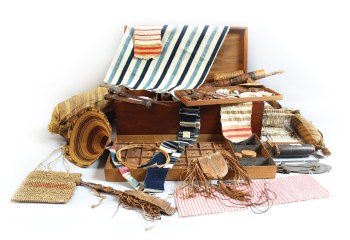
Campaign chest of abolitionist activist Thomas Clarkson, which included West African textiles and other objects that he used to argue against the slave trade. It was given to Wisbech & Fenland Museum in 1870 (Photo: Wisbech & Fenland Museum, Sarah Cousins).
Among the Nominees for Research Project of the Year:
From West Africa to Wisbech: Analysing 18th-Century Textiles in Thomas Clarkson’s Campaign Chest
Margarita Gleba (University of Padua), Malika Kraamer (University of Leicester), and Sarah Coleman (formerly Wisbech & Fenland Museum, now National Horseracing Museum), Current Archaeology, issue 383
Can the study of an abolitionist collection of West African textiles weave new threads into the story of cross-cultural contacts in the era of the Atlantic slave trade?
◊ ◊ ◊ ◊ ◊
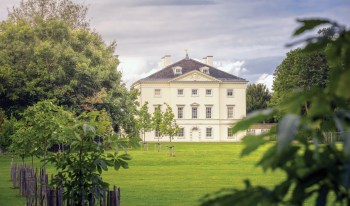
Roger Morris, Marble Hill House, Twickenham, 1724–29. As noted at Wikipedia, “the compact design soon became famous and furnished a standard model for the Georgian English villa and for plantation houses in the American colonies.” Having opened in May 2022 following the restoration, Marble Hill House is currently closed for the winter, with plans to reopen in April.
Among the Nominees for Rescue Project of the Year:
Restoring Marble Hill: How Archaeology Helped Revive a Georgian Gem
English Heritage, Current Archaeology, issue 388
Ongoing restoration work at Marble Hill in Twickenham and recent investigations of its grounds have revealed the fabric of the Georgian building alongside the story of its owner, Henrietta Howard.
HMS Invincible: Excavating a Georgian Time Capsule
Daniel Pascoe / Bournemouth University, Current Archaeology, issue 389
Investigations of the wreck of HMS Invincible, which sank off Portsmouth in 1758, have shed illuminating light on what life was like on board this 18th-century warship, and within the Georgian Royal Navy.
Lessons from Canterbury: Saving Heritage with New Approaches to Urban Development
SAVE Britain’s Heritage, Current Archaeology, issue 389
SAVE Britain’s Heritage have recommended a more historically sympathetic approach to urban development in response to the scale and height of new buildings proposed for Canterbury’s city centre.
Exhibition | Love Stories from the NPG
Now on view at The Baker Museum in Florida:
Love Stories from the National Portrait Gallery, London
Worcester Art Museum, 13 November 2021 — 13 March 2022
Amsterdam Museum in the Hermitage, 17 September 2022 — 8 January 2023
The Baker Museum, Naples, 4 February – 7 May 2023
Curated by Lucy Peltz
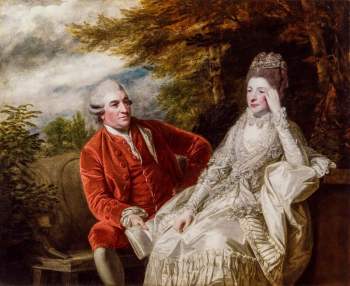
Joshua Reynolds, Portrait of David Garrick and Eva Maria Garrick, 1772–73, oil on canvas, 55 × 67 inches (London: National Portrait Gallery, purchased, 1981).
This groundbreaking exhibition presents masterpieces from the collection of the National Portrait Gallery, London, arguing that ideas of love and desire have been critical to the development of portraiture from the 16th century to the present day. Portraits provide visual records of relationships, are used to memorialize dead or absent lovers and have often been given as love tokens. Featured artists include Sir Joshua Reynolds, Angelica Kauffman, Man Ray, Lee Miller, David Hockney, and others. At the heart of this exhibition are a series of real-life love stories, from the English Renaissance to today, grouped thematically. Each of the love stories sheds light on a different aspect of romantic love and the role of portraits within it, from images that capture an artist’s obsession with their muse to those that record tragic love affairs or celebrate the triumph of love against the odds.
Love Stories from the National Portrait Gallery, London is organized by the National Portrait Gallery, London, and is curated by Dr. Lucy Peltz. The presentation of this exhibition at Artis—Naples, The Baker Museum is curated by Courtney McNeil, museum director and chief curator.
Lucy Peltz, ed., with contributions by Peter Funnell, Simon Callow, Marina Warner, Louise Stewart, and Kate Williams, Love Stories: Art, Passion & Tragedy (London: National Portrait Gallery, 2020), 231 pages, ISBN: 978-1855147034, $40.
Sweden Nationalmuseum Acquires Three Garden Views
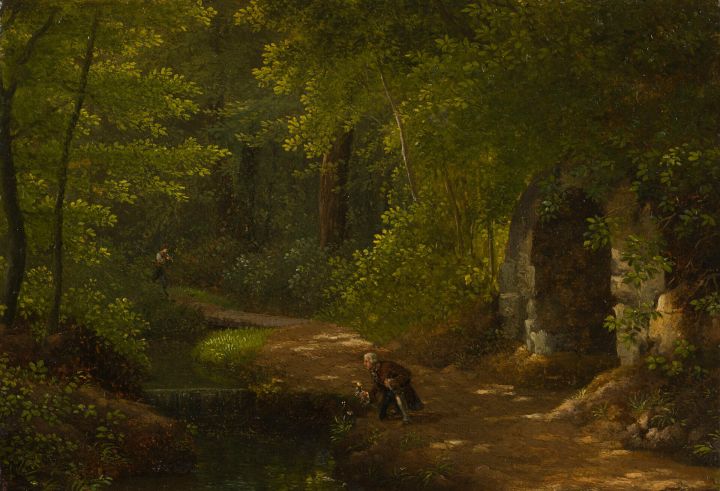
Alexandre Dunouy, Rousseau Picking Flowers near the Banc des Vieillards, View of the Park at Ermenonville, ca.1800, oil on paper mounted on canvas, 13 × 18.5 cm (Stockholm: Nationalmuseum 7607; photo by Anna Danielsson).
◊ ◊ ◊ ◊ ◊
From the press release:
Nationalmuseum has acquired three views of French gardens and parks painted in the latter half of the 18th century by Louis-Gabriel Moreau and Alexandre Dunouy. Building on the proud tradition of topographical depictions in 17th-century French art, these artists catered to the early Romantic penchant for dense foliage and picturesque dilapidation. The park at Ermenonville features in two of the paintings, one of which shows the philosopher Jean-Jacques Rousseau picking flowers.
One of Rousseau’s disciples was Marquis René-Louis de Girardin, who in 1766 began constructing a landscaped park on his estate at Ermenonville, 40 km northeast of Paris. For the marquis, landscape gardening represented a blend of art and poetry, where drawings or paintings served as patterns for creating scenic variety. For this purpose, he seems to have engaged the services of Hubert Robert, the noted painter of ruins. In the summer of 1778, as the park at Ermenonville was nearing completion, Rousseau came to visit. As fate would have it, the famous philosopher died there just three weeks later. His pupil and patron, Marquis de Girardin, seized the opportunity and arranged for Rousseau to be buried on a poplar-covered island in a sarcophagus designed by Hubert Robert. Rousseau soon became a cult figure, and many admirers made the pilgrimage to his grave, including King Gustav III of Sweden. The philosopher lay at rest in Ermenonville until France’s new republican rulers had his remains transferred to the Panthéon in Paris in 1794. Among those who sought to profit from Rousseau’s tremendous popularity was the landscape painter Alexandre Dunouy (1757–1841). One of Nationalmuseum’s two recently acquired paintings by Dunouy is an anecdotal image of the philosopher picking flowers near the Banc des vieillards in the park, which is believed to have been painted around 1800.
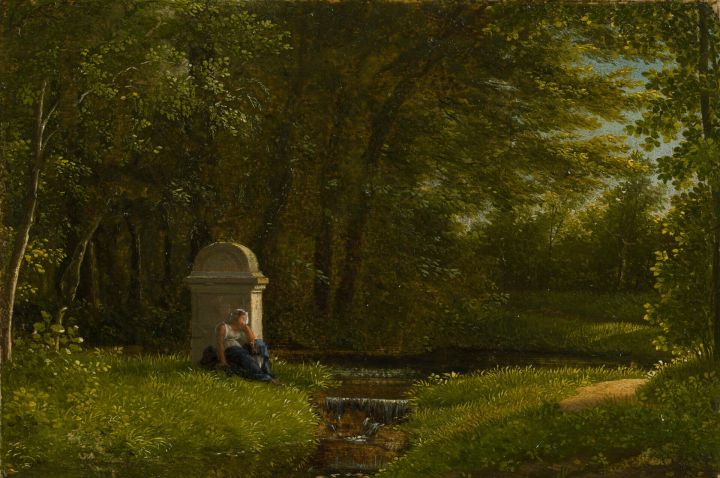
Alexandre Dunouy, La Fontaine du Bocage, View of the Park at Ermenonville, ca. 1800, oil on paper mounted on canvas, 13 × 18.5 cm (Stockholm: Nationalmuseum 7608; photo by Anna Danielsson).
◊ ◊ ◊ ◊ ◊
The second of the acquired views of Ermenonville by Dunouy depicts a spot known as la Fontaine de Bocage, a woodland grove in the section of park north of the chateau. As the painting shows, the grove was traversed by a stream, and by a small waterfall the marquis had erected an altar with a love poem by Petrarch. In Dunouy’s composition, we can see a woman resting in deep contemplation beside this diminutive monument. Despite the small scale, both here and in the image of Rousseau, the artist has managed to capture all the small details without being overly finicky. He reproduces the play of light in the branches and the reflections in the water surface using finely tuned colour values and a number of coloristic accents.
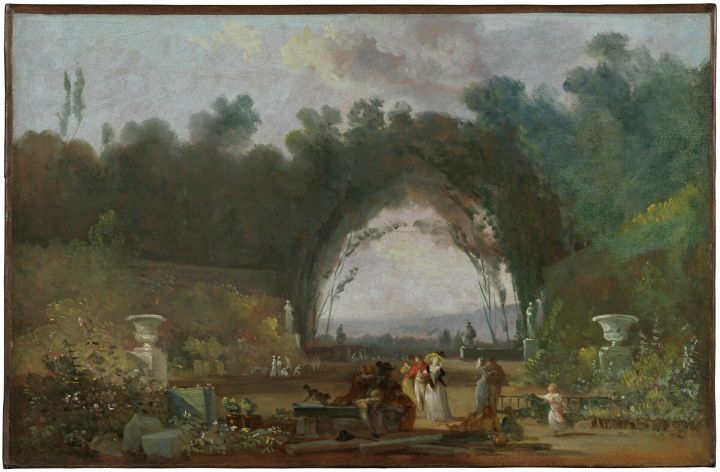
Louis-Gabriel Moreau the Elder, Terrace in the Park of Saint-Cloud, ca. 1780s, oil on paper mounted on canvas (Stockholm: Nationalmuseum 7653; photo by Anna Danielsson).
◊ ◊ ◊ ◊ ◊
Slightly older than Dunouy, Louis-Gabriel Moreau the elder (1740–1806) had specialised much earlier in painting views, especially of gardens and parks in Paris and the surrounding area. He was a pupil of another of the city’s more prominent topographical artists, Pierre-Antoine Demachy. They soon realised there was a market for motifs of this kind, either as small, delicate images on snuff boxes or as cabinet paintings. But commercially viable motifs were not a given route to election to the French academy of fine arts. Moreau made two attempts to be elected, in 1787 and 1788, but was unsuccessful because the members considered his motifs too trivial. However, he found greater favour with one of the king’s brothers, the Count of Artois, who appointed Moreau as his court painter.
Unsurprisingly, Moreau drew many of his motifs from the old royal pleasure gardens and parks, several of which were in a state of picturesque dilapidation by the late 18th century. One such place was the baroque garden at Saint-Cloud near Paris, which provides the motif for the third of Nationalmuseum’s recent acquisitions. Another version by Moreau can be found in the Louvre, likewise depicting the majestic trees in this pleasure garden which, along with the associated chateau, was sold by the Duke of Chartres to his relative King Louis XVI in 1785. The buildings were damaged in the Franco-German war of 1870 and later demolished, but the garden designed by André Le Nôtre survives to this day.
“The acquisition of Dunouy’s rare and unique depictions of Ermenonville and Moreau’s view of Saint-Cloud introduces a category of painting that was previously largely absent from the Nationalmuseum collection. And we are delighted to have the opportunity to put them on display in the exhibition The Garden: Six Centuries of Art and Nature, which opens to the public on 23 February,” said Magnus Olausson, head of collections at Nationalmuseum and exhibition curator.
Nationalmuseum receives no state funds with which to acquire design, applied art and artwork; instead the collections are enriched through donations and gifts from private foundations and trusts. The acquisition of Dunouy’s views of Ermenonville was generously funded by the Hedda and N.D. Qvist Foundation, while Moreau’s view of the Saint-Cloud park was purchased with a generous donation from the Lars Vogel bequest.
All three paintings will be on display in the exhibition The Garden from 23 February 2023 until 7 January 2024.
Exhibition | The Garden: Six Centuries of Art and Nature

Johan Johnsen, Still Life with a Bouquet of Flowers, detail, oil on canvas, 65 × 50 cm (Stockholm: National Museum, 487, bequest 1863 Marshal of the Court Martin von Wahrendorff).
◊ ◊ ◊ ◊ ◊
Opening this month at Sweden’s Nationalmuseum:
The Garden: Six Centuries of Art and Nature
Trädgården: Konst och natur under sex sekler
Nationalmuseum, Stockholm, 23 February 2023 — 7 January 2024
On display throughout 2023 at the Nationalmuseum, The Garden: Six Centuries of Art and Nature explores how gardens have been portrayed in art. Visitors will experience nearly 300 paintings, drawings, applied art, and sculpture by artists such as Watteau, Boucher, Oudry, Le Nôtre, Monet, and Carl Larsson and, from contemporary times, Peter Frie and Emma Helle.
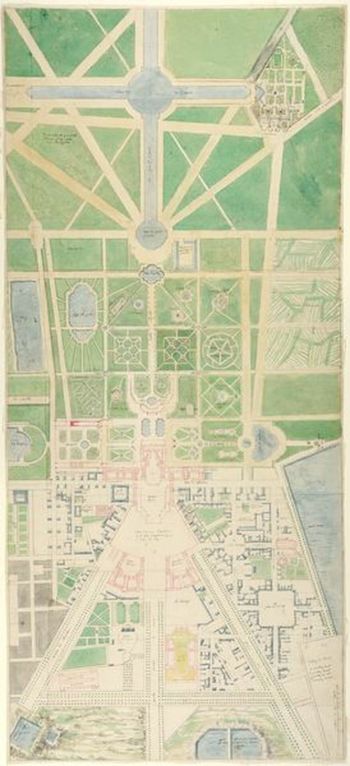
Jean II Le Blond, Versailles, Large Plan of the Château, Town, Gardens, and Surroundings, ca 1687, pen and black ink, grey wash, and watercolour, on paper, 128 × 57 cm (Stockholm: Nationalmuseum, NMH THC 1, transferred in 1866 from Kongl. Museum).
The exhibition takes the form of a grand tour showing how gardens have been portrayed in art, often walking the line between culture and nature. Garden art has always involved living materials: nature itself and the changing seasons. This makes it a dynamic artform—transforming, dying, and renewing in line with the natural cycle.
A garden, whether artful or utilitarian, is not the same thing as nature. It has always been consciously designed in accordance with particular ideas and plans. Ultimately, the garden can be seen as a desire to recreate Paradise. The square, geometric quarters of a Renaissance garden with a fountain in the middle were one expression of this desire. Likewise, baroque pleasure gardens could be seen as a way of restoring what was lost in the fall of man. On the drawing board, God’s creation would be resurrected with the aid of compasses and rulers. Geometry and optics would then translate the architect’s vision into practice.
A complete reappraisal occurred in the 18th century, when humanity suddenly realised that it could be a danger to nature. The dark forests and rugged mountains were no longer considered threatening. Virgin nature, yet to be exploited by mankind, was the new ideal influencing landscape architecture. Eventually, though, the toytown scale and artificial character were perceived as so comical that art and nature went their separate ways after 1800—a distinction that has endured. However, many of the questions raised throughout history about mankind’s relationship with art and nature have persisted and recurred. This is clearly apparent in contemporary art, where both Paradise and the threat to nature are ever present themes.
The relationship between art and nature is central to the exhibition. The introductory section, devoted to the myth of Paradise, occupies a large gallery of its own, lined with cabinets containing the various natural elements as reflected in the artworks. Similarly, the artificial garden forms the focus of the second large gallery, covering the period from the Renaissance to the present day. This gallery is surrounded by smaller exhibition rooms featuring individual design forms ranging from caves to ruins. At the centre of all this is a section covering the human presence in the garden.

Olof Fridsberg, A Huge Pumpkin, 1757, oil on canvas, 89 × 104 cm (Stockholm: National Museum, 7007, Acquisition Gåva 2001 av Nationalmusei Vänner).
As an example of contemporary interpretations, we have invited the artist Peter Frie to take part in the exhibition. Known as a painter of dreamlike landscapes, Frie has created a series of bronze sculptures of trees, having progressed from painting to a three-dimensional format. Trees of various sizes are presented as an installation in dialogue with the historical material on landscape and gardens. Emma Helle, another contemporary artist invited to take part, works in ceramics and draws inspiration from sources such as classical mythology. Her decorative and colourful, almost baroque works take us on a fanciful journey through the history of myth and literature. Helle has also created two new works especially for Nationalmuseum’s exhibition as a commentary on the theme of Paradise.
The majority of the almost 300 exhibits come from Nationalmuseum’s own collections, but the exhibition also includes important pieces on loan, in order to give a complete picture of the garden as a phenomenon. A catalogue with a series of in-depth articles will be published to coincide with the exhibition.
Exhibition | The Mysterious Peter Adolf Hall
Opening this spring at Sweden’s Nationalmuseum :
The Mysterious Peter Adolf Hall: A Swedish Miniature Painter in 18th-Century Paris
Mysteriet Peter Adolf Hall: En svensk miniatyrmålare i 1700-talets Paris
Nationalmuseum, Stockholm, 23 March — 25 June 2023
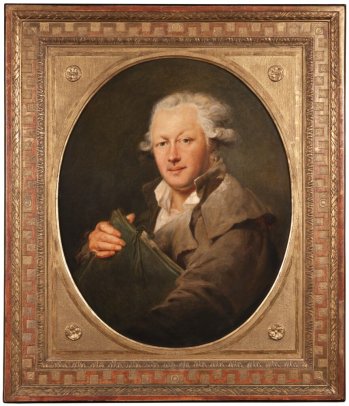
Peter Adolf Hall, Self-portrait, 1780, oil on canvas, 71 × 58 cm (Stockholm: National Museum 7091, gift of Gunvor Svartz-Malmberg).
During the spring and early summer 2023, Nationalmuseum presents an exhibition on Peter Adolf Hall, a Swedish artist, who revolutionised the art of miniature portraits in Paris in the latter half of the 18th century. The exhibition includes some 70 portrait miniatures from the museum’s collection, both by Hall himself and some of his followers.
Based on the museum’s miniatures collection, Nationalmuseum is to present an exhibition on the Swedish artist Peter Adolf Hall, who revolutionised the art of miniature portraits in the French capital in the latter half of the 18th century. Born in Borås, Hall studied in Stockholm under the pastel painter Gustaf Lundberg. This offers a clue as to how Hall came by his innovative miniature painting technique, but how he learned or developed this art form, remains a mystery.
When Hall arrived in Paris in 1766, he was already a fully fledged miniature portraitist, with a particular talent for reproducing the finish of garment fabrics. This was to become something of a trademark. He used relatively thick layers of watercolour in relief, a technique known as impasto, to create the illusion of reflected light on various materials, especially textiles. Folds were emphasised with wide brushstrokes and lines. Another revolutionary feature of Hall’s free style was the way he depicted a glowing skin by taking advantage of the ivory on which miniatures were painted and allowing it to shine through a thin, transparent layer of watercolour paint.
In 1767, a mere year after his arrival, Hall received a royal commission. Two years later he became an associate member of the French academy of fine arts, but he never applied for full membership as expected of him. He was so secure in his success that he clearly felt no need to devote time to producing a reception piece in order to become a full member. Besides his artistic talent and skill, there was another reason for Hall’s rapid progress in Paris: he was an adept social climber.
The exhibition traces how Hall’s painting style changed over the years. The colour palette became warmer, and the subjects were portrayed more freely. In the 1780s he enjoyed great success, was incredibly productive and made a lot of money. Perhaps out of a desire to please his subjects, Hall eventually developed a somewhat affected style which meant that, in particular, all the women in his portraits looked alike. The French Revolution put an abrupt end to all this. Hall’s patrons left the country, and he went too. He departed for Brussels in May 1791 and died two years later in Liège.
Although Hall’s style of portraiture did not survive the French Revolution, his innovative miniature paintings influenced several of his younger French contemporaries. The exhibition includes some 70 portrait miniatures from the museum’s collection, both by Hall himself and some of these followers who were heavily influenced by his mastery of free style.
The exhibition will be on show for a few months in the spring and summer of 2023, adjacent to the Treasury on the middle floor of Nationalmuseum. It will form a thematic extension to the permanent exhibition of pieces from the museum’s miniatures collection, which is the world’s largest. This collection comprises 5,700 miniatures, mainly portraits, by Swedish and European artists from the 16th to the mid 20th century. The Treasury houses 1,170 small works of significance, the majority of which are miniature portraits.
Amanda Dotseth Named Director of SMU’s Meadows Museum
From the press release (10 February 2023) . . .

Amanda W. Dolseth (Photo by Tamytha Cameron).
SMU has named Amanda W. Dotseth Linda P. and William A. Custard Director of the Meadows Museum. Dotseth, who will be the first female director of the Meadows Museum, served as the director ad interim and curator of the Museum since the passing of its previous director, Mark A. Roglán, in 2021. Dotseth assumes the role on 1 March 2023.
“As a scholar, collaborator, and arts leader, Amanda Dotseth brings a unique understanding of the important mission and role of the Meadows Museum,” said SMU President R. Gerald Turner. “In addition, her many years as curator, then interim director has prepared her to position the Museum for the future while understanding its legacy.”
In her combined 19 years of experience with the Museum, Dotseth published extensively on Spanish art, contributed to and curated more than 30 exhibitions, and oversaw the acquisition of major additions to the Meadows collection. Notably, Dotseth was an instrumental participant in the early development of the historic partnership between the Meadows Museum and Madrid’s Museo Nacional del Prado in 2009, in which the Prado loaned three major paintings and exchanged curatorial fellows between the institutions. She played an integral role in the pioneering collaboration with Fundación ARCO in 2019 as well. By initiating and cultivating partnerships with international art institutions from the Rijksmuseum and National Gallery of Ireland to the Museo del Traje in Madrid and the Museo del Arte Abstracto Español (Fundación Juan March), Dotseth has expanded the reach and profile of the Meadows Museum and of SMU. Dotseth’s existing partnerships with academic and art institutions around the world, including the Spanish National Research Council, will be a tremendous asset for the Museum as she continues its mission to advance the knowledge, understanding and appreciation of the arts and culture of Spain in the US.
In addition to her nearly two decades with the Museum, Dotseth is also an alumna of SMU Meadows School of the Arts, receiving her master’s degree in art history from the University in 2006. She later completed her Ph.D. at the Courtauld Institute of Art (University of London) in medieval Spanish art in 2015.
“After an extensive international search, I am thrilled that the best person to serve as the next director of the Meadows Museum is an extremely accomplished member of the SMU Meadows community,” said Samuel S. Holland, Algur H. Meadows Dean for SMU Meadows School of the Arts. “I look forward to seeing the new directions in which Dr. Dotseth will take the Museum, through her collaborative and innovative leadership, and strong curatorial voice.”
“The Meadows Museum has been a part of my professional DNA for two decades; to now be at the helm of the institution as the Linda P. and William A. Custard Director during the next phase of the museum’s life is a great honor,” said Dotseth. “I look forward to building upon and expanding the Museum’s existing strengths as we reach out to the next generation of scholars, students, and museum-goers.”
The Meadows Museum is the leading U.S. institution focused on the study and presentation of the art of Spain. In 1962, Dallas businessman and philanthropist Algur H. Meadows donated his private collection of Spanish paintings, as well as funds to start a museum, to Southern Methodist University. The museum opened to the public in 1965, marking the first step in fulfilling Meadows’s vision to create “a small Prado for Texas.” Today, the Meadows is home to one of the largest and most comprehensive collections of Spanish art outside of Spain. The collection spans from the 10th to the 21st centuries and includes medieval objects, Renaissance and Baroque sculptures, and major paintings by Golden Age and modern masters.
Call for Articles | Spanish Royalty in Naples, 1598–1713
From ArtHist.net:
Spanish Royalty in Naples: Between Art and Architecture, 1598–1713
Edited by Laura García Sánchez
Proposals due by 28 February 2023; final papers due by 31 August 2023
The series Temi e frontiere della conoscenza e del progetto (Themes and Frontiers of Knowledge and Design), published by ‘La scuola di Pitagora’ and edited by prof. Ornella Zerlenga of the University of Campania ‘Luigi Vanvitelli’ in Italy, is launching a call for papers for a forthcoming open access volume entitled Reali spagnoli a Napoli: fra arte e architettura (1598–1713), edited by Prof. Laura García Sánchez, lecturer at the Department of Art History of the University of Barcelona. The series, multidisciplinary in nature, includes volumes that propose a critical reflection on architecture, the city, the environment, and industrial design, investigating disciplinary sources and cultural trends with a focus on the themes of form, structure, innovation, representation, and communication.
The broad scope of the proposed theme allows for a transversal look at the figure of the Viceroy and his closest collaborators and relatives as authentic protagonists of an interesting historical and artistic period. During this period, Naples was not only one of the most prosperous cities in Italy but also one of the largest in Europe and an investment for the Spanish monarchs that dominated it. This unique metropolis had a Spanish presence that lasted four centuries. Traces can still be seen today in the layout of its streets, in some of the city’s most representative monuments as well as the habits and customs of the Neapolitans. This relationship gave rise to one of the city’s most mythical neighbourhoods, the Quartieri Spagnoli, which was founded in the 16th century to house the Spanish military garrisons during the period of the Aragonese’s struggle with the French who, like the Spanish, wanted to take control of the city. Once the war was over, a relatively quiet secular rule began during which Spanish proxies remodelled Naples. The chronology of the volume spans the long period between the reign of Philip III (1598) and the end of the War of the Spanish Succession (1713), a stage in which the figure of the Viceroy was decisive for many reasons in that he not only exercised the administrative and governing function as representative of the Spanish monarchy, but also played an important role in promoting the cultural activities of what was called the Spanish Siglo de Oro and which, in other words, represented the Baroque language par excellence.
In the territories of the Hispanic monarchy, the Viceroys, as alter egos of the king and therefore of noble lineage, travelled frequently. The office or ‘job’ usually lasted from three to six years. During this stay in Naples, the incumbent controlled not only the economic resources, which allowed him to build a residence and surround himself with the most famous artists, thus increasing the prestige of the crown. The Viceroys were not only faithful deliverers of the political power of the kings but also played the role of patrons of the arts, so much so that during the 17th century, it is possible to recognise a significant influence of Naples in Spain through their work. Many of the works that today are exhibited at the Prado Museum in Madrid were sent to Spain by the Viceroys as gifts for the king or, on specific commission, to decorate the royal palaces.
The role of the wives of viceroys is also interesting in this cultural exchange. Women did not possess property titles but did accompany their husbands, which, for example, was not possible for those governing Latin America. This made the role of the vicereine very active in the Kingdom of Naples. Their participation in public ceremonies aroused much interest, helping to consolidate Spanish power in the city.
Original and unpublished contributions are favoured with a focus on the relations between Naples and Spain during the period indicated; without excluding other topics, the following themes are proposed:
• The Viceroys’ journey to Naples: methods; route to Italy; length of stay in Naples; entourage (family, secretaries, servants); trousseaux; gifts to Neapolitan dignitaries.
• Contact with local artists: patronage networks.
• The Spanish influence on Neapolitan religion and beliefs.
• The Vicereine: the role of the wife between interests and influence on locals.
• The Viceroys’ collections: interests; preferences; influence on Spanish artists.
• Investments in public works to demonstrate Spanish power and the expansion of the Hispanic monarchy in Italy: the reform of urban spaces (creation of fountains; squares; etc.).
• The Viceroys and the stories of their return from Spain and vice versa.
• The return of the Viceroys to Spain: construction of palaces and convents; collection of works of art and books from the Kingdom of Naples.
• Founding of convents as family ‘pantheons’, to which the Viceroys donated many Italian works of art.
• Stories of travellers and travel descriptions.
• Representation of the Viceroys in art.
• The Viceroys as seen by the Neapolitan nobility and people.
• The Spanish influence on the architecture of the Kingdom of Naples.
To submit a proposal, please send the provisional title and an abstract of no more than 3,000 characters (including spaces). The material must be sent by 28 February 2023 to ornella.zerlenga@unicampania.it and laura.garcia@ub.edu. The authors of the selected abstracts will be contacted by 31 March 2023, after which the editorial guidelines for the text and images of the paper will be sent by email. Papers must be written between 15,000 and 30,000 characters (including spaces) by 31 August 2023 and sent to the above-mentioned email addresses.
Volumes published in this series will be pre-screened by at least two members of the Scientific Committee, who will assess whether the contribution responds to the research lines of the Series, whether it is based on an adequate bibliographical analysis related to the proposed theme, and whether it offers a careful examination of the sources and/or current trends with respect to the proposed theme. Once this preliminary assessment has been passed, the paper will be submitted to the international Double-blind Peer Review criterion and sent to two anonymous reviewers, at least one of whom must be external to the Scientific Committee. The reviewers, i.e., professors and researchers of recognised competence in the specific fields of study and belonging to various Italian and foreign universities and research institutes, constitute the Refereeing Committee. The list of anonymous reviewers and refereeing procedures is available to national and international scientific assessment bodies.
Texts in Italian, French, Spanish and English are accepted. Translation into English is also required for those submitted in Italian, French and Spanish.
Research Lunch | Anna Jamieson on Topographical Asylum Prints
From the Mellon Centre:
Anna Jamieson | Viewing Virtually and Learning to Look: The Topographical Asylum Print
Paul Mellon Centre for Studies in British Art, London, 17 March 2023, 1pm

T. H. Shepherd, St Luke’s Hospital, Cripplegate, London, 1815, engraving (London: Wellcome Collection).
By the final decades of the eighteenth century, asylums and hospitals had become mainstays of England’s philanthropic tourist circuit. Providing visitors with the opportunity to interact with human suffering, asylums were uniquely placed to encourage and facilitate the display of humanity deemed socially appropriate during this period.
For the educated elite engaged in philanthropic tourism, the asylum was often first encountered via the topographical print. Analysing a range of prints that depict asylum exteriors and their environs, this talk argues that these prints played an important role in shaping first impressions before a tour, guiding tourists in ways to look and behave in these unique and unsettling spaces. It demonstrates that viewing topographical prints prior to a visit evoked one’s social status, in that they characterised asylums as polite and esteemed destinations only accessible to the elite classes. At the same time, the talk suggests that topographical prints were designed to intrigue and titillate guests, with painters and printmakers employing unusual perspectives or fragmentary scenes to pique the interest of the visitor and provide a tantalising glimpse of life behind the asylum façade.
Book tickets here»
Anna Jamieson is an interdisciplinary art historian, a postdoctoral fellow at the Paul Mellon Centre, and an associate lecturer at Birkbeck, University of London. Anna specialises in visual and material cultures of the late eighteenth and early nineteenth century, with a particular interest in women’s mental illness; the cultural history of psychiatry; and dark tourism. She is currently writing her first monograph, The Gaze of the Sane: Asylum Tourism in England, 1770–1845. She is co-director of Birkbeck’s Centre for Museum Cultures and a member of the steering committee for Birkbeck’s Centre for Interdisciplinary Research on Mental Health. Anna’s research has been published in Eighteenth-Century Studies and Journal for Eighteenth-Century Studies, and her co-edited volume, Pockets, Pouches and Secret Drawers is forthcoming with Brill (2023). She is an associate editor for the medical humanities website The Polyphony and tweets at @annafranjam.
Research Lunch | Deepthi Bathala on Crop Trials and Tropicality in India
From the Mellon Centre:
Deepthi Bathala | Plantation Failures, Famine Crops, and Contesting Tropicality: Trials of the Calcutta Botanic Garden in the Early Nineteenth Century
Paul Mellon Centre for Studies in British Art, London, 10 March 2023, 1pm

“The Physical Geography of India and the Botanical Provinces 1855,” published in Joseph Dalton Hooker and Thomas Thomson, Flora Indica: Or Description of Indian Plants (1855; image from the Biodiversity Heritage Library).
In the late eighteenth century during a famine in British India, the Botanical Garden in Calcutta emerged as a response to the crisis. Envisioned as an institution of agricultural improvement, the garden sought to mobilise and introduce climatically suitable crops from various parts of the world for what was understood to be the tropical climate in India. In a quest to introduce famine crops such as wheat and potatoes from the Cape along with plantation crops like coffee, teak, and mulberry, horticulture, along with plantation trials, were administered at the same time both within and outside the garden compound. This paper discusses the plantation and horticultural trials of the Botanic Garden and their subsequent failures in the early nineteenth century to argue that these experiments were integral to contesting the preconceived tropicality of India. These failures determined not only the agricultural landscape of the country but also dictated the siting of other botanical gardens through the production of new climate knowledge in relation to the plants that grew, thrived, or failed. By using maps of the garden, rough sketches of early plantation grounds, and correspondence letters between officials of the garden and the company, the paper illustrates how the officials and affiliates of the garden produced an imaginary climate for British India contesting the tropicality of India while at the same time transforming its landscape in the early nineteenth century.
Book tickets here»
Deepthi Bathala is a PhD candidate in Architecture (History/Theory) at the University of Michigan. Her research interests include environmental histories of the built environment at the intersection of colonialism, climate knowledge, and horticulture. Her research is being supported by the Paul Mellon Center for Studies in British Art, London; Oak Spring Garden Foundation, Virginia; Society of Architectural Historians; and the Rackham Graduate School at the University of Michigan. She has a MSArch in Architecture History and Theory from the University of Washington in Seattle, and a BArch from the College of Engineering Trivandrum, Kerala University in India.
New Book | Making Worlds: Global Invention in the Early Modern Period
From Toronto UP:
Angela Vanhaelen and Bronwen Wilson, eds., Making Worlds: Global Invention in the Early Modern Period (Toronto: University of Toronto Press, 2022), 512 pages, ISBN: 978-1487544935, $95.
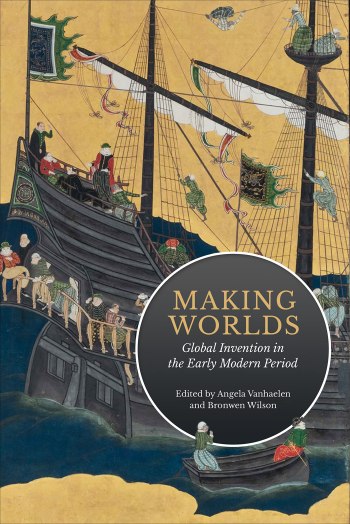 Taking into account the destructive powers of globalization, Making Worlds considers the interconnectedness of the world in the early modern period. This collection examines the interdisciplinary phenomenon of making worlds, with essays from scholars of history, literary studies, theatre and performance, art history, and anthropology. The volume advances questions about the history of globalization by focusing on how the expansion of global transit offered possibilities for interactions that included the testing of local identities through inventive experimentation with new and various forms of culture. Case studies show how the imposition of European economic, religious, political, and military models on other parts of the world unleashed unprecedented forces of invention as institutionalized powers came up against the creativity of peoples, cultural practices, materials, and techniques of making. In doing so, Making Worlds offers an important rethinking of how early globalization inconsistently generated ongoing dynamics of making, unmaking, and remaking worlds. The volume is part of the UCLA Clark Memorial Library Series.
C O N T E N T S
List of Illustrations
Acknowledgments
1. Introduction — Angela Vanhaelen and Bronwen Wilson
Part One: Material Flows
2 The Early Modern Fold: Pleated Media in Japan’s Encounter with Europe — Kristopher Kersey
3 From Textile to Text: Cloth, Slavery, and the Archive in the Dutch Atlantic —Carrie Anderson
4 Drawing Worlds in Smoke, Powder, and Fumes: Bodies and Trifles in Il Tabacco, the Courtly Ballet Staged in Turin (1650) — Elisa Antonietta Daniele
5 From Hot Reverence to Cold Sweat: Christian Art and Ambivalence in Early Modern Japan — Benjamin Schmidt
6 Eggs, Cheese, and (Francis) Bacon — Helen Smith
Part Two: In-Between Spaces
7 The Cabinet and the World: Non-European Objects in Early Modern European Collections — Daniela Bleichmar
8 Le Jeu du monde: Games, Maps, and World Conquest in Early Modern France — Ting Chang
9 The World Contained in an Imperial Ottoman Album — Emine Fetvaci
10 World Building, the Folger Folios, and the University of British Columbia — Patricia Badir
Part Three: Other Worlds
11 Ascetic Ecology: Landscape of a Desert Saint — Lyle Massey
12 The End of All: Worldliness, Piety, and the Social Life of Maps in the Post-Reformation English Household — Gavin Hollis
13 Enlightenment Cosmology: A Medialogical Interpretation — J.B. Shank
14 Masked Alliances: Global Politics and Economy in the Art and Performance Rituals of Mexico’s Indigenous People — John M.D. Pohl and Danny Zborover
15 Unease with the Exotic: Ambiguous Responses to Chinese Material Culture in the Dutch Republic — Thijs Weststeijn
Contributors
Index










 Enfilade
leave a comment