New Book | Chinese Rank Badges
Distributed by The University of Chicago Press:
David Hugus, Chinese Rank Badges: Symbols of Power, Wealth, and Intellect in the Ming and Qing Dynasties (Hong Kong University Press, 2022), 280 pages, ISBN: 978-9627956457, $65.
 Both utilitarian objects and examples of textile design of wondrous beauty, Chinese rank badges were developed in the Ming and Qing dynasties to indicate the bearer’s station in the civil or military bureaucracies. David Hugus centers his study on their chronology and iconography, accompanying his work with beautiful color illustrations. Beginning with the earliest dynastic period to the end of the imperial period, and beyond to the present day, Hugus’s analyses of the style and iconography of Chinese rank badges provide the reader with the tools to recognize the circumstances of individual badge design and to develop a basis for connoisseurship.
David Hugus is a longtime collector of Chinese rank badges. He is the co-author of Ladder to the Clouds.
New Book | The Full-Length Mirror
Distributed by The University of Chicago Press:
Wu Hung, The Full-Length Mirror: A Global Visual History (London: Reaktion Books, 2023), 288 pages, ISBN: 978-1789146103, $35.
 Beautifully illustrated, a stirring and wide-ranging reflection on art, technology, culture—and the full-length mirror.
This book tells two stories about the full-length mirror. One story, through time and space, crisscrosses the globe to introduce a broad range of historical actors: kings and slaves, artists and writers, merchants and craftsmen, courtesans, and commoners. The other story explores the connections among objects, painting, and photography, the full-length mirror providing a new perspective on historical artifacts and their images in art and visual culture. The Full-Length Mirror represents a new kind of global art history in which ‘global’ is understood in terms of both geography and visual medium, a history encompassing Europe, Asia, and North America, and spanning over two millennia from the fourth century BCE to the early twentieth century.
Wu Hung is the Harrie A. Vanderstappen Distinguished Service Professor, director for the Center for the Art of East Asia, and consulting curator at the Smart Museum of Art, all at the University of Chicago.
C O N T E N T S
Prelude A Prehistory of the Full-Length Mirror
Part One: Object and Reflection
1 From Versailles to the Forbidden City: The Global Invention of the Full-Length Mirror
2 From the House of Green Delights to the Hall of Mental Cultivation: Mirror-Screens in the Literary and Visual Imagination
Part Two: Medium and Subjectivity
3 From Europe to the World: The Global Circulation of Full-Length Mirror Photography
4 From Iconography to Subjectivity: Discovering the Self in the Full-Length Mirror
Coda: Disenchantment of the Full-Length Mirror
References
Select Bibliography
Photo Acknowledgments
Index
Lectures | John Finlay and Kristel Smentek on China and France
From BGC:
John Finlay and Kristel Smentek | China and France in the Intercultural 18th Century
Bard Graduate Center, New York, 19 April 2023, 6.00pm
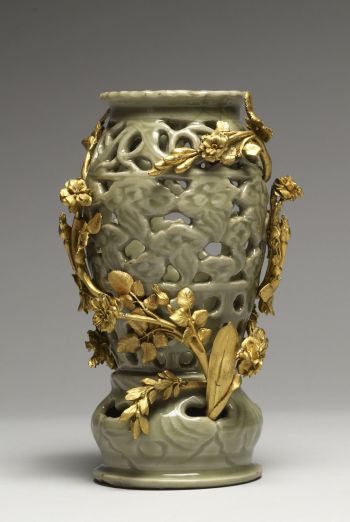
Long Quan celadon lamp, 15th–16th century, Ming dynasty, porcelain, with French gilt mounts, mid-18th century, gilt bronze (Baltimore: The Walters Art Museum, 49.1508).
A Françoise and Georges Selz Lecture Duet on Eighteenth- and Nineteenth-Century French Decorative Arts and Culture with John Finlay and Kristel Smentek. In this pairing of mini-lectures, scholars John Finlay and Kristel Smentek offer complementary views on arts and intercultural exchange between France and China in the eighteenth century.
John Finlay | Henri Bertin and the Representation of China in 18th-Century France
The role of Henri-Léonard Bertin (1720–1792), who served as a minister of state under Louis XV, is crucial to understanding the encounters between China and France in the eighteenth century. Bertin first established his contact with the French Jesuits in Beijing through two Chinese Catholic priests, Aloys Ko and Étienne Yang. When the missionaries returned to China in 1765, they took with them an important set of gifts to be presented to the Qianlong emperor. Not to be misconstrued as tribute from France to China, these gifts were intended to stimulate Chinese interest in French culture and French artistic production.
Kristel Smentek | Disorienting China: Negotiating the Foreign in 18th-Century France
As European trade with the Qing empire accelerated in the eighteenth century, France was flooded with objects from China whose technologies, materials, and motifs challenged European understanding. These ranged from the lacquers and porcelains with which historians are familiar, to scroll paintings, bronzes, and worked jades whose presence in eighteenth-century Europe is far less studied. This talk investigates the display and material alteration of Asian imports in France and the design of new objects in response to them—strategies by which the French negotiated the pleasures and disorientations of China’s arts.
Formerly a curator of Chinese art, John Finlay is an independent scholar based in Paris, affiliated with the Centre d’Études sur la Chine Moderne et Contemporaine (CECMC). He began his academic career studying paintings and prints produced for the Qing imperial court in the eighteenth century. His current research focuses on Henri-Léonard Bertin (1720–1792), who served as a minister of state under Louis XV. His passion for all things Chinese placed him at the center of intersecting networks of like-minded individuals who shared his vision of China as a nation from which France had much to learn.
Kristel Smentek is associate professor of art history in the Department of Architecture at MIT. Her research focuses on eighteenth-century European graphic and decorative arts in their transcultural contexts. She is the author of Mariette and the Science of the Connoisseur in Eighteenth-Century Europe (2014), co-curator of Dare to Know: Prints and Drawings in the Age of Enlightenment recently on view at the Harvard Art Museums, and co-editor of its accompanying catalogue. She is currently completing Disorient: Arts from China in Eighteenth-Century France, a book investigating French responses to Chinese imports over the course of the long eighteenth century.
Registration is available here»
New Book | In Asian Waters
From Princeton UP:
Eric Tagliacozzo, In Asian Waters: Oceanic Worlds from Yemen to Yokohama (Princeton: Princeton University Press, 2022), 512 pages, ISBN: 978-0691146829, £30 / $35.
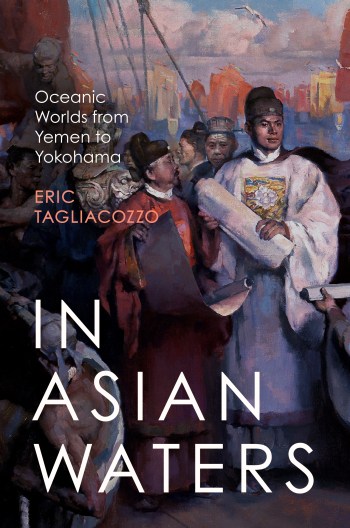 A sweeping account of how the sea routes of Asia have transformed a vast expanse of the globe over the past five hundred years, powerfully shaping the modern world.
In the centuries leading up to our own, the volume of traffic across Asian sea routes—an area stretching from East Africa and the Middle East to Japan—grew dramatically, eventually making them the busiest in the world. The result was a massive circulation of people, commodities, religion, culture, technology, and ideas. In this book, Eric Tagliacozzo chronicles how the seas and oceans of Asia have shaped the history of the largest continent for the past half millennium, leaving an indelible mark on the modern world in the process. Paying special attention to migration, trade, the environment, and cities, In Asian Waters examines the long history of contact between China and East Africa, the spread of Hinduism and Buddhism across the Bay of Bengal, and the intertwined histories of Islam and Christianity in the Philippines. The book illustrates how India became central to the spice trade, how the Indian Ocean became a ‘British lake’ between the seventeenth and nineteenth centuries, and how lighthouses and sea mapping played important roles in imperialism. The volume ends by asking what may happen if China comes to rule the waves of Asia, as Britain once did. A novel account showing how Asian history can be seen as a whole when seen from the water, In Asian Waters presents a voyage into a past that is still alive in the present.
Eric Tagliacozzo is the John Stambaugh Professor of History at Cornell University. His books include Secret Trades, Porous Borders: Smuggling and States along a Southeast Asian Frontier, 1865–1915 and The Longest Journey: Southeast Asians and the Pilgrimage to Mecca.
The table of contents is available here»
Exhibition | Across Shared Waters
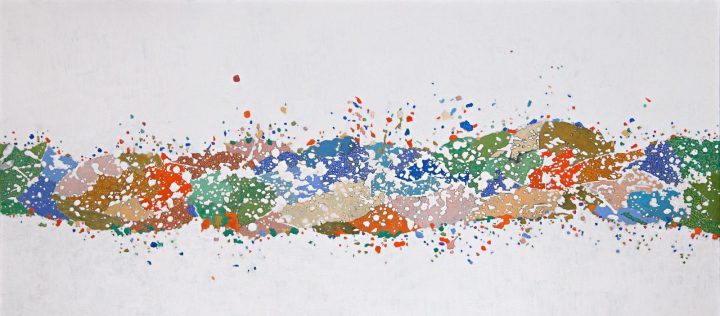
Pema Rinzin, Abstract Sound #4, 2010, ground mineral pigment on wooden panel. Rinzin was born in 1966 in Tibet; studied in Dharamsala, India; lived and worked in Nagano, Japan and Wurzburg, Germany; and now lives and works in New York City.
◊ ◊ ◊ ◊ ◊
From the press release for the exhibition:
Across Shared Waters: Contemporary Artists in Dialogue with Tibetan Art from the Jack Shear Collection
Williams College Museum of Art, Williamstown, Massachusetts, 17 February — 16 July 2023
Organized by Ariana Maki, with Elizabeth Gallerani and Nicholas Liou, with research support from Priya Rajbhandary and Tibetan translation by Rongwo Lugyal
The Williams College Museum of Art (WCMA) is delighted to present Across Shared Waters: Contemporary Artists in Dialogue with Tibetan Art from the Jack Shear Collection, on view from 17 February through 16 July 2023. Much as the headwaters of Asia’s major rivers form in the Tibetan plateau and flow into the world’s seas, interest in Tibetan art and culture has circulated globally, inspiring artists within Tibetan regions and throughout the world. Across Shared Waters presents works by 11 contemporary artists of Himalayan heritage alongside traditional Tibetan Buddhist rolled paintings, or thangka, from the Jack Shear Collection, a juxtaposition that highlights the richness and diversity of Tibetan artistic expression and fosters greater understanding and appreciation of Himalayan histories and identities.
 Traditional works in Across Shared Waters are part of a generous initiative by collector Jack Shear to foster collaboration among the art museums of Williams, Skidmore, and Vassar Colleges. The paintings and other objects comprising the gift will be used for education, research, and informed display. Across Shared Waters is the second in a series of exhibitions of the Jack Shear Collection of Tibetan Art. The first, Mastery and Merit: Tibetan Art from the Jack Shear Collection, was on view at the Loeb Center at Vassar College in the spring and summer of 2022. The third exhibition will be on view at the Tang Teaching Museum at Skidmore College beginning in August 2023.
The WCMA exhibition is organized by guest curator Ariana Maki, the Associate Director of the University of Virginia Tibet Center and Bhutan Initiative, with Elizabeth Gallerani, Curator of Mellon Academic Programs, and Nicholas Liou, Mellon Curatorial Fellow and MA ’24, along with research support from Curatorial Intern Priya Rajbhandary ’25. Tibetan translation is provided by Rongwo Lugyal.
Pamela Franks, Class of 1956 Director of WCMA, said, “The Williams College Museum of Art is thrilled to participate in this visionary, collaborative approach that engages three leading liberal arts colleges and expands our collective research and teaching capacities to appropriately present this important work. This initiative highlights WCMA’s ongoing commitment of both sharing the art itself and collaborating across institutions to strengthen the pedagogical approaches and research resources within our teaching museum. I am so grateful to Jack Shear, our colleagues at the Skidmore and Vassar museums, and for the engaged scholarship of guest curator Ariana Maki throughout the development of these three exhibitions. We look forward to collaboration long into the future.”
“The Shear Collection provides remarkable examples of traditional Tibetan Buddhist art and its wide range of uses and meanings,” Maki said. “As the academic approach to Buddhism is generally text-focused, the paintings and 3-D objects from Shear offer faculty an incredible set of resources to further enrich their courses and help broaden student understanding of Buddhist practices. Displaying these works allows everyone direct access to better study and appreciate how historical artists masterfully gave form to highly sophisticated philosophical principles.
“It’s exciting to experience the traditional works alongside contemporary paintings and photography. The juxtaposition reflects the innovations and incredible creativity of Himalayan makers, whose works invite us into their lived experiences and challenge us to consider issues that both impact them as individuals and all of us as members of a global society,” Maki said.
Created between the 18th and 20th centuries, the thangka feature elaborate depictions of Buddhist narratives, deities, and practices. Talented, highly trained artists produced engaging scenes detailing the lives of the Buddha, chronicled incarnation lineages, and transmitted teaching stories. Some works would be used by initiates to support advanced meditation techniques while others depict deities who aid Buddhist practitioners with everyday concerns, granting blessings of wealth, long life, protection, or healing.
The traditional thangka are displayed in conversation with contemporary works by featured artists based around the world, including Marie-Dolma Chophel, Dedron, Nyema Droma, Gonkar Gyatso, Tenzin Norbu Lama, Kesang Lamdark, Tashi Norbu, Karma Phuntsok, Pema Rinzin, Rabkar Wangchuk, and Palden Weinreb. While some draw inspiration from Tibetan cultural markers, including repurposing or reimagining Buddhist imagery, others source inspiration completely outside those frames. Exploring themes of identity, consumerism, place, and cultural expectations, the artists employ a diverse range of media, from ground mineral pigments to acrylic paint, digital photography, mixed media works, and resin cast sculptures.
A complete press kit including images can be found here»
Poster Images Left: Lama Tashi Norbu, Accepting Flowers’ Culture, 2013, mixed media (Shelley and Donald Rubin Private Collection). Norbu was born 1974 in Jigmenang, Bhutan, studied in Dharamsala, India and Ghent, Belgium; and now lives and works in Emmen, The Netherlands.
Right: Unidentified maker, Shakyamuni Buddha with Arhats and Four Guardian Kings, eighteenth century, distemper on cloth, Central Tibetan style (Jack Shear Collection of Himalayan Art).
Metropolitan Museum Journal 2022
The eighteenth century in the latest issue of The Met’s journal , and a reminder that digital copies are free!
Metropolitan Museum Journal 57 (2022)
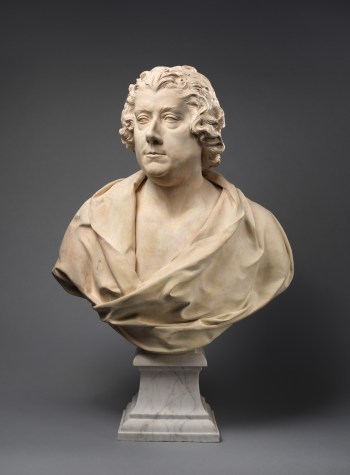
Louis François Roubiliac, Francesco Bernardi, known as ‘II Senesino’ (ca. 1686–1758), ca. 1735, terracotta with later marble base, bust: 62 × 55 × 23 cm (New York: The Metropolitan Museum of Art, Purchase, Gift of Irwin Untermyer by exchange, 2016.47).
A R T I C L E S
• Malcolm Baker, “Sculpting Reputation: A Terracotta Bust of Senesino by Roubiliac,” pp. 25–39.
• Ronda Kasl, “Witnessing Ingenuity: Lacquerware from Michoacán for the Vicereine of New Spain,” pp. 40–56.
• Wendy McGlashan, “John Kay’s Watercolor Drawing John Campbell (1782),” pp. 57–66.
• Kimberly Chrisman-Campbell, “A Tale of Two Chapeaux: Fashion, Revolution, and David’s Portrait of the Lavoisiers,” pp. 67–84.
R E S E A R C H N O T E S
• Ludmila Budrina, “Malachite Networks: The Demidov and Medici Vases-Torchères (1821–23) in The Met,” pp. 148–59.
In the News | ‘Prize Papers’ in UK’s National Archives
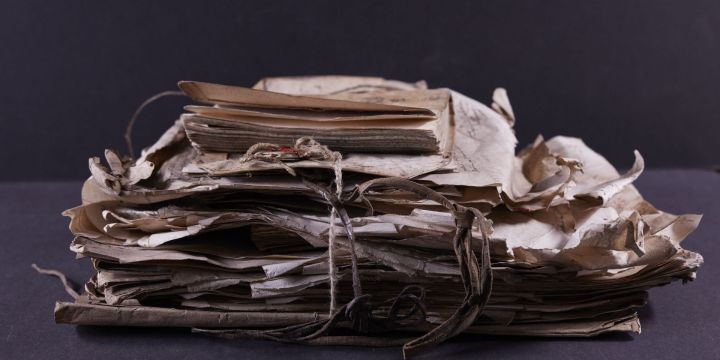
Photograph from The Prize Papers Project.
◊ ◊ ◊ ◊ ◊
From The NY Times (and Art Daily) . . .
Bryn Stole, “Long-Lost Letters Bring Word, at Last,” The New York Times (9 March 2023). Researchers are sorting through a centuries old cache of undelivered mail that gives a vivid picture of private lives and international trade in an age of rising empires.
In a love letter from 1745 decorated with a doodle of a heart shot through with arrows, María Clara de Aialde wrote to her husband, Sebastian, a Spanish sailor working in the colonial trade with Venezuela, that she could “no longer wait” to be with him.
Later that same year, an amorous French seaman who signed his name M. Lefevre wrote from a French warship to a certain Marie-Anne Hoteé back in Brest: “Like a gunner sets fire to his cannon, I want to set fire to your powder.”
Fifty years later, a missionary in Suriname named Lene Wied, in a lonely letter back to Germany, complained that war on the high seas had choked off any news from home: “Two ships which have been taken by the French probably carried letters addressed to me.”
None of those lines ever reached their intended recipients. British warships instead snatched those letters, and scores more, from aboard merchant ships during wars from the 1650s to the early 19th century. . . .
Poorly sorted and only vaguely cataloged, the Prize Papers, as they became known, have now begun revealing lost treasures. Archivists at Britain’s National Archives and a research team at the Carl von Ossietzky University of Oldenburg in Germany are working on a joint project to sort, catalog, and digitize the collection, which gives a nuanced portrait of private lives, international commerce, and state power in an age of rising empires. The project, expected to last two decades, aims to make the collection of more than 160,000 letters and hundreds of thousands of other documents, written in at least 19 languages, freely available and easily searchable online. . . .
The full article is available here»
◊ ◊ ◊ ◊ ◊
From The Prize Papers Project:
The objects in the Prize Papers Collection were impounded by the High Court of Admiralty of the English and later British Royal Navy between 1652 and 1817, and they are now held by The National Archives of the UK.
The Prize Papers were collected a result of the early modern naval practice of prize-taking: capturing ships belonging to hostile powers, dealing severe blows to their military, political and economic capabilities. This practice had its heyday in the 17th and 18th centuries, and so the collection proves a fascinating insight into the formative period of European colonial expansion. . . .
The practice of prize-taking resulted in a vast, extraordinary and partly accidental archive of the early modern world, contains documents from more than 35,000 captured ships, held in around 4088 boxes and 71 printed volumes. The Prize Papers Collection includes at least 160,000 undelivered letters intercepted on their way across the seas, many of which remain unopened to this day. These are accompanied by books and papers on all manner of legal, commercial, maritime, colonial, and administrative matters, often embellished with notes and doodles. Documents in at least 19 different languages have been identified so far, and more languages are likely to be discovered as the project progresses. Alongside this written material is a variety of small miscellaneous artifacts, including jewelry, textiles, playing cards, and keys.
◊ ◊ ◊ ◊ ◊
In June 2022, the project published the first of the Prize Papers from the War of the Austrian Succession (1740–48), with papers from ten French ships.
The project has a YouTube site with a handful of video presentations, including a fascinating session on letterlocking.
Online Talk | Beckfords and the Transatlantic Slave Trade
From The Salisbury Museum and Eventbrite:
Amy Frost, The Beckfords and the Transatlantic Slave Trade
Online, Thursday, 16 March 2023, 7.30pm (GMT)

Beckford’s Tower, 1826–27 (photo by Tom Burrows).
From the purchase of Fonthill in Wiltshire by William Beckford in 1744 to the death of his son in Bath 100 years later, the social advancements and retreats of the Beckford family relied upon the profits of transatlantic slavery. This talk will explore the extensive collecting and architectural creations of the Beckfords, and highlight how they were made possible by a vast fortune built from the stolen labour of thousands of enslaved Africans. This is a fundraising talk for The Salisbury Museum: £12 (£9 members).
Dr Amy Frost is an expert on the life and work of William Beckford and curator of Beckford’s Tower in Bath.
◊ ◊ ◊ ◊ ◊
Press release (7 March 2023) from the Bath Preservation Trust:
Alex Wheatle and State of Trust Join Forces with Beckford’s Tower
As part of the ‘Our Tower’ regeneration plan, Beckford’s Tower and State of Trust join forces with author Alex Wheatle to deliver interpretive dance performance of Wheatle’s prize-winning 2020 novel Cane Warriors.
 Cane Warriors tells the story of Tacky’s Rebellion, an uprising of Akan people fighting for their freedom that took place in Jamaica in 1760, and included enslaved people on a plantation owned by the Beckford family. The new project will put a spotlight on the link between the Beckford family and the rebellion and engage with a wide cross section of people in the process, particularly young people in the community and online, in order to develop an interpretive dance performance of the novel. The research and development will build a team of exceptional performers. New choreography, music, photography, and film will be created, and there will also be a virtual gallery and film archive for future use.
The resulting performances will take place in March 2024. Beckford’s Tower will host one performance, with the other two to be held in other Bath and Bristol venues. The new production has been supported by The National Lottery Heritage Fund, thanks to money raised by National Lottery players.
The performance, which will be filmed for posterity, will encourage attendees to engage with one of the most troubling aspects of William Beckford’s legacy: his claiming in ownership enslaved people, which funded his lifestyle and his vast collections. The aim is to build awareness around the effects of enslavement and colonialism on the culture and psyche of modern Britain and improve community relations through greater understanding of the shared history.
Built between 1826 and 1827, Beckford’s Tower was intended to house the collections of books, furniture, and art that were owned by William Beckford, whose wealth was gained from his ownership of plantations and enslaved people in Jamaica. Beckford would ride up to the Tower from his townhouse in Bath’s Lansdown Crescent every morning before breakfast, and enjoyed its solitude and the panoramic views from the Belvedere at the top.
Today Beckford’s Tower is owned and run by Beckford Tower Trust, part of Bath Preservation Trust. The landmark is a Grade 1 listed monument and is the only museum in the world dedicated to the life and work of William Beckford. In 2019, the Tower was added to the National ‘At Risk’ Register, sparking a major project to raise the necessary funds to repair and restore the Tower, transform the museum, open up the landscape and create opportunities for volunteering, formal learning and community engagement. In 2022, thanks to a £3million grant from The National Lottery Heritage Fund, the fundraising target of £3.9 million was reached. £480,000 of partnership funding had already been secured, with support from Historic England, Garfield Weston Foundation, The Medlock Charitable Trust, Historic Houses Foundation, Pilgrim Trust, and several other organisations, as well as £50,000 in public donations. This second grant of £100,000 will enable Beckford’s Tower to deliver the Cane Warriors project, which will compliment the wider work taking place at the Tower.

State of Trust Cane Warriors Meeting
Commenting on the new project, Director of Museums Claire Dixon said: “One of our main priorities at Beckford’s Tower is to ensure the transparent and sensitive portrayal of William Beckford’s troubling legacy; as his building and collecting was funded through his ownership of plantations it is vital that this is made clear in the regeneration of the Tower and its new exhibition. We approached State of Trust owing to their reputation for delivering powerful performances that tackle challenging social themes, and we look forward to working with them on this exciting project. It will enable us to explore more creative and artistic events, engage new and more diverse audiences, and embed this approach in the new museum programme when it opens in 2024. I would like to thank The National Lottery Heritage Fund and National Lottery players for their support in helping us to fully contextualise and reconfigure the story of Beckford’s Tower for a modern-day audience.”
Deborah Baddoo MBE and Steve Marshall, the Directors at State of Trust and State of Emergency Limited, said: “We are delighted that Heritage Lottery has agreed to fund the R&D phase of Cane Warriors. When Alex Wheatle first approached us, nearly three years ago, with a view to our making a dance interpretation of his novel, we didn’t realise what an uphill struggle it would be to achieve funding. Thanks to Bath Preservation Trust, and the synergy between the story and the history of Beckford’s Tower, we are now able to start working on what we believe will be an important work of African contemporary dance theatre. This production will allow us to pursue a long-term artistic vision, which began with the foundation of State of Emergency Limited in 1986, and to hone our skills as directors and performers. For us Cane Warriors is the natural progression of all that has gone before. Working alongside the history of Beckford’s Tower, this project can make the connection between historic buildings in our local communities and the transatlantic slave trade, and reveal their hidden histories. We feel it is very important to reach and engage with people, particularly young people, on this subject, and through a range of activities, including workshops in schools, and online events, we know we can make a difference. Through the media of dance, music, and film, we aim to bring the story to life, to animate history in a way that is relevant and impactful to our contemporary lives, to get beyond the facts and to achieve a level of understanding and truth.”

Alex Wheatle MBE
Alex Wheatle MBE, author of Cane Warriors, said: “The real story of Chief Tacky’s rebellion has been passed down through generations of my mother’s family who resided in Richmond, St Mary’s parish in Jamaica—very close to the plantations where Chief Tacky and his Cane Warriors toiled and planned their Easter rebellion in 1760. I was simply compelled to relate this story to the wider world, and I’m very proud that State of Emergency will tell the story in the art form of dance. Indeed, the Cane Warriors will be honoured.”
Stuart McLeod, Director England – London & South at The National Lottery Heritage Fund, said: “Inclusive heritage is very important to us at The National Lottery Heritage Fund which is why we are proud to support projects that engage people with the complexity of our history. This project will help broaden everyone’s understanding of Beckford and tell his story and its significance to Bath. Our history can teach us a great deal about ourselves and who we want to be, and we encourage people to explore, understand, and learn from it.”
Iris Moon and Rachel Silberstein on Feminist Revisions of Chinoiserie
An upcoming research seminar at the Paul Mellon Centre:
Iris Moon and Rachel Silberstein on Feminist Revisions of Chinoiserie
Online and in-person, Paul Mellon Centre, London, Wednesday, 22 March 2023, 5–7pm
Part of the series ‘In Conversation: New Directions in Art History’, which will explore the changing modes and methodologies of approaching visual and material worlds. Book tickets here.
Iris Moon — The Woman in the Mirror
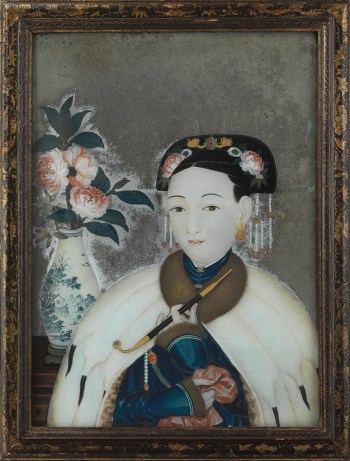
Woman with a Pipe, ca. 1760–80, reverse-painted crown glass, imitation lacquer frame, 52 × 40 × 3 cm (New York: The Metropolitan Museum of Art, Larry and Ann Burns Gift, in honor of Austin B. Chinn, 2022.52).
Chinoiserie, a style of decoration that emerged in early modern Europe, has typically been pictured as a neutral, harmless, and nostalgic fantasy of the ‘exotic’ Far East, one that was embodied by the traffic, trade and ravenous consumption of luxury objects such as mirrors, wallpaper, furniture, and porcelain. Though Chinoiserie is often pictured as encompassing a wide field of material production, it has rarely been considered as part of the contested forms of subjectivity that emerged in the eighteenth century. This presentation proposes that we rethink the history of Chinoiserie. It asks what a feminist approach to Chinoiserie might look like, and what the ramifications are for British decorative arts in positioning Chinoiserie at the inflection point of racialised and gendered forms of subjectivity that continue to exert a hold on the present. Building on a rich and growing body of critical and theoretical literature, the presentation nonetheless anchors the discussion of Chinoiserie in a formal analysis of a group of reverse-painted mirrors made for the British market. These eighteenth-century mirrors picture women, both real and imagined, in different modes of dress and postures, painted on the reverse side of the glass scraped of its reflective surface. Scholars have relegated these export objects to a secondary status, considering them as trade paintings of little artistic merit, refusing in turn to probe the subtle and complex questions they raise about gender, identity, power, representation, and reflection. Yet these are the questions that materialise when standing before the mirrors. You ask: Who is the woman in the mirror? Myself or another? Where do I position myself? Who am I supposed to be?
Iris Moon is an assistant curator in the European Sculpture and Decorative Arts Department at The Metropolitan Museum of Art, where she is responsible for European ceramics and glass. At The Met, she participated in the reinstallation of the British Galleries, and she is currently planning an exhibition on Chinoiserie, women, and the porcelain imaginary that will open in 2025. She is the author of Luxury after the Terror, and co-editor with Richard Taws of Time, Media, and Visuality in Post-Revolutionary France. A new book on Wedgwood, generously supported by a publication grant from the Paul Mellon Centre, will be published next year with MIT Press. In addition to curatorial work, she teaches at Cooper Union.
◊ ◊ ◊ ◊ ◊
Rachel Silberstein — The Women on the Garment
Chinese material culture offers several routes for a feminist approach to Chinoiserie. One could counter its insistence on the generic Chinese woman by exploring histories of specific Chinese women: the Qing dynasty social counterparts of the privileged European women who purchased Chinoiserie silks, porcelains, and mirrors. Their consumption, especially of textiles and fashion, offers an arena of specificity, agency, and control that refutes Chinoiserie’s imagined Qing beauties: languorous and ahistorical. Alternatively, one could consider a different counterpart: Qing society’s engagement with images of European women. Though such imagery may not have travelled far beyond the imperial palace, recent scholarship has clarified how European textiles, architecture, and dress fascinated those elites able to access such new visualities, introduced by Jesuit missionaries, print culture, and the East India Companies.
But perhaps most intriguing when considering Chinoiserie’s potential for contesting female subjectivities is to understand it not as a European fantasy unrelated to Chinese practice, but rather a shared global visual space whose dynamic was driven by fashion. Accordingly, the presentation focuses on a genre of Qing fashion: the embroidered figures of beauties that adorned the fabrics and trimmings of the mid-late period jackets, robes, and accessories. Similar to the eighteenth-century mirror designed for a European consumer, these embroideries depict women, both real and imagined, in different postures and dress. In the same way as the eighteenth-century mirror, the embroideries derived from imagery circulating in pattern books and print culture. Yet, these embroideries were produced for Chinese female consumers and, in an intriguing act of self-referentiality, the female figures were placed on the very surface that covered the female wearer’s body. By showing how this fashion trend traversed different media, cities, and classes, this presentation explores how it allowed Chinese women a way of exploring identity by playing with narrative, and how this figural bricolage can be understood alongside European women’s consumption of Chinoiserie.
Rachel Silberstein is currently an adjunct assistant professor in the Department of Art History at the University of Florida. She has also taught courses in fashion history and art history at Rhode Island School of Design, the University of Washington, and the University of Puget Sound. Her research focuses on textiles, dress, and fashion in Chinese and global history. Her monograph, A Fashionable Century: Textile Artistry and Commerce in the Late Qing (University of Washington Press, 2020)—a study of fashion and textile handicrafts in early modern China—won the Costume Society of America’s Millia Davenport Publication Award 2021. Rachel has published widely on Qing fashion in the journals West 86th, Fashion Theory, Costume, and Late Imperial China. Forthcoming publications include an essay on Ming-Qing Fashion in the Cambridge Encyclopedia of Global Fashion. She has also served as a consultant on Chinese dress collections and exhibits at museums including the Fine Arts Museums of San Francisco, Rhode Island School of Design Museum, Seattle’s Museum of History & Industry, and the Cooper Hewitt Smithsonian Design Museum.
New Book | Pearl: Nature’s Perfect Gem
Distributed by The University of Chicago Press:
Fiona Lindsay Shen, Pearl: Nature’s Perfect Gem (London: Reaktion Books, 2022), 256 pages, ISBN: 978-1789146219, $35.
 From their creation in the maw of mollusks to lustrous objects of infatuation and conflict, a revealing look at pearls’ dark history.
This book is a beautifully illustrated account of pearls through millennia, from fossils to contemporary jewelry. Pearls are the most human of gems, both miraculous and familiar. Uniquely organic in origin, they are as intimate as our bodies, created through the same process as we grow bones and teeth. They have long been described as an animal’s sacrifice, but until recently their retrieval often entailed the sacrifices of enslaved and indentured divers and laborers. While the shimmer of the pearl has enticed Roman noblewomen, Mughal princes, Hollywood royalty, mavericks, and renegades, encoded in its surface is a history of human endeavor, abuse, and aspiration—pain locked in the layers of a gleaming gem.
Fiona Lindsay Shen is an art historian and director of the Escalette Permanent Collection of Art at Chapman University in California.
C O N T E N T S
Preface: Sarah Siddons’s Necklace
1 The Oyster’s Autobiography
2 Harvest
3 Culturing Pearls, Capturing Markets, Cultivating Brands
4 The Seven Pearly Sins
5 And the Seven Virtues
6 Embodied
References
Bibliography
Acknowledgments
Photo Acknowledgments
Index










 Enfilade
leave a comment