Call for Papers | Intellectual Histories of Art and the Archive
From the Paul Mellon Centre:
The Intellectual Histories of Art and the Archive
Paul Mellon Centre, London, 10 May 2023
Proposals due by 15 March 2023
Organized by Chloe Julius and Ambra D’Antone
For those interested in art’s intellectual histories, the archive offers a multitude of possibilities—especially those archives that hold the papers of art historians and critics. While the development of an idea can be traced through drafts, notes, and annotations, correspondence allows a wider intellectual context to be mapped. Yet these archives also pose certain problems, raising questions around authorship, authority, and authenticity. Given the selective and often partial nature of archive collections, what place should the discoveries they yield be afforded in a wider research project? Moreover, given the move from paper to a digital record, are the same kinds of research journeys still possible with email?
This event will bring together scholars working directly with the archives of art historians and critics to discuss the methodological questions and issues posed by archive-driven intellectual histories. While there is no geographical or historical restriction for the presentations, they should be rooted in a discussion of a particular archive. Presentations on early-stage research projects are encouraged.
This event has been organised in conjunction with the workshop Abiding Present: Challenges of Time in Art History, which will take place 11–12 May 2023 at The Warburg Institute. The workshop will explore anew art history’s complex dealings with time and the relationship between the present and the past in art history, initiating a dialogue that critically considers old and new methods in our field.
Please submit a one-hundred word abstract for a fifteen-minute presentation by 11.59pm (GMT) on Monday, 15 March 2023 listing “The Intellectual Histories of Art and the Archive” as the subject line to: events@paul-mellon-centre.ac.uk. Incomplete or late submissions will not be considered.
This is a collaboration between the Paul Mellon Centre for Studies in British Art and the Warburg Institute, London. The co-convenors of this workshop are Chloe Julius, current holder of the PMC’s Archive & Library Fellowship, and Ambra D’Antone, Research Associate, Bilderfahrzeuge International Research Project, Max Weber Stiftung.
New Book | Edward Geoffrey Stanley, A Grand Tour Journal, 1820–22
From Fonthill Media:
Edward Geoffrey Stanley, with an introduction and notes by Angus Hawkins, A Grand Tour Journal, 1820–1822: The Awakening of the Man (Stroud: Fonthill Media, 2022), 224 pages, ISBN: 978-1781558904, £25 / $35.
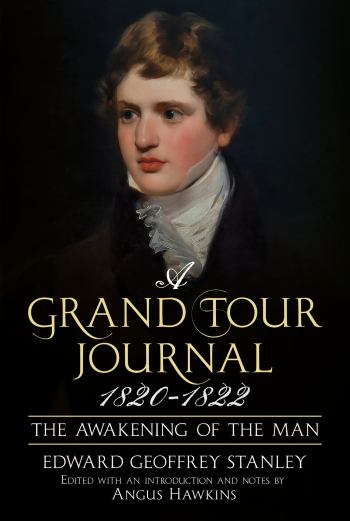 In December 1820, at twenty-one years old, Edward Geoffrey Stanley, the future 14th earl of Derby and three-times prime minister, began an extensive tour of continental Europe. By the time of his return to England twenty months later, he had visited many of the foremost centres for art and culture in Europe, and mostly in Italy. In his travel diaries he recorded his intensive social life, his visits to historical sites, his viewings of art collections, his comments on architecture, his admiration of landscapes, and his impressions of foreign societies. He was energetic, enthusiastic, and discerning: the bridge of Augustus in Umbria gave him “a stupendous idea of Roman grandeur”; the charm of the towns crowning the Tuscan hills struck him with the same delight that he felt when gazing at one of Poussin’s paintings; the waterfall at Terni, which dropped 370 feet into an abyss of spray, was “awfully magnificent”; while the ceremonies of the Italian Catholic Church he judged to be a blend of mummery, superstition, and bigotry. Sights and experiences like these influenced him for the rest of his life. This precious collection of diaries—found only recently and published here for the first time—reveal Edward Stanley to have been a young man of diligence, courage, and decisiveness: a future leader with a conspicuous and burgeoning sense of political and social justice. It was these characteristics, seen in early development within these pages, that shaped the man and the extraordinary career to come.
Edward Geoffrey Stanley (1799–1869), later Lord Stanley and the 14th earl of Derby, was the first British statesman to become prime minister three times and remains the longest serving party leader in modern British politics.
Angus Hawkins (1953–2020) was a fellow of the Royal Historical Society and director of the Research Centre in Victorian Political Culture at Keble College, University of Oxford. Professor Hawkins wrote an acclaimed two-volume biography of Edward Geoffrey Stanley, The Forgotten Prime Minister, published by Oxford University Press in 2007 and 2008.
New Book | Politics and the English Country House, 1688–1800
From McGill-Queen’s University Press:
Joan Coutu, Jon Stobart, and Peter Lindfield, eds., Politics and the English Country House, 1688–1800 (Montreal: McGill-Queen’s University Press, 2023), 344 Pages, ISBN: 978-0228014027, $95.
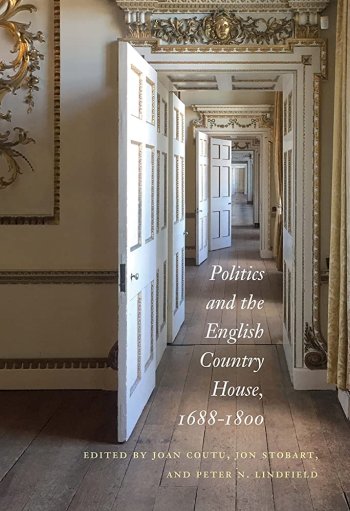 Politics has always been at the heart of the English country house, in its design and construction, as well as in the activities and experiences of those who lived in and visited these places. As Britain moved from an agrarian to an imperial economy over the course of the eighteenth century, the home mirrored the social change experienced in the public sphere. This collection focuses on the relationship between the country house and the mutable nature of British politics in the eighteenth century. Essays explore the country house as a stage for politicking, a vehicle for political advancement, a symbol of party allegiance or political values, and a setting for appropriate lifestyles. Initially the exclusive purview of the landed aristocracy, politics increasingly came to be played out in the open, augmented by the emergence of career politicians—usually untitled members of the patriciate—and men of new money, much of it created on Caribbean plantations or in the employ of the East India Company. Politics and the English Country House, 1688–1800 reveals how, during this period of profound change, the country house remained a constant. The country house was the definitive tangible manifestation of social standing and, for the political class, owning one became almost an imperative. In its consideration of the country house as lived and spatial experience, as an aesthetic and symbolic object, and as an economic engine, this book offers a new perspective on the complexity of political meaning embedded in the eighteenth-century country house—and on ourselves as active recipients and interpreters of its various narratives, more than two centuries later.
Joan Coutu is professor of art history and visual culture at the University of Waterloo.
Jon Stobart is professor of social history at Manchester Metropolitan University.
Peter Nelson Lindfield is lecturer in history at Manchester Metropolitan University.
C O N T E N T S
Table and Figures
Acknowledgements
1 Introduction — Joan Coutu, Jon Stobart, and Oliver Cox
Part One: Political Positioning after the Glorious Revolution
2 Introduction — Oliver Cox
3 For Politics, Progresses, or Posterity? Some Alternative Reasons for Building State Apartments — Amy Lim
4 Holding Court at Marlborough House: The London Residence of Sarah, Duchess of Marlborough — Juliet Learmouth
Part Two: The Question of Style
5 Introduction — Anne Bordeleau
6 Gothic Architecture and the Liberty Trope — Matthew M. Reeve
7 ‘Whig Gothic’: An Antidote to Houghton Hall — Peter N. Lindfield
8 The House with Two Faces: From Baroque to Palladian at Wentworth Woodhouse — Dylan Wayne Spivey
Part Three: The Social Politics of the Country House
9 Introduction — Jon Stobart
10 Burke’s Exemplum: The ‘Natural Family Mansion’ and Wentworth Woodhouse — Joan Coutu
11 House Painting: Place and Position in Estate Portraiture, circa 1770 — John Bonehill
12 The House and Estate of a Rich West Indian: Two Slaveholders in Eighteenth-Century East Anglia — Elisabeth Grass
Part Four: Houses and Homes
13 Introduction — Kate Retford
14 The Clives at Home: Self-Fashioning, Collecting, and British India — Kieran Hazzard
15 William Pitt the Younger, 1759–1806: Reshaping the Political Home — Rowena Willard-Wright
Afterword: Whose Country House? — Dana Arnold
Bibliography
Contributors
Index










 Enfilade
leave a comment