New Book | Stigma: Marking Skin
From Penn State UP:
Katherine Dauge-Roth and Craig Koslofsky, eds., Stigma: Marking Skin in the Early Modern World (University Park: The Pennsylvania State University Press, 2023), 294 pages, ISBN: 978-0271094427, $120.
 The early modern period opened a new era in the history of dermal marking. Intensifying global travel and trade, especially the slave trade, bought diverse skin-marking practices into contact as never before. Stigma examines the distinctive skin cultures and marking methods of Asia, Europe, Africa, and the Americas as they began to circulate and reshape one another in the early modern world. By highlighting the interwoven histories of tattooing, branding, stigmata, baptismal and beauty marks, wounds and scars, this volume shows that early modern markers of skin and readers of marked skin did not think about different kinds of cutaneous signs as separate from each other. On the contrary, Europeans described Indigenous tattooing in North America, Thailand, and the Philippines by referring their readers to the tattoos Christian pilgrims received in Jerusalem or Bethlehem. When explaining the devil’s mark on witches, theologians claimed it was an inversion of holy marks such as those of baptism or divine stigmata. Stigma investigates how early modern people used permanent marks on skin to affirm traditional roles and beliefs, and how they hybridized and transformed skin marking to meet new economic and political demands.
Katherine Dauge-Roth is Associate Professor of Romance Languages and Literatures at Bowdoin College in Brunswick, Maine. She is the author of Signing the Body: Marks on Skin in Early Modern France.
Craig Koslofsky is Professor of History and Germanic Languages and Literatures at the University of Illinois, Urbana-Champaign. He is the author of Evening’s Empire: A History of the Night in Early Modern Europe and The Reformation of the Dead: Death and Ritual in Early Modern Germany, 1450–1700, and the coeditor of A German Barber-Surgeon in the Atlantic Slave Trade: The Seventeenth-Century Journal of Johann Peter Oettinger.
C O N T E N T S
List of Illustrations
Acknowledgements
Introduction, Marking Skin: A Cutaneous Collection — Katherine Dauge-Roth and Craig Koslofsky
Part I | Marked Encounters in America, Asia, and Africa
1 ‘Pownced, Pricked, or Paynted’: English Ideas of Tattooing as Indigenous Literacy — Mairin Odle
2 Indigenous Taiwanese Skin Marking in Early Modern European and Chinese Eyes — Xiao Chen
3 Following the Trail of the Slave Trade: Branding, Skin, and Commodification — Katrina H. B. Keefer and Matthew S. Hopper
Part II | Marks of Faith
4 Jerusalem Under the Skin: The History of Jerusalem Pilgrimage Tattoos — Mordechay Lewy
5 Stigmata and the Mind-Body Connection — Allison Stedman
6 The Invisible Mark: Representing Baptism in Early Modern French Dramaturgy — Ana Fonseca Conboy
7 Rabies and Relics: Cutaneous Marks and Popular Healing in Early Modern Europe — Katherine Dauge-Roth
Part III | Standing Out: Marks of Honor, Shame, and Beauty
8 Skin Narratives: Speaking about Wounds and Scars in Shakespeare’s Coriolanus — Nicole Nyffenegger
9 Branding on the Face in Early Modern Europe — Craig Koslofsky
10 Mouches Volantes: The Enigma of Paste-On Beauty Marks in Seventeenth-Century France — Claire Goldstein
Afterword, Cultural Inscriptions: Body Marking after 1800 — Peter S. Erickson
List of Contributors
Index
New Book | Tokens of Love, Loss, and Disrespect, 1700–1850
Published by Paul Holberton and distributed by The University of Chicago Press:
Sarah Lloyd, ed., Tokens of Love, Loss, and Disrespect, 1700–1850 (London: Paul Holberton Publishing, 2023), 360 pages, ISBN: 978-1911300946, £45 / $55. With other contributions by Timothy Millett, Tim Hitchcock, Susan Whyman, Steve Poole, Sally Holloway, Katrina Navickas, Joe Cozens, Hamish Maxwell-Stewart, Graham Dyer, Gary Oddie, and Brian Maidme.
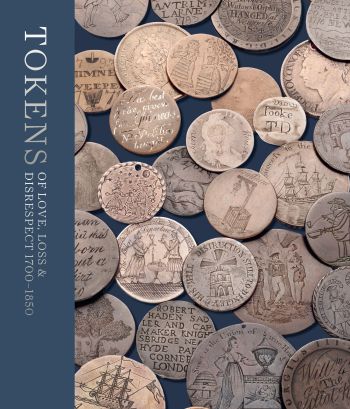 Coins are physically and visually intriguing. Explicitly designed to have monetary value, they can be used for their intended purpose. But coins have also frequently been repurposed to communicate private and public messages—from ad hoc scratchings and punch marks to complete re-engraving of surfaces. As carriers of messages, coins have the advantage of being unobtrusive: They can easily be carried around, and their exchange does not arouse suspicion.
Tokens of Love, Loss and Disrespect gives insight into the many unofficial purposes coins served in the past. Drawing on the largest extant collection of defaced coins and tokens, Sarah Lloyd brings together the full range of expertise required to understand the phenomenon, with contributions from eleven scholars and collectors. Tokens of Love, Loss and Disrespect focuses on a period in British history when modification of coinage expressed political commentary, commercial activity, familial and emotional commitment, personal identity, and life history. It examines the coins and tokens themselves and looks at who modified them, where, why, and how. Defaced coins and tokens are often enigmatic objects, and this book offers a means of decoding and assessing them, while also drawing attention to their value as a distinctive source of historical evidence. Tokens of Love, Loss and Disrespect considers what these surviving coins reveal about the society in which they were produced and the light they shed on major historical developments of the period.
Sarah Lloyd is a fellow of the Royal Historical Society and a public historian with extensive experience of working with twenty-first-century communities on history and heritage projects. She researches the social and cultural history of eighteenth-century Britain.
Exhibition | Coins, Medals, and the Rule of Law

Der Medailleur Jacques-Antoine Dassier setzte 1753 Charles de Montesquieu ins Medaillenrund. In dessen Hauptwerk De l’Esprit des lois von 1748 entfaltete er eine Theorie der Gewaltentrennung, die erheblichen Einfluss auf die Entwicklung des modernen Verfassungsstaates hatte (Staatliche Museen zu Berlin, Münzkabinett, ex Slg. Thomas Würtenberger / Karsten Dahmen)
◊ ◊ ◊ ◊ ◊
From the Staatliche Museen zu Berlin:
Ius in nummis: Die Sammlung Thomas Würtenberger
Bode-Museum, Berlin, 26 May 2023 — 7 April 2024
Eine Sonderausstellung des Münzkabinetts der Staatlichen Museen zu Berlin
Ius in nummis: Die Sammlung Thomas Würtenberger ist in ihrer Breite einzigartig. Sie wurde über den Zeitraum eines halben Jahrhunderts zusammengetragen und umfasst mehr als 3.000 Objekte—vornehmlich Medaillen und einige Münzen—mit dem Fokus auf die neuzeitliche Rechtsgeschichte Westeuropas in zunehmend globaler Perspektive. Jedes Objekt erschließt dabei ein Stück juristischer Vergangenheit.
Iūs, iūris, n. bedeutet unter anderem Recht. Regeln und Gesetze ordnen und durchdringen seit Jahrtausenden den Alltag der Menschen. Recht und Gerechtigkeit bilden dabei dynamische Spannungsfelder. Rechtshandlungen und Rechtsauffassungen gehen von Individuen aus. Rechtsstaat und Unrechtsstaat oder Verfassungsstaat und Willkürherrschaft erinnern an die Konsequenzen gelebter Wertesysteme. Die Rechtsgeschichte erkundet mittels vielfältiger Quellen Ereignisse wie Rechtssetzungen und Rechtsakte, aber auch individuelle Rechtspersonen und Rechtskulturen.
nummus -ī, m. bezeichnet eigentlich Münzen und Geldstücke, doch hat es sich bewährt, auch ein verwandtes Medium unter diesen Begriff zu fassen: die Medaille. Für die Rechtsarchäologie bietet sie eine ergiebige Primärquelle. Von Moses bis zu den Menschenrechten eröffnet die Medaillenkunst ein weites Panorama der Inszenierung von Recht.
Die Ausstellung Ius in nummis: Ein Sammlungsüberblick in zwölf Segmenten
Das Münzkabinett hat es sich zur Aufgabe gesetzt, die Sammlung Würtenberger zu verwahren und zugänglich zu machen. Die digitale Erfassung seit 2020 ist die Voraussetzung der ersten systematischen Erschließung dieses Kulturguts. Ausstellung, Katalog und Begleitprogramm sind dicht am Puls laufender Forschungsarbeiten um diese wichtige Neuerwerbung angesiedelt. Präsentiert wird zunächst die Fragestellung der Spezialsammlung „Ius in nummis“. Weiterführend geht es aber nicht zuletzt um die Erkenntnispotenziale numismatischer Quellen für die Rechtsgeschichte.
Weitgehend geschlossen überliefert, zeigen numismatische Objekte das nahezu vollständige Bild einer erfolgreichen Kulturtechnik. Je nach Materialität und Auflage exklusiv oder für Jedermann halten sie Personen, Dinge und Ereignisse fest. Als mobile und beständige Medien können Medaillen über politische, religiöse und kulturelle Barrieren hinweg von Mensch zu Mensch gehen. Und bisweilen künden die Oberflächen dieser handlichen Denkmale von wechselvollen Objektgeschichten.
Die Ausstellung bietet innerhalb des thematisch, geografisch und diachron vielfältigen Bestandes eine erste Orientierung. Zwölf Segmente präsentieren anhand von Schwerpunkten einen Sammlungsüberblick. Von Symbolen, Individuen, Strukturen, Institutionen, bis hin zu Revolutionen und Verfassungsfragen werden dabei stets weiterhin aktuelle Themen im Medaillenrund vergleichbar.
Heutige Perspektiven auf Fragen von Recht und Gerechtigkeit
Eine eigens für Ius in nummis ins Leben gerufene Edition des Berliner Medailleurkreises flankiert die Ausstellung. Aktuelle Perspektiven auf die großen und kleinen Fragen von Recht und Gerechtigkeit kommentieren im Medaillenrund die Ausstellungsthemen. Beteiligt sind der Berliner Medailleurkreis sowie Mitglieder der Deutschen Gesellschaft für Medaillenkunst.
Zur Ausstellung wird ein Begleitband erscheinen.
New Book | Numismatic Antiquarianism
From Brepols:
Francçois de Callataÿ, ed., Numismatic Antiquarianism through Correspondence, 16th–18th Centuries (Turnhout: Brepols, 2023), 400 pages, ISBN: 978-0897223911 , €150.
 This book brings together 14 articles into a volume of conference proceedings from the 2017 meeting on numismatic antiquarianism held in Rome.
C O N T E N T S
Foreword — François de Callataÿ
About the Authors
1 Fool Me Once, Don’t Fool Me Twice: Collecting Forgeries to Train the Eye, 17th–early 19th Centuries — Daniela Williams
2 Moulages de monnaies antiques ou comment produire des copies, XVIe–XVIIIe siècles — Guy Meyer
3 The Missing Caesar: Inventing Bronze Coins for Otho — Johan van Heesch
4 Speaking about Manuscripts: Unpublished Works in Correspondence — Michiel Verweij
5 Recording Coin Finds and Hoards in Early Modern England — Ute Wartenberg and Jonathan H. Kagan
6 Two Centuries of Collecting, Describing, and Explaining Contorniates — John Cunnally
7 Di vizi e di virtù: Di Pertinaci e di Didii, di Pescenniie di Gordiani — Federica Missere Fontana
8 Numismatic Antiquarianism: Coins from the Ancient East in Early Modern Europe — Martin Mulsow
9 Queen Elizabeth and the Twelve Caesars — Andrew M. Burnett
10 Peiresc and the Coins through his Correspondence — Elena Vaiani
11 About Books and Coins: The Letters of Charles Patin to Giulio Antonio Arevoldi between 1679 and 1693 — Marco Callegari
12 The Story of Francesco Gottifredi’s Unpublished Book through the Analysis of the Letters of his Contemporaries — Maria Cristina Molinari
13 Monastic Antiquarianism in Austria and the République de Médailles: The Numismatic Collection of Göttweig Abbey — Manuela Mayer
14 Publishing the Doctrina Numorum Veterum: New Evidence on the Three Editions of Joseph Eckhel’s Masterwork — Bernhard E. Woytek
New Book | Shakespeare, Hogarth & Garrick
Happy Shakespeare Day! . . . Distributed by Paul Holberton Publishing and The University of Chicago Press:
Robin Simon, Shakespeare, Hogarth, and Garrick: Plays, Painting and Performance (London: Hogarth Press,, 2023), 256 pages, ISBN: 978-1913645441, £55 / $65.
 In London in 1770 Georg Christoph Lichtenberg (1742–1799) remarked, “What a work could be written on Shakespeare, Hogarth and Garrick! There is something similar in the genius of all three.” Two-and-a-half centuries on, Robin Simon’s highly original and illuminating book takes up the challenge.
William Hogarth (1697–1764) and David Garrick (1717–1779) closely associated themselves with Shakespeare, embodying a relationship between plays, painting, and performance that had been understood since Antiquity and which shaped the rules for history painting drawn up by the Académie royale in Paris in the seventeenth century. History painting was considered the highest form of art: a picture illustrating a moment drawn from just a few lines in a revered text. Hogarth’s David Garrick as Richard III (1745) transformed those ideas because, although it looked like a history painting, it was also a portrait of an actor in performance. With it, Hogarth established the genre of theatrical portraiture, a new and distinctively British kind of history painting. This book offers a fresh examination of theatrical portraits through close analysis of the pictures and of the texts used in performance. It also examines the central role of the theatre in British culture, while highlighting the significance of Shakespeare, Hogarth, and Garrick in the European Enlightenment and the rise of Romanticism. In this context another trio of genius features prominently: Lichtenberg, Gotthold Ephraim Lessing, and Denis Diderot. Familiar paintings and performances are seen in an entirely new light, while unfamiliar pictures are also introduced, including major paintings and drawings that have never been published. The final chapter shows that the inter-relationship between plays, painting, and performance survived into the age of cinema, revealing the pictorial sources of Laurence Olivier’s legendary film Richard III.
Robin Simon FSA is Editor of The British Art Journal and author of the acclaimed Hogarth, France, and British Art: The Rise of the Arts in Eighteenth-Century Britain (2007). He is Visiting Professor in the Department of English, University College London, and Professorial Research Fellow in the History of Art at Buckingham University.
Exhibition | Rear View
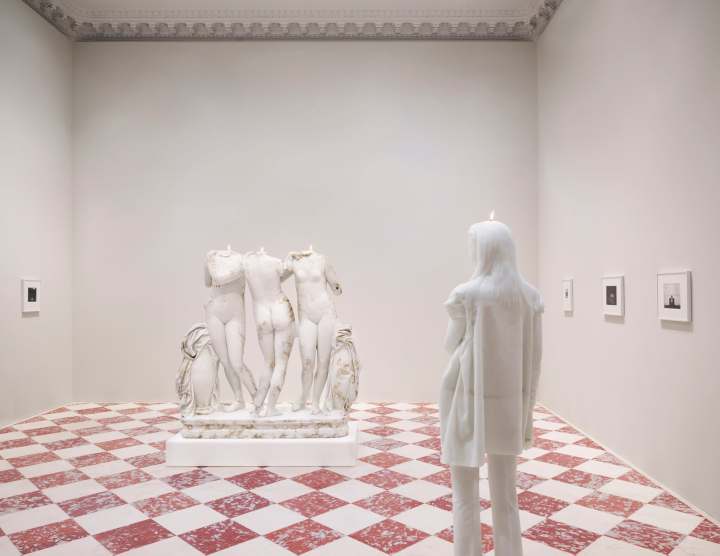
Urs Fischer, Divine Interventions, 2023, wax, based on the Metropolitan Museum of Art’s Roman sculpture The Three Graces (second century CE), with a wax portrait in the foreground of Pauline Karpidas, the contemporary art patron who once owned the ancient work. Installation view of a gallery at LGDR, 2023.
◊ ◊ ◊ ◊ ◊
It’s not an eighteenth-century show, but I’m left wishing that it were: an exploration of where classicism(s) and Romanticism meet, with Rococo impulses in-between. The emotional tenor of works varies widely; Carrie Mae Weems’s photographs strike me as especially powerful. See Jason Farago’s review for The New York Times (20 April 2023). –CH. From the press release for the exhibition:
Rear View
LGDR, New York, 18 April — 1 June 2023
Spanning two floors of LGDR’s landmark Beaux-Arts-style townhouse, Rear View presents a transhistorical selection of over sixty paintings, sculptures, works on paper, and photographs that explore representation of the human figure as seen from behind—an enduring, wide-ranging paradigm that has exerted potent influence upon modern and contemporary artists. In addition to rare twentieth-century masterworks by Félix Vallotton, Edgar Degas, René Magritte, Francis Bacon, Egon Schiele, Paul Cadmus, Aristide Maillol, and others, Rear View brings together seminal works by a diverse group of living artists spanning generations.
Long before the term Rückenfigur was popularized in the nineteenth century by Caspar David Friedrich, painters and sculptors from as far back as antiquity deployed the human figure seen from behind as a conceptual and formal device. Rear View provides a lens onto this specific genre as it pertains to artists’ desire to capture a range of human states and emotions—contemplation, longing, voyeurism, refusal, fetishism, and defiance—while drawing our attention to the act of looking itself and to the viewer’s role in constructing meaning and identity.
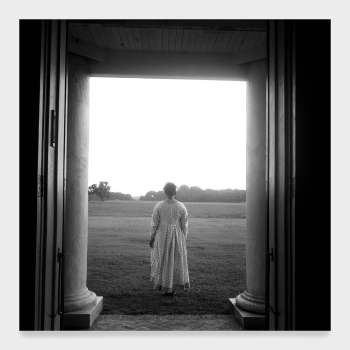
Carrie Mae Weems, Passageway II, 2003 (Jack Shainman Gallery, New York and LGDR).
Many contemporary artists have engaged the Rückenfigur trope, deliberately harnessing its critical potential. In one of the most compelling examples, Carrie Mae Weems has photographed herself in canonical landscapes and charged historical sites over many years, as a means of addressing complex issues around race, gender, and class, while also subjecting the signature paradigm of Romanticism to radical, politicized revision.
From the idealized bodies celebrated in Hellenistic sculpture to the bathers glimpsed in snapshot-like paintings and drawings by Impressionists and early modernists, images of nude bodies portrayed from behind have been integral to the unfolding story of figuration in the West. Urs Fischer directly quotes the Classical origins of this art historical paradigm in a monumental new candle sculpture made specifically for Rear View. Divine Interventions (2023) reprises one of the Metropolitan Museum of Art’s Roman marble Three Graces (second century CE), turning the trio of iconic feminine paragons, Aglaia (Beauty), Euphrosyne (Mirth), and Thalia (Abundance), into ephemeral forms cast in wax. Admiring this sculptural group—and in essence joining the Graces—is a wax effigy of Pauline Karpidas, the legendary contemporary art patron who once owned the ancient work that the Met would come to acquire.
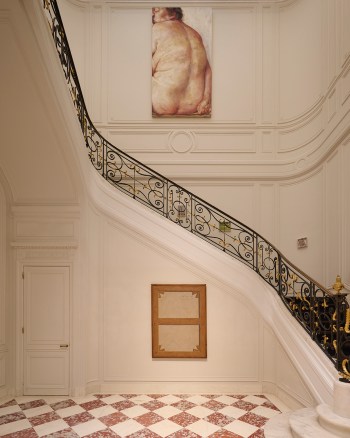
Installation view of Rear View at LGDR with work by Jenny Saville, Juncture (1994), top, and Domenico Gnoli, Back View (1968), below (Photo by Jason Schmidt).
The eroticism of ‘rear view’ images emerges not only from the frisson of nudity—the iconography of the human derrière emerges as a whole transhistorical subject onto itself—but from the narrative implication of intimacy between the depicted subject and the artist, the viewer’s fantasizing gaze and the sensuousness of the image on canvas. The trope of the mirror, the ritual of bathing, and the lounging or sleeping body are typical rear view scenarios taken up by artists across the centuries—from Edgar Degas to René Magritte, from Félix Vallotton to Barkley L. Hendricks, through to our present day. Fernando Botero’s painting The Bathroom (1989) features a woman, at once monumental and delicate, gazing at herself in the mirror, wearing only heels and a headband. The figure’s unselfconscious posture suggests she is unaware of the artist, invested only in herself.
By contrast, John Currin’s Nude in a Convex Mirror (2015) looks over her shoulder, presumably at the painter who is depicting the curves of her accentuated buttocks—but also at the viewer observing the action. The subject of Paul Cadmus’s ca. 1965 crayon drawing Standing Male Nude (NM 48) likewise peeks over his shoulder at the artist and the viewer, but with a loaded glance and flirtatious pose—one foot ever so slightly lifted to reveal its sole—that encode a sexual charge of mutual male gazes into an otherwise classical image. Jared French, who was part of the homosocial circle of artists around Cadmus, are represented in the exhibition by emblematic, dreamlike paintings populated uniquely by idealized male figures. The performative signifiers of masculinity emerge as an important subtheme of Rear View, evident in Giorgio de Chirico’s hyper-stylized Gladiatori (1928), Francis Bacon’s tormented figure in Study for Portrait of John Edwards (1986), and Andy Warhol’s abstracted depiction of a butch man’s hind quarters.

John Currin, Nude in a Convex Mirror, 2015, oil on canvas, 42 inches.
In their foreclosure of a complete picture, turned figures such as Currin’s nude also signal fetishism, another theme explored in Rear View. A number of works in the exhibition illuminate ways in which contemporary painting has absorbed the cinematic motif of the rear view, translating the camerawork of film noir and Hitchcockian thrillers like Rear Window (1954) into paint on canvas or rich black-and-white photographic images. Eric Fischl and Danielle Mckinney, for example, draw upon our collective cinematic imagination in composing their deeply narrative scenes, often populated by mysterious figures shown from the back and seemingly unaware of being observed. By contrast, but with no less enigmatic intensity, Harry Callahan’s mid-century rear-view photographs of his beloved wife, Eleanor, testify to the impact of cinematic vision when personalized to a single, deceptively simple subject.
In this context, another thematic trope of Rear View manifests in the work of Edgar Degas. Second only to his images of ballet dances, Degas’s voyeuristic bathing scenes dominate his vast oeuvre. On view in the exhibition, the artist’s delicate 1889–92 pastel Femme se peignant depicts a young nude female, seen from behind, combing her raven-colored tresses over her head. Degas’s scopophilic gaze focuses on the model’s flowing mane—a visual and psychological effect echoed by Domenico Gnoli’s sumptuous large-scale canvas Curly Red Hair (1969), which lingers over the texture of auburn curls cascading down a woman’s back. Tightly cropped to the subject at hand and denying the identifying details of the figure, this painting reveals Gnoli’s seeming uninterest in the body, except as a support for signifying ornament.

Félix Vallotton, Étude de fesses / Study of Buttocks, ca. 1884, oil on canvas, 38 × 46 cm (Private Collection).
The fragmented, fetishized human body emerged as a loaded trope in art history, according to esteemed feminist scholar Linda Nochlin in her study The Body in Pieces: The Fragment as a Metaphor of Modernity (1994). Spurred by the violence and social upheaval of the French Revolution, Nochlin notes, artists began to systematically deploy radical spatial cropping as well as isolating specific body parts, in order to explore the specific conditions of modern urban life—alienation, desire, suffering, obsession, ambiguous anonymous experiences. Nochlin’s observations find a contemporary echo in Issy Wood’s intimate canvas on view in the exhibition: Health and Hotness (2018) shows only the muscular back and bottom of a swimmer framed by her purple bathing suit. Wood’s enigmatic image is also a meditation on the impact of compressed and splitting planes and shapes—a study of the body as an abstraction.
Political refusal and personal irreverence also figure into art historical manifestations of the rear view. Six photographs from Anselm Kiefer’s polemical 1969 series Occupations (Besetzungen) take up this political mantle. In this series, the young artist photographed himself—often shown from behind, mimicking the heroic stance of Friedrich’s Rückenfigur—performing the Nazi salute in front of European monuments and natural sites. Of the series, controversial then as now, art historian Benjamin Buchloh remarked that it is “a real working through of German history. You have to inhabit it to overcome it.”
“String bottoms together in place of signatures for petition of peace.” This is how Yoko Ono described her infamous Film No. 4 (Bottoms) (1966–67)—an 80-minute montage of 365 human bottoms, featuring different genders, races, and body types. Marshaling her conceptual Fluxus rigor and sly humor into a powerful political protest against the Vietnam War, Ono’s provocative film retains its antiwar bite as well as its universalizing humanism today.
In the diptych that Francesco Clemente created for Rear View, Gold on Green, Green on Gold (2023), the artist slyly questions the front/back logic that underpins the exhibition as well as the binary thinking that governs so much of Western culture. Using gold leaf and a radically reduced palette, Clemente portrays ambiguous, gender-indeterminate figures that appear to be engaged in oral sex. The artist muses, “Maybe our mistaken ideas—based on duality, based on ‘us against them’—begin with the fact that we can only see half of what there is. We can only face one direction. We feel incomplete because we can never see completely ourselves. Painting may repair that, offering a vision of totality.”
As a pendant presentation to Rear View, Full Frontal (exhibited on the gallery’s second floor) explores the opposite art historical trope: frontal nudity. As the idiom of the title suggests, debates around moral propriety and censorship in art and popular culture often ascribe a confrontational value to front-facing nudes. While the naked body has always been present in visual culture, shifting social values have influenced representational approaches to the subject. Featured in Full Frontal are works by Miriam Cahn, Jenna Gribbon, and Barkley L. Hendricks, among others.
New Book | Environment, Society, and The Compleat Angler
Coming in June from Penn State UP (Walton’s text appeared in multiple editions throughout the eighteenth century) . . .
Marjorie Swann, Environment, Society, and The Compleat Angler (University Park: The Pennsylvania State University Press, 2023), 268 pages, ISBN: 978-0271095196, $125.
 First published in 1653, The Compleat Angler is one of the most influential environmental texts ever written. Addressing a politically and religiously polarized nation devastated by warfare, disease, ecological degradation, and climate change, Izaak Walton’s famous fishing treatise stages a radical thought experiment: how might humanity’s enhanced relationship with the natural world generate a new kind of sustaining—and sustainable—social order beyond the traditional boundaries of the church, the state, and the biological family?
Challenging the current scholarly consensus that reads Walton’s how-to manual as a conservative polemic camouflaged by fishlore, Marjorie Swann examines this richly complicated portrayal of the natural world through an ecocritical lens and explores other neglected aspects of Walton’s writings, including his depictions of social hierarchy, gender, and sexuality. In the process, Swann analyzes a host of noncanonical environmental texts and provides a groundbreaking reappraisal of Charles Cotton’s “Part II” of The Compleat Angler. This study extends the hydrological turn in early modern ecocriticism and demonstrates how, as a genre, angling manuals provide new insights into the environmental, cultural, social, and literary history of early modern England. Taking its place alongside landmark works of ecocriticism such as Green Shakespeare and Milton and Ecology, this fresh and timely reassessment of The Compleat Angler rightly ranks Izaak Walton among the most important environmental writers of the early modern era.
Marjorie Swann is Professor of English at Ottawa University. She is the author of Curiosities and Texts: The Culture of Collecting in Early Modern England and editor of a new critical edition of The Compleat Angler (Oxford University Press, 2014).
New Book | Versed in Living Nature: Wordsworth’s Trees
Marking Earth Day (with Arbor Day just around the corner, on April 28) . . . distributed by The University of Chicago Press:
Peter Dale and Brandon Yen, Versed in Living Nature: Wordsworth’s Trees (London: Reaktion Books, 2022), 256 pages, ISBN: 978-1789146448, $40.
 Verdant with illustrations, a meditation upon the rootedness of trees in Wordsworth’s writing and beyond.
This is the first book to address William Wordsworth’s profound identification of the spirit of nature in trees. It looks at what trees meant to him, and how he represented them in his poetry and prose: the symbolic charm of blasted trees, a hawthorn at the heart of Irish folk belief, great oaks that embodied naval strength, yews that tell us about both longevity and the brevity of human life. Linking poetry and literary history with ecology, Versed in Living Nature explores intricate patterns of personal and local connections that enabled trees—as living things, cultural topics, horticultural objects, and even commodities—to be imagined, theorized, discussed, and exchanged. In this book, the literary past becomes the urgent present.
Peter Dale lives in Essex. His previous books include The Irish Garden: A Cultural History. Brandon C. Yen divides his time between the United Kingdom and Taiwan. He is the author of ‘The Excursion’ and Wordsworth’s Iconography.
C O N T E N T S
Preface
1 Between the Royal Oak and the Liberty Tree
2 An Ash Tree in Cambridge
3 Yews and the Earth
4 Ways of Seeing
5 Gardens and Parklands
6 Peregrinations
7 Scotland, 1803
8 Burns Taking Root in Cumbria
9 A Voyage to Ireland
Epilogue
References
Further Reading
Acknowledgments
Photo Acknolwedgments
Index
Exhibition | In a New Light: Paintings from the YCBA

J. M. W. Turner, Dort or Dordrecht: The Dort Packet-Boat from Rotterdam Becalmed, detail, 1818, oil on canvas
(New Haven: Yale Center for British Art, Paul Mellon Collection)
◊ ◊ ◊ ◊ ◊
From the YCBA:
In a New Light: Paintings from the Yale Center for British Art
Yale University Art Gallery, New Haven, 24 March — 3 December 2023
More than fifty paintings from the Yale Center for British Art will be on view at the Yale University Art Gallery through December 3, 2023. The exhibition offers visitors the opportunity to engage with the YCBA’s collection while the museum is closed to the public for a building conservation project. The exhibition spans four centuries of British landscape and portraiture traditions, with works by Mary Beale, John Constable, Thomas Gainsborough, William Hogarth, Gwen John, Angelica Kauffman, George Stubbs, and Joseph Mallord William Turner, among others. Several of these paintings were on view at the Gallery in 2015, where they were featured in The Critique of Reason: Romantic Art, 1760–1860, the first major collaborative exhibition between the two Yale art museums.
In a New Light will occupy the special-exhibition galleries on the fourth floor of the Gallery’s Kahn building, which opened in 1953 and was the architect’s first significant commission and the first modernist structure on Yale’s campus. Directly across the street, Kahn’s final building, the YCBA, was completed after his death and opened to the public in 1977.
Exhibition | Léopold and Aurèle Robert
From the Musée d’art et d’histoire in Neuchâtel:
Léopold et Aurèle Robert. Oh saisons…
Musée des beaux-arts, La Chaux-de-Fonds / Musée d’art et d’histoire, Neuchâtel, 14 May — 12 November 2023
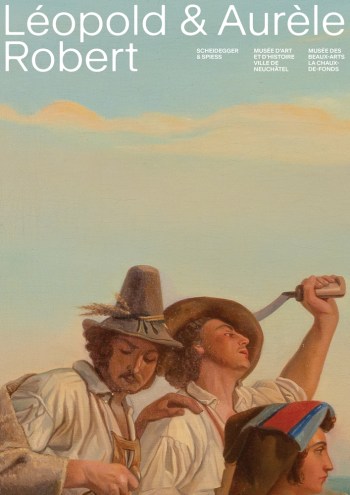 The Neuchâtel artist Léopold Robert (1794–1835), who enjoyed European acclaim during his lifetime, embodies the myth of the Romantic painter, doomed to a tragic fate and shrouded in mystery.
Educated in Paris at the École des Beaux-Arts and later in the studio of Jacques-Louis David, Robert moved to Italy in 1818. His genre paintings brought him great popular success during the first half of the 19th century but were less fulsomely received by the critics. The Musée d’art et d’histoire de Neuchâtel and the Musée des beaux-arts de La Chaux-de-Fonds have joined forces to pay tribute to the work of Léopold Robert and his brother Aurèle (1805–1871). The exhibition also re-examines Aurèle’s role, considering him not only as a ‘disseminator’ of Léopold’s oeuvre, but also as an artist in his own right. The joint exhibition focuses on Léopold Robert’s unfinished Seasons cycle and features works from both institutions as well as several prestigious loans. The exhibition in La Chaux-de-Fonds is given over to ‘Spring’, while Neuchâtel celebrates ‘Summer’ and ‘Winter’. The exhibition also explores how these masterpieces were produced and circulated, and examines their depiction of music, dance, and the beauty ideal. The exhibition is enriched by contributions from artist Gina Proenza that offer a direct, contemporary response to the historical works of Léopold and Aurèle Robert.
The catalogue (in French) is distributed by ACC Art Books:
David Lemaire and Antonia Nessi, eds., Léopold & Aurèle Robert (Scheidegger & Spiess, 2023), 240 pages, ISBN: 978-3858818874, £45.
◊ ◊ ◊ ◊ ◊
Note (added 26 October 2023) — The posting was updated to correct the dates of the exhibition (here originally given as 15 May — 15 October).










 Enfilade
leave a comment