New Book | Jewish Blues: A History of a Color in Judaism
From Penn Press:
Gadi Sagiv, Jewish Blues: A History of a Color in Judaism (Philadelphia: University of Pennsylvania Press, 2023), 252 pages, ISBN: 978-1512823370, $55.
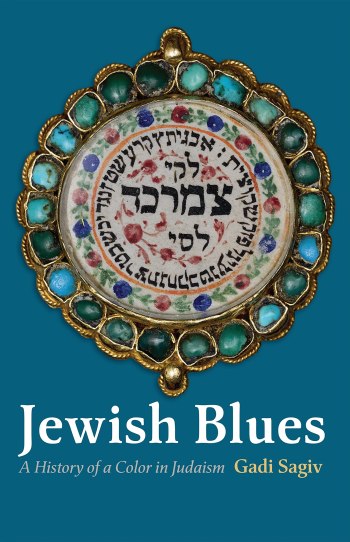 Jewish Blues presents a broad cultural, social, and intellectual history of the color blue in Jewish life between the sixteenth and twenty-first centuries. Bridging diverse domains such as religious law, mysticism, eschatology, as well as clothing and literature, this book contends that, by way of a protracted process, the color blue has constituted a means through which Jews have understood themselves.
In ancient Jewish texts, the term for blue, tekhelet, denotes a dye that serves Jewish ritual purposes. Since medieval times, however, Jews gradually ceased to use tekhelet in their ritual life. In the nineteenth century, however, interest in restoring ancient dyes increased among European scholars. In the Jewish case, rabbis and scientists attempted to reproduce the ancient tekhelet dye. The resulting dyes were gradually accepted in the ritual life of many Orthodox Jews. In addition to being a dye playing a role in Jewish ritual, blue features prominently in the Jewish mystical tradition, in Jewish magic and popular custom, and in Jewish eschatology. Blue is also representative of the Zionist movement, and it is the only chromatic color in the national flag of the State of Israel.
Through the study of the changing roles and meanings attributed to the color blue in Judaism, Jewish Blues sheds new light on the power of a visual symbol in shaping the imagination of Jews throughout history. The use of the color blue continues to reflect pressing issues for Jews in our present era, as it has become a symbol of Jewish modernity.
Gadi Sagiv is Associate Professor in the Department of History, Philosophy, and Judaic Studies at The Open University of Israel.
C O N T E N T S
Introduction
1 The Materiality of Blue in Premodern Judaism
2 Tekhelet in Medieval Jewish Mysticism: Cosmology, Theology, and Vision
3 Blue Garments in Early Modern Judaism: Between Kabbalistic Symbolism and Social Practice
4 The Modern Renaissance of the Tekhelet Dye
5 Reactions to Modern Tekhelet: Blue as a Sociocultural Challenge
Conclusion
Glossary
Notes
Index
Acknowledgments
Exhibition | The Sassoons
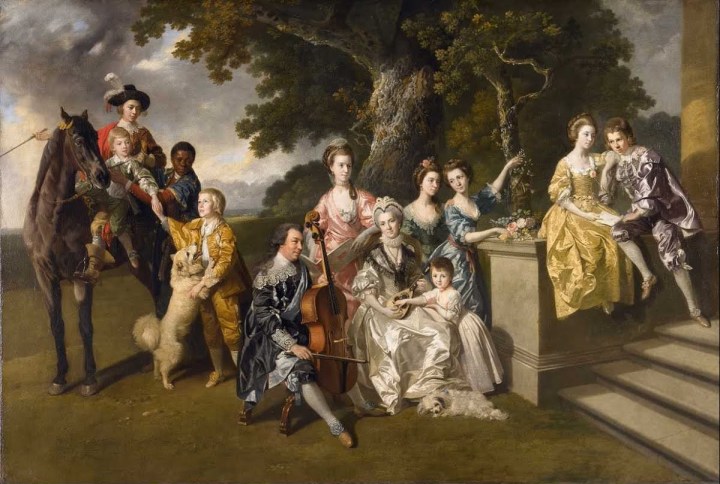
Johan Zoffany, The Family of Sir William Young, 1767–69, oil on canvas; 45 × 66 inches (National Museums Liverpool, Walker Art Gallery). Formerly in the Philip Sassoon Collection.
◊ ◊ ◊ ◊ ◊
From the press release (17 November 2022) for the exhibition:
The Sassoons
The Jewish Museum, New York, 3 March — 13 August 2023
Organized by Claudia Nahson and Esther da Costa
The Jewish Museum presents The Sassoons, an exhibition that reveals the fascinating story of a remarkable Jewish family, highlighting their pioneering role in trade, art collecting, architectural patronage, and civic engagement from the early 19th century through World War II. The exhibition follows four generations from Iraq to India, China, and England, featuring a rich selection of works collected by family members over time.
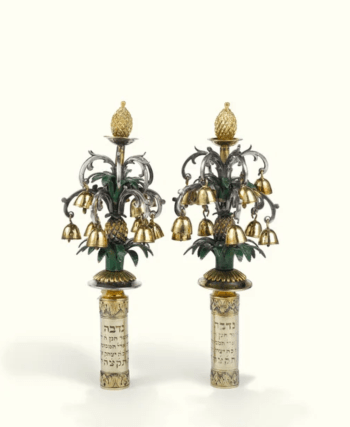
Torah finials, England, probably London, 1804, dedicated in 1834/35 (Hebrew inscription date), silver parcel gilt, and enamel, 6 inches (Collection of Jane and Stuart Weitzman). Formerly in the Reuben and Flora Sassoon Collections.
Over 120 works—paintings, Chinese art, illuminated manuscripts, and Judaica—amassed by Sassoon family members and borrowed from numerous private and public collections are on view. Highlights include Hebrew manuscripts from as early as the 12th century, many lavishly decorated; Chinese art and ivory carvings; rare Jewish ceremonial art; and Western masterpieces including paintings by Thomas Gainsborough and Jean-Baptiste-Camille Corot, and magnificent portraits by John Singer Sargent of various Sassoon family members. The Sassoons explores themes such as discrimination, diaspora, colonialism, global trade, and war that not only shaped the history of the family but continue to define our world today.
The exhibition narrative begins in the early 1830s when David Sassoon, the patriarch of the family, was forced to leave his native Baghdad due to the increasing persecution of the city’s Jewish population. Establishing himself in Mumbai (then Bombay) and initially involved in the cotton trade, his vision led the family from Iraq to India, China, and finally England where his descendants gradually settled over the decades. His activities soon grew to include the opium trade, which had escalated after the collapse of the East India Company in the mid-19th century, ending its monopoly and allowing private companies to engage in this profitable enterprise. He aligned with and benefitted from British colonial interests soon extending his business to China and England by deploying his eight sons to oversee new branches in Shanghai, Hong Kong, and London.
Although less known, the Sassoon women were discerning collectors. The exhibition will pay special attention to these unsung patrons of art. Rachel Sassoon Beer became the first woman in Britain to edit two newspapers, The Sunday Times and The Observer, and played a crucial role reporting on the Dreyfus affair in Britain. Her painting collection, sold at auction in 1927, listed, among other great works, one drawing and 15 paintings by Corot, a Constable, and a Peter Paul Rubens. Of a younger generation, Hannah Gubbay, a Sassoon on both her father’s and her mother’s side, was a major collector of 18th-century art, furniture, and porcelain, as was her cousin, Mozelle Sassoon.
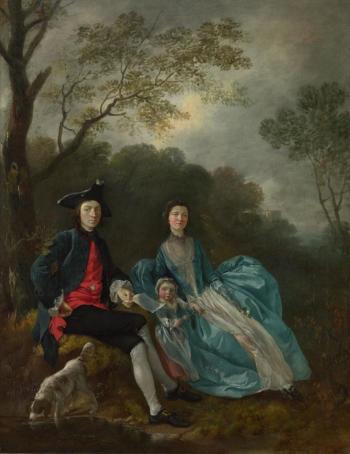
Thomas Gainsborough, Portrait of the Artist with His Wife and Daughter, ca. 1748, oil on canvas, 36 × 28 inches (London: National Gallery; acquired under the acceptance-in-lieu scheme at the wish of Sybil, Marchioness of Cholmondeley, in memory of her brother, Sir Philip Sassoon, 1994). Formerly in the Philip Sassoon Collection.
The exhibition also highlights the distinguished properties of the Sassoons in the United Kingdom. A Member of Parliament for the Conservative Party, Sir Philip Sassoon made active use of his three great residences, Park Lane (now destroyed) and Trent Park in London, and Port Lympne in Kent. Surrounded by landscaped gardens (in the case of Trent Park and Port Lympne) and filled with priceless works of art, all three were used by the government for high-profile cabinet meetings and receptions of foreign dignitaries and celebrities. Paintings of Port Lympne by Sir Winston Churchill, a frequent visitor, are featured.
The last section of the exhibition focuses on the service of a younger generation of Sassoons in the First World War. Sir Victor Sassoon served in the Royal Flying Corps, barely surviving an airplane crash that left him permanently disabled. Sir Philip Sassoon, private secretary to Field Marshal Douglas Haig, recruited his artist friends including John Singer Sargent to cover the war, and several of these works will be on display. A very different war is experienced through the poetry of Siegfried Sassoon. Though a brave and much decorated soldier, his graphic and shocking portrayal of the trenches and fierce criticism of the establishment were emblematic of a generation scarred by war’s brutality. Some of the journals he wrote and illustrated during battle, including his famous anti-war statement, will be on view.
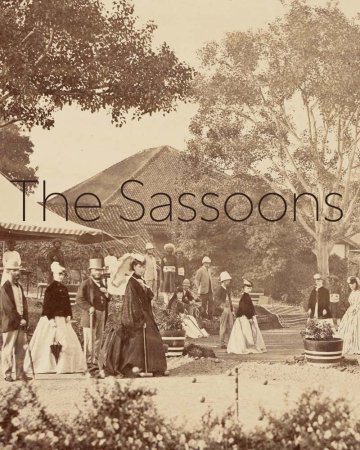 During the Second World War, some 18,000 Jewish refugees arrived in Shanghai fleeing Nazi Europe. They were able to survive the war thanks to the money raised by members of the Baghdadi Jewish community who resided in the city at the time. Prominent among them was Sir Victor Sassoon who donated considerable funds and placed several buildings at the disposal of the International Committee for European Immigrants.
Numerous private and public collections have contributed loans to the exhibition including His Majesty King Charles III, the British Museum, the National Gallery of London, the National Trust of Britain, the Tate, the Victoria & Albert Museum, the British Library, the Houghton Hall Collection, the Cambridge University Library, the Fitzwilliam Museum, the National Gallery of Ireland, the Israel Museum, the Metropolitan Museum of Art, the Museum of Fine Arts Boston, the Cleveland Museum of Art, and the Yale Center for British Art.
The Sassoons is organized by Claudia Nahson, Morris and Eva Feld Senior Curator at the Jewish Museum, New York, and Esther da Costa Meyer, Professor Emerita at Princeton University. The exhibition design is by Leslie Gill and Adam Johnston, Leslie Gill Architect; graphic design by Miko McGinty.
Esther da Costa Meyer and Claudia J. Nahson, The Sassoons (New Haven: Yale University Press, 2023), 256 pages, ISBN: 978-0300264302, $60.
British Art Studies, March 2023
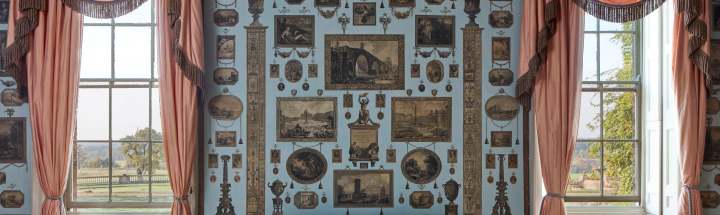
West Wall of the Print Room at Woodhall Park, Hertfordshire, created in 1782 by R. Parker.
Photographed in 2023 Matthew Hollow.
◊ ◊ ◊ ◊ ◊
The long eighteenth century in the latest issue of British Art Studies (lots of fascinating material; I’m especially taken by the videos that accompany Kate Retford’s article: they’re fabulous, particularly the one on ‘Making the Print Room’. –CH)
British Art Studies 24 (March 2023)
“Monuments Must Fall,” a ‘Conversation Piece’ convened by Edwin Coomasaru, with responses by Jodie Dowd and Nathan mudyi Sentance, Sasanka Perera, Wendy Bellion, Chrislyn Laurie Laurore, Stacy Boldrick, Joan Coutu, Emma Mahony, Nomusa Makhubu, Nickolas Lambrianou, and Raqs Media Collective.
‘Conversation Piece’ is a British Art Studies series that draws together a group of contributors to respond to an idea, provocation, or question.
Monumentality is an aesthetic form of social antagonism. . . . Many monuments are erected to do controversial work, and while they may proclaim a matter resolved or a problem consolidated, the reactions to them (sometimes long after they have been placed on pedestals) actually demonstrate the opposite is often the case. Monuments are not solely statues. Monumentality is the discursive space that surrounds certain public sculptures, including demands they be pulled down or protected, which can erupt into spontaneous or managed removal. Such a discursive space is inherently unstable, which is why most monuments ultimately must fall, physically or conceptually: either by being toppled or by having their original intentions obliterated and reimagined. . . .
Monuments are not simply physical structures, nor empty symbols, but are shaped by either social support systems that erect and conserve them, or by forms of social conflict which contest and topple them. The discursive space around a public statue, from protest to press coverage, and its translation into material conditions, is the making of its monumentality. . . .
Edwin Coomasaru’s essay and the ten responses are available here»
Kate Retford, “Cutting and Pasting: The Print Room at Woodhall Park.”
This article explores the exemplary surviving print room at Woodhall Park in Hertfordshire, created in 1782 for Sir Thomas Rumbold. A professional named “R. Parker” pasted more than 350 prints around the walls of this interior; the results were then carefully recorded in a catalogue and set of elevation diagrams. The first section, ‘Space’, analyses the print room within the broader context of the house, in order to connect exterior and interior, explore the relative qualities of ‘public’ and ‘private’ space, and consider neoclassical style as worked out in various media. The second, ‘Display’, unpacks the pasted scheme, looking at the relationship between ‘background’ images and ‘starring’ works, and that between iconography and pattern-making. The final part explores ‘Making’, analysing the processes by which prints were selected, trimmed, given paper borders, and arranged around the walls. This discussion considers both the degree to which the intermedial object of the reproductive print was translated into a trompe l’œil painting or sculpture in such schemes, and the creative work of collaging at play. The analysis in this article weaves together textual discussion with still and moving images, film, and animation. Combining these techniques, it aims to provide full documentation and analysis of the scheme, and to engage with embodied, mobile, and temporally determined viewing experience in both the house and the print room.
Article available here»
Melissa L. Gustin, “Do Sleeping Shepherds Dream of 3D-Printed Sheep: John Gibson, Oliver Laric, and Digital Neoclassicism.”
This article considers the relationship between John Gibson’s neoclassical sculpture The Sleeping Shepherd Boy [designed 1818] and Oliver Laric’s installations for the 2016 Liverpool Biennial using 3D models and prints of the Shepherd. These bodies of work allow us to think about their similarities in attitude towards imitation, the significance of the ‘neoclassical’ across different historic moments, and the cultures of copying or reproduction. It looks at the reproductive technologies of 3D scanning, printing, CNC milling, and digital remixing alongside historical reproductions such as casts and copies. These offer new potentially disruptive—but not destructive—opportunities within the legacy of neoclassical practices. The intellectual and artistic inheritance of neoclassical sculpture as an imitative practice after Greek and Roman antiquity informs Laric’s sculptural work. I draw on Alexander Nagel and Christopher Wood’s Anachronic Renaissance (2010) and George Kubler’s The Shape of Time (1968) to discuss Laric’s modular, large-scale 3D prints, which point towards issues of replacement, imitation, and wholeness. The open-source 3D models he produces as part of his practice are then used by other artists, including Zachary Eastwood-Bloom in his Divine Principles series, and the author, for making research objects.
Article available here»
Conference | Arts and Culture in the Capuchin Order
From ArtHist.net:
De habitudine Ordinis ad artem: Arts, Religion, and Culture in the Capuchin Order between the 16th and 18th Centuries
In-person and online, University of Teramo, 12–14 April 2023
The international conference De habitudine. Ordinis ad artem. Arts, Religion, and Culture in the Capuchin Order between the 16th and 18th Centuries aims to deepen the relationship between the arts, culture, religion, and the Capuchin Order on an international level, with a particular focus on the historical context and the religious dimension as an essential prerequisite for understanding artists, the production of art objects, commissions, and relations with the secular world on a global scale.
 The conference is divided into six sessions:
• The role of the Order in the context of the post-Tridentine Church
• Artistic practice between norms, prohibitions, and customs
• The cultural objects of the Capuchin world: use and circulation
• Capuchin patronage
• Capuchin painters and marangoni
• Images, knowledge, and preaching between devotion and catechesis
The conference will be held in-person and online in Italian. For both modalities, registration is required here. Links to access the conference in webinar mode will be sent by email in the days following registration.
W E D N E S D A Y , 1 2 A P R I L 2 0 2 3
9.00 Saluti Istituzionali
• Dino Mastrocola (Magnifico Rettore)
• Christian Corsi (Direttore Dip. Scienze della Comunicazione)
• fr. Roberto Genuin (Ministro Generale dei Frati Minori Cappuccini)
• fr. Carlo Maria Chistolini (Vicario provinciale della Prov. Serafica Immacolata Concezione OFM Cap.)
• fr. Daniel Kowalewski (Presidente Istituto Storico dei Cappuccini)
• Massimo Carlo Giannini (Università degli Studi di Teramo, Universidad Complutense de Madrid)
• Raffaella Morselli (Università degli Studi di Teramo)
9.30 Prolusione
• Mons. Felice Accrocca (Arcivescovo di Benevento, docente di Storia Francescana)
10.00 I Sessione | Il ruolo dell’Ordine nel contesto della Chiesa post-tridentina
Presiede: Grado Giovanni Merlo (Università degli Studi di Milano)
• Paolo Cozzo (Università degli Studi di Torino) — Fra corte e missioni: i cappuccini nella politica religiosa degli Stati sabaudi (sec. XVI–XVII)
• Massimo Carlo Giannini (Università degli Studi di Teramo, Universidad Complutense de Madrid) — ‘Las obligaciones de Religiosos y buenos Vassallos’: l’ordine dei cappuccini e la Monarchia spagnola (1671–1698)
• Giovanni Pizzorusso (Università degli Studi di Chieti-Pescara) — La controversa attività missionaria del cappuccino francese Pacifique de Provins dalla Persia al Nuovo Mondo (prima metà XVII secolo)
• Maria Teresa Fattori (Humboldt, Universität zu Berlin) — Cronologia e casi di frati cappuccini contrari alla schiavitù (XVII–XVIII secolo)
• Giuseppe Patisso (Università del Salento) — ‘I cappuccini di Richelieu’: Missioni ed evangelizzazione nella Nuova Francia durante la prima metà del XVII secolo
• Carlo Pelliccia (Università degli Studi Internazionali di Roma) — L’esperienza religiosa e missionaria di Onofrio Villiani (1715–1789) tra la Compagnia di Gesù e l’Ordine dei Frati Minori Cappuccini
13.15 Pausa pranzo
15.00 II Sessione | La pratica artistica tra norme, divieti e consuetudini
Presiede: Raffaella Morselli (Università degli Studi di Teramo)
• Yuri Primarosa (Roma, Gallerie Nazionali di Arte Antica) — Per un’estetica cappuccina nella Roma del primo Seicento. Caravaggio e Orazio Gentileschi
• Alessandro Zuccari (Sapienza Università di Roma) — Sviluppi dell’arte cappuccina tra Roma e Bologna
• Claudio Sagliocco (Sapienza Università di Roma) — Originale e copia nella pittura cappuccina
• Arianna Petraccia (Liceo Scientifico ‘D’Ascanio’, Montesilvano, PE) — I dipinti di Baccio Ciarpi per i cappuccini: Affinità elettive tra un pittore ed un Ordine religioso
• Attilio Maria Spanò (Liceo Classico ‘Campanella’, Reggio Calabria) — Controriforma e pauperismo francescano: L’esperienza architettonica e insediativa dei frati minori cappuccini
T H U R S D A Y , 1 3 A P R I L 2 0 2 3
9.30 III Sessione | Gli oggetti culturali del mondo cappuccino: uso e circolazione
Presiede: Luca Siracusano (Università degli Studi di Teramo)
• Roberto Rusconi (Università di Roma Tre) — Le parole e le pagine: I Cappuccini e i libri ovvero i libri dei Cappuccini
• Mario Tosti (Università degli Studi di Perugia) — Gli Atlanti cappuccini e l’immagine dell’Ordine nell’età della Controriforma
• Giovanna Granata (Università degli Studi di Cagliari) — Il patrimonio librario antico dei Cappuccini: Il caso della Sardegna
• Andrea Pezzini (Universität Bern) — Il culto di S. Ignazio da Santhià (1686–1770): Oggetti di devozione come cultura materiale
• Jason Di Resta (Wesleyan University) — Os ex ossibus meis et caro de carne mea: Giving Shape to Collective Identity in the Crypts of the Capuchin Order
12.45 Pausa pranzo
15.00 IV Sessione | La committenza cappuccina
Presiede: Anna Orlando (Advisor Cultura Comune di Genova)
• Donatella Biagi Maino (Università di Bologna) — L’arte per i cappuccini in Emilia-Romagna
• Laura Facchin (Università degli Studi dell’Insubria) — Arti figurative nelle chiese cappuccine dalla capitale ai territori della Provincia Pedemontana
• Vincenzo Sorrentino (Fondazione 1563 per l’Arte e la Cultura) — Alessandro, Giovanni e Cherubino Alberti nella chiesa dei Cappuccini di Frascati
• Ondřej Slanina (Universität Bern) — Unique Large Pearl Monstrance from the Capuchin Loreto in Hradčany, Prague
• Pietro Costantini (Università degli Studi di Teramo) — Insediamenti e patrimonio culturale: Donazioni e committenze per i frati cappuccini in Abruzzo (sec. XVI–XVIII)
F R I D A Y , 1 4 A P R I L 2 0 2 3
9.30 V SESSIONE | Pittori, marangoni e fabbricieri cappuccini
Presiede: Giorgio Fossaluzza (Università degli Studi di Verona)
• Isabella Di Liddo (Università degli Studi di Bari Aldo Moro) — Le botteghe dei cappuccini in Puglia tra Sei e Settecento: Prime tracce per uno studio
• Anna Orlando (Advisor Cultura Comune di Genova) — Bernardo Strozzi sperimentatore: Un pittore cappuccino dal convento genovese alla fuga a Venezia
• Miriam Kreischer (Ludwig-Maximilians-Universität) — The impact and importance of Paolo Piazza on the European art landscape of the 17th and 18th centuries: Paolo Piazza in Bavaria
• Luca Calenne (Archivio storico diocesano ‘Innocenzo III’, Segni, RM) — Un risarcimento per Fra’ Antonio Borgognone
• Daniele Giglio (Archivio storico Prov. Serafica Immacolata Concezione OFM Cap. – sez. di Assisi) — Fabbriche, arti e mestieri dei cappuccini umbri nel Settecento
12.45 Pausa pranzo
15.00 VI Sessione | Le immagini, i saperi e la predicazione tra devozione e catechesi
Presiede: Cecilia Paolini (Università degli Studi di Teramo)
• Francesco Nocco (Archivio storico Prov. dei Cappuccini di Puglia, Università degli Studi di Bari Aldo Moro) — Predicatori della Terra di Bari e della Terra d’Otranto nell’Archivio storico della Provincia dei Cappuccini di Puglia (sec. XVI–XVIII)
• Tereza Horáková (Masaryk University) — Possibilities and ‘offer’ of devotional practice in Capuchin monasteries in the Czech lands during the 18th century
• Javier González Torres (Fundación Victoria) Sergio Ramírez González (Universidad de Málaga) — La promoción cultual de un santoral eucarístico propio: Concreción conceptual y praxis artística en los conventos capuchinos andaluces
• Daniela Caracciolo (Università del Salento) — ‘Le cose spirituali non si possono dipingere’: La questione delle immagini sacre negli scritti di Bernardino Ochino
• Martina Leone (Università degli Studi di Teramo) — Iconografia cappuccina da Roma alla Serenissima: Francesco Ruschi tra innovazione e tradizione
Predoctoral Fellow | Decay, Loss and Conservation in Art History
From the Bibliotheca Hertziana:
Predoctoral Fellow for the Research Group ‘Decay, Loss and Conservation in Art History’
Led by Francesca Borgo at the Bibliotheca Hertziana – Max Planck Institute for Art History in Rome
Applications due by 31 May 2023
The Lise Meitner Research Group “Decay, Loss and Conservation in Art History” led by Francesca Borgo at the Bibliotheca Hertziana – Max Planck Institute for Art History in Rome seeks to appoint a Predoctoral Fellow (M/F/D). The Max Planck Society is Germany’s premier research organization. The 86 Max Planck Institutes conduct research at the highest level in the service of the general public in the natural sciences, life sciences, social sciences, and the humanities. The deadline for application is 31 May 2023, 12pm CEST. Interviews will be held virtually in June 2023. Candidates should propose a funding period of desired length within the academic year 2023/2024. Motivations for the length of period proposed should be made clear in the cover letter.
The Predoctoral Fellow will conduct their own research within the framework of the Research Group, which focuses on European and Colonial art histories from the fifteenth to the eighteenth century, a period during which techniques and media were ranked based on their ability to last, and decay was first recognized as a subject worthy of aesthetic and scientific attention.
Excellence in research, commitment to pursue new insights through original scholarship, and willingness to become part of a group of young, international scholars are essential. Fellows will actively participate in the Group’s activities and are invited to contribute to its publication output while benefitting from editorial and image licensing support. They will be responsible for planning and organizing seminars, workshops, visits, and fieldtrips in collaboration with other team members and under the supervision of the Group Leader. Candidates must be conversant in English and familiar with Italian and/or German.
This position is intended for a PhD student enrolled at any university worldwide who is in the finishing stages of their dissertation. In addition to clarifying how residence in Rome benefits their PhD research, candidates should include in their cover letter a statement of how their work advances the goals of the research group. Candidates should also seek the approval of their doctoral advisor. Candidates are expected to review the Research Group’s research agenda, past initiatives and event series, as well as the broader structure of the Bibliotheca Hertziana into which the Research Group fits. We welcome applications from doctoral students in every field within the history of art, technical art history, conservation history, and museum studies, with preference given to projects spanning traditional disciplinary boundaries. The selection committee aims to assess the ability of candidates to contribute in a collegial way to the intellectual life of the Research Group.
This is a residential fellowship. By the start of the appointment, candidates are expected to have taken up residence in Rome. The fellowship may not be held concurrently with another major fellowship award; applicants must disclose any supplementary funding and may not take on other obligations during their fellowship period.
The Max Planck Society offers a fixed-term contract of employment. Stipend and benefits are determined according to the German Civil Service Collective Agreement (65% TVöD Bund E 13) or equivalent, depending on individual personal circumstances. Fellows enjoy all the privileges of the Institute, including library access seven days a week, a research budget, and their own carrel or desk.
We encourage women and individuals from communities that are underrepresented in academia to apply. The Max Planck Society is committed to fostering equal opportunities and diversity and welcomes applicants from all parts of society, regardless of gender, ethnicity, disabilities, or sexual orientation.
To apply the candidate must upload the following documents as separate PDF files to the application portal:
• Cover letter that clearly states the candidate’s contribution to the Research Group’s objectives
• Description of proposed research project (max. 1000 words), accompanied by a bibliography
• Curriculum vitae with list of publications (including those forthcoming, under revision, submitted, or in preparation)
• One reference letter
• Output proposal (max. 500 words). This could be a site visit, a collaboration with a local collection, a research seminar, a publishable piece of writing, or a contribution to a national or international conference. The proposal should detail specific names and locations and specify how the output aligns with the Research Group’s themes.
New Book | Uproar! Scandal and Satire in Georgian London
From Icon Books:
Alice Loxton, Uproar! Scandal and Satire in Georgian London (London: Icon Books, 2023), 416 pages, ISBN: 978-1785789540, £25.
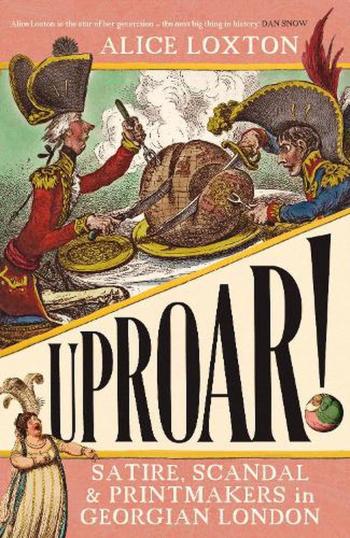 London, 1772: a young artist called Thomas Rowlandson is making his way through the grimy backstreets of the capital, on his way to begin his studies at the Royal Academy Schools. Within a few years, James Gillray and Isaac Cruikshank would join him in Piccadilly, turning satire into an artform, taking on the British establishment, and forever changing the way we view power.
Set against a backdrop of royal madness, political intrigue, the birth of modern celebrity, French revolution, American independence and the Napoleonic Wars, UPROAR! follows the satirists as they lampoon those in power, from the Prince Regent to Georgiana, Duchess of Devonshire. Their prints and illustrations deconstruct the political and social landscape with surreal and razor-sharp wit, as the three men vie with each other to create the most iconic images of the day.
UPROAR! fizzes with energy on every page. Alice Loxton writes with verve and energy, never failing to convince in her thesis that Gillray and his gang profoundly altered British humour, setting the stage for everything from Gilbert and Sullivan to Private Eye and Spitting Image today. This is a book that will cause readers to reappraise everything they think they know about genteel Georgian London, and see it for what it was—a time of UPROAR!
Alice Loxton is a 27-year-old historian and the lead female presenter at History Hit TV, where she regularly co-presents documentaries with Dan Snow. She is also a well-loved face of the History Hit YouTube channel, and shares her passion for history with over a million followers on TikTok and Instagram. Follow her at @history_alice.










 Enfilade
leave a comment