Colloquium | A Multifaceted Rococo
From the conference programme:
A Multifaceted Rococo / Un Rococo Multiforme
Musée de Grenoble and MSH Alpes, Grenoble, 21-22 September 2023
Organized by Marlen Schneider and Michael Yonan, with Joëlle Vaissiere
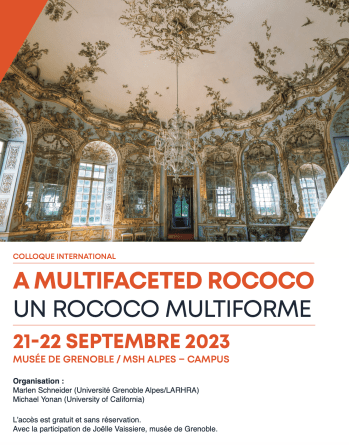 Né à Paris sous l’Ancien Régime en réponse à la culture artistique du règne de Louis XIV, le rococo semble évocateur de toute une ère de l’histoire française : un art dédié aux surfaces et à la sensualité, doté d’une complexité formelle et visuelle et d’une abondance ornementale. Or, le rococo a eu un impact sur l’évolution de l’art du XVIIIe siècle à une échelle globale, et certaines nations ont même vu naître des variations capables de rivaliser avec les exemples parisiens. Le colloque permettra d’aborder à la fois le rococo dans sa dimension transnationale, mais aussi sa culture matérielle, prenant en compte les formes et usages multiples de l’art rocaille. Cette approche mettra en lumière un large éventail d’utilisations, d’expressions formelles, de choix stylistiques, de significations culturelles et de pratiques, qui dépassent grandement nos connaissances actuelles.
t h u r s d a y , 2 1 s e p t e m b e r 2 0 2 3
14.30 Accueil
15.00 Introduction — Michael Yonan (University of California) and Marlen Schneider (Université Grenoble Alpes/LARHRA)
15.30 Redéfinir le rococo
Modération: Marlen Schneider (Université Grenoble Alpes/LARHRA)
• Carl Magnusson (Université de Lausanne) — Réduire le foisonnement artistique du XVIIIe siècle en style
• Michael Yonan (University of California) — The Ecological Rococo of 18th-Century Bavaria
• Philippe Halbert (Wadsworth Atheneum Museum of Art) — Canada’s Spiritual Rococo
f r i d a y , 2 2 s e p t e m b e r 2 0 2 3
9.00 Accueil
9.15 Géographies du rococo
Modération: Michael Yonan (University of California)
• Philippe Bordes (Université Lyon II / LARHRA) — Du Rococo européen à Paris dans les années 1780: Johann Julius Heinsius et Gaetano Merchi
• Vladimir Simic (University of Belgrade) — Transcending Borders: Rococo Artistic Synthesis in Southeast Europe and the Habsburg Influence
• Marlen Schneider (UGA / LARHRA) — Le Rococo frédéricien fut-il français? Les sources et enjeux multiples de l’art de cour sous Frédéric II en Prusse
• Stacey Sloboda (UMass Boston) — Making Lines Matter: Carving in 18th-Century London
14.00 Matérialités
Modération: Sophie Raux (Université Lyon II / LARHRA)
• Thomas Wilke (Universität Greifswald) — Rocaille in the Making: François Antoine Vassé’s Designs for the French Navy
• Agata Dworzak (Jagiellonian University) — Expressive Rococo: Lviv Rococo Sculpture between Emotions and Form
• Sandra Costa Saldanha (Universidade de Coimbra) — The Rise of Rococo: Approaches on a Long-term Sensibility in 18th-Century Portuguese Sculpture
• Joana Mylek (Munich) — An Abundance of Everything: The Bohemian Rococo in the 19th Century
17.30 Conclusions
Call for Papers | Collecting and Knowledge Production through Travel
A reminder that a few sessions at RSA push the ‘Renaissance’ well into the early modern period. The full Call for Papers is available here.
Collecting and Knowledge Production through Travel (The Society for the History of Collecting)
Renaissance Society of America Conference, Palmer House Hilton, Chicago, 21–23 March 2024
Proposals due by 8 August 2023
The importance of travel in the circulation of ideas and goods in the early modern period cannot be overemphasized. Travel—whether for commercial, private, or public purposes—was a source of information and experience, and travellers collected at every level, bringing back new and rare objects as well as commercially important goods. Travellers might return with works of art, which they then organised and arranged into their collections, while traders negotiated and acquired rarities to be sold on the European markets. However, collectors created imaginary worlds in their collections as they gathered information, ideas, descriptions, and literary texts from cultures other than their own, or employed ekphrasis to relate new narratives and new art works.
The proposed sessions at RSA 2024 aim to investigate the intellectual contexts in which objects were collected, the relationships between travel accounts, whether published or unpublished, and the creation of new understandings of worlds beyond the immediate world of the collector. We intend to explore the dynamic relationships between trade and collectibles, the perceptions created by travelogues and travel manuscripts, and travels of the imagination, which could transcend the voyages made and recounted. We invite new research into any aspect of these topics as we aim to recover the intellectual environment created by travel in early modern Europe that influenced collectors. Equally important were the networks created by travellers who voyaged to different centres in Europe and beyond, possibly through previous contacts but equally creating new contacts and new networks in which collections were discussed and exchanged. We are also interested in papers that delve into the question of travel from a non-European perspective.
As an associate organization of RSA, the Society for the History of Collecting can sponsor up to four sessions. Proposals are invited for 20-minute papers. They must include a title, an abstract of no more than 150 words, keywords, and a one-page CV (including PhD completion year or expected completion). Speakers will need to be members of RSA at the time of the conference, and we strongly encourage them to be members of the Society for the History of Collecting. Proposals should be sent to session convenors Sophia McCabe, Adriana Turpin, and Lisa de Zoete at info@societyhistorycollecting.org with the heading “RSA 2024 Proposal” by 8 August 2023.
Conference | Listening In: Architectures, Cities, and Landscapes
From the conference website:
Listening In: Conversations on Architectures, Cities, and Landscapes, 1700–1900
ETH Zürich, Hönggerberg and Zentrum campus, 13–15 September 2023
 Who do we listen to when we write histories of architectures, cities, and landscapes? How many women authors can we find among our sources? How many of them are cited by those whose research we read? We argue that women and other marginalised groups have always been part of conversations on architectures, cities, and landscapes—but we have not had the space to listen to them. This conference is an invitation to reconstruct such conversations, real, imagined, and metaphorical ones, taking place in the 18th and 19th centuries, in any region, in order to diversify the ways we write histories. Taking the art of conversation, integral as both practice and form to the period in Western thought, and repurposing it to dismantle the exclusivity of historiography, this conference calls for contributions which bring women into dialogue with others.
Listening In proposes a new approach to the ‘canon’ and its protagonists. Rather than either fighting its existence or expanding it by means of ‘exceptions to the rule’, we call for the setting up of productive conversations. We acknowledge that the canon never exists on its own; instead, it is shaped by what Griselda Pollock has called “that which, while repressed, is always present as its structuring other” (1999, 8). This conference is envisaged as a listening exercise. We regard a conversation as both codified practice as well as a specific act of verbal exchange, spoken or written, on a particular subject—here architectures, cities, and landscapes—occurring in a specific site, from street to salon, kitchen to court, construction site to theatre, field to church, or book to newspaper, to name but a few.
Listening In is organised in the context of two externally funded research projects based at gta, ETH Zurich. Women Writing Architecture, 1700–1900 (WoWA) is funded by the ERC, led by Anne Hultzsch, and studies female experiences of architecture and landscapes as recorded in women’s writings from South America and Europe. The SNSF-funded project Building Identity: Character in Architectural Discourse and Design, 1750–1850, led by Sigrid de Jong and Maarten Delbeke, focuses on the uses and meaning of the notion of ‘character’ in architectural criticism and practice. Both projects share an interest in the experiences of marginalised groups, especially those who identified as women, and strive to have them heard not in a niche, but in the centre of our field. With this conference we wish to open up our approaches to a wider field of research, going beyond our respective geographical frameworks.
There will be a limited number of free audience tickets for our two-day conference. To register and for more information please visit our website.
This conference is part of a project that has received funding from the European Research Council (ERC) under the European Union’s Horizon 2020 research and innovation programme (Grant agreement No.949525).
Key Note Speakers
• Prof Mabel O. Wilson
• Prof Jane Rendell
Organised by
Group Anne Hultzsch and Professor Maarten Delbeke Chair, Institute for the History and Theory of Architecture (gta), ETH Zürich
Scientific Committee
Prof Maarten Delbeke, PD Dr Anne Hultzsch, Dr Sigrid de Jong, Dr Sol Pérez Martínez, Dr Nikos Magouliotis
Orginising Committee
Prof Maarten Delbeke, PD Dr Anne Hultzsch, Dr Sigrid de Jong, Dr Sol Pérez Martínez, Dr Nikos Magouliotis, Dr Noelle Paulson, Elena Rieger, Alejandra Fries
Call for Papers | Women Making Space in South America, 1400–1900
Women Making Space in South America, 1400–1900 (#S11)
Session at EAHN, Athens, 19–23 June 2024
Chairs: Anne Hultzsch and Dr Sol Pérez Martínez, ETH Zurich
Proposals due by 8 September 2023
The period between 1400 and 1900 in South America is characterised by a set of transitions and processes of transculturation as indigeneity emerged from the clash with colonisation. Empires competed, indigenous cultures grappled with European colonisation, and both later fed into American nation building. This session focuses on the period between the creation of the Tawantinsuyu, the Incan Realm of the Four Parts, in 1438, thus the definition of Andean territory as a continuous region, to the 1880s when the Mapuche people in Southern Chile and Argentina were the last indigenous group to lose control over their territories. The session aims to address gaps in the architectural historiography of the Andean region especially regarding moments of transition where “cultures meet, clash and grapple with each other,” creating “contact zones” (Pratt, 1991). We seek to start these new histories through the perspective of women—from any class or ethnicity—as one of the groups often excluded from scholarship on the period. We ask how those identifying as women influenced, shaped, critiqued, and made spaces within and alongside the force field of the contact zone, with its asymmetrical power relations, its struggles, pains, and opportunities?
Challenging linear Euro-American architectural narratives of styles imported to the supposed new world, we invite contributions exploring the role of women in shaping public and private spaces in the Andean territories—from home and convent to street and plaza. Practices to be examined for female space-making opportunities could include, for example, building, homemaking, designing, writing, patronage, financing, teaching, lobbying, gardening, or farming, even mothering. Contributions should explore questions emerging from the triangle between gender, architectures, and South America as a contact zone. What are the spatial categories most useful when exploring women ‘making space’ in the period and region (Matrix, 1984)? Does the public-private dichotomy of separate spheres serve here? What sources provide evidence how women made space? Which writing techniques yield the best results, from archival tracing to historical fiction? How can we fill gaps when there are few traces (Hartman, 2021)?
Besides a methodological appeal for new approaches, the session also queries key terminologies of architectural history: Who is the space-maker during this period? What is the relationship between space-making and the architect? Did the professionalisation of architecture during the 19th century further the exclusion of women from space-making practices? Was there a period of increased access colonial or institutional transitions closed doors to women? Are there comparable developments in other regions?
This session hopes to facilitate a pivotal change to how we look at the formation of architectural cultures in the past through the eyes of women and their lived experiences, considering questions of race, class, or religion, besides those of gender. As scholarship in the field of Latin American architectural history has so far often been dominated by isolated time periods defined by the male coloniser—such as pre-colonial, colonial, post-colonial, modernism—the proposed period between c. 1400 and 1900 invites cross-readings based on dynamic approaches to historical moments, places, and protagonists.
Information about the session can be found here.
Abstracts are invited by September 8, 2023, and should consist of no more than 300 words. Please submit your proposal following the instructions on the conference website. Submit at eahn2024@gmail.com along with the applicant’s name, email address, professional affiliation, address, telephone number, and a short curriculum vitae, all included in one single PDF file. The file must be named as follows: session or round table number, hyphen, surname e.g. S11-Tsiambaos.pdf.
Display | Works by José Campeche and Francisco Oller at MFA, Boston
From the press release (20 June 2023) . . .
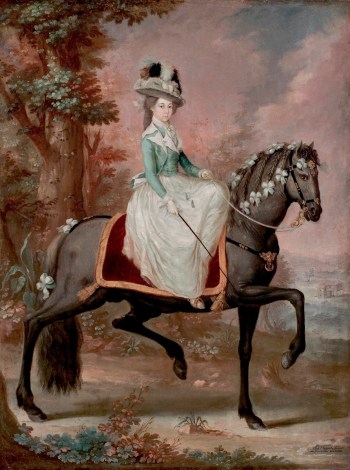
José Campeche y Jordán, Lady on Horseback, 1785, oil on panel, 40 × 30 cm (Museo de Arte de Ponce, Luis A. Ferré Foundation).
Paintings by legendary Puerto Rican artists José Campeche and Francisco Oller are presented in dialogue with art from the same period in the MFA’s collection. The Museo de Arte de Ponce continues to share its collection with museums worldwide as it rebuilds its Edward Durell Stone-designed building damaged by the January 2020 earthquakes.
The Museum of Fine Arts, Boston (MFA) and the Museo de Arte de Ponce (MAP) jointly announce that important works by José Campeche y Jordán (1751–1809) and Francisco Oller y Cestero (1833–1917)—the most influential Puerto Rican artists of the 18th and 19th centuries—are now on display at the MFA (as of 29 June 2023). This special installation features five paintings by Campeche and Oller from MAP’s collection, including one of the most iconic works in the history of Puerto Rican art, Campeche’s Lady on Horseback (1785). Oller’s famed Hacienda Aurora (1898), as well as two rare paintings on ceramic plates, open conversations about histories of the Puerto Rican landscape and artistic exchanges across Europe and the Americas.
“This partnership with the Museo de Arte de Ponce creates an unprecedented opportunity for us to introduce our audiences to Campeche and Oller, two deeply significant Puerto Rican painters who remain understudied outside of the island,” said Matthew Teitelbaum, Ann and Graham Gund Director. “Displayed in our Art of the Americas Wing alongside important works of colonial art and landscape painting from our collection, these special loans from MAP will highlight the contributions of Puerto Rican artists and offer a new point of connection for Boston’s vibrant Puerto Rican community.”
The paintings will be highlighted during tours at the MFA’s annual Latinx Heritage Night on September 21 as well as through additional programs.
The collection of the Museo de Arte de Ponce consists of approximately 4,500 works of art and is recognized for important examples of Baroque, Pre-Raphaelite, and Victorian art. The renowned collection of Puerto Rican art makes up about one-third of the museum’s holdings, including works from the 18th to 21st centuries. Following a catastrophic series of earthquakes in January 2020 that damaged the internationally recognized Edward Durell Stone-designed building, the main galleries of MAP have remained closed to the public.
As the galleries are rebuilt, MAP remains committed to keeping the collection accessible through collaborations with institutions on the island and beyond. In New York City, the Metropolitan Museum of Art is currently displaying five Victorian masterpieces, including Flaming June by Frederic Leighton, John Everet Millais’s The Escape of a Heretic, 1559, and Edward Burne-Jones’s Small Briar Rose series. From September 2022 to June 2023, Chicago’s National Museum of Puerto Rican Arts and Culture exhibited Nostalgia for My Island: Puerto Rican Painting from the Museo do Arte de Ponce (1786–1962). Additional loans are expected to be announced in other major cities in the United States, as well as in Europe.
“Not only is the museum a cultural institution ingrained in the fabric of Puerto Rican society, but it is also internationally renowned because of the extraordinary collections it houses, “said Cheryl Hartup, Director of the Museo de Arte de Ponce. “When the works travel, a conversation is created within the ecosystem of international art institutions and their collections and audiences. We couldn’t be more thrilled to share iconic paintings by Puerto Rican artists with the MFA, Boston as the museum is repaired.”
The Museo de Arte de Ponce expects to fully reopen in 2024.
New Book | Textile in Architecture
From Routledge:
Didem Ekici, Patricia Blessing, Basile Baudez, eds., Textile in Architecture: From the Middle Ages to Modernism (Routledge, 2023), 240 pages, ISBN: 978-1032250441 (hardback), $136 / ISBN: 978-1032250427 (paperback), $39.
 This book investigates the interconnections between textile and architecture via a variety of case studies from the Middle Ages through the twentieth century and from diverse geographic contexts.
Among the oldest human technologies, building and weaving have intertwined histories. Textile structures go back to Palaeolithic times and are still in use today and textile furnishings have long been used in interiors. Beyond its use as a material, textile has offered a captivating model and metaphor for architecture through its ability to enclose, tie together, weave, communicate, and adorn. Recently, architects have shown a renewed interest in the textile medium due to the use of computer-aided design, digital fabrication, and innovative materials and engineering. The essays edited and compiled here, work across disciplines to provide new insights into the enduring relationship between textiles and architecture. The contributors critically explore the spatial and material qualities of textiles as well as cultural and political significance of textile artifacts, patterns, and metaphors in architecture.
Textile in Architecture is organized into three sections: “Ritual Spaces,” which examines the role of textiles in the formation and performance of socio-political, religious, and civic rituals; “Public and Private Interiors” explores how textiles transformed interiors corresponding to changing aesthetics, cultural values, and material practices; and “Materiality and Material Translations,” which considers textile as metaphor and model in the materiality of built environment. Including cases from Morocco, Samoa, France, India, the UK, Spain, the Ancient Andes and the Ottoman Empire, this is essential reading for any student or researcher interested in textiles in architecture through the ages.
Didem Ekici is Assistant Professor in the Department of Architecture and Built Environment at the University of Nottingham. She is the co-editor of Housing and the City (Routledge, 2022). Healing Spaces, Modern Architecture, and the Body (Routledge, 2017) as well as the author of numerous articles on modern architecture culture. She is currently working on her monograph titled Body, Cloth, and Clothing in Architecture from the Age of Mass Manufacture to the First World War.
Patricia Blessing is Assistant Professor of Islamic Art History in the Department of Art & Archaeology at Princeton University. Her first book, Rebuilding Anatolia after the Mongol Conquest: Islamic Architecture in the Lands of Rūm, 1240–1330 (Ashgate, 2014) investigates the relationship between patronage, politics, and architectural style after the integration of the region into the Mongol empire. Her second book, Architecture and Material Politics in the Fifteenth-Century Ottoman Empire (Cambridge University Press, 2022) analyses how transregional exchange and the use of paper shaped building practices across the Ottoman realm.
Basile Baudez is Assistant Professor of architectural history in the Art & Archaeology department at Princeton University. His first book Architecture et Tradition Académique au Siècle des Lumières (2012) questions the role of architects in early modern European academies. He co-edited several volumes dedicated to French architecture and curated exhibitions on architectural drawings at the Ecole des Beaux-Arts and the Courtauld Institute of Art. His latest book, Inessential Colors: Architecture on Paper in Early Modern Europe (Princeton University Press, 2021) questions the role of color in Western architectural representation from the Renaissance to the nineteenth century. He currently works on an urban history of textiles in 18th-century Venice.
c o n t e n t s
Part 1 | Ritual Spaces
Introduction to Part One — Didem Ekici
1 The Red Tent in the Red City: The Caliphal Qubba in Almohad Marrakesh — Abbey Stockstill
2 ‘He will Lift off the Covering Which is Over All the Peoples’: Seeing Through Medieval Lenten Veils — Clare Frances Kemmerer
3 Architectural Space and Textiles: Tying Samoan Society Together — Anne E. Guernsey Allen
Part 2 | Public and Private Interiors
Introduction to Part Two — Basile Baudez
4 Le Rideau Tire: Interior Drapery, Architectural Space, and Desire in Eighteenth-Century France — Mei Mei Rado
5 The Fabric of the New: Mediating Architectural Change in Late Colonial India — Abigail McGowan
6 Contrast and Cohesion: Textiles and Architecture in 1930’s London — Emily M. Orr
Part 3 | Materiality and Material Translations
Introduction to Part Three — Patricia Blessing
7 Textiles by Other Means: Seeing and Conceptualizing Textile Representations in Early Islamic Architecture — Theodore Van Loan
8 The Textility of the Alhambra — Olga Bush
9 The Textile Foundations of Ancient Andean Architecture — Andrew James Hamilton
10 The Ruler’s Clothes and the Manifold Dimensions of Textile Patterns on Muslim Funeral Architecture in the Mausoleum of the First Crimean Khans — Nicole Kancal-Ferrari
11 A Tented Baroque: Ottoman Fabric (and) Architecture in the Long Nineteenth Century — Ashley Dimmig
Sarah Turner Appointed Director of the Paul Mellon Centre
From the press release (29 June 2023) from the Mellon Centre:
 Dr Sarah Victoria Turner has been appointed Director of the Paul Mellon Centre. Sarah Turner has been Acting Director of the Centre since March 2023 and will take up the post from July 2023. She follows Mark Hallett as the sixth Director of the Paul Mellon Centre and will be its first female Director since its founding in 1970.
Sarah Turner’s directorship will build on her eight years at the Centre, first as Assistant Director for Research and lately as Deputy Director, during which time she has overseen many innovative programmes and collaborative projects with partners in the UK and internationally, including establishing the national art writing competition, Write on Art, with Art UK, co-leading the London-Asia research project, and co-writing and co-hosting the Sculpting Lives podcast. She is editor-in-chief of the award-winning, open-access journal British Art Studies (since its founding in 2015). During her time at the Paul Mellon Centre, Dr Turner has had oversight of the archive & library, digital activities, book and online publications, and the research programme.
Sarah Turner read History of Art at Pembroke College, Cambridge. At the University of Leeds, she studied for an MA in Sculpture Studies, run in partnership with the Henry Moore Institute, and then completed her PhD at the Courtauld Institute of Art. She began her academic career at the University of York where she was first a Teaching Fellow and then a Lecturer in the Department of History of Art. As an art historian, she has published widely and has co-curated several major exhibitions, and much of her writing has focused on the entangled relationships between Britain, the British Empire, and South Asia.
Susan Gibbons, Vice Provost for Collections and Scholarly Communication, Yale University, and ex-officio Chief Executive of the Paul Mellon Centre commented: “I am delighted to announce the appointment of Sarah Victoria Turner. Her energy and passion for collaboration as a scholar and curator, and her strong leadership skills, make her an exceptional appointee.”
Sarah Turner said: “I am thrilled to be leading an outstanding team of people at the Paul Mellon Centre. I look forward to working closely with the Yale community, particularly our partner institution, the Yale Center for British Art, to take the Centre forward in its mission to promote activities that expand and enhance understandings of British art. The Paul Mellon Centre offers incredible resources that support research, curating and education activities. One of my aims as Director is to share these as widely as possible and to open up new conversations, ideas and narratives about the histories of British art. I am excited about the future direction of work that the Centre will shape and support. As Director, I will be a vocal champion for the value of art and architectural history and research on visual culture more broadly in helping us navigate some of the most complex questions of our time.”
Portrait at Greenwich Reattributed to Gainsborough
From the press release, via Art Daily:
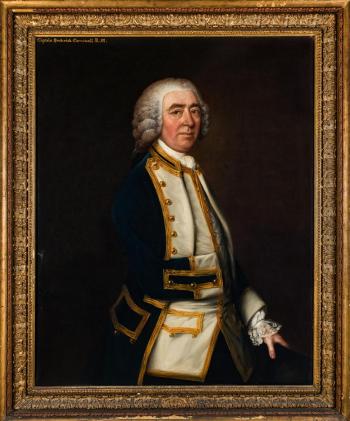
Thomas Gainsborough, Portrait of Captain Frederick Cornewall, ca. 1762 (Greenwich: National Maritime Museum).
Royal Museums Greenwich has announced the discovery of a portrait by famed eighteenth-century artist Thomas Gainsborough (1727–1788). Recent research into the Portrait of Captain Frederick Cornewall (ca. 1762) by Hugh Belsey and RMG curators has led to the exciting reattribution to Gainsborough.
Gainsborough was a leading artist in the second half of the eighteenth century. He is celebrated for his intimate and characterful portraits produced with lively brushwork. He was a founding member of the Royal Academy and has had a lasting influence in British art. The three-quarter-length portrait of Captain Frederick Cornewall (1706–1788) entered the RMG collection in 1960. It was recorded as a Gainsborough, but the curator at the time did not deem it of a high enough quality. It was attributed to an unknown artist and has been in storage for at least three decades.
Hugh Belsey had discovered a photograph of Cornewall’s portrait from the early twentieth century when the painting was owned by the London dealers, Agnew’s. He then traced the painting through several sales to the collector, Edward Peter Jones, but here the trail went cold. Unbeknownst to Belsey, Jones had bequeathed the painting to RMG in 1960. It was not until 2022, when Belsey’s friend was looking through the illustrated catalogue of the National Maritime Museum’s collection, that Belsey became aware that the painting may be in the RMG collection. Belsey requested to see the portrait in the museum stores in February 2022 and, on inspection of the painting, it became clear from the warm palette and unrivalled draughtsmanship that it was a Gainsborough.
Belsey has dated the painting to about 1762 when Gainsborough was working in Bath and sees it as an impressive example of the painter’s work from this period. Cornewall stands against a plain brown background in undress uniform and a bag wig. Gainsborough’s delicate brushwork is especially obvious in the most detailed areas of the picture, such as the lace cuff around Cornewall’s left wrist. Society columns from newspapers of the time show that Cornewall visited Bath in March 1762. The painting was presumably commissioned during this visit. It was perhaps intended to commemorate Cornewall’s retirement from active naval service the previous year. Cornewall had lost his arm during the Battle of Toulon (1744) and Gainsborough highlights the injury, styling Cornewall as a courageous fighter. The sleeve of his coat attached by a small loop to a button on his waistcoat in imitation of the traditional eighteenth-century pose where men were often painted tucking one hand into their waistcoat.
Fundraising has now started to conserve the painting and frame for display. Urgent treatment is needed as the paint layer is loose and there is flaking in some areas. As the painting has not been displayed for some time, there is a layer of dust over the surface of the front and back of the painting, which creates a dull appearance. A layer of conservation grade varnish, which is resistant to yellowing with age, will be applied to re-saturate the pigments. RMG’s crowdfunding campaign will aim to raise £60,000 towards the conservation, which will return the portrait to something closer to Gainsborough’s original intentions in preparation for display at the Queen’s House. The fundraising page went live on Monday, 10 July.
Katherine Gazzard, curator, said: “It is thrilling to be able to rescue this lost masterpiece from obscurity. Those of us lucky enough to see the portrait in the museum stores knew it was something special, but it was only with Hugh’s help that we were able to piece together the full story. We are excited about sharing the painting with the public, but it is currently too fragile for display. The fundraising campaign will enable us to perform the remedial work that the portrait desperately needs. Once the conservation is complete, the painting will hang in the Queen’s House, where our visitors will be able to enjoy this rediscovered masterpiece for themselves.”
Hugh Belsey said: “I have been studying Gainsborough’s works for over forty years, and during that time I have taken every opportunity to look at as many paintings and drawings as possible. I am delighted that this splendid portrait is now identified as a fine early work by Gainsborough. Gainsborough’s work was developing at a very fast pace in the early 1760s, and during the decade and as he attracted more commissions, his style became more assured and his brushwork freer.”
Captain Frederick Cornewall was born in 1706 in Shropshire. He had an active naval career, serving in two high profile battles, the Battle of Toulon (1744) and Battle of Minorca (1756). Both received public scrutiny and criticism with some officers being accused of inaction and cowardice.
At the Battle of Toulon, Cornewall was wounded which resulted in the amputation of his right arm. He served on the Marlborough one of the few British ships that engaged with the Franco-Spanish fleet. In the portrait, Cornewall is positioned with his right arm towards the viewer, emphasising his war wound. The composition could be interpreted as Cornewall distinguishing himself as a participant in the main action thereby portraying himself as a dutiful and willing officer, unlike his colleagues who had failed to engage the enemy at Toulon.
At the Battle of Minorca, fought against the French, the British Navy came under scrutiny once more. The battle ended in failure and ultimately led to Minorca being captured by the French. The British public reacted with outrage. Vice-Admiral John Byng, who commanded the fleet, was court-martialled and sentenced to death. Although the court recommended clemency, the public’s appetite for punishment, political divisions, and George II’s personal reluctance to grant a royal pardon led to Byng’s execution. Cornewall’s testimony played a key role in his sentencing.
New Book | Tempest
From Yale UP:
James Davey, Tempest: The Royal Navy and the Age of Revolutions (New Haven: Yale University Press, 2023), 448 pages, ISBN: 978-0300238273, $35.
 The French Revolutionary Wars catapulted Britain into a conflict against a new enemy: Republican France. Britain relied on the Royal Navy to protect its shores and empire, but as radical ideas about rights and liberty spread across the globe, it could not prevent the spirit of revolution from reaching its ships. In this insightful history, James Davey tells the story of Britain’s Royal Navy across the turbulent 1790s. As resistance and rebellion swept through the fleets, the navy itself became a political battleground. This was a conflict fought for principles as well as power. Sailors organized riots, strikes, petitions, and mutinies to achieve their goals. These shocking events dominated public discussion, prompting cynical—and sometimes brutal—responses from the government. Tempest uncovers the voices of ordinary sailors to shed new light on Britain’s war with France, as the age of revolution played out at every level of society.
James Davey teaches at the University of Exeter. He was formerly curator of naval history at the National Maritime Museum and is the author of In Nelson’s Wake: The Navy and the Napoleonic Wars.
c o n t e n t s
List of Illustration and Maps
Acknowledgments
Note on Conventions
Prologue
Introduction
1 Lawless Mobs and a Gore of Blood: Naval Mobilisation and Impressment
2 War of Principle: Naval Conflict in Europe, 1793–5
3 ‘We the Seamen’: Protest and Resistance at Sea
4 Tides, Currents, and Winds: Navy and Empire, 1793–7
5 Splintering the Wooden Walls: The Threat of Invasion, 1796–8
6 The Delegates in Council: The Naval Mutinies of 1797
7 A Tale of Two Sailors: Camperdown and Naval Propaganda
8 Bad Luck to the British Navy! Mutiny and Naval Warfare, 1798–1801
Epilogue
Conclusion
Notes on Sources
Notes
Bibliography
Index
New Book | Hersilia’s Sisters
From the Getty:
Norman Bryson, Hersilia’s Sisters: Jacques-Louis David, Women, and the Emergence of Civil Society in Post-Revolution France (Los Angeles: Getty Research Institute, 2023), 352 pages, ISBN 978-1606067710, $75.
 Political and cultural history and the arts combine in this engaging account of 1790s France.
In 1799, when the French artist Jacques-Louis David (1748–1825) exhibited his Intervention of the Sabines, a history painting featuring the ancient heroine Hersilia, he added portraits of two contemporary women on either side of her—Henriette de Verninac, daughter of Charles-François Delacroix, minister of foreign affairs, and Juliette Récamier, a well-known and admired socialite. Drawing on many disciplines, Norman Bryson explains how such a combination of paintings could reveal the underlying nature of the Directoire, the period between the vicious and near-dictatorial Reign of Terror (1793–94) and the coup in 1799 that brought Napoleon to power. Hersilia’s Sisters illuminates ways that cultural life and civil society were rebuilt during these years through an extraordinary efflorescence of women pioneers in every cultural domain—literature, the stage, opera, moral philosophy, political theory, painting, popular journalism, and fashion. Through a close examination of David’s work between The Intervention of the Sabines (begun in 1796) and Bonaparte Crossing the Alps (begun in 1800), Bryson explores how the flowering of women’s culture under the Directoire became a decisive influence on David’s art.
Norman Bryson is a professor of art history at the University of California, San Diego. He has published widely in the areas of eighteenth-century art history, critical theory, and contemporary art.
c o n t e n t s
Acknowledgments
Introduction
1 The Festival of the Sabine Women
2 David in the Louvre in 1800
3 The Portrait of Henriette de Verninac
4 The Portrait of Juliette Récamier
5 Ancient Liberty, Modern Freedom
6 Aspasia, the Merveilleuse
7 Hersilia’s Accomplished Sisters
8 Salonnières
9 Brumaire
Bibliography
About the Author
Illustration Credits
Index










 Enfilade
leave a comment